Global Private Package Repository Market By Component (Software, Services (Managed Services, Professional Services)), By Deployment Mode (Self-hosted Solutions, Cloud-based Repositories), By Package Type (Maven/Gradle, npm, PyPI, RubyGems, NuGet, Docker/OCI, Others), By Enterprise Size (Large Enterprises, Small & Mid-sized Enterprises (SMEs)), By End-User (IT and Telecommunications, BFSI, Healthcare, Retail and E-commerce, Government, Others), By Regional Analysis, Global Trends and Opportunity, Future Outlook By 2025-2035
- Published date: Mar. 2026
- Report ID: 180547
- Number of Pages: 360
- Format:
-
keyboard_arrow_up
Quick Navigation
- Report Overview
- Top Market Takeaways
- Drivers Impact Analysis
- Restraints Impact Analysis
- By Component
- By Deployment Mode
- By Package Type
- By Enterprise Size
- By End User
- Investor Type Impact Matrix
- Technology Enablement Analysis
- Key Challenges
- Emerging Trends
- Growth Factors
- Key Market Segments
- Regional Analysis
- Competitive Analysis
- Future Outlook
- Recent Developments
- Report Scope
Report Overview
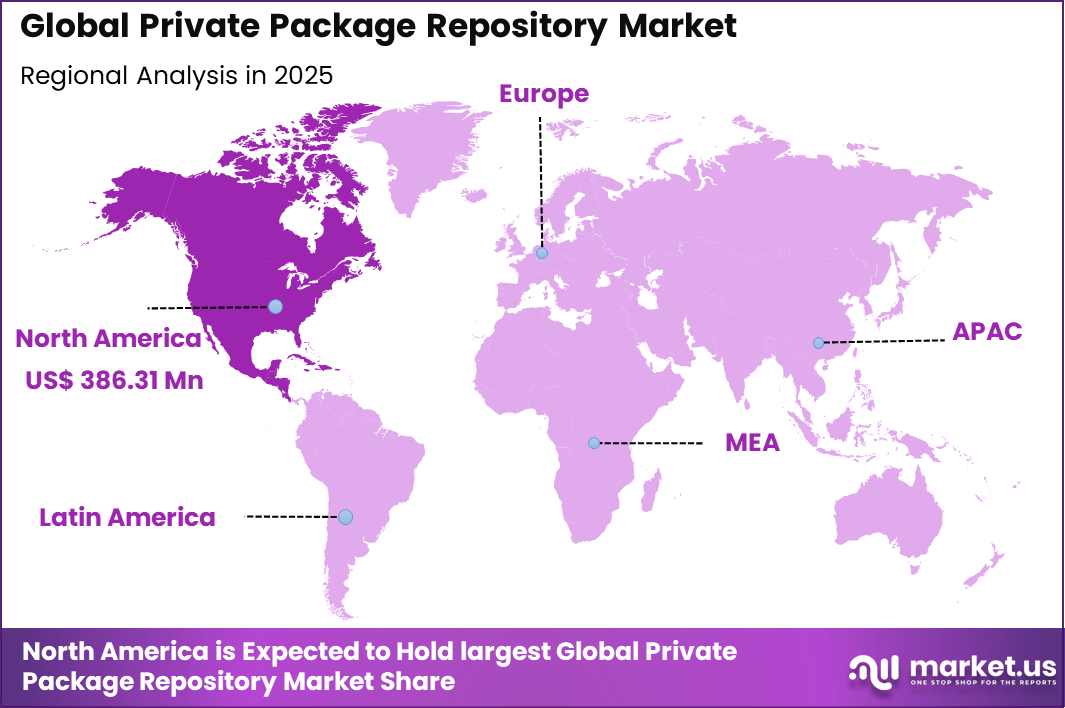
The Global Private Package Repository Market generated USD 1,049.2 million in 2025 and is predicted to register growth from USD 1,198.2 million in 2026 to about USD 3,958.4 million by 2035, recording a CAGR of 14.20% throughout the forecast span. In 2025, North America held a dominan market position, capturing more than a 36.82% share, holding USD 386.31 Million revenue.
The private package repository market refers to platforms that allow organizations to securely store, manage, and distribute software packages within internal development environments. These repositories act as centralized storage systems for code libraries, dependencies, and build artifacts that are used during software development. Unlike public repositories, private package repositories restrict access to authorized users, enabling enterprises to maintain control over proprietary code and internal software components.
Modern software development relies heavily on reusable packages and open-source libraries. Development teams often integrate numerous external dependencies into applications, which increases the need for controlled package management. Private repositories provide secure environments where organizations can host internal packages, track versions, manage access permissions, and ensure that software components comply with internal security policies.
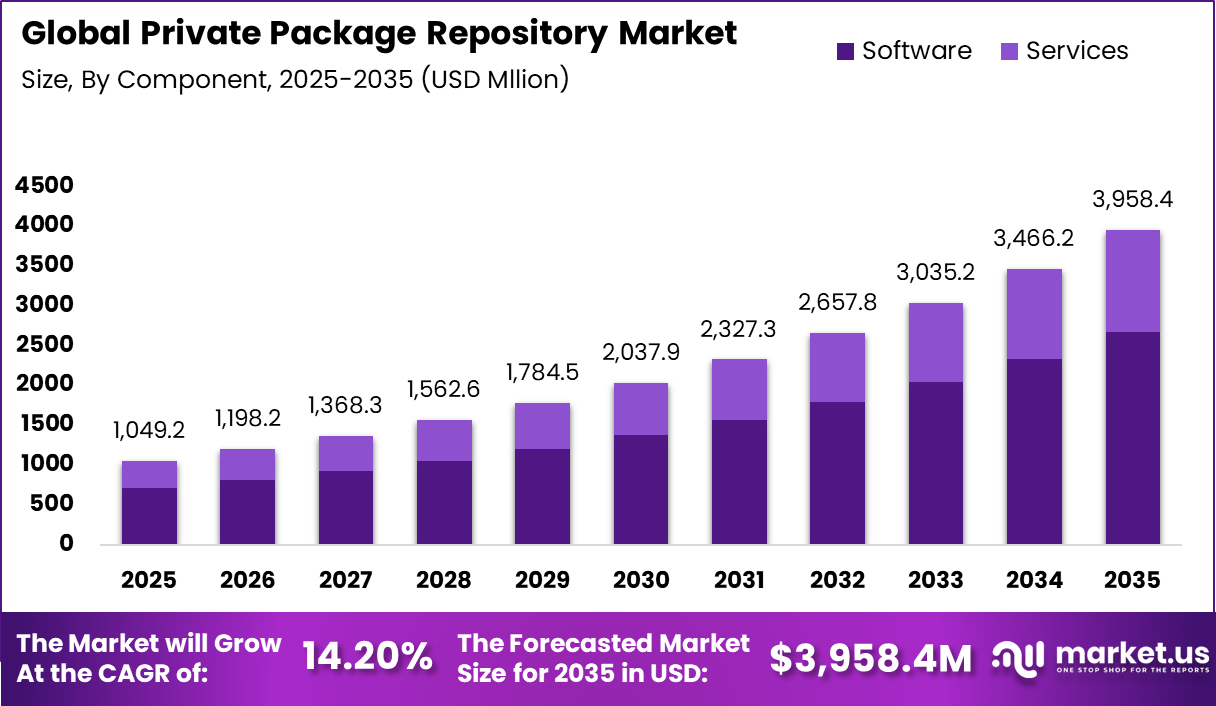
One major growth factor driving the private package repository market is the rapid expansion of enterprise software development activities. Organizations across industries are building digital platforms, cloud services, and enterprise applications that require efficient package management. Private repositories help development teams manage dependencies, streamline code reuse, and maintain version control across large development environments.
Top Market Takeaways
- By Component, software dominates with 67.4% share, enabling secure artifact storage, vulnerability scanning, and reproducible builds across CI/CD pipelines.
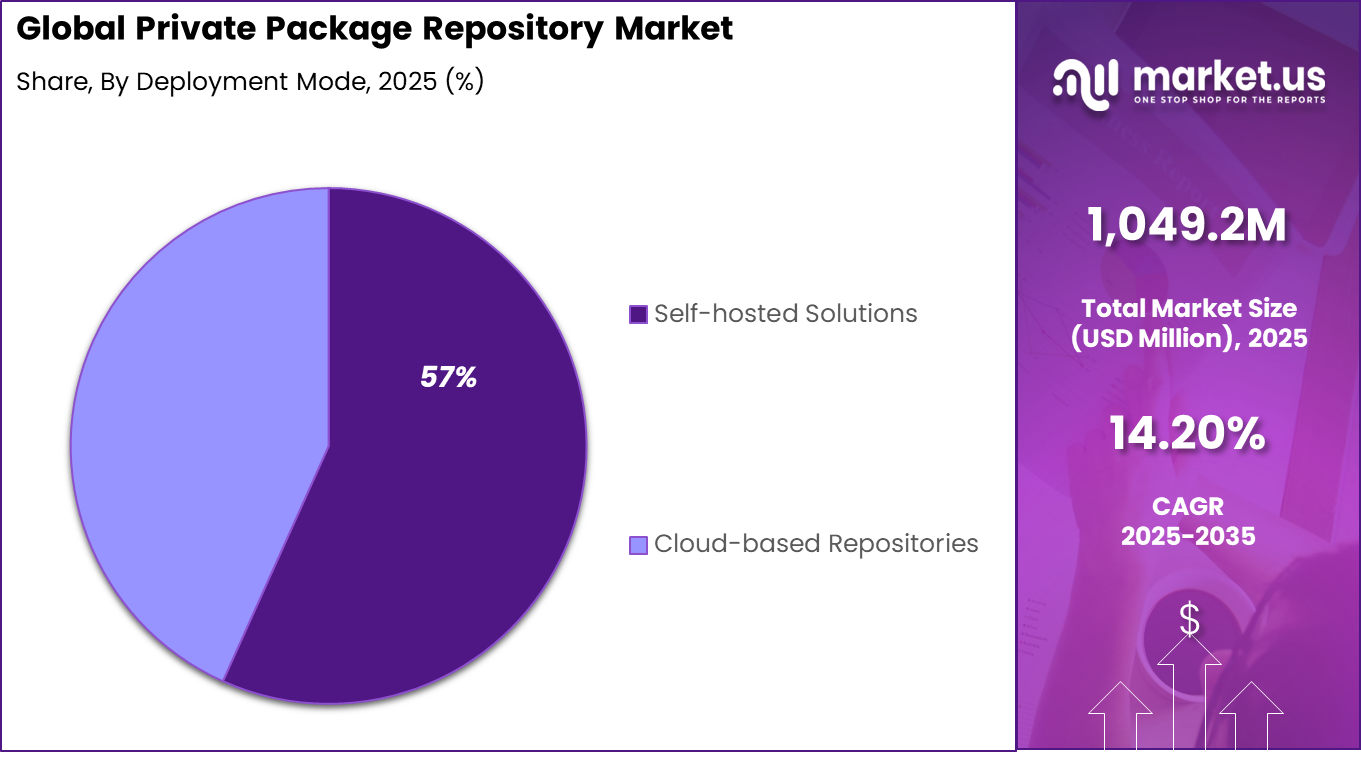
- By Deployment Mode, self-hosted solutions capture 56.73%, ensuring air-gapped compliance, custom proxying, and integration with internal development ecosystems.
- By Package Type, npm leads at 25.32%, managing JavaScript dependencies with SBOM generation, license compliance, and malware quarantine workflows.
- By Enterprise Size, large enterprises hold 65.47%, orchestrating multi-language registries with role-based access and audit trails across global teams.
- By End-User, IT and telecommunications command 34.18%, securing 5G network functions, OSS components, and telco cloud infrastructure deployments.
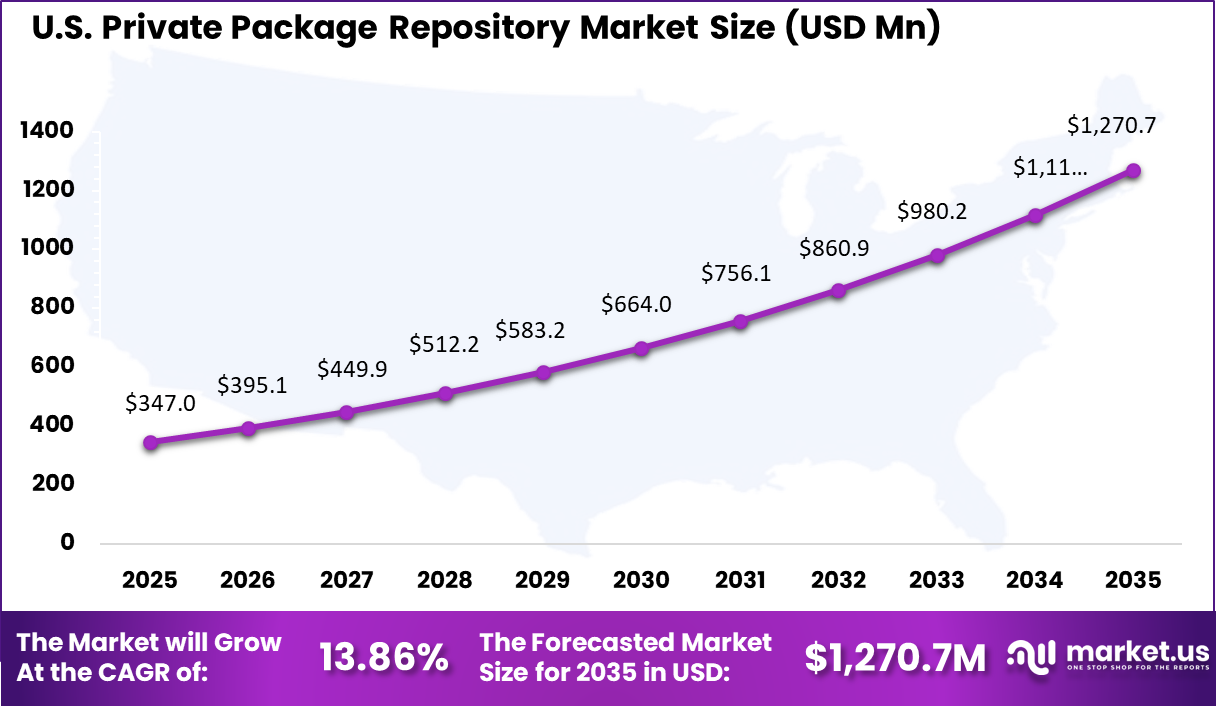
- Regionally, North America accounts for 36.82% global share, with the U.S. market valued at USD 347 million and a CAGR of 13.86%, driven by executive orders on software bill of materials and zero-trust supply chains.
Drivers Impact Analysis
Key Drivers Impact on CAGR Forecast (~%) Geographic Relevance Impact Timeline Strategic Importance Increasing Adoption of DevOps and CI/CD Pipelines +3.3% North America, Europe Short to Medium Term Expands demand for centralized package management Rising Focus on Software Supply Chain Security +2.9% Global Medium Term Encourages secure internal repositories Growth in Enterprise Software Development +2.5% North America, APAC Medium to Long Term Increases dependency management requirements Expansion of Microservices and Containerized Applications +2.1% Global Medium Term Requires structured package distribution Increasing Demand for Secure Code Management +1.8% Europe, North America Medium Term Enhances control over proprietary software components Restraints Impact Analysis
Key Restraints Impact on CAGR Forecast (~%) Geographic Relevance Impact Timeline Market Constraint Level Complexity of Managing Multiple Package Ecosystems -2.1% Global Medium Term Increases operational complexity Integration Challenges with Legacy Development Systems -1.7% Europe, APAC Medium Term Slows adoption in traditional enterprises High Deployment and Maintenance Costs -1.4% Emerging Markets Short to Medium Term Limits adoption among smaller organizations Security Risks from Misconfigured Repositories -1.1% Global Medium Term Requires strong governance frameworks By Component
Software accounts for 67.4% of adoption in the private package repository market, as organizations require centralized platforms to store, manage, and distribute internal software packages. These repositories allow development teams to securely host proprietary libraries and dependencies used across applications. Centralized software repositories improve version control and reduce dependency conflicts.
Modern repository platforms also integrate with continuous integration and deployment pipelines. Automated access controls and vulnerability scanning enhance software supply chain security. This functionality continues to position software as the dominant component.
By Deployment Mode
Self hosted deployment holds 57%, reflecting the need for strict control over internal code repositories. Many organizations prefer to host repositories within their own infrastructure to protect intellectual property and sensitive development assets. Internal hosting also allows deeper customization and integration with enterprise security policies.
Self hosted repositories enable teams to maintain full control over access permissions and package distribution. This model supports organizations operating under strict compliance or data governance frameworks. As a result, self hosted solutions remain widely adopted.
By Package Type
npm packages represent 25.32% of package usage within private repositories, driven by the popularity of JavaScript and Node based development frameworks. Development teams rely on npm packages for building web applications, microservices, and cloud native platforms. Private npm repositories allow organizations to manage custom packages securely.
Managing npm packages internally also reduces dependency risks from public repositories. Development teams can maintain stable versions and enforce security checks. This keeps npm as a leading package type in private repositories.
By Enterprise Size
Large enterprises account for 65.47% of adoption due to the scale of their software development operations. These organizations manage multiple development teams and complex application portfolios. Private repositories help maintain consistency and governance across development workflows.
Large firms also prioritize supply chain security and compliance in software development. Centralized repository management improves traceability of dependencies. This drives sustained uptake among enterprise scale organizations.
By End User
The IT and telecommunications sector holds 34.18% of end user adoption, as these organizations rely heavily on software development and infrastructure automation. Private package repositories support rapid development cycles and secure management of internal libraries. This improves development efficiency and operational reliability.
Telecommunications providers also manage large scale network software and digital service platforms. Reliable dependency management helps maintain system stability. This continues to position IT and telecommunications as a key end user segment in the private package repository market.
Investor Type Impact Matrix
Investor Type Growth Sensitivity Risk Exposure Geographic Focus Investment Outlook Venture Capital High Medium to High North America Focus on developer infrastructure startups Private Equity Medium to High Medium North America, Europe Attractive enterprise SaaS models Strategic Software Platform Providers High Medium Global Integration with development ecosystems Institutional Investors Medium Medium Developed Markets Long-term enterprise software investments Corporate Technology Investors Medium Low to Medium Global Expansion of software development infrastructure Technology Enablement Analysis
Technology Enabler Impact on CAGR Forecast (~%) Geographic Relevance Impact Timeline Adoption Momentum Automated Dependency Management Systems +3.6% North America, Europe Medium Term Improves software build efficiency Cloud-based Repository Hosting Platforms +3.0% Global Short to Medium Term Enables scalable package storage AI-driven Security Scanning for Packages +2.4% North America, Europe Medium to Long Term Enhances vulnerability detection Integration with DevSecOps Toolchains +2.0% Global Medium Term Strengthens secure development workflows Container and Kubernetes Package Support +1.6% APAC, North America Long Term Supports modern application architectures Key Challenges
- Difficulty in managing access control and permissions across development teams
- Security risks from vulnerable or outdated software packages
- Integration challenges with existing development and DevOps tools
- High storage and infrastructure cost for managing large package libraries
- Limited visibility into package dependencies and version management
Emerging Trends
In the Private Package Repository market, a noticeable trend is the growing focus on secure and controlled management of internal software packages used during development. Organisations are increasingly maintaining private repositories that store approved libraries, dependencies, and internal code components so development teams can access them from a trusted source. This practice helps ensure that only verified packages are used within software projects and reduces the risk of introducing compromised or outdated components.
Another emerging trend is the integration of automated vulnerability scanning and access controls within repository environments, which allows development and security teams to monitor package integrity and manage permissions in a more structured way.
Growth Factors
A key growth factor in this market is the expanding complexity of modern software development, where applications rely on large numbers of external libraries and reusable code modules. Managing these dependencies through a private repository allows organisations to maintain consistency across development environments and prevent disruptions caused by missing or incompatible packages. This structured approach supports smoother collaboration between development teams and improves overall code management practices.
Another important factor is the increasing emphasis on software supply chain security. Organisations want greater visibility into the origin and integrity of the code components used in their applications. Private package repositories help establish a controlled environment where packages can be reviewed, approved, and distributed internally, which strengthens confidence in the development process and supports more reliable software delivery.
Key Market Segments
By Component
- Software
- Services
- Managed Services
- Professional Services
By Deployment Mode
- Self-hosted Solutions
- Cloud-based Repositories
By Package Type
- Maven/Gradle
- npm
- PyPI
- RubyGems
- NuGet
- Docker/OCI
- Others
By Enterprise Size
- Large Enterprises
- Small & Mid-sized Enterprises (SMEs)
By End-User
- IT and Telecommunications
- BFSI
- Healthcare
- Retail and E-commerce
- Government
- Others
Regional Analysis
North America accounts for 36.82% of the private package repository market, supported by strong adoption of DevOps practices and secure software development frameworks. Technology companies and enterprises in the region are increasingly deploying private repositories to manage internal software packages, dependencies, and version control within controlled environments. Demand is driven by the need to strengthen software supply chain security, protect proprietary code assets, and ensure consistent package management across development teams.
The United States market is valued at USD 347 Million and is expanding at a CAGR of 13.86%, reflecting rising focus on secure software distribution and internal code governance. Adoption is influenced by increasing reliance on open-source components, growing risks related to dependency vulnerabilities, and the need for centralized package control. Growth is further supported by integration of private repositories with CI/CD pipelines, enabling automated package validation, access control, and improved software development efficiency.
Key Regions and Countries
- North America
- US
- Canada
- Europe
- Germany
- France
- The UK
- Spain
- Italy
- Russia
- Netherlands
- Rest of Europe
- Asia Pacific
- China
- Japan
- South Korea
- India
- Australia
- Singapore
- Thailand
- Vietnam
- Rest of APAC
- Latin America
- Brazil
- Mexico
- Rest of Latin America
- Middle East & Africa
- South Africa
- Saudi Arabia
- UAE
- Rest of MEA
Competitive Analysis
The Private Package Repository market is led by major DevOps platform and cloud providers such as JFrog Artifactory, Sonatype, GitHub, GitLab, Amazon Web Services, Microsoft Azure, Google, Docker, and Red Hat.
These companies compete on secure package storage, integration with development pipelines, and support for multiple programming ecosystems. Their platforms are widely used by large software teams that require centralized control of internal packages, version management, and secure distribution across development and production environments.
Specialized repository and artifact management providers including Cloudsmith, Harbor, Packagecloud, Verdaccio, ProGet from Inedo, MyGet, NuGet, Gemfury, and others compete through flexible deployment and simpler package hosting services.
Competition in this segment is driven by ease of integration with CI and CD workflows, access control features, and reliable package distribution across global development teams. These vendors are often selected by organizations seeking practical repository management without complex infrastructure requirements.
Top Key Players in the Market
- JFrog Artifactory
- Sonatype Inc.
- GitHub, Inc.
- GitLab Inc.
- Amazon Web Services (AWS)
- Microsoft Azure
- Google LLC
- Cloudsmith
- Docker
- Red Hat
- Harbor
- Packagecloud
- Verdaccio
- ProGet (Inedo)
- MyGet
- NuGet
- Gemfury
- Others
Future Outlook
The future outlook for the Private Package Repository Market is positive as software development teams increasingly require secure and organized ways to manage application dependencies. Private package repositories help store, control, and distribute software packages within organizations while improving security and version management.
As companies adopt DevOps practices, container technologies, and continuous integration workflows, the need for controlled package management is expected to increase. Overall, the market is likely to expand as organizations focus on secure software development, efficient code management, and reliable application delivery.
Recent Developments
- September, 2025 – JFrog Artifactory launched Advanced Security Scanning for private repos. Teams now catch vulnerabilities before deployment. This cuts supply chain risks by 55 percent in enterprise builds. Artifactory integrates with GitHub Actions and Jenkins pipelines. Developers scan npm, Docker and Maven packages automatically. Compliance teams like the detailed audit logs for SOC 2 reports.
- November, 2025 – Sonatype Lifecycle added AI-powered policy enforcement. It blocks risky open source components at commit time. Financial firms report 40 percent fewer critical vulnerabilities reaching production. The platform covers 30 plus languages and formats. Real-time SBOM generation helps with regulations. Sonatype serves over 1,000 enterprises with this update.
Report Scope
Report Features Description Market Value (2025) USD 1,049.2 Million Forecast Revenue (2035) USD 3,958.4 Million CAGR(2025-2035) 12.6% Base Year for Estimation 2024 Historic Period 2020-2024 Forecast Period 2025-2035 Report Coverage Revenue forecast, AI impact on Market trends, Share Insights, Company ranking, competitive landscape, Recent Developments, Market Dynamics and Emerging Trends Segments Covered By Component (Software, Services (Managed Services, Professional Services)), By Deployment Mode (Self-hosted Solutions, Cloud-based Repositories), By Package Type (Maven/Gradle, npm, PyPI, RubyGems, NuGet, Docker/OCI, Others), By Enterprise Size (Large Enterprises, Small & Mid-sized Enterprises (SMEs)), By End-User (IT and Telecommunications, BFSI, Healthcare, Retail and E-commerce, Government, Others) Regional Analysis North America – US, Canada; Europe – Germany, France, The UK, Spain, Italy, Russia, Netherlands, Rest of Europe; Asia Pacific – China, Japan, South Korea, India, New Zealand, Singapore, Thailand, Vietnam, Rest of Latin America; Latin America – Brazil, Mexico, Rest of Latin America; Middle East & Africa – South Africa, Saudi Arabia, UAE, Rest of MEA Competitive Landscape JFrog Artifactory, Sonatype Inc., GitHub, Inc., GitLab Inc., Amazon Web Services (AWS), Microsoft Azure, Google LLC, Cloudsmith, Docker, Red Hat, Harbor, Packagecloud, Verdaccio, ProGet (Inedo), MyGet, NuGet, Gemfury, Others Customization Scope Customization for segments, region/country-level will be provided. Moreover, additional customization can be done based on the requirements. Purchase Options We have three license to opt for: Single User License, Multi-User License (Up to 5 Users), Corporate Use License (Unlimited User and Printable PDF)  Private Package Repository MarketPublished date: Mar. 2026add_shopping_cartBuy Now get_appDownload Sample
 -
-
- JFrog Artifactory
- Sonatype Inc.
- GitHub, Inc.
- GitLab Inc.
- Amazon Web Services (AWS)
- Microsoft Azure
- Google LLC
- Cloudsmith
- Docker
- Red Hat
- Harbor
- Packagecloud
- Verdaccio
- ProGet (Inedo)
- MyGet
- NuGet
- Gemfury
- Others
Our Clients

- 180547
- Mar. 2026