


Global Privacy-Preserving AI Market Size, Share and Analysis Report By Component (Solutions, Services), By Deployment (On-Premises, Cloud-based), By Technology (Homomorphic Encryption, Secure Multi-Party Computation, Federated Learning, Differential Privacy), By Application (Healthcare, BFSI, Education, Retail & E-commerce, IT & Telecom, Government, Others), By Regional Analysis, Global Trends and Opportunity, Future Outlook By 2025-2035
- Published date: Feb. 2026
- Report ID: 179228
- Number of Pages: 233
- Format:
-
keyboard_arrow_up
Quick Navigation
Report Overview
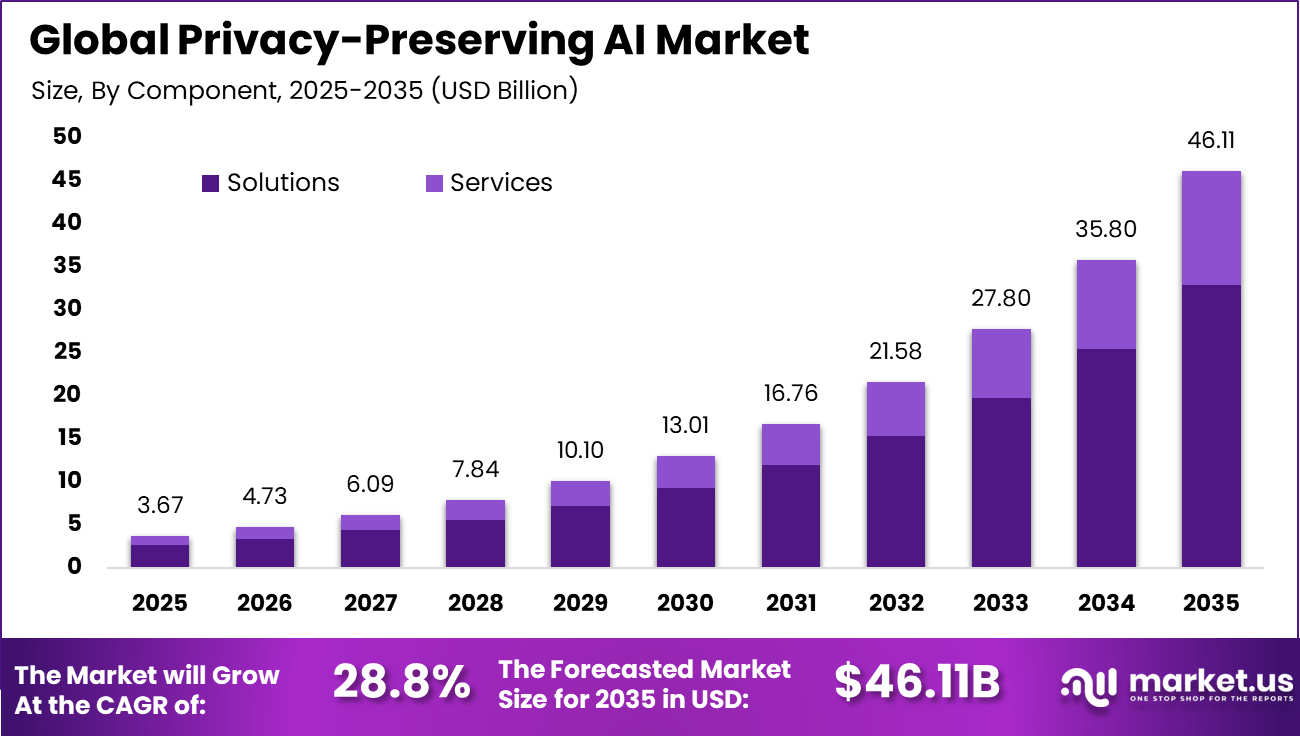
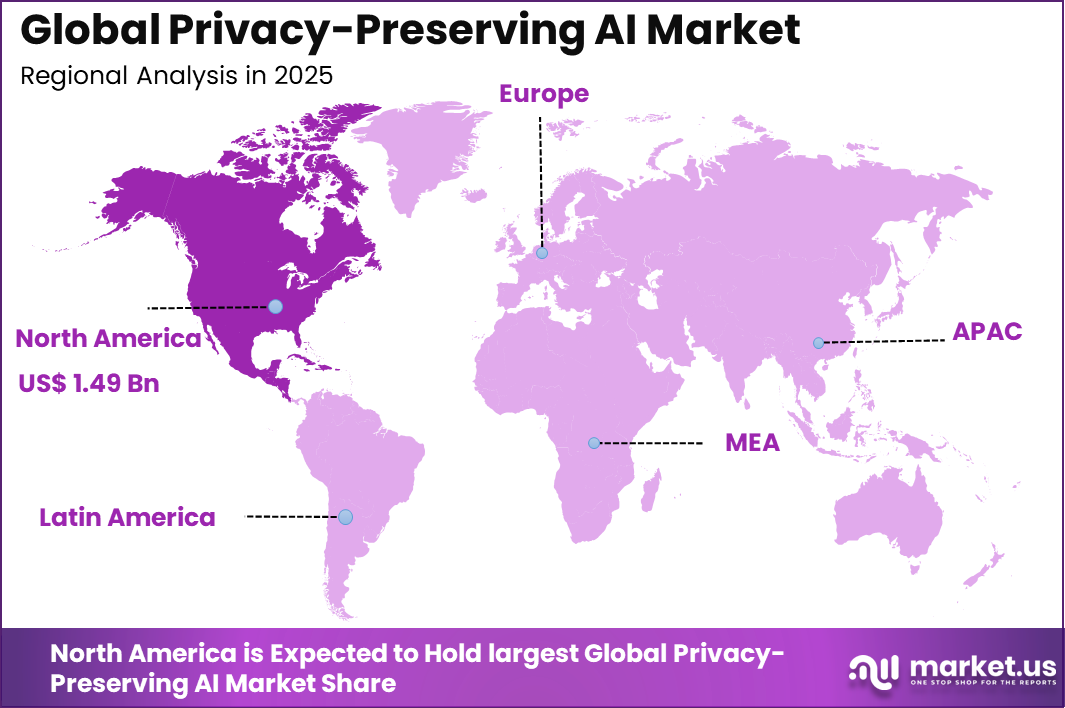
The Global Privacy-Preserving AI Market size is expected to be worth around USD 46.11 billion by 2035, from USD 3.67 billion in 2025, growing at a CAGR of 28.8% during the forecast period from 2025 to 2035. North America held a dominant market position, capturing more than a 40.82% share, holding USD 1.49 billion in revenue.
The privacy preserving AI market is developing as organizations seek to extract value from data while maintaining strict confidentiality standards. Enterprises are increasingly deploying AI models on sensitive datasets that include financial records, healthcare information, and personal identifiers. Privacy preserving AI technologies address this concern by enabling computation and model training without exposing raw data.
Regulatory pressure and consumer awareness regarding data protection are shaping enterprise investment strategies. Organizations are required to comply with data protection frameworks while continuing to innovate through advanced analytics. Techniques such as secure multi party computation, federated learning, and encrypted processing allow collaboration across distributed datasets without direct data sharing.
Privacy-preserving AI methods have become critical for organizations seeking to deploy artificial intelligence while safeguarding sensitive information. As concerns around data security intensify, 57% of consumers perceive AI as a significant risk to their privacy. At the same time, nearly 40% of organizations have reported experiencing AI-related privacy incidents. These trends underline the growing importance of implementing robust data protection frameworks to ensure responsible and secure AI adoption.
The stakes for data privacy have never been higher. In 2024, the average cost of a data breach rose to $4.88 million, reflecting the growing financial impact of security failures. Regulatory oversight has also intensified. It is estimated that 75% of the global population is now covered by modern data protection laws, while enforcement actions remain significant, with Europe issuing approximately €2.3 billion in GDPR fines in 2025 alone.
For instance, in May 2025, IBM and Oracle expanded their partnership to advance agentic AI on Oracle Cloud Infrastructure, integrating watsonx AI with OCI’s native services. The collaboration focuses on secure, privacy-enhanced hybrid cloud AI workflows for regulated industries.
Key Takeaway
- In 2025, the Solutions segment led the Global Privacy-preserving AI market, accounting for 71.2% share, supported by demand for secure analytics platforms and encrypted data processing tools.
- In 2025, Cloud-based deployment captured 54.31% of the market, reflecting increasing reliance on scalable and remotely managed privacy-enhancing technologies.
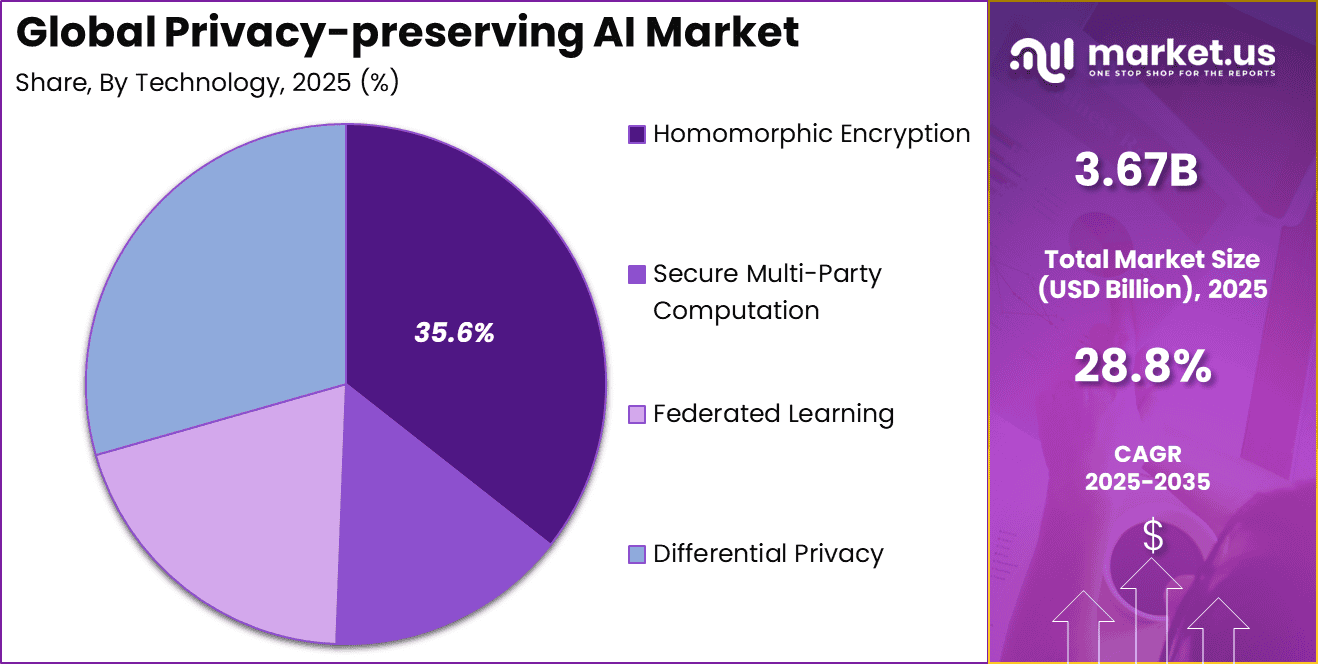
- In 2025, Homomorphic Encryption held 35.6% share, driven by its ability to enable computation on encrypted data without exposing sensitive information.
- In 2025, the BFSI sector represented 27.81% of total demand, as financial institutions prioritized confidential data analysis and regulatory compliance.
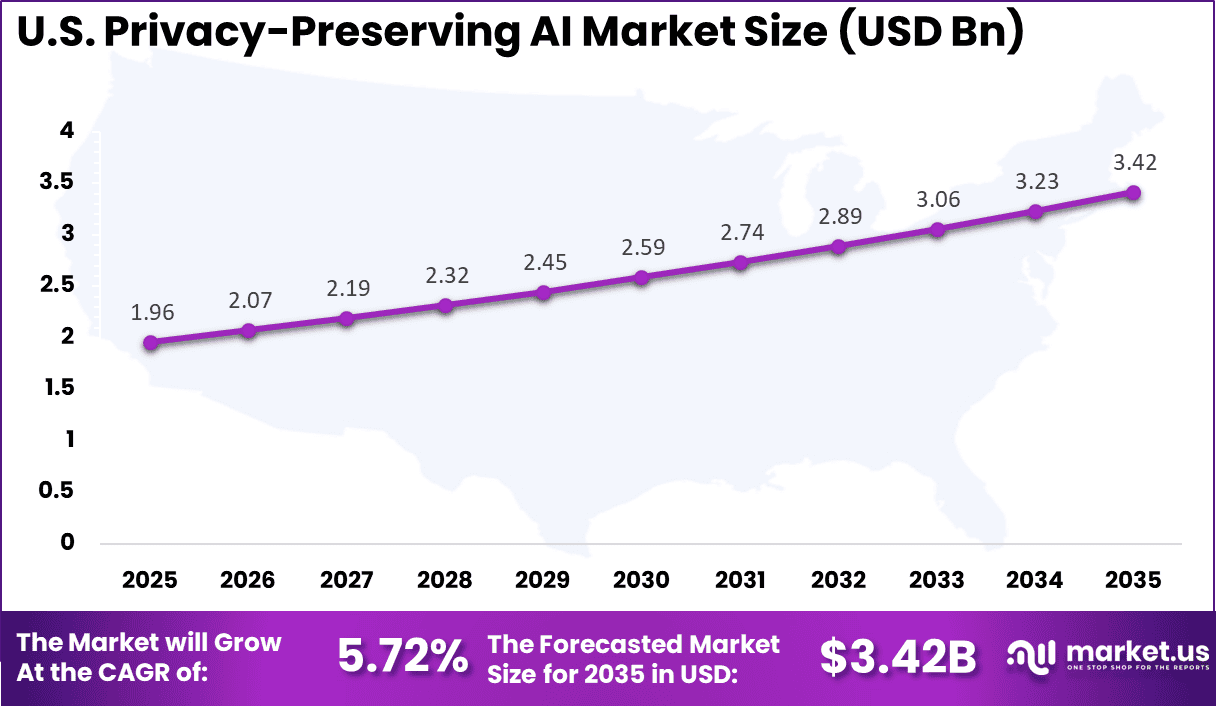
- The U.S. Privacy-preserving AI market was valued at USD 1.96 billion in 2025 and is projected to expand at a 5.72% CAGR, supported by rising investments in secure AI frameworks.
- In 2025, North America accounted for more than 40.82% of the global market, reflecting strong adoption across finance, healthcare, and government sectors.
By Component
Solutions dominate with 71.2% because enterprises prioritize end to end platforms that integrate privacy preserving mechanisms within AI workflows. These solutions combine encryption libraries, secure model training environments, and governance dashboards into unified systems. Organizations prefer packaged offerings that reduce complexity compared to assembling standalone cryptographic tools.
Comprehensive solutions also support compliance reporting and audit documentation. Privacy preserving AI implementations must demonstrate that sensitive data remains protected during processing. Integrated platforms simplify monitoring and policy enforcement across distributed systems.
The need for scalable deployment further strengthens solution demand. Enterprises require systems capable of handling large datasets and cross organizational collaboration. Structured solution frameworks provide operational consistency and security assurance.
For Instance, in February 2026, IBM Corp. announced updates to its AI platform, emphasizing solutions that protect data during model training. Built for scalability, these tools help organizations handle large datasets privately. This development strengthens their position by offering practical safeguards that align with compliance demands across sectors.
By Deployment
Cloud based deployment accounts for 54.31% as enterprises seek flexible infrastructure for AI experimentation and scaling. Cloud environments provide computational resources necessary for advanced encryption and secure model training. Privacy preserving AI workloads often demand significant processing power, which cloud systems can deliver efficiently. Cloud providers also offer secure environments with controlled access management and encryption standards.
Organizations can implement federated learning or encrypted computation models while maintaining governance oversight. This balance supports innovation without compromising compliance obligations. Hybrid models are also emerging, where sensitive data remains on premise while encrypted computations are performed in the cloud. This approach enables broader collaboration while preserving data sovereignty.
For instance, in January 2026, Google LLC expanded its Google Cloud with private AI services that keep data encrypted during cloud processing. Features like confidential VMs support seamless AI training without exposure, appealing to enterprises shifting from on-prem setups. This reflects the ease and cost savings pushing cloud dominance in secure AI.
By Technology
Homomorphic encryption leads with 35.6% because it enables computation on encrypted data without decryption. This capability allows organizations to analyze confidential datasets while maintaining strict privacy boundaries. Financial institutions and healthcare providers are particularly interested in this approach. Despite computational intensity, advancements in cryptographic optimization have improved feasibility.
Enterprises can now apply homomorphic techniques to targeted AI tasks such as risk scoring and fraud detection. As processing efficiency improves, broader use cases are expected. Other privacy preserving techniques complement encryption models. Federated learning distributes model training across decentralized data sources, while differential privacy introduces controlled noise to protect individual records.
For Instance, in November 2025, Intel Corp. introduced new hardware accelerators optimized for homomorphic encryption in AI computations. These chips speed up encrypted data processing, making it viable for real-time applications like fraud detection. By lowering performance barriers, Intel helps bring this tech from labs to everyday use in privacy-critical scenarios.
By Application
BFSI accounts for 27.81% of application demand due to high sensitivity of financial data. Banks and insurance providers must protect customer information while conducting analytics for fraud detection and credit assessment. Privacy preserving AI enables collaboration between institutions without exposing raw transaction data. Regulatory oversight in financial services further drives adoption.
Institutions must demonstrate compliance with data protection and confidentiality standards. Secure AI processing supports both innovation and regulatory adherence. Cross border financial data exchange also increases the importance of privacy preserving methods. Encrypted model training allows institutions to collaborate on risk models while respecting jurisdictional data restrictions.
For Instance, in December 2025, McAfee LLC integrated privacy AI into its cybersecurity suite for BFSI clients, focusing on encrypted threat intelligence sharing. Banks gain better anomaly detection across networks without exposing account details. The development addresses sector pain points, boosting trust and efficiency in digital finance operations.
Regional Analysis
In 2025, North America held a dominant market position in the Global Privacy-preserving AI Market, capturing more than a 40.82% share, holding USD 1.49 billion in revenue. Due to advanced AI research ecosystems and strict data governance frameworks. Enterprises in the region actively invest in technologies that align with privacy compliance and cybersecurity mandates. The regulatory environment encourages adoption of secure data processing models.
For instance, in January 2026, Cisco released its 2026 Data Privacy Benchmark Study, revealing 90% of organizations expanded privacy programs amid AI growth. Investments surged to $5M+ annually for many, emphasizing governance for secure AI innovation. This underscores North America’s pivotal role in balancing data protection and AI scalability.
The market for Privacy-preserving AI within the U.S. is growing tremendously and is currently valued at USD 1.96 billion; the market has a projected CAGR of 5.72%. The market is growing due to tough data protection laws like state privacy acts that demand secure AI handling. Businesses in finance and healthcare push adoption to avoid huge fines while leveraging AI for insights without exposing sensitive info.
For instance, in November 2025, Duality Technologies announced integration with Google Cloud’s Confidential Computing, including NVIDIA H100 GPUs. This breakthrough enables secure, high-throughput AI training and inference for healthcare and defense sectors, protecting data confidentiality at scale. The platform combines FHE, federated learning, and TEEs, solidifying U.S. dominance.
Emerging Trends Analysis
A notable trend is the convergence of federated learning and homomorphic encryption. Combining decentralized model training with encrypted computation enhances both privacy and scalability. This hybrid approach is gaining attention in collaborative research and financial analytics.
Another emerging trend is the integration of privacy preserving AI into generative AI systems. Enterprises are exploring secure model training on proprietary datasets without direct exposure. This allows innovation while maintaining strict confidentiality controls.
Growth Factors
Growth factors in privacy-preserving AI stem from tightening global regulations that demand secure data handling without stifling innovation. Enterprises across healthcare and finance increasingly adopt these technologies to enable collaborative model training on sensitive datasets while minimizing compliance risks.
Advancements in techniques like homomorphic encryption and synthetic data generation address computational challenges, making privacy viable for real-world applications. Rising AI adoption amplifies risks such as data memorization, driving demand for privacy-by-design frameworks that build trust and foster cross-industry data sharing.
Key Market Segments
By Component
- Solutions
- Services
By Deployment
- On-Premises
- Cloud-based
By Technology
- Homomorphic Encryption
- Secure Multi-Party Computation
- Federated Learning
- Differential Privacy
By Application
- Healthcare
- BFSI
- Education
- Retail & E-commerce
- IT & Telecom
- Government
- Others
Key Regions and Countries
North America
- US
- Canada
Europe
- Germany
- France
- The UK
- Spain
- Italy
- Russia
- Netherlands
- Rest of Europe
Asia Pacific
- China
- Japan
- South Korea
- India
- Australia
- Singapore
- Thailand
- Vietnam
- Rest of APAC
Latin America
- Brazil
- Mexico
- Rest of Latin America
Middle East & Africa
- South Africa
- Saudi Arabia
- UAE
- Rest of MEA
Drivers
Rising Data Privacy Regulations
Growing data protection laws across regions are pushing organizations to rethink how they use artificial intelligence with sensitive data. Governments and regulatory bodies are introducing stricter rules on data collection, storage, and sharing, which is encouraging companies to adopt privacy-preserving AI methods. These technologies help firms analyze data securely while staying aligned with legal and ethical standards.
In addition, rising public awareness about data misuse is forcing enterprises to prioritize privacy in their AI strategies. Businesses now focus on building systems that protect user information during model training and analysis. This shift toward responsible AI practices is strengthening the demand for privacy-preserving technologies across highly regulated sectors.
For instance, in February 2025, Google LLC rolled out new tools in its cloud platform to meet global privacy standards for AI models. These features let teams process data under tight regulations without exposure, easing adoption in regulated fields. It reflects a clear push to align tech with legal demands.
Restraint
High Computational Complexity
High computational complexity remains a key barrier in the adoption of privacy-preserving AI solutions. Advanced techniques such as encrypted computation and secure learning require more processing power than traditional AI models. This often leads to slower performance and higher infrastructure requirements, especially when handling large datasets.
Many organizations also face challenges in optimizing these systems without compromising efficiency. The need for specialized hardware, technical expertise, and system redesign increases operational burden. As a result, some enterprises hesitate to fully deploy privacy-preserving AI due to concerns related to cost, speed, and technical feasibility.
For instance, in October 2025, IBM Corp. shared updates on its privacy tech stack, admitting that complex encryption slows model training times significantly. Developers must tweak systems to balance security and performance, limiting use in time-sensitive projects. Efforts continue to bridge this gap through optimizations.
Opportunities
Expansion into New Sectors
The expansion of digital transformation across industries is opening new opportunities for privacy-preserving AI adoption. Sectors such as healthcare, education, public administration, and retail are increasingly dealing with sensitive personal data, which creates a strong need for secure AI solutions. Privacy-preserving technologies allow these industries to extract insights while maintaining data confidentiality.
Furthermore, cross-organization data collaboration is becoming more common, especially in research and policy development. Privacy-preserving AI enables institutions to share insights without exposing raw data, which supports innovation while protecting privacy. This capability is expected to accelerate adoption in sectors that were previously cautious about using AI due to data security concerns.
For instance, in December 2025, Microsoft launched privacy-focused AI services for healthcare partners, enabling secure data sharing across hospitals. This opens doors in patient care analytics without breach risks, drawing interest from medical networks. It marks a step into sensitive sectors long wary of AI.
Challenges
Shortage of Skilled Workforce
The limited availability of skilled professionals in privacy-enhancing technologies is a major challenge for the market. Implementing privacy-preserving AI requires expertise in cryptography, machine learning, and secure data architecture, which are still niche skill areas. Many organizations struggle to find talent capable of developing and managing such complex systems.
This skills gap also slows down deployment and increases dependency on specialized training and external expertise. Companies must invest more time and resources in workforce development to successfully integrate privacy-focused AI solutions. Without a strong talent pipeline, the pace of adoption may remain uneven across industries and regions.
For instance, in March 2025, OpenAI highlighted talent gaps in a blog post, noting that few experts can blend privacy tech with AI deployment. Recruitment for secure model roles outpaces hires, slowing internal projects. They started training programs to grow this skill set over time.
Key Players Analysis
The Privacy Preserving AI market is supported by major technology providers with strong enterprise and cloud capabilities. Cisco Systems Inc., IBM Corp., Microsoft Corp., Oracle Corp., and Intel Corp. integrate privacy enhancing technologies into secure infrastructure and AI platforms. Google LLC and Hewlett Packard focus on confidential computing and protected data processing environments. Thales Group and Gen Digital Inc. strengthen encryption, identity security, and compliance focused solutions across regulated sectors.
Specialized firms are advancing federated learning and advanced cryptographic methods. Duality Technologies Inc., Tune Insight, and Skyflow Inc. enable secure data collaboration without direct data sharing. Owkin Inc. applies privacy preserving AI in healthcare research and clinical analytics. Keyless Technologies S.r.l. focuses on biometric authentication without storing sensitive personal data, reducing breach risks.
AI developers and cybersecurity vendors also shape market competition. OpenAI and Mistral AI emphasize responsible model deployment and controlled data governance practices. McAfee LLC integrates AI driven threat detection with strong privacy controls. Emerging players such as AI LLC address niche requirements in secure data orchestration and cross border compliance. Strategic partnerships and regulatory alignment remain central to competitive positioning.
Top Key Players in the Market
- Cisco Systems Inc.
- Duality Technologies Inc.
- Gen Digital Inc.
- Google LLC
- Hewlett Packard
- Intel Corp.
- IBM Corp.
- Keyless Technologies S.r.l.
- McAfee LLC
- Microsoft Corp.
- Mistral AI
- OpenAI
- Oracle Corp.
- Owkin Inc.
- Skyflow Inc.
- Thales Group
- Tune Insight
- AI LLC
- Others
Recent Developments
- January, 2026 – Cisco’s Data and Privacy Benchmark Study found 90% of organizations expanded privacy programs due to AI. 93% plan more investments in governance tools. This reflects a shift to protect data in AI pipelines.
- June, 2025 – Thales’ Global Cloud Security Study showed 52% struggle with AI security in cloud setups. Organizations seek privacy-preserving methods like homomorphic encryption. Thales pushes CipherTrust for data protection.
Report Scope
Report Features Description Market Value (2025) USD 3.6 Bn Forecast Revenue (2035) USD 46.1 Bn CAGR(2026-2035) 28.8% Base Year for Estimation 2025 Historic Period 2020-2024 Forecast Period 2026-2035 Report Coverage Revenue forecast, AI impact on Market trends, Share Insights, Company ranking, competitive landscape, Recent Developments, Market Dynamics and Emerging Trends Segments Covered By Component (Solutions, Services), By Deployment (On-Premises, Cloud-based), By Technology (Homomorphic Encryption, Secure Multi-Party Computation, Federated Learning, Differential Privacy), By Application (Healthcare, BFSI, Education, Retail & E-commerce, IT & Telecom, Government, Others) Regional Analysis North America – US, Canada; Europe – Germany, France, The UK, Spain, Italy, Russia, Netherlands, Rest of Europe; Asia Pacific – China, Japan, South Korea, India, New Zealand, Singapore, Thailand, Vietnam, Rest of Latin America; Latin America – Brazil, Mexico, Rest of Latin America; Middle East & Africa – South Africa, Saudi Arabia, UAE, Rest of MEA Competitive Landscape Cisco Systems Inc., Duality Technologies Inc., Gen Digital Inc., Google LLC, Hewlett Packard, Intel Corp., IBM Corp., Keyless Technologies S.r.l., McAfee LLC, Microsoft Corp., Mistral AI, OpenAI, Oracle Corp., Owkin Inc., Skyflow Inc., Thales Group, Tune Insight, X.AI LLC, Others Customization Scope Customization for segments, region/country-level will be provided. Moreover, additional customization can be done based on the requirements. Purchase Options We have three license to opt for: Single User License, Multi-User License (Up to 5 Users), Corporate Use License (Unlimited User and Printable PDF)  Privacy-Preserving AI MarketPublished date: Feb. 2026add_shopping_cartBuy Now get_appDownload Sample
 -
-
- Cisco Systems Inc.
- Duality Technologies Inc.
- Gen Digital Inc.
- Google LLC
- Hewlett Packard
- Intel Corp.
- IBM Corp.
- Keyless Technologies S.r.l.
- McAfee LLC
- Microsoft Corp.
- Mistral AI
- OpenAI
- Oracle Corp.
- Owkin Inc.
- Skyflow Inc.
- Thales Group
- Tune Insight
- AI LLC
- Others
Our Clients

- 179228
- Feb. 2026









