


Report Overview
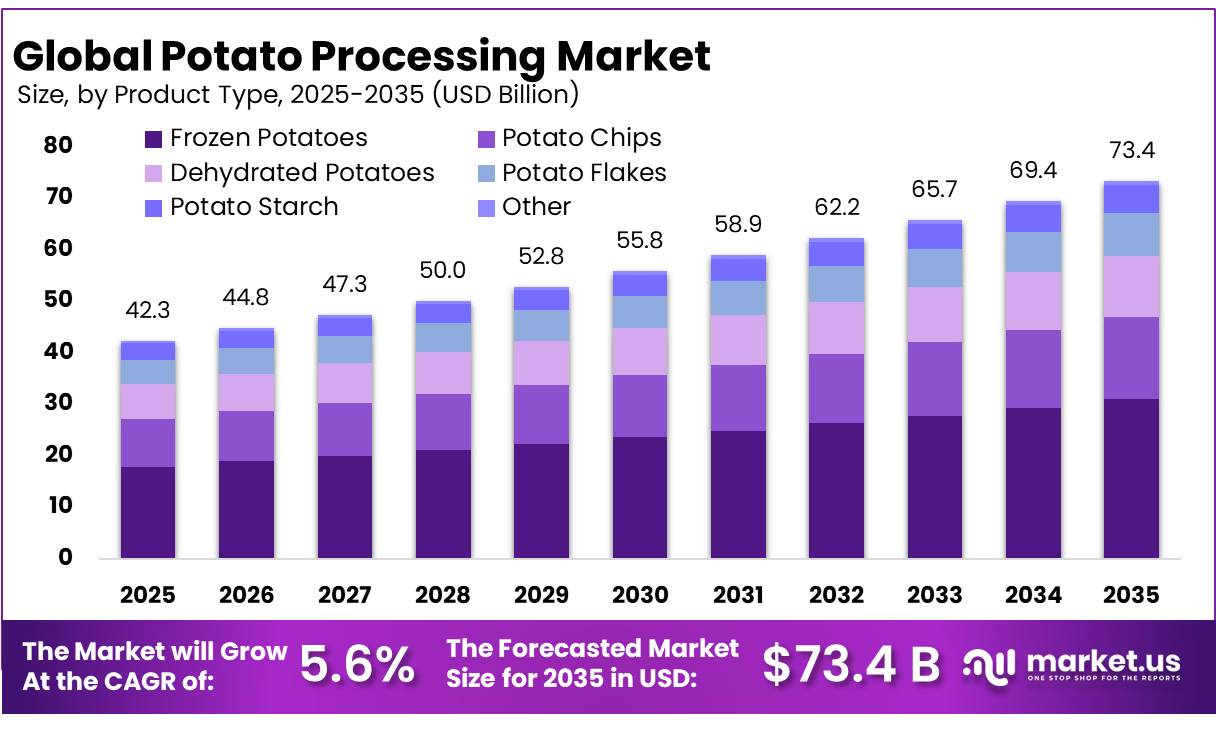
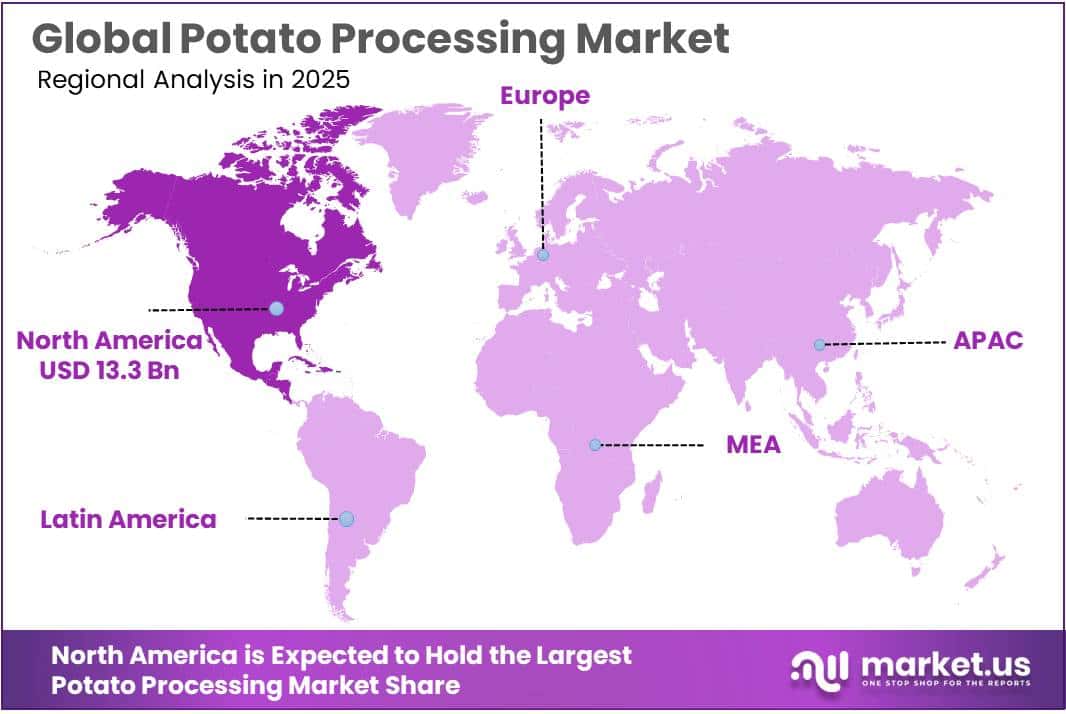
The Global Potato Processing Market size is expected to be worth around USD 73.4 Billion by 2035, from USD 42.3 Billion in 2025, growing at a CAGR of 5.6% during the forecast period from 2026 to 2035. In 2025, North America held a dominant market position, capturing more than a 31.50% share, holding USD 13.3 Billion revenue.
The potato processing industry plays an important role in the global food system, converting raw potatoes into frozen fries, chips, flakes, dehydrated products, starch, prepared foods, and other value-added products. Modern plants rely on washing, peeling, cutting, blanching, frying, freezing, drying, packaging, and wastewater-treatment systems to handle large production volumes.
- The raw-material base remains substantial. According to the USDA National Agricultural Statistics Service, combined potato production in the United States and Canada reached about 539 million cwt in 2025. U.S. production was estimated at 413 million cwt, down 2% from 2024, while Canadian production reached 126 million cwt, down 1%. This large crop volume provides a stable feedstock base for processors producing frozen, chipped, dehydrated, and starch-based products.
Processing accounts for a major share of potato utilization. The USDA Economic Research Service reported in July 2025 that more than 60% of the U.S. potato crop is destined for processing each season. Through May 31, 2025, eight surveyed states processed about 184.3 million cwt of potatoes, with 80% of this volume concentrated in the Pacific Northwest. Monthly processing volumes between December 2024 and May 2025 ranged from 16.7 million to 19.3 million cwt, highlighting the scale and continuous operating requirements of industrial processing facilities.
- Frozen products remain a key demand driver. USDA ERS reported in September 2025 that frozen potato products, mainly French fries, accounted for about 50% of U.S. potato availability, equal to roughly 58 pounds per person. Total potato availability averaged 115 pounds per person during 2022–2024, while fresh potato availability had declined to about 28 pounds per person, showing the long-term shift toward processed forms.
Industrial expansion is also being shaped by water, starch recovery, and waste-management requirements. EPA technical work shows that traditional potato starch processing can generate significant wastewater loads; a plant handling 450 metric tons per day could produce about 4,500 m³ of effluent and roughly 18,000 kg of dissolved solids daily. These operating pressures are encouraging processors to invest in water recycling, starch recovery, centrifugation, filtration, and lower-waste production systems.
Key Takeaways
- Potato Processing Market size is expected to be worth around USD 73.4 Billion by 2035, from USD 42.3 Billion in 2025, growing at a CAGR of 5.6%.
- Frozen Potatoes held a dominant market position, capturing more than a 42.30% share.
- Ready-to-Cook Products held a dominant market position, capturing more than a 46.90% share
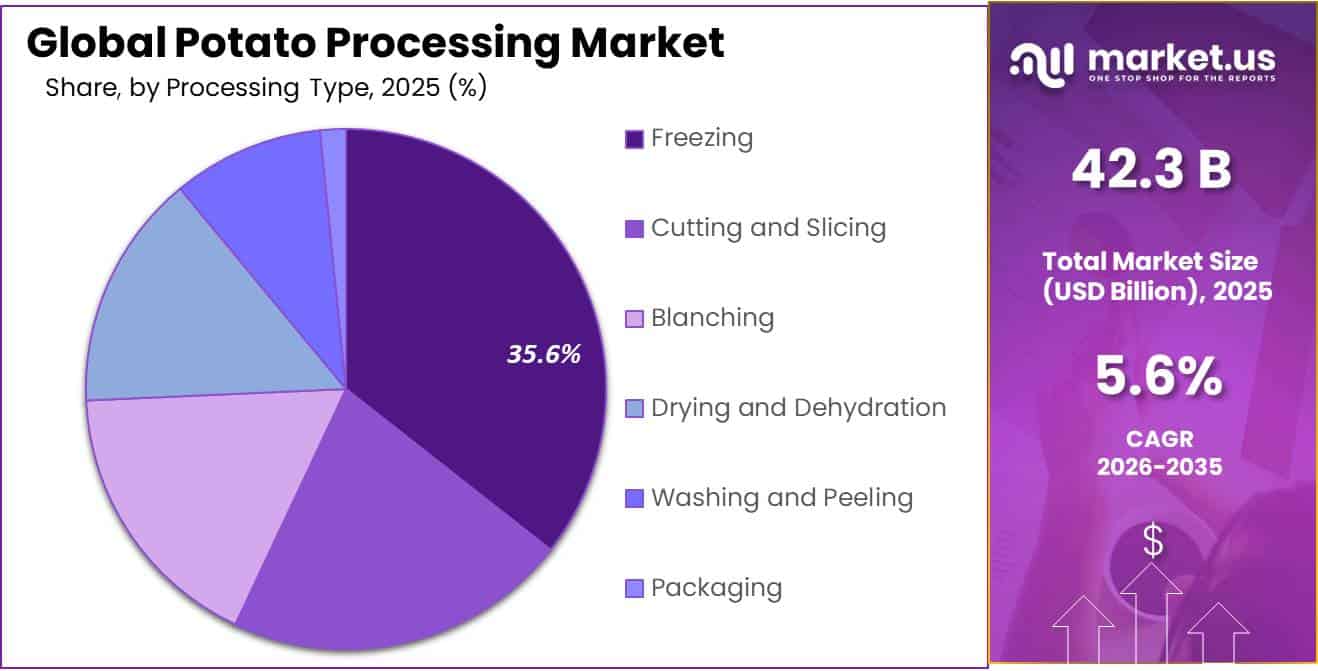
- Freezing held a dominant market position, capturing more than a 35.60% share.
- Foodservice held a dominant market position, capturing more than a 56.20% share.
- North America held a dominant market position in 2025, capturing more than a 31.50% share and reaching USD 13.34 billion.
By Product Type Analysis
Frozen Potatoes Lead the Potato Processing Market with 42.30% Share as French Fries and Convenience Foods Stay in Demand
In 2025, Frozen Potatoes held a dominant market position, capturing more than a 42.30% share of the Potato Processing Market by product type. Frozen fries, wedges, hash browns, and other ready-to-cook potato products remain widely used across restaurants, institutional foodservice, and retail channels because they provide convenience, longer shelf life, and consistent quality.
USDA data shows the strength of this segment. In 2024, 163 million cwt of raw potatoes were used for frozen French fries and other frozen products in the United States. USDA also reported in 2025 that frozen potato products represented about 50% of U.S. potato per-capita availability, equal to roughly 58 pounds per person. These volumes underline the importance of freezing, cutting, blanching, frying, and cold-storage infrastructure across large potato-processing plants.
Fruits are not normally classified as a product type within the Potato Processing Market, but they represent an important adjacent processed-food category across frozen, canned, dried, and juice applications. Processing facilities serving both vegetables and fruits can share technologies such as washing, sorting, freezing, packaging, inspection, and cold storage.
By Application Analysis
Ready-to-Cook Products Lead the Potato Processing Market with 46.90% Share as Frozen Convenience Foods Stay in Strong Demand
In 2025, Ready-to-Cook Products held a dominant market position, capturing more than a 46.90% share of the Potato Processing Market by application. Ready-to-cook potato products, including frozen French fries, wedges, hash browns, and other prepared formats, remain widely used across restaurants, foodservice, and retail because they reduce preparation time and provide consistent quality.
USDA data shows the strength of this application. In 2024, U.S. processors used 163 million cwt of raw potatoes for frozen French fries and other frozen products. USDA also reported in September 2025 that frozen potato products accounted for about 50% of U.S. potato availability, equal to approximately 58 pounds per person. These volumes support continued investment in cutting, blanching, frying, freezing, packaging, and cold-storage systems across large potato-processing plants.
Snacks remain an important application within the Potato Processing Market, particularly through potato chips, shoestring potatoes, and other fried snack products. These products require specialized slicing, frying, seasoning, inspection, and packaging equipment, creating steady demand for automated processing lines and quality-control systems.
According to the USDA National Agricultural Statistics Service, U.S. processors used 55.8 million cwt of potatoes for chips and shoestrings in 2024, while total potatoes used for processing reached 274 million cwt. Growers sold 269 million cwt of raw potatoes to processors, showing the large feedstock base available for snack and other processed-product manufacturing.
By Processing Type Analysis
Freezing Leads the Potato Processing Market with 35.60% Share as Frozen Potato Consumption Remains Strong
In 2025, Freezing held a dominant market position, capturing more than a 35.60% share of the Potato Processing Market by processing type. Freezing is widely used for French fries, wedges, hash browns, and other prepared potato products because it extends shelf life, supports large-scale distribution, and provides consistent quality across foodservice and retail channels.
USDA data shows the strong role of frozen products in potato processing. In 2024, U.S. processors used 163 million cwt of raw potatoes for frozen French fries and other frozen products. USDA also reported in 2025 that frozen potato products accounted for about 50% of U.S. potato per-capita availability, equal to roughly 58 pounds per person. These volumes support continued investment in blanching, frying, freezing, cold storage, and automated packaging systems.
Washing and Peeling represent an important processing stage because nearly every potato product requires cleaning, soil removal, inspection, and peel removal before cutting, cooking, freezing, or dehydration. These operations directly influence product yield, water use, waste generation, and final product quality.
By Distribution Channel Analysis
Foodservice Leads the Potato Processing Market with 56.20% Share as Away-From-Home Food Spending Remains Strong
In 2025, Foodservice held a dominant market position, capturing more than a 56.20% share of the Potato Processing Market by distribution channel. Restaurants, quick-service outlets, hotels, cafeterias, and institutional kitchens are major users of frozen fries, hash browns, wedges, and other processed potato products because these formats offer fast preparation, portion consistency, and easier inventory management.
Government spending data supports the strength of this channel. According to the USDA Economic Research Service, U.S. food-away-from-home spending reached USD 1.41 trillion in 2025, accounting for 56.3% of total food expenditures. Limited-service restaurant sales reached USD 516.1 billion, while full-service restaurant sales totaled USD 488.4 billion in inflation-adjusted terms. This large foodservice base supports continued demand for processed potato products, especially frozen and ready-to-cook formats.
Retail remains an important distribution channel in the Potato Processing Market as supermarkets, grocery stores, warehouse clubs, and supercenters sell frozen fries, hash browns, potato snacks, and other prepared potato products for home consumption. Convenience, longer shelf life, and easy preparation make processed potato products well suited to packaged retail formats.
Key Market Segments
By Product Type
- Frozen Potatoes
- Potato Chips
- Dehydrated Potatoes
- Potato Flakes
- Potato Starch
- Other
By Application
- Snacks
- Ready-to-Cook Products
- Prepared Meals
- Bakery Products
- Baby Food
- Other
By Processing Type
- Washing and Peeling
- Cutting and Slicing
- Blanching
- Drying and Dehydration
- Freezing
- Packaging
By Distribution Channel
- Foodservice
- Retail
Driver Analysis
QSR and Delivery-Led Fry Demand
Global quick-service restaurant expansion, menu standardization, and food-delivery penetration are increasing the structural pull for frozen potato products because fries provide a high-volume, easy-to-store, operationally consistent side item with comparatively predictable preparation time, portioning, and food-cost control. This is commercially significant because a typical QSR outlet can use roughly 10–35 kg of frozen fries per day depending on format, traffic, and menu mix; at a network level, an additional 1,000 outlets can create annual demand of approximately 3,650–12,800 tonnes, sufficient to support dedicated cold-chain volume, regional distribution contracts, and incremental processing-line utilization.
U.S. raw-potato utilization for frozen fries and related frozen products increased from 163 million cwt in 2024 to 173 million cwt in 2025, a 6% increase, while total U.S. potato processing utilization reached 286 million cwt, up 5%, indicating renewed throughput demand after prior volume weakness. The strategic effect is not limited to bulk fries: restaurant chains increasingly require standardized straight-cut, crinkle-cut, shoestring, wedge, coated, skin-on, seasoned, sweet-potato-blend, and air-fryer-compatible products, allowing processors to increase average selling price by an estimated 10–35% versus basic commodity fries while improving customer retention through co-developed specifications and private-label supply agreements.
Delivery platforms reinforce the value of engineered coated fries that retain texture for 15–30 minutes after frying, creating demand for batter systems, par-fry optimization, moisture-control packaging, and product R&D rather than only raw-potato conversion. The growth is most pronounced in India, China, Southeast Asia, the GCC, Latin America, and second-tier urban markets, where new QSR outlets and modern cold-chain capacity are expanding from lower installed bases; this driver is estimated to add approximately +2.2 percentage points to baseline potato-processing CAGR through 2028–2030.
Drivers Impact Analysis
| Driver | (\~) % Impact on CAGR Forecast | Geographic Relevance | Impact Timeline |
|---|---|---|---|
| QSR and delivery-led fry demand | +2.2 pp | North America, EU, India, China, GCC, LATAM | Medium term (2–4 years) |
| Frozen retail convenience expansion | +1.7 pp | North America core, EU, APAC urban markets | Short term (≤ 2 years) |
| Emerging-market local processing | +1.5 pp | India, Southeast Asia, MENA, LATAM, Africa | Long term (≥ 4 years) |
| Premium specialty potato formats | +1.2 pp | North America, EU, Japan, South Korea, GCC | Medium term (2–4 years) |
| Food-waste yield optimization | +1.0 pp | EU, North America, China, Australia | Medium term (2–4 years) |
| Health-led ingredient reformulation | +0.9 pp | EU, North America, Japan, urban APAC | Long term (≥ 4 years) |
Restraint Analysis
Climate-Driven Raw Potato Volatility
Climate-linked volatility in potato acreage, yield, dry-matter content, tuber size, defect incidence, storage quality, and processing-grade availability is the most immediate restraint because processing plants require specific varieties with stable solids, low reducing sugars, controlled size distribution, and predictable fry color rather than merely adequate volumes of table potatoes. Europe’s 2026 growing season illustrates the exposure: heat and drought reduced expected production across Germany, France, Belgium, and the Netherlands from a record 27.3 million tonnes in 2025 to an estimated 19.5–20.5 million tonnes, while planted area across the north-western European potato belt reportedly declined by about 67,000 hectares, from 604,100 hectares to 536,900 hectares.
The resulting raw-material economics can deteriorate rapidly: British processors reportedly paid more than GBP 300 per tonne for supply compared with GBP 180 per tonne earlier in the year, German processing-potato prices moved toward EUR 240 per tonne after lows near EUR 15, and Belgian open-market prices exceeded EUR 200 per tonne after approaching zero in the prior oversupply cycle. For a frozen-fries plant converting 200,000 tonnes of raw potatoes annually at a 60–68% finished-product yield, a USD 50 per tonne increase in contracted potato cost can add USD 10 million in annual raw-material expense before accounting for lower recovery, higher peeling loss, increased sorting rejects, or greater cold-store shrinkage; if the same crop also contains lower dry matter, oil absorption can rise and finished-weight output can fall by 2–5%, compounding margin erosion.
Processors can partially mitigate risk through multiyear grower contracts, geographic sourcing diversification, irrigation-linked agronomy, storage investments, varietal trials, and higher ingredient utilization of off-spec tubers, but crop cycles and weather patterns remain difficult to hedge fully. This volatility can force contract renegotiations, reduce processor operating rates, delay expansion investment, and raise foodservice and retail pricing beyond demand elasticity thresholds, resulting in an estimated -2.2-percentage-point short-term drag on the market’s baseline CAGR.
Restraint Impact Analysis
| Restraint | (\~) % Impact on CAGR Forecast | Geographic Relevance | Impact Timeline |
|---|---|---|---|
| Climate-driven raw potato volatility | -2.2 pp | Europe, North America, China, India | Short term (≤ 2 years) |
| Energy-intensive processing costs | -1.5 pp | EU, North America, import-dependent APAC | Medium term (2–4 years) |
| Frying-oil and packaging inflation | -1.2 pp | Global, strongest in EU and APAC | Short term (≤ 2 years) |
| Acrylamide and residue compliance | -1.0 pp | EU, UK, North America, Japan | Medium term (2–4 years) |
| Cold-chain logistics constraints | -0.9 pp | Emerging APAC, LATAM, Africa, Middle East | Medium term (2–4 years) |
| Health-driven category pressure | -0.8 pp | North America, EU, Japan, urban APAC | Long term (≥ 4 years) |
Opportunity Analysis
By-Product Biorefinery Platforms
The most material future white space is the transition from a linear potato-to-fries or potato-to-chips model into integrated biorefinery platforms that monetize peel, pulp, undersized potatoes, starch-rich wash water, defective cuts, spent frying oil, and other residual streams as food ingredients, feedstocks, bioenergy inputs, fiber, protein fractions, bioactive extracts, and biodegradable-material precursors. This is an opportunity rather than a current market driver because most processors still view these streams primarily as low-value animal feed, anaerobic-digestion material, wastewater load, or disposal cost, despite the fact that a large frozen-fries or chips facility can generate 25–40% of incoming raw-potato weight as peel, trim, solids, and process loss.
Capital requirements are meaningful—USD 3–15 million for separation, drying, extraction, anaerobic digestion, or recovery equipment at an industrial site—but revenue diversification can lower exposure to fry-price cycles, reduce wastewater-treatment costs by 10–30%, improve ESG performance, and increase raw-potato value realization by 2–6%. This opportunity is especially relevant in the EU, North America, China, and India, where disposal costs, sustainability targets, ingredient demand, and industrial-biotechnology capabilities are sufficiently developed, supporting an estimated +1.7-percentage-point upside to potato-processing CAGR if co-product systems are scaled over the next two to four years.
Opportunity Impact Analysis
| Opportunity | (\~) % Potential CAGR Upside | Geographic Relevance | Execution Window |
|---|---|---|---|
| By-product biorefinery platforms | +1.7 pp | EU, North America, China, India | Medium term (2–4 years) |
| Foodservice digital co-manufacturing | +1.5 pp | North America, EU, India, GCC, Southeast Asia | Short term (≤ 2 years) |
| Premium health-forward potato formats | +1.4 pp | EU, North America, Japan, South Korea, urban APAC | Medium term (2–4 years) |
| Localized emerging-market fry hubs | +1.3 pp | India, ASEAN, MENA, LATAM, Africa | Long term (≥ 4 years) |
| AI-enabled yield monetization | +1.2 pp | North America, EU, China, Australia | Short term (≤ 2 years) |
| Potato-based material ingredients | +1.0 pp | EU, North America, China, Japan | Long term (≥ 4 years) |
Challenges Analysis
Processing-Grade Crop Inconsistency
Climate volatility makes this persistent: the 2026 European heat and drought period was expected to remove 3.1 million tonnes from the north-west European harvest, with country-level yields estimated 7–21% below the five-year average, while temperatures above 40°C during tuber initiation and bulking increased risks of hollow heart, secondary growth, cracks, irregular shape, bruising, and lower dry matter.
For a fries plant handling 200,000 tonnes of raw potatoes annually, a reduction in factory-acceptable yield from 66% to 61% can remove roughly 10,000 tonnes of finished-product equivalent before further losses from higher peeling depth, manual sorting, oil uptake, and line slowdowns; at a net contribution of USD 250–600 per tonne, that represents USD 2.5–6.0 million of annual value exposure.
These adaptations take several crop cycles and infrastructure investments to normalize, particularly in Europe, North America, China, and India, sustaining an estimated -1.4-percentage-point drag on the market’s maximum CAGR.
Challenges Impact Analysis
| Challenge | (\~) % CAGR Friction Drag | Geographic Relevance | Mitigation Horizon |
|---|---|---|---|
| Processing-grade crop inconsistency | -1.4 pp | Europe, North America, China, India | Long term (≥ 4 years) |
| Water and wastewater intensity | -1.1 pp | EU, India, China, Middle East, Australia | Medium term (2–4 years) |
| Cold-chain labor capability gap | -1.0 pp | APAC emerging, LATAM, Africa, Middle East | Long term (≥ 4 years) |
| Multi-input margin volatility | -0.9 pp | Global, strongest in EU and import-dependent APAC | Medium term (2–4 years) |
| Plant automation integration gap | -0.8 pp | North America, EU, China, India | Medium term (2–4 years) |
| Quality-data traceability fragmentation | -0.7 pp | EU, North America, Japan, export-focused APAC | Long term (≥ 4 years) |
Geopolitical Impact Analysis
The ongoing Russia–Ukraine war and 2026 Middle East conflict are affecting the Potato Processing Market through higher energy, fertilizer, transport, and raw-material costs. Potato processors depend heavily on electricity, natural gas, refrigeration, frying, freezing, cold storage, and road transport, making the sector sensitive to geopolitical disruption.
In September 2026, FAO reported that Brent crude prices had risen 39% above pre-conflict levels, while natural gas prices had increased by 129%–139%. The Gulf region supplies around 30%–35% of global urea, and disruptions pushed DAP fertilizer prices up 26%. Higher fertilizer and fuel costs can raise potato-growing expenses, which may eventually increase raw-potato procurement costs for processors.
The Russia–Ukraine war continues to create additional agricultural supply-chain pressure. FAO reported that Ukraine’s 2025 cereal production was about 5% below average, while export volumes remained below pre-war levels because access to farmland and logistics remained constrained.
Regional Insights
North America held a dominant market position in 2025, capturing more than a 31.50% share and reaching USD 13.34 billion. USDA reported that combined U.S. and Canadian potato production reached 539 million cwt in 2025, including 413 million cwt from the United States and 126 million cwt from Canada. More than 60% of the U.S. potato crop is typically directed to processing, while 184.3 million cwt had been processed across eight surveyed states through May 2025. About 80% of this processing occurred in the Pacific Northwest.
The Potato Processing Market shows strong regional activity as processors expand frozen, snack, dehydrated, and ready-to-cook potato production. North America remains the dominant regional market, supported by a large raw-potato base, established processing plants, strong foodservice demand, and high consumption of frozen potato products. Asia Pacific is emerging as the fastest-growing region as potato production, urban food demand, processing investment, and value-added product consumption increase.
Asia Pacific is emerging as the fastest-growing regional segment, supported by its large production base and growing investment in potato processing technology. FAO states that Asia accounts for approximately 54% of global potato production, making it the world’s largest producing region. In October 2025, the China Potato Expo brought together more than 3,000 enterprises and producer organizations from 26 countries, covering seeds, machinery, equipment, processing, and finished potato products.
Key Regions and Countries Insights
- North America
- US
- Canada
- Europe
- Germany
- France
- The UK
- Spain
- Italy
- Rest of Europe
- Asia Pacific
- China
- Japan
- South Korea
- India
- Australia
- Rest of APAC
- Latin America
- Brazil
- Mexico
- Rest of Latin America
- Middle East & Africa
- GCC
- South Africa
- Rest of MEA
Key Players Analysis
McCain Foods Limited is a major global potato processor with operations across frozen French fries, appetizers, potato specialties, and foodservice products. The company operates in more than 160 countries and has over 20,000 employees worldwide. McCain has continued investing in processing capacity, including a CAD 600 million expansion announced for its Coaldale, Alberta facility. Its broad production and distribution network supports restaurants, retailers, and institutional customers requiring large, consistent volumes of frozen potato products.
Lamb Weston Holdings, Inc. is one of the largest frozen potato processors, serving restaurants, foodservice distributors, and retailers globally. In fiscal 2025, the company reported net sales of approximately USD 6.5 billion. Lamb Weston operates a broad manufacturing network across North America, Europe, and other regions and continues to focus on frozen French fries and value-added potato products. Its scale, customer relationships, and high-capacity processing facilities support strong participation in the global potato processing industry.
J.R. Simplot Company has a strong presence in potato processing through frozen French fries, formed potato products, and other foodservice offerings. The company employs more than 13,000 people and operates businesses across food, agriculture, mining, and fertilizer. Simplot has built a large potato-processing footprint in North America and internationally, supplying major restaurant and foodservice customers. Its vertically integrated structure, covering seed, farming, processing, and distribution, helps improve raw-material control and supports stable production across large-scale potato processing operations.
Top Key Players Outlook
- McCain Foods Limited
- Lamb Weston Holdings, Inc.
- J.R. Simplot Company
- Aviko B.V.
- Farm Frites International B.V.
- Agristo NV
- Cavendish Farms
- The Kraft Heinz Company
- Intersnack Group GmbH & Co. KG
- Idahoan Foods, LLC
- AGRANA Beteiligungs-AG
- PepsiCo, Inc. (Frito-Lay)
- Agrarfrost GmbH & Co. KG
- HyFun Foods Pvt. Ltd.
- Basic American Foods
Recent Developments
- In June 2026, Aviko introduced 24/7 potato loading at Poperinge and extended the approach to Steenderen and Lomm to shorten chain time and improve processing quality. Aviko processes about 2 million tonnes of potatoes annually, operates 11 production locations, works with more than 1,000 growers, and produces more than 100 potato products, giving it strong scale across fries, specialties, flakes, and granules.
- October 2026 Farm Frites International B.V. currently grows more than 1.5 million tonnes of potatoes annually, offers over 80 product types, employs more than 1,600 people, operates 5 manufacturing facilities, and serves customers in over 100 countries.
Report Scope
| Report Features | Description |
|---|---|
| Market Value (2025) | USD 42.3 Bn |
| Forecast Revenue (2035) | USD 73.4 Bn |
| CAGR (2026-2035) | 5.6% |
| Base Year for Estimation | 2025 |
| Historic Period | 2020-2024 |
| Forecast Period | 2026-2035 |
| Report Coverage | Revenue Forecast, Market Dynamics, Competitive Landscape, Recent Developments |
| Segments Covered | By Product Type (Frozen Potatoes, Potato Chips, Dehydrated Potatoes, Potato Flakes, Potato Starch, Other), By Application (Snacks, Ready-to-Cook Products, Prepared Meals, Bakery Products, Baby Food, Other), By Processing Type (Washing and Peeling, Cutting and Slicing, Blanching, Drying and Dehydration, Freezing, Packaging), By Distribution Channel (Foodservice, Retail) |
| Regional Analysis | North America – US, Canada; Europe – Germany, France, The UK, Spain, Italy, Rest of Europe; Asia Pacific – China, Japan, South Korea, India, Australia, Singapore, Rest of APAC; Latin America – Brazil, Mexico, Rest of Latin America; Middle East & Africa – GCC, South Africa, Rest of MEA |
| Competitive Landscape | McCain Foods Limited, Lamb Weston Holdings, Inc., J.R. Simplot Company, Aviko B.V., Farm Frites International B.V., Agristo NV, Cavendish Farms, The Kraft Heinz Company, Intersnack Group GmbH & Co. KG, Idahoan Foods, LLC, AGRANA Beteiligungs-AG, PepsiCo, Inc. (Frito-Lay), Agrarfrost GmbH & Co. KG, HyFun Foods Pvt. Ltd., Basic American Foods |
| Customization Scope | Customization for segments, region/country-level will be provided. Moreover, additional customization can be done based on the requirements. |
| Purchase Options | We have three licenses to opt for: Single User License, Multi-User License (Up to 5 Users), Corporate Use License (Unlimited User and Printable PDF) |





































