


Market Overview
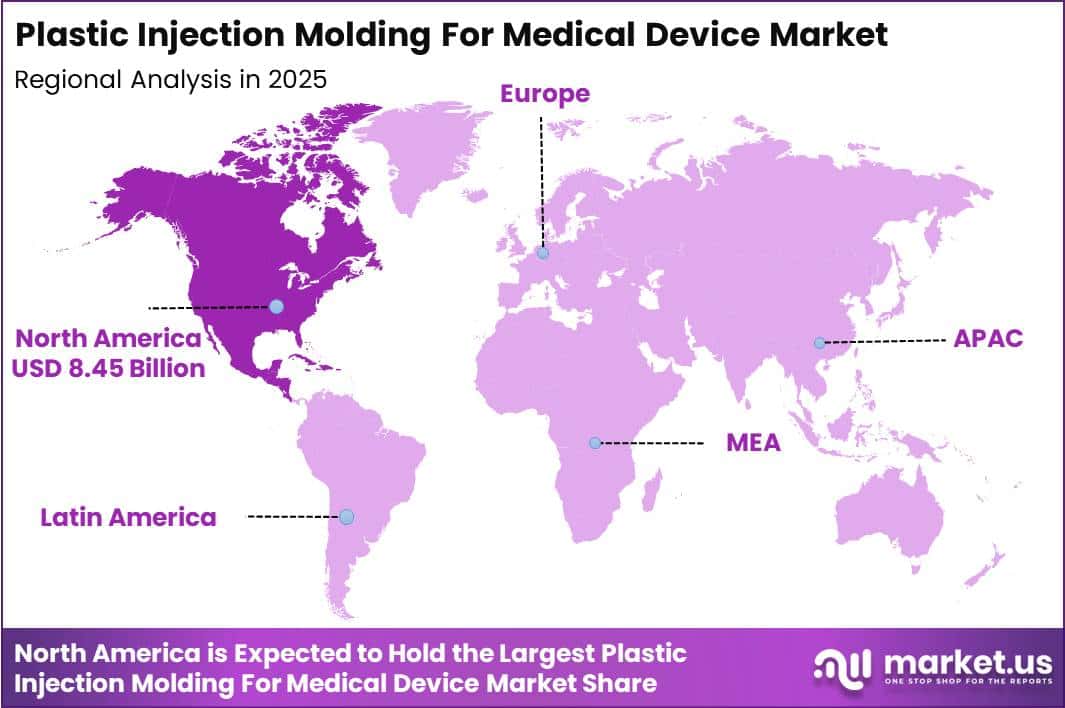
Global Plastic Injection Molding For Medical Device Market size is expected to be worth around US$ 33.44 Billion by 2035 from US$ 21.41 Billion in 2025, growing at a CAGR of 4.56% during the forecast period from 2026 to 2035. In 2025, North America led the market, achieving over 39.50% share with a revenue of US$ 8.45 Billion.
The global plastic injection molding for medical device market is supported by the expanding demand for precision-engineered, high-volume, and cost-effective medical components used across diagnostic systems, surgical instruments, drug delivery devices, implants, and disposable consumables.
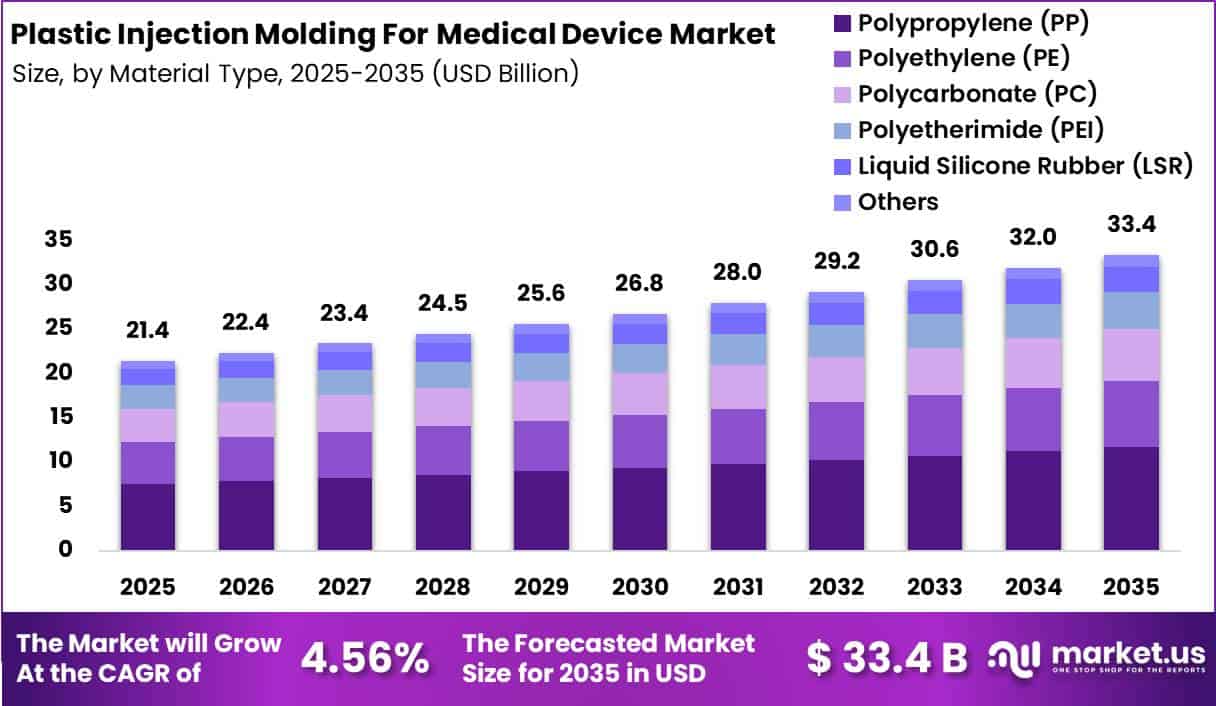
Plastic injection molding enables manufacturers to produce complex geometries with tight dimensional tolerances while maintaining consistency, biocompatibility, and sterility requirements. The increasing adoption of minimally invasive procedures, home healthcare devices, and single-use medical products continues to accelerate demand for advanced molding technologies.
The regulatory environment is also strengthening manufacturing quality standards worldwide. In February 2026, the U.S. Food and Drug Administration (FDA) implemented its Quality Management System Regulation (QMSR), harmonizing U.S. medical device manufacturing requirements with the internationally recognized ISO 13485:2016 quality management standard.
This transition reinforces risk-based manufacturing, product traceability, and lifecycle quality management for medical device manufacturers and their contract manufacturing partners.
Medical device manufacturing is further supported by stringent establishment registration and product listing requirements. Under U.S. regulations, manufacturers and contract manufacturers producing medical devices for the U.S. market must register their establishments annually with the FDA and list the medical devices manufactured at their facilities.
The FDA updates these registration records monthly, improving supply chain transparency and strengthening preparedness during public health emergencies.
Growing use of engineering-grade polymers such as polycarbonate, polypropylene, polyethylene, PEEK, and medical-grade silicone is enabling lightweight, durable, and chemically resistant device components. Automation, cleanroom injection molding, multi-cavity tooling, micro-injection molding, and real-time process monitoring are also improving manufacturing efficiency while reducing material waste and production costs.
These technological advancements continue to enhance product quality, regulatory compliance, and scalability, positioning plastic injection molding as a critical manufacturing technology for the evolving global medical device industry.
Key Takeaways
- Market Size : Plastic Injection Molding For Medical Device Market size is expected to be worth around US$ 33.44 Billion by 2035 from US$ 21.41 Billion in 2025.
- Market Share : The market is growing at a CAGR of 4.56% during the forecast period from 2026 to 2035.
- Material Type Analysis : The Polypropylene (PP) segment dominated the Plastic Injection Molding for Medical Device Market with a 35.10% market share in 2025.
- Process Type Analysis : The Conventional Injection Molding segment accounted for the largest 48.70% market share in 2025.
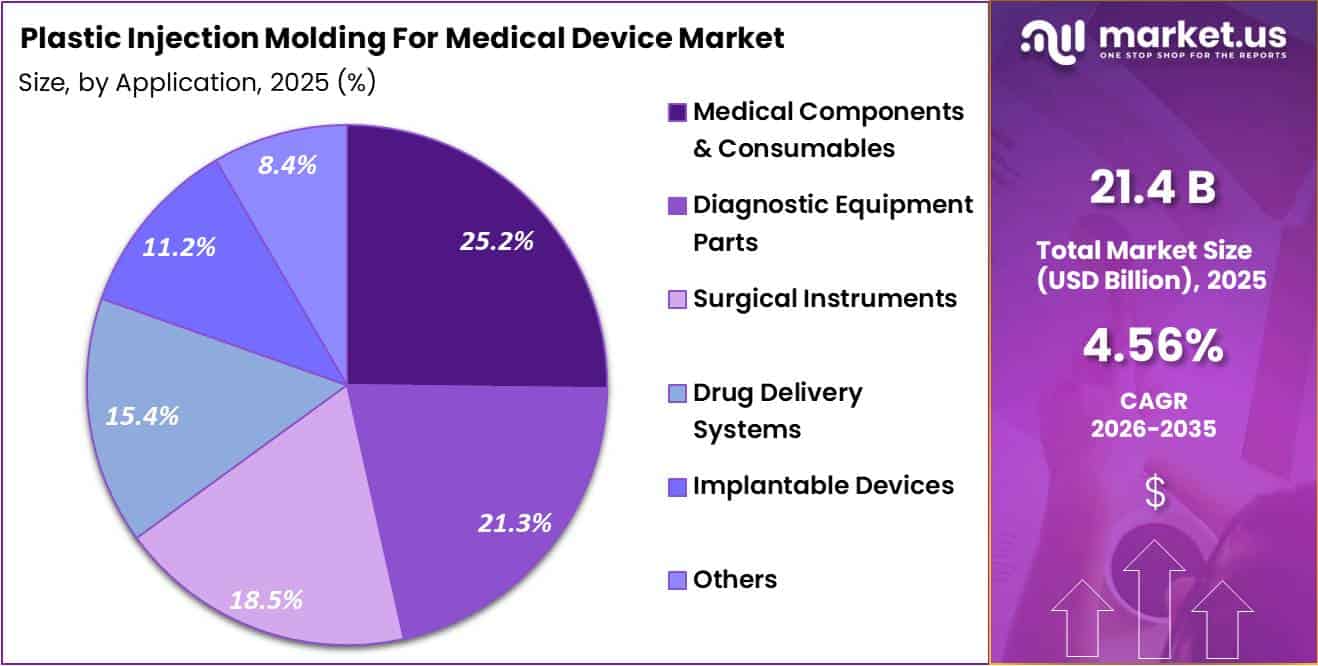
- Application Analysis : The Medical Components & Consumables segment held the largest 25.20% market share in 2025.
- End User Analysis : The Hospitals & Healthcare Facilities segment dominated the Plastic Injection Molding for Medical Device Market with a 39.10% market share in 2025.
- Regional Analysis : In 2025, North America led the market, achieving over 39.50% share with a revenue of US$ 8.45 Billion.
Material Type Analysis
The Polypropylene (PP) segment dominated the Plastic Injection Molding for Medical Device Market with a 35.10% market share in 2025. PP remains the preferred material because it offers an excellent balance of low cost, lightweight properties, chemical resistance, and compatibility with common sterilization methods such as ethylene oxide and gamma irradiation.
It is widely used in disposable syringes, specimen containers, diagnostic cartridges, IV components, and laboratory consumables. Its high fatigue resistance also makes it suitable for products with living hinges and repeated handling.
Polyethylene (PE) holds a significant share due to its flexibility, impact resistance, and suitability for tubing, pharmaceutical containers, and medical packaging. Polycarbonate (PC) is extensively used where optical clarity, dimensional stability, and high impact strength are essential, including diagnostic devices and transparent medical housings.
Polyetherimide (PEI) continues to gain demand in reusable surgical instruments and high-temperature medical components because it withstands repeated sterilization cycles. Liquid Silicone Rubber (LSR) is increasingly adopted for seals, valves, catheters, wearable medical devices, and overmolded products due to its biocompatibility and flexibility.
The Others segment includes advanced engineering plastics such as PEEK, PPSU, TPU, and specialty polymers that address demanding implantable and high-performance healthcare applications. Continuous material innovation is helping manufacturers improve durability, regulatory compliance, and manufacturing efficiency across medical device production.
Process Type Analysis
The Conventional Injection Molding segment accounted for the largest 48.70% market share in 2025. This process remains the industry standard because it enables high-volume production of precise, repeatable, and cost-effective medical plastic components.
Manufacturers widely use conventional molding for syringes, specimen containers, diagnostic consumables, surgical accessories, and numerous single-use healthcare products. The process supports tight dimensional tolerances, rapid production cycles, and compatibility with cleanroom manufacturing, making it ideal for regulated medical device production.
Insert Molding continues to expand as manufacturers integrate metal inserts, electronic contacts, and threaded components directly into molded plastic parts, reducing assembly requirements while improving product strength and reliability.
Overmolding is increasingly used to combine rigid plastics with soft-touch materials such as medical-grade silicone or thermoplastic elastomers, improving ergonomics, sealing performance, and patient comfort. Micro Injection Molding is experiencing strong growth because it enables the production of miniature, highly precise components required for minimally invasive surgical devices, microfluidic systems, catheters, and advanced diagnostic equipment.
The Others category includes specialized molding technologies designed for multi-material parts and complex geometries. Growing demand for miniaturized medical devices, automation, and consistent product quality continues to encourage adoption of advanced injection molding processes throughout the medical manufacturing industry.
Application Analysis
The Medical Components & Consumables segment held the largest 25.20% market share in 2025. The segment dominates because healthcare systems require enormous volumes of disposable products such as syringes, connectors, specimen containers, IV components, tubing accessories, and laboratory consumables.
Injection molding provides the precision, repeatability, and cost efficiency necessary for manufacturing these products while meeting strict regulatory and sterility requirements. Increasing emphasis on infection prevention and single-use medical products further supports segment growth.
Diagnostic Equipment Parts represent a significant application as demand rises for imaging systems, point-of-care testing devices, laboratory analyzers, and diagnostic cartridges that require lightweight, durable, and dimensionally stable plastic components.
Surgical Instruments continue to adopt molded engineering plastics to improve ergonomics, reduce weight, and withstand repeated sterilization. Drug Delivery Systems are expanding steadily with growing use of injection-molded components in inhalers, auto-injectors, insulin delivery devices, infusion systems, and wearable drug delivery technologies.
Implantable Devices increasingly utilize high-performance polymers for selected orthopedic, cardiovascular, and neurological applications where biocompatibility and long-term durability are essential. The Others segment includes medical packaging, rehabilitation devices, and specialized healthcare equipment.
Rising demand for precision manufacturing and advanced medical technologies continues to strengthen injection molding applications across the healthcare sector.
End User Analysis
The Hospitals & Healthcare Facilities segment dominated the Plastic Injection Molding for Medical Device Market with a 39.10% market share in 2025. Hospitals remain the largest end users because they consume substantial quantities of disposable medical products, diagnostic accessories, drug delivery components, surgical instruments, and patient care devices every day.
Growing patient admissions, infection control measures, and increasing demand for sterile, single-use medical products continue to support high procurement volumes. Injection-molded medical devices help healthcare providers maintain product consistency, safety, and operational efficiency while complying with stringent regulatory standards.
Medical Device OEMs represent another major end-user segment as they rely on precision injection molding partners to manufacture complex components with high repeatability, regulatory compliance, and scalable production capabilities.
Growing investments in innovative medical technologies and device miniaturization continue to increase outsourcing of molding operations. Research Laboratories also contribute to market growth through demand for laboratory consumables, diagnostic cartridges, prototype components, and specialized research equipment used in pharmaceutical development, biotechnology, and clinical studies.
The Others segment includes ambulatory surgical centers, contract manufacturing organizations, home healthcare providers, and specialty clinics that increasingly utilize molded medical products for patient treatment and diagnostic procedures. Continuous advancements in healthcare infrastructure and medical technology are expected to sustain demand across all end-user categories.
Market Segmentations
By Material Type
- Polypropylene (PP)
- Polyethylene (PE)
- Polycarbonate (PC)
- Polyetherimide (PEI)
- Liquid Silicone Rubber (LSR)
- Others
By Process Type
- Conventional Injection Molding
- Insert Molding
- Overmolding
- Micro Injection Molding
- Others
By Application
- Medical Components & Consumables
- Diagnostic Equipment Parts
- Surgical Instruments
- Drug Delivery Systems
- Implantable Devices
- Others
By End User
- Hospitals & Healthcare Facilities
- Medical Device OEMs
- Research Laboratories
- Others
Drivers
Diabetes CGM, insulin delivery, and wearable disposables scale-up
The diabetes burden remains a fundamental volume engine for molded medical plastics: WHO reports 830 million people living with diabetes in 2022, while the IDF indicates about 589 million adults were living with diabetes in 2024 and projects 853 million by 2050, creating a large installed base for continuous glucose monitors, insulin pens, infusion-set parts, reservoirs, housings, clips, sensor applicators, and other high-volume polymer components.
Clinical and care-model momentum also supports device penetration rather than just disease prevalence, with CGM literature showing HbA1c reductions of about 0.25%–3.0% and time-in-range gains of 15%–34%, reinforcing payer, provider, and patient willingness to adopt higher-frequency disposable and semi-disposable device ecosystems.
For plastic injection molders, the business-model consequence is a shift toward recurring-volume programs with tighter dimensional tolerances, biocompatible resin qualification, automated assembly interfaces, and aggressive cycle-time optimization because the value pool is driven by annual consumable throughput rather than one-time capital equipment sales.
That combination supports the largest driver in this framework, about +2.6 percentage points to CAGR, led by North America and Europe but increasingly reinforced by East Asia and India as diagnosis and monitoring access widen.
| Driver | (~) % Impact on CAGR Forecast | Geographic Relevance | Impact Timeline |
|---|---|---|---|
| QMSR and ISO 13485 process-validation upgrade cycle | +1.9% | North America core, EU follow-through, APAC export hubs | Short term (≤ 2 years) |
| Diabetes CGM, insulin delivery, and wearable disposables scale-up | +2.6% | North America core, EU, East Asia, India, Southeast Asia | Medium term (2-4 years) |
| Outpatient and ASC procedure shift increasing single-use component demand | +1.4% | U.S. core, Western Europe, select APAC urban corridors | Short term (≤ 2 years) |
| Supply-chain resilience and China-plus-one localization in medtech plastics | +1.7% | U.S.-Mexico corridor, EU, China rebalancing, ASEAN | Medium term (2-4 years) |
| Higher-value micro-molding, cleanroom molding, and traceability mix shift | +1.5% | North America, Germany/Ireland/Switzerland, Japan, Singapore | Medium term (2-4 years) |
| Chronic-care burden expanding sterile consumables and home-care device housings | +1.3% | Global, strongest in North America, Europe, large LMIC demand pools | Long term (≥ 4 years) |
Challenges
Regulatory Documentation Burden Slows Medical Component Innovation
For injection-molded medical components interfacing with US FDA and EU MDR regimes, the expanding weight of documentation, covering design history files, device master records, process validation protocols, lot traceability, and post-market surveillance linkages, acts as a chronic organizational drag, reducing effective innovation velocity and adding an estimated 1.1 % point friction to achievable CAGR even though it does not directly stop current sales.
A typical Class II/III molding transfer today entails 300–800 pages of protocol documentation, 40–120 pages of IQ/OQ/PQ records per mold, and digital retention obligations under GMP and data-integrity expectations, such as ALCOA+ principles, requiring cross-functional input from regulatory, quality, engineering, and production teams that collectively consume hundreds of hours of senior staff time per project.
FDA expectations around design controls and process validation, combined with MDR’s expanded clinical evidence and vigilance requirements, mean that even minor resin changes, such as alternative suppliers for a USP Class VI or ISO 10993-tested polymer, can trigger 8–16 weeks of documentation work and small-scale revalidation, slowing the introduction of material improvements and capacity moves.
To navigate this, firms are investing in electronic quality management systems, standardized validation templates, and centralized regulatory operations hubs to shave 10–20% off cycle times; however, the number of new device introductions and line extensions has grown steadily post-pandemic, keeping document volume high and making this friction structurally persistent through at least the late 2020s as regulators continue tightening expectations on traceability and lifecycle management.
| Challenge | (~) % CAGR Friction Drag | Geographic Relevance | Mitigation Horizon |
|---|---|---|---|
| GMP cleanroom cost overhang | -1.3% | North America, EU, East Asia hubs | Medium term (2-4 years) |
| Regulatory documentation burden | -1.1% | US FDA core, EU MDR cluster | Long term (≥ 4 years) |
| Validated material supply volatility | -0.9% | Global, APAC resin corridors | Medium term (2-4 years) |
| Precision tooling & validation cycle drag | -1.0% | Global medtech clusters | Medium term (2-4 years) |
| Skilled medtech manufacturing talent gap | -1.4% | US, EU, selected APAC | Long term (≥ 4 years) |
| Digital QA / data integrity transition risk | -0.8% | US, EU, Japan, Korea | Short–Medium term (≤ 4 years) |
Restraints
Medical Resin Price Volatility Impacts Component Manufacturing Growth
Medical-grade resins such as polypropylene, polycarbonate, and specialty elastomers have exhibited elevated price volatility since the 2020–2022 disruptions, with resin indices in Europe and North America still oscillating in ranges that can exceed ±20–25% year-on-year for certain grades, particularly when oil prices swing and when force majeure events or logistics choke points hit key petrochemical hubs.
Medical polymers command a premium over commodity grades due to stricter purity, biocompatibility, and documentation requirements, and the need for lot-level traceability and change control means OEMs are reluctant to approve alternates quickly.
In many cases, qualifying a new medical-grade resin can take 6–12 months, involving re-tooling checks, mechanical testing, and partial biocompatibility re-runs, which locks molders into price escalations from a narrow supplier base.
For a typical single-use device program where raw material accounts for 35–45% of piece-part cost, a 15% resin price increase translates into a 5–7% rise in total unit cost; if OEM contracts cap annual price adjustments to 2–3%, the molder absorbs the residual 3–5% gap, directly eroding gross margin unless volumes can be re-priced or offsetting productivity gains are realized.
In parallel, sporadic tightness in high-purity resins can extend lead times from 4–6 weeks to 10–14 weeks, forcing molders to carry safety stocks equal to 2–3 months of demand, which ties up working capital and raises inventory risk when OEM forecasts shift.
Strategically, sustained input cost unpredictability and longer material lead times encourage OEMs to delay or compress product refresh cycles and to rationalize SKUs that are resin-intensive or margin-thin, thereby dampening incremental mold builds and capacity expansions while reinforcing conservative volume commitments that shave nearly a full percentage point from achievable market CAGR in the near term.
| Restraint | (~) % Impact on CAGR Forecast | Geographic Relevance | Impact Timeline |
|---|---|---|---|
| Stricter device QMS and documentation load | -1.2% to -1.8% | US, EU, UK, India tier-1 | Medium term (2–4 years) |
| EU MDR / UKCA certification bottlenecks | -0.8% to -1.5% | EU, UK export corridors | Short–Medium term (≤ 4 years) |
| Medical-grade resin price and volatility | -0.9% to -1.4% | EU, NA, APAC polymers hub | Short term (≤ 2 years) |
| Tooling, cleanroom, and automation CapEx inflation | -0.7% to -1.2% | Global OEM and EMS hubs | Medium–Long term (≥ 3 years) |
| Supply-chain concentration and lead-time risk | -0.6% to -1.0% | US, EU, import-dependent APAC, India | Medium term (2–4 years) |
| Skilled workforce and validation bottlenecks | -0.5% to -0.9% | NA, EU, India, SE Asia | Long term (≥ 4 years) |
Opportunity
RWE-Enabled Device Launches Accelerate Manufacturing Opportunities
Real-world evidence is opening a new commercialization lane for molded device platforms because it allows OEMs to justify iterative product expansion, supplemental claims, and post-market optimization with less dependence on long, expensive premarket evidence packages.
For molders, the opportunity is to become a co-development partner for fast-cycle design iteration, rapid tooling updates, and data-linked component performance improvement, which can be used to support launch sequencing across sub-populations and care settings.
The value upside comes from shortening design-to-commercialization timelines by roughly 20% to 30% and increasing the lifetime revenue per tooling program by enabling more frequent product refreshes and variant launches.
North America is the most immediate geography because FDA has expanded acceptance of real-world evidence for certain device submissions, while select EU markets may follow where post-market evidence expectations are high. This is a strategic opportunity because it creates new monetization around evidence generation and variant manufacturing, rather than simply reflecting existing device demand.
| Opportunity | (~) % Potential CAGR Upside | Geographic Relevance | Execution Window |
|---|---|---|---|
| Micro-molding for wearables | +2.4% | North America core, EU medtech hubs, APAC export | Short term (≤ 2 years) |
| Diabetes device platforms | +2.1% | North America, EU, India, SEA | Short term (≤ 2 years) |
| QMSR compliance premium | +1.6% | North America core, EU suppliers selling into U.S. | Short term (≤ 2 years) |
| RWE-enabled device launches | +1.3% | North America core, selective EU | Medium term (2-4 years) |
| Nearshore capacity roll-ups | +1.8% | Mexico, Eastern Europe, ASEAN | Medium term (2-4 years) |
| Circular reprocessing models | +1.0% | EU, North America, Japan | Long term (≥ 4 years) |
Regional Analysis
In 2025, North America dominated the Plastic Injection Molding for Medical Device Market, capturing over 39.50% of global revenue and reaching approximately US$ 8.45 billion. The region benefits from a highly developed medical device manufacturing industry, advanced healthcare infrastructure, and a strong concentration of original equipment manufacturers (OEMs) and contract manufacturing organizations (CMOs).
The United States remains the primary growth engine, supported by stringent regulatory oversight from the U.S. Food and Drug Administration (FDA). Since February 2026, the FDA’s Quality Management System Regulation (QMSR) has aligned U.S. manufacturing quality requirements with ISO 13485:2016, strengthening quality management, traceability, and regulatory compliance across medical device production.
Additionally, FDA regulations require annual registration and listing of medical device manufacturing establishments, improving supply chain transparency and manufacturing oversight.
Europe represents the second-largest regional market, supported by a mature medical technology industry, strong regulatory frameworks under the Medical Device Regulation (MDR), and continuous investments in advanced manufacturing and precision-engineered medical components. The region maintains a significant role in producing high-value diagnostic, surgical, and implantable devices.
Asia-Pacific is projected to witness the fastest expansion during the forecast period due to increasing healthcare expenditure, expanding medical device manufacturing capacity in China, Japan, India, and South Korea, and favorable government initiatives promoting domestic production.
According to the World Health Organization (WHO), effective national regulatory authorities and quality standards are fundamental to ensuring safe and effective medical device manufacturing, supporting continued industrial growth across the region.
Latin America and the Middle East & Africa currently account for smaller market shares but are steadily progressing through improving healthcare infrastructure, rising adoption of medical technologies, and increasing investments in local medical device manufacturing capabilities, creating long-term opportunities for plastic injection molding suppliers.
Key Regions and Countries
North America
- The US
- Canada
Europe
- Germany
- France
- The U.K.
- Italy
- Spain
- Russia & CIS
- Rest of Europe
Asia Pacific
- China
- India
- Japan
- South Korea
- ASEAN
- Australia & New Zealand
- Rest of Asia Pacific
Middle East & Africa
- GCC
- South Africa
- Rest of Middle East & Africa
Latin America
- Brazil
- Mexico
- Rest of Latin America
Key Player Analysis
The Plastic Injection Molding for Medical Device Market is characterized by the presence of established contract manufacturers and technology providers that specialize in precision molding, cleanroom production, and regulatory-compliant manufacturing. Companies are increasingly investing in automation, high-precision tooling, and medical-grade polymer processing to meet the growing demand for complex and high-volume medical components.
C&J Industries is a key player with FDA-registered manufacturing operations, ISO 13485:2016 certification, and Class 7 and Class 8 cleanroom facilities, offering end-to-end services from product design to molding, assembly, testing, and sterile packaging for medical devices.
Gerresheimer AG strengthens the market through the development and large-scale production of drug delivery systems, diagnostic products, and precision injection-molded medical device components.
Milacron Holdings Corp. and ENGEL Austria GmbH play an important role by supplying advanced injection molding machinery, automation solutions, and digital manufacturing technologies that improve production efficiency and part quality. Proto Labs Inc. supports rapid prototyping and low-volume production, enabling faster product development for medical device manufacturers.
HTI Plastics focuses on custom plastic injection molding and value-added assembly services, while AMS Micro-Medical LLC specializes in micro-injection molding for miniature, high-precision medical components used in minimally invasive and diagnostic devices. Together, these companies continue to drive innovation, manufacturing efficiency, and regulatory compliance across the global market.
Top Key Players
- C&J Industries
- Gerresheimer AG
- Milacron Holdings Corp.
- ENGEL Austria GmbH
- Proto Labs Inc.
- HTI Plastics
- AMS Micro-Medical LLC
- Metro Mold & Design
- HARBEC Inc.
- Currier Plastics Inc.
- PROVIDIEN LLC
- Baytech Plastics Inc.
Recent Developments
- In June 2026, Gerresheimer AG reported that 2025 revenue increased 16.6% to €2.321 billion, driven primarily by the consolidation of Bormioli Pharma and continued growth in its Plastics & Devices business. The company highlighted strong demand for drug delivery devices, supporting expansion of its medical plastics manufacturing operations.
- In April 2025, C&J Industries completed a US$6 million expansion of its Meadville, Pennsylvania manufacturing facility by adding a 25,000-square-foot expansion, including a 12,000-square-foot ISO Class 8 cleanroom and additional cleanroom injection molding presses. The project significantly expands medical-grade plastic injection molding and contract manufacturing capacity for healthcare customers.
- In March 2025, Milacron Holdings Corp. completed Bain Capital’s majority investment transaction, marking the next phase of the company’s growth strategy. The company stated that the investment will support continued development of injection molding technologies, products, and services for global markets including medical device manufacturing.
- In February 2025, Bain Capital announced a majority investment in Milacron’s Injection Molding and Extrusion business, acquiring approximately 51% for US$287 million, while Hillenbrand retained about 49% ownership. The investment is intended to accelerate Milacron’s technology development, global expansion, and plastics processing capabilities serving medical and other high-value industries.
Report Scope
| Report Features | Description |
|---|---|
| Market Value (2025) | US$ 21.41 Billion |
| Forecast Revenue (2035) | US$ 33.44 Billion |
| CAGR (2026-2035) | 4.56% |
| Base Year for Estimation | 2025 |
| Historic Period | 2020-2024 |
| Forecast Period | 2026-2035 |
| Report Coverage | Revenue Forecast, Market Dynamics, Competitive Landscape, Recent Developments |
| Segments Covered | By Material Type (Polypropylene (PP), Polyethylene (PE), Polycarbonate (PC), Polyetherimide (PEI), Liquid Silicone Rubber (LSR), Others), By Process Type (Conventional Injection Molding, Insert Molding, Overmolding, Micro Injection Molding, Others), By Application (Medical Components & Consumables, Diagnostic Equipment Parts, Surgical Instruments, Drug Delivery Systems, Implantable Devices, Others), By End User (Hospitals & Healthcare Facilities, Medical Device OEMs, Research Laboratories, Others) |
| Regional Analysis | North America – The US, Canada; Europe – Germany, France, U.K., Italy, Spain, Russia & CIS, Rest of Europe; Asia Pacific – China, India, Japan, South Korea, ASEAN, Australia & New Zealand, Rest of Asia Pacific; Middle East & Africa – GCC, South Africa, Rest of Middle East & Africa; Latin America – Brazil, Mexico, Rest of Latin America |
| Competitive Landscape | C&J Industries, Gerresheimer AG, Milacron Holdings Corp., ENGEL Austria GmbH, Proto Labs Inc., HTI Plastics, AMS Micro-Medical LLC, Metro Mold & Design, HARBEC Inc., Currier Plastics Inc., PROVIDIEN LLC, Baytech Plastics Inc. |
| Customization Scope | Customization for segments, region/country-level will be provided. Moreover, additional customization can be done based on the requirements. |
| Purchase Options | We have three licenses to opt for: Single User License, Multi-User License (Up to 5 Users), Corporate Use License (Unlimited User and Printable PDF) |





































