


Market Overview
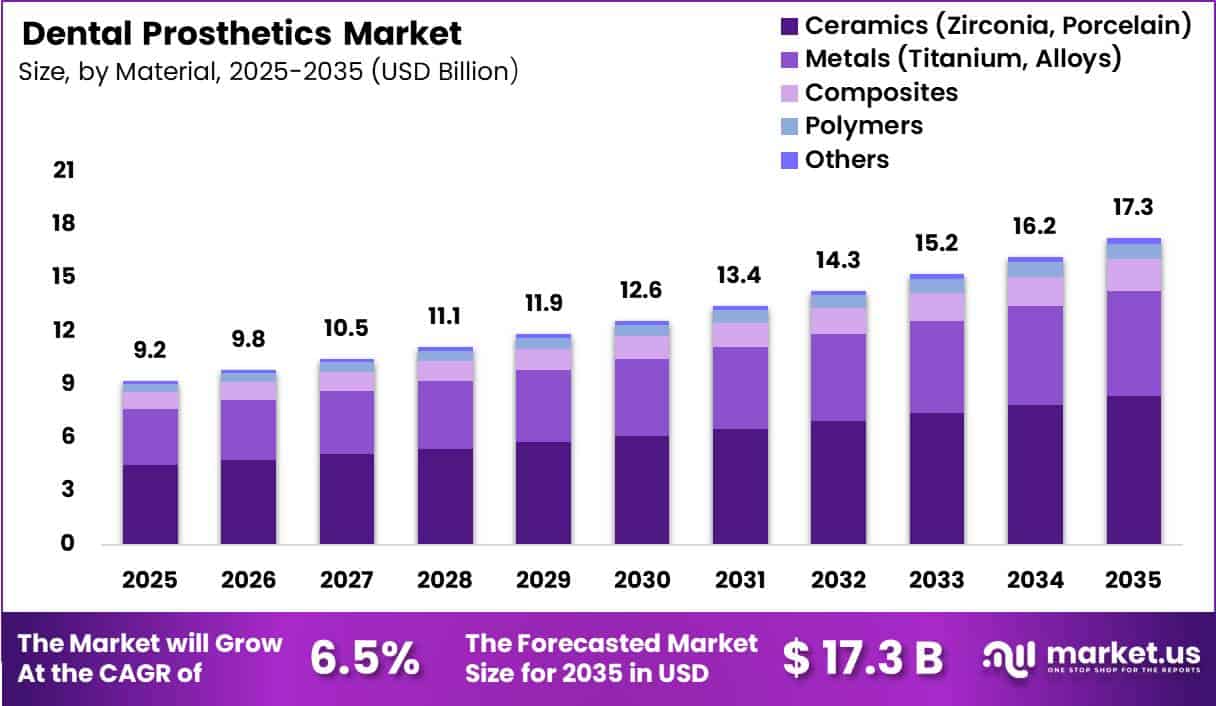
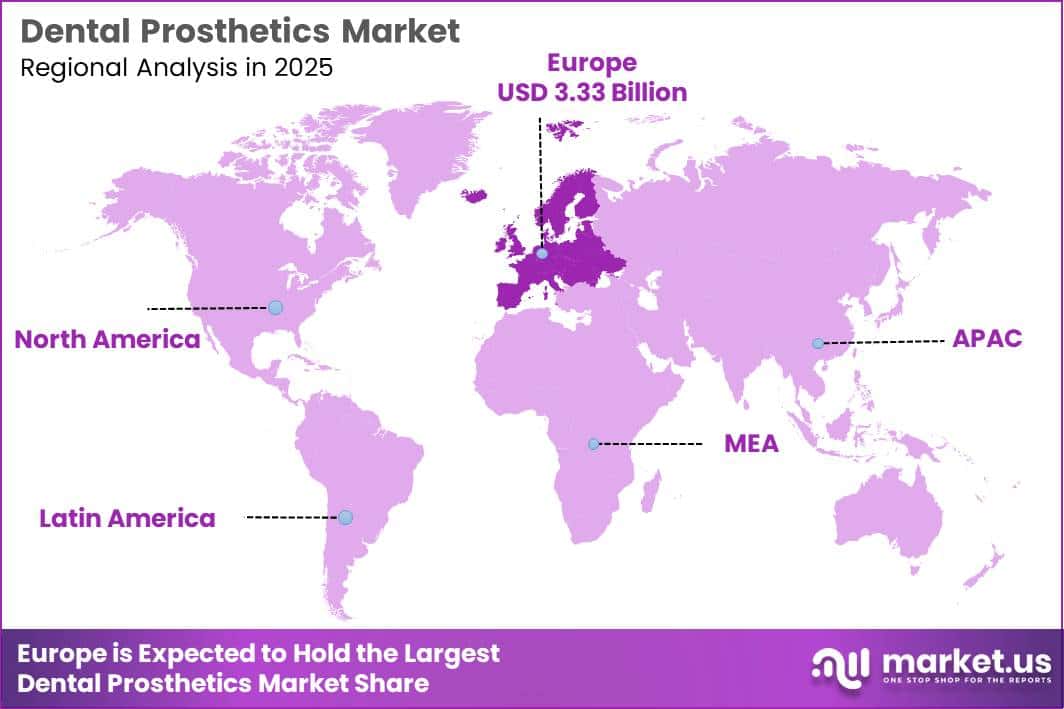
Global Dental Prosthetics Market size is expected to be worth around US$ 17.3 Billion by 2035 from US$ 9.2 Billion in 2025, growing at a CAGR of 6.5% during the forecast period from 2026 to 2035. In 2025, Europe led the market, achieving over 36.1% share with a revenue of US$ 3.33 Billion.
The dental prosthetics sector continues to benefit from rising oral healthcare awareness, an aging population, and increasing demand for restorative dental procedures worldwide. According to the World Health Organization (WHO), oral diseases affect nearly 3.5 billion people globally, while severe tooth loss remains a significant public health concern, particularly among older adults.
Growing attention to oral rehabilitation is supporting the adoption of crowns, bridges, dentures, and implant-supported prosthetic solutions. Data from the World Health Organization indicates that approximately 2 billion people suffer from caries of permanent teeth, emphasizing the ongoing need for restorative dental treatments.
Furthermore, the United Nations projects that the global population aged 65 years and above will exceed 1.6 billion by 2050, creating sustained demand for advanced dental prosthetic solutions designed to improve functionality, aesthetics, and quality of life.
Technological developments are also reshaping the industry landscape. Digital dentistry, including computer-aided design and computer-aided manufacturing (CAD/CAM) systems, intraoral scanners, and three-dimensional printing technologies, is enhancing precision, reducing treatment times, and improving patient outcomes. The growing availability of biocompatible materials such as zirconia and high-performance ceramics is further supporting innovation in prosthetic dentistry.
Government-backed oral health initiatives and increased access to dental care services across both developed and emerging economies are expected to contribute to continued expansion in the global dental prosthetics industry over the coming years.
Key Takeaways
- Market Size : Dental Prosthetics Market size is expected to be worth around US$ 17.3 Billion by 2035 from US$ 9.2 Billion in 2025.
- Market Share : The Market is growing at a CAGR of 6.5% during the forecast period from 2026 to 2035.
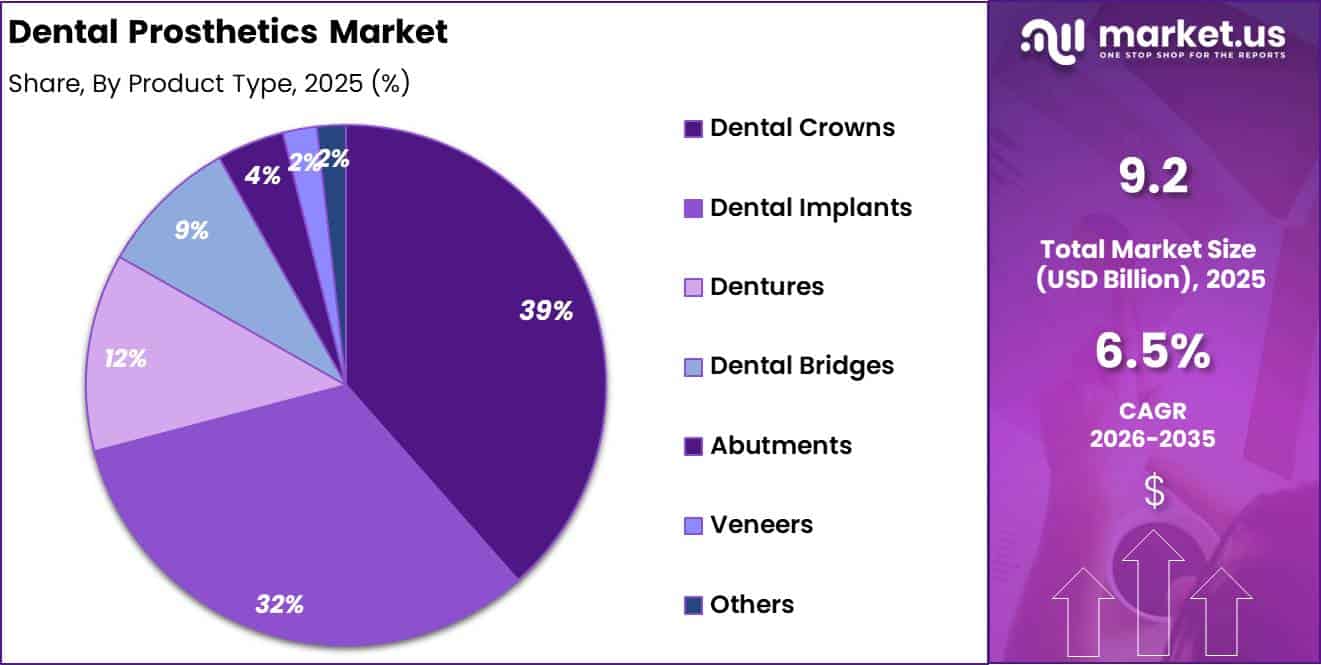
- Product Type Analysis : Dental crowns dominated the Dental Prosthetics Market in 2025, accounting for 38.5% of the total market share.
- Material Analysis : Ceramics, including zirconia and porcelain materials, dominated the Dental Prosthetics Market in 2025, capturing 48.6% of the total market share.
- End User Analysis : Dental hospitals and clinics emerged as the dominant end-user segment in the Dental Prosthetics Market, accounting for 53.1% of total revenue in 2025.
- Regional Analysis : In 2025, Europe led the market, achieving over 36.1% share with a revenue of US$ 3.33 Billion.
Product Type Analysis
Dental crowns dominated the Dental Prosthetics Market in 2025, accounting for 38.5% of the total market share. Their leading position is attributed to the growing prevalence of tooth decay, fractures, and cosmetic dental procedures.
Dental crowns are widely used for restoring damaged teeth, improving aesthetics, and enhancing oral functionality. Advancements in digital dentistry, including CAD/CAM technology and high-strength ceramic materials, have further increased the adoption of crowns across dental practices.
Dental implants represented the second-largest segment, holding 32.4% of the market share in 2025. Rising demand for permanent tooth replacement solutions and increasing awareness regarding implant-supported restorations continue to support segment growth. Dentures accounted for 12.3% of the market due to their affordability and suitability for elderly populations experiencing tooth loss.
Dental bridges captured 8.7% share, driven by demand for fixed restorative treatments. Abutments contributed 4.2% as essential components in implant procedures. Veneers held 2.1% share, supported by increasing interest in cosmetic dentistry and smile enhancement treatments. The others segment accounted for 1.8%, comprising specialized prosthetic products used for customized dental restorations.
Material Analysis
Ceramics, including zirconia and porcelain materials, dominated the Dental Prosthetics Market in 2025, capturing 48.6% of the total market share. Their popularity stems from superior aesthetics, excellent biocompatibility, durability, and their ability to closely resemble natural teeth.
Zirconia-based prosthetics have gained significant acceptance due to their high strength, fracture resistance, and long-term clinical performance. Continuous innovations in ceramic manufacturing technologies are further enhancing treatment outcomes.
Metals, including titanium and various dental alloys, accounted for 34.2% of the market in 2025. Their widespread use is primarily associated with dental implants and structural prosthetic components because of their mechanical strength and excellent osseointegration properties. Composite materials represented 10.3% share, benefiting from improved aesthetics, lightweight characteristics, and cost-effectiveness.
Polymers contributed 5.1% of the market, supported by increasing utilization in temporary restorations, dentures, and digital manufacturing applications. The others segment held 1.8%, comprising emerging biomaterials and hybrid restorative substances designed to enhance patient comfort, treatment precision, and prosthetic longevity.
End User Analysis
Dental hospitals and clinics emerged as the dominant end-user segment in the Dental Prosthetics Market, accounting for 53.1% of total revenue in 2025. Their leadership is driven by the increasing number of restorative dental procedures, availability of advanced treatment technologies, and access to specialized dental professionals. Hospitals and clinics also benefit from growing patient preference for comprehensive oral healthcare services and minimally invasive restorative treatments.
Dental laboratories represented a substantial share of the market owing to their critical role in designing, manufacturing, and customizing prosthetic devices such as crowns, bridges, dentures, and implant-supported restorations. Solo practices continue to maintain steady demand as independent dentists increasingly adopt digital workflows and chairside manufacturing technologies to improve patient convenience.
DSO/group practices are witnessing notable growth due to expanding dental networks, operational efficiencies, and increasing investments in advanced prosthetic solutions. The others category includes academic institutions, specialty centers, and research facilities involved in prosthetic development and training activities.
Rising awareness regarding oral health and increasing demand for aesthetic dentistry are expected to support growth across all end-user segments over the forecast period.
Market Segmentations
By Product Type
- Dental Crowns
- Dental Implants
- Dentures
- Dental Bridges
- Abutments
- Veneers
- Others
By Material
- Ceramics (Zirconia, Porcelain)
- Metals (Titanium, Alloys)
- Composites
- Polymers
- Others
By End User
- Dental Hospitals & Clinics
- Dental Laboratories
- Solo Practices
- DSO/Group Practices
- Others
Drivers
Aging edentulous pool and functional rehabilitation demand
The strongest structural demand driver remains population aging combined with the persistence of tooth loss as a cumulative outcome of caries and periodontal disease. WHO estimates oral diseases affect nearly 3.7 billion people globally, severe periodontal disease affects more than 1 billion cases, complete tooth loss averages almost 7 % among adults aged 20+ and rises to 23 % among people aged 60+ which creates a very large prosthetic candidate pool even before partial edentulism demand is included.
For market modeling, that supports a roughly +2.4 % age point uplift to baseline CAGR because prosthetic need scales with elderly population growth, but revenue capture is amplified by the fact that older adults often require multi unit restorations, relines, replacement cycles, and combined treatment plans rather than single unit repairs.
| Driver | (~) % Impact on CAGR Forecast | Geographic Relevance | Impact Timeline |
|---|---|---|---|
| Aging edentulous pool and functional rehabilitation demand | +2.4% | North America core, EU, Japan, South Korea, urban China | Medium term (2-4 years) |
| Digital workflow adoption in crowns, bridges, dentures | +1.9% | North America core, EU, developed APAC, GCC premium clinics | Short term (≤ 2 years) |
| Limited public coverage pushes premium private-pay mix | +1.3% | U.S., Canada, UK private segment, India metros, Southeast Asia private corridors | Short term (≤ 2 years) |
| Medical-dental integration expands case identification | +0.9% | U.S. core, EU hospital dentistry, advanced APAC health systems | Medium term (2-4 years) |
| Oral disease burden in diabetics and medically complex adults | +1.6% | Global, strongest in U.S., India, China, Brazil, Middle East | Medium term (2-4 years) |
| Shift toward higher-value fixed and implant-supported prosthetics | +2.1% | North America, EU, Australia, Japan, affluent urban APAC | Long term (≥ 4 years) |
Challenge
Global prosthodontist and dental workforce capacity constraints
Structural shortages of prosthodontists and wider dental staff mean that even as prosthetic demand rises with aging populations, chairside capacity constrains throughput at thousands of practices, effectively capping annual case volumes per clinic at 70 to 85% of installed capacity.
In the United States alone, around 63 to 64 million people live in dental Health Professional Shortage Areas and HRSA estimates roughly 10,700 additional dental providers are needed to close access gaps, with over 33% of dentists already above 55 years of age and nearing retirement.
Recruitment challenges for hygienists and assistants, reported by up to 95% of practices in some surveys, further reduce utilization by 10 to 15% age points and extend prosthetic treatment timelines from 3 to 4 visits over 6 weeks to 4 to 5 visits over 8 to 10 weeks. This creates a persistent demand capacity gap where order intake grows faster than completed case volumes, leaving unmet “shadow demand” that does not fully convert into revenue.
Over 2026 to 2030, slow workforce expansion and 3 to 5 year training lags are expected to keep supply constrained, limiting market realization and reducing achievable global prosthetics CAGR by roughly 1 to 1.5% age points without meaningful productivity gains from workflow automation and expanded mid level clinical support.
| Challenge | (~) % CAGR Friction Drag | Geographic Relevance | Mitigation Horizon |
|---|---|---|---|
| Prosthodontist workforce gaps | -1.3% | North America, Western Europe, GCC urban | Long term (≥ 4 years) |
| Dental lab digitization lag | -1.0% | Latin America, CEE, Southeast Asia | Medium term (2-4 years) |
| Advanced materials cost volatility | -0.9% | EU regulatory hubs, APAC sourcing belts | Medium term (2-4 years) |
| Uneven patient access to care | -0.8% | US HPSAs, rural APAC, EMENA periphery | Long term (≥ 4 years) |
| Cross-border supply chain fragility | -0.7% | Global OEM–lab–clinic corridors | Short term (≤ 2 years) |
| Regulatory and quality complexity | -0.6% | US, EU, Japan, emerging hubs | Medium term (2-4 years) |
Restraints
Inflationary Pressure from Zirconia and Advanced Dental Material Costs
The dental prosthetics market enters 2026 with structurally elevated material and energy costs, as zirconia-based dental ceramics and advanced composite resins have seen effective price inflation of roughly 20 to 30 % over 2022 to 2024.
On the back of higher yttria zirconium input prices, gas intensive sintering, and premium CAD CAM grade disk formulations, while global zirconia-based dental materials are themselves growing at close to high single digit value rates, signaling sustained pricing power rather than normalization.
At lab level, this translates into a 6 to 10 % increase in bill of materials per unit crown or bridge, given that materials can account for 25 to 35 % of direct case costs in high end labs, alongside 5 to 8 % wage and overhead inflation from 2023 onwards, eroding gross margins by 150 to 250 bps where reimbursement has not adjusted.
Since pricing cycles lag 12 to 24 months, labs either absorb margin pressure or raise prices by 8 to 12 % on complex prostheses, leading to some case deferrals and down trading to lower cost alternatives. The net effect is a persistent drag on premium prosthetic volume growth and a mix shift toward lower margin products, justifying a 2.0 % age point downward adjustment to the otherwise unconstrained growth path.
| Restraint | (~) % Impact on CAGR Forecast | Geographic Relevance | Impact Timeline |
|---|---|---|---|
| Inflationary input cost spikes (zirconia, alloys, resins) | -2.0% | North America, Western Europe, East Asia | Short to Medium term |
| Dental lab capacity and technician constraints | -1.5% | North America, EU-5, Japan, GCC hubs | Medium term |
| Reimbursement and out-of-pocket affordability pressure | -1.3% | North America core, EU public systems, select LATAM | Medium to Long term |
| Regulatory tightening on biomaterials and MDR-style compliance | -1.0% | EU-27, UK, North America, advanced APAC | Medium to Long term |
| Digital dentistry adoption gap in mid- and low-income markets | -0.9% | Emerging APAC, LATAM, Middle East, Africa | Long term |
| Demographic and workforce misalignment vs prosthetic demand | -0.8% | OECD aging economies, China, Eastern Europe | Long term |
Opportunity
Value Based Geriatric Prosthetic Bundles in Aging Health Systems
This opportunity rests on structuring value based geriatric prosthetic bundles such as crowns, bridges, and implant supported overdentures aligned with healthy ageing agendas rather than fee for service models, which underpin the baseline CAGR.
Global edentulism affects roughly 0.35 billion people, with higher burden in older cohorts, while most systems still do not reimburse full prosthetic rehabilitation as part of geriatric care packages, leaving uncaptured demand through 2035.
WHO guidance supports integrating prosthetic care into primary and geriatric services, but implementation remains limited, meaning bundled models could unlock 10 to 15 % of latent demand in covered seniors if reimbursement improves in leading markets.
For manufacturers and DSOs, the upside comes from standardized geriatric packages such as two implant overdenture plus maintenance priced 20 to 30 % below fragmented care pathways, supported by volume based contracts with payers and insurers.
By 2030, expanded bundled coverage for 10 to 12 million additional geriatric patients could generate 15 to 18 billion USD in incremental revenue over the decade, supporting a 1.5 % age point CAGR uplift through improved reimbursement alignment and workflow standardization.
| Opportunity | (~) % Potential CAGR Upside | Geographic Relevance | Execution Window |
|---|---|---|---|
| Value-based geriatric prosthetics bundles | +1.5% | North America, Western Europe, Japan, South Korea | Short term |
| Low-cost digital dentures for emerging seniors | +2.0% | Latin America, South Asia, ASEAN, Eastern Europe | Medium term |
| Chairside CAD/CAM same-day prosthetics | +1.2% | North America core, EU, urban China, Gulf states | Short term |
| AI-guided design and 3D printing networks | +1.0% | Global tier-1 and tier-2 cities | Medium term |
| Integrated oral care in long-term care facilities | +0.8% | North America, Europe, Brazil, China | Long term |
| Preventive-to-prosthetic subscription models | +0.7% | US, UK, Germany, GCC, urban India | Medium term |
Regional Analysis
In 2025, Europe dominated the Dental Prosthetics Market, accounting for over 36.1% of the global market and generating revenue of US$ 3.33 billion. The region’s leadership is driven by advanced dental care infrastructure, a high concentration of skilled dental professionals, favorable reimbursement systems, and widespread adoption of digital dentistry technologies.
Countries including Germany, France, Italy, and the United Kingdom continue to witness strong demand for crowns, bridges, dentures, and implant-supported prostheses, supported by an aging population and increasing emphasis on aesthetic dentistry.
North America represented the second-largest regional market, benefiting from high healthcare expenditure, strong awareness regarding oral health, and rapid incorporation of CAD/CAM technologies, intraoral scanners, and 3D printing solutions. The presence of major dental device manufacturers and growing acceptance of cosmetic dental procedures further support regional growth.
Asia Pacific is anticipated to register the fastest expansion during the forecast period due to rising disposable incomes, expanding dental tourism, improving healthcare infrastructure, and increasing access to restorative dental treatments in countries such as China, India, Japan, and South Korea.
Meanwhile, Latin America is experiencing gradual growth driven by urbanization and improving dental service accessibility. The Middle East and Africa market is also progressing steadily, supported by investments in healthcare facilities, rising awareness of oral hygiene, and growing demand for advanced prosthetic solutions.
Key Regions and Countries
North America
- The US
- Canada
Europe
- Germany
- France
- The U.K.
- Italy
- Spain
- Russia & CIS
- Rest of Europe
Asia Pacific
- China
- India
- Japan
- South Korea
- ASEAN
- Australia & New Zealand
- Rest of Asia Pacific
Middle East & Africa
- GCC
- South Africa
- Rest of Middle East & Africa
Latin America
- Brazil
- Mexico
- Rest of Latin America
Key Player Analysis
The Dental Prosthetics Market is highly competitive, with leading companies focusing on product innovation, digital dentistry technologies, and expanding their global distribution networks. Manufacturers are increasingly investing in advanced materials, customized prosthetic solutions, and digital workflows to improve treatment precision and patient outcomes.
Institut Straumann AG remains a prominent participant due to its extensive portfolio of dental implants, prosthetic components, and digital dentistry solutions. Envista Holdings Corporation strengthens its market position through a broad range of implant systems and restorative products. Dentsply Sirona Inc. is recognized for its expertise in CAD/CAM technologies, imaging systems, and prosthetic materials that support efficient dental restoration procedures.
Meanwhile, Henry Schein Inc. benefits from its extensive distribution capabilities and comprehensive dental product offerings. Osstem Implant Co. Ltd. continues to expand internationally through cost-effective implant solutions and training programs for dental professionals. Zimmer Biomet Holdings Inc. and 3M Company also contribute significantly through innovative biomaterials, restorative products, and continuous advancements in dental prosthetic technologies.
Top Key Players
- Institut Straumann AG
- Envista Holdings Corporation
- Dentsply Sirona Inc.
- Henry Schein Inc.
- Osstem Implant Co. Ltd.
- Zimmer Biomet Holdings Inc.
- 3M Company
- Ivoclar Vivadent AG
- Glidewell Dental
- ZimVie Inc.
- Coltene Holding AG
- VITA Zahnfabrik H. Rauter GmbH & Co. KG
- Kuraray Noritake Dental Inc.
- Bego GmbH & Co. KG
- Mitsui Chemicals Inc.
- Others
Recent Developments
- In February 2026, Nobel Biocare (Envista Holdings) acquired Versah®, a Michigan-based developer of Densah® Burs and Osseodensification technology. The acquisition expands Nobel Biocare’s implant site preparation and regenerative portfolio, adding technologies used for bone densification, sinus elevation, ridge expansion, and immediate implant placement procedures.
- In January 2026, Dentsply Sirona renewed its U.S. dental technology distribution partnership with Patterson Dental. The agreement focuses on expanding access to integrated digital dentistry technologies and accelerating adoption of advanced restorative and prosthetic solutions throughout North America.
- In June 2025, Straumann Group acquired full ownership of maxon dental GmbH, increasing its stake from 49% to 100%. The German company specializes in ceramic injection molding technology and developed the world’s first two-piece ceramic implant system, strengthening Straumann’s ceramic implant and prosthetic manufacturing capabilities.
- In 2025, Straumann invested CHF 223.5 million in capital expenditures, including manufacturing expansion projects in Shanghai (China), Curitiba (Brazil), Calw (Germany), and Villeret (Switzerland). These investments were directed toward increasing production capacity and supporting future demand for implant and prosthetic products.
Report Scope
| Report Features | Description |
|---|---|
| Market Value (2025) | US$ 9.2 Billion |
| Forecast Revenue (2035) | US$ 17.3 Billion |
| CAGR (2026-2035) | 6.5 % |
| Base Year for Estimation | 2025 |
| Historic Period | 2020-2024 |
| Forecast Period | 2026-2035 |
| Report Coverage | Revenue Forecast, Market Dynamics, Competitive Landscape, Recent Developments |
| Segments Covered | By Product Type (Dental Crowns, Dental Implants, Dentures, Dental Bridges, Abutments, Veneers, Others), By Material (Ceramics (Zirconia, Porcelain), Metals (Titanium, Alloys), Composites, Polymers, Others), By End User (Dental Hospitals & Clinics, Dental Laboratories, Solo Practices, DSO/Group Practices, Others) |
| Regional Analysis | North America – The US, Canada; Europe – Germany, France, U.K., Italy, Spain, Russia & CIS, Rest of Europe; Asia Pacific – China, India, Japan, South Korea, ASEAN, Australia & New Zealand, Rest of Asia Pacific; Middle East & Africa – GCC, South Africa, Rest of Middle East & Africa; Latin America – Brazil, Mexico, Rest of Latin America |
| Competitive Landscape | Institut Straumann AG, Envista Holdings Corporation, Dentsply Sirona Inc., Henry Schein Inc., Osstem Implant Co. Ltd., Zimmer Biomet Holdings Inc., 3M Company, Ivoclar Vivadent AG, Glidewell Dental, ZimVie Inc., Coltene Holding AG, VITA Zahnfabrik H. Rauter GmbH & Co. KG, Kuraray Noritake Dental Inc., Bego GmbH & Co. KG, Mitsui Chemicals Inc., Others |
| Customization Scope | Customization for segments, region/country-level will be provided. Moreover, additional customization can be done based on the requirements. |
| Purchase Options | We have three licenses to opt for: Single User License, Multi-User License (Up to 5 Users), Corporate Use License (Unlimited User and Printable PDF) |





































