Report Overview
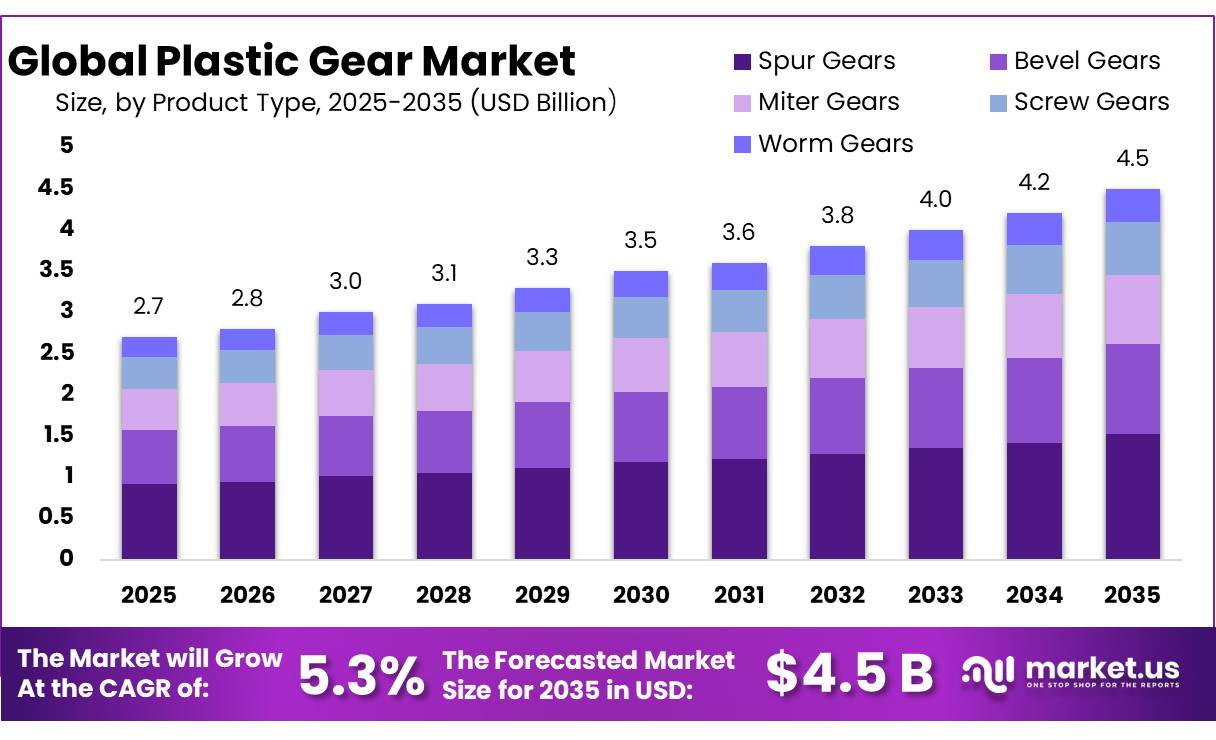
The Global Plastic Gear Market size is expected to be worth around USD 4.5 Billion by 2035, from USD 2.7 Billion in 2025, growing at a CAGR of 5.3% during the forecast period from 2026 to 2035. In 2025, North America held a dominant market position, capturing more than a 38.60% share, holding USD 0.5 Billion revenue.
Plastic gears are increasingly used in modern mechanical systems because they offer lightweight construction, low operating noise, corrosion resistance and cost-effective manufacturing. They are produced using engineering thermoplastics such as polyoxymethylene (POM), nylon (polyamide), polyether ether ketone (PEEK) and polybutylene terephthalate (PBT). These materials provide good dimensional stability, wear resistance and mechanical strength for applications requiring continuous movement and precise power transmission.
- The industrial scenario for plastic gears is closely connected to developments in the global plastics and engineering polymers industries. According to Plastics Europe’s Plastics the Fast Facts 2025, global plastics production reached 430.9 million tonnes in 2024, compared with 413.8 million tonnes in 2023, representing an annual increase of approximately 4.1%. Asia accounted for 57.2% of global plastics production, while North America represented 16.3% and Europe accounted for 12%.
The United States also represents an important industrial base for plastic components and engineered polymer manufacturing. According to the Plastics Industry Association’s 2025 Size and Impact Report, the US plastics industry operated 15,123 manufacturing establishments, employed approximately 827,900 people and generated USD 453 billion in shipments in 2024. Plastics materials and resin manufacturing alone recorded approximately USD 108.9 billion in shipments. These figures demonstrate the scale of the industrial supply chain supporting polymer-based components.
Sustainability is also becoming an important consideration in future product development. The European Union’s revised End-of-Life Vehicles Regulation entered into force on 13 August 2026, with application scheduled from 1 September 2028. It introduces recycled-plastic content requirements of 15% from 2032, increasing to 25% from 2036 for new vehicles. Although these requirements do not specifically target plastic gears, they are expected to encourage automotive component suppliers to investigate recyclable engineering polymers, material traceability and circular product designs.
Key Takeaways
- Plastic Gear Market size is expected to be worth around USD 4.5 Billion by 2035, from USD 2.7 Billion in 2025, growing at a CAGR of 5.3%.
- Polyamide 66 held a dominant market position, capturing more than a 23.56% share.
- Spur Gears held a dominant market position, capturing more than a 33.89% share.
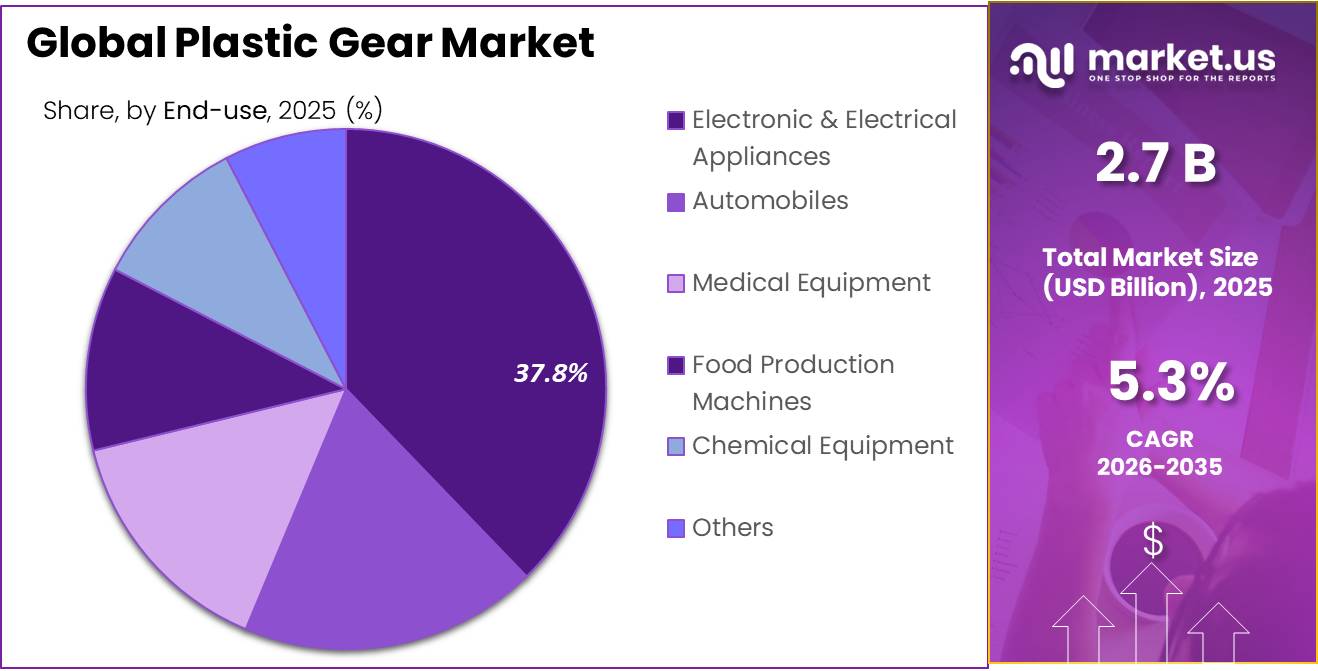
- Electronic & Electrical Appliances held a dominant market position, capturing more than a 37.89% share.
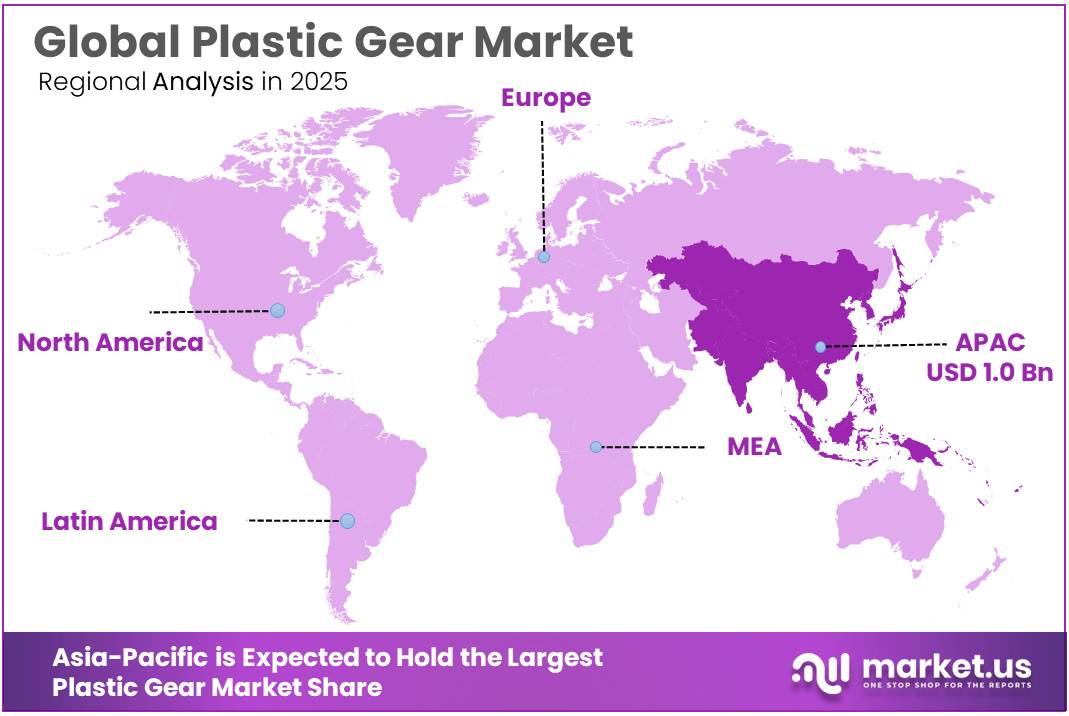
- Asia-Pacific dominated the Plastic Gear Market in 2025, accounting for a 39.67% share and market value of USD 1.0 billion.
By Material Type Analysis
Polyamide 66 dominates the material segment due to its high mechanical strength, thermal stability and excellent wear resistance in precision gear applications.
In 2025, “Polyamide 66″ held a dominant market position, capturing more than a 23.56% share. Polyamide 66 (PA66) is widely preferred in plastic gear manufacturing because of its strong mechanical properties, dimensional stability and ability to withstand continuous friction and demanding operating conditions. Its higher thermal resistance compared with conventional nylon materials makes it suitable for automotive transmission components, industrial machinery, electric motors and power transmission systems.
According to Mitsubishi Chemical Group, PA66 has a melting point of approximately 260°C, compared with 215°C for PA6, supporting its suitability for applications involving higher operating temperatures. In 2025, demand was supported by increasing requirements for durable, lightweight and low-noise mechanical components. The material also offers opportunities in electric vehicle components, robotics and automated manufacturing equipment, where improved strength and reliable gear performance are important.
Polyamide 6 (PA6) is an important engineering thermoplastic used in plastic gear manufacturing because of its good mechanical strength, impact resistance, fatigue performance and sliding properties. The material is suitable for automotive mechanisms, household appliances, industrial equipment, conveyor systems and compact power transmission applications.
According to technical information published by Mitsubishi Chemical Group, PA6 has a melting point of approximately 215°C and a heat deflection temperature of around 80°C. In 2025, its industrial relevance was supported by demand for economical engineering plastics that offer a balance between strength, durability and production efficiency. PA6 also provides future opportunities in lightweight automotive components, electric motors and industrial automation.
By Product Type Analysis
Spur gears dominate the product segment due to their simple construction, efficient power transmission and cost-effective manufacturing.
In 2025, “Spur Gears” held a dominant market position, capturing more than a 33.89% share. Spur gears are widely used in plastic gear manufacturing because of their straightforward design, ease of production and ability to transfer motion between parallel shafts. Their straight teeth provide reliable power transmission and make them suitable for automotive systems, household appliances, electric motors, office equipment and industrial machinery.
Injection moulding also allows manufacturers to produce spur gears in large volumes with consistent tooth profiles and dimensional accuracy. In 2025, demand was supported by the growing use of compact electric motors, automated equipment and lightweight mechanical assemblies. Their relatively simple geometry also makes them easier to design, manufacture and replace than more complex gear configurations.
Government industry data also indicates continued activity in major end-use industries. According to the U.S. Census Bureau’s 2025 manufacturing statistics, motor vehicle and parts shipments reached approximately USD 731.06 billion during the reported January–November period, while electrical equipment, appliances and components shipments totalled approximately USD 191.58 billion.
Bevel Gears are used in plastic gear manufacturing for applications that require power transmission between shafts positioned at an angle. Their design makes them suitable for automotive mechanisms, power tools, household appliances, industrial equipment and specialised mechanical assemblies. Plastic bevel gears offer advantages such as lightweight construction, reduced operating noise, corrosion resistance and lower maintenance requirements.
By End Use Industry Analysis
Electronic and electrical appliances dominate the end-use segment due to increasing demand for compact, lightweight and noise-efficient mechanical components.
In 2025, “Electronic & Electrical Appliances” held a dominant market position, capturing more than a 37.89% share. The segment benefits from the extensive use of plastic gears in washing machines, refrigerators, air conditioners, printers, power tools, electric fans and other household and electronic equipment. Plastic gears are preferred in these applications because they offer low operating noise, reduced weight, corrosion resistance and cost-effective production.
In 2025, demand was supported by the growing adoption of smart appliances, energy-efficient electrical equipment and automated household devices. According to the U.S. Census Bureau’s manufacturing data, electrical equipment, appliances and components shipments reached approximately USD 174.71 billion during January–October 2025, compared with USD 167.44 billion during the corresponding period in 2024, representing an increase of approximately 4.3%. This industrial performance reflects continued activity in an important downstream sector for plastic gear applications.
Automobiles represent an important end-use segment for plastic gears because modern vehicles require lightweight mechanical components for efficient movement, adjustment and power transmission. Plastic gears are used in power windows, seat adjustment systems, windshield wipers, mirror controls, dashboard mechanisms, heating and ventilation systems, and selected electric motor assemblies.
In 2025, demand was supported by the expansion of electric vehicles, increasing electronic content in vehicles and the growing use of automated comfort and safety features. According to the International Organization of Motor Vehicle Manufacturers (OICA), global vehicle production increased from 92.7 million units in 2024 to 96.4 million units in 2025, representing growth of 3.9%. Global vehicle sales also increased from 95.3 million units to 99.8 million units, reflecting growth of 4.7%.
Key Market Segments
By Material Type
- Polyamide 66
- Polyamide 6
- Calaumid 612
- Calaumid 1200
- Cast Polyamide 6 + Oil
- Polyacetal-C
- Polyethylene
- Polyester
- Polycarbonate
- Polyurethane
By Product Type
- Spur Gears
- Bevel Gears
- Miter Gears
- Screw Gears
- Worm Gears
By End Use Industry
- Automobiles
- Electronic & Electrical Appliances
- Medical Equipment
- Food Production Machines
- Chemical Equipment
- Others
Driver Analysis
Automotive auxiliary electrification
The estimated +1.0 pp contribution reflects expanding vehicle production and the use of engineered polymers in auxiliary mechanisms—not substitution for high-torque traction gears. Global electric-car output reached nearly 22 million units in 2025, increasing more than 25%; EU production rose 30% to approximately 3.2 million, while North American production increased 10%. The 2026 outlook projects 23 million electric-car sales, although an 8% year-on-year decline in first-quarter sales demonstrates that annual growth should not be treated as uninterrupted monthly momentum. Polymer applications already include seat adjustment, window lifters, sliding roofs, heating controls, and door locks, giving gear suppliers established qualification routes into automotive auxiliary systems.
An illustrative procurement sensitivity—not measured vehicle content—shows that one additional USD 1 gear component per vehicle across a 10-million-vehicle production pool creates USD 10 million of annual component demand. The strategic shift is toward jointly engineered actuator components with validated wear, dimensional stability, emissions, and acoustic performance rather than interchangeable commodity gears. The +1.0 pp attribution discounts both drivetrain simplification and material limits: electrification alone does not prove higher plastic-gear content per vehicle, and metals remain preferable for many high-load and high-temperature duties.
Drivers Impact Analysis
| Driver | (~) % Impact on CAGR Forecast | Geographic Relevance | Impact Timeline |
|---|---|---|---|
| Automotive auxiliary electrification | +1.0 pp | China, EU, Japan, South Korea, U.S. | Medium term (2–4 years) |
| Service-robot deployment | +0.8 pp | China, Japan, South Korea, EU, U.S. | Medium term (2–4 years) |
| Lubrication-free metal substitution | +0.7 pp | Germany, U.S., Japan; ASEAN factories | Medium term (2–4 years) |
| Low-noise product differentiation | +0.5 pp | EU, Japan, South Korea, U.S. | Short term (≤ 2 years) |
| Scalable molded-gear economics | +0.5 pp | China, India, ASEAN; EU production hubs | Medium term (2–4 years) |
| Rapid custom-gear production | +0.3 pp | Germany, U.S., Japan; EU repair networks | Short term (≤ 2 years) |
Restraint Analysis
Load–temperature limits
The estimated −0.9 pp deduction reflects the direct exclusion of conventional polymer gears from applications whose temperature, tooth loading, or deformation limits exceed the selected material’s validated operating envelope. Manufacturer reference data list continuous working temperatures of 95°C for the cited acetal copolymer and 120°C and 150°C for two specified cast-nylon grades; these are material reference values, not allowable gear-mesh temperatures at rated torque.
The same guide reports standardized tensile strengths of 61 MPa for the acetal and 96 MPa for the nylon grades, while warning that strength declines as temperature rises; neither tensile strength nor melting point can substitute for fatigue, wear, and tooth-root calculations.
An illustrative application screen shows the commercial consequence: if thermal and mechanical validation requires a 30% torque derating, a nominal 10 N·m design becomes a 7 N·m solution, potentially forcing a larger gear, reinforced material, hybrid construction, or metal alternative.
The 30% is a scenario assumption, not a universal derating factor. Higher-performance polymers can expand the operating envelope, but the additional material and validation expenditure must remain competitive with metal. The −0.9 pp weighting is the largest because failed operating-envelope qualification removes addressable applications outright rather than merely reducing manufacturing margin.
Restraint Impact Analysis
| Restraint | (~) % Impact on CAGR Forecast | Geographic Relevance | Impact Timeline |
|---|---|---|---|
| Load–temperature limits | −0.9 pp | Germany, Japan, China, U.S. | Long term (≥ 4 years) |
| Moisture-driven dimensional change | −0.6 pp | India, ASEAN, coastal China; EU exporters | Medium term (2–4 years) |
| Resin-price escalation | −0.5 pp | China, ASEAN, EU, U.S. | Short term (≤ 2 years) |
| Low-volume tooling economics | −0.5 pp | EU, U.S., Japan; Indian SMEs | Medium term (2–4 years) |
| Precision-grade cost penalties | −0.4 pp | Japan, Germany, South Korea, U.S. | Medium term (2–4 years) |
| Automotive order softness | −0.4 pp | EU automotive hubs; global tier suppliers | Short term (≤ 2 years) |
Opportunity Analysis
Authorized repair catalogues
The estimated +0.7 pp upside comes from building OEM-authorized catalogues of replacement gears for discontinued or poorly supported products, rather than treating existing rapid-printing services as a new opportunity. EU right-to-repair rules were scheduled for national application from July 31, 2026, and provide at least a 12-month extension of the seller’s liability period when consumers choose repair; obligations apply to covered product categories, not every appliance or individual gear.
The strategic white space is therefore an authorized supply arrangement combining original drawings or licensed reverse engineering, validated materials, revision control, and repair-channel distribution—not an assumed legal right to reproduce proprietary parts.
Illustratively, a catalogue containing 300 viable gear references, averaging 100 incremental orders annually at USD 12 per gear, produces USD 360,000 of annual component revenue. At an assumed USD 5 variable production-and-fulfilment cost, contribution is USD 210,000 before licensing, catalogue maintenance, qualification, and overhead; an assumed USD 150,000 initial digitization-and-validation investment would recover in approximately 8.6 months after reaching that sales rate, excluding ramp-up.
Suppliers should prioritize failure-prone, non-safety-critical mechanisms with sufficient installed equipment and unavailable economical replacements. Market-wide upside exists only where a gear sale enables an otherwise abandoned repair; transferring an existing spare-part order between suppliers is market-share redistribution, not additional demand.
Opportunity Impact Analysis
| Opportunity | (~) % Potential CAGR Upside | Geographic Relevance | Execution Window |
|---|---|---|---|
| Authorized repair catalogues | +0.7 pp | Germany, France, Italy, Netherlands | Short term (≤ 2 years) |
| Medical microgear platforms | +0.6 pp | U.S., Germany, Switzerland, Ireland | Medium term (2–4 years) |
| Qualified hybrid gear families | +0.5 pp | Japan, Germany, South Korea, U.S. | Medium term (2–4 years) |
| Hygienic retrofit gear kits | +0.4 pp | EU, U.S.; ASEAN food-processing hubs | Short term (≤ 2 years) |
| Shared-tooling production platforms | +0.3 pp | India, ASEAN, Central Europe, U.S. | Medium term (2–4 years) |
Challenges Analysis
Production process repeatability
The estimated −0.6 pp drag reflects the continuous difficulty of holding tooth geometry, bore concentricity, and local material properties stable across cavities, production shifts, and tool-maintenance cycles—not the upfront cost of precision tooling. Manufacturer troubleshooting guidance identifies gate position, venting, melt temperature, injection speed, and fiber orientation as interacting causes of weld-line and warpage behavior, recommending mold-flow analysis before tooling changes. Processing windows also differ materially by resin: one high-performance PPA family specifies approximately 320°C melt temperature, 140°C mold temperature, and less than 0.05% resin moisture before processing; these are grade-specific requirements, not universal plastic-gear settings.
In an illustrative eight-cavity process operating at a 20-second cycle, theoretical output is 1,440 gears/hour; moving from 98% to 94% first-pass yield reduces accepted output from approximately 1,411 to 1,354 gears/hour. Recovering the difference requires additional machine time even though orders remain available. The strategic response is cavity-specific process monitoring, documented drying controls, preventive tool maintenance, and dimensional sampling linked to actual functional characteristics. The revenue-growth penalty arises when recurrent instability consumes qualified capacity or delays customer acceptance; scrap expenditure alone is a profitability penalty and should not automatically be translated into lower market CAGR.
Challenges Impact Analysis
| Challenge | (~) % CAGR Friction Drag | Geographic Relevance | Mitigation Horizon |
|---|---|---|---|
| Production process repeatability | −0.6 pp | China, Germany, Japan, U.S. | Medium term (2–4 years) |
| Application-specific life validation | −0.5 pp | Germany, Japan, South Korea, U.S. | Long term (≥ 4 years) |
| Assembly-level acoustic consistency | −0.4 pp | EU, Japan, South Korea, China | Medium term (2–4 years) |
| Specialist workforce continuity | −0.4 pp | U.S., Germany, Japan; EU tooling hubs | Long term (≥ 4 years) |
| Material-change qualification management | −0.3 pp | EU, U.S., China, ASEAN | Medium term (2–4 years) |
| Multi-site quality traceability | −0.3 pp | China–EU, ASEAN–U.S., India–EU | Medium term (2–4 years) |
Geopolitical Impact Analysis
Geopolitical Impact of the Middle East War on the Plastic Gear Market
The ongoing Middle East conflict in 2026 is creating supply chain uncertainty for the global Plastic Gear Market, mainly through disruptions in crude oil, petrochemical feedstocks and international transportation. Plastic gears depend on engineering polymers such as polyamide, polyoxymethylene and other petroleum-based materials, making manufacturers sensitive to fluctuations in raw material prices. Disruptions around the Strait of Hormuz have affected energy and petrochemical supplies, increasing procurement costs and creating uncertainty for polymer manufacturers.
According to the International Energy Agency (IEA), global oil inventories declined by a cumulative 462 million barrels since the beginning of the conflict. The World Bank reported in October 2026 that global energy prices are projected to increase by 32% in 2026, adding further pressure on polymer production and manufacturing expenses. Higher freight charges, insurance premiums and longer delivery schedules are also affecting international suppliers.
These conditions may increase production costs for plastic gear manufacturers serving automotive, electrical appliances and industrial machinery industries. Smaller manufacturers could face additional pressure due to limited purchasing power and restricted raw material inventories. However, the situation may encourage regional sourcing, supplier diversification, recycled polymer adoption and improved inventory management, creating opportunities for manufacturers to strengthen supply chain resilience.
Regional Insights
Dominating Region: Asia-Pacific – 39.67% Market Share | USD 1.0 Billion
Asia-Pacific dominated the Plastic Gear Market in 2025, accounting for a 39.67% share and market value of USD 1.0 billion. The region benefits from its strong manufacturing base, expanding automotive industry, growing electronics production and established engineering plastics supply chain. China, Japan and South Korea remain important industrial centres for automotive components, electrical appliances, precision machinery and automation equipment.
According to Plastics Europe, global plastics production reached 430.9 million tonnes in 2024, with Asia accounting for 57.2% of total production. China alone represented 34.5%, while the rest of Asia contributed 20.1% and Japan accounted for 2.6%. This extensive polymer manufacturing base supports the availability of raw materials for plastic gear producers. Increasing demand for lightweight automotive components, compact electric motors, household appliances and industrial machinery further strengthens regional demand.
Asia-Pacific is also experiencing strong industrial expansion, supported by automotive electrification, automation and increasing demand for advanced electrical equipment. According to the International Organization of Motor Vehicle Manufacturers (OICA), Asia-Pacific vehicle production increased by 7.6% in 2025, reaching approximately 59.2 million vehicles and representing more than 61% of global vehicle production. This growth creates opportunities for plastic gear manufacturers supplying automotive adjustment systems, electric motors, actuators and transmission components.
Growing investments in robotics, smart appliances and precision manufacturing are also supporting demand for high-performance engineering plastics. However, a separate fastest-growing regional market and its CAGR cannot be established from the available verified regional statistics without a comparable plastic gear dataset.
Key Regions and Countries Insights
- North America
- US
- Canada
- Europe
- Germany
- France
- The UK
- Spain
- Italy
- Rest of Europe
- Asia Pacific
- China
- Japan
- South Korea
- India
- Australia
- Rest of APAC
- Latin America
- Brazil
- Mexico
- Rest of Latin America
- Middle East & Africa
- GCC
- South Africa
- Rest of MEA
Key Players Analysis
Designatronics has maintained a strong presence in the precision mechanical components industry since 1950, serving automotive, aerospace, medical, defence and industrial customers. Through its SDP/SI and QTC Metric Gears brands, the company offers precision gears, moulded components, gear assemblies and customised motion-control solutions. Its operations were consolidated into a 96,000-square-foot manufacturing facility in 2017. The company reports a catalogue of more than 100,000 standard mechanical products and a workforce of over 180 employees, supporting both specialised engineering requirements and large-scale component supply.
Winzeler Gear is a specialised manufacturer of precision injection-moulded plastic gears, with operations dating back to 1940. The company serves automotive, off-road, lawn and garden, and office automation industries. Its manufacturing capabilities include scientific moulding, precision gear design and customised gear systems. In July 2025, injection-moulding specialist Adkev acquired Winzeler Gear to expand its manufacturing capabilities. At the time of the acquisition, Winzeler operated 42 injection-moulding machines, employed more than 40 full-time workers and had annual production capacity exceeding 150 million plastic gears. The acquisition strengthened its position in automotive actuator applications.
AmTech International has been active in precision manufacturing since 1995, supplying gears, shafts and engineered components to original equipment manufacturers across industrial and automotive sectors. In 1996, the company secured its first production contract with Funk Transmission, a division of John Deere, to manufacture 25 gears and shafts. In 1997, it opened a 50,000-square-foot warehouse to support OEM customers. By 2000, its cumulative production exceeded 1 million parts, increasing to more than 15 million parts by 2010. Its capabilities in gear manufacturing, machining and component engineering support its position in the broader gear industry.
Top Key Players Outlook
- Designatronics
- Winzeler Gear
- AmTech International
- IMS Gear
- Rush Gears
- Eurogear
- Creative & Bright Group
- Ningbo Tianlong Electronics
- Other Key Players
Recent Developments
- In August 2026, Ningbo Tianlong Electronics announced a further proposed acquisition of a 3.42% stake in Suzhou Haomibo for approximately CNY 24.06 million, subject to the required approval process.
- In January 2025, Creative & Bright Group the Indian Creative Group signed a non-binding memorandum of understanding with EPIC Group for a proposed joint venture involving an investment of INR 500 crore and potential employment for 10,000 people.
Report Scope
| Report Features | Description |
|---|---|
| Market Value (2025) | USD 2.7 Bn |
| Forecast Revenue (2035) | USD 4.5 Bn |
| CAGR (2026-2035) | 5.3% |
| Base Year for Estimation | 2025 |
| Historic Period | 2020-2024 |
| Forecast Period | 2026-2035 |
| Report Coverage | Revenue Forecast, Market Dynamics, Competitive Landscape, Recent Developments |
| Segments Covered | By Material Type (Polyamide 66, Polyamide 6, Calaumid 612, Calaumid 1200, Cast Polyamide 6 + Oil, Polyacetal-C, Polyethylene, Polyester, Polycarbonate, Polyurethane), By Product Type (Spur Gears, Bevel Gears, Miter Gears, Screw Gears, Worm Gears), By End Use Industry, Automobiles, Electronic & Electrical Appliances, Medical Equipment, Food Production Machines, Chemical Equipment, Others) |
| Regional Analysis | North America – US, Canada; Europe – Germany, France, The UK, Spain, Italy, Rest of Europe; Asia Pacific – China, Japan, South Korea, India, Australia, Singapore, Rest of APAC; Latin America – Brazil, Mexico, Rest of Latin America; Middle East & Africa – GCC, South Africa, Rest of MEA |
| Competitive Landscape | Designatronics, Winzeler Gear, AmTech International, IMS Gear, Rush Gears, Eurogear, Creative & Bright Group, Ningbo Tianlong Electronics, Other Key Players |
| Customization Scope | Customization for segments, region/country-level will be provided. Moreover, additional customization can be done based on the requirements. |
| Purchase Options | We have three licenses to opt for: Single User License, Multi-User License (Up to 5 Users), Corporate Use License (Unlimited User and Printable PDF) |