Quick Navigation
Report Overview
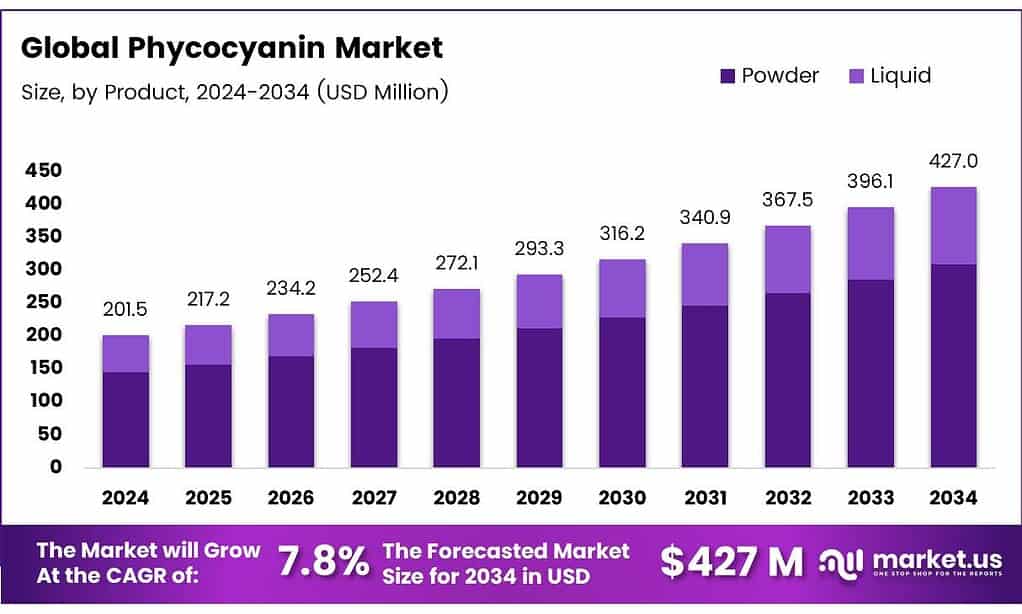
The Global Phycocyanin Market size is expected to be worth around USD 427.0 million by 2034, from USD 201.5 million in 2024, growing at a CAGR of 7.8% during the forecast period from 2025 to 2034.
Phycocyanin is a vibrant blue pigment-protein complex found primarily in cyanobacteria, commonly known as blue-green algae, and is especially abundant in Spirulina platensis. It plays a crucial role in photosynthesis by functioning as a light-harvesting accessory pigment that works cooperatively with chlorophyll. Specifically, phycocyanin absorbs red-orange wavelengths of light, transferring that energy to chlorophyll and significantly increasing the efficiency of oxygen production, particularly under low-light conditions.
- Its intense blue color arises from the presence of an open-chain tetrapyrrole chromophore called phycocyanobilin, which is covalently bound to the protein. Beyond its biological role in algae, phycocyanin has gained attention for its health-promoting properties. As one of the main active components of Spirulina, a nutrient-dense biomass containing approximately 60% protein, 24% carbohydrates, 8% fat, and various vitamins and minerals, phycocyanin contributes to Spirulina’s reputation as a popular dietary supplement for humans and as a feed additive in aquaculture and poultry farming.
Research highlights its powerful antioxidant activity, enabling it to scavenge reactive oxygen species (ROS) and reactive nitrogen species (RNS), thereby protecting cells from oxidative damage. These properties are believed to underlie many of its observed beneficial effects in both in vitro and in vivo studies, prompting calls for further clinical trials to validate its therapeutic potential.
Phycocyanin is widely used as a natural food and cosmetic colorant, particularly in Japan and China, where it colors products such as jellies, candies, gums, beverages, dairy items, and cosmetics. Compared to other natural blue pigments like gardenia or indigo, phycocyanin offers a more vivid and stable hue, though it remains sensitive to light and heat. Emerging evidence also suggests potential anti-cancer properties, positioning phycocyanin as a multifunctional compound of growing scientific and commercial interest.
Key Takeaways
- The Global Phycocyanin Market reached USD 201.5 million in 2024 and is projected to hit USD 427.0 million by 2034, growing at a 7.8% CAGR.
- Powder led the market with a dominant 72.3% share due to its higher stability and suitability for food and nutraceutical applications.
- Phycocyanin E18 accounted for the highest contribution with 46.9%, supported by strong adoption in large-scale food and beverage processing.
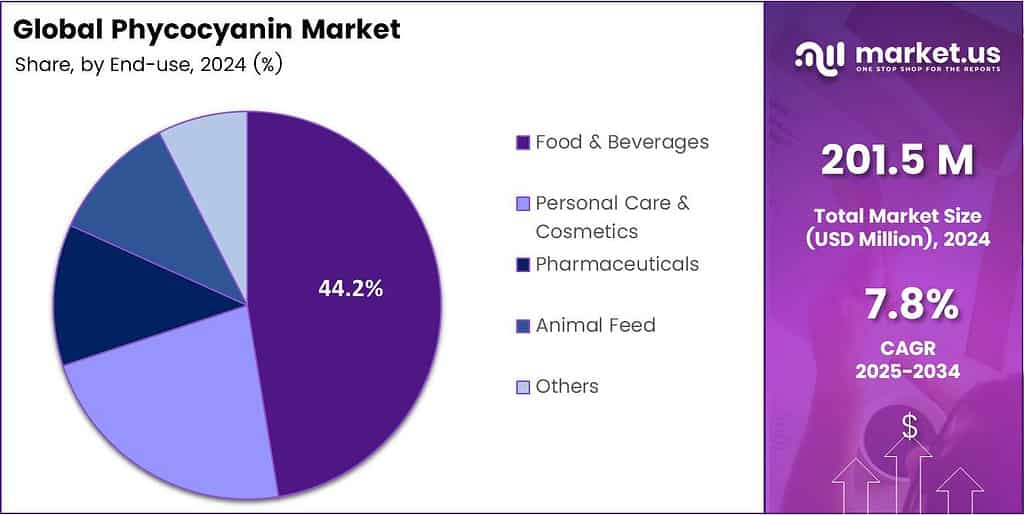
- Food and Beverages dominated with a 44.2% market share, driven by clean-label and natural blue colorant demand.
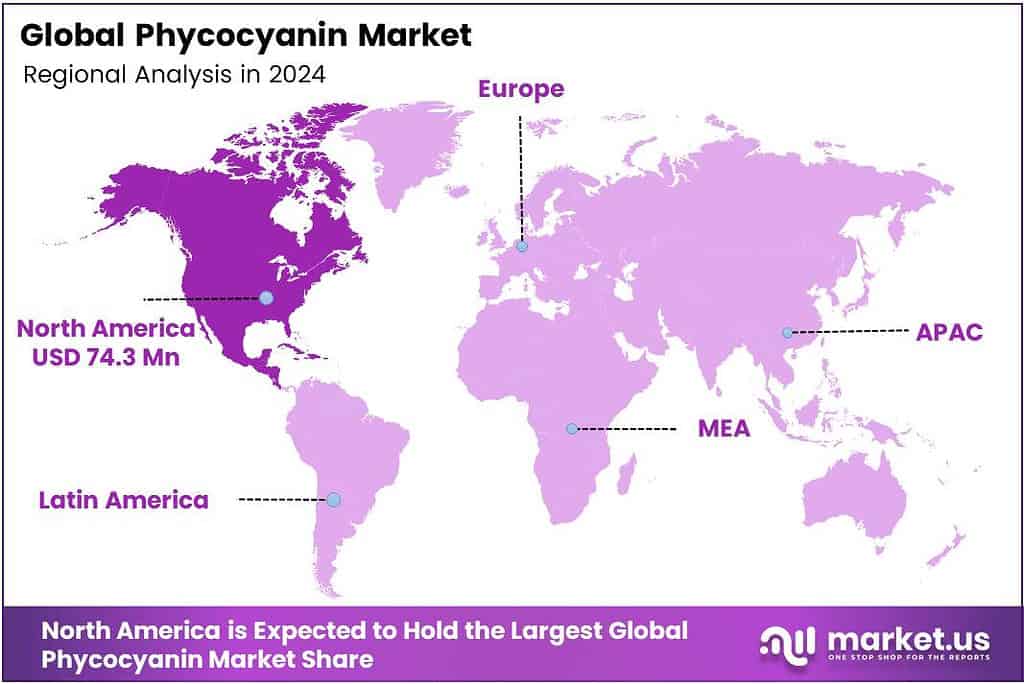
- North America emerged as the leading region with a 36.8% market share, valued at USD 74.3 million in 2024.
By Form Analysis
Powder dominates with 72.3% due to its longer shelf life, high color stability, and widespread suitability for food, beverage, and nutraceutical uses.
In 2024, Powder held a dominant market position in the By Form Analysis segment of the Phycocyanin Market, with a 72.3% share. Its stable structure, easy blending, and higher pigment concentration support strong adoption. Powder also enables simplified transport and storage, which continues to attract major manufacturers worldwide.
The Liquid segment advanced steadily as producers expanded applications in ready-to-drink beverages and liquid dietary supplements. Liquid phycocyanin offers fast solubility and brighter dispersion, making it suitable for fresh food formulations. Although smaller in share, ongoing innovation in clean-label beverages is expected to keep this segment active.
By Grade Analysis
Phycocyanin E18 dominates with 46.9% because of its balanced purity, cost efficiency, and suitability for mass-scale food and nutraceutical applications.
In 2024, Phycocyanin E18 held a dominant market position in the By Grade Analysis segment of the Phycocyanin Market, with a 46.9% share. Its moderate purity and affordability allow widespread use in snacks, beverages, and confectionery. Manufacturers prefer E18 for bulk coloring needs where high purity is not essential.
The Phycocyanin E25 segment grew as brands shifted toward cleaner, brighter natural pigments. E25 offers enhanced purity and color intensity, making it ideal for premium beverages, plant-based dairy, and wellness formulations. Its rising adoption reflects growing consumer expectations for visually appealing natural products.
The Phycocyanin E30 segment progressed as high-purity applications expanded across dietary supplements and medical nutrition. E30 delivers superior antioxidant activity and therapeutic suitability. Although niche, this segment is gaining attention from pharmaceutical developers using high-purity pigments for advanced formulations.
By End-use Analysis
Food and Beverages dominate with 44.2% driven by clean-label demand and the rapid shift toward natural blue colorants.
In 2024, Food and Beverages held a dominant market position in the By End-use Analysis segment of the Phycocyanin Market, with a 44.2% share. Growing preference for natural food coloring, functional drinks, and plant-based snacks continues to strengthen this segment across global markets.
The Personal Care and Cosmetics segment expanded steadily as brands explored marine-derived ingredients for skin-care formulations. Phycocyanin’s antioxidant and anti-inflammatory benefits support its use in masks, serums, and natural makeup. Its algae-based origin aligns strongly with clean beauty trends.
The Pharmaceuticals segment progressed as research validated phycocyanin’s immune-supportive and antioxidant properties. Its therapeutic potential in anti-inflammatory and detoxification products is driving greater formulation interest, especially within nutraceutical capsules and functional health blends.
The Animal Feed segment continued to grow as breeders incorporated natural pigments to improve feed quality and animal health. Its nutrient-rich profile supports livestock immunity, making it a preferred alternative to synthetic additives. The Others segment advanced gradually, supported by emerging uses in biotechnology, diagnostics, and academic research.
Key Market Segments
By Form
- Powder
- Liquid
By Grade
- Phycocyanin E18
- Phycocyanin E25
- Phycocyanin E30
By End-use
- Food and Beverages
- Personal Care and Cosmetics
- Pharmaceuticals
- Animal Feed
- Others
Emerging Trends
Phycocyanin as the wellness blue for clean-label foods
One clear trend around phycocyanin is its move from a niche algae pigment to a mainstream wellness blue in clean-label foods and drinks. A big part of this shift is that food regulators now treat phycocyanin-rich spirulina extracts as both safe and useful, which gives brands confidence to build colourful products around it.
- In the U.S., the Food and Drug Administration (FDA) accepted a phycocyanin-enriched spirulina extract (GRN 424) as GRAS for use in almost all foods, at levels up to 250 mg per serving. This GRAS notice sits alongside the FDA’s separate color-additive listings for spirulina extract, which now allow its use in a wide range of foods such as confectionery, frozen desserts, beverage mixes, yogurts, puddings, cottage cheese, and ready-to-eat cereals.
Together, these decisions have turned phycocyanin into a fully legitimate natural blue for everyday foods, not just a supplement ingredient. India’s Food Safety and Standards Authority (FSSAI) has gone in the same direction. Its nutraceutical schedule allows phycocyanin from Spirulina platensis at 50–250 mg per day, and spirulina powder itself at 500–3,000 mg per day, in health-oriented products.
Drivers
Rising Demand for Natural & Clean-Label Food Ingredients
One major driving factor behind the increasing uptake of phycocyanin—an intensely blue pigment derived from microalgae like Spirulina platensis and used in food and beverages—is the shift in consumer and regulatory preference toward natural, clean-label ingredients and away from synthetic additives. Consumers are increasingly seeking foods with fewer artificial additives, prompting food companies to reformulate.
This trend is reinforced by the European Food Safety Authority (EFSA), which subjects food colour additives to rigorous scientific review. Manufacturers of natural colourants such as phycocyanin can position their ingredients as safer, more transparent options. In fact, specialised market commentary notes that one of the major factors driving growth of the phycocyanin market is the approval of phycocyanin for use in food & beverages by recognised food-safety authorities.
In simple human terms, more people are choosing foods that say natural, no artificial colours, or display ingredient transparency. That makes a pigment like phycocyanin, which is derived from a safe algae source and can provide vibrant blue colouring, much more attractive to food brands. Also, when regulatory agencies approve it for food use, that removes a major barrier and gives manufacturers confidence to adopt it in mainstream products.
Restraints
Thermal Instability and Processing Limits as a Key Restraint
One big restraint for phycocyanin is that it simply does not like the real world of food processing. The blue pigment is sensitive to heat, light, and pH, so it loses its colour and activity faster than many other natural colours. A recent review on phycocyanin notes that, despite its promise, it still suffers from instability towards light, pH, and temperature, lower yield, and higher production costs when used in food systems.
- Laboratory studies show how tight this stability window really is. One paper reports that phycocyanin is most stable around pH 5.5–6.0 and at temperatures below 45 °C in the dark; outside this range, the pigment degrades much more quickly. Another study on Arthrospira (spirulina) extracts found that to keep about 98.7% of the pigment stable for 35 days, samples had to be stored at –20 °C and pH 7; at room temperature, stability dropped sharply.
When researchers tested phycocyanin in non-alcoholic carbonated beverages at 4 °C over 12 weeks, they still saw colour losses of around 30% in the best formulation and up to 87% in unsweetened drinks. Another technical review bluntly calls thermal instability the biggest drawback of phycocyanin as a colourant, because both colour and bioactivity fade with normal heat treatments.
Opportunity
Growing Demand from Sustainable Protein & Algae Ingredient Trends
One of the major growth drivers for pigments like Phycocyanin comes via the broader surge of the algae‐ and micro-algae-based ingredient sector, especially driven by interest in sustainable plant-proteins and blue bio-economy solutions. The Food and Agriculture Organization of the United Nations (FAO), annual production of the filamentous cyanobacterium Arthrospira platensis has reached around 30,000 tonnes of biomass globally.
That biomass expansion matters because phycocyanin is extracted from that material; as cultivation scales, cost barriers ease, and availability improves, enabling food/beverage companies to consider blue pigments more seriously. In simple human terms, when algae producers grow faster and cheaper, it becomes easier for colour houses and food formulators to incorporate natural blues instead of synthetic ones.
Government and multilateral initiatives amplify this — for example, the UN-hosted Intergovernmental Institution for the Use of Micro‑Algae Spirulina Against Malnutrition (IIMSAM) promotes spirulina cultivation as an accessible nutrient-rich food to tackle malnutrition in developing regions.
Regional Analysis
North America Dominates the Phycocyanin Market with a Market Share of 36.8%, Valued at USD 74.3 Million
North America emerged as the leading region in the global phycocyanin market, supported by strong consumer demand for natural colors and clean-label ingredients. In 2024, the region captured a dominant 36.8% share, representing a valuation of USD 74.3 million, driven by the growth of functional foods, plant-based beverages, and nutraceuticals.
Europe shows steady growth in the phycocyanin market, fueled by stringent regulations promoting natural colorants and sustainability-driven food innovations. Increasing consumer preference for organic and vegan products creates wide opportunities for phycocyanin-infused beverages, confectionery, and dietary supplements. Strong research activities in algae cultivation technologies also support long-term market demand across the region.
Asia Pacific is rapidly becoming a high-potential market due to expanding spirulina farming, rising functional beverage consumption, and growing awareness of algae-derived proteins. Countries such as China, India, and Japan are witnessing increased investments in microalgae processing facilities. The region’s growing health-focused middle-income population further accelerates the uptake of natural pigments in food, cosmetics, and wellness applications.
Latin America shows increasing interest in phycocyanin due to its growing natural colorants industry and expanding algae-cultivation capabilities, particularly in Brazil and Mexico. Demand for plant-based and wellness-oriented products is rising across urban populations. The region’s food & beverage manufacturers are slowly shifting toward natural formulations, supporting future growth.
Key Regions and Countries
North America
- US
- Canada
Europe
- Germany
- France
- The UK
- Spain
- Italy
- Rest of Europe
Asia Pacific
- China
- Japan
- South Korea
- India
- Australia
- Rest of APAC
Latin America
- Brazil
- Mexico
- Rest of Latin America
Middle East & Africa
- GCC
- South Africa
- Rest of MEA
Key Players Analysis
In 2024, Givaudan Sense Colour is positioned as a premium natural-colour provider leveraging phycocyanin-rich solutions within its Sense Colour platform. The company’s focus on clean-label and sustainable ingredients aligns with rising demand for natural blue food and beverage colourants, and its development of acid-stable micro-algae-derived blues gives it a distinctive edge.
Cyanotech Corporation, rooted in Hawai‘i micro-algae cultivation, offers high-quality spirulina-based extracts that include phycocyanin as part of its health-nutrition portfolio. Its decades-old cultivation infrastructure and sustainability credentials provide a platform to serve both speciality nutraceutical and natural-colour segments. In the context of 2024, Cyanotech appears to be cementing its niche in premium spirulina-derived phycocyanin rather than competing purely on price in commodity volumes.
AlgoSource (France) brings considerable expertise in micro-algae extraction and bioactive formulation, with phycocyanin among its key functional ingredients. Its focus on nutraceutical and health-prevention applications suggests it is addressing market segments beyond colour, which may command a higher margin. In 2024, AlgoSource appears to be leveraging phycocyanin to differentiate via functionality rather than only pigmentation.
Bluetec Naturals Co., Ltd., headquartered in China, emphasises large-scale spirulina cultivation and GMP-certified extraction of phycocyanin & blue spirulina products for global distribution. In 2024, it is likely to act as a volume supplier catering to a wide range of applications (food, beverage, supplements) and thus occupies a more cost-competitive tier in the market.
Top Key Players in the Market
- Givaudan Sense Colour
- Cyanotech Corporation
- AlgoSource
- Bluetec Naturals Co., Ltd.
- DIC Corporation
- Phyco-Biotech
- Japan Algae Co., Ltd.
- PARRY Nutraceuticals
- Others
Recent Developments
- In 2025, A phycocyanin-rich natural blue color from fermented Galdieria sulphuraria microalgae, developed with Fermentalg. Offers acid stability for beverages and confections, expanding beyond spirulina applications. Sampling available in the US; production scale-up.
- In 2024, Cyanotech, a key producer of spirulina-derived phycocyanin (branded as BioAstin and Spirulina Pacifica), reported strong financial growth tied to demand for microalgae nutraceuticals, including phycocyanin extracts. Spirulina production capacity expansion increased output to meet rising phycocyanin demand in nutraceuticals and natural colorants.
Report Scope
| Report Features | Description |
|---|---|
| Market Value (2024) | USD 201.5 Million |
| Forecast Revenue (2034) | USD 427.0 Million |
| CAGR (2025-2034) | 7.8% |
| Base Year for Estimation | 2024 |
| Historic Period | 2020-2023 |
| Forecast Period | 2025-2034 |
| Report Coverage | Revenue Forecast, Market Dynamics, Competitive Landscape, Recent Developments |
| Segments Covered | By Form (Powder, Liquid), By Grade (Phycocyanin E18, Phycocyanin E25, Phycocyanin E30), By End-use (Food and Beverages, Personal Care and Cosmetics, Pharmaceuticals, Animal Feed, Others) |
| Regional Analysis | North America (US and Canada), Europe (Germany, France, The UK, Spain, Italy, and Rest of Europe), Asia Pacific (China, Japan, South Korea, India, Australia, and Rest of APAC), Latin America (Brazil, Mexico, and Rest of Latin America), Middle East & Africa (GCC, South Africa, and Rest of MEA) |
| Competitive Landscape | Givaudan Sense Colour, Cyanotech Corporation, AlgoSource, Bluetec Naturals Co., Ltd., DIC Corporation, Phyco-Biotech, Japan Algae Co., Ltd., PARRY Nutraceuticals, Others |
| Customization Scope | Customization for segments, region/country-level will be provided. Moreover, additional customization can be done based on the requirements. |
| Purchase Options | We have three licenses to opt for: Single User License, Multi-User License (Up to 5 Users), Corporate Use License (Unlimited Users and Printable PDF) |