


Global Pea Derivatives Market Size, Share Analysis Report By Type (Pea Protein, Pea Starch, Pea Fiber, Others), By Protein Type (Isolates, Concentrates, Textured, Hydrolysate), By Application (Meat Substitutes, Bakery Goods, Dietary Supplements, Beverages, Others), By Region and Companies - Industry Segment Outlook, Market Assessment, Competition Scenario, Trends and Forecast 2026-2035
- Published date: Mar 2026
- Report ID: 182904
- Number of Pages: 295
- Format:
-
keyboard_arrow_up
Quick Navigation
Report Overview
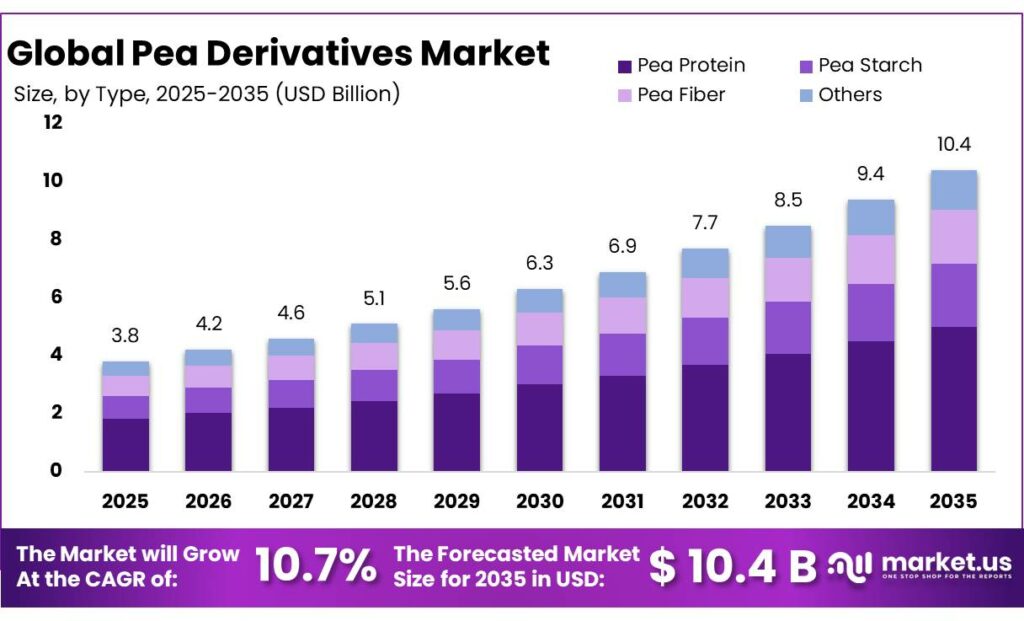
The Global Pea Derivatives Market size is expected to be worth around USD 10.4 Billion by 2035, from USD 3.8 Billion in 2025, growing at a CAGR of 10.7% during the forecast period from 2026 to 2035. In 2025, North America held a dominant market position, capturing more than a 36.9% share, holding USD 1.4 Billion revenue.
Pea derivatives refer to value-added ingredients such as pea protein isolates, concentrates, starches, hull fibres and cell-wall fibres produced mainly from yellow peas for food, beverage and nutrition applications. FAO notes that the major pulse groups, including dry peas, have shown long-term output growth, with major pulse categories rising by 16% to 58% over time, underlining a larger agricultural base for downstream ingredient processing.
The current industrial scenario shows a sector moving from commodity pulses toward specialized food ingredients. In the European Union, the arable sector supplied 64 million tonnes of crude plant protein in 2023-24, yet dry pulses accounted for only 1.1 million tonnes, while the bloc still imported plant-based products equal to 19 million tonnes of crude protein for food, feed and industrial use.
In North America, Agriculture and Agri-Food Canada reported Canadian packaged-food pea protein ingredient volumes at 2,442.9 tonnes in 2023, up from 1,817.3 tonnes in 2019, and projected them to reach 2,714.0 tonnes by 2027. U.S. packaged-food pea protein volumes were much larger at 25,171.1 tonnes in 2023 and are projected at 28,651.5 tonnes by 2027.
Demand conditions are also supportive. According to GFI, global retail sales of plant-based meat, seafood, milk, yogurt, ice cream, and cheese reached $28.6 billion in 2024, up 5% year on year, while the U.S. plant-based food retail market totaled $8.1 billion. In Europe, GFI Europe reported that Germany’s plant-based market across six categories reached €1.68 billion in 2024, France reached €537 million, and Italy reached €639 million.
Government and institutional support adds further momentum. India approved the Mission for Aatmanirbharta in Pulses to expand pulse area by an additional 35 lakh hectares, while the European Commission’s February 2025 Vision for Agriculture and Food and CAP-linked protein measures continue to encourage lower import dependency and stronger plant-protein value chains.
NutriPea entered Natural Products Expo West 2025 as an exhibitor at booth 398, while continuing to position itself around 40 years of specialization and four core yellow-pea ingredient lines: Propulse, Centara, Accu-Gel and Uptake 80.
Key Takeaways
- Pea Derivatives Market size is expected to be worth around USD 10.4 Billion by 2035, from USD 3.8 Billion in 2025, growing at a CAGR of 10.7%.
- Pea Protein held a dominant market position, capturing more than a 48.4% share.
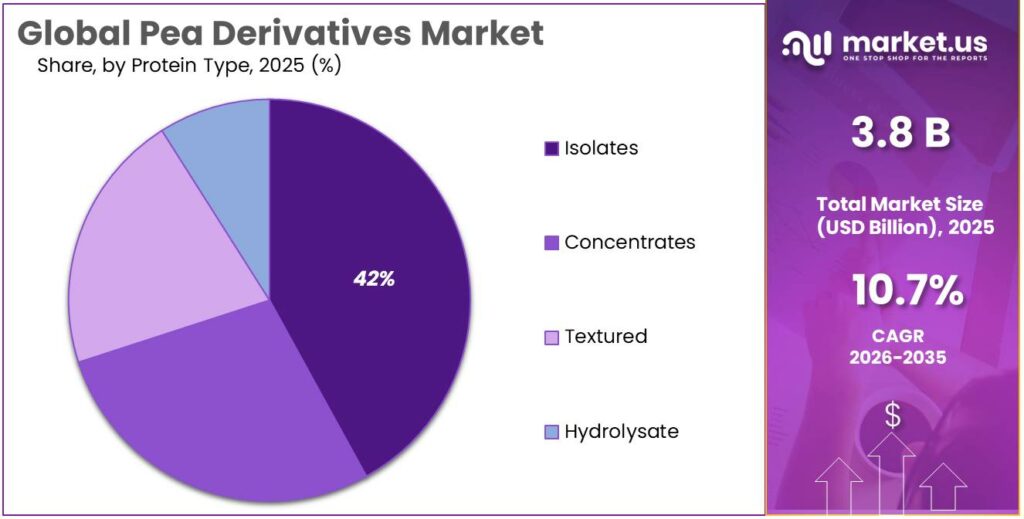
- Isolates held a dominant market position, capturing more than a 42.3% share.
- Meat Substitutes held a dominant market position, capturing more than a 32.5% share.
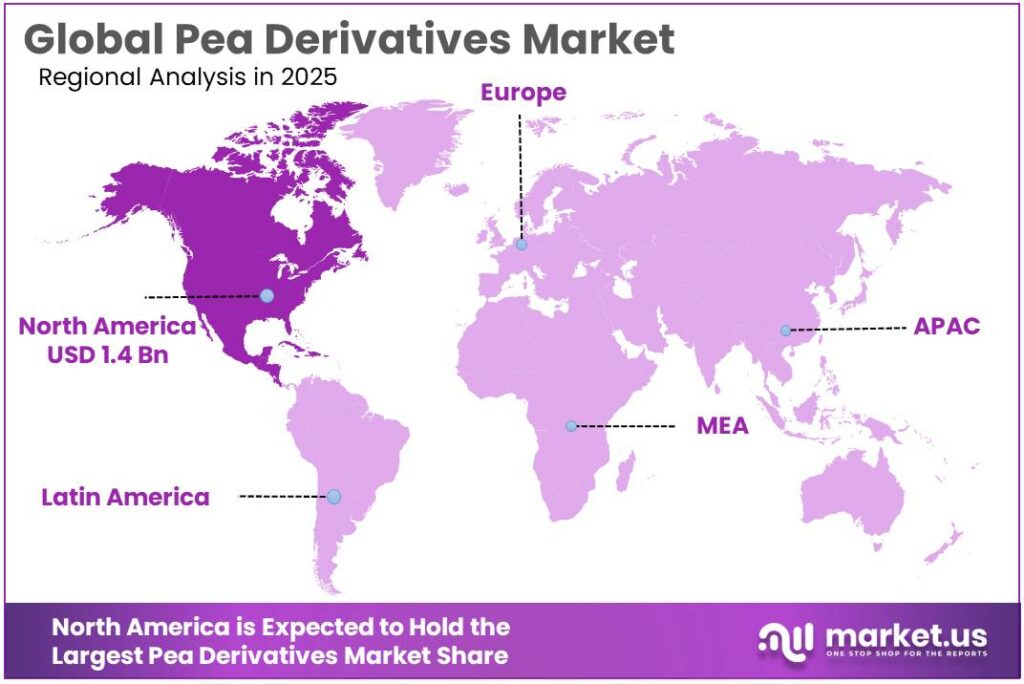
- North America held the dominant position in the global pea derivatives market, accounting for 36.9% of the total share and reaching around USD 1.4 billion.
By Type Analysis
Pea Protein leads the market with 48.4% as its wide use in food, beverages, and nutrition keeps demand strong.
In 2025, Pea Protein held a dominant market position, capturing more than a 48.4% share. This leading position was mainly supported by its strong demand across plant-based foods, dairy alternatives, sports nutrition, and clean-label packaged products. Food manufacturers continue to prefer pea protein because it offers a neutral taste, good texture support, and easy blending in a wide range of formulations. Its popularity is also growing among health-conscious consumers looking for allergen-friendly and vegan protein options.
By Protein Type Analysis
Isolates dominate with 42.3% as their high purity and broad use in nutrition products keep them in strong demand.
In 2025, Isolates held a dominant market position, capturing more than a 42.3% share. This segment remained ahead because isolates are widely preferred in applications where high protein concentration, low fat content, and better formulation consistency are important. Their strong use in sports nutrition, meal replacement powders, dairy alternatives, and protein-enriched snacks continues to support steady demand. Manufacturers also favor isolates for their smooth texture, easy solubility, and ability to improve the nutritional value of food and beverage products without significantly affecting taste.
By Application Analysis
Meat Substitutes lead with 32.5% as rising demand for plant-based protein foods continues to support strong adoption.
In 2025, Meat Substitutes held a dominant market position, capturing more than a 32.5% share. This segment continued to grow as consumers increasingly looked for plant-based alternatives that offer both nutrition and a meat-like eating experience. Pea derivatives are widely used in this application because they help improve texture, binding, moisture retention, and protein content in burgers, sausages, nuggets, and other meat-free products. Their neutral flavor profile and strong functional performance make them highly suitable for manufacturers developing clean-label and vegan food ranges.
Key Market Segments
By Type
- Pea Protein
- Pea Starch
- Pea Fiber
- Others
By Protein Type
- Isolates
- Concentrates
- Textured
- Hydrolysate
By Application
- Meat Substitutes
- Bakery Goods
- Dietary Supplements
- Beverages
- Others
Emerging Trends
Fermentation-led improvement in taste and texture is becoming the clearest trend
One of the latest trends in pea derivatives is the strong move toward better-tasting and better-performing ingredients, especially through fermentation and process improvement. For a long time, pea-based ingredients were accepted for nutrition, but taste and mouthfeel often held products back. That is now changing. The same report also highlighted that companies are increasingly using process optimization and fermentation partnerships to improve quality and reduce costs.
The trend is not just about product development in labs. It is being supported by public money and policy direction as well. GFI reported that governments around the world announced about $510 million in new committed funding for alternative proteins in 2024, taking cumulative public commitments to around $2.1 billion. Out of this, fermentation technologies received $203 million, which for the first time moved ahead of some other alternative protein platforms in public support.
Pea ingredients are also moving into everyday food as public nutrition support grows
Another important trend is that pea derivatives are no longer seen only as specialty vegan ingredients. They are slowly becoming part of the wider conversation around daily nutrition, protein diversity, and healthier food design. The Scientific Report of the 2025 Dietary Guidelines Advisory Committee recommended a higher intake of beans, peas, and lentils, increasing the suggested level from 1.5 cup-equivalents per week to 2.5 cup-equivalents per week in the Healthy U.S.-Style Dietary Pattern.
Retail data also shows that the market is broadening beyond one or two headline categories. In the U.S., the plant-based food retail market was worth $8.1 billion in 2024, and 59% of households purchased plant-based foods. GFI also reported meaningful growth in categories such as plant-based protein powders and liquids, bars, ready-to-drink beverages, tofu, tempeh, and seitan.
Drivers
Rising Demand for Plant-Based Meat Alternatives is a Major Growth Driver
One of the biggest driving factors for pea derivatives is the fast rise in plant-based meat and protein-rich food demand. A strong industry signal comes from the plant-based meat segment, where global demand for pea protein reached USD 1.6 billion in 2025 and is projected to grow to USD 4.5 billion by 2035.
Food manufacturers are also expanding pea-based product launches because pea ingredients are allergen-friendly and fit clean-label trends. In addition, the USDA reported that dry pea production increased by 23% in 2025, showing strong agricultural support for raw material supply and long-term ingredient availability.
Government and Sustainable Agriculture Support is Strengthening Supply Growth
Another major growth driver is the increasing support from governments and agriculture bodies for pulse farming and sustainable protein sources. Pea crops require less water and improve soil nitrogen levels, which makes them highly aligned with sustainable agriculture goals. A trusted example comes from the USDA’s 2025 outlook, which highlighted that dry pea output rose 23% year-over-year, supported by better yields and improved cultivation efficiency.
This increase in production is important because it reduces supply pressure for processors making pea starch, pea flour, and protein isolates. On the consumer side, the push for healthier diets is also helping. Research linked to the 2025–2030 Dietary Guidelines for Americans showed that 19.9% of the population consumed 1.5 cups of pulses per week, reflecting a gradual rise in pulse inclusion in everyday diets.
Restraints
Off-Flavor and Bitter Taste Challenges Remain a Major Restraining Factor
One of the biggest restraining factors for the pea derivatives market is the off-flavor profile, especially the beany, earthy, bitter, and chalky notes that can affect consumer acceptance. This remains a key challenge in food applications such as plant-based milk, protein beverages, yogurt alternatives, and nutritional powders where taste plays a direct role in repeat purchases.
Trusted food-sector sources continue to highlight this as a major barrier. The Good Food Institute (GFI) noted that off-flavors in plant proteins, including pea protein, remain one of the main reasons limiting wider use in meat, dairy, and egg alternatives.
Additional Processing Costs to Improve Taste Are Slowing Commercial Expansion
Another major restraint connected to the same issue is the extra cost burden created by flavor correction technologies. To reduce bitterness and aftertaste, food processors often rely on fermentation, enzymatic treatment, flavor masking systems, or advanced extrusion methods. Scientific studies on pea protein fermentation showed that targeted processing is required to reduce compounds such as hexanal, one of the main contributors to beany aroma.
A trusted numerical example again comes from the £1 million public-private innovation initiative in the UK, which reflects how much investment is now needed just to solve taste-related issues in pea-based ingredients. This means companies entering the pea derivatives space must spend more on R&D, sensory testing, and processing optimization before reaching commercial scale.
Opportunity
Expansion of Pulse-Based Functional Foods is Creating the Biggest Growth Opportunity
One of the strongest growth opportunities for pea derivatives is the rapid expansion of functional and everyday protein foods, especially products that fit health-focused diets. The 2025–2030 U.S. Dietary Guidelines Advisory Committee recommended increasing pulse intake from 1.5 cups to 2.5 cups per week, which gives food manufacturers a clear opportunity to expand pea-based ingredients into daily-use categories such as cereals, snack bars, dairy alternatives, soups, bakery mixes, and protein beverages.
The opportunity becomes even larger when we look at real consumption gaps. In the latest national intake findings, only 19.9% of the population reached 1.5 cups per week, while just 10.9% reached the newer 2.5 cups target. This large gap between recommended and actual intake creates a wide innovation space for manufacturers using pea flour, pea starch, and pea protein in easy-to-consume formats.
Government Nutrition Programs and Sustainable Farming Support Open New Demand Channels
Another major growth opportunity lies in government-backed food programs and sustainable agriculture initiatives. School and public feeding systems are increasingly moving toward plant-forward protein choices. Recent U.S. school meal data shows that the National School Lunch Program serves 29.4 million lunches daily, creating a very large institutional opportunity for pulse-based ingredients in soups, burgers, pasta, snacks, and blended meals.
From the farming side, sustainability adds another layer of opportunity. Research published in 2025 noted that pea cultivation can support biological nitrogen fixation of up to 150 kg N/ha, reducing fertilizer dependency and supporting climate-smart agriculture goals. This makes peas attractive not only to food companies but also to governments promoting low-input crop systems.
Regional Insights
North America dominated the Pea Derivatives Market with a 36.9% share, valued at USD 1.4 billion.
North America held the dominant position in the global pea derivatives market, accounting for 36.9% of the total share and reaching around USD 1.4 billion. The region’s leadership is mainly driven by the United States and Canada, where demand for plant-based foods, protein-fortified beverages, meat substitutes, and functional nutrition products continues to rise steadily. Industry data shows the U.S. plant-based food market reached USD 8.1 billion, highlighting the strong commercial base that supports higher use of pea protein, starch, and fiber in mainstream food products.
Canada further strengthens the regional supply chain through its strong pulse farming advantage. As one of the world’s leading yellow pea producers, the country ensures consistent raw material availability for derivative manufacturers, especially for isolates, starches, and flours. This supply-side strength reduces sourcing risks and supports stable processing economics across North America.
Key Regions and Countries Insights
- North America
- US
- Canada
- Europe
- Germany
- France
- The UK
- Spain
- Italy
- Rest of Europe
- Asia Pacific
- China
- Japan
- South Korea
- India
- Australia
- Rest of APAC
- Latin America
- Brazil
- Mexico
- Rest of Latin America
- Middle East & Africa
- GCC
- South Africa
- Rest of MEA
Key Players Analysis
Nutri-Pea remains a recognized specialist in yellow pea protein and derivative ingredients, with a strong presence in North America’s plant-based nutrition supply chain. The company’s strength comes from its vertically integrated sourcing model linked to Canadian pea cultivation, helping maintain steady raw material quality. Industry estimates indicate North America contributes nearly 32% of global pea protein demand, which supports Nutri-Pea’s strong regional relevance.
Roquette Frères is one of the most dominant players in pea derivatives, supported by one of the largest dedicated pea protein investments globally. The company invested over CAD 400 million in its Manitoba processing facility, significantly strengthening its supply capacity for North America and export markets. With the broader pea derivatives industry crossing USD 4.0 billion in 2025, Roquette’s manufacturing scale and R&D depth continue to keep it among the top market leaders.
PURIS continues to stand out as a major U.S.-based pea ingredient innovator, especially in non-GMO pea protein and starch solutions. Its ingredients are widely used in meat alternatives, dairy-free beverages, and protein powders. In 2025, with the U.S. plant-based food market exceeding USD 8.1 billion, PURIS remains well positioned to capture growth from mainstream food manufacturers expanding plant-based product lines.
Top Key Players Outlook
- International Flavors & Fragrances Inc.
- Nutri-Pea
- COSCURA
- Roquette Frères
- PURIS
- Burcon
- Shandong Jianyuan Group
- SOTEXPRO
- The Scoular Company
- FENCHEM
- The Green Labs LLC
Recent Industry Developments
In 2025, Roquette Frères remained one of the strongest companies in the pea derivatives sector, mainly through its NUTRALYS® range of pea protein ingredients used in meat alternatives, dairy-free products, beverages, and specialized nutrition. The company’s scale is a major advantage. Roquette reported €4.9 billion in turnover in 2025, with €612 million in current EBITDA, showing that it has the financial strength to keep expanding its plant-based ingredient business.
In 2025, PURIS continued to strengthen its position in the pea derivatives sector through its broad ingredient platform covering pea protein, pea starch & syrup, pea fiber, textured & extruded proteins, and organic pulse ingredients—a 5-category derivatives portfolio that gives it strong reach across food applications. The company’s ingredient use is highly diversified, supporting beverages, non-dairy products, cereal & snacks, alternative meat, pet food, and industrial applications, which reflects deep penetration into both mainstream and emerging plant-based categories. PURIS also highlights that it has been operating since 1985, giving it 40 years of plant-based ingredient expertise in 2025.
Report Scope
Report Features Description Market Value (2025) USD 3.8 Bn Forecast Revenue (2035) USD 10.4 Bn CAGR (2026-2035) 10.7% Base Year for Estimation 2025 Historic Period 2020-2024 Forecast Period 2026-2035 Report Coverage Revenue Forecast, Market Dynamics, Competitive Landscape, Recent Developments Segments Covered By Type (Pea Protein, Pea Starch, Pea Fiber, Others), By Protein Type (Isolates, Concentrates, Textured, Hydrolysate), By Application (Meat Substitutes, Bakery Goods, Dietary Supplements, Beverages, Others) Regional Analysis North America – US, Canada; Europe – Germany, France, The UK, Spain, Italy, Rest of Europe; Asia Pacific – China, Japan, South Korea, India, Australia, Singapore, Rest of APAC; Latin America – Brazil, Mexico, Rest of Latin America; Middle East & Africa – GCC, South Africa, Rest of MEA Competitive Landscape International Flavors & Fragrances Inc., Nutri-Pea, COSCURA, Roquette Frères, PURIS, Burcon, Shandong Jianyuan Group, SOTEXPRO, The Scoular Company, FENCHEM, The Green Labs LLC Customization Scope Customization for segments, region/country-level will be provided. Moreover, additional customization can be done based on the requirements. Purchase Options We have three licenses to opt for: Single User License, Multi-User License (Up to 5 Users), Corporate Use License (Unlimited User and Printable PDF) 
-
-
- International Flavors & Fragrances Inc.
- Nutri-Pea
- COSCURA
- Roquette Frères
- PURIS
- Burcon
- Shandong Jianyuan Group
- SOTEXPRO
- The Scoular Company
- FENCHEM
- The Green Labs LLC
Our Clients

- 182904
- Mar 2026






