


Global Organic Baby Shampoo Market Size, Share, Growth Analysis By Type (Below 500ml, Above 500ml), By Product (Liquid Shampoo, Foam Shampoo, Bar Shampoo), By Distribution Channel (Hypermarket & Supermarket, Pharmacies & Drug Stores, E-commerce, Others), By Region and Companies - Industry Segment Outlook, Market Assessment, Competition Scenario, Statistics, Trends and Forecast 2026-2035
- Published date: Mar 2026
- Report ID: 180144
- Number of Pages: 260
- Format:
-
keyboard_arrow_up
Quick Navigation
Report Overview
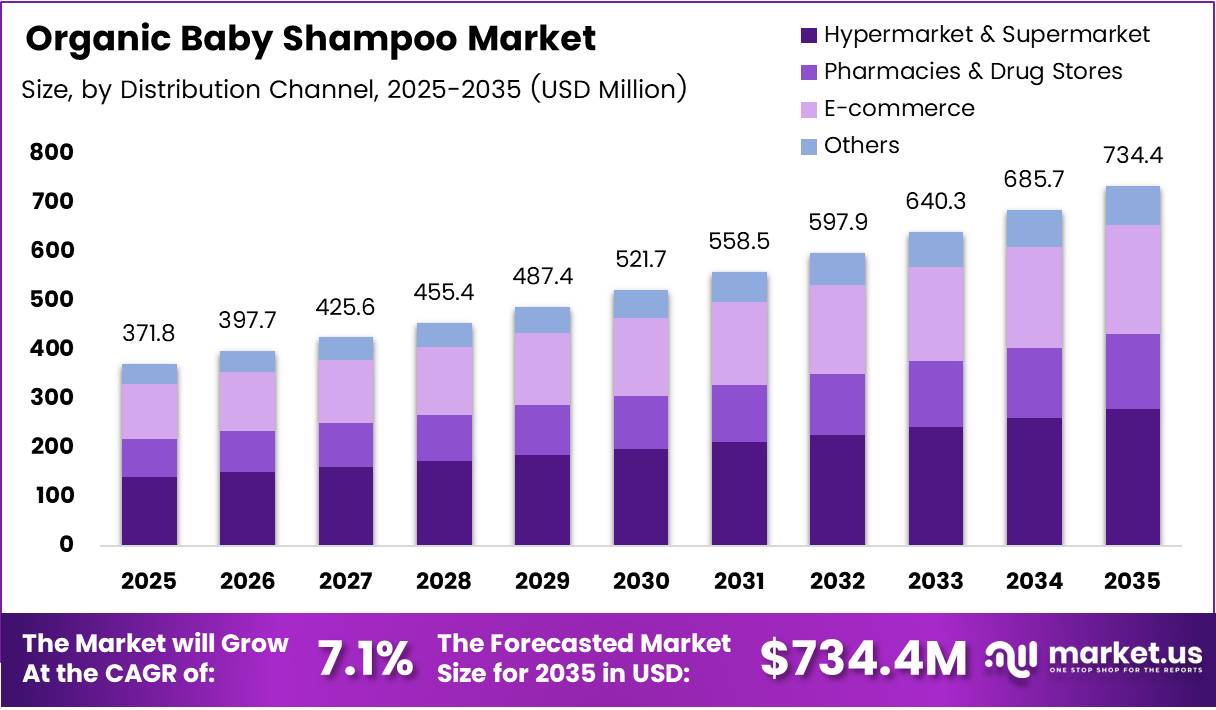
Global Organic Baby Shampoo Market size is expected to be worth around USD 734.4 Million by 2035 from USD 371.8 Million in 2025, growing at a CAGR of 7.1% during the forecast period 2026 to 2035.
The organic baby shampoo market covers gentle, plant-derived cleansing products formulated specifically for infant scalp and hair care. These products exclude synthetic surfactants, artificial fragrances, and chemical preservatives. Manufacturers reformulate using botanical extracts, certified organic oils, and hypoallergenic ingredients to meet pediatric safety standards.
Millennial parents now treat baby personal care as a health decision, not a routine purchase. This shift changes where buying decisions happen — from pharmacy shelves to online research, parenting forums, and pediatrician recommendations. Brands that secure clinical endorsements and third-party organic certifications convert this scrutiny into lasting purchase loyalty.
Regulatory momentum reinforces buyer behavior. The European Union has banned or restricted over 1,300 chemicals from cosmetic products due to potential health risks, according to the European Commission. This regulatory benchmark sets expectations globally — and brands operating across both EU and US markets must now reformulate or lose shelf access in high-value regions.
Government standards act as a market filter, not just a compliance hurdle. Brands holding EU-compliant or USDA Organic certifications use these credentials as differentiation tools in retail and DTC channels. For market entrants, the cost of certification creates a real barrier — but also protects established organic players from low-cost generic competition.
According to the Environmental Working Group, about 60% of parents in the United States actively avoid products containing parabens, phthalates, or similar chemicals when purchasing baby personal care products. This behavior signals that chemical avoidance has become a baseline buying criterion — not a niche preference — which compresses demand for conventional baby shampoo and redirects it toward certified organic alternatives.
According to the National Institutes of Health, infant skin is around 20–30% thinner than adult skin, increasing susceptibility to irritation from surfactants and chemicals in cleansing products. This physiological fact gives organic baby shampoo its core product rationale — thinner skin absorbs more and tolerates less, making every ingredient choice clinically relevant and commercially defensible.
Key Takeaways
- The Global Organic Baby Shampoo Market is valued at USD 371.8 Million in 2025 and is forecast to reach USD 734.4 Million by 2035.
- The market advances at a CAGR of 7.1% over the forecast period 2026 to 2035.
- By Type, the Below 500ml segment dominates with a 76.3% market share in 2025.
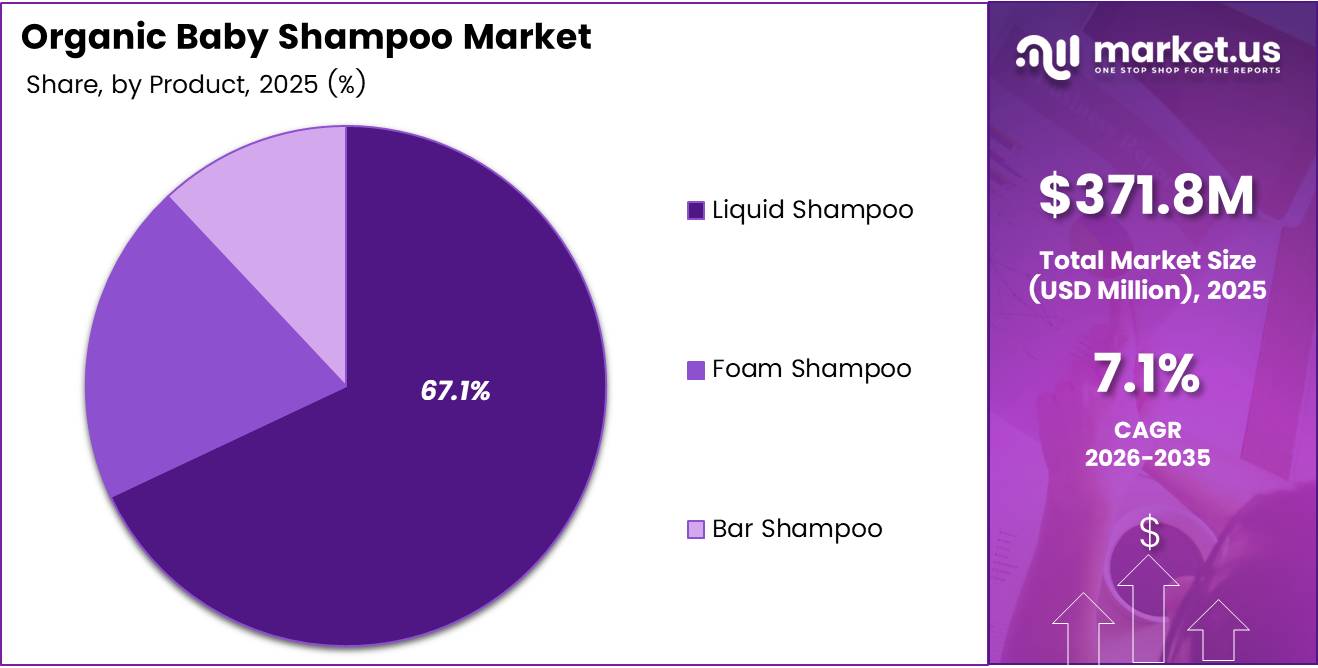
- By Product, Liquid Shampoo leads with a 67.1% share, reflecting strong preference for rinse-ready formulations.
- By Distribution Channel, Hypermarket and Supermarket holds the top position with a 37.9% share.
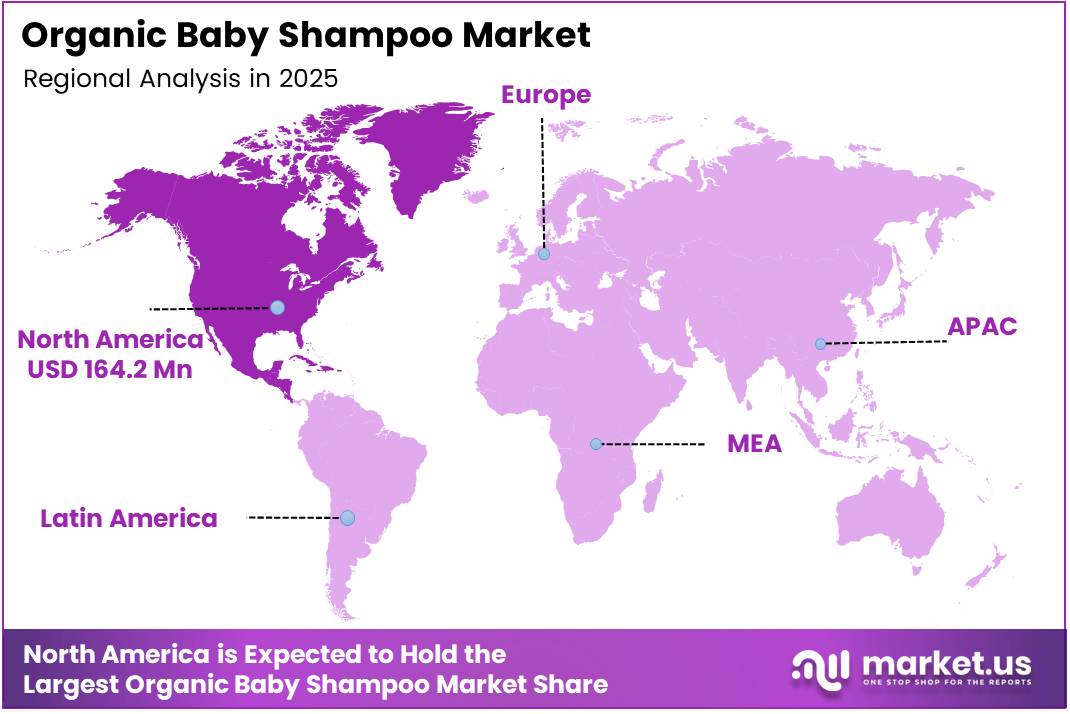
- North America leads all regions with a 44.20% share, valued at USD 164.2 Million in 2025.
Type Analysis
Below 500ml dominates with 76.3% due to trial-friendly sizing and retail convenience.
In 2025, Below 500ml held a dominant market position in the By Type segment of the Organic Baby Shampoo Market, with a 76.3% share. Parents treat infant skincare purchases as iterative — they test new organic formulations before committing to bulk quantities. Smaller pack sizes reduce financial risk per trial, accelerating new brand adoption and keeping repeat purchase cycles shorter.
Above 500ml serves repeat buyers who have already validated a formulation’s safety and efficacy. This segment carries stronger per-unit margins for manufacturers, but its growth depends on brand trust built through smaller-pack trial cycles. Consequently, brands that dominate the Below 500ml entry point typically convert a measurable share of buyers into higher-volume repurchase behavior.
Product Analysis
Liquid Shampoo dominates with 67.1% due to rinse-ease and broad retail availability.
In 2025, Liquid Shampoo held a dominant market position in the By Product segment of the Organic Baby Shampoo Market, with a 67.1% share. Liquid formats align with established parent bathing routines and require no behavioral change to adopt. Additionally, they allow manufacturers to incorporate water-soluble botanical actives at precise concentrations, supporting both product efficacy and organic certification compliance.
Foam Shampoo differentiates through lower active-ingredient concentration per application, which appeals to parents managing very young infants with sensitive scalps. The pre-foamed format reduces direct scalp contact with undiluted surfactants, positioning it as a premium safety-first option. However, its higher per-use cost limits penetration in price-sensitive segments. The September 2025 launch of The Honest Company’s Disney-themed 2-in-1 shampoo and body wash — a dermatologist-tested, fragrance-free formulation — illustrates how foam-format innovation can drive incremental category volume.
Bar Shampoo carries the highest sustainability perception within the product segment, resonating with eco-focused parents who actively reduce single-use plastic. However, bar formats remain a small share of the market due to limited familiarity with application technique for infants and inconsistent retail shelf presence. Their growth trajectory depends on sustained packaging innovation and targeted DTC distribution.
Distribution Channel Analysis
Hypermarket and Supermarket dominates with 37.9% due to trial-purchase accessibility and high foot traffic.
In 2025, Hypermarket and Supermarket held a dominant market position in the By Distribution Channel segment of the Organic Baby Shampoo Market, with a 37.9% share. Physical retail allows first-time parents to evaluate label claims, scan certifications, and compare organic alternatives side-by-side — a decision process that drives conversion at shelf. Moreover, placement in mainstream supermarkets signals category legitimacy to cautious first-time buyers.
Pharmacies and Drug Stores carry a structural credibility advantage — parents associate pharmacy environments with clinical rigor and dermatologist-endorsed products. This channel captures a quality-seeking buyer who prioritizes safety credentials over price. According to the American Academy of Pediatrics, mild, low-irritant cleansers help maintain the skin barrier and reduce dryness compared with traditional soap products — a recommendation that pharmacy staff actively relay to new parents, reinforcing category demand in this channel.
E-commerce enables organic baby shampoo brands to reach buyers outside traditional retail geographies. Subscription models, detailed ingredient transparency, and peer review ecosystems remove the trial barriers that constrain brick-and-mortar conversion. Furthermore, DTC e-commerce allows brands to capture first-party data on repurchase patterns, enabling personalized retention campaigns that strengthen lifetime customer value.
Others — including specialty baby stores, health food retailers, and direct brand boutiques — serve a high-intent buyer segment that seeks curated organic assortments rather than mass-market variety. While this channel represents a smaller volume share, it delivers premium pricing power and strong brand association. Brands positioned in specialty retail often use these outlets to test new formulations before committing to broader distribution.
Key Market Segments
By Type
- Below 500ml
- Above 500ml
By Product
- Liquid Shampoo
- Foam Shampoo
- Bar Shampoo
By Distribution Channel
- Hypermarket & Supermarket
- Pharmacies & Drug Stores
- E-commerce
- Others
Drivers
Parental Chemical Avoidance, E-Commerce Access, and Regulatory Certification Standards Collectively Push Organic Baby Shampoo Adoption
Parental concern about synthetic chemicals has moved from a fringe preference to a documented purchasing behavior. According to the Centers for Disease Control and Prevention, approximately 13% of children in the United States have been diagnosed with eczema — a condition that heightens sensitivity to harsh soaps and shampoos. This clinical reality gives parents a concrete, medically grounded reason to choose certified organic formulations over conventional alternatives.
Millennial parents with higher disposable incomes treat organic certification as a purchasing prerequisite, not a premium upgrade. This buyer profile actively researches ingredient lists, seeks pediatrician endorsements, and participates in parenting communities where product recommendations spread quickly. In March 2025, Princess Madeleine of Sweden partnered with Weleda to launch “minLen,” a natural family skincare brand including baby shampoo — demonstrating how high-profile endorsements translate parental values into brand credibility and accelerate market entry.
E-commerce channels remove geographic constraints that previously limited premium organic brands to urban specialty stores. Global digital distribution enables small certified producers to compete directly with multinational brands. Moreover, strengthening regulatory standards — particularly the EU’s requirement that cosmetics clear a documented safety assessment process — create certification-based market barriers that reward organic-first brands and restrict low-quality generic entrants.
Restraints
Premium Price Points and Certified Ingredient Sourcing Constraints Limit Market Reach in Cost-Sensitive Segments
Organic baby shampoo commands a price premium that creates a hard ceiling for adoption in price-sensitive households. Consumers in emerging markets and lower-income segments cannot consistently prioritize certified organic products when conventional alternatives cost a fraction of the price. This price gap is not a perception problem — it reflects genuine cost structures driven by certified organic ingredient procurement and third-party compliance processes.
Supply chain fragility compounds the pricing challenge. Certified organic botanical ingredients depend on limited agricultural sources, seasonal crop yields, and strict contamination protocols. Any disruption — drought, contamination event, or certification withdrawal — forces manufacturers to reformulate or absorb cost increases. These supply risks make consistent organic formulation more difficult to scale without either raising prices or diluting certification standards.
Both restraints reinforce each other. Higher sourcing costs push retail prices up, which narrows the addressable buyer pool. A narrower buyer pool limits production volumes, which prevents manufacturers from achieving the economies of scale needed to reduce costs. Breaking this cycle requires either sustained volume growth in premium markets or targeted government subsidy programs for organic ingredient agriculture — neither of which is guaranteed in the near term.
Growth Factors
Multi-Functional Formulations, Pediatrician Partnerships, and Eco-Packaging Open New Revenue Pathways for Organic Baby Shampoo Brands
Multi-functional product development creates meaningful revenue expansion without requiring new customer acquisition. A 2-in-1 shampoo and body wash formulation, for example, consolidates two SKUs into one purchase, increases per-transaction value, and reduces parent decision fatigue. According to the National Institutes of Health, mothers used an average of 3–5 different baby care products daily during the infant stage — a usage pattern that signals strong appetite for bundled or multi-use organic solutions.
Partnerships between organic baby shampoo brands and pediatricians accelerate trust-building in ways that advertising cannot replicate. When a pediatrician recommends a specific formulation, conversion rates and purchase loyalty both increase significantly. Brands that embed themselves into clinical recommendation pathways — through pediatric dermatology partnerships, hospital gifting programs, or AAP-aligned communication — access a high-credibility channel that also serves as a durable competitive moat.
Eco-friendly packaging directly addresses a buyer priority that sits alongside ingredient safety for sustainability-conscious parents. Brands adopting refillable containers, recycled materials, or reduced-plastic formats attract a segment that would otherwise choose between organic formulation and sustainability values. In October 2024, Burt’s Bees announced that its Baby Bee line now contains 100% natural fragrances and is dermatologist-tested — combining ingredient safety with natural positioning to strengthen its appeal across both value dimensions simultaneously.
Emerging Trends
Clean-Label Specificity, DTC Subscription Models, and Botanical Ingredient Innovation Reshape Competitive Positioning in Organic Baby Shampoo
Fragrance-free and hypoallergenic claims now function as product differentiators rather than baseline expectations. According to the Environmental Working Group, nearly 80% of Americans express concern about chemicals in everyday personal care products and support stronger safety regulations. For baby shampoo specifically, this concern converts directly into purchasing behavior — parents who associate fragrance with hidden chemicals actively filter product selections by fragrance-free and hypoallergenic labels, reshaping shelf assortments across both mass and specialty retail.
DTC subscription models change the economics of customer retention in this market. Instead of competing for repeat purchases at retail shelf level, brands using subscription lock in predictable revenue, reduce dependence on retail intermediaries, and build direct consumer relationships. Subscription data also enables precise product refinement based on real repurchase behavior. In February 2025, The Honest Company reported full year 2024 results highlighting growth in its baby personal care segment and expanded consumption in digital channels — a direct indicator of subscription-driven DTC momentum.
Ayurvedic and botanical ingredient positioning attracts a growing buyer segment that connects ingredient origin with cultural authenticity and clinical effectiveness. Ingredients such as neem, tulsi, and brahmi carry established herbal safety profiles that resonate in both South Asian diaspora markets and Western wellness-oriented consumer segments. This dual cultural and functional appeal gives brands using botanical formulations a differentiated narrative that mass-market organic labels cannot easily replicate.
Regional Analysis
North America Dominates the Organic Baby Shampoo Market with a Market Share of 44.20%, Valued at USD 164.2 Million
North America leads with a 44.20% share valued at USD 164.2 Million, driven by mature e-commerce infrastructure, high millennial parent disposable income, and active ingredient regulatory advocacy. The region’s established parenting culture around chemical transparency — reinforced by organizations like the Environmental Working Group — creates a sustained demand base for certified organic baby care products at premium price points.
Europe Organic Baby Shampoo Market Trends
Europe benefits from the EU’s stringent cosmetics regulatory framework, which bans or restricts over 1,300 chemicals from personal care products. This environment elevates consumer trust in certified organic formulations and raises the baseline standard for all market participants. Germany, France, and the UK anchor regional demand, while Scandinavia contributes above-average per-capita spend on organic and natural baby care categories.
Asia Pacific Organic Baby Shampoo Market Trends
Asia Pacific presents the largest volume expansion opportunity, supported by rising urban birth rates in India and Southeast Asia, combined with a rapidly expanding middle-class parent segment in China. Consumer Reports found that 48% of U.S. consumers prioritize natural ingredients in personal care — a preference mirroring trends emerging across urban Asia Pacific markets, where product safety concerns following past contamination incidents drive organic certification demand.
Middle East and Africa Organic Baby Shampoo Market Trends
The Middle East and Africa market develops unevenly, with GCC countries — particularly the UAE and Saudi Arabia — leading adoption through premium retail channels and growing expatriate consumer bases. High birth rates across Sub-Saharan Africa create a structural long-term volume opportunity, but price sensitivity and limited certified organic distribution infrastructure constrain near-term penetration outside Gulf urban markets.
Latin America Organic Baby Shampoo Market Trends
Latin America advances through Brazil and Mexico, where urban middle-class parents increasingly align purchasing decisions with global wellness trends. Brazil’s sizeable domestic cosmetics manufacturing base and growing ANVISA regulatory framework support local organic formulation development. However, currency volatility and import cost exposure continue to limit the reach of premium international organic baby shampoo brands across the broader region.
Key Regions and Countries
North America
- US
- Canada
Europe
- Germany
- France
- The UK
- Spain
- Italy
- Rest of Europe
Asia Pacific
- China
- Japan
- South Korea
- India
- Australia
- Rest of APAC
Latin America
- Brazil
- Mexico
- Rest of Latin America
Middle East & Africa
- GCC
- South Africa
- Rest of MEA
Key Company Insights
Johnson & Johnson Services, Inc. anchors its organic and gentle baby care positioning through scale advantages no challenger brand can replicate. Its global retail footprint, clinical heritage, and pediatric dermatology relationships give it shelf placement and prescription channel access simultaneously. However, its dual presence in mass-market and premium organic tiers creates brand clarity challenges as consumers demand cleaner formulations with verifiable certification credentials.
The Clorox Company competes in this market primarily through its natural and organic personal care portfolio, using its distribution scale to place products in mainstream retail channels that organic-only brands cannot access efficiently. Its strategic positioning bridges the gap between mass-market availability and natural ingredient messaging — a competitive advantage in households that want cleaner products but buy primarily through grocery and club store formats.
Himalaya Wellness Company leverages Ayurvedic formulation heritage as its core differentiation strategy in the organic baby care segment. Its botanical ingredient sourcing, combined with clinical safety testing, addresses both the ingredient transparency and efficacy demands of modern parents. In February 2025, The Honest Company’s reported growth in digital channel consumption reflects a pattern Himalaya mirrors through its own expanding e-commerce presence in South and Southeast Asian markets.
Unilever operates in organic baby shampoo through portfolio brands that span natural, certified organic, and sustainability-positioned product lines. Its advantage lies in supply chain depth — Unilever’s sustainable sourcing infrastructure reduces certified organic ingredient procurement risk at a scale smaller brands cannot achieve. However, its portfolio breadth also means organic baby care competes internally for investment allocation against higher-margin adult personal care categories.
Key players
- Johnson & Johnson Services, Inc.
- The Clorox Company
- Himalaya Wellness Company
- Unilever
- Galderma Laboratories, L.P.
- Earth Mama Organics
- Pigeon Corporation
- Beiersdorf AG
Recent Developments
- April 2025 – Weleda announced strategic expansion plans in its 2024 sustainability report, setting the stage for new product line launches in 2025 focused on natural and holistic cosmetics, including baby care categories. These updates signal Weleda’s commitment to scaling its certified natural portfolio across key international markets.
- August 2024 – The Honest Company unveiled a bilingual baby product line featuring culturally inspired packaging, including baby shampoos and washes, broadening its portfolio presence across major U.S. retail channels. This launch targets multicultural parent segments, expanding the brand’s addressable market within domestic retail.
- October 2024 – Burt’s Bees announced that its Baby Bee line of baby care products now contains 100% natural fragrances and is dermatologist-tested, reinforcing its positioning in the natural baby care space. This reformulation directly addresses fragrance-free and clean-label buyer criteria increasingly prioritized by safety-conscious parents.
Report Scope
Report Features Description Market Value (2025) USD 371.8 Million Forecast Revenue (2035) USD 734.4 Million CAGR (2026-2035) 7.1% Base Year for Estimation 2025 Historic Period 2020-2024 Forecast Period 2026-2035 Report Coverage Revenue Forecast, Market Dynamics, Competitive Landscape, Recent Developments Segments Covered By Type (Below 500ml, Above 500ml), By Product (Liquid Shampoo, Foam Shampoo, Bar Shampoo), By Distribution Channel (Hypermarket & Supermarket, Pharmacies & Drug Stores, E-commerce, Others) Regional Analysis North America (US and Canada), Europe (Germany, France, The UK, Spain, Italy, and Rest of Europe), Asia Pacific (China, Japan, South Korea, India, Australia, and Rest of APAC), Latin America (Brazil, Mexico, and Rest of Latin America), Middle East & Africa (GCC, South Africa, and Rest of MEA) Competitive Landscape Johnson & Johnson Services, Inc., The Clorox Company, Himalaya Wellness Company, Unilever, Galderma Laboratories, L.P., Earth Mama Organics, Pigeon Corporation, Beiersdorf AG Customization Scope Customization for segments, region/country-level will be provided. Moreover, additional customization can be done based on the requirements. Purchase Options We have three licenses to opt for: Single User License, Multi-User License (Up to 5 Users), Corporate Use License (Unlimited User and Printable PDF)  Organic Baby Shampoo MarketPublished date: Mar 2026add_shopping_cartBuy Now get_appDownload Sample
 -
-
- Johnson & Johnson Services, Inc.
- The Clorox Company
- Himalaya Wellness Company
- Unilever
- Galderma Laboratories, L.P.
- Earth Mama Organics
- Pigeon Corporation
- Beiersdorf AG
Our Clients

- 180144
- Mar 2026






