


Report Overview
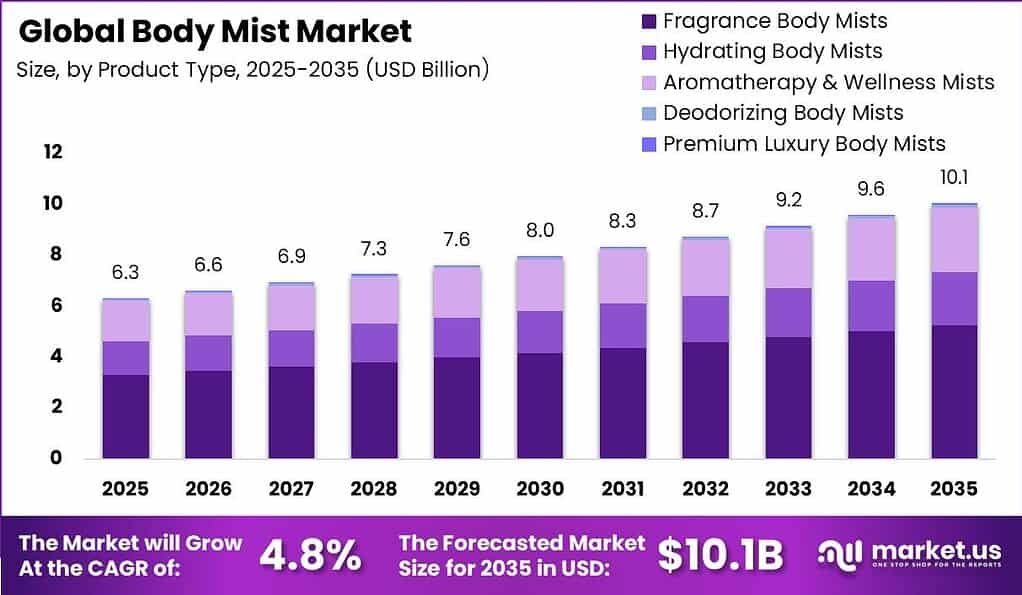
Global Body Mist Market size is expected to be worth around USD 10.1 Billion by 2035 from USD 6.3 Billion in 2025, growing at a CAGR of 4.8% during the forecast period 2026 to 2035. This steady climb reflects a shift in how consumers treat scent. Buyers now use body mists for daily layering rather than occasional wear. This creates a reliable, repeat-purchase revenue base for brands.
Therefore, the Body Care Products Market increasingly treats body mist as a core daily category. Body mist sits between fine perfume and functional skincare in structure. Brands formulate lighter, re-sprayable products at accessible price points. This positioning lets manufacturers sell higher volumes without premium flacon costs. This means the category grows through frequency and basket size rather than single high-value purchases.
Key Takeaways
- Global Body Mist Market size will reach USD 10.1 Billion by 2035, up from USD 6.3 Billion in 2025.
- The market grows at a CAGR of 4.8% across the 2026 to 2035 forecast window.
- Fragrance Body Mists lead product type with a 52.40% share.
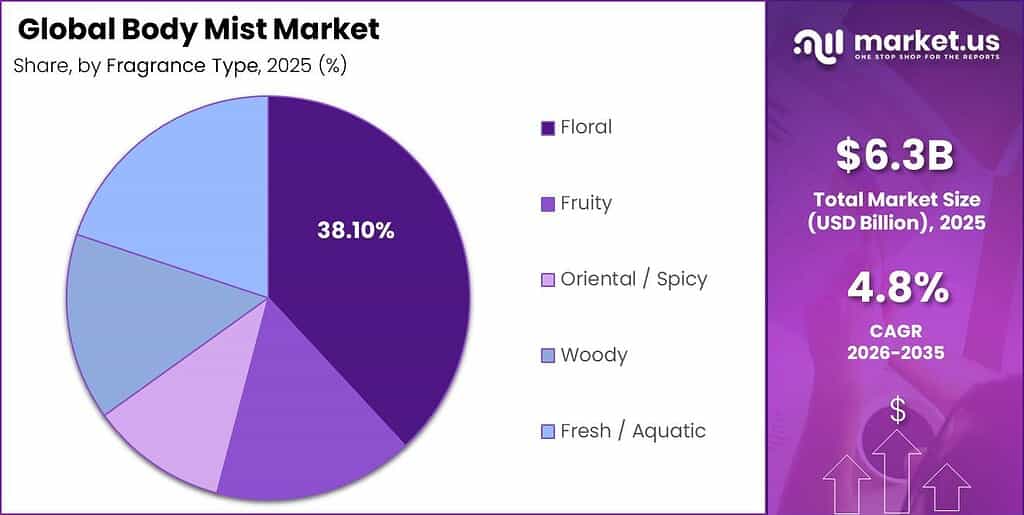
- Floral leads fragrance type with a 38.10% share.
- Women dominate end users with a 71.60% share.
- Mass-Market and Economy leads price range with a 44.90% share.
- Offline Retail holds a 58.70% share of distribution.
- Spray Bottles dominate packaging with a 76.20% share.
- Synthetic Fragrances lead ingredient type with a 61.40% share.
- Daily Personal Use leads applications with a 64.80% share.
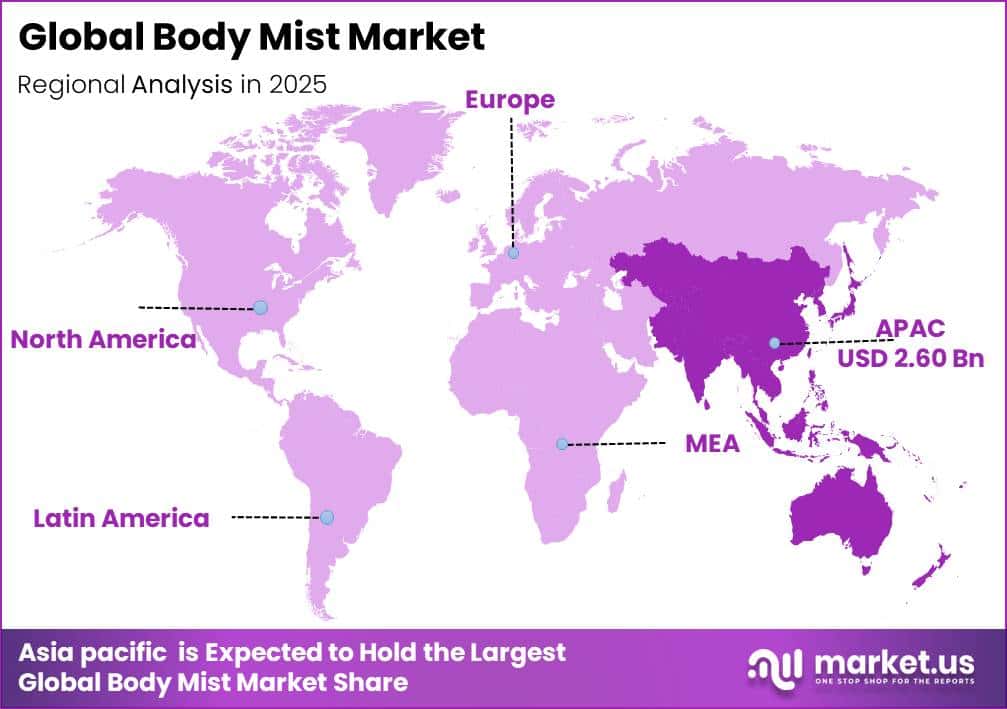
- Asia-Pacific leads regionally with a 41.20% share, valued at USD 2.60 Billion.
Government bodies now tighten fragrance labeling and volatile organic compound rules across major markets. These regulations push brands toward cleaner, compliant formulations before selling leave-on sprays. As a result, manufacturers that invest early in reformulation protect their shelf access in regulated regions.
As per our research, body sprays and mists increased their share of fragrance unit sales from 7% to 12% over three years. This near doubling shows mass buyers trading down from costly perfumes. This means brands can capture volume share by leading with affordable daily scent alternatives. Meanwhile, formulations in 2025 to 2026 now reach up to 12% fragrance oil concentration. This strength approaches eau de toilette levels and lets mists compete directly on performance.
Product Type Analysis
Fragrance Body Mists dominates with 52.40% due to affordable everyday scent positioning.
In 2025, Fragrance Body Mists held a dominant market position in the By Product Type segment of Body Mist Market, with a 52.40% share. UN Comtrade data shows global trade in perfumery and toilet preparations under HS code 3303 exceeds USD 20 Billion annually. This scale confirms deep raw-material supply for scent-led mists. This means brands can source concentrate at stable cost and defend margins across volume launches.
Hydrating Body Mists serve buyers who want scent plus light skin benefits in one spray. FAO trade records show glycerin, a common humectant, moves in volumes above 2 Million tonnes globally each year. This steady humectant supply supports mass hydrating formulations. This creates a low-cost route for brands to upsell functional variants at higher prices.
Aromatherapy and Wellness Mists target relaxation-focused users, while Deodorizing Body Mists appeal to freshness-seeking daily buyers. World Bank consumer-spending indicators show personal-care outlays rising across emerging economies since 2022. This spending lift widens the buyer pool for both niches. This means brands can test wellness and deodorizing claims in growth markets first. Premium Luxury Body Mists hold the remaining share collectively, serving aspirational buyers seeking designer scent at lower entry cost.
Fragrance Type Analysis
Floral dominates with 38.10% due to broad cross-demographic scent appeal.
In 2025, Floral held a dominant market position in the By Fragrance Type segment of Body Mist Market, with a 38.10% share. UN Comtrade figures show essential oils under HS code 3301, including floral extracts, trade above USD 3 Billion yearly. This robust floral-input flow anchors mass production. This means brands can scale floral lines quickly without ingredient shortages.
Fruity scents attract younger buyers seeking playful, sweet profiles for daily wear. ITC Trade Map records show citrus and fruit aroma chemical flows concentrated in Europe and Asia. This sourcing base supports rapid fruity launches near demand centers. This creates faster route-to-shelf for brands chasing Gen Z buyers.
Oriental and Spicy profiles serve evening and special-occasion buyers, while Woody scents attract unisex and mature users. National statistical offices report fragrance consumption climbing across Middle East markets where warm scents perform strongly. This regional taste supports niche placement. This means brands can localize spicy and woody lines for specific climates. Fresh and Aquatic profiles hold the remaining share collectively, appealing to buyers who prefer clean, light daily scent.
End User Analysis
Women dominates with 71.60% due to established daily fragrance habits.
In 2025, Women held a dominant market position in the By End User segment of Body Mist Market, with a 71.60% share. World Bank data shows women drive a majority of household personal-care spend across most economies. This spending pattern locks in a large, repeat buyer base. This means brands should anchor core ranges around female scent preferences first.
Teenagers buy body mists as an affordable entry into fragrance before premium perfume. ITU digital-adoption figures show teen social-media use exceeding 90% in many developed markets. This connectivity fuels scent discovery through influencers. This creates a direct channel for brands to convert young viewers into first-time buyers.
Men increasingly enter the mist category for grooming and daily freshness routines. Unisex Users hold the remaining share collectively, choosing gender-neutral scents for shared or minimalist preferences. National statistical offices report male grooming spend rising steadily across urban markets since 2022. This shift widens the total addressable base. This means brands that launch clear male and unisex lines can capture underserved demand early.
Price Range Analysis
Mass-Market Economy dominates with 44.90% due to high price-sensitive volume demand.
In 2025, Mass-Market and Economy held a dominant market position in the By Price Range segment of Body Mist Market, with a 44.90% share. World Bank inflation data shows consumers trading down in discretionary categories during recent cycles. This behavior pushes buyers toward cheaper daily scent. This means value-led brands can capture switchers exiting premium perfume tiers.
Mid-Range products bridge affordability and quality for buyers wanting better scent longevity. IMF household-consumption data shows a growing middle-income segment across Asia-Pacific economies. This income growth lifts mid-tier demand. This creates room for brands to upsell buyers from economy into mid-range lines.
Premium products target buyers seeking stronger concentration and refined packaging. Luxury and Designer mists hold the remaining share collectively, serving aspirational users who want brand prestige at accessible cost. UNIDO manufacturing data shows cosmetics output expanding across developing regions. This capacity supports premium local production. This means brands can build higher-margin tiers close to emerging demand pools.
Distribution Channel Analysis
Offline Retail dominates with 58.70% due to in-store scent testing behavior.
In 2025, Offline Retail held a dominant market position in the By Distribution Channel segment of Body Mist Market, with a 58.70% share. National statistical offices report physical beauty stores still capturing most fragrance transactions. Shoppers test scent before buying in-store. This means brands must secure supermarket and pharmacy shelf placement to defend volume.
Online Retail serves buyers who value convenience and wider scent selection. ITU e-commerce data shows global online retail adoption exceeding 2 Billion digital buyers. This large base accelerates mist sales through e-commerce platforms. This creates a fast-scaling channel for brands to reach buyers beyond store reach.
Specialty Stores and Brand Outlets offer curated ranges for loyal scent enthusiasts. Direct-To-Consumer channels hold the remaining share collectively, letting brands own the customer relationship and data. UNCTAD reports DTC commerce expanding across urban markets since 2022. This shift improves margin capture. This means brands investing in owned channels can lift lifetime value per buyer.
Packaging Type Analysis
Spray Bottles dominates with 76.20% due to even mist dispersion preference.
In 2025, Spray Bottles held a dominant market position in the By Packaging Type segment of Body Mist Market, with a 76.20% share. UN Comtrade data shows plastic and glass packaging components trading in volumes above USD 15 Billion yearly. This deep packaging supply keeps spray-bottle costs stable. This means brands can standardize formats and scale production efficiently.
Pump Bottles serve buyers who prefer controlled dosing for concentrated formulations. UNIDO manufacturing data shows global plastics output supporting steady pump-component supply. This capacity enables reliable premium packaging. This creates a route for brands to differentiate higher-value SKUs through format.
Roll-On Body Mists appeal to targeted, mess-free application users. Travel-Size Packaging holds the remaining share collectively, driving impulse and on-the-go purchases. ITC Trade Map records show miniature cosmetic containers trading actively across retail hubs. This flow supports travel-format launches. This means brands can boost basket size through compact, add-on impulse SKUs.
Ingredient Type Analysis
Synthetic Fragrances dominates with 61.40% due to consistent low-cost scent production.
In 2025, Synthetic Fragrances held a dominant market position in the By Ingredient Type segment of Body Mist Market, with a 61.40% share. UN Comtrade data shows synthetic aroma chemicals under HS code 2914 trading above USD 5 Billion yearly. This scale keeps synthetic scent affordable and stable. This means mass brands can hold price points while protecting supply.
Natural and Organic Ingredients serve clean-beauty buyers willing to pay premiums. FAO data shows global essential-oil and botanical output rising to meet natural-formulation demand. This supply growth supports credible clean claims. This creates a higher-margin path for brands targeting conscious consumers.
Alcohol-Based Formulations deliver stronger scent projection for performance-focused buyers. Alcohol-Free Formulations hold the remaining share collectively, appealing to sensitive-skin and gentle-use users. National statistical offices report alcohol-free personal-care demand rising across warm-climate markets. This shift widens formulation choice. This means brands can segment by skin need to capture distinct buyer groups.
Application Analysis
Daily Personal Use dominates with 64.80% due to routine everyday freshness demand.
In 2025, Daily Personal Use held a dominant market position in the By Application segment of Body Mist Market, with a 64.80% share. World Bank consumer data shows daily grooming spend rising steadily across urban populations. This routine demand generates predictable repeat purchases. This means brands can forecast volume reliably and plan production around habit-driven buyers.
Special Occasions buyers seek stronger, memorable scents for events and gatherings. IMF spending data shows discretionary event outlays recovering across major economies since 2022. This recovery lifts occasion-driven mist demand. This creates a premium upsell moment for brands during holiday and event seasons.
Aromatherapy and Relaxation users buy mists for calming, mood-focused benefits. Sports and Fitness Use holds the remaining share collectively, serving active buyers who want quick post-workout freshness. UNIDO data shows wellness-product manufacturing expanding globally. This capacity supports functional launches. This means brands can build niche lines around specific lifestyle moments.
Key Market Segments
By Product Type
- Fragrance Body Mists
- Hydrating Body Mists
- Aromatherapy & Wellness Mists
- Deodorizing Body Mists
- Premium Luxury Body Mists
By Fragrance Type
- Floral
- Fruity
- Oriental / Spicy
- Woody
- Fresh / Aquatic
By End User
- Women
- Teenagers
- Men
- Unisex Users
By Price Range
- Mass-Market / Economy
- Mid-Range
- Premium
- Luxury / Designer
By Distribution Channel
- Offline Retail (Supermarkets, Pharmacies, Beauty Stores)
- Online Retail (E-Commerce Platforms)
- Specialty Stores & Brand Outlets
- Direct-To-Consumer (DTC)
By Packaging Type
- Spray Bottles
- Pump Bottles
- Roll-On Body Mists
- Travel-Size Packaging
By Ingredient Type
- Synthetic Fragrances
- Natural & Organic Ingredients
- Alcohol-Based Formulations
- Alcohol-Free Formulations
By Application
- Daily Personal Use
- Special Occasions
- Aromatherapy & Relaxation
- Sports & Fitness Use
Regional Analysis
Asia-Pacific Dominates the Body Mist Market with a Market Share of 41.20%, Valued at USD 2.60 Billion
Asia-Pacific leads the global Body Mist Market with a 41.20% share, valued at USD 2.60 Billion. As per our research, the region combines large young populations with rising personal-care spend. Warm climates push buyers toward light, re-sprayable formats over heavy perfume. This means brands that localize scent and price for Asian buyers can capture the largest volume pool globally.
The Luxury Fragrance Market expands fastest across Asia-Pacific as middle-income buyers trade up. Rising urban incomes and organized beauty retail growth accelerate premium mist demand. This means early movers into tier-2 and tier-3 Asian cities can build brand loyalty before competitors scale. This creates a durable first-mover advantage in high-growth urban corridors.
Key Regions and Countries
North America
- US
- Canada
Europe
- Germany
- France
- The UK
- Spain
- Italy
- Rest of Europe
Asia Pacific
- China
- Japan
- South Korea
- India
- Australia
- Rest of APAC
Latin America
- Brazil
- Mexico
- Rest of Latin America
Middle East and Africa
- GCC
- South Africa
- Rest of MEA
Market Dynamics
Market Opportunity Analysis - Underserved price tiers, male buyers, and functional formats open clear entry points
Men remain underexploited within the End User segment despite growing grooming interest. Women hold 71.60% of consumption, which leaves male and unisex demand only lightly served. This gap signals room for dedicated male scent lines with clear positioning. This means new entrants can build loyalty in a low-competition niche before large brands scale male ranges.
The Premium and Luxury tiers stay underexploited while Mass-Market and Economy holds 44.90% of the price segment. This concentration at the low end leaves higher-value buyers underserved in many markets. Therefore, brands can introduce concentrated, refined mists priced above mass tiers. This creates margin headroom for entrants willing to invest in quality signals and packaging.
Online Retail remains underexploited against Offline Retail’s 58.70% distribution share. This offline dominance shows digital channels still hold untapped reach for scent buyers. Instead of fighting for shelf space, new brands can scale through e-commerce and DTC. This means digital-first entrants can reach buyers efficiently without heavy retail listing costs.
Fruity fragrance stays underexploited while Floral leads with 38.10% of preference. This concentration in floral leaves younger, trend-led scent tastes only partly addressed. This signals demand for playful fruity and gourmand profiles among Gen Z buyers. This means brands targeting youth culture can differentiate through underserved scent families.
Technology and Innovation Landscape - Higher concentration, functional actives, and long-lasting technology reshape mist performance
Brands now push fragrance oil concentration up to 12% in 2025 to 2026 formulations. This strength approaches eau de toilette levels and closes the gap with fine perfume. This means mists can compete on longevity, a historic weakness of the format. Manufacturers that master high-concentration formulas can charge more while keeping mist affordability.
Long-lasting fragrance technology now extends wear time significantly across new launches. Sol de Janeiro introduced 8-hour fragrance technology in its Cheirosa Perfume Mist collection in 2025. This advance addresses the top consumer complaint of weak scent longevity. This means brands adopting extended-wear technology can convert perfume buyers into repeat mist users.
Functional formulation adds skincare actives at 1 to 3% inclusion levels into mists. This lets brands layer hydration, soothing, and mood benefits onto fragrance bases. This means manufacturers can build higher-value SKUs without proportionally higher ingredient costs. Brands investing in hybrid active-scent technology capture the intersection of fragrance and skincare demand.
Drivers
Urban consumers now premiumise everyday fragrance routines, and this shift drives steady volume gains. Household surveys in major cities show discretionary beauty spend growing 1 to 2 points faster than total consumer spending since 2022. Buyers build daily routines using 3 to 5 scented products, with mists priced at just 10 to 30% of a matching perfume. This means brands lift frequency and basket size rather than chasing premium flacon sales.
Retailers also report multi-buy bundles lifting unit volumes by 30 to 50% during event weeks. Realized price per unit stays within 5 to 10% of list during these events. Therefore, a modest 5 to 8% annual price rise plus 2 to 3% more units per customer adds about +1.6% above the baseline CAGR of 4.8%. This means brands that reorganize portfolios around layering unlock reliable incremental growth.
| Driver | (~) % Impact on CAGR Forecast | Geographic Relevance | Impact Timeline |
|---|---|---|---|
| Premiumisation of everyday fragrance routines among urban consumers | +1.6% | North America, Europe, Asia-Pacific | Short term (≤ 2 years) |
| Shift from heavy perfumes to lighter, re-sprayable formats in hot climates | +1.3% | Middle East, Latin America, Asia-Pacific | Medium term (2–4 years) |
| Rapid proliferation of private-label body mists in modern grocery and drug channels | +0.9% | Global | Short term (≤ 2 years) |
| Influence of social-media-driven layering and “scent wardrobe” behaviors | +0.7% | Global | Short term (≤ 2 years) |
| Expansion of organized beauty retail chains into tier-2 and tier-3 cities | +0.5% | Asia-Pacific, Latin America, Middle East&Africa | Medium term (2–4 years) |
| Rising participation of male and gender-neutral consumers in fine-fragrance categories | +0.4% | Global | Medium term (2–4 years) |
Restraints
Body mists carry input costs dominated by alcohol, fragrance concentrate, and packaging components. Since 2021, ethanol prices rose roughly 15 to 25%, aroma chemicals climbed 10 to 20%, and pumps increased 8 to 12%. These rises squeeze gross margins that sit in the 40 to 60% range for branded mass players. This means brands face direct pressure on profitability across value SKUs.
Retail prices in key channels move up only in low single digits yearly without hurting volume. Therefore, brands turn to smaller packs, simpler formulas, and fewer promotions to protect profit. Each move shaves 1 to 2 points off unit growth and contributes an estimated -1.4% to the baseline CAGR. This means some low-priced SKUs become unviable in highly price-sensitive markets.
| Restraint | (~) % Impact on CAGR Forecast | Geographic Relevance | Impact Timeline |
|---|---|---|---|
| Cost inflation in alcohol, fragrance oils, and aerosol packaging inputs | -1.4% | Global | Short term (≤ 2 years) |
| Tightening VOC and allergen labeling regulations for leave-on sprays | -1.1% | Europe, North America | Medium term (2–4 years) |
| Shelf-space pressure from higher-margin skincare and makeup categories | -0.8% | Global | Short term (≤ 2 years) |
| Trade-down behavior during consumer inflation cycles | -0.7% | Latin America, Eastern Europe, parts of Asia-Pacific | Short term (≤ 2 years) |
| Skepticism toward synthetic fragrances among clean-beauty consumers | -0.5% | North America, Western Europe | Medium term (2–4 years) |
Challenges
Scanner and loyalty data from large chains show most units, often over 60 to 70% in developed markets, sell on promotion. Elasticity studies show a 10% discount can lift volume 20 to 40%, yet few buyers repeat at full price. This pattern cements deal expectations and weakens pricing power. This means brands struggle to expand margins even as volumes grow.
Low switching costs and crowded aisles holding dozens of SKUs in the $5 to $15 band deepen the problem. This promotional treadmill acts as a friction drag of about -1.3% on the attainable CAGR. Therefore, brands must build loyalty programs and DTC bundles over the next 2 years. This creates a path to hold full-price sell-through across a stable 30 to 40% of volume.
| Challenge | (~) % CAGR Friction Drag | Geographic Relevance | Mitigation Horizon |
|---|---|---|---|
| High promotional intensity and brand-switching | -1.3% | Global | Short term (≤ 2 years) |
| Fragmented fragrance regulations across regions | -1.1% | Global | Long term (≥ 4 years) |
| Limited differentiation in core scent families and formats | -0.9% | Global | Medium term (2–4 years) |
| Omnichannel execution gaps between offline and online fragrance selling | -0.7% | Global | Medium term (2–4 years) |
| Supply-chain complexity for natural and ethically sourced ingredients | -0.6% | Europe, North America | Long term (≥ 4 years) |
Opportunities
Today’s mist shelves lean on plain fragrance, yet adjacent categories prove buyers pay more for benefits. Facial mists and aromatherapy show consumers accept price premiums of 20 to 40% when products deliver hydration, soothing, or stress relief. Early crossovers add light actives at 1 to 3% inclusion levels. This means brands can migrate fragrance-only users into higher-value functional SKUs.
Therefore, converting even 10 to 15% of current volume into functional variants over 2 to 4 years unlocks strong upside. Brands can lift those SKU prices by roughly a third while keeping added formulation cost under 10% of COGS. This margin and basket expansion creates an incremental upside of about +1.5% above the baseline CAGR of 4.8%. This means early movers capture unmet demand across fragrance, skincare, and wellness.
| Opportunity | (~) % Potential CAGR Upside | Geographic Relevance | Execution Window |
|---|---|---|---|
| Functional body mists with skincare or mood-enhancing benefits | +1.5% | North America, Europe, Asia-Pacific | Medium term (2–4 years) |
| Localized fragrance concepts tailored to emerging-market scent preferences | +1.2% | Asia-Pacific, Middle East&Africa, Latin America | Medium term (2–4 years) |
| Refillable and low-waste packaging formats capturing eco-conscious consumers | +1.0% | Europe, North America | Long term (≥ 4 years) |
| Direct-to-consumer and subscription models for curated scent wardrobes | +0.9% | Global urban markets | Short term (≤ 2 years) |
| Co-branded collaborations with fashion, athleisure, and wellness brands | +0.7% | Global | Short term (≤ 2 years) |
Key Company Insights
The Estée Lauder Companies Inc. builds its advantage through a broad prestige portfolio spanning fragrance, skincare, and makeup. This scale lets the company cross-sell mists alongside premium perfume lines and capture layering buyers. Its strong retail relationships secure prime shelf placement across global beauty chains. However, its premium tilt leaves a gap in the mass-economy tier where 44.90% of buyers sit. This creates a risk that value-led rivals capture price-sensitive volume first.
L’Oréal S.A. leans on deep research capability and wide distribution to defend its fragrance position. Its access to advanced formulation supports functional and cleaner mists that meet tightening regulations. This positioning lets the company move fast as clean-label criteria become mainstream purchasing standards. Its brand breadth spreads risk across price tiers and regions. This means L’Oréal can absorb input-cost pressure better than single-tier competitors while scaling new scent lines globally.
Key Players
- The Estée Lauder Companies Inc.
- L’Oréal S.A.
- Unilever Plc
- Procter & Gamble
- Bath & Body Works
- Victoria’s Secret & Co.
- Shiseido Company, Limited
- Coty Inc.
- Amway Corporation
- Revlon, Inc.
- Oriflame Holding AG
- Mary Kay Inc.
- Natura &Co
- Johnson & Johnson
- LVMH Moët Hennessy Louis Vuitton
Recent Developments
- 2025: Sol de Janeiro introduced 8-hour fragrance technology in its Cheirosa Perfume Mist collection, raising the performance bar for daily wear mists.
- 2025: Circana consumer sales analysis reported body sprays and mists lifting their share of fragrance unit sales from 7% to 12% over three years.
Geopolitical Impact Analysis
According to the WTO, global merchandise trade growth slowed to around 2.7% in 2025 amid rising tariff tensions. Body mist makers depend on imported ethanol, aroma chemicals, and packaging components crossing these strained trade lanes. New tariff lines on chemical inputs, some reaching 10% or higher, raise landed costs for concentrate and pumps. This means brands sourcing globally face direct margin pressure on price-sensitive mist SKUs.
Figures from the IEA show energy price swings feeding directly into plastic and aerosol packaging costs. Freight disruption compounds this, as the World Shipping Council reports Red Sea rerouting adding 10 to 14 days to some Asia-Europe transit. These delays inflate logistics costs for mist components moving from Asian factories to Western shelves. This means brands must diversify sourcing and hold safety stock to protect supply continuity.
Report Scope
| Report Features | Description |
|---|---|
| Market Value (2025) | USD 6.3 Billion |
| Forecast Revenue (2035) | USD 10.1 Billion |
| CAGR (2026-2035) | 4.8% |
| Base Year for Estimation | 2025 |
| Historic Period | 2020-2024 |
| Forecast Period | 2026-2035 |
| Report Coverage | Revenue Forecast, Market Dynamics, Market Opportunity Analysis, Technology and Innovation Landscape, Competitive Landscape, Recent Developments |
| Segments Covered | By Product Type (Fragrance Body Mists, Hydrating Body Mists, Aromatherapy & Wellness Mists, Deodorizing Body Mists, Premium Luxury Body Mists), By Fragrance Type (Floral, Fruity, Oriental / Spicy, Woody, Fresh / Aquatic), By End User (Women, Teenagers, Men, Unisex Users), By Price Range (Mass-Market / Economy, Mid-Range, Premium, Luxury / Designer), By Distribution Channel (Offline Retail, Online Retail, Specialty Stores & Brand Outlets, Direct-To-Consumer), By Packaging Type (Spray Bottles, Pump Bottles, Roll-On Body Mists, Travel-Size Packaging), By Ingredient Type (Synthetic Fragrances, Natural & Organic Ingredients, Alcohol-Based Formulations, Alcohol-Free Formulations), By Application (Daily Personal Use, Special Occasions, Aromatherapy & Relaxation, Sports & Fitness Use) |
| Regional Analysis | North America (US and Canada), Europe (Germany, France, The UK, Spain, Italy, and Rest of Europe), Asia Pacific (China, Japan, South Korea, India, Australia, and Rest of APAC), Latin America (Brazil, Mexico, and Rest of Latin America), Middle East and Africa (GCC, South Africa, and Rest of MEA) |
| Competitive Landscape | The Estée Lauder Companies Inc., L’Oréal S.A., Unilever Plc, Procter & Gamble, Bath & Body Works, Victoria’s Secret & Co., Shiseido Company Limited, Coty Inc., Amway Corporation, Revlon Inc., Oriflame Holding AG, Mary Kay Inc., Natura &Co, Johnson & Johnson, LVMH Moët Hennessy Louis Vuitton |
| Customization Scope | Customization for segments, region / country-level will be provided. Additional customization can be done based on requirements. |
| Purchase Options | We have three licenses to opt for: Single User License | Multi-User License (Up to 5 Users) | Corporate Use License (Unlimited User and Printable PDF) |





































