


Report Overview
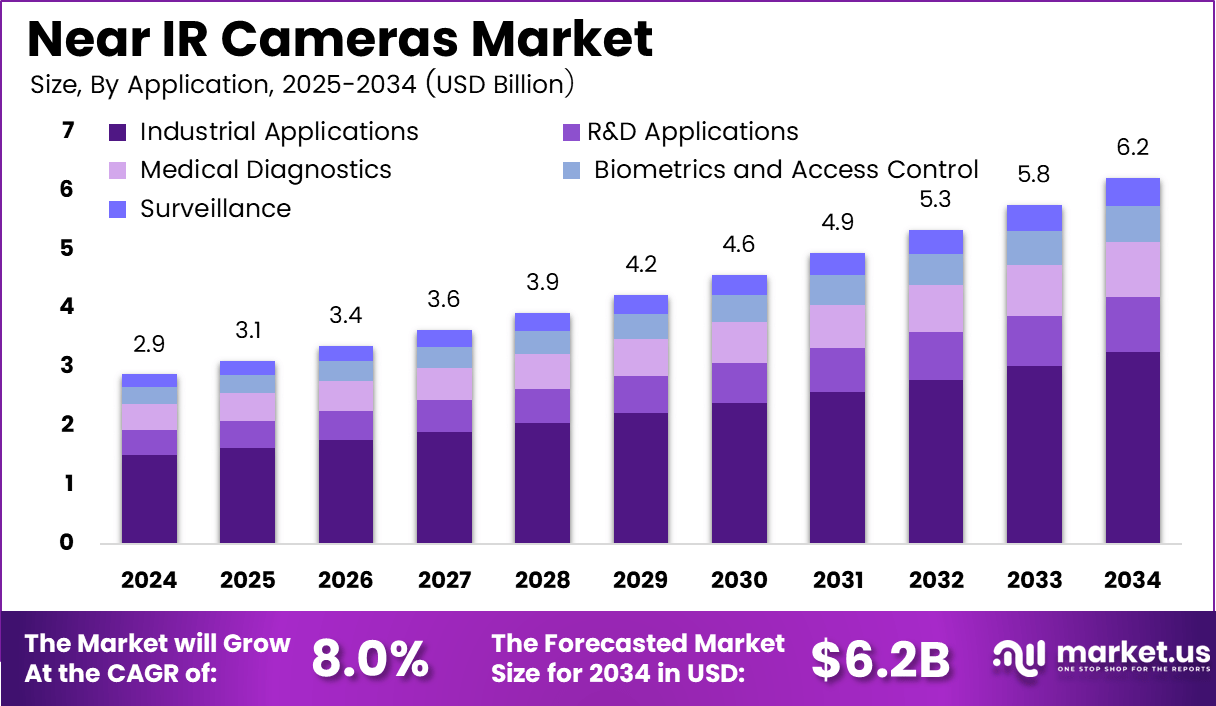
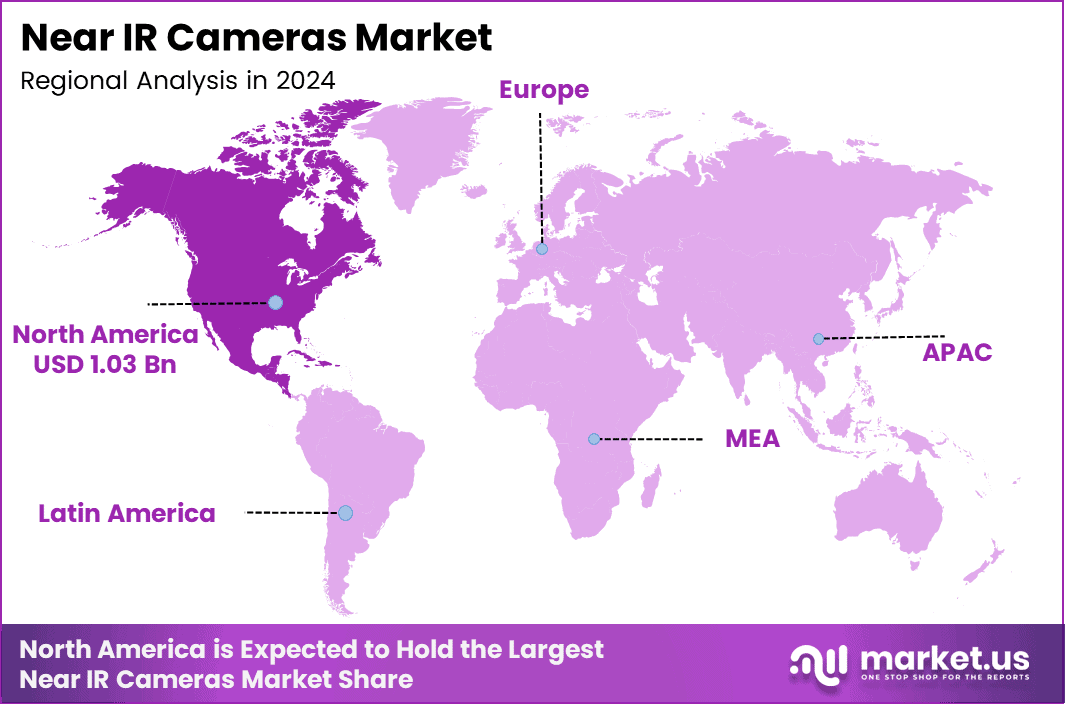
In 2024, the Global Near IR Cameras Market was valued at USD 2.9 billion. The market is projected to grow at a CAGR of 8.0% during 2024–2034, reaching approximately USD 6.2 billion by 2034. North America dominated the global market in 2024, accounting for 35.8% of the total market share and generating approximately USD 1.03 billion in revenue.
Cameras are specialized imaging devices that capture light in the near-infrared spectrum, typically ranging from 700 nm to 1700 nm. These cameras are widely used in agriculture, industrial inspection, environmental monitoring, and scientific research due to their ability to detect features and materials not visible in the standard visible light spectrum.
Common sensor types include InGaAs (Indium Gallium Arsenide) for wavelengths up to 1700 nm and silicon-based sensors for up to 950 nm. Resolution varies, with entry-level models offering 320×256 pixels and advanced models reaching 640×512 pixels.
Field of view typically ranges from 40° to 60°, while frame rates can go up to 30 fps for consumer-grade models. Notable examples, like the MAPIR Survey 3N, offer a 12 MP resolution, 850 nm wavelength, and a 41° field of view, making them ideal for vegetation analysis and agricultural surveys. These cameras also play a vital role in detecting moisture content, material defects, and monitoring land use and water quality.
Key Takeaways
- The global Near IR Cameras Market was valued at USD 2.9 billion in 2024.
- The global Near IR Cameras Market is projected to grow at a CAGR of 8.0% during 2024–2034.
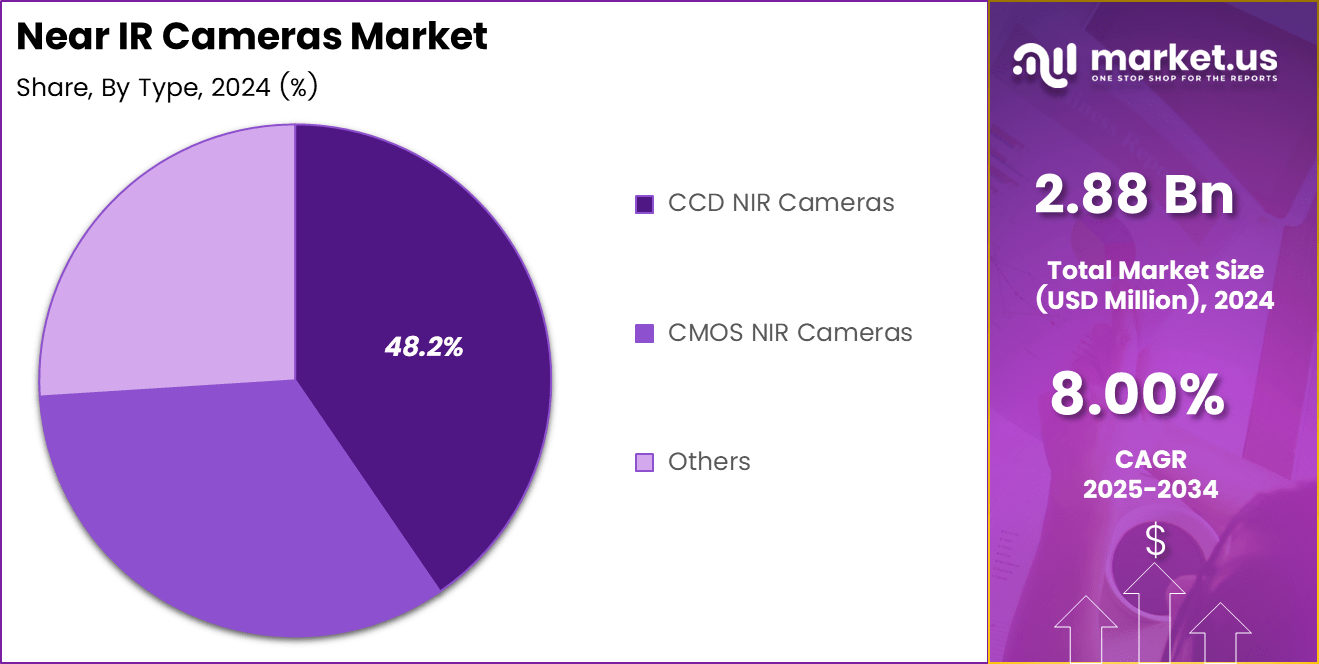
- On the basis of type, the CCD NIR Cameras segment dominated the market, accounting for 48.2% of the total market share.
- By application, the Industrial Applications segment dominated the market, accounting for 36.1% of the total market share.
- In 2024, North America was the most dominant region in the Near IR Cameras Market, accounting for 35.8% of the total market share and generating approximately USD 1.03 billion in revenue.
By Type
The CCD NIR Cameras segment holds the largest share of the Near IR Cameras Market at 48.2%, with predicted sales growth of 40% of total NIR camera sales over the next 5 years. This growth is largely driven by advancements in sensor technology, particularly for industrial diagnostics and surveillance. The CMOS NIR Cameras segment follows with 35.3% of the market share.
It is expected to grow by 30% in the next 5 years, driven by increasing demand in medical diagnostics due to CMOS technology’s lower costs and energy efficiency, especially in portable applications. The Others category represents 16.5% of the market, with a predicted 25% sales growth in emerging markets, such as APAC, as niche NIR technologies see growing adoption.
By Applications
Industrial Applications lead the Near IR Cameras Market with 36.1% of the share, projected to grow by 30% over the next 5 years. This growth is fueled by the expanding use of NIR cameras in automation, real-time monitoring, and process control in manufacturing.
R&D Applications contribute 22.b% of the market and are expected to grow by 20%, driven by increased research in fields such as environmental and food safety. Medical Diagnostics, accounting for 18.3% of the market, is anticipated to see a significant 35% growth, with rising demand for non-invasive diagnostic procedures and personalized medicine.
The Biometrics and Access Control segment holds 10.8% of the market, projected to grow by 15% as biometric authentication becomes increasingly prevalent in security systems. Finally, Surveillance accounts for 12.3% of the market, with a 10% growth expected, as advanced imaging systems are increasingly used in security and monitoring applications.
Key Market Segments
By Type
- CCD NIR Cameras
- CMOS NIR Cameras
- Others
By Application
- R&D Applications
- Medical Diagnostics
- Biometrics and Access Control
- Surveillance
- Industrial Applications
Investment and Business Benefits
On the Investment side, the Near IR Cameras Market is experiencing demand across healthcare, industrial, agricultural, and surveillance sectors. Investment in the market is focused on the development of portable, compact NIR models for medical diagnostics and industrial automation, which account for approximately 40% of total sales.
There is also a significant push toward advancing hyperspectral imaging capabilities in high-end NIR systems, which make up 25% of the market. On the business side, larger-scale systems used for industrial inspections and surveillance contribute about 35% to the total market sales.
As industries continue to seek more efficient and accurate imaging solutions for real-time data processing, predictive maintenance, and enhanced low-light performance, both the investment in and demand for Near IR Cameras Market are expected to grow. The rise of automation in industrial sectors and the increasing need for non-invasive diagnostic tools in healthcare further add to the market’s potential.
Regional Analysis
North America dominates the global market, contributing USD 1.03 billion in 2024, reflecting its leadership in adopting new technologies and innovations. While regions such as Europe, APAC, and MEA show promising growth, North America continues to hold the largest market share.
This region accounts for approximately 45% of the global Near IR Cameras Market in 2024, highlighting its strong foothold. While regions such as Europe, APAC, and MEA show promising growth, North America continues to hold the largest market share. Europe follows with a market share of around 25%, driven by advancements in industrial automation and medical diagnostics.
U.S Market Size
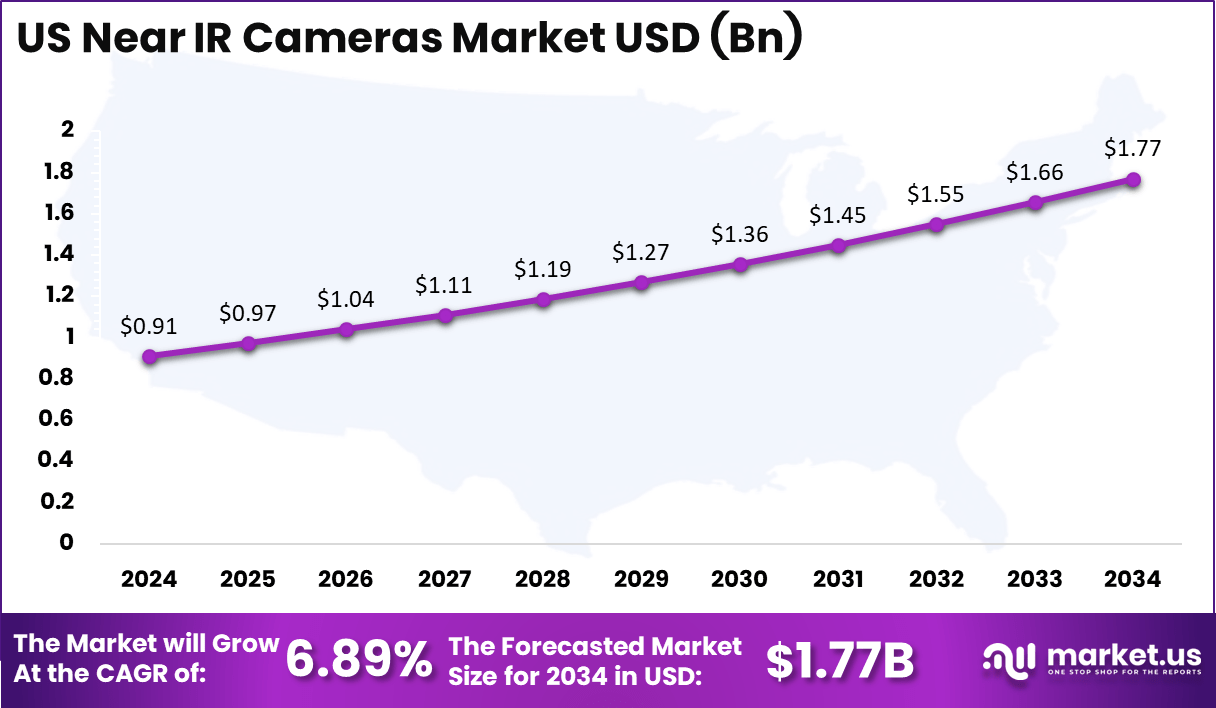
The US Near IR Cameras Market is expected to experience significant growth from 2024 to 2034, with a projected compound annual growth rate (CAGR) of 6.9%. Starting at a market size of USD 0.91 billion in 2024, it is forecasted to reach USD 1.77 billion by 2034.
Additionally, the sales of the Near IR Cameras Market are predicted to rise by approximately 90% over the next decade due to growing demand across various industries. The demand for these systems is particularly high in sectors that require precision imaging in low-light conditions.
Key Regions and Countries
- North America
- US
- Canada
- Europe
- Germany
- France
- The UK
- Spain
- Italy
- Rest of Europe
- Asia Pacific
- China
- Japan
- South Korea
- India
- Australia
- Singapore
- Rest of Asia Pacific
- Latin America
- Brazil
- Mexico
- Rest of Latin America
- Middle East & Africa
- South Africa
- Saudi Arabia
- UAE
- Rest of MEA
Drivers
| Driver | (~) % Impact on CAGR Forecast | Geographic Relevance | Impact Timeline |
|---|---|---|---|
| Vehicle driver-monitoring mandates | +1.4% | European Union, Japan, South Korea | Short term (≤ 2 years) |
| Factory vision automation | +1.2% | China, Germany, United States, Japan | Short term (≤ 2 years) |
| Defense night-surveillance procurement | +1.0% | North America, Europe, Indo-Pacific | Medium term (2–4 years) |
| Food sorting modernization | +0.7% | Europe, North America, China | Medium term (2–4 years) |
| Non-contact clinical imaging | +0.5% | North America, Western Europe, East Asia | Medium term (2–4 years) |
Vehicle driver-monitoring mandates
Mandatory driver-monitoring requirements are converting near-IR cabin cameras from optional safety content into a homologation-linked vehicle subsystem: European rules applied to new vehicle types from 6 July 2022 and to all newly registered relevant vehicles from 7 July 2024.
This creates a predictable platform-design cycle in which camera suppliers secure positions roughly 18–36 months before vehicle start of production, supporting the estimated +1.4% CAGR contribution through higher attach rates, recurring design-win revenue, and tighter integration of illuminators, optics, image sensors, and driver-attention software.
Restraints
| Restraint | (~) % Impact on CAGR Forecast | Geographic Relevance | Impact Timeline |
|---|---|---|---|
| High system acquisition costs | -1.5% | Global, strongest in cost-sensitive markets | Short term (≤ 2 years) |
| Gallium and germanium supply controls | -1.2% | China-linked global supply chains | Short term (≤ 2 years) |
| Automotive qualification expense | -0.9% | Europe, North America, East Asia | Medium term (2–4 years) |
| Biometric data compliance burden | -0.7% | Europe, North America, China | Short term (≤ 2 years) |
| Deferred industrial capital spending | -0.6% | Europe, North America, Latin America | Short term (≤ 2 years) |
High system acquisition costs
Near-IR deployment remains constrained where buyers must fund the camera, controlled illumination, optics, enclosure, integration engineering, and validation as a single capital project rather than procure a standalone sensor.
The resulting installed-system cost can be several multiples of a conventional visible-light camera, while industrial buyers commonly require payback within roughly 12–24 months; projects failing that threshold are deferred or reduced in scope, creating the estimated -1.5% drag through lower order conversion and margin pressure on suppliers that absorb integration costs to preserve volume.
Challenges
| Challenge | (~) % CAGR Friction Drag | Geographic Relevance | Mitigation Horizon |
|---|---|---|---|
| Ambient-light calibration complexity | -1.1% | Global | Medium term (2–4 years) |
| Optical thermal integration | -0.9% | Global manufacturing hubs | Medium term (2–4 years) |
| Spectral-vision skills scarcity | -0.6% | North America, Europe, East Asia | Long term (≥ 4 years) |
| Algorithm robustness validation | -0.5% | Global | Medium term (2–4 years) |
| Interoperability standard fragmentation | -0.4% | Global | Long term (≥ 4 years) |
Ambient-light calibration complexity
Near-IR imaging performance varies with sunlight leakage, reflectance differences across materials and skin tones, motion blur, lens contamination, and changes in illumination geometry, making reliable field performance materially harder than laboratory image capture.
A design may require validation across hundreds of illumination, temperature, distance, and subject-condition combinations, extending development cycles by roughly 6–12 months and raising software, test-fixture, and application-engineering expense; sustained investment in adaptive exposure control, multi-illuminator architectures, and edge-model monitoring is therefore required to limit the estimated -1.1% ceiling drag.
Opportunities
| Opportunity | (~) % Potential CAGR Upside | Geographic Relevance | Execution Window |
|---|---|---|---|
| Under-display biometric sensing | +1.3% | China, South Korea, Taiwan, North America | Medium term (2–4 years) |
| Battery-material sorting systems | +1.2% | Europe, China, North America | Medium term (2–4 years) |
| Home ophthalmic screening | +1.1% | North America, Europe, Japan | Long term (≥ 4 years) |
| Drone crop-analytics platforms | +0.9% | North America, Brazil, Australia, India | Medium term (2–4 years) |
| Advanced semiconductor inspection | +0.8% | Taiwan, South Korea, Japan, United States | Long term (≥ 4 years) |
Under-display biometric sensing
Under-display near-IR biometric sensing remains future white space rather than a current baseline driver because broad deployment requires coordinated advances in display transmission, low-power illumination, anti-spoofing performance, and handset design adoption.
Suppliers that package the sensor, illumination, optical stack, secure-enclave interface, and authentication software can shift from component sales toward higher-value subsystem content, potentially improving gross-margin capture by roughly 5–10 percentage points and reducing per-device integration cost by approximately 15%–25% at scale; successful ecosystem partnerships could therefore add an estimated +1.3% above the baseline CAGR.
Key Players Analysis
The Near-IR camera market is concentrated around diversified imaging platforms rather than pure-play NIR suppliers; disclosed company segment revenues are broader than NIR cameras, so the shares below are analyst estimates of the addressable NIR-camera revenue pool not reported market shares.
Tier 1: Teledyne FLIR/Teledyne Imaging is the scale leader, estimated at 20–25%, supported by Teledyne Digital Imaging sales of roughly $3.15 billion in FY2025 (sum of reported quarterly sales) and a $6.12 billion corporate revenue base.
Its $8.1 billion 2021 FLIR acquisition combined commercial/industrial IR, machine vision and defense imaging, creating the deepest channel and sensor portfolio among listed competitors. Hamamatsu ranks alongside it at an estimated 15–20%, with FY2025 Opto-semiconductor revenue of ¥79,505 million and Imaging & Measurement Instruments revenue of ¥32,703 million; these businesses provide the detector, camera and measurement-system supply chain underpinning NIR applications.
Hamamatsu’s investment intensity differentiates it technologically: FY2025 R&D was ¥18,439 million, equal to 8.7% of consolidated sales, while property, plant and equipment purchases were ¥35,905 million. This funding supports proprietary photonics production, even as its imaging-and-measurement revenue declined 0.1% and opto-semiconductor revenue increased 1.7%, illustrating exposure to cyclical scientific and semiconductor-equipment demand.
Tier 2 Basler, Allied Vision, JAI, IDS, Xenics and similar machine-vision specialists collectively constitute an estimated 35–45% but remain fragmented; Basler alone generated €224.5 million revenue in FY2025, up 22%, with €237.1 million orders and €17.7 million EBIT. Its growth was tied to logistics, AI-hardware, and battery-production projects in China and the US applications that favor NIR-enabled inspection cameras.
Top Key Players
- FLIR Systems, Inc.
- Hamamatsu Photonics K.K.
- Teledyne Technologies
- JAI A/S
- Allied Vision Technologies
- IDS
- Basler
- HORIBA Scientific
- Lumenera
- Qimaging
- Xenics
- Photonfocus
- Others
Recent Developments
- In May 2025, ROHM introduced compact surface-mount NIR LEDs, designed specifically for high radiant intensity in applications such as VR/AR devices, industrial optical sensors, and human detection/biosensing. These LEDs help improve illumination sources for NIR imaging, allowing smaller, more power-efficient systems.
Rohm - In April 2025, Nikon Corporation developed the AX NIR with NSPARC system, a super-resolution confocal microscope that extends super-resolution multicolor imaging further into the NIR spectrum. The technology delivers approximately a two-fold improvement in resolution compared to prior NIR imaging systems, enabling better molecular/biomolecular imaging, especially in drug-discovery and cellular biology.
Report Scope
| Report Features | Description |
|---|---|
| Market Value (2024) | USD 2.9 Bn |
| Forecast Revenue (2034) | USD 6.2 Bn |
| CAGR(2025-2034) | 8.0% |
| Base Year for Estimation | 2024 |
| Historic Period | 2020-2023 |
| Forecast Period | 2025-2034 |
| Report Coverage | Revenue forecast, AI impact on Market trends, Share Insights, Company ranking, competitive landscape, Recent Developments, Market Dynamics, and Emerging Trends |
| Segments Covered | By Type (CCD NIR Cameras, CMOS NIR Cameras, Others), By Application (R&D Applications, Medical Diagnostics, Biometrics and Access Control, Surveillance, Industrial Applications) |
| Regional Analysis | North America – US, Canada; Europe – Germany, France, The UK, Spain, Italy, Russia, Netherlands, Rest of Europe; Asia Pacific – China, Japan, South Korea, India, New Zealand, Singapore, Thailand, Vietnam, Rest of Latin America; Latin America – Brazil, Mexico, Rest of Latin America; Middle East & Africa – South Africa, Saudi Arabia, UAE, Rest of MEA |
| Competitive Landscape | FLIR Systems, Inc., Hamamatsu Photonics K.K., Teledyne Technologies, JAI A/S, Allied Vision Technologies, IDS, Basler, HORIBA Scientific, Lumenera, Qimaging, Xenics, Photonfocus, Others |
| Customization Scope | Customization for segments, region/country-level will be provided. Moreover, additional customization can be done based on the requirements. |
| Purchase Options | We have three licenses to opt for: Single User License, Multi-User License (Up to 5 Users), Corporate Use License (Unlimited Users and Printable PDF) |





































