Global Named Entity Linking AI Market By Component (Software/Solutions (NEL Core Algorithms & Models, Knowledge Graph Integration Tools, Others), Services (Professional Services, Managed Services, Others)), By Deployment Mode (Cloud-based/API, On-premises), By Application (Search & Information Retrieval, Enhancing Search Engine Relevance ), By End-User Industry (Media & Publishing, Financial Services, Healthcare & Life Sciences, E-commerce & Retail, Others),By Regional Analysis, Global Trends and Opportunity, Future Outlook By 2025-2035
- Published date: Feb. 2026
- Report ID: 178951
- Number of Pages: 323
- Format:
-
keyboard_arrow_up
Quick Navigation
- Report Overview
- Top Market Takeaways
- Key Statistics and Performance Metrics
- Drivers Impact Analysis
- Restraints Impact Analysis
- By Component
- By Deployment Mode
- By Application
- By End User Industry
- Investor Type Impact Matrix
- Technology Enablement Analysis
- Emerging Trends
- Growth Factors
- Key Market Segments
- Regional Analysis
- Competitive Analysis
- Future Outlook
- Recent Developments
- Report Scope
Report Overview
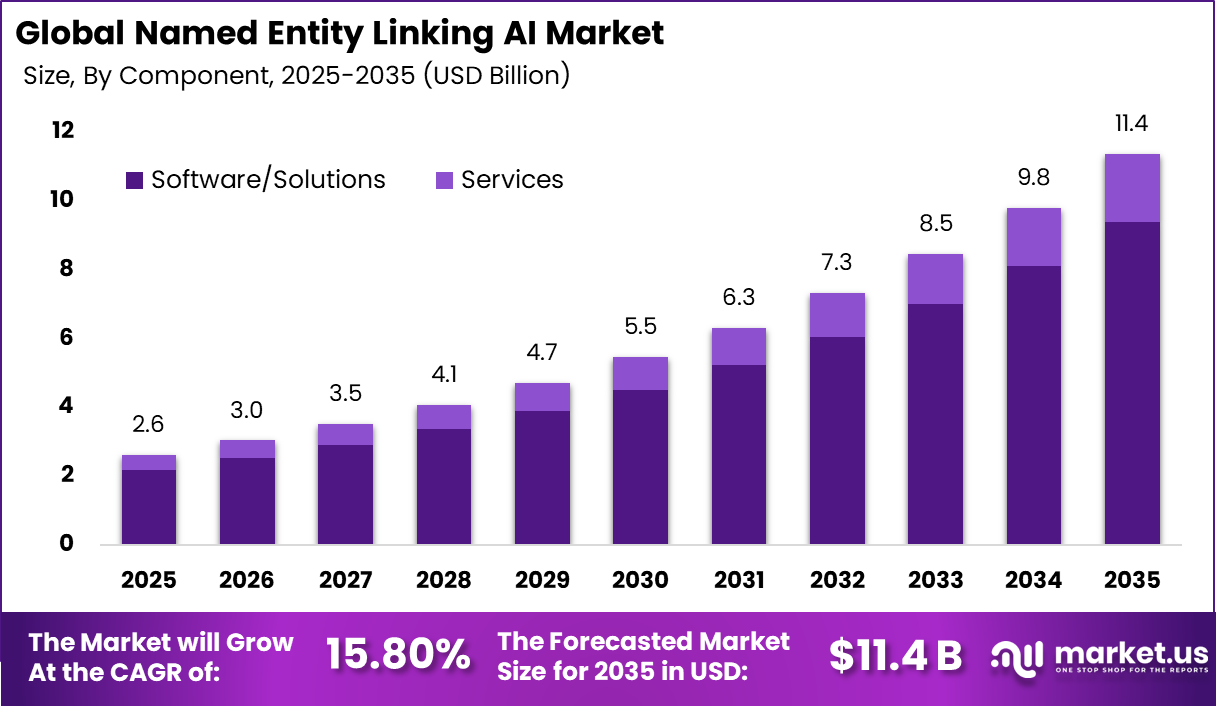
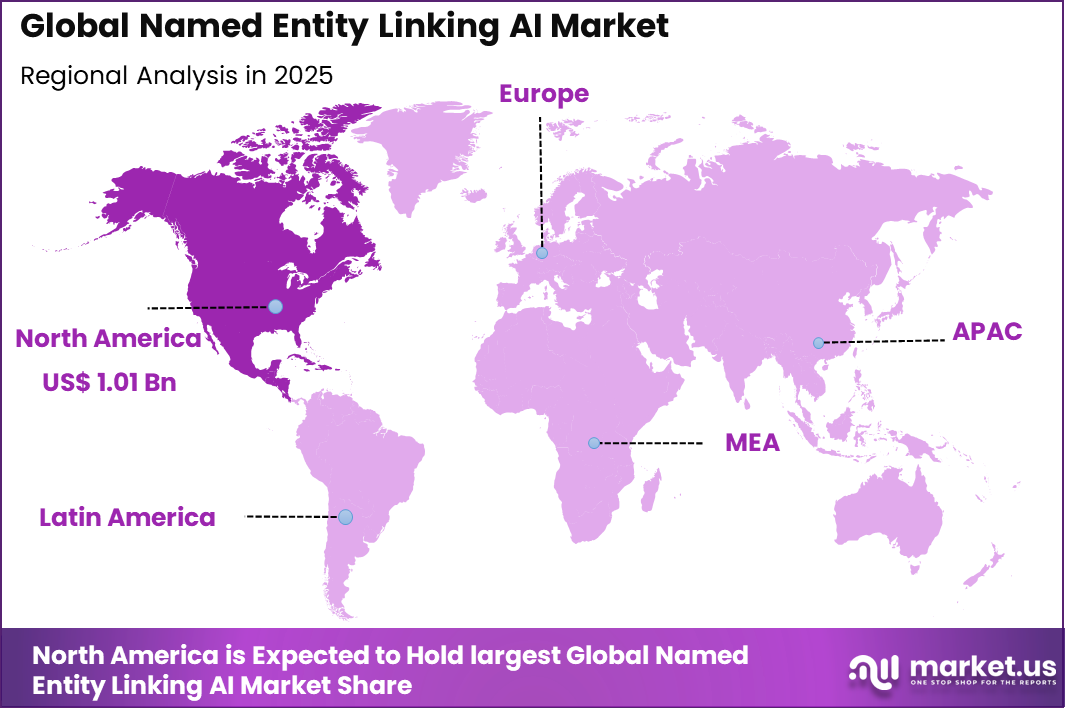
The Global Named Entity Linking AI Market generated USD 2.6 billion in 2025 and is predicted to register growth from USD 3 billion in 2026 to about USD 11.4 billion by 2035, recording a CAGR of 15.80% throughout the forecast span. In 2025, North America held a dominan market position, capturing more than a 38.6% share, holding USD 1.01 Billion revenue.
The Named Entity Linking AI Market refers to artificial intelligence systems that automatically identify entities in unstructured text and link them to structured knowledge bases. These entities may include people, organizations, locations, products, or events. The technology improves contextual understanding by disambiguating similar names and mapping them to the correct reference in a database or ontology.
Named entity linking is widely used to enhance search accuracy, content recommendation, knowledge graph construction, and automated content tagging. As digital content volumes expand across news, social media, enterprise documents, and research databases, the ability to connect text to structured data has become increasingly valuable. The technology is positioned as a core layer within natural language processing pipelines.
A primary driver of this market is the increasing volume of unstructured textual data generated by organisations. Data from support tickets, emails, documents, and online interactions requires intelligent processing to extract actionable insights. Named entity linking solutions help organisations structure this data by associating text content with known entities, reducing ambiguity and improving retrieval. The growing complexity of business information has elevated the need for AI driven language understanding capabilities.
Demand for named entity linking AI is strong among sectors with high volumes of text data and complex knowledge domains. Industries such as finance, legal, healthcare, and media generate extensive unstructured content requiring context aware interpretation. In these sectors, linking entities to structured knowledge improves research, compliance analysis, and decision support. Enterprise knowledge graphs that incorporate entity linking provide a unified framework for data exploration and analytics.
Top Market Takeaways
- By component, software/solutions account for 82.7% of the market, providing entity resolution engines that connect mentions to knowledge graphs like Wikidata or DBpedia.
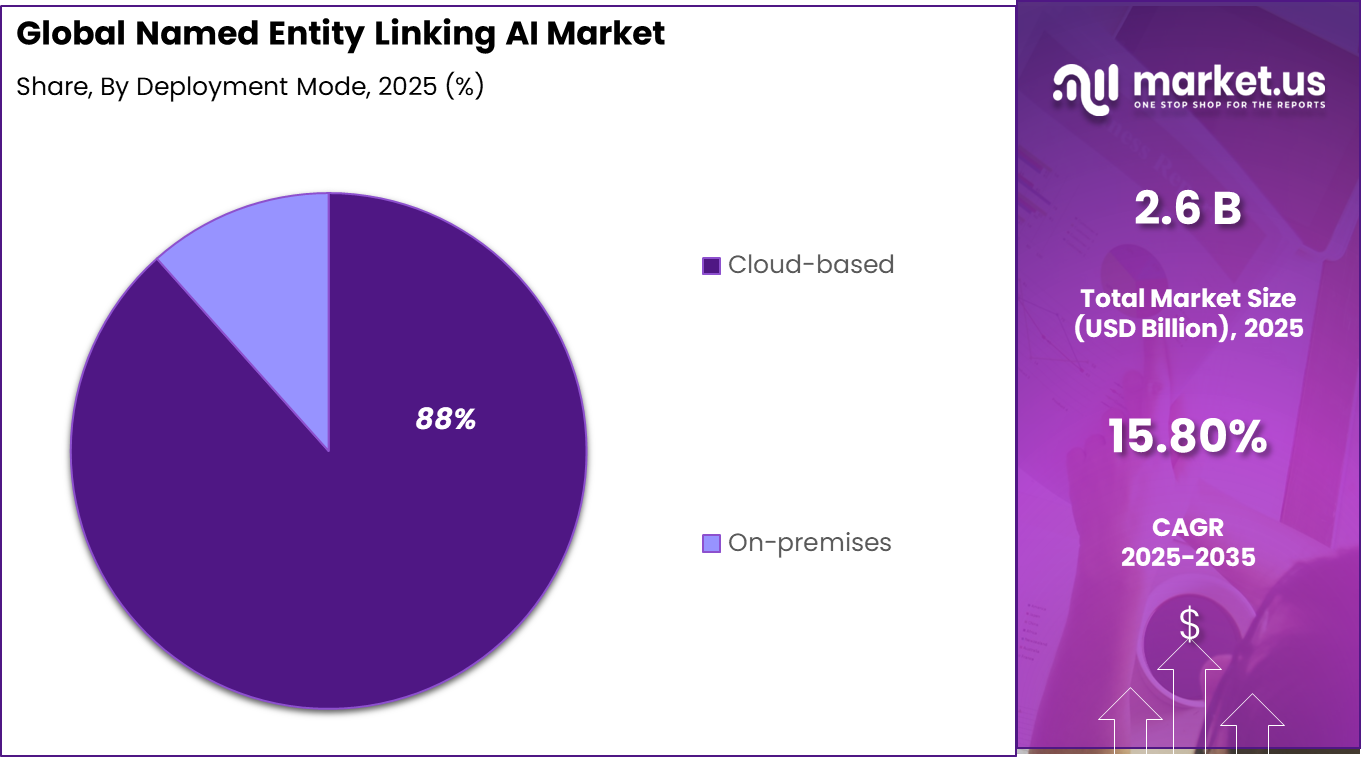
- By deployment mode, cloud-based/API represents 88.4%, enabling scalable integration into search pipelines, content platforms, and real-time NLP workflows.
- By application, search & information retrieval captures 41.3%, enhancing query understanding and result relevance through disambiguated entities.
- By end-user industry, media & publishing holds 38.6% share, leveraging entity linking for automated tagging, content recommendation, and fact-checking at scale.
Key Statistics and Performance Metrics
- Modern Named Entity Linking systems achieve accuracy levels above 91%, with recent benchmarks reaching 91.3% on the AIDA-YAGO-CoNLL dataset, indicating measurable improvements over earlier architectures.
- Advanced NEL models enhance performance across complex entity categories, delivering 66.7% improvement for food entities, 33.3% for animal entities, and 20.0% for time-related entities, particularly when integrated with improved Named Entity Recognition pipelines.
- In production environments, confidence scores above 0.85 on a 0.0 to 1.0 scale are generally treated as reliable thresholds for entity extraction and linking decisions.
- NEL systems operate through two primary components: entity recognition, which identifies textual mentions, and disambiguation, which links each mention to the correct knowledge base identifier, ensuring contextual precision.
Drivers Impact Analysis
Key Driver Impact on CAGR Forecast (~%) Geographic Relevance Impact Timeline Increasing adoption of NLP across enterprise search and knowledge management +4.1% North America, Europe Short to medium term Rising demand for contextual data enrichment in analytics platforms +3.5% Global Medium term Expansion of AI-driven customer service and chatbot systems +3.0% Asia Pacific, North America Medium term Growth in unstructured data volumes across industries +2.7% Global Medium term Regulatory requirements for accurate entity recognition in compliance use cases +2.3% Europe, North America Medium to long term Restraints Impact Analysis
Key Restraint Impact on CAGR Forecast (~%) Geographic Relevance Impact Timeline High training data requirements and model development costs -3.0% Global Short to medium term Accuracy limitations in domain-specific entity linking -2.6% Global Medium term Integration complexity with legacy content management systems -2.3% North America, Europe Medium term Data privacy and compliance constraints in sensitive sectors -2.0% Europe Medium term Shortage of specialized NLP expertise -1.7% Global Medium to long term By Component
Software and solutions accounting for 82.7% indicate that the primary value lies in AI-driven platforms rather than services or consulting. Named entity linking is typically delivered through APIs, AI libraries, and integrated modules within broader analytics or search platforms. Enterprises prioritize scalable and customizable software capable of processing high data volumes.
These solutions often include pre-trained models, domain adaptation capabilities, and multilingual support. Continuous model refinement and real-time processing capabilities enhance performance across varied text sources. As use cases expand, vendors focus on improving precision, recall rates, and contextual understanding.
Another contributing factor is integration capability. Modern entity linking solutions are designed to work seamlessly with enterprise content management systems, customer relationship platforms, and digital publishing tools. This interoperability increases adoption across industries.
By Deployment Mode
Cloud-based and API-driven deployment holding 88.4% reflects strong demand for scalable, on-demand processing infrastructure. Organizations prefer cloud delivery because it allows rapid integration into existing workflows without significant hardware investment. API models also enable flexible usage across multiple applications.
Cloud deployment supports real-time entity recognition across dynamic content streams such as news feeds and social platforms. High elasticity ensures consistent performance even during peak data loads. This is particularly important for enterprises managing large-scale digital ecosystems.
Security and compliance frameworks within modern cloud environments further support adoption. Enterprises can leverage encrypted data transmission and access controls while benefiting from global availability and low-latency performance.
By Application
Search and information retrieval representing 41.3% highlight the importance of semantic accuracy in digital discovery systems. Named entity linking enhances search relevance by connecting queries with structured knowledge bases rather than relying solely on keyword matching. This improves user experience and result precision.
Digital libraries, enterprise knowledge repositories, and media platforms increasingly integrate entity linking to refine contextual understanding. By recognizing entities within both user queries and stored content, systems can deliver more meaningful search outcomes.
Additionally, entity linking supports advanced analytics such as trend identification and topic clustering. Organizations leverage this capability to gain deeper insights into large document collections and evolving information patterns.
By End User Industry
Media and publishing accounting for 38.6% reflect the sector’s reliance on accurate content tagging and contextual linking. News organizations generate large volumes of daily content that require classification and cross-referencing. Named entity linking automates this process, improving efficiency and consistency. Publishers also use entity linking to enhance reader engagement through related content suggestions.
By connecting articles to knowledge graphs, platforms can recommend relevant stories and multimedia assets. Moreover, fact-checking and content verification processes benefit from entity disambiguation. Linking entities to authoritative databases supports higher editorial accuracy and reduces misinformation risk.
Investor Type Impact Matrix
Investor Type Growth Sensitivity Risk Exposure Geographic Focus Investment Outlook NLP and AI software providers Very High Medium North America, Europe Strong SaaS scalability Enterprise search and analytics vendors High Medium Global Platform extension opportunity Private equity firms Medium Medium North America, Europe Consolidation of AI tool vendors Venture capital investors High High North America Innovation in domain-specific NLP models Strategic technology investors Medium Low to Medium Global Ecosystem integration expansion Technology Enablement Analysis
Technology Enabler Impact on CAGR Forecast (~%) Primary Function Geographic Relevance Adoption Timeline Transformer-based NLP models and large language models +4.5% Context-aware entity recognition Global Short to medium term Knowledge graph integration frameworks +3.8% Semantic linking and enrichment North America, Europe Medium term Domain-adaptive training and fine-tuning tools +3.2% Industry-specific accuracy improvement Global Medium term Real-time API-based entity linking services +2.7% Scalable deployment Global Medium to long term Compliance and explainability modules +2.3% Transparent AI decision support Europe, North America Long term Emerging Trends
In the Named Entity Linking AI market, a notable trend is the move toward deeper context understanding in connecting names in text to real-world entities. Rather than simply matching words to a list of known entities, systems are being designed to consider surrounding content, document purpose, and semantic meaning before deciding which entity a name refers to.
This trend helps reduce ambiguity when a name could refer to multiple possibilities, so the output feels more accurate and useful. Another emerging pattern is simpler user feedback loops that help the system learn from corrections and refine future linking decisions in a way that aligns with how humans interpret language.
Growth Factors
A key growth driver in this market is the increasing volume of unstructured text data in business and research environments. Organisations are generating large amounts of text from reports, correspondence, and customer interactions, and there is a strong need to organise this content so it can be analysed and acted upon. Named entity linking helps by turning scattered names into structured references that can be tracked and queried.
Another important driver is the demand for clearer insights from language analytics. When entities are linked accurately, teams can trust search results, trend analysis, and summarisation outcomes more easily, which improves confidence in decisions based on text data. Together, these needs are encouraging adoption of AI-based approaches that focus on both accuracy and user trust in entity linking outcomes.
Key Market Segments
By Component
- Software/Solutions
- NEL Core Algorithms & Models
- Knowledge Graph Integration Tools
- Pre-processing & Disambiguation Modules
- API & SDKs for Developers
- Others
- Services
- Professional Services
- Managed Services
- Others
By Deployment Mode
- Cloud-based/API
- On-premises
By Application
- Search & Information Retrieval
- Enhancing Search Engine Relevance
- Intelligent Document Search
- Content Intelligence & Analytics
- News & Social Media Monitoring
- Market & Competitive Intelligence
- Knowledge Base Enrichment
- Automated Population of Knowledge Graphs
- Database & CRM Record Enhancement
By End-User Industry
- Media & Publishing
- Financial Services
- Healthcare & Life Sciences
- E-commerce & Retail
- Others
Regional Analysis
North America accounts for 38.6% of the named entity linking AI market, supported by advanced adoption of natural language processing technologies across media, finance, healthcare, and enterprise analytics.
Organizations in the region are deploying entity linking models to accurately connect names, locations, organizations, and concepts across structured and unstructured data sources. Demand is driven by increasing content digitization, growth in knowledge graph applications, and the need to improve search accuracy, data enrichment, and contextual analytics.
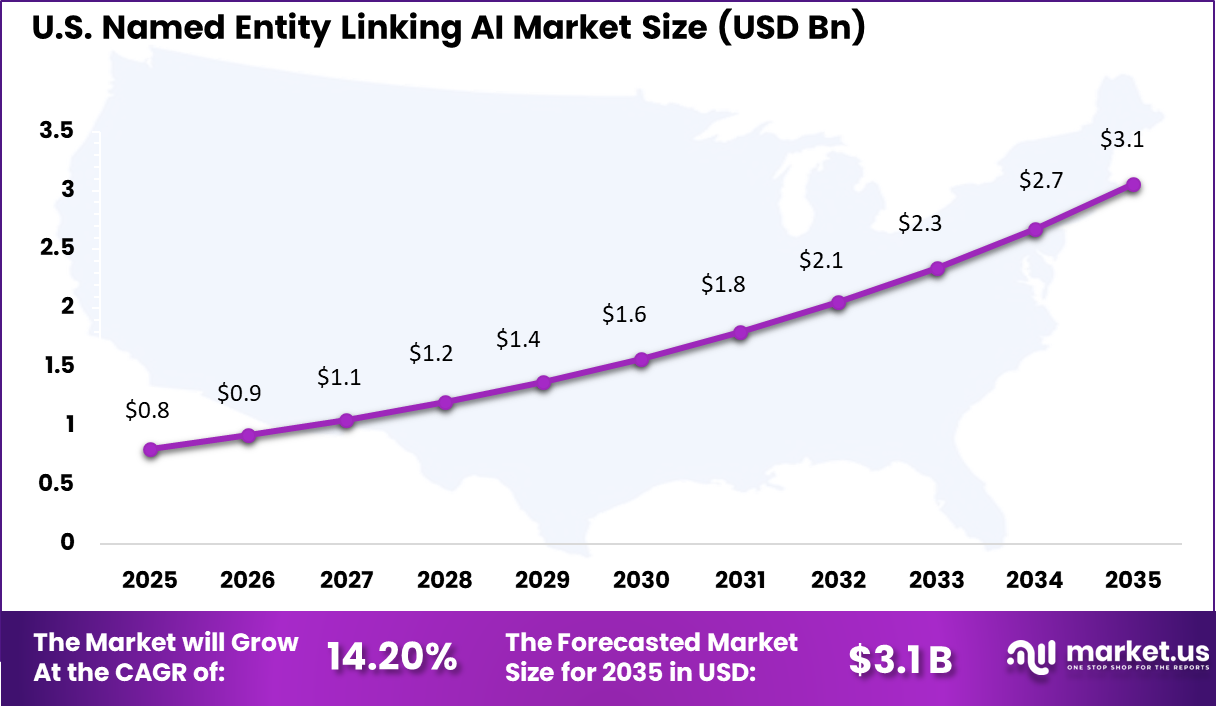
The United States market is valued at USD 0.91 Bn and is growing at a CAGR of 14.20%, reflecting expanding integration of AI-driven text analysis in enterprise workflows. Adoption is influenced by rising volumes of digital content, demand for automated document processing, and enhanced semantic search capabilities.
Growth is further supported by increasing use of AI in compliance monitoring, intelligence analysis, and customer insight generation, strengthening the role of entity linking within broader AI-driven data ecosystems.
Key Regions and Countries
- North America
- US
- Canada
- Europe
- Germany
- France
- The UK
- Spain
- Italy
- Russia
- Netherlands
- Rest of Europe
- Asia Pacific
- China
- Japan
- South Korea
- India
- Australia
- Singapore
- Thailand
- Vietnam
- Rest of APAC
- Latin America
- Brazil
- Mexico
- Rest of Latin America
- Middle East & Africa
- South Africa
- Saudi Arabia
- UAE
- Rest of MEA
Competitive Analysis
The competitive landscape of the Named Entity Linking AI Market is led by large technology providers such as Google LLC, Microsoft Corporation, Amazon Web Services, Inc., IBM Corporation, and OpenAI, L.L.C. These companies integrate entity linking capabilities into broader cloud and AI ecosystems. Their platforms support search, digital assistants, enterprise knowledge graphs, and analytics solutions. Strong research capabilities and global infrastructure strengthen their position.
Specialized providers including Expert.ai S.p.A., MeaningCloud, S.L., TextRazor Ltd., Cortical.io AG, Ambiverse GmbH, Aylien Ltd., Rosette Text Analytics, and Lymba Corporation focus on domain-specific intelligence. These firms offer advanced semantic analysis and ontology-driven linking tools. Their solutions are widely adopted in media monitoring, publishing, financial services, and compliance applications. Customization and linguistic depth remain key strengths.
Data-centric and knowledge graph oriented players such as Diffbot and BabelNet contribute structured web-scale datasets and multilingual lexical databases. Their platforms enhance large-scale information extraction and cross-lingual entity mapping. These capabilities support enterprise search, threat intelligence, and academic research use cases. The market also includes emerging startups and niche vendors that focus on real-time APIs and integration flexibility.
Top Key Players in the Market
- Google LLC
- Microsoft Corporation
- Amazon Web Services, Inc.
- IBM Corporation
- Expert.ai S.p.A.
- MeaningCloud, S.L.
- TextRazor Ltd.
- Cortical.io AG
- BabelNet
- OpenAI, L.L.C.
- Ambiverse GmbH
- Diffbot
- Aylien Ltd.
- Rosette Text Analytics
- Lymba Corporation
- Others
Future Outlook
The future outlook for the Named Entity Linking AI Market is positive as more organizations use artificial intelligence to understand and organize large amounts of text data. Demand for named entity linking solutions is expected to grow because these tools help accurately identify and connect key names, places, and concepts across documents.
Adoption of advanced natural language processing and machine learning will improve accuracy and support real-time data analysis. Growth can be attributed to rising use of AI in search, customer analytics, and knowledge management. Overall, the market is expected to expand as businesses prioritize smarter text understanding and information extraction.
Recent Developments
- May 2025, Google: The Gemini API was upgraded with broader JSON Schema support for structured outputs. In named entity linking workflows, this makes entity extraction and entity resolution outputs more consistent, which reduces post-processing errors in production pipelines.
- October 2025, AWS: Amazon Bedrock AgentCore was announced as generally available. For named entity linking, agent platforms are increasingly used to orchestrate multi-step pipelines (extract entities, retrieve candidates, validate, then write back to a knowledge store).
Report Scope
Report Features Description Market Value (2025) USD 2.6 Billion Forecast Revenue (2035) USD 11.4 Billion CAGR(2025-2035) 15.80% Base Year for Estimation 2024 Historic Period 2020-2024 Forecast Period 2025-2035 Report Coverage Revenue forecast, AI impact on Market trends, Share Insights, Company ranking, competitive landscape, Recent Developments, Market Dynamics and Emerging Trends Segments Covered By Component (Software/Solutions (NEL Core Algorithms & Models, Knowledge Graph Integration Tools, Others), Services (Professional Services, Managed Services, Others)), By Deployment Mode (Cloud-based/API, On-premises), By Application (Search & Information Retrieval, Enhancing Search Engine Relevance ), By End-User Industry (Media & Publishing, Financial Services, Healthcare & Life Sciences, E-commerce & Retail, Others) Regional Analysis North America – US, Canada; Europe – Germany, France, The UK, Spain, Italy, Russia, Netherlands, Rest of Europe; Asia Pacific – China, Japan, South Korea, India, New Zealand, Singapore, Thailand, Vietnam, Rest of Latin America; Latin America – Brazil, Mexico, Rest of Latin America; Middle East & Africa – South Africa, Saudi Arabia, UAE, Rest of MEA Competitive Landscape Google LLC, Microsoft Corporation, Amazon Web Services, Inc., IBM Corporation, Expert.ai S.p.A., MeaningCloud, S.L., TextRazor Ltd., Cortical.io AG, BabelNet, OpenAI, L.L.C., Ambiverse GmbH, Diffbot, Aylien Ltd., Rosette Text Analytics, Lymba Corporation, Others Customization Scope Customization for segments, region/country-level will be provided. Moreover, additional customization can be done based on the requirements. Purchase Options We have three license to opt for: Single User License, Multi-User License (Up to 5 Users), Corporate Use License (Unlimited User and Printable PDF)  Named Entity Linking AI MarketPublished date: Feb. 2026add_shopping_cartBuy Now get_appDownload Sample
 -
-
- Google LLC
- Microsoft Corporation
- Amazon Web Services, Inc.
- IBM Corporation
- Expert.ai S.p.A.
- MeaningCloud, S.L.
- TextRazor Ltd.
- Cortical.io AG
- BabelNet
- OpenAI, L.L.C.
- Ambiverse GmbH
- Diffbot
- Aylien Ltd.
- Rosette Text Analytics
- Lymba Corporation
- Others
Our Clients

- 178951
- Feb. 2026