


Report Overview
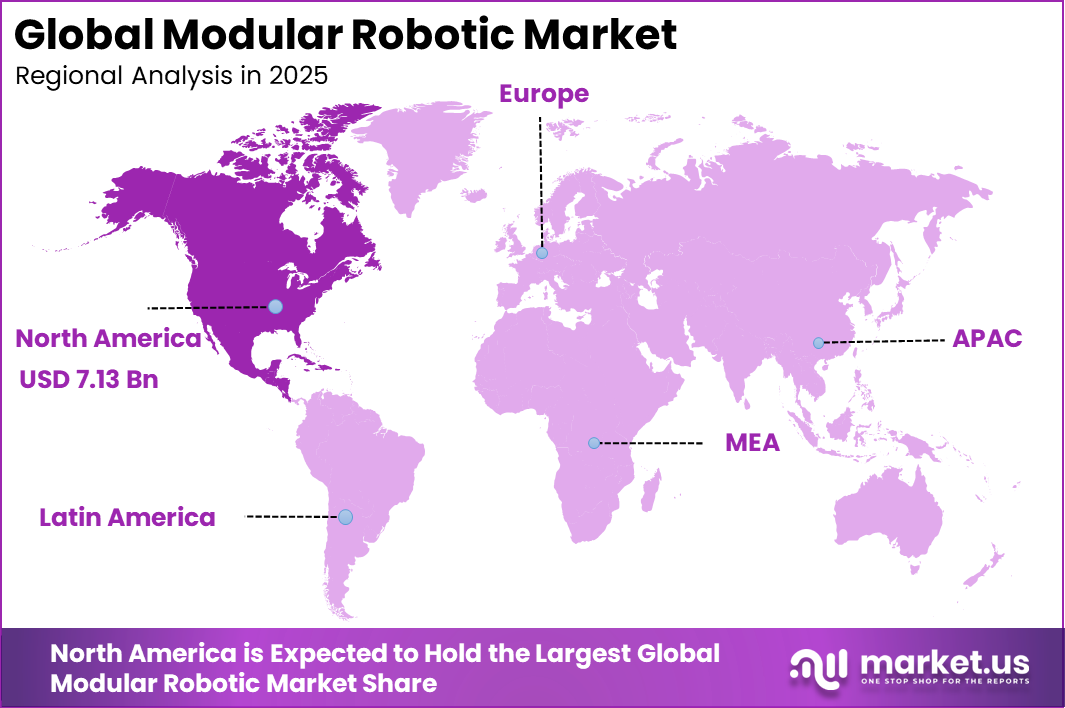
The Global Modular Robotic Market size is expected to be worth around USD 78.93 billion by 2035, from USD 18.52 billion in 2025, growing at a CAGR of 15.6% during the forecast period from 2025 to 2035. North America held a dominant market position, capturing more than a 38.5% share, holding USD 7.13 billion in revenue.
The modular robotics market refers to robotic systems designed with interchangeable and reconfigurable modules that can be combined to perform different tasks. These robots consist of multiple units or modules that can be assembled, rearranged, or replaced to adapt to specific applications. Modular robotics offers flexibility, scalability, and cost efficiency, making it suitable for industries such as manufacturing, healthcare, logistics, and research.
The market is gaining momentum as organizations seek adaptable automation solutions that can evolve with changing operational requirements. Unlike traditional fixed robotic systems, modular robots can be reconfigured to handle new tasks without requiring complete system replacement. This capability supports dynamic production environments and reduces long-term investment costs.
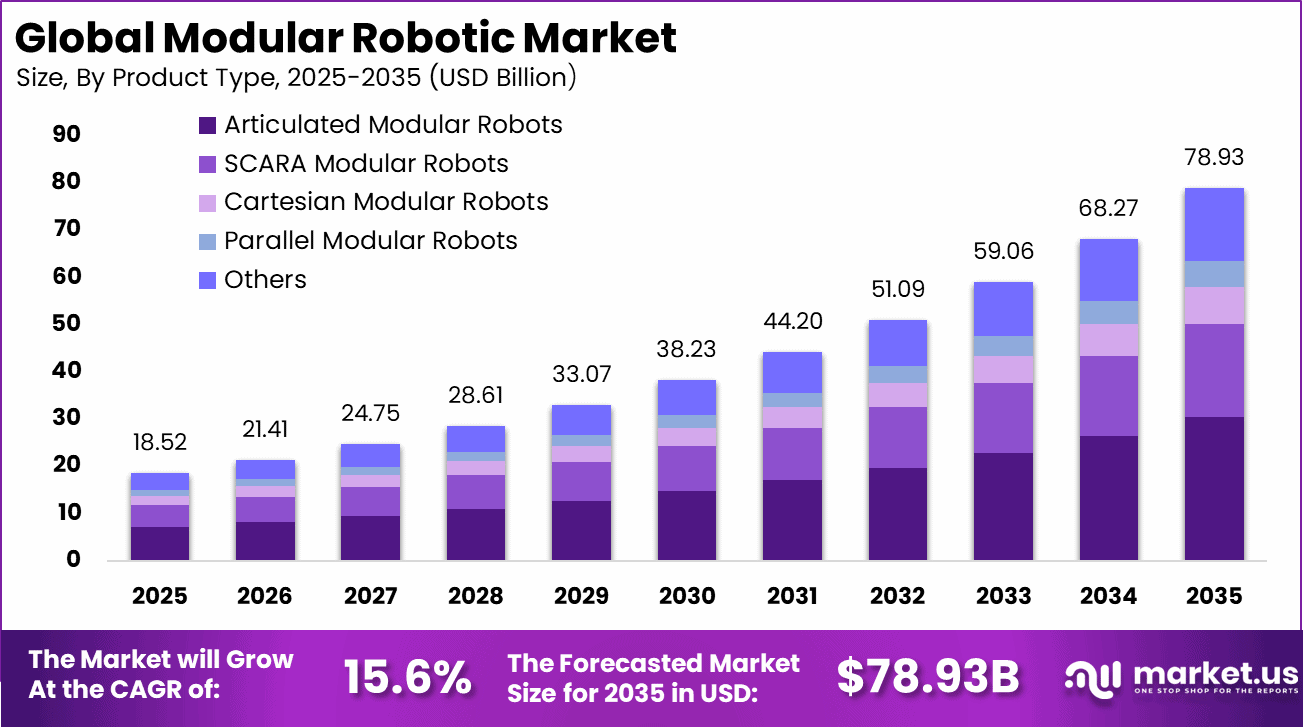
Demand is rising strongly across manufacturing and logistics as workflows become more dynamic. Around 70% of firms report a growing need for automation to match e-commerce expansion and faster delivery expectations. Modular robotics also supports safer workplaces by handling risky and physically demanding tasks, reducing injury risks, and improving worker productivity while maintaining consistent operational performance across shifting environments.
For instance, in September 2025, Kawasaki Heavy Industries launched the duAro2+ F-series dual-arm modular robot for logistics. With 8 swappable function modules, it handles palletizing, depalletizing, and inspection simultaneously. Warehouse automation projects using these robots achieved 28% labor cost savings.
Key Takeaway
- In 2025, articulated modular robots led the market with a 36.8% share.
- In 2025, chain-based systems dominated the structure segment with 48.7% share.
- In 2025, auto-configuration held the highest share at 56.2%.
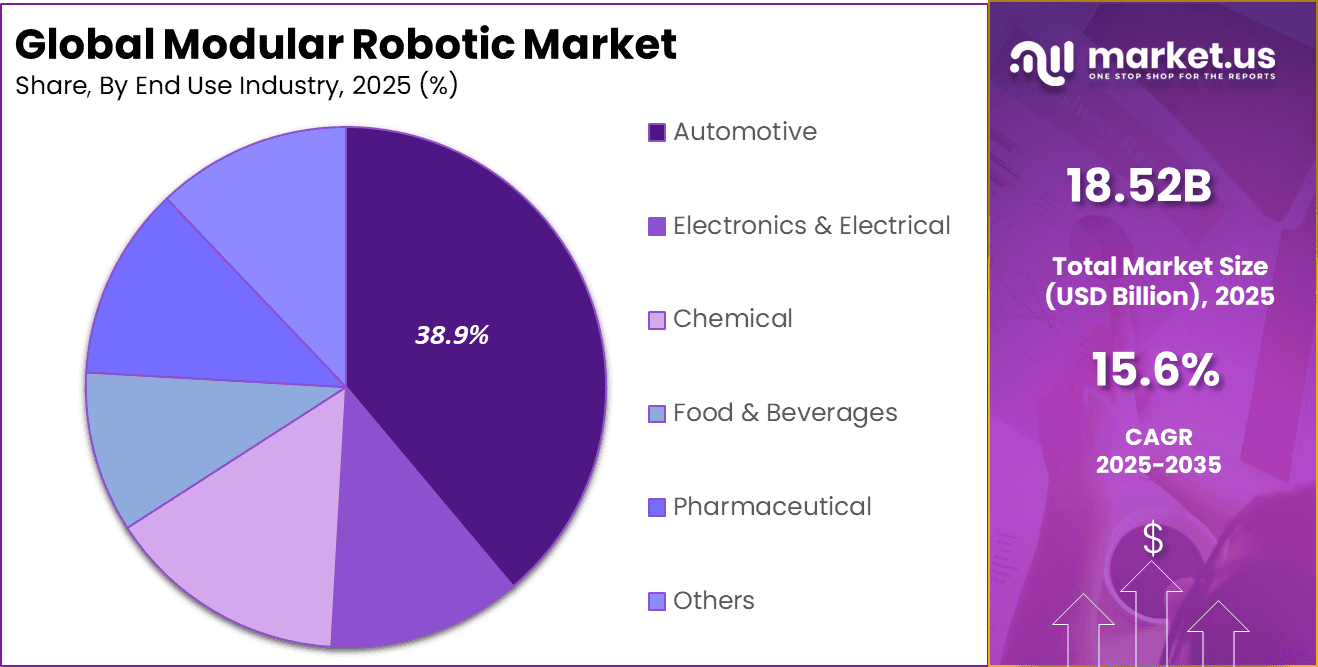
- In 2025, the automotive sector led applications with 38.9% share.
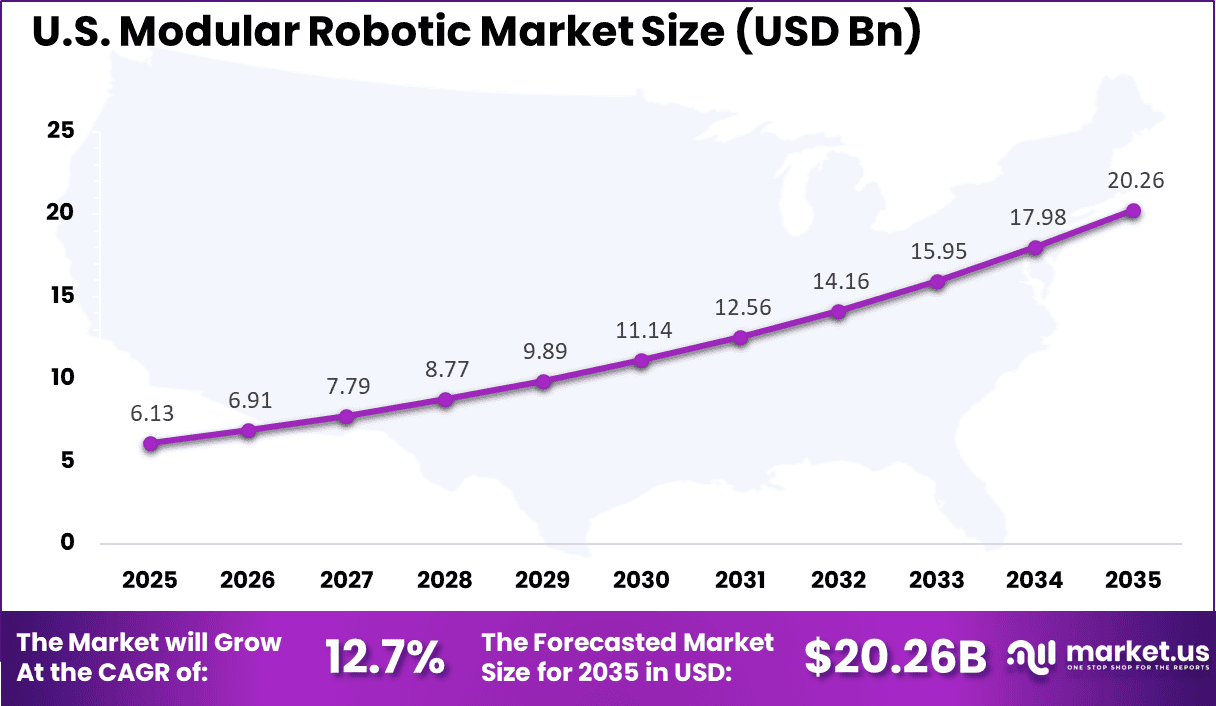
- The U.S. modular robotic market was valued at USD 6.13 billion in 2025, growing at a CAGR of 12.7%.
- In 2025, North America dominated the market with over 38.5% share.
- Adoption of modular robotics supports measurable cost optimization, with production expenses reduced by 35%.
- Operational performance has improved by 56%, reflecting higher efficiency levels driven by robotic advancements.
- System downtime has decreased by 42%, supported by flexible reconfiguration capabilities of modular components.
- Approximately 48% of businesses have implemented modular robotics to enhance operational processes.
Product Type Analysis
In 2025, The Articulated Modular Robots segment held a dominant market position, capturing a 38.6% share of the Global Modular Robotic Market. This dominance is due to the strong flexibility of articulated modular robots in handling complex industrial tasks. Their multi joint structure supports precise movement, which makes them suitable for assembly, welding, and material handling operations. Industries prefer them because they adapt well to changing production needs and help improve workflow accuracy.
Articulated modular robots also support better space utilization and smoother integration into automated lines. Their design allows manufacturers to reconfigure systems without replacing complete setups. This practical advantage helps reduce operational disruption and improves long term efficiency, making them a preferred choice in industries that require both precision and adaptability.
For Instance, in March 2026, ABB expanded its line of articulated modular robots to support more flexible production environments. The company is focusing on standardized arms and modular linkages that can be mixed and matched across applications, reducing engineering time when changing tasks on the factory floor. This approach helps manufacturers quickly adapt lines for new products without overhauling the entire setup.
Hardware Design Analysis
In 2025, the Chain-Based segment held a dominant market position, capturing a 48.7% share of the Global Modular Robotic Market. This dominance is due to the reliable structure and stable motion offered by chain based modular robot designs. These systems maintain strong connections between modules, which helps them perform repetitive tasks with consistency. Their design suits industrial environments where durability, load handling, and steady operation remain essential for daily performance.
Chain based hardware also supports efficient movement across linked robotic sections, improving coordination during continuous operations. Manufacturers value this design because it handles demanding workloads without frequent interruptions. Its dependable framework makes it useful for production settings that need long operating cycles, lower maintenance concerns, and consistent mechanical support.
For instance, in February 2026, FANUC introduced updated chain‑based handling modules that can be combined with its existing robots and conveyors. The emphasis is on rapid re‑routing and reconfiguration of material‑flow paths without deep reprogramming. This approach appeals to manufacturers that frequently change production layouts and need hardware that can follow those changes easily.
Configuration Analysis
In 2025, The Auto-Configuration segment held a dominant market position, capturing a 56.2% share of the Global Modular Robotic Market. This dominance is due to the growing preference for auto configuration systems that simplify robotic setup and adjustment. These systems help robots respond to task changes with limited manual effort, which saves time and improves operational flow. Businesses value this feature because it supports faster deployment in flexible production environments.
Auto configuration also strengthens adaptability in workplaces where processes shift often and customization is important. It allows robotic systems to align with new requirements more efficiently than fixed setups. This makes operations smoother, reduces setup delays, and supports better productivity for industries working under changing production schedules.
For Instance, in March 2026, Universal Robots is advancing auto‑configuration features in its collaborative robotic arms so that users can swap end‑effectors and tools with minimal manual setup. The robots recognize new hardware and adjust motion parameters automatically, which shortens deployment time in small‑batch and mixed‑product environments. This reduces the need for specialized programming and speeds integration into new workflows.
End Use Industry Analysis
In 2025, The Automotive segment held a dominant market position, capturing a 38.9% share of the Global Modular Robotic Market. This dominance is due to the strong use of modular robotics in automotive manufacturing, where precision and repeatability are critical. Automotive facilities rely on robotic systems for assembly, welding, inspection, and painting tasks. Modular designs help improve production control and support the fast paced environment of vehicle manufacturing operations.
The automotive industry also benefits from the flexibility of modular robotics when model changes or line adjustments are required. These systems help manufacturers modify workflows without major disruption. This practical advantage supports better efficiency, stable output, and improved production planning in an industry that depends on accuracy and speed.
For Instance, in March 2026, Kawasaki introduced new modular robots tailored for automotive body‑in‑white and powertrain assembly. The systems are designed to handle multiple vehicle models on the same line by reusing and reconfiguring modules rather than installing separate robots for each model. This reduces footprint and capital cost while supporting flexible platforms that plants are adopting nowadays.
By Region
North America holds 38.5% of the market share due to strong adoption of industrial automation technologies and advanced manufacturing systems. Organizations in the region actively invest in robotics to improve production efficiency and reduce operational costs. The presence of major manufacturing and technology companies further supports regional market growth.
Within North America, the United States contributes USD 6.13 billion with a growth rate of 12.7%. The country’s advanced automotive industry and increasing adoption of automation technologies have strengthened demand for modular robotic systems. Continued investment in smart manufacturing and industrial automation is expected to sustain market expansion across the region.
For instance, in September 2024, Rethink Robotics, based in Boston, Massachusetts, showcased U.S. leadership in modular robotics by unveiling its Reacher cobot series, Ryder AMRs, and Riser mobile manipulators at IMTS Chicago. These innovative platforms highlight North America’s edge in flexible, high-performance automation solutions for manufacturing, reinforcing the region’s dominance through cutting-edge product launches and market-ready technology.
Growth Factors
One of the primary growth factors driving the modular robotics market is the increasing demand for flexible automation in manufacturing. Industries are shifting toward customized production and shorter product life cycles, which require adaptable robotic systems. Modular robots allow manufacturers to quickly adjust production lines and respond to changing market demands.
Another growth factor is the expansion of robotics adoption across multiple industries. Beyond manufacturing, sectors such as healthcare, defense, and logistics are using modular robots for tasks such as surgical assistance, inspection, and material handling. This broad application range supports market growth.
Emerging Trends
One emerging trend in the modular robotics market is the integration of artificial intelligence and machine learning. AI-enabled modular robots can analyze data, learn from operations, and optimize performance over time. This enhances their ability to perform complex tasks and adapt to changing environments.
Another trend is the development of collaborative modular robots designed to work alongside humans. These systems are equipped with sensors and safety features that enable safe interaction with human operators, improving productivity and operational efficiency.
Key Market Segments
By Product Type
- Articulated Modular Robots
- SCARA Modular Robots
- Cartesian Modular Robots
- Parallel Modular Robots
- Others
By Hardware Design
- Chain-Based
- Lattice-Based
- Strut-Based
By Configuration
- Auto-Configuration
- Manual Configuration
By End Use Industry
- Automotive
- Electronics & Electrical
- Chemical
- Food & Beverages
- Pharmaceutical
- Others
Key Regions and Countries
North America
- US
- Canada
Europe
- Germany
- France
- The UK
- Spain
- Italy
- Russia
- Netherlands
- Rest of Europe
Asia Pacific
- China
- Japan
- South Korea
- India
- Australia
- Singapore
- Thailand
- Vietnam
- Rest of APAC
Latin America
- Brazil
- Mexico
- Rest of Latin America
Middle East & Africa
- South Africa
- Saudi Arabia
- UAE
- Rest of MEA
Drivers
Rising Need for Flexible Automation
This driver is driven by the growing need for production systems that can quickly adjust to changing demand and product variations. Modular robotics allows industries to reconfigure operations without major disruptions. This flexibility supports faster turnaround times and helps businesses maintain efficiency in environments where customization and speed are becoming essential.
It also improves operational continuity by reducing downtime during process changes. Industries such as manufacturing and logistics benefit from systems that adapt easily to new tasks. As automation becomes more central to productivity, modular robotics provides a practical solution for handling complex workflows while maintaining consistent output and improving overall efficiency.
For instance, in March 2026, ABB just rolled out fresh variants in its robot lineup, all built on a shared modular base that lets shops swap arms and wrists fast for different jobs. This setup cuts install time and fits shifting factory needs, like jumping between auto parts and logistics hauls without big delays. Teams on the floor love how it keeps pace with sudden orders, making daily shifts feel less chaotic.
Restraint
High Setup Costs
This restraint is caused by the initial investment required to deploy modular robotic systems. Businesses must spend on hardware, software integration, and skilled personnel, which can create financial pressure, especially for smaller firms. These upfront costs often delay adoption despite the long term operational benefits that modular robotics can provide.
In addition, customization and integration with existing infrastructure can increase total setup expenses. Companies may need additional resources to ensure compatibility and smooth operation. This makes decision making more cautious, as organizations evaluate return on investment before committing to modular robotic solutions in their operations.
For instance, in January 2026, Mitsubishi launched compact SCARA models that promise easy installs but still carry a steep upfront bill for the full kit and tweaks. Smaller plants pause here, weighing whether the speed gains offset the initial outlay for hardware and software links. It highlights how even smart designs strain budgets at the start.
Opportunities
Expansion in Emerging Applications
Expansion in emerging applications is creating strong opportunities for modular robotics beyond traditional industries. Sectors like healthcare logistics, inspection, and disaster response are exploring these systems for their flexibility and adaptability. Modular robots can be customized for specific tasks, making them suitable for complex and unpredictable environments.
Advancements in digital tools and design technologies are also supporting this growth. Businesses can now develop and test modular systems more efficiently, reducing deployment time. As industries continue to look for scalable and responsive solutions, these new applications are expected to open up wider adoption and long term growth potential.
For instance, in April 2026, at Modex, KUKA teamed up to demo AMRs with swappable top modules for warehouse flows and custom tools. This opens doors in logistics where bots adapt for sorting or moving odd loads, pulling modular tech into non-factory spots. It’s a natural step for places craving quick, on-demand help.
Challenges
Skills Shortage
This challenge is driven by the limited availability of skilled professionals who can design, operate, and maintain modular robotic systems. Advanced technical knowledge is required for system integration and configuration, which creates a gap between technology adoption and workforce capability in many industries.
Training and upskilling efforts are necessary but take time and resources, which can slow down implementation. Companies may struggle to fully utilize modular robotics without proper expertise. This challenge highlights the importance of workforce development to support the growing use of advanced automation technologies across industries.
For instance, in June 2025, ABB’s Automatica showcase of AI-powered AMRs underlined the need for trained hands to program and maintain them amid labor gaps. With bots handling complex nav, shops struggle to find folks who can tweak modules without downtime. It spotlights the human side holding back full rollout.
Key Players Analysis
The Modular Robotic Market is driven by global industrial automation companies that develop flexible robotic systems for manufacturing, logistics, and assembly operations. ABB Ltd., KUKA AG, FANUC Corporation, and Yaskawa Electric Corporation provide advanced modular robotic platforms that enable reconfigurable production lines. These systems allow manufacturers to adapt quickly to changing production requirements while maintaining high efficiency and precision.
Industrial and collaborative robotics providers also contribute significantly to market growth. Mitsubishi Electric Corporation, Kawasaki Heavy Industries, Denso Corporation, and Universal Robots focus on modular and collaborative robotic systems designed for human robot interaction. These solutions are widely used in automotive, electronics, and packaging industries. Their technologies support improved productivity, reduced downtime, and enhanced operational flexibility.
Emerging robotics companies further expand innovation in modular systems. Acutronic Robotics, Rethink Robotics, and Nachi-Fujikoshi focus on adaptive robotic modules and intelligent automation platforms. These companies emphasize ease of integration, scalability, and cost efficiency for small and medium sized enterprises. The market remains competitive, with differentiation driven by modular design flexibility, AI integration, and the ability to support diverse industrial applications.
Top Key Players in the Market
- ABB Ltd.
- Acutronic Robotics
- KUKA AG
- Mitsubishi Electric Corp.
- FANUC Corporation
- Kawasaki Heavy Industries Ltd.
- Yaskawa Electric Corporation
- Denso Corporation
- Universal Robots
- Nachi-Fujikoshi Corp.
- Rethink Robotics
- Others
Recent Developments
- In November 2025, Universal Robots acquired a modular gripper specialist, adding patented adaptive end-effectors to its cobot lineup. The integration enables seamless switching between 12 task-specific grippers without programming. Small manufacturers report 35% reduction in setup times for mixed production runs.
- In December 2025, Yaskawa Electric rolled out the MOTOMAN-HC20DT modular collaborative robot with IP67-rated modular joints. Healthcare facilities adopted 200 units for sterile environment tasks like medication handling. The system’s hot-swappable modules cut downtime by 45% during shift changes.
Report Scope
| Report Features | Description |
|---|---|
| Market Value (2025) | USD 18.5 Bn |
| Forecast Revenue (2035) | USD 78.9 Bn |
| CAGR (2026-2035) | 15.6% |
| Base Year for Estimation | 2025 |
| Historic Period | 2020-2024 |
| Forecast Period | 2026-2035 |
| Report Coverage | Revenue forecast, AI impact on Market trends, Share Insights, Company ranking, competitive landscape, Recent Developments, Market Dynamics and Emerging Trends |
| Segments Covered | By Product Type (Articulated Modular Robots, SCARA Modular Robots, Cartesian Modular Robots, Parallel Modular Robots, Others), By Hardware Design (Chain-Based, Lattice-Based, Strut-Based), By Configuration (Auto-Configuration, Manual Configuration), By End Use Industry (Automotive, Electronics & Electrical, Chemical, Food & Beverages, Pharmaceutical, Others) |
| Regional Analysis | North America – US, Canada; Europe – Germany, France, The UK, Spain, Italy, Russia, Netherlands, Rest of Europe; Asia Pacific – China, Japan, South Korea, India, New Zealand, Singapore, Thailand, Vietnam, Rest of Latin America; Latin America – Brazil, Mexico, Rest of Latin America; Middle East & Africa – South Africa, Saudi Arabia, UAE, Rest of MEA |
| Competitive Landscape | ABB Ltd., Acutronic Robotics, KUKA AG, Mitsubishi Electric Corp., FANUC Corporation, Kawasaki Heavy Industries Ltd., Yaskawa Electric Corporation, Denso Corporation, Universal Robots, Nachi-Fujikoshi Corp., Rethink Robotics, Others |
| Customization Scope | Customization for segments, region/country-level will be provided. Moreover, additional customization can be done based on the requirements. |
| Purchase Options | We have three license to opt for: Single User License, Multi-User License (Up to 5 Users), Corporate Use License (Unlimited User and Printable PDF) |





























