


Report Overview
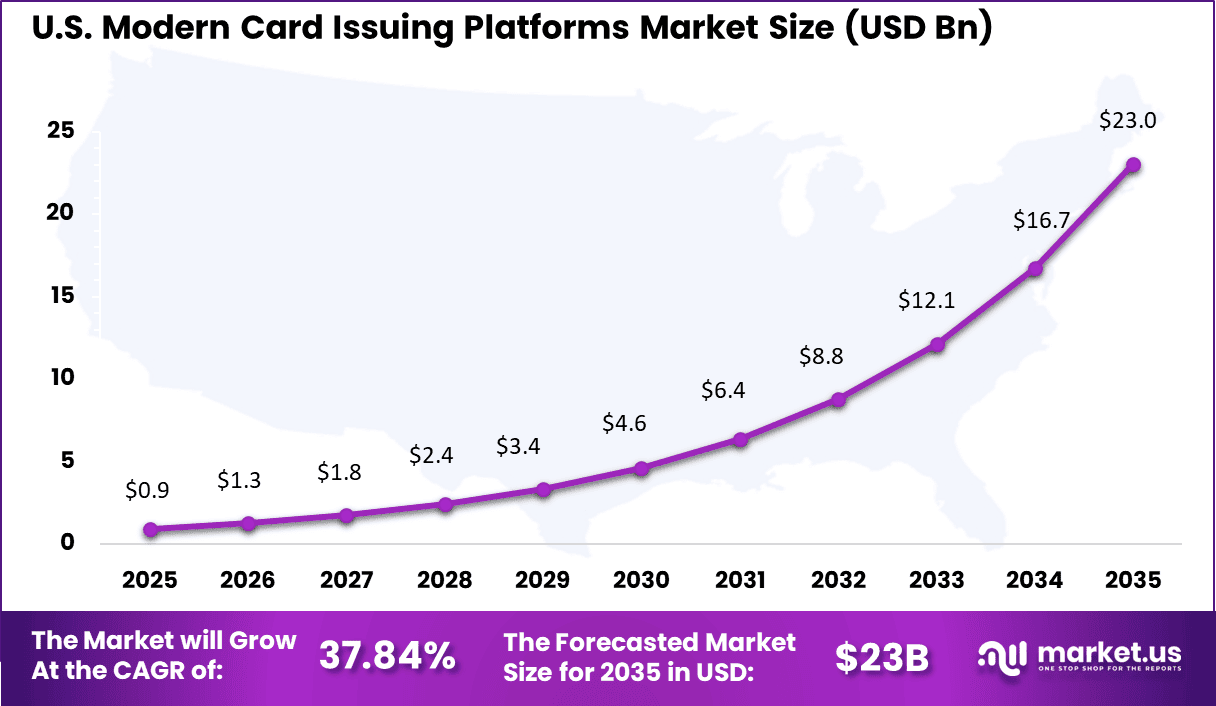
The Global Modern Card Issuing Platforms Market generated USD 2.2 billion in 2025 and is predicted to register growth from USD 3.0 billion in 2026 to about USD 60.0 billion by 2035, recording a CAGR of 39.5% throughout the forecast span. In 2025, North America held a dominant market position, capturing more than a 48.3% share, with USD 1.03 billion in revenue.
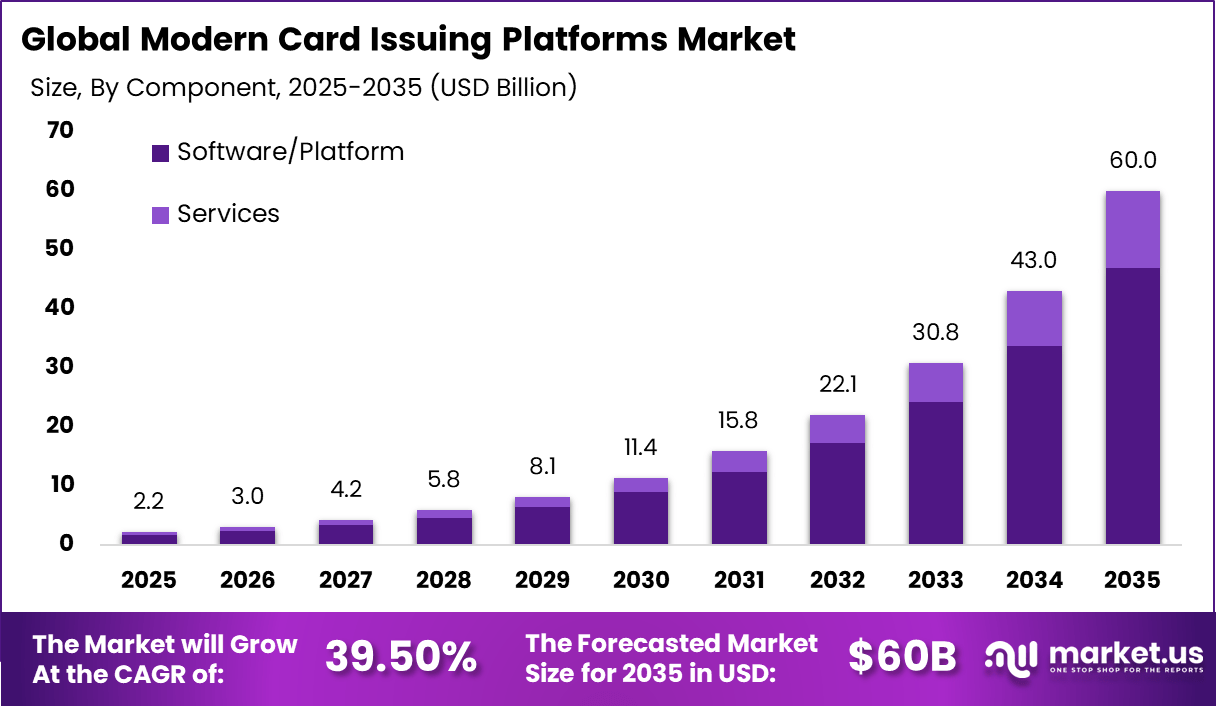
The modern card issuing platforms market refers to the software and services that enable banks, fintech firms, and businesses to create, manage, and deliver payment cards for consumers and corporate users. These platforms support digital and physical card issuance, account linking, transaction controls, fraud monitoring, and integration with mobile wallets.
The main driving factors for the modern card issuing platforms market are the growing demand for digital financial services and the need for flexible payment solutions. Consumers and businesses increasingly prefer digital banking experiences that offer quick access to payment tools and control over spending.
The rise of mobile wallets and e-commerce has encouraged issuers to provide instant virtual cards and programmable payment features. Fintech innovation and open banking standards also support rapid integration of card services with other financial systems. Regulatory focus on secure payment processing and risk management encourages the adoption of platforms that include built-in compliance and fraud detection.
Top Market Takeaways
- By component, software/platform dominated the modern card issuing platforms market with 78.4% share, enabling instant card creation, customization, and lifecycle management.
- By card type, virtual cards captured 52.6%, favored for secure digital payments, fraud reduction, and seamless integration with mobile wallets.
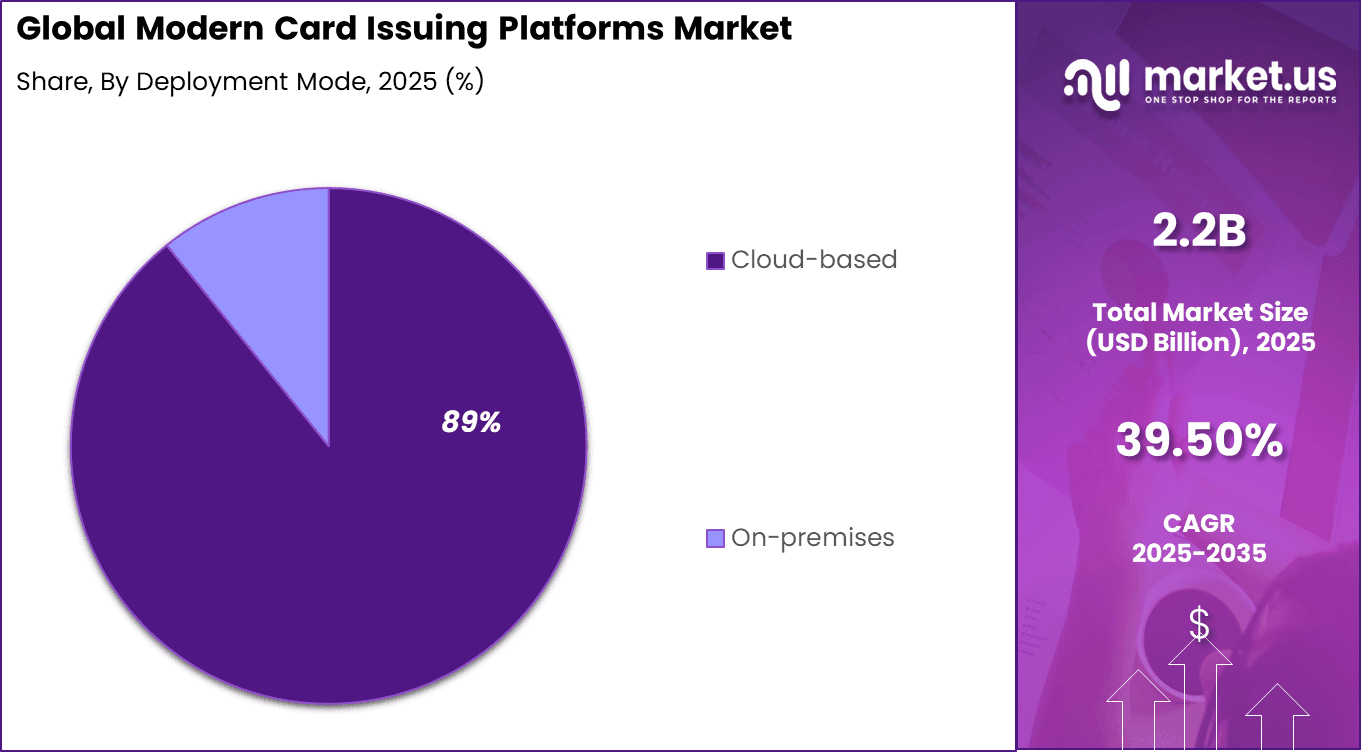
- By deployment mode, cloud-based solutions led at 89.2%, offering scalability, API flexibility, and rapid global rollout.
- By end-user, FinTechs accounted for 58.7%, leveraging platforms to launch branded cards quickly without heavy infrastructure.
- North America held 48.3% of the global market, with the U.S. valued at USD 0.93 billion and growing at a CAGR of 37.84%.
Component Analysis
Software and platform solutions account for 78.4% of the Modern Card Issuing Platforms market, showing that value creation is driven mainly by digital infrastructure rather than physical components. These platforms manage card lifecycle functions such as issuance, activation, transaction control, fraud monitoring, and settlement.
Financial institutions and FinTechs rely on software platforms to launch card programs quickly and manage them efficiently at scale. The flexibility of software-based platforms supports rapid customization and integration with banking systems.
From an operational perspective, platform-based solutions reduce time-to-market and operational complexity. They allow issuers to configure card features, limits, and rules through centralized dashboards. The strong share of this segment reflects increasing preference for programmable and API-driven card issuing systems that support innovation and regulatory compliance.
Card Type Analysis
Virtual cards represent 52.6% of the card type segment, making them the most widely adopted option in modern card issuing. Virtual cards are issued digitally and can be used for online transactions, subscriptions, and controlled spending scenarios. Their instant issuance and easy management make them attractive for both businesses and consumers. Virtual cards also reduce the cost and delay associated with physical card production.
From a security standpoint, virtual cards offer enhanced control and reduced fraud risk. Features such as dynamic card numbers and spending limits improve transaction safety. The strong share of this segment reflects rising demand for digital-first payment solutions and increased adoption of online and mobile payments.
Deployment Mode Analysis
Cloud-based deployment dominates the market with 89%, highlighting a strong shift toward scalable and flexible infrastructure. Cloud platforms enable card issuers to manage large transaction volumes without maintaining on-site systems. They also support real-time updates and high availability, which are critical for payment operations.
Cloud deployment allows faster innovation and easier integration with third-party services. Issuers can launch new features and expand geographically with minimal infrastructure changes. The overwhelming adoption of cloud-based platforms reflects demand for agility, reliability, and cost efficiency in card issuing operations.
End-User Analysis
FinTech companies account for 58.7% of end-user adoption, making them the largest user group in the market. FinTechs use modern card issuing platforms to build digital banking, payment, and expense management products. These platforms support rapid product development and enable FinTechs to compete with traditional financial institutions.
FinTechs value flexibility and speed, which are key strengths of modern card issuing platforms. Cloud-native and API-driven systems align well with their business models. The strong presence of this segment reflects continued growth of FinTech-driven innovation in digital payments and financial services.
Key Market Segments
By Component
- Software/Platform
- Services
By Card Type
- Debit Cards
- Credit Cards
- Prepaid Cards
- Others
By Deployment Mode
- Cloud-based
- On-premises
By End-User
- Banks
- FinTechs
- Corporates
- Neobanks
Regional Analysis
North America accounted for a 48.3% share, supported by rapid modernization of payment infrastructure and strong adoption of digital banking services. Financial institutions, fintech companies, and payment processors in the region have increasingly adopted modern card issuing platforms to support faster card issuance, flexible program management, and real-time transaction control.
Demand has been driven by growth in digital wallets, virtual cards, and embedded finance solutions. The region’s mature payments ecosystem and high consumer acceptance of digital payments have further reinforced market expansion.
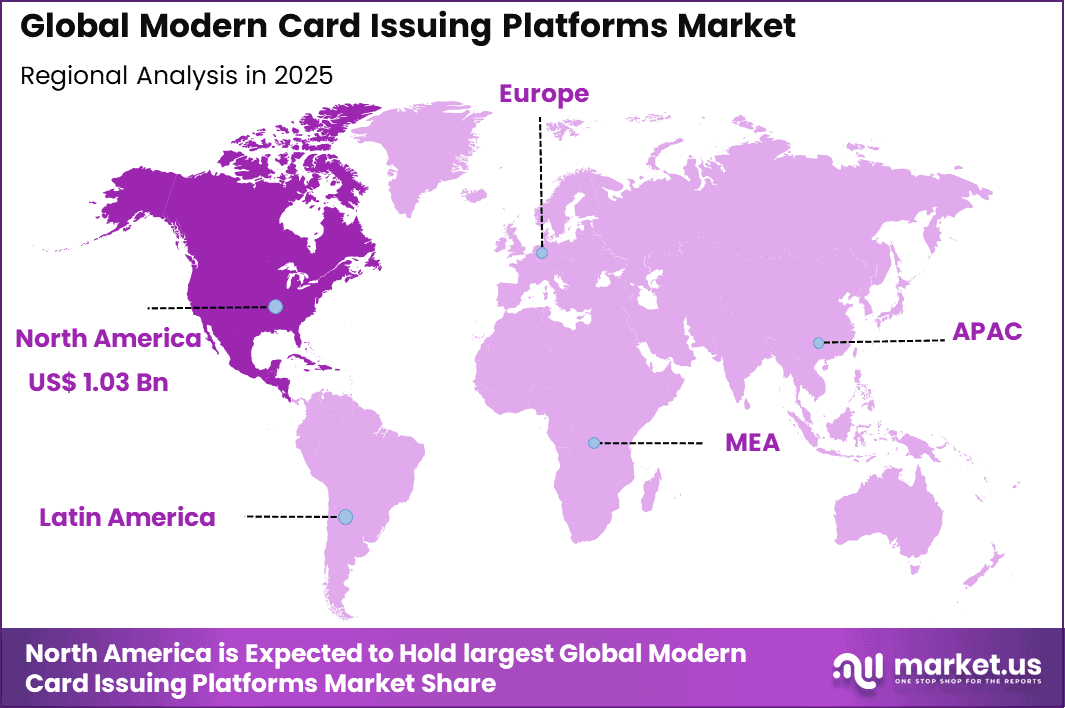
The U.S. market reached USD 0.93 Bn and is projected to grow at a 37.84% CAGR, reflecting strong demand from fintech startups and traditional banks expanding digital offerings. Adoption has been driven by the need to launch card products quickly and customize features for different customer segments. Modern card issuing platforms have helped U.S. issuers reduce time to market, improve user experience, and support innovative use cases such as buy now pay later and expense management.
Key Regions and Countries
- North America
- US
- Canada
- Europe
- Germany
- France
- The UK
- Spain
- Italy
- Russia
- Netherlands
- Rest of Europe
- Asia Pacific
- China
- Japan
- South Korea
- India
- Australia
- Singapore
- Thailand
- Vietnam
- Rest of APAC
- Latin America
- Brazil
- Mexico
- Rest of Latin America
- Middle East & Africa
- South Africa
- Saudi Arabia
- UAE
- Rest of MEA
Market Dynamics
Driver Analysis - Rising Demand for Virtual and Embedded Card Programs
The growing use of virtual cards across digital businesses is a key driver for modern card issuing platforms. Companies are increasingly shifting toward virtual and embedded card programs to manage online payments, subscriptions, and corporate spending. These platforms allow businesses to issue cards instantly, apply spending controls, and integrate payments directly into digital workflows, which improves speed and operational control.
This demand is further supported by the expansion of embedded finance across e-commerce, travel, and software platforms. Card issuing solutions enable these businesses to launch branded payment products without building banking infrastructure. As a result, modern issuing platforms are becoming essential tools for fintech firms and non-banking enterprises looking to offer flexible and secure payment experiences.
Restraint Analysis - High Compliance and Security Requirements
Regulatory compliance remains a major restraint for modern card issuing platforms. Payment platforms are required to follow strict security and data protection standards, which are frequently updated. Meeting these evolving requirements increases operational complexity and requires continuous investment in audits, security controls, and compliance systems.
In addition, card issuing platforms rely heavily on partner banks to meet regulatory obligations such as customer verification and transaction monitoring. Any delay or mismatch in compliance processes between the platform and the sponsoring bank can slow down onboarding and product launches. This dependency creates friction, especially for smaller fintech firms entering the market.
Opportunity Analysis - Expansion of Tokenization and Advanced Security Features
The adoption of tokenization creates strong opportunities for growth in the card issuing platforms market. Tokenization replaces sensitive card details with secure digital tokens, reducing exposure to fraud in online and mobile payments. Platforms that offer built-in tokenization can provide safer transactions for merchants and cardholders, which increases trust and adoption.
As digital payments continue to grow across online and mobile channels, businesses are actively seeking issuing platforms that prioritize security without compromising speed. Card issuing providers that integrate tokenization, real-time controls, and smart authorization rules can position themselves as preferred partners for enterprises focused on secure digital payment expansion.
Challenge Analysis - Managing Fraud in Complex Digital Environments
Fraud management remains a critical challenge for modern card issuing platforms. The increase in online and remote transactions has made card-based payments more vulnerable to sophisticated fraud techniques. Issuers must continuously monitor transactions and respond quickly to suspicious activity, which places pressure on technology and operational teams.
At the same time, platforms must ensure that fraud prevention measures do not negatively affect user experience. Excessive transaction declines or onboarding friction can lead to customer dissatisfaction. Balancing strong risk controls with smooth payment flows requires constant system upgrades and close coordination with merchants and banking partners, making this an ongoing challenge for the market.
Key Reasons for Adoption
- Demand is increasing for faster and more flexible card issuance processes
- Digital payments are expanding across consumer and business transactions
- Financial institutions require scalable platforms to support new card programs
- Customer expectations are shifting toward instant and personalized card services
- Regulatory requirements are pushing for stronger control and monitoring of card operations
Benefits
- Card launch timelines are shortened through automated issuance workflows
- Customer experience is improved with instant and digital-first card delivery
- Operational efficiency is increased by reducing manual processing
- Security is strengthened with advanced controls and real-time monitoring
- Product innovation is supported through flexible platform configurations
Usage
- Used by banks to issue debit and credit cards efficiently
- Applied by fintech companies to launch virtual and physical card products
- Deployed in corporate card programs for expense management
- Utilized in prepaid and loyalty card offerings
- Integrated with payment networks and digital wallets for seamless transactions
Emerging Trends
| Key Trend | Description |
|---|---|
| Virtual card proliferation | Instant digital issuance for online and B2B payments. |
| Embedded finance integration | Non-banks embed cards in apps like ride-sharing. |
| Tokenization standards | Secure provisioning to mobile wallets seamlessly. |
| AI-driven personalization | Dynamic controls and limits based on user behavior. |
| Programmable cards | API controls enable real-time spend management. |
Growth Factors
| Key Factors | Description |
|---|---|
| Fintech disruptor competition | Digital natives demand agile issuing platforms. |
| Open banking regulations | APIs enable ecosystem partnerships and innovation. |
| Digital wallet dominance | Push provisioning accelerates mobile adoption. |
| B2B virtual card surge | Procurement automation drives commercial volumes. |
| Data intelligence focus | Analytics unlock personalized revenue streams. |
Competitive Analysis
The competitive landscape of the modern card issuing platforms market is shaped by fintech-focused infrastructure providers and established payment processing companies. Marqeta, Galileo, Stripe Issuing, Rapyd, Currencycloud, Lithic, Treasury Prime, Synapse, Unit, and Alkami compete by offering API driven platforms that enable fast card issuance, account management, and real-time transaction controls.
These players are widely adopted by fintechs and digital banks because they support rapid product launches, flexible configuration, and seamless integration with mobile and digital channels.
Large payment networks and processors such as FIS, Fiserv, Global Payments, Mastercard, and Visa strengthen competition through global acceptance, regulatory expertise, and deep relationships with banks and merchants. Competitive differentiation increasingly depends on platform reliability, compliance support, scalability, and value-added services such as fraud management and analytics.
Top Key Players in the Market
- Marqeta
- Galileo
- Stripe Issuing
- Rapyd
- Currencycloud
- Lithic
- Treasury Prime
- Synapse
- Unit
- Alkami
- FIS
- Fiserv
- Global Payments
- Mastercard
- Visa
- Others
- Recent Developments
Future Outlook
Growth in the Modern Card Issuing Platforms market is expected to remain strong as financial institutions and fintech companies focus on digital-first payment solutions. These platforms enable fast issuance of virtual and physical cards, flexible controls, and integration with digital wallets.
Rising adoption of cashless payments and embedded finance models is supporting steady demand. Over time, deeper integration with fraud prevention, analytics, and compliance systems is likely to improve security and customer experience.
Recent Development
- In November 2025, Mastercard introduced its Product Express platform, offering fast, scalable card issuance via APIs for fintechs and banks, aimed at shortening time‑to‑market for new card programs and improving user experience.
- In December 2025, leading modern card issuing vendors expanded partnerships with banks and fintechs as part of broader competitive landscape moves that included new service and product launches, business expansions and acquisitions across the last five years.
Report Scope
| Report Features | Description |
|---|---|
| Market Value (2025) | USD 2.2 Bn |
| Forecast Revenue (2035) | USD 60.0 Bn |
| CAGR(2025-2035) | 39.5% |
| Base Year for Estimation | 2024 |
| Historic Period | 2020-2024 |
| Forecast Period | 2025-2035 |
| Report Coverage | Revenue forecast, AI impact on Market trends, Share Insights, Company ranking, competitive landscape, Recent Developments, Market Dynamics and Emerging Trends |
| Segments Covered | By Component (Software/Platform, Services), By Card Type (Debit Cards, Credit Cards, Prepaid Cards, Others), By Deployment Mode (Cloud-based, On-premises), By End-User (Banks, FinTechs, Corporates, Neobanks), By Regional Analysis, Global Trends and Opportunity, Future Outlook By 2025-2035 |
| Regional Analysis | North America – US, Canada; Europe – Germany, France, The UK, Spain, Italy, Russia, Netherlands, Rest of Europe; Asia Pacific – China, Japan, South Korea, India, New Zealand, Singapore, Thailand, Vietnam, Rest of Latin America; Latin America – Brazil, Mexico, Rest of Latin America; Middle East & Africa – South Africa, Saudi Arabia, UAE, Rest of MEA |
| Competitive Landscape | Marqeta, Galileo, Stripe Issuing, Rapyd, Currencycloud, Lithic, Treasury Prime, Synapse, Unit, Alkami, FIS, Fiserv, Global Payments, Mastercard, Visa, Others |
| Customization Scope | Customization for segments, region/country-level will be provided. Moreover, additional customization can be done based on the requirements. |
| Purchase Options | We have three licenses to opt for: Single User License, Multi-User License (Up to 5 Users), Corporate Use License (Unlimited Users and Printable PDF) |





































