Report Overview
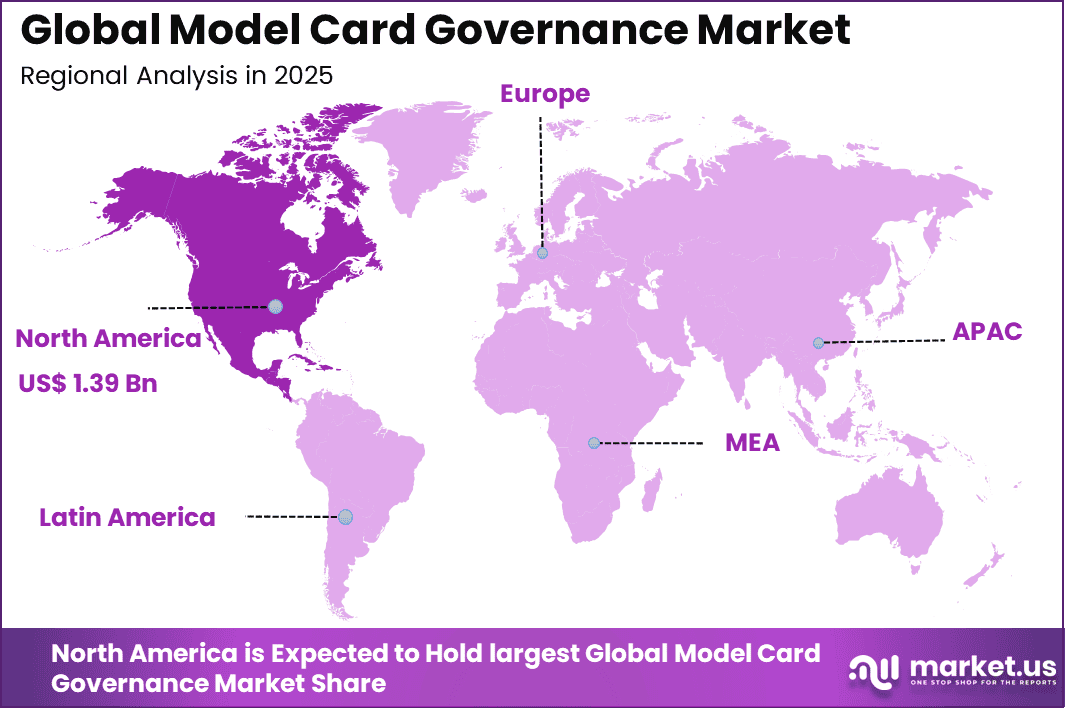
The Global Model Card Governance Market size is expected to be worth around USD 14.55 billion by 2035, from USD 3.66 billion in 2025, growing at a CAGR of 14.8% during the forecast period from 2025 to 2035. North America held a dominant market position, capturing more than a 38% share, holding USD 1.39 billion in revenue.
The Model Card Governance Market refers to the ecosystem of tools, frameworks, and processes designed to standardize, manage, and enforce documentation of artificial intelligence models through model cards. Model cards are structured documents that describe a model’s purpose, performance, limitations, and ethical considerations, enabling transparency and responsible deployment.
This market is emerging as a critical component of AI governance, where organizations aim to ensure accountability, traceability, and compliance across the entire lifecycle of machine learning systems. The primary driving factor for this market is the increasing need for transparency and explainability in AI systems. As AI models are being deployed in high impact sectors, stakeholders require clear documentation on how models function and perform across different conditions.
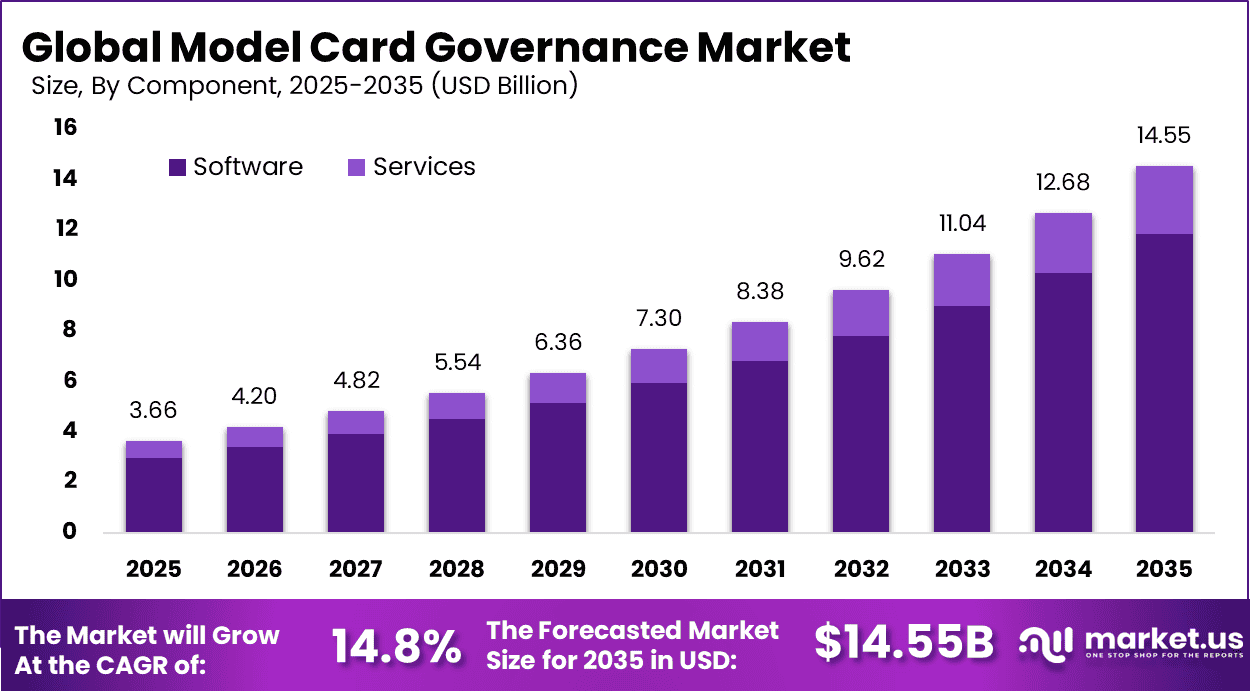
The market for Model Card Governance is driven by the growing need for transparency and control in AI systems used across industries. Organizations are focusing on clear documentation to manage risks, reduce bias, and improve trust in automated decisions. Increasing use of AI in critical operations is also pushing demand for structured governance practices that support better oversight and accountability.
Model cards are increasingly recognized as essential tools for transparency in AI systems, with 90% of developers acknowledging their importance and 70% recommending immediate adoption. They also play a critical role in identifying performance disparities, as seen in cases where a facial recognition model achieves 98% accuracy for light-skinned men but only 82% for dark-skinned women, highlighting the need for better visibility into bias and model behavior.
For instance, in September 2025, DataRobot acquired Credo AI to accelerate enterprise-ready model governance capabilities. The combined platform now offers automated lineage tracking across hybrid cloud environments, reducing compliance reporting time from weeks to hours. This acquisition positions DataRobot as the end-to-end AutoML + governance leader.
Key Takeaway
- In the model card governance market, software accounted for 81.3%, reflecting strong demand for governance and documentation platforms.
- Large enterprises held a dominant share of 72.1%, driven by broader AI deployment and higher compliance requirements.
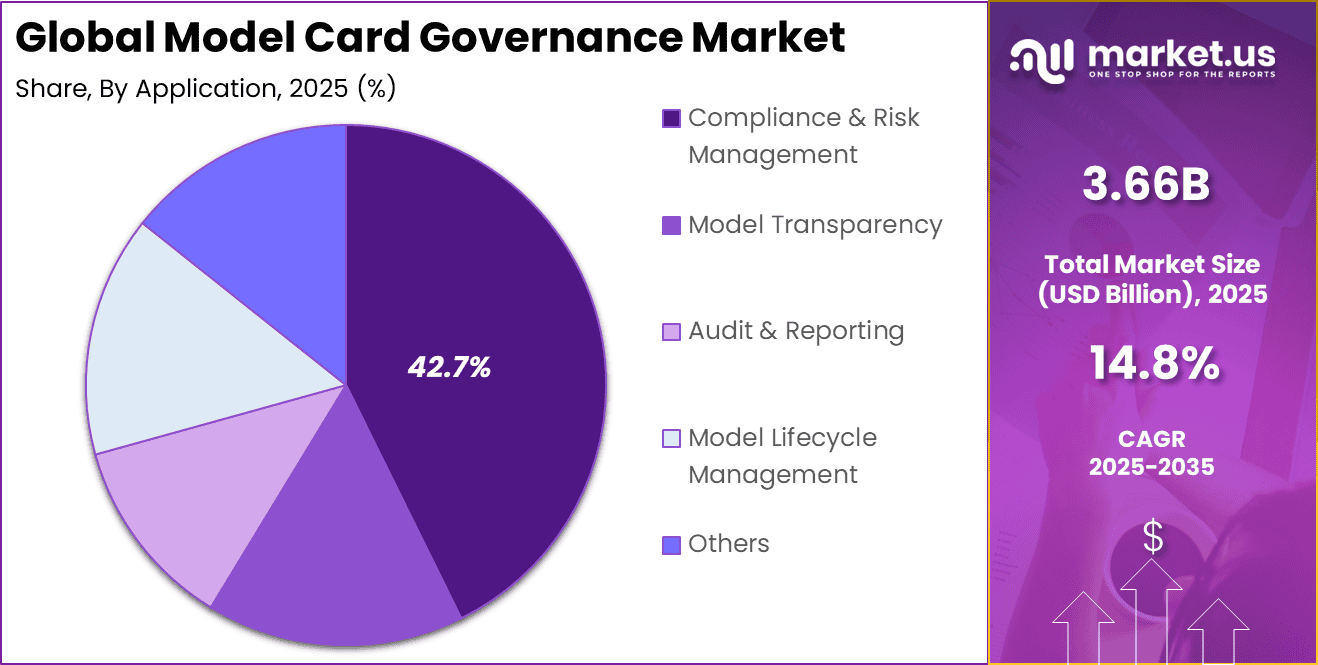
- Compliance and risk management led by application with 42.7%, highlighting the need for structured oversight of AI models.
- The BFSI sector represented 33.2%, making it the leading end-user segment in the market.
- North America held a leading share of 38% in the global market.
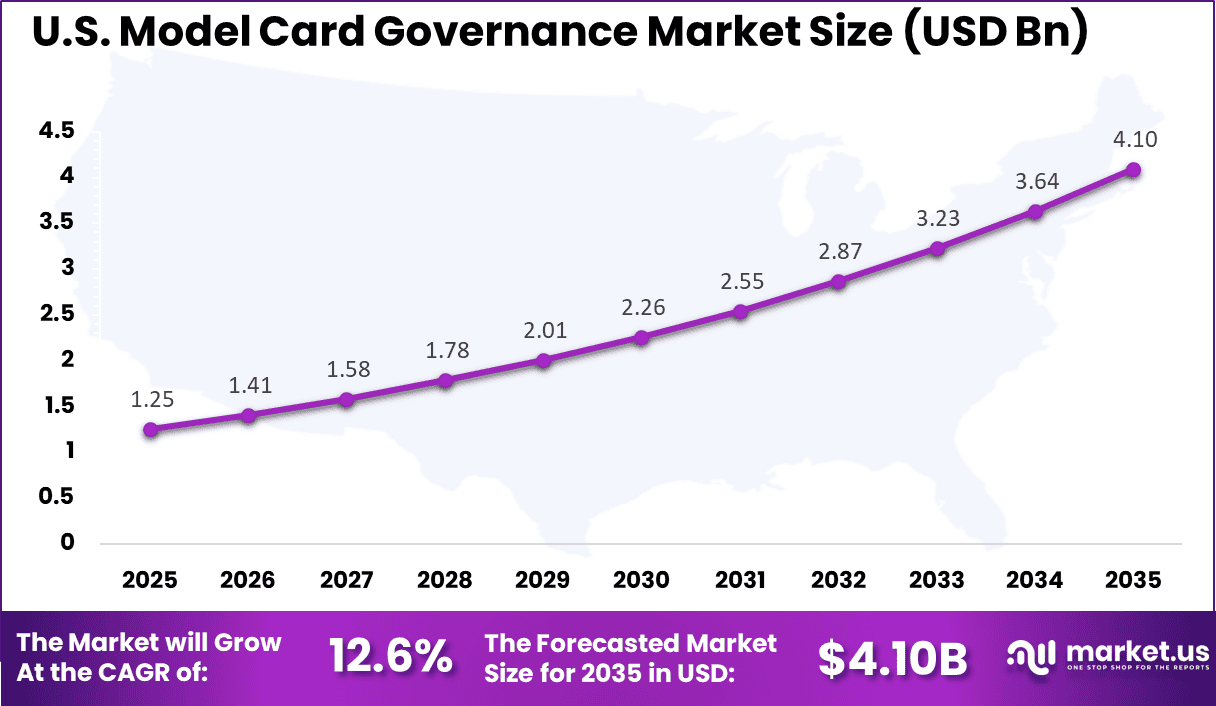
- The U.S. market was valued at USD 1.25 billion and is projected to grow at a CAGR of 12.6%.
Component Analysis
In 2025, The Software segment held a dominant market position, capturing a 81.3% share of the Global Model Card Governance Market. This dominance is due to the growing reliance on software tools that help manage and document AI models across their lifecycle. These solutions bring structure to model tracking and support consistent reporting, making it easier for teams to maintain clarity and control in complex AI environments.
Software platforms also improve coordination between development and compliance teams by offering centralized systems for governance. They help streamline updates, support audits, and reduce manual work. As AI adoption expands, organizations prefer software-driven approaches to ensure smooth operations and reliable model oversight.
For Instance, in April 2026, IBM launched updates to WatsonX.governance, adding a local server for secure AI agent operations on governance objects. This move helps teams automate model tracking while keeping full control and audit trails. It fits right into software’s lead by making oversight smoother for everyday AI builds, easing the burden on developers who juggle compliance daily.
Organization Size Analysis
In 2025, the Large Enterprises segment held a dominant market position, capturing a 72.1% share of the Global Model Card Governance Market. This dominance is due to the extensive use of AI systems across large enterprises, which creates a strong need for structured governance practices. These organizations handle multiple models at scale, making proper documentation and monitoring essential to maintain transparency and operational stability.
Large enterprises also have dedicated teams and resources to implement governance frameworks effectively. They focus on reducing risks and improving accountability in AI usage. Their ability to invest in advanced tools allows them to maintain strong control over model performance and compliance requirements.
For instance, in March 2026, Microsoft advanced its Responsible AI Standard with new impact assessments and tooling. It targets large-scale operations, ensuring teams meet fairness and accountability across deployments. For enterprises, this means easier integration into workflows, helping them handle volume without governance gaps.
Application Analysis
In 2025, The Compliance & Risk Management segment held a dominant market position, capturing a 42.7% share of the Global Model Card Governance Market. This dominance is due to the increasing importance of managing risks and meeting regulatory expectations in AI usage. Organizations rely on governance practices to ensure models operate fairly and transparently, especially in areas where decisions directly impact users and business outcomes.
Compliance-focused applications help identify potential issues early and support better decision-making. They also ensure that proper documentation is available for internal reviews and external audits. This makes governance tools a key part of maintaining trust and avoiding operational challenges in AI-driven environments.
For Instance, in March 2026, Google expanded AI responsibility tools in its latest progress report. Updates focus on transparency features that flag biases early in development. It strengthens risk management apps by embedding checks that make models safer before launch, a key win for compliance-focused teams.
End-User Analysis
In 2025, The BFSI segment held a dominant market position, capturing a 33.2% share of the Global Model Card Governance Market. This dominance is due to the high dependence on AI systems in financial services, where accuracy and transparency are critical. Institutions use governance practices to monitor models closely and ensure that decisions remain fair, reliable, and aligned with regulatory expectations.
The sector also faces strict oversight, which increases the need for clear documentation and accountability. Governance tools help manage risks and improve confidence among stakeholders. As AI use continues to grow in BFSI, structured model management remains essential for stable and secure operations.
For Instance, in November 2025, Microsoft detailed red teaming and content safety in its transparency report, with case studies on financial tools. This helps BFSI pros test models rigorously against threats. The focus on real-world safeguards like these drives trust in AI for sensitive sectors.
U.S. Model Card Governance Market Size
The market for Model Card Governance within the U.S. is growing tremendously and is currently valued at USD 1.25 billion; the market has a projected CAGR of 12.6%. The market is growing due to the rising use of AI across finance, healthcare, government, and enterprise operations.
Organizations are under pressure to improve transparency, reduce bias, and document how models are trained and used. Stronger focus on responsible AI, internal risk control, and regulatory readiness is also supporting demand. Businesses want clearer oversight tools to build trust and manage AI systems more effectively.
For instance, in March 2026, IBM enhanced WatsonX.governance with advanced model card automation, enabling seamless documentation of AI model risks and performance metrics. This Armonk-based leader solidified U.S. dominance by helping enterprises comply with emerging federal AI transparency mandates. IBM’s platform now supports lifecycle governance for generative AI, setting industry benchmarks for responsible deployment across regulated sectors.
In 2025, North America held a dominant market position in the Global Model Card Governance Market, capturing more than a 38% share, holding USD 1.39 billion in revenue. This dominance is due to its early and widespread adoption of AI across major industries such as finance, healthcare, and technology.
The region has a strong focus on responsible AI practices, risk management, and regulatory preparedness. Organizations in North America are investing more in transparency tools to track model performance, reduce bias, and improve trust, which continues to support strong market leadership.
For instance, in February 2026, Google launched Responsible AI Standard updates within Vertex AI, mandating comprehensive model cards for all enterprise deployments. From Mountain View, this initiative strengthened North America’s leadership by integrating bias audits and ethical documentation into cloud workflows. Google’s standardized model cards now serve millions of developers, driving transparency in production AI systems globally.
Emerging Trends Analysis
Model card governance is evolving as a central component of responsible AI frameworks, driven by the increasing need for transparency and accountability in AI systems. Model cards are now widely adopted as standardized documentation that explains model purpose, performance, limitations, and risks, enabling stakeholders to better understand AI behavior.
Model cards are being integrated into enterprise AI workflows to ensure consistent reporting across development and deployment stages. This trend is reinforced by regulatory expectations, where structured documentation is becoming essential for compliance and audit readiness. Another important trend is the expansion from basic documentation to lifecycle governance. Organizations are moving beyond static reports toward dynamic, version-controlled model cards that track updates, approvals, and risk assessments over time.
Platforms such as Amazon SageMaker Model Cards support automated documentation, audit trails, and governance workflows, allowing enterprises to manage models throughout their lifecycle. This shift reflects a broader move toward integrating governance into MLOps and ModelOps environments, where documentation becomes a living control mechanism rather than a one-time artifact.
Growth Factors
The primary growth factor is the rapid adoption of AI across industries, which has increased the need for structured governance frameworks. As AI models are deployed in high-impact sectors such as healthcare, finance, and public services, organizations are required to document how models function, what data they use, and where risks may arise.
Model cards provide a standardized way to capture this information, making them essential for operational transparency and decision-making. Another key growth factor is the rising importance of regulatory compliance and risk management. Global frameworks such as the EU AI Act and NIST AI Risk Management Framework recommend or require documentation similar to model cards for high-risk AI systems.
This regulatory push is encouraging enterprises to adopt governance tools that can demonstrate accountability, reduce legal exposure, and ensure ethical AI usage. As a result, model card governance is becoming a foundational requirement rather than an optional practice.
Key Market Segments
By Component
- Software
- Services
By Organization Size
- Large Enterprises
- SMEs
By Application
- Compliance & Risk Management
- Model Transparency
- Audit & Reporting
- Model Lifecycle Management
- Others
By End-User
- BFSI
- Healthcare
- Retail
- Government
- Manufacturing
- Others
Key Regions and Countries
North America
- US
- Canada
Europe
- Germany
- France
- The UK
- Spain
- Italy
- Russia
- Netherlands
- Rest of Europe
Asia Pacific
- China
- Japan
- South Korea
- India
- Australia
- Singapore
- Thailand
- Vietnam
- Rest of APAC
Latin America
- Brazil
- Mexico
- Rest of Latin America
Middle East & Africa
- South Africa
- Saudi Arabia
- UAE
- Rest of MEA
Top Use Cases
One of the most prominent use cases is AI model auditing and compliance reporting. Model cards are used to document performance metrics, bias evaluations, and intended use cases, allowing compliance teams to assess whether a model meets internal and external standards. This is particularly critical in regulated sectors, where organizations must demonstrate that AI systems operate within defined boundaries and do not introduce unintended risks.
Another major use case is model selection and deployment decision-making. Developers and business teams rely on model cards to compare models based on performance, limitations, and suitability for specific applications. By providing a clear snapshot of each model’s capabilities, model cards help organizations avoid misuse and ensure that AI systems are applied in appropriate contexts, improving both efficiency and reliability.
Driver Analysis
A key driver for this market is the growing demand for explainable and trustworthy AI systems. Organizations are under pressure to demonstrate how AI decisions are made, especially when outcomes affect customers, employees, or public services. Model cards address this need by offering structured insights into model behavior, including performance across different population groups and known limitations. This enhances trust and supports informed decision-making across stakeholders.
Another driver is the increasing complexity of AI models, particularly with the rise of large-scale machine learning systems. As models become more advanced, understanding their behavior becomes more difficult, even for developers. Model cards act as simplified, standardized summaries that make complex systems more accessible, enabling broader adoption and safer deployment of AI technologies across enterprises.
Restraint Analysis
One major restraint is the lack of standardization and consistency in model card implementation. While the concept is widely accepted, there is no single universal format, leading to variations in quality, completeness, and usability. Some organizations provide detailed documentation, while others offer minimal information, reducing the effectiveness of model cards as a governance tool.
Another restraint is the additional operational effort required to create and maintain model cards. Developing comprehensive documentation requires collaboration between data scientists, compliance teams, and business stakeholders. This process can be time-consuming and resource-intensive, particularly for organizations managing large volumes of models, which may slow adoption in smaller enterprises or early-stage AI deployments.
Opportunity Analysis
A significant opportunity lies in the integration of model card governance with automated AI lifecycle management platforms. As enterprises adopt ModelOps practices, there is growing demand for tools that can automatically generate, update, and validate model cards. This creates opportunities for vendors to offer solutions that combine governance, monitoring, and reporting into a unified platform, improving efficiency and scalability.
Another opportunity is the expansion of model card governance into emerging AI systems such as generative AI and autonomous agents. New frameworks like policy cards are being developed to extend governance into runtime decision-making, enabling continuous compliance and real-time risk management. This evolution indicates that model card governance will expand beyond static documentation to become an active component of AI system control.
Challenge Analysis
One of the main challenges is ensuring the accuracy and completeness of model card information. Since model cards rely on self-reporting by developers, there is a risk of incomplete or biased documentation. Studies have shown that important sections such as limitations and environmental impact are often underreported, which can reduce the reliability of model cards as governance tools.
Another challenge is aligning model card governance with evolving regulatory and ethical standards. As AI regulations continue to develop globally, organizations must continuously update their documentation practices to remain compliant. This requires ongoing investment in governance frameworks, training, and monitoring systems, making it difficult for some organizations to keep pace with regulatory changes while maintaining operational efficiency.
Key Players Analysis
The competitive landscape of the Model Card Governance Market is led by major technology firms such as IBM, Google, and Microsoft. These companies focus on responsible AI frameworks and transparency tools. Their platforms support documentation, monitoring, and auditability of machine learning models. Adoption of AI governance tools has increased by over 30% among enterprises to ensure compliance and trust. Salesforce and AWS also contribute by embedding governance features within cloud ecosystems.
Specialized AI and analytics providers such as SAS, H2O.ai, and DataRobot are strengthening model governance capabilities through automated documentation and lifecycle management. These platforms enable consistent model validation and risk assessment. Enterprises using such tools have reported up to 25% improvement in model reliability and compliance tracking. Alteryx and TIBCO further support governance through advanced data integration and analytics workflows.
Emerging and niche players such as Domino Data Lab, Dataiku, RapidMiner, MathWorks, and ModelOp are driving innovation in model governance practices. These firms offer tools for model monitoring, explainability, and regulatory alignment. Adoption of model lifecycle management solutions has grown by nearly 20% as organizations scale AI deployments. Other players continue to enter the market with domain specific governance solutions.
Top Key Players in the Market
- IBM
- Microsoft
- Salesforce
- SAS
- H2O.ai
- DataRobot
- AWS
- Alteryx
- TIBCO
- Domino Data Lab
- Dataiku
- RapidMiner
- MathWorks
- ModelOp
- Others
Recent Developments
- In February 2026, Salesforce embedded Model Card Governance into Einstein Trust Layer, automatically generating compliance documentation for every AI model deployed in Salesforce CRM. The solution cuts governance overhead by 75% while maintaining audit-ready transparency across 200+ countries. This makes Salesforce the practical choice for customer-facing AI deployments.
- In January 2026, H2O.ai launched Driverless Governance, automating model card creation with one-click fairness audits and drift alerts. Processing 10,000+ models daily across North American enterprises, H2O.ai makes governance accessible even for teams without dedicated MLOps engineers. Their approach prioritizes practical usability over theoretical perfection.
Report Scope
| Report Features | Description |
|---|---|
| Market Value (2024) | USD 3.6 Bn |
| Forecast Revenue (2034) | USD 14.5 Bn |
| CAGR(2025-2034) | 14.8% |
| Base Year for Estimation | 2024 |
| Historic Period | 2020-2023 |
| Forecast Period | 2025-2034 |
| Report Coverage | Revenue forecast, AI impact on Market trends, Share Insights, Company ranking, competitive landscape, Recent Developments, Market Dynamics and Emerging Trends |
| Segments Covered | By Component (Software, Services), By Organization Size (Large Enterprises, SMEs), By Application (Compliance & Risk Management, Model Transparency, Audit & Reporting, Model Lifecycle Management, Others), By End-User (BFSI, Healthcare, Retail, Government, Manufacturing, Others) |
| Regional Analysis | North America – US, Canada; Europe – Germany, France, The UK, Spain, Italy, Russia, Netherlands, Rest of Europe; Asia Pacific – China, Japan, South Korea, India, New Zealand, Singapore, Thailand, Vietnam, Rest of Latin America; Latin America – Brazil, Mexico, Rest of Latin America; Middle East & Africa – South Africa, Saudi Arabia, UAE, Rest of MEA |
| Competitive Landscape | IBM, Google, Microsoft, Salesforce, SAS, H2O.ai, DataRobot, AWS, Alteryx, TIBCO, Domino Data Lab, Dataiku, RapidMiner, MathWorks, ModelOp, Others |
| Customization Scope | Customization for segments, region/country-level will be provided. Moreover, additional customization can be done based on the requirements. |
| Purchase Options | We have three license to opt for: Single User License, Multi-User License (Up to 5 Users), Corporate Use License (Unlimited User and Printable PDF) |