


Global MEMS Oscillator Market Size, Share, Industry Analysis Report By Type (Temperature Compensated Oscillator (TCXO), Spread Spectrum Oscillator (SSXO), Voltage Control Oscillator (VCXO), Digitally Controlled Oscillator (DCXO), Other), By General Circuitry (Simple Packaged MEMS Oscillator (SPMO), Temperature-Compensated MEMS Oscillator (TCMO), Voltage-Controlled MEMS Oscillator (VCMO), Frequency Select MEMS Oscillator (FSMO), Digitally Controlled MEMS Oscillator (DCMO), Spread-Spectrum MEMS Oscillator (SSMO)), By Packaging Type (Surface-Mount Device Package, Chip-Scale Package), By Band (MHz Band, kHz Band), By Application (Networking, Consumer Electronics, Industrial, Automotive, Wearables and Internet of Things, Mobile Devices, Military and Aerospace, Others), By Region, Global Opportunity Analysis, Future Outlook and Industry Trends Forecast 2025-2034
- Published date: Sept. 2025
- Report ID: 158173
- Number of Pages: 312
- Format:
-
keyboard_arrow_up
Quick Navigation
- Report Overview
- Key Insight Summary
- Analysts’ Viewpoint
- Investment and Business Benefits
- Role of Generative AI
- US Market Size
- Emerging Trends
- Growth Factors
- By Type Analysis
- By General Circuitry Analysis
- By Packaging Type Analysis
- By Band Analysis
- By Application Analysis
- Key Market Segments
- Driver Analysis
- Restraint Analysis
- Opportunity Analysis
- Challenge Analysis
- Competitive Analysis
- Recent Developments
- Report Scope
Report Overview
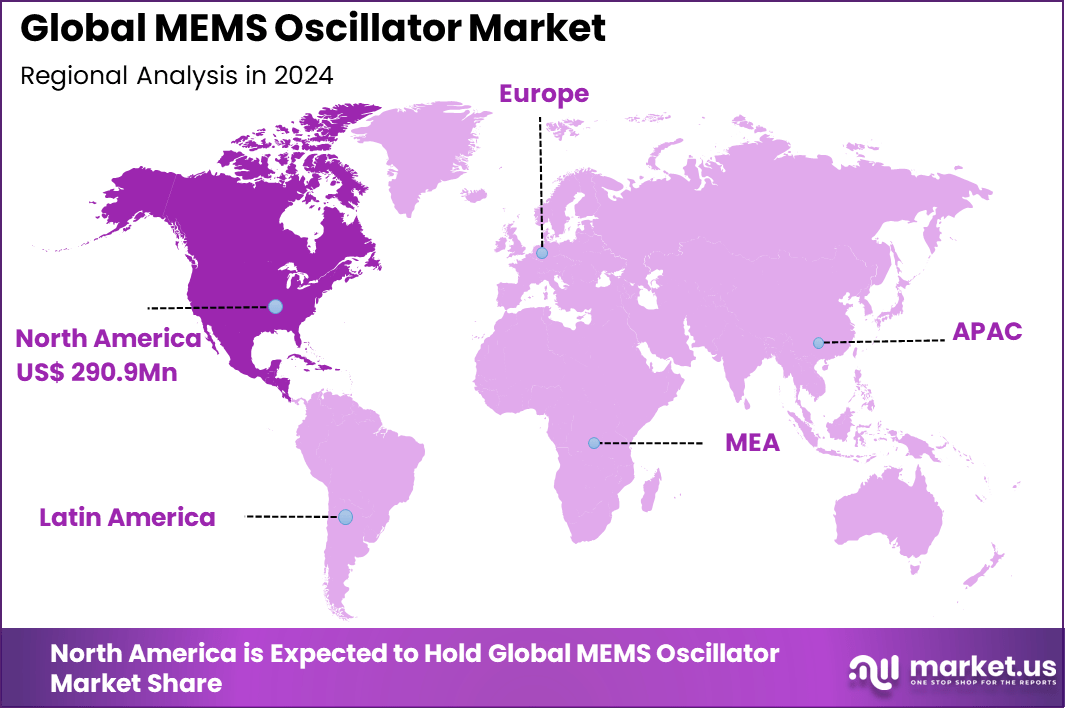
The Global MEMS Oscillator Market size is expected to be worth around USD 2,460.2 Million By 2034, from USD 757.6 Million in 2024, growing at a CAGR of 12.5% during the forecast period from 2025 to 2034. In 2024, North America held a dominan market position, capturing more than a 38.4% share, holding USD 290.9 Million revenue.
The MEMS Oscillator Market refers to the industry focused on micro-electromechanical system (MEMS) based oscillators, which generate precise timing signals used in electronic devices. These oscillators serve as alternatives to traditional quartz crystal oscillators, offering advantages in size, robustness, and power efficiency.
MEMS oscillators are used in applications such as smartphones, wearables, automotive electronics, data centers, industrial equipment, and telecommunications infrastructure. The market encompasses oscillator designs, integrated circuits, packaging solutions, and supporting software for timing control.
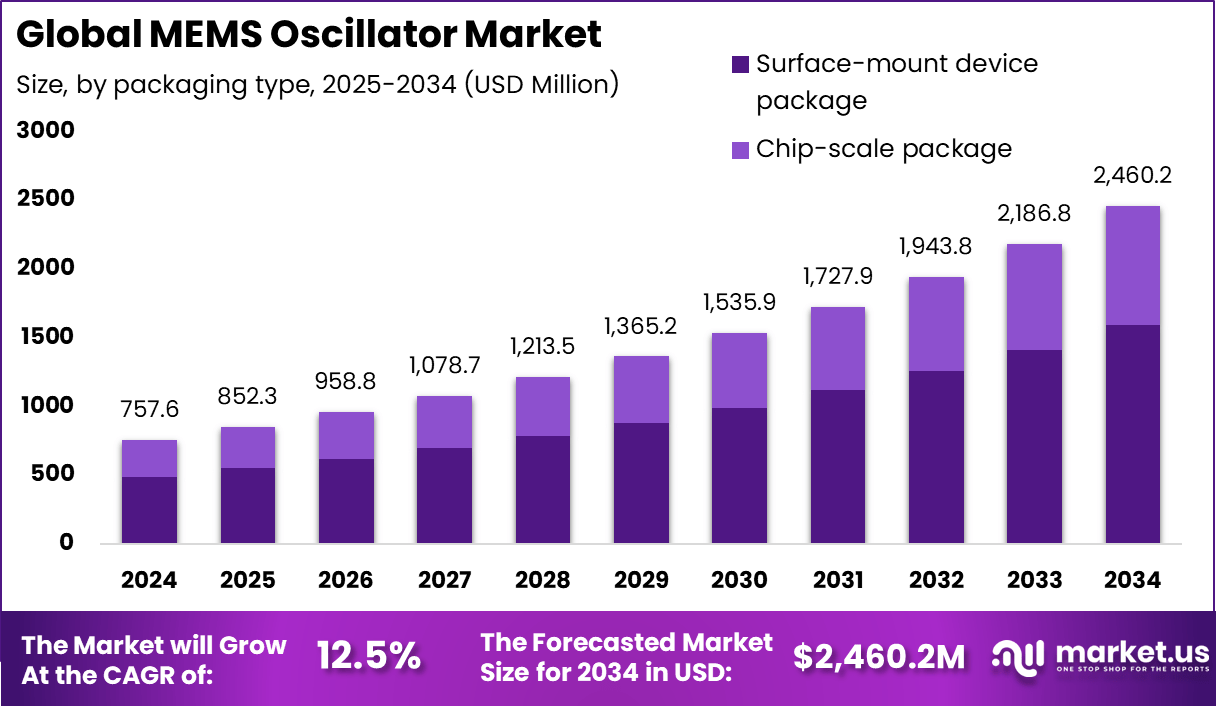
The market is driven by increasing demand for compact, reliable, and energy-efficient timing solutions in modern electronics. The growing adoption of connected devices, IoT systems, and wearable technologies is boosting demand for small form-factor oscillators. The need for precise timing in high-speed data transmission and wireless communication is another key driver.
Automotive applications, including advanced driver assistance systems and infotainment, are also fueling market growth due to the demand for robust oscillators that can withstand harsh environments. In addition, the limitations of quartz oscillators, such as fragility and slower startup times, are pushing industries to adopt MEMS alternatives.
Key Insight Summary
- By Type, Temperature Compensated Oscillator (TCXO) held the leading share at 37.7%, favored for its high frequency stability in varying environmental conditions.
- By General Circuitry, Simple Packaged MEMS Oscillator (SPMO) dominated with 28.7%, driven by cost-effectiveness and suitability for mass-market applications.
- By Packaging Type, Surface-Mount Device (SMD) package accounted for 64.7%, reflecting widespread adoption due to compactness and ease of integration in electronic devices.
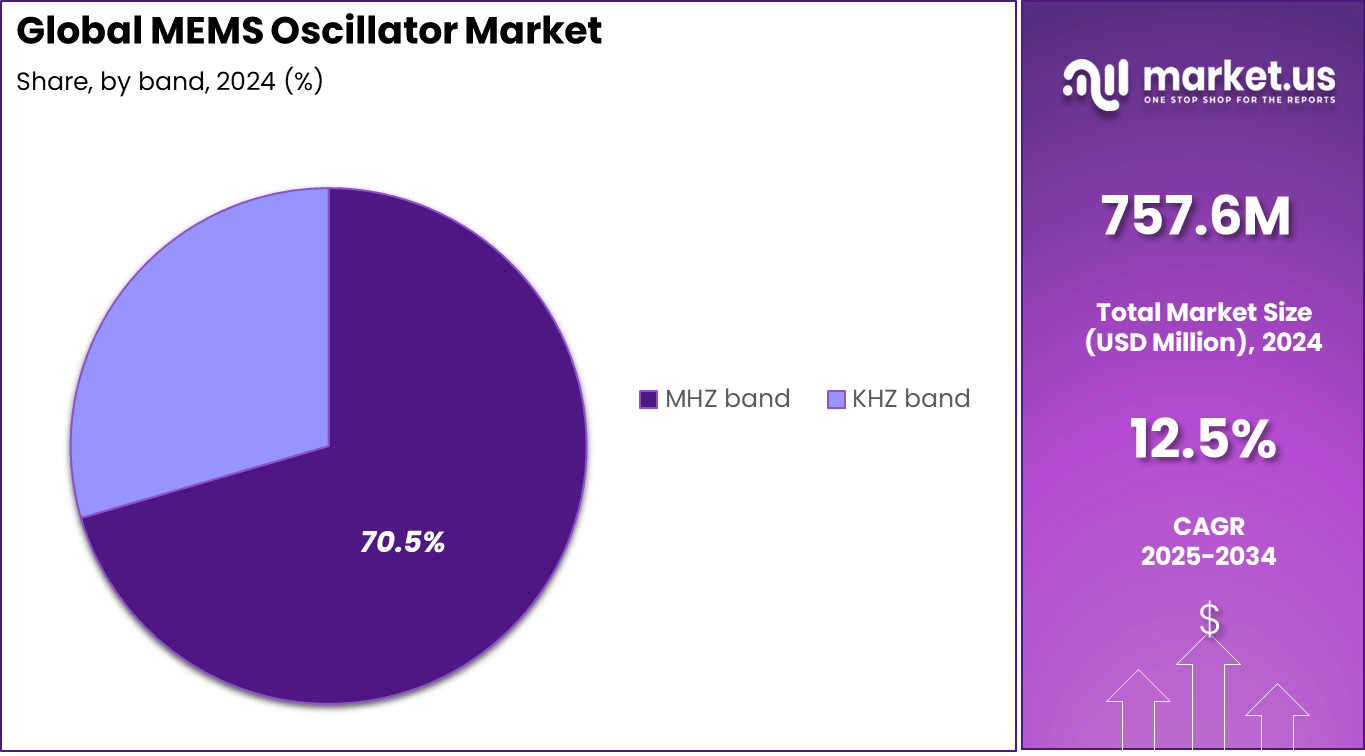
- By Band, the MHz band led the market, capturing 70.5%, supported by extensive use in consumer electronics, communication systems, and IoT devices.
- By Application, the Networking segment dominated with 28.6%, highlighting the critical role of MEMS oscillators in data centers, telecom infrastructure, and cloud connectivity.
Analysts’ Viewpoint
Increasing adoption of MEMS oscillator technologies is driven by silicon MEMS and Bulk Acoustic Wave (BAW) technologies. Silicon MEMS is favored for its reliability, cost-effectiveness, and long-term performance in mobile and industrial devices. BAW technology supports high-frequency, low-loss applications, meeting demands for precision in 5G wireless communications and critical aerospace uses.
These technologies appeal because of their compactness, power efficiency, and environmental resilience. Key reasons for adopting MEMS oscillators include their compact form factor, high durability against shock and temperature extremes, and integration ease with semiconductor manufacturing.
They streamline design with programmable frequency trimming, allowing flexibility late in the product development cycle without costly PCB redesigns. Their energy efficiency is particularly advantageous in battery-operated devices, while automotive industries value their performance in challenging conditions.
Investment and Business Benefits
Investment opportunities in the MEMS Oscillator Market arise from the expanding use in consumer electronics, automotive, and IoT sectors. The continuous technological advancements, including improved fabrication and packaging, provide fertile ground for innovation investments.
Government initiatives promoting electronics manufacturing and increasing automotive electrification offer additional incentives for capital infusion into research and production capacity. Business benefits of integrating MEMS oscillators revolve around improved product reliability, reduced power consumption, and enhanced performance stability.
Companies benefit from simplified supply chains through the use of programmable parts and from meeting the demand for increasingly compact, high-performance devices. The regulatory environment affecting MEMS oscillators focuses on quality standards, environmental regulations, and industry-specific certifications.
Automotive and aerospace sectors impose strict requirements for reliability and endurance, driving manufacturers to meet rigorous testing and qualification protocols. Regional regulatory frameworks often encourage local production and innovation, further shaping the market landscape.
Role of Generative AI
The role of generative AI in the MEMS oscillator sector is becoming increasingly significant. Generative AI models help optimize the design and performance of MEMS oscillators by simulating various real-world environmental factors, such as temperature fluctuations and vibrations, which affect oscillator stability and accuracy.
This accelerates design iterations and reduces development time without compromising quality. AI-driven problem-solving techniques are also poised to create smarter, self-calibrating oscillator systems that can adapt to manufacturing variations and operational stresses more efficiently, advancing precision in timing components essential for critical applications.
US Market Size
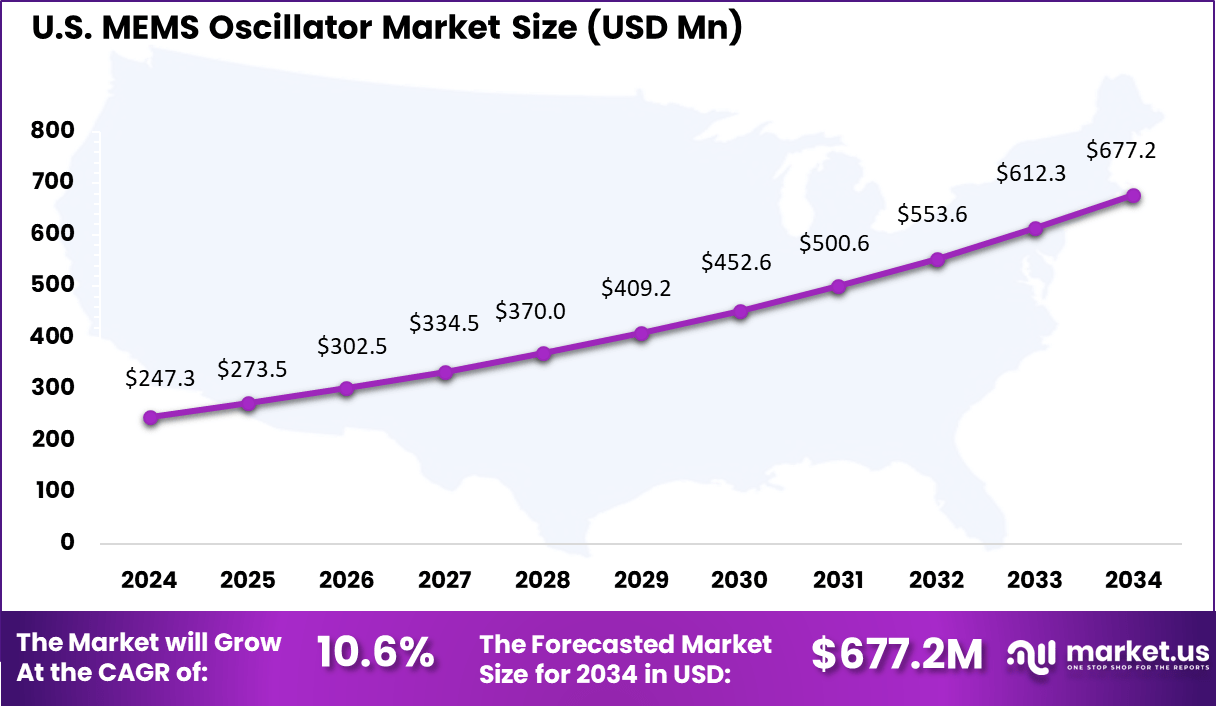
The U.S. MEMS Oscillator Market was valued at USD 247.3 Million in 2024 and is anticipated to reach approximately USD 677.2 Million by 2034, expanding at a compound annual growth rate (CAGR) of 10.6% during the forecast period from 2025 to 2034.
In 2024, North America held a dominant market position, capturing more than 38.4% share and generating USD 290.9 million in revenue in the MEMS oscillator market. The region’s leadership is strongly influenced by its advanced semiconductor ecosystem, high demand for precision timing devices, and the widespread use of MEMS oscillators in consumer electronics, automotive systems, telecommunications, and industrial applications.
The United States, in particular, remains a hub for technological innovation, with major companies investing heavily in the integration of MEMS-based solutions to replace traditional quartz oscillators due to their reliability, low power consumption, and compact size.
North America’s dominance is also supported by growing adoption of 5G networks, IoT devices, and autonomous systems, all of which require highly stable and efficient timing solutions. The region benefits from early adoption of advanced electronic components in critical sectors such as aerospace and defense, where performance and accuracy are paramount.
Emerging Trends
Emerging trends in MEMS oscillators include the drive toward further miniaturization, ultra-low power consumption, and enhanced integration with digital and analog circuits at the chip level. This is in response to the growing demand from diverse industries such as consumer electronics, automotive, industrial automation, and 5G communications.
Advanced manufacturing techniques, such as wafer-level packaging, are improving mechanical stability and longevity, allowing MEMS oscillators to function reliably in harsh environments. Additionally, the shift toward higher-frequency oscillators to support 5G infrastructure and edge computing is creating new innovation demands.
Growth Factors
Several growth factors underpin the increasing adoption of MEMS oscillators. The surge in consumer electronic devices, including smartphones and wearable gadgets, is a primary driver due to MEMS oscillators’ smaller footprints and low energy consumption compared to traditional quartz technology.
The automotive sector also plays a vital role, particularly with the widespread integration of advanced driver-assistance systems and electric vehicles, where precise timing is critical. Expanding applications in industrial automation and IoT devices further boost demand.
The ongoing deployment of 5G networks puts additional pressure on oscillator performance, pushing manufacturers to innovate continuously. Despite challenges such as supply chain disruptions and technological constraints at very high frequencies, recent research and development efforts have focused on overcoming these barriers.
By Type Analysis
In 2024, The Temperature Compensated Oscillator (TCXO) segment holds a significant share of 37.7% in the MEMS oscillator market due to its precision and stability. TCXOs are preferred when accurate frequency output is necessary despite temperature fluctuations.
Compared to basic oscillators, TCXOs maintain superior frequency stability under varying environmental conditions, which makes them ideal for applications like telecommunications, GPS, and automotive electronics. Their ability to resist degradation from temperature changes and mechanical vibrations has driven strong adoption in sectors requiring high reliability.
With the growing deployment of 5G networks and connected devices, the demand for TCXOs continues to rise. These oscillators effectively replace more costly options like OCXOs by offering robust performance at a lower price and smaller package. Innovations such as integrating two MEMS resonators on a single chip help eliminate issues seen in traditional quartz TCXOs, enhancing both performance and durability.
By General Circuitry Analysis
In 2024, the Simple Packaged MEMS Oscillator (SPMO) segment accounts for 28.7% of the market and is favored for its cost-effectiveness and compact design. Unlike TCXOs, SPMOs lack temperature compensation circuits but remain popular in applications where moderate frequency stability is sufficient.
This makes SPMOs a go-to choice for consumer electronics, IoT devices, and wearables that require stable oscillation yet operate under less stringent accuracy demands. Their simple structure facilitates high-volume production and supports growing requirements for miniaturized components.
SPMOs are widely used in devices with low-power constraints where budget is a critical factor but stable timing remains necessary. These oscillators provide a balance of performance and affordability, supporting rapid market adoption. Despite lower precision, their reliability and smaller footprint have made them essential in the wearable and portable electronics segment, further driving the overall MEMS oscillator market’s growth.
By Packaging Type Analysis
In 2024, Surface-Mount Device (SMD) packaging dominates the MEMS oscillator market with a share of 64.7%. This packaging type offers major advantages related to assembly efficiency, size reduction, and cost savings.
SMD packages are designed for automated mounting on printed circuit boards, making them ideal for mass production environments. Their small footprint and contact reliability make them essential for modern electronic devices that demand compact and scalable solutions. The widespread adoption of SMD packages is heavily influenced by the rising demand for miniaturization in consumer electronics, telecommunications infrastructure, and automotive devices.
Compared with alternatives like chip-scale packages, SMD packages provide easier handling and better compatibility with existing manufacturing processes. This segment also benefits from global trends toward more integrated and complex electronic systems requiring high-performance oscillators in small form factors.
By Band Analysis
In 2024, MEMS oscillators operating in the MHz frequency band lead the market with a dominant share of 70.5%. These oscillators cater to high-speed communication applications, including networking equipment, servers, and data centers, which require precise timing and signal integrity at medium frequencies.
The MHz band is critical for synchronous operations, network timing, and data processing, all essential in expanding telecom infrastructure like 5G and cloud computing. The strong preference for MHz band oscillators is driven by their ability to deliver low jitter, enhanced signal quality, and robust frequency stability under challenging conditions.
They are favored in mission-critical networking and telecommunications environments where maintaining data accuracy and low latency is paramount. This segment’s dominance reflects broader market trends emphasizing high-frequency, reliable timing solutions for increasingly complex digital networks.
By Application Analysis
In 2024, the networking application segment holds 28.6% market share, underscoring the vital role MEMS oscillators play in data communication and network infrastructure. As networking environments demand precise synchronization and timing, MEMS oscillators are integral to telecom equipment, servers, routers, and switches.
They support jitter reduction, timing accuracy, and overall network stability, which are crucial for maintaining high data throughput and reduced errors in modern networks. This segment’s growth is propelled by the rapid expansion of broadband, 5G deployments, and cloud data centers that require scalable and reliable timing components.
MEMS oscillators tailored for networking applications offer enhanced performance features such as temperature stability, vibration resistance, and long operational life, making them preferred timing sources. The networking segment’s leading share highlights the increasing reliance on MEMS technology to support global communication demands.
Key Market Segments
By Type
- Temperature compensated oscillator (TCXO)
- Spread spectrum oscillator (SSXO)
- Voltage control oscillator (VCXO)
- Digitally controlled oscillator (DCXO)
- Other
By General Circuitry
- Simple packaged mems oscillator (SPMO)
- Temperature-compensated mems oscillator (TCMO)
- Voltage-controlled mems oscillator (VCMO)
- Frequency select mems oscillator (FSMO)
- Digitally controlled mems oscillator (DCMO)
- Spread-spectrum mems oscillator (SSMO)
By Packaging Type
- Surface-mount device package
- Chip-scale package
By Band
- MHZ band
- KHZ band
By Application
- Networking
- Consumer electronics
- Industrial
- Automotive
- Wearables and internet of things
- Mobile devices
- Military and aerospace
- Others
Regional Analysis and Coverage
- North America
- US
- Canada
- Europe
- Germany
- France
- The UK
- Spain
- Italy
- Russia
- Netherlands
- Rest of Europe
- Asia Pacific
- China
- Japan
- South Korea
- India
- Australia
- Singapore
- Thailand
- Vietnam
- Rest of Latin America
- Latin America
- Brazil
- Mexico
- Rest of Latin America
- Middle East & Africa
- South Africa
- Saudi Arabia
- UAE
- Rest of MEA
Driver Analysis
Growing Demand for Miniaturized Electronic Devices
The demand for smaller, energy-efficient, and highly reliable components has driven the adoption of MEMS oscillators significantly. Consumer electronics such as smartphones, wearables, and Internet of Things (IoT) devices require compact timing components that occupy less space and consume less power.
MEMS technology perfectly meets these needs, enabling seamless integration into space-constrained devices, which fuels market growth. The rise in 5G infrastructure deployment and automotive electronics requiring precise timing also strengthens this driver, as MEMS oscillators offer better shock resistance and operational stability in harsh environments compared to traditional quartz oscillators.
This trend is evident in the strong market projections where Asia-Pacific and North America lead demand due to their expanding electronics manufacturing hubs and adoption of advanced technologies. These regions contribute significantly to expanding use cases spanning telecommunications, automotive, and industrial automation.
Restraint Analysis
High Manufacturing Costs
One significant restraint for the MEMS oscillator market is the high production cost associated with the fabrication process. MEMS devices demand specialized equipment and cleanroom facilities, making their manufacturing more expensive than traditional quartz oscillators.
This cost factor can limit entry for smaller manufacturers and reduce price competitiveness, especially in regions sensitive to production expenses. The precision required in the calibration and integration of MEMS oscillators into electronic systems also adds complexity, leading to longer development cycles and increased overall project costs.
This restraint may slow the market growth in price-competitive segments and regions where cost is a major deciding factor for manufacturers and consumers. Despite technological advances, the challenge of balancing manufacturing costs with performance features remains a critical barrier. Unless companies aggressively innovate to scale production efficiently or reduce costs, this restraint could moderate some of the rapid market expansion expected from demand growth.
Opportunity Analysis
Expansion of IoT and 5G Technology
The proliferation of IoT devices presents a substantial opportunity for MEMS oscillators. As billions of connected devices come online, they require reliable, compact, and low-power timing solutions to function effectively across diverse applications including smart homes, industrial systems, healthcare, and transportation.
MEMS oscillators are well-suited for these conditions due to their small size and energy efficiency. With the expected surge in IoT devices surpassing 30 billion by 2030, this market segment offers a vast growth frontier. Moreover, the ongoing global rollout of 5G networks drives demand for oscillators capable of operating at higher frequencies with precision timing.
5G technology requires synchronization with minimal jitter to support high-speed data transfer, making MEMS oscillators crucial components in communication infrastructure. Investment and innovation in MEMS oscillators designed for 5G applications can create strong business prospects in the near future, especially as manufacturers seek components that combine high performance with miniaturized form factors.
Challenge Analysis
Integration Complexity and Technological Limitations
A key challenge in the MEMS oscillator market is the complexity involved in integrating MEMS devices into existing or new electronic systems. MEMS oscillators require precise calibration and customization to meet specific application requirements, which can prolong product development times and increase costs.
This integration complexity demands high engineering expertise and makes it more difficult to achieve mass-market scalability quickly. Additionally, MEMS technology still faces limitations in achieving very high frequency ranges compared to some traditional oscillators. The continuous push for higher frequencies, especially for advanced communication and industrial automation needs, puts pressure on MEMS manufacturers to innovate rapidly.
Failure to improve frequency capabilities and reduce integration hurdles could constrain broader adoption, particularly in sectors demanding ultra-high precision and performance. These challenges necessitate ongoing R&D efforts to enhance MEMS technology and simplify integration processes.
Competitive Analysis
In the MEMS oscillator market, SiTime Corporation and Microchip Technology Inc. lead with strong product portfolios and technological expertise. Their dominance is driven by high-performance solutions used in consumer electronics, automotive, and communication systems. With a focus on precision timing, miniaturization, and energy efficiency, these companies have built a strong presence across global markets.
Other notable players such as Vectron International, Abracon Holdings, Jauch Quartz GmbH, IQD Frequency Products, and Raltron Electronics Corporation contribute with diverse offerings tailored to industrial, medical, and IoT applications. Their ability to provide reliable, customized oscillators enables them to serve niche segments where stability and performance are critical.
Japanese manufacturers including Epson, Murata, and Kyocera Corporation, along with NXP, play a key role in driving innovation. Their expertise in electronics, semiconductors, and frequency control products supports wide adoption of MEMS oscillators in automotive safety systems, smartphones, and wireless infrastructure. These players are well-positioned to capture growing demand for compact, durable, and cost-efficient timing solutions across multiple industries.
Top Key Players in the Market
- SiTime Corporation
- Microchip Technology Inc.
- Vectron International
- Abracon Holdings
- Jauch Quartz GmbH
- IQD Frequency Products Ltd
- Raltron Electronics Corporation
- NXP
- Epson
- Murata
- Kyocera Corporation
- Others
Recent Developments
- In January 2024, SiTime, a leading MEMS oscillator company, acquired a smaller MEMS oscillator startup to expand its portfolio and strengthen its market position. This move underlines the industry’s trend of consolidation as key players aim to broaden their technology offerings and enhance competitiveness.
- In May 2024, STMicroelectronics and Texas Instruments entered a strategic partnership to co-develop next-generation MEMS oscillator technologies. This collaboration is designed to broaden their product portfolios and reinforce their positions in the fast-expanding MEMS oscillator market, where demand for high-performance timing solutions continues to rise.
- In August 2024, Sensirion AG completed the acquisition of Vesper Technologies, a U.S.-based specialist in MEMS microphones and sensors. The deal is set to enhance Sensirion’s product range and strengthen its foothold in the global MEMS sensor market, enabling the company to capture new growth opportunities across consumer electronics and industrial applications.
Report Scope
Report Features Description Market Value (2024) USD 757.6 Mn Forecast Revenue (2034) USD 2,460.2 Mn CAGR(2025-2034) 12.5% Base Year for Estimation 2024 Historic Period 2020-2023 Forecast Period 2025-2034 Report Coverage Revenue forecast, AI impact on Market trends, Share Insights, Company ranking, competitive landscape, Recent Developments, Market Dynamics and Emerging Trends Segments Covered By Type (Temperature Compensated Oscillator (TCXO), Spread Spectrum Oscillator (SSXO), Voltage Control Oscillator (VCXO), Digitally Controlled Oscillator (DCXO), Other), By General Circuitry (Simple Packaged MEMS Oscillator (SPMO), Temperature-Compensated MEMS Oscillator (TCMO), Voltage-Controlled MEMS Oscillator (VCMO), Frequency Select MEMS Oscillator (FSMO), Digitally Controlled MEMS Oscillator (DCMO), Spread-Spectrum MEMS Oscillator (SSMO)), By Packaging Type (Surface-Mount Device Package, Chip-Scale Package), By Band (MHz Band, kHz Band), By Application (Networking, Consumer Electronics, Industrial, Automotive, Wearables and Internet of Things, Mobile Devices, Military and Aerospace, Others) Regional Analysis North America – US, Canada; Europe – Germany, France, The UK, Spain, Italy, Russia, Netherlands, Rest of Europe; Asia Pacific – China, Japan, South Korea, India, New Zealand, Singapore, Thailand, Vietnam, Rest of Latin America; Latin America – Brazil, Mexico, Rest of Latin America; Middle East & Africa – South Africa, Saudi Arabia, UAE, Rest of MEA Competitive Landscape SiTime Corporation, Microchip Technology Inc., Vectron International, Abracon Holdings, Jauch Quartz GmbH, IQD Frequency Products Ltd, Raltron Electronics Corporation, NXP, Epson, Murata, Kyocera Corporation, Others Customization Scope Customization for segments, region/country-level will be provided. Moreover, additional customization can be done based on the requirements. Purchase Options We have three license to opt for: Single User License, Multi-User License (Up to 5 Users), Corporate Use License (Unlimited User and Printable PDF) 
-
-
- SiTime Corporation
- Microchip Technology Inc.
- Vectron International
- Abracon Holdings
- Jauch Quartz GmbH
- IQD Frequency Products Ltd
- Raltron Electronics Corporation
- NXP
- Epson
- Murata
- Kyocera Corporation
- Others
Our Clients

- 158173
- Sept. 2025






