


Market Overview
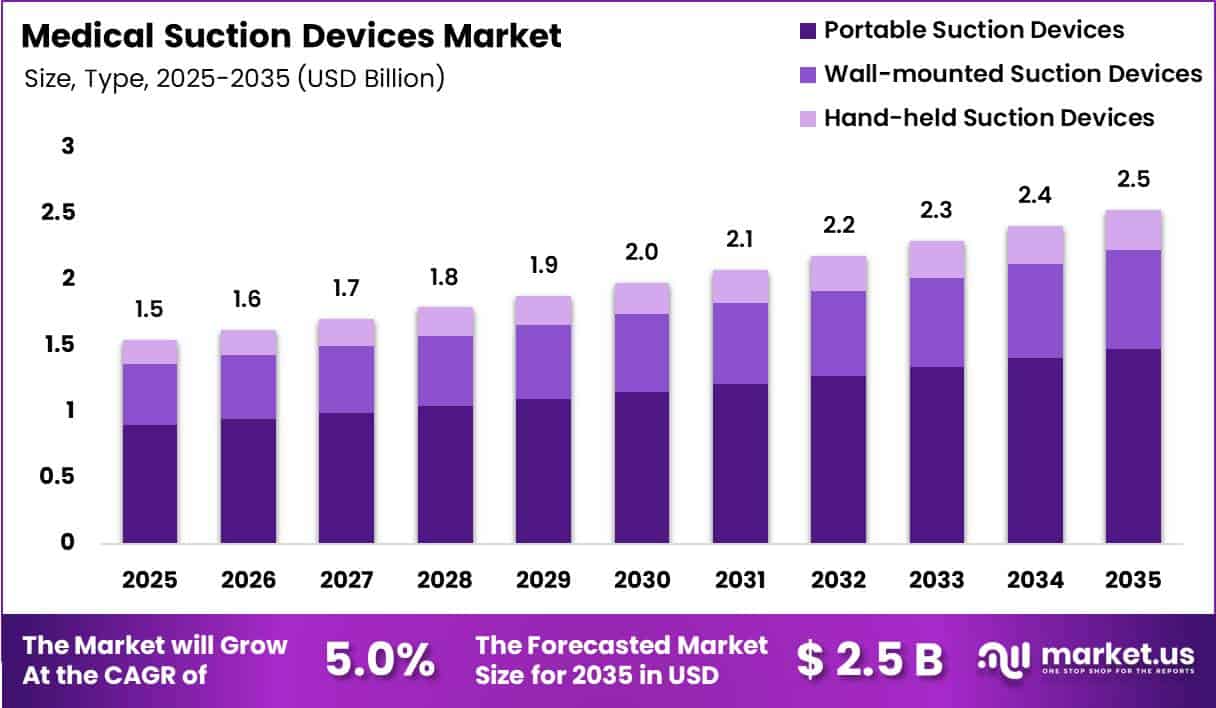
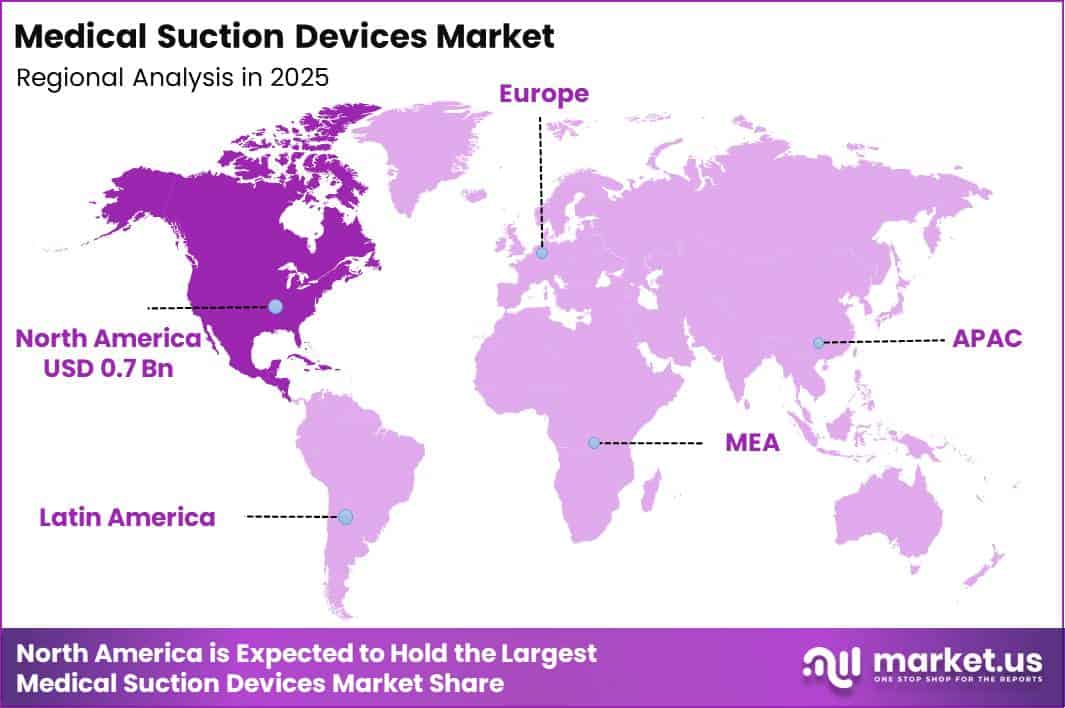
Global Medical Suction Devices Market size is expected to be worth around US$ 2.5 Billion by 2035 from US$ 1.5 Billion in 2025, growing at a CAGR of 5.0% during the forecast period from 2026 to 2035. In 2025, North America led the market, achieving over 44.1% share with a revenue of US$ 0.7 Billion.
Medical suction devices are essential healthcare technologies used to remove blood, mucus, saliva, vomit, and other bodily fluids from a patient’s airway or surgical site, helping maintain airway patency and providing a clear surgical field during medical procedures.
These devices are extensively used in hospitals, ambulatory surgical centers, emergency departments, intensive care units (ICUs), dental clinics, ambulances, and home healthcare settings. Their importance continues to grow with the expansion of surgical services, emergency medical care, and critical care infrastructure worldwide.
According to the World Health Organization (WHO), there are an estimated 2 million different types of medical devices categorized into more than 7,000 generic device groups, reflecting the broad role of medical technologies in improving healthcare access and patient outcomes.
Medical suction devices include electrically powered, manually powered, portable, and centralized vacuum-powered systems designed for different clinical environments. In the United States, patient care suction apparatus are regulated by the U.S. Food and Drug Administration (FDA) as Class II medical devices under 21 CFR 870.5050.
The FDA recognizes the ISO 10079 series of international standards, including ISO 10079-1 (electrically powered suction equipment), ISO 10079-2 (manually powered suction equipment), ISO 10079-3 (vacuum- or gas-powered suction equipment), and ISO 10079-4 (general requirements), which establish safety and performance requirements for medical suction equipment used in hospitals, transport settings, and home care.
Ongoing advancements such as battery-powered portable units, quieter motors, antimicrobial collection systems, and improved vacuum control technologies continue to enhance patient safety, infection prevention, and clinical efficiency across healthcare settings.
Key Takeaways
- Market Size: Global Medical Suction Devices Market size is expected to be worth around US$ 2.5 Billion by 2035 from US$ 1.5 Billion in 2025.
- Market Share: The market is growing at a CAGR of 5.0% during the forecast period from 2026 to 2035.
- Type: The Portable Suction Devices segment dominated the Medical Suction Devices Market in 2025, accounting for 58.4% of the total market share.
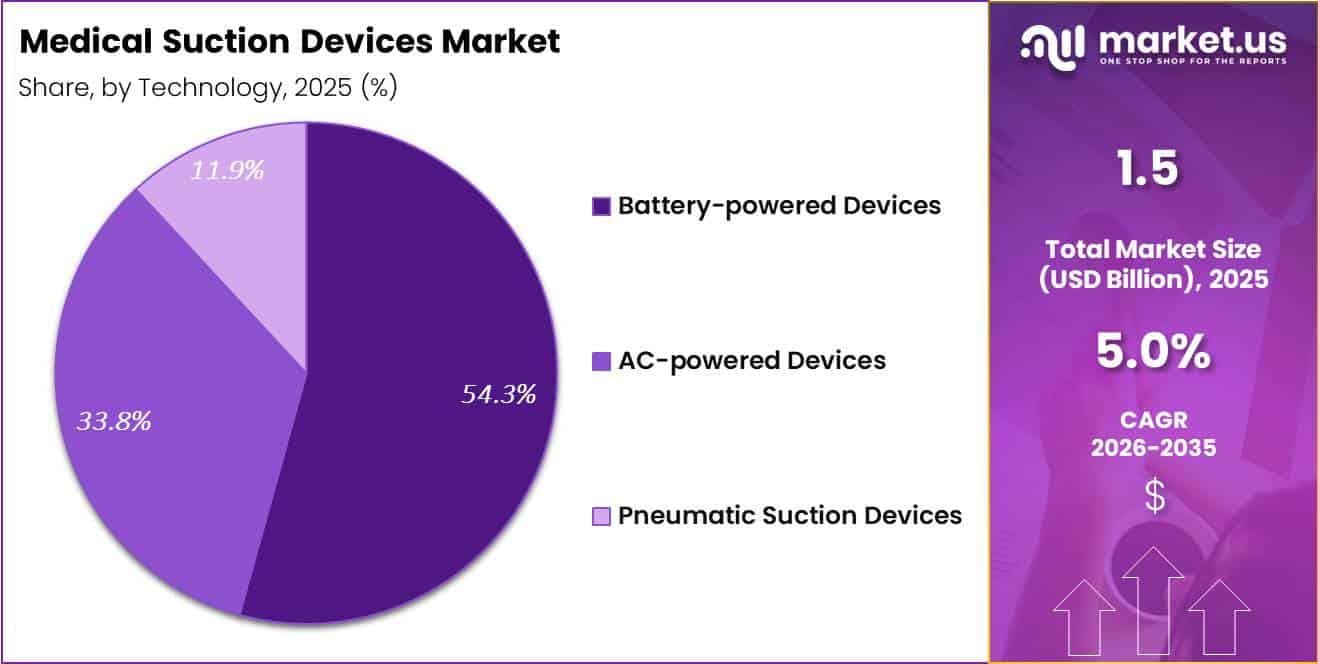
- Technology: The Battery-powered Devices segment led the Medical Suction Devices Market in 2025, capturing 54.3% of total revenue.
- Application: The Surgical Procedures segment dominated the Medical Suction Devices Market in 2025, accounting for 34.2% of the total market share.
- End User: The Hospitals (EDs, ICUs, ORs) segment dominated the Medical Suction Devices Market in 2025, accounting for 56.4% of the total market share.
- Suction Capacity:The Medium Vacuum (350–450 mmHg) segment dominated the Medical Suction Devices Market in 2025, capturing 48.6% of total market share.
- Regional Analysis: In 2025, North America led the market, achieving over 44.1% share with a revenue of US$ 0.7 Billion.
Type Analysis
Portable Suction Devices segment dominated the Medical Suction Devices Market in 2025.
The Portable Suction Devices segment dominated the Medical Suction Devices Market in 2025, accounting for 58.4% of the total market share. Their leadership is driven by growing demand for flexible, lightweight, and easy-to-transport suction systems across emergency care, ambulances, home healthcare, military medical services, and disaster response.
Portable units provide uninterrupted suction support during patient transfers and pre-hospital treatment, making them indispensable for emergency airway management and trauma care. Improvements in compact motor technology, rechargeable battery integration, quieter operation, and ergonomic designs have further strengthened adoption among healthcare professionals.
Rising investments in mobile healthcare infrastructure and increasing home-based chronic respiratory care have also supported strong demand for portable systems.
The Wall-mounted Suction Devices segment held 29.6% of the market, supported by their widespread installation in hospital operating rooms, intensive care units, and emergency departments where continuous suction availability is essential. These systems offer high reliability, stable vacuum performance, and integration with centralized medical gas infrastructure.
Meanwhile, Hand-held Suction Devices represented 12.0% of the market, primarily serving first responders, military personnel, field hospitals, and remote healthcare settings. Their compact design, rapid deployment capability, and ease of operation make them valuable for immediate airway clearance and emergency interventions despite their comparatively lower suction capacity.
Technology Analysis
Battery-powered Devices segment led the Medical Suction Devices Market.
The Battery-powered Devices segment led the Medical Suction Devices Market in 2025, capturing 54.3% of total revenue. Their dominance reflects the growing need for uninterrupted suction support outside conventional hospital settings, including ambulances, emergency transport, homecare, and disaster response.
Modern battery-powered systems feature longer operating times, rapid charging, intelligent battery management, and lightweight construction, enabling reliable performance during patient transfers and emergency interventions.
Healthcare providers increasingly prefer these devices because they eliminate dependence on fixed electrical outlets while maintaining consistent suction efficiency. Rising adoption of portable healthcare equipment and expanding emergency medical services continue to reinforce this segment’s leadership.
The AC-powered Devices segment accounted for 33.8% of the market, benefiting from widespread use in hospitals, surgical suites, and intensive care units where continuous power supply ensures stable, high-capacity suction during prolonged procedures. These systems remain the preferred choice for demanding clinical environments requiring uninterrupted performance.
Meanwhile, Pneumatic Suction Devices represented 11.9% of the market. Powered by compressed medical air or oxygen, these units are widely utilized in facilities with centralized gas infrastructure, particularly operating rooms and critical care departments. Their dependable operation, low maintenance requirements, and ability to function without electrical power make them valuable for specialized clinical applications.
Application Analysis
Surgical Procedures segment dominated the Medical Suction Devices Market in 2025.
The Surgical Procedures segment dominated the Medical Suction Devices Market in 2025, accounting for 34.2% of the total market share. Surgical suction systems are essential for maintaining a clear operative field by removing blood, bodily fluids, irrigation solutions, and tissue debris during procedures.
Increasing surgical volumes, expanding minimally invasive interventions, and the growing prevalence of chronic diseases requiring operative treatment continue to drive demand for reliable suction equipment. Hospitals increasingly invest in advanced suction technologies that improve precision, reduce contamination risks, and enhance surgical efficiency, further strengthening the segment’s market leadership.
The Airway Clearance & Respiratory Emergencies segment represents another major application, supported by increasing cases of respiratory disorders, emergency airway management, and pre-hospital critical care. Suction devices play a vital role in removing mucus, secretions, and foreign materials to maintain patient ventilation.
Wound Suction & Drainage continues to experience stable demand due to its importance in post-operative recovery, infection prevention, and faster wound healing through effective fluid removal. Chest Drainage applications remain significant for managing pleural effusions, pneumothorax, and thoracic surgeries requiring controlled fluid evacuation.
The Others category includes dental procedures, neonatal care, gastrointestinal treatments, and various specialized medical applications, collectively contributing to sustained market expansion across multiple healthcare settings.
End User Analysis
Hospitals (EDs, ICUs, ORs) segment dominated the Medical Suction Devices Market.
The Hospitals (EDs, ICUs, ORs) segment dominated the Medical Suction Devices Market in 2025, accounting for 56.4% of the total market share. Hospitals remain the largest consumers of suction equipment due to the continuous need for airway management, surgical procedures, intensive care treatment, and emergency interventions.
Emergency departments, intensive care units, and operating rooms require highly reliable suction systems capable of supporting critical patient care around the clock. Growing hospital admissions, rising surgical volumes, and investments in modern healthcare infrastructure continue to strengthen procurement of advanced suction technologies equipped with improved safety, infection control, and digital monitoring capabilities.
The Homecare Settings segment continues to expand steadily as more patients with chronic respiratory conditions, neurological disorders, and long-term tracheostomy care receive treatment outside hospitals. Portable suction devices have significantly improved home-based patient management and caregiver convenience.
Ambulatory Surgical Centers are witnessing increasing adoption due to the growing number of outpatient surgical procedures requiring compact, efficient suction systems that support rapid patient turnover.
Meanwhile, Clinics & Long-term Care Facilities represent an important segment, utilizing suction devices for routine medical procedures, elderly care, rehabilitation services, and chronic disease management. Rising demand for decentralized healthcare delivery continues to support growth across these end-user categories.
Suction Capacity Analysis
Medium Vacuum (350–450 mmHg) segment dominated the Medical Suction Devices Market in 2025.
The Medium Vacuum (350–450 mmHg) segment dominated the Medical Suction Devices Market in 2025, capturing 48.6% of total market share. This vacuum range offers an optimal balance between effective suction performance and patient safety, making it suitable for a broad spectrum of medical procedures including surgery, airway management, wound drainage, and general hospital applications.
Healthcare providers favor medium-vacuum devices because they deliver sufficient suction strength while minimizing the risk of tissue damage. Their versatility allows deployment across operating rooms, emergency departments, intensive care units, ambulances, and outpatient facilities, contributing significantly to their widespread adoption.
The High Vacuum (Above 450 mmHg) segment serves specialized clinical environments requiring rapid removal of large fluid volumes, blood, and thick secretions during complex surgical procedures, trauma care, and intensive emergency interventions. These systems provide powerful suction performance essential for critical situations where rapid clearance directly influences patient outcomes.
Meanwhile, the Low Vacuum (Below 350 mmHg) segment is primarily utilized for delicate medical applications involving neonates, pediatric patients, sensitive wound management, and procedures requiring controlled, gentle suction.
The growing emphasis on patient-specific treatment protocols and precision medical care continues to support balanced demand across all suction capacity categories.
Key Market Segments
By Type
- Portable Suction Devices
- Wall-mounted Suction Devices
- Hand-held Suction Devices
By Technology
- Battery-powered Devices
- AC-powered Devices
- Pneumatic Suction Devices
By Application
- Surgical Procedures
- Airway Clearance & Respiratory Emergencies
- Wound Suction & Drainage
- Chest Drainage
- Others
By End User
- Hospitals (EDs, ICUs, ORs)
- Homecare Settings
- Ambulatory Surgical Centers
- Clinics & Long-term Care Facilities
By Suction Capacity
- Medium Vacuum (350-450 mmHg)
- High Vacuum (Above 450 mmHg)
- Low Vacuum (Below 350 mmHg)
Drivers
Infection Control Procurement Uplift in Airway and Procedure Care.
WHO’s 2024–2030 global infection prevention and control (IPC) action plan, reinforced by 2025–2026 guidance updates, is sustaining hospital level investment in infection control systems through 2026 and beyond.
This is increasing focus on airway management and suction based care, where contamination risks are closely tied to hospital acquired infections and mucosal injury.Airway suctioning is a routine procedure across acute, long term, and home care settings, making it a consistent target for IPC upgrades.
As a result, procurement is shifting toward safer and more controlled systems, including closed suction devices, single use consumables, improved canister hygiene solutions, and antimicrobial workflow components.This shift does not only increase device adoption but also raises recurring revenue through higher accessory usage, preventive maintenance contracts, and bundled staff training programs.
Even when base equipment volumes remain stable, the overall value per installed system increases due to higher compliance and safety requirements.Overall, stronger IPC enforcement and monitoring frameworks are expected to support higher value procurement cycles and modestly expand growth in airway and suction care markets through increased safety driven adoption and replacement demand.
| Driver | (~) % Impact on CAGR Forecast | Geographic Relevance | Impact Timeline |
|---|---|---|---|
| Infection-control procurement uplift in airway and procedure care | +1.4% | North America core, EU, GCC hospitals, APAC tertiary centers | Short term |
| Home-care suction reimbursement and chronic-care discharge shift | +1.1% | U.S. core, Western Europe selective, Japan, developed APAC | Medium term |
| Portable emergency airway readiness across EMS and ambulatory sites | +0.9% | North America, EU, Australia, urban APAC corridors | Short term |
| Regulatory quality tightening after suction-related recall activity | +0.8% | U.S. core, EU regulated markets, export-oriented APAC manufacturing hubs | Medium term |
| Aging and multi-morbidity burden increasing secretion-management demand | +1.3% | U.S., EU5, Japan, South Korea, China tier-1/2 hospital markets | Long term |
| Procedure-volume recovery and decentralization into ASC and bedside workflows | +1.0% | North America core, EU, private hospital APAC, Latin America spill-over | Medium term |
Challenge
Cross Facility Standards Heterogeneity in Medical Suction Devices.
The medical suction devices market is constrained by inconsistent interpretation and application of standards such as ISO 10079 and IEC 60601 across hospitals and regions. This lack of harmonization creates operational and design complexity for manufacturers, reducing potential market efficiency and scale.
In practice, performance requirements vary significantly across care settings vacuum pressure ranges from 300–560 mmHg, flow rates from 20–40 L/min, and noise limits from 45–60 dB depending on ICU, OR, emergency, or general ward use. These differences force OEMs to maintain multiple product variants within the same portfolio, increasing engineering, validation, and manufacturing complexity.
As a result, manufacturers often support 4–6 regional configurations instead of a more streamlined 2–3 global platforms, increasing component cost dispersion by 15–20% and raising validation workload by 25–35%. Hospitals also upgrade suction systems on staggered replacement cycles (3–10 years), which slows coordinated modernization across departments.
Overall, fragmented standards and procurement practices reduce scalability and efficiency in both manufacturing and adoption, contributing to an estimated 1.2 % point drag on global market growth until greater standardization and platform unification are achieved.
| Challenge | (~) % CAGR Friction Drag | Geographic Relevance | Mitigation Horizon |
|---|---|---|---|
| Cross-facility standards heterogeneity | -1.2% | North America, EU, APAC hospitals | Medium term (2–4 years) |
| Infection-control compliance burden | -1.0% | Global acute-care hubs | Long term (≥ 4 years) |
| Capital-equipment budget cyclicality | -0.8% | North America core, EU public systems | Medium term (2–4 years) |
| Skilled biomedical technician deficit | -0.7% | Emerging APAC, LATAM corridors | Long term (≥ 4 years) |
| Battery-portable performance bottlenecks | -0.6% | EMS networks, home care clusters | Medium term (2–4 years) |
| Fragmented aftermarket service logistics | -0.5% | APAC, Africa, tier-2 cities | Long term (≥ 4 years) |
Restraints
Capital Budget Tightening in Care Settings.
Between 2024 and 2026, many OECD healthcare systems have faced sustained margin pressure, with hospital operating margins often remaining in the 1–3% range. At the same time, nursing and respiratory therapy wages have increased by 5–7% annually, while reimbursement uplifts have lagged at around 2–3%, squeezing discretionary spending capacity.
As a result, hospital capital budgets have tightened, with equipment allocation in some systems declining from 4–6% of revenue historically to around 3–4%. This has reduced available funds for non urgent equipment replacement, including suction devices, often delaying refresh cycles by 12–24 months.
In the U.S., this shift has led to an estimated 15–25% reduction in discretionary equipment upgrade pools, while in Europe, hospitals are increasingly bundling multiple capital projects into larger procurement cycles. This extends replacement timelines for devices like suction systems from about 7–8 years to 9–10 years.
In cost constrained APAC markets, lower margin hospitals prioritize critical infrastructure such as ventilators, imaging, and lab automation over suction system upgrades, further slowing adoption of newer equipment.
Overall, tighter capital budgets are extending equipment life cycles, reducing replacement frequency, and increasing price sensitivity in procurement decisions, which collectively slow market growth and intensify competitive pressure on device vendors.
| Restraint | (~) % Impact on CAGR Forecast | Geographic Relevance | Impact Timeline |
|---|---|---|---|
| Capital budget tightening in care settings | -1.4% | North America core, EU, selected APAC hospitals | Short–Medium term |
| Stricter electro-medical and suction performance compliance | -0.9% | U.S., EU, Japan, GCC | Medium–Long term |
| Supply chain and component volatility | -0.8% | Global (OEM hubs in APAC; importers in NA/EU/LatAm) | Short term |
| Reimbursement and procedure-mix pressure | -0.7% | U.S., EU public systems, select APAC | Medium term |
| Fragmented procurement and pricing erosion | -0.6% | Emerging APAC, LatAm, MEA public tenders | Medium–Long term |
| Infection control and reprocessing complexity | -0.5% | Global acute care, ambulatory, home-care | Short–Medium term |
Opportunity
LMIC Surgical Suction Build Out Bundles.
This opportunity captures growth from expanding surgical access in low and middle income countries (LMICs), where healthcare systems are scaling operating room capacity to address a large unmet surgical burden. Global estimates suggest around 143 million additional procedures per year are needed to close the surgical gap, with billions of people still lacking timely access to safe surgery.
As LMICs invest in new and upgraded operating rooms, suction devices become a core requirement rather than a replacement market item. Standardized “OR readiness” bundles typically include primary and backup suction units integrated alongside anesthesia and monitoring equipment, ensuring basic surgical safety and workflow reliability.
This bundled procurement approach can significantly expand addressable demand, particularly as surgical volumes in LMICs are expected to grow at 6–8% annually with increased funding and policy focus. It also improves procurement efficiency for ministries of health by reducing fragmented purchasing and lowering per OR setup costs.
From a commercial perspective, bundled offerings can improve margins through integrated service contracts and recurring consumables such as tubing, filters, and canisters. Vendors that design durable, low maintenance, and multi power compatible suction systems are better positioned to capture this growth.
Overall, this represents a forward looking expansion opportunity driven by surgical system build out rather than replacement demand, with meaningful upside tied to coordinated health system investment and procurement modernization.
| Opportunity | (~) % Potential CAGR Upside | Geographic Relevance | Execution Window |
|---|---|---|---|
| LMIC surgical suction build-out bundles | +2.8% | LMIC APAC, Sub-Saharan Africa, Latin America | Medium term (2-4 years) |
| Home-based airway suction & clearance platforms | +2.3% | North America, Western Europe, urban APAC | Medium term (2-4 years) |
| AI-enabled closed-loop suction integration in OR/ICU | +1.9% | North America core, EU, advanced APAC | Long term (≥ 4 years) |
| Disposable & hybrid-reusable infection-optimized lines | +1.7% | Global hospitals, ambulatory centers | Short term (≤ 2 years) |
| Value-based suction service & uptime contracts | +1.6% | U.S., Western Europe, selective APAC | Medium term (2-4 years) |
| Neonatal & pediatric suction ecosystems for tier-2 providers | +1.4% | Emerging APAC, MENA, Latin America | Long term (≥ 4 years) |
Regional Analysis
North America led the Medical Suction Devices Market.
In 2025, North America accounted for more than 44.1% of the global Medical Suction Devices Market, generating approximately US$ 0.7 billion in revenue. The region’s leadership is supported by its highly developed healthcare infrastructure, widespread adoption of advanced medical technologies, and strong demand for emergency, surgical, and home healthcare services.
A growing elderly population, coupled with the increasing prevalence of chronic respiratory disorders such as chronic obstructive pulmonary disease (COPD), asthma, and sleep-related breathing conditions, continues to drive demand for reliable suction systems across hospitals, ambulatory surgical centers, and home care settings.
The United States represents the largest contributor within the region, supported by high healthcare spending, advanced critical care facilities, and ongoing investments in patient safety and infection prevention.
North America also benefits from the presence of leading medical device manufacturers, continuous product innovation, and favorable regulatory standards that encourage the adoption of technologically advanced portable and battery-powered suction devices.
Increasing demand for minimally invasive surgical procedures and the expansion of emergency medical services have further strengthened market growth. The region has also witnessed greater use of compact suction devices in ambulances, outpatient facilities, and home-based respiratory care, reflecting the broader shift toward decentralized healthcare delivery.
In addition, healthcare providers continue to prioritize equipment that enhances mobility, reduces maintenance requirements, and improves clinical efficiency, reinforcing North America’s position as the largest and most technologically advanced regional market for medical suction devices.
Key Regions and Countries
North America
- The US
- Canada
Europe
- Germany
- France
- The U.K.
- Italy
- Spain
- Russia & CIS
- Rest of Europe
Asia Pacific
- China
- India
- Japan
- South Korea
- ASEAN
- Australia & New Zealand
- Rest of Asia Pacific
Middle East & Africa
- GCC
- South Africa
- Rest of Middle East & Africa
Latin America
- Brazil
- Mexico
- Rest of Latin America
Key Player Analysis
The Medical Suction Devices Market is moderately fragmented, with established multinational manufacturers competing alongside specialized medical device companies that address diverse clinical and emergency care requirements.
Competition is driven by technological innovation, product reliability, regulatory compliance, and the ability to provide integrated suction solutions across hospitals, ambulatory surgical centers, emergency medical services, and home healthcare settings.
Companies are increasingly investing in portable, battery-powered, and digitally enhanced suction systems that improve mobility, infection prevention, and workflow efficiency. Medtronic plc, BD (Becton, Dickinson and Company), Olympus Corporation, Stryker Corporation, and Drägerwerk AG & Co.
KGaA remain among the leading participants due to their broad product portfolios, global distribution networks, and continuous investment in medical technology innovation. Competitive strategies emphasize sustained R&D, strategic collaborations, and product enhancements to improve suction performance, ease of use, and patient safety.
Integra LifeSciences Corporation, Laerdal Medical AS, Precision Medical, Inc., SSCOR, Inc., ATMOS MedizinTechnik GmbH & Co. KG, Ohio Medical, LLC, ZOLL Medical Corporation (Asahi Kasei), Allied Healthcare Products, Inc., Medicop, Inc., INTEGRA Biosciences AG, and Others strengthen market competition by introducing application-specific suction devices for operating rooms, emergency response, intensive care, and pre-hospital environments.
Manufacturers are also integrating suction equipment with broader clinical workflows through compatibility with anesthesia systems, patient monitoring platforms, and hospital infrastructure. Ecosystem-based competition is becoming increasingly important, as companies differentiate themselves through comprehensive service offerings, digital connectivity, preventive maintenance, training support, and long-term healthcare partnerships that enhance operational efficiency and customer retention across healthcare facilities.
Top Key Players
- Medtronic plc
- BD (Becton, Dickinson and Company)
- Olympus Corporation
- Stryker Corporation
- Drägerwerk AG & Co. KGaA
- Integra LifeSciences Corporation
- Laerdal Medical AS
- Precision Medical, Inc.
- SSCOR, Inc.
- ATMOS MedizinTechnik GmbH & Co. KG
- Ohio Medical, LLC
- ZOLL Medical Corporation (Asahi Kasei)
- Allied Healthcare Products, Inc.
- Medicop, Inc.
- INTEGRA Biosciences AG
- Others
Recent Developments
- In April 2026, Medtronic plc completed the acquisition of CathWorks in a transaction valued at up to US$585 million. The acquisition adds the FFRangio® technology to Medtronic’s cardiovascular business, strengthening its diagnostic and interventional solutions portfolio.
- In September 2025, Olympus Corporation announced the commercial launch of the EVIS X1™ OLYSENSE Platform in additional global markets, expanding its AI-assisted endoscopy portfolio to improve visualization and workflow efficiency in minimally invasive procedures.
- In April 2026, Drägerwerk AG & Co. KGaA reported strong first-quarter 2026 performance, with higher order intake and revenue growth across its Medical division. The company attributed the results to sustained demand for medical equipment and continued expansion of its healthcare technology portfolio.
Report Scope
| Report Features | Description |
|---|---|
| Market Value (2025) | US$ 1.5 Billion |
| Forecast Revenue (2035) | US$ 2.5 Billion |
| CAGR (2026-2035) | 5.0% |
| Base Year for Estimation | 2025 |
| Historic Period | 2020-2024 |
| Forecast Period | 2026-2035 |
| Report Coverage | Revenue Forecast, Market Dynamics, Competitive Landscape, Recent Developments |
| Segments Covered | By Type (Portable Suction Devices, Wall-mounted Suction Devices, Hand-held Suction Devices), By Technology (Battery-powered Devices, AC-powered Devices, Pneumatic Suction Devices), By Application (Surgical Procedures, Airway Clearance & Respiratory Emergencies, Wound Suction & Drainage, Chest Drainage, Others), By End User (Hospitals (EDs, ICUs, ORs), Homecare Settings, Ambulatory Surgical Centers, Clinics & Long-term Care Facilities), By Suction Capacity (Medium Vacuum (350-450 mmHg), High Vacuum (Above 450 mmHg), Low Vacuum (Below 350 mmHg)) |
| Regional Analysis | North America – The US, Canada; Europe – Germany, France, U.K., Italy, Spain, Russia & CIS, Rest of Europe; Asia Pacific – China, India, Japan, South Korea, ASEAN, Australia & New Zealand, Rest of Asia Pacific; Middle East & Africa – GCC, South Africa, Rest of Middle East & Africa; Latin America – Brazil, Mexico, Rest of Latin America |
| Competitive Landscape | Medtronic plc,BD (Becton, Dickinson and Company),Olympus Corporation,Stryker Corporation,Drägerwerk AG & Co. KGaA,Integra LifeSciences Corporation,Laerdal Medical AS,Precision Medical, Inc.,SSCOR, Inc.,ATMOS MedizinTechnik GmbH & Co. KG,Ohio Medical, LLC,ZOLL Medical Corporation (Asahi Kasei),Allied Healthcare Products, Inc.,Medicop, Inc.,INTEGRA Biosciences AG,Others |
| Customization Scope | Customization for segments, region/country-level will be provided. Moreover, additional customization can be done based on the requirements. |
| Purchase Options | We have three licenses to opt for: Single User License, Multi-User License (Up to 5 Users), Corporate Use License (Unlimited User and Printable PDF) |





































