Report Overview
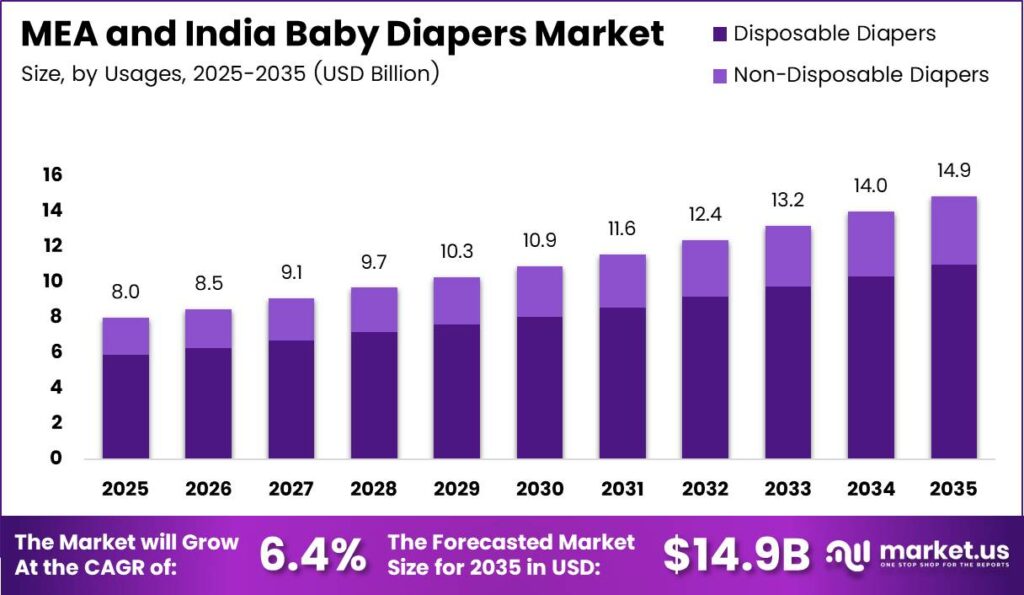
MEA and India Baby Diapers Market size is expected to be worth around USD 14.9 Billion by 2035 from USD 8.0 Billion in 2025, growing at a CAGR of 6.4% during the forecast period 2026 to 2035. Unicharm’s February 2025 Ahmedabad plant announcement cited approximately 23 million annual births in India, illustrating the scale of recurring infant demand that underpins this market’s long-run consumption floor.
The MEA and India Baby Diapers Market covers absorbent hygiene products designed for infants and toddlers across two distinct geographies: the Middle East and Africa and India. The market structures around usage type, diaper construction format, and sales channel, with manufacturers competing on absorption performance, pack affordability, and distribution reach across vastly different retail infrastructures.
Key Takeaways
- The MEA and India Baby Diapers Market is valued at USD 8.0 Billion in 2025 and is forecast to reach USD 14.9 Billion by 2035.
- The market grows at a CAGR of 6.4% during the forecast period 2026 to 2035.
- Disposable Diapers lead the By Usages segment with a dominant share of 73.45% in 2025.
- Non-Disposable Diapers represent the fastest-growing sub-segment within the By Usages category.
- Closed Diapers (Pull-Up or Pants) hold the largest share in the By Type segment at 67.45% in 2025.
- Open Diapers (Taped) register as the fastest-growing sub-segment within the By Type category.
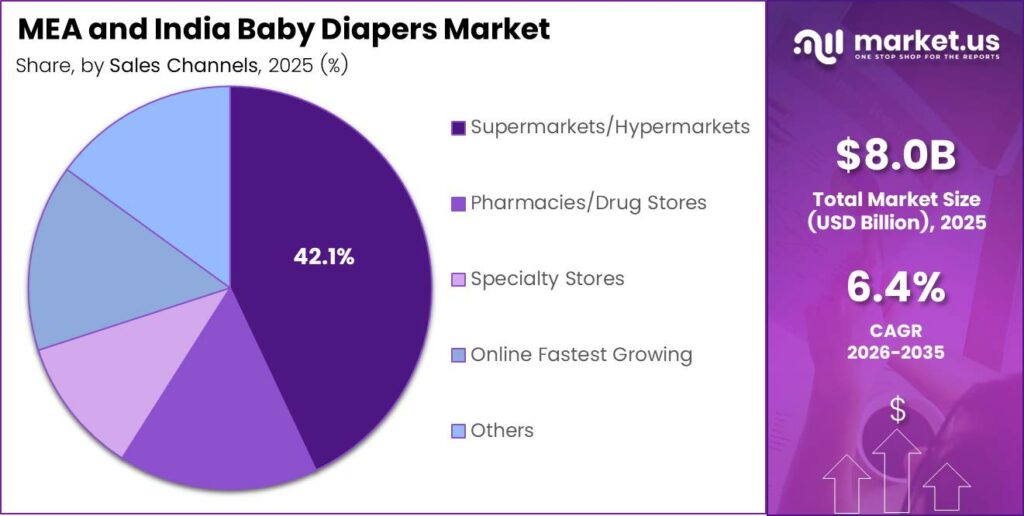
- Supermarkets and Hypermarkets dominate the By Sales Channels segment with a 42.12% share in 2025.
- The Online channel records the fastest growth rate within the By Sales Channels segment.
- India leads the combined market as the dominant region, accounting for the largest share of total revenue in 2025.
- Sub-Saharan Africa within MEA registers as the fastest-growing regional bloc across the forecast period.
UNICEF’s State of the World’s Children 2024 projects that the global population of children under 18 will reach approximately 2.3 billion in the 2050s. This sustained child population base creates a structurally durable demand floor for infant hygiene products across MEA and India, where birth rates remain elevated relative to developed markets. Suppliers planning capacity now are positioning ahead of the next decade’s consumption cohort.
The World Bank’s October 2026 India Development Update projected India’s economic growth at 7.1% in FY2026–27. Stronger household incomes at this growth rate translate directly into higher diaper adoption rates, as more families cross the affordability threshold for regular disposable use. Brands with mid-tier price points and wide distribution are best placed to capture this conversion wave before premium competitors scale their India presence.
In March 2026, Softcare disclosed plans to invest approximately KSh698 million in expanding Kenyan production of baby diapers, baby pants, sanitary pads, and wet wipes. This signals that regional manufacturers view Africa’s urban consumer base as commercially viable at scale. Investors tracking local manufacturing buildout in Africa should note that this capital commitment targets both domestic supply and export positioning across neighbouring markets.
Usages Analysis
Disposable Diapers dominate with 73.45% due to urban convenience and retail availability.
In 2025, Disposable Diapers held a dominant market position in the By Usages segment of the MEA and India Baby Diapers Market, with a 73.45% share. WHO and UNICEF data confirm that urban household penetration of single-use hygiene products rises in parallel with healthcare contact frequency and institutional birth rates. India’s Unified Payments Interface processed 172.2 billion transactions in 2024 according to the World Bank, reflecting a digital commerce infrastructure that makes repeat disposable diaper purchases easier to execute and sustain. Brands that integrate subscription replenishment into digital payment ecosystems gain a measurable retention advantage over competitors relying on in-store impulse purchasing.
Non-Disposable Diapers represent the fastest-growing sub-segment within By Usages, driven by cost-conscious households and sustainability-aware urban buyers in select markets. WHO and UNICEF reported that 2.1 billion people worldwide lacked safely managed drinking-water services in 2024, a constraint that directly limits the practicality of cloth diaper washing in rural and peri-urban MEA communities. This infrastructure gap concentrates reusable adoption among middle-income urban households rather than low-income rural ones, narrowing the addressable market for non-disposable formats. In August 2026, Unicharm announced completion of registration for SOFY UNICHARM EAST AFRICA LIMITED, its Nairobi-based joint venture with Toyota Tsusho, with operations scheduled to begin in September 2026. Manufacturers entering sub-Saharan Africa must therefore prioritise disposable formats for rural scale while offering reusable lines selectively in cities with reliable water access.
Type Analysis
Closed Diapers (Pull-Up or Pants) dominate with 67.45% due to ease of independent toddler use.
In 2025, Closed Diapers (Pull-Up or Pants) held a dominant market position in the By Type segment of the MEA and India Baby Diapers Market, with a 67.45% share. Pull-up formats align with toilet-training milestones, which typically begin between 18 and 36 months of age according to the American Academy of Pediatrics, extending the purchase window beyond the newborn phase and driving higher average units consumed per child over the diaper-wearing period. Caregivers in urban India and the GCC consistently choose pants-style diapers for daytime use because the format reduces changing time during work hours. Manufacturers that price pull-up packs competitively within the mid-tier can sustain wallet share through the full toddler segment rather than losing buyers at the newborn-to-toddler transition.
Open Diapers (Taped) represent the fastest-growing sub-segment within By Type, anchored in newborn and clinical care use cases where adjustable fit is non-negotiable. WHO estimated that 13.4 million babies were born preterm worldwide in 2020, before 37 completed weeks of gestation, establishing a persistent clinical demand for ultra-small taped formats that pull-up construction cannot serve. In November 2025, P&G introduced Pampers Swaddlers Preemie extra extra small (Pxxs), designed for infants born weighing less than 500 grams, becoming the fourth and smallest diaper in the Pampers Preemie Collection. This product action confirms that the clinical newborn segment is commercially active and that first-mover investment in preterm sizing creates defensible shelf positioning within hospital procurement channels across tertiary-care facilities in India and the GCC.
Sales Channels Analysis
Supermarkets/Hypermarkets dominate with 42.12% due to high footfall and bulk-pack accessibility.
In 2025, Supermarkets/Hypermarkets held a dominant market position in the By Sales Channels segment of the MEA and India Baby Diapers Market, with a 42.12% share. Reliance Retail reported 19,340 stores across its retail formats at the end of FY2024–25, after opening 2,659 stores during the year, reflecting the scale of modern trade expansion that places branded diapers within reach of millions of additional Indian households annually. Modern trade environments allow manufacturers to deploy large-format packs and multi-buy promotions, both of which improve per-transaction value and reduce the effective cost per diaper for the shopper. Suppliers without structured shelf agreements at major organised retail chains risk losing first-purchase occasions to incumbents already embedded in category planning cycles.
Pharmacies and Drug Stores serve a distinct purchase occasion anchored in healthcare-adjacent trust, with caregivers often choosing this channel after clinical recommendations or when buying alongside infant health products. Clicks reported a network of 780 pharmacies at 31 August 2025, following a net addition of 60 pharmacies during the financial year, demonstrating active physical expansion of the pharmacy channel across South Africa. This channel concentration in South Africa signals that pharmacy-listed diaper SKUs reach a health-conscious, higher-income consumer cohort. Brands that invest in pharmacist training and clinical positioning can extract premium pricing that is difficult to sustain in the volume-driven supermarket channel.
Online remains the fastest-growing sales channel across MEA and India, accelerated by digital payment infrastructure and expanding last-mile delivery networks in metropolitan areas. In August 2025, R for Rabbit raised US$27 million in Series B funding led by Filter Capital, with the Indian baby-products company earmarking the proceeds for omnichannel distribution, product innovation, and digital initiatives. This capital deployment confirms that investors see structural growth in digitally enabled baby-product commerce rather than a temporary post-pandemic shift. Specialty Stores and other channels serve niche or proximity demand and collectively absorb the remaining channel share not captured by the top three formats.
Key Market Segments
By Usages
- Disposable Diapers
- Non-Disposable Diapers
By Type
- Closed Diapers (Pull-Up or Pants)
- Open Diapers (Taped)
By Sales Channels
- Supermarkets/Hypermarkets
- Pharmacies/Drug Stores
- Specialty Stores
- Online
- Others
Market Dynamics
Market Opportunity Analysis - Underpenetrated formats and underserved geographies offer high-return entry points for focused manufacturers
Open Diapers (Taped) represent an underexploited commercial opportunity within the By Type segment, despite anchoring the fastest-growing sub-segment classification. Clinical procurement channels in India’s tertiary-care hospitals and GCC neonatal units remain underdeveloped relative to mainstream retail, and few manufacturers have invested in dedicated hospital sales teams or preterm assortment depth. Suppliers that build clinical-grade taped diaper portfolios and structured hospital procurement agreements capture volume from a buyer cohort that prioritises specification over price.
The Online sales channel holds material upside beyond its current fastest-growing status, as digital payment infrastructure across India and the GCC continues to expand into smaller urban centres. Subscription-based replenishment models remain rare among mid-tier Indian manufacturers, creating a structural gap that digitally native brands or established players with e-commerce investment can fill before offline-only competitors recognise the retention value of auto-replenishment. This segment rewards early technology investment rather than incremental marketing spend.
Sub-Saharan Africa outside South Africa remains the most geographically underexploited region in the combined market, despite the IMF projecting 4.5% real GDP growth across the bloc in both 2026 and 2027. Organised retail density in West and East African cities is still low, but the July 2025 Hayat Egypt facility investment and August 2026 Unicharm East Africa joint venture registration confirm that forward-looking manufacturers are treating the region as a near-term manufacturing and distribution target. Entrants that establish local production partnerships now avoid the import-duty and foreign-exchange headwinds that restrain purely import-dependent competitors.
Pharmacies and Drug Stores represent an underdeveloped premium positioning channel across India and the MEA region compared with their role in South Africa, where Clicks operates 780 pharmacies with active category management. Indian and GCC pharmacy chains apply limited shelf discipline to baby hygiene, creating space for brands to occupy healthcare-adjacent category leadership positions that command price premiums unavailable in the supermarket channel. Manufacturers that invest in pharmacist engagement and clinical positioning extract margin that the volume channel cannot support.
Technology and Innovation Landscape - Product engineering and manufacturing process innovation define the next competitive separation in this market
Multi-layer absorption architecture represents the most commercially visible product technology in this market, with P&G’s March 2026 Pampers AMORE launch citing a 5-layer protection system and third-party laboratory testing across more than 1,000 harmful chemicals as the primary consumer-facing differentiators. This level of testing documentation raises the technical standard for premium tier entry and forces mid-market manufacturers to disclose their own material safety validation or cede the trust premium to incumbents. Brands that cannot match published chemical-screening protocols risk shelf displacement as retail buyers formalise category safety requirements.
Waistband and fit engineering is emerging as a second technical battleground, with Huggies’ May 2025 HuggFit 360° launch claiming twice the waistband stretch of its own predecessor product. Elastic system performance directly affects leakage containment, which remains the primary caregiver complaint driving brand switching in the pull-up format. Manufacturers that invest in fit-technology differentiation create a product attribute that retailers can merchandise as a feature upgrade, supporting price-tier progression without requiring a full premium repositioning.
In December 2025, Unicharm announced development of a disposable-diaper recycling “Dry Cleaning Method” in collaboration with Fuji Clean in Japan, targeting water usage of approximately one-fiftieth of conventional methods. This process innovation addresses postconsumer waste management, which the market’s challenge data identifies as a long-term friction drag in dense Indian cities, the GCC, and African urban centres. Manufacturers that develop commercially viable recycling pathways first gain a regulatory and reputational advantage as urban municipal waste policies tighten across MEA markets.
Solar energy integration in manufacturing facilities signals a parallel operational technology investment that reduces energy cost exposure and meets emerging ESG procurement criteria. Unicharm’s February 2025 Ahmedabad plant announcement secured 35,000 square metres for future solar-power generation facilities, embedding energy infrastructure planning into the factory design rather than retrofitting it. This approach lowers long-term operating costs and positions the facility to meet sustainability certification thresholds that large retail buyers are beginning to require from their primary hygiene suppliers.
Drivers
Large annual birth cohorts across sub-Saharan Africa, India, and selected Middle Eastern markets sustain a recurring diaper demand pool that replenishes across successive infant cohorts. The United Nations population revision released on 11 July 2024 confirmed that countries with fertility of at least 4 births per woman remained concentrated in sub-Saharan Africa, supporting a geographically differentiated demand outlook. Increasing disposable-diaper usage from 1 to 2 units daily adds 365 units per participating child annually without requiring additional births, making frequency gains as commercially valuable as new household acquisition.
Cloth-to-disposable conversion, organised retail expansion, and urban convenience purchasing collectively reinforce the market’s structural demand trajectory. Distributor networks reaching Indian semi-urban markets and major African cities shorten the distance between product availability and the consumer’s first purchase. Premium absorbency products in the GCC and affluent Indian cities open a parallel value-upgrade pathway alongside the volume story, giving manufacturers a two-speed commercial strategy across a single regional portfolio.
| Driver | (~) % Impact on CAGR Forecast | Geographic Relevance | Impact Timeline |
|---|---|---|---|
| Large recurring infant cohorts | +0.65% | India; sub-Saharan Africa; selected Middle Eastern markets | Long term (≥ 4 years) |
| Cloth-to-disposable usage conversion | +0.45% | India; West Africa; East Africa | Medium term (2–4 years) |
| Organized retail distribution expansion | +0.30% | India; GCC; South Africa; major African cities | Short term (≤ 2 years) |
| Urban convenience-led purchasing | +0.25% | Urban India; GCC; metropolitan MEA | Medium term (2–4 years) |
| Premium absorbency product mix | +0.20% | GCC; affluent Indian cities; South Africa | Short term (≤ 2 years) |
Restraints
When food and essential expenditures absorb household cash, discretionary diaper purchases face immediate cutbacks, making affordability a current sales restraint rather than a future risk. UNICEF’s 2024 assessment estimated that 27% of young children globally experienced severe child food poverty, with South Asia and sub-Saharan Africa accounting for 68% of affected children. The World Bank reported Nigerian consumer-price inflation of 33.2% in 2024 and 23.0% in 2025, illustrating the direct purchasing-power pressure in one of Africa’s largest consumer markets. Manufacturers face pressure to lead with entry-price packs, which protect transaction affordability but raise per-unit packaging costs and compress margins.
Import settlement restrictions, conflict-related market closures, and distributor credit withdrawal compound affordability pressures at the channel level. Foreign-exchange constraints in multiple African import markets delay stock replenishment, while active conflict in Sudan and Yemen suspends retail operations entirely in affected corridors. Import duties on finished diapers in selected tariff-protected African markets add a structural cost layer that disadvantages imported brands against locally manufactured alternatives over the medium term.
| Restraint | (~) % Impact on CAGR Forecast | Geographic Relevance | Impact Timeline |
|---|---|---|---|
| Household essential-spending displacement | −0.45% | Low-income India; Nigeria; vulnerable African households | Short term (≤ 2 years) |
| Import settlement and foreign-exchange restrictions | −0.25% | Foreign-exchange-constrained African import markets | Short term (≤ 2 years) |
| Conflict-related retail market closures | −0.20% | Sudan; Yemen; conflict-affected MEA markets | Short term (≤ 2 years) |
| Distributor credit withdrawal | −0.15% | Credit-constrained Indian and African trade channels | Short term (≤ 2 years) |
| Import duties on finished diapers | −0.10% | Selected tariff-protected African markets | Medium term (2–4 years) |
Challenges
Dependence on cross-border absorbent material supplies exposes diaper supply chains to maritime route variability that raises costs and disrupts replenishment cycles. UNCTAD reported that Suez Canal tonnage fell by 70% and Gulf of Aden tonnage by 76% by mid-2024 relative to late 2023, with rerouting increasing global container-ship demand by an estimated 12%. Extending inbound lead time from 30 to 45 days increases pipeline inventory requirements by 50% at unchanged daily consumption, tying up working capital that smaller manufacturers cannot easily absorb.
Absorbent material qualification complexity, converting line maintenance gaps, and fragmented size demand forecasting further slow operational efficiency across Indian and African production clusters. Postconsumer diaper waste management adds a long-term structural pressure in dense Indian cities, the GCC, and African urban centres where municipal waste infrastructure is constrained. Manufacturers that invest early in route-diversified procurement and qualified backup supplier networks convert these friction points from reactive costs into competitive separation from peers that manage supply reactively.
| Challenge | (~) % CAGR Friction Drag | Geographic Relevance | Mitigation Horizon |
|---|---|---|---|
| Maritime routing and replenishment variability | −0.25% | Red Sea-linked MEA supply chains; India–MEA trade | Short term (≤ 2 years) |
| Absorbent material qualification complexity | −0.18% | India; MEA diaper manufacturing hubs | Medium term (2–4 years) |
| Converting line maintenance shortages | −0.12% | Emerging Indian and African production clusters | Medium term (2–4 years) |
| Fragmented size demand forecasting | −0.10% | India; multi-country African distribution networks | Medium term (2–4 years) |
| Postconsumer diaper waste management | −0.10% | Dense Indian cities; GCC; African urban centers | Long term (≥ 4 years) |
Opportunities
Maternity-to-home replenishment partnerships represent the highest-upside commercial pathway within this market, targeting the hospital discharge moment as an enrollment trigger for recurring diaper subscriptions. An illustrative pilot targeting consented enrollment of 10–15% of eligible discharge households, followed by 50–60% retention through the initial 90 days, could yield a modeled 15–20% reduction in customer acquisition cost relative to separately acquired direct-to-consumer buyers. Brands that secure healthcare-provider agreements in India, the GCC, and urban African maternity networks before competitors establish access will create switching costs that are structural rather than price-dependent.
Preterm-specific diaper portfolios, specialist swim-diaper adjacencies, contract manufacturing consolidation, and reusable-disposable hybrid systems collectively address underserved sub-segments that the mainstream product range does not cover. Preterm portfolios target India, the GCC, and tertiary-care African hospital clusters where neonatal unit expansion creates a steady institutional procurement channel. Reusable-disposable hybrid systems serve selected Indian, GCC, and South African consumer segments where sustainability preferences and water access together define a distinct product brief that neither pure disposable nor pure cloth formats fully address.
| Opportunity | (~) % Potential CAGR Upside | Geographic Relevance | Execution Window |
|---|---|---|---|
| Maternity-to-home replenishment partnerships | +0.30% | India; GCC; South Africa; urban African maternity networks | Medium term (2–4 years) |
| Preterm-specific diaper portfolios | +0.22% | India; GCC; tertiary-care African hospital clusters | Medium term (2–4 years) |
| Specialist swim-diaper adjacencies | +0.18% | GCC; South Africa; Indian leisure destinations | Medium term (2–4 years) |
| Contract manufacturing consolidation | +0.16% | India; fragmented African converting markets | Long term (≥ 4 years) |
| Reusable-disposable hybrid systems | +0.14% | Selected Indian, GCC and South African consumer segments | Long term (≥ 4 years) |
Key Company Insights
The Procter & Gamble Company operates Pampers as the category’s global reference brand, with product architecture spanning preterm clinical formats through premium mainstream. In February 2025, The Procter & Gamble Company completed the Ahmedabad plant reconstruction through its partner Unicharm — however, this positions P&G’s broader India strategy alongside Unicharm’s own manufacturing expansion. P&G’s multi-tier Pampers range from preterm Pxxs to standard Swaddlers creates shelf presence across hospital procurement, pharmacy, and modern trade simultaneously, limiting the space available to single-tier challengers.
Unicharm India Pvt. Ltd reported 5% sales growth in the Middle East in FY2025 on a management-accounting basis excluding foreign-exchange effects, confirming active regional momentum beyond its core India operation. The company reported consolidated global sales of JPY945.3 billion in FY2025, providing a financial scale that supports simultaneous investment in India manufacturing capacity and GCC market development. Unicharm’s August 2026 East Africa joint venture registration with Toyota Tsusho extends its geographic reach into sub-Saharan Africa, creating a multi-region platform that smaller India-only competitors cannot replicate without equivalent capital commitment.
Key Players
- The Procter & Gamble Company
- Unicharm India Pvt. Ltd
- Kimberly-Clark India Pvt. Ltd
- Nobel Hygiene Pvt. Ltd.
- Pan Healthcare Pvt. Ltd. (PHPL)
- Swara Baby Products Pvt. Ltd.
- Millennium Baby Care Pvt. Ltd.
- Uniclan Healthcare Pvt. Ltd.
- Luzon Healthcare LLP
- RGI Meditech Pvt. Ltd.
- L’il Masters
- National Pride (Pty) Ltd
- Other Key Players
Recent Developments
- March 2026: P&G introduced Pampers AMORE in the United States, with nationwide retail availability from March 15. The taped diapers underwent third-party laboratory testing for more than 1,000 harmful chemicals and offered a 5-layer protection system.
- May 13, 2025: Huggies announced the launch of Little Movers with HuggFit 360° slip-on diapers alongside a partnership with Giannis Antetokounmpo. The product claimed twice the waistband stretch of Huggies Little Movers open diapers.
- September 23, 2024: DOMS Industries completed its acquisition of a 51.77% equity stake in Uniclan Healthcare for INR54.88 crore, including INR28.88 crore of primary capital infusion intended for capacity expansion, debt repayment, and working capital.
- November 2025: Ontex completed the divestment of its Turkish business to Dilek Grup. The transaction included the Canbebe baby-diaper brand, Canped and Prosafe brands, the Istanbul manufacturing plant, and exports to certain surrounding countries, with expected net proceeds of approximately EUR25 million.
- November 10, 2025: Softcare completed its Hong Kong Stock Exchange IPO, raising approximately HK$2.38 billion, equivalent to US$306.6 million. The manufacturer of baby diapers and feminine hygiene products, with substantial operations in Africa, commenced trading on this date.
- August 2026: Swara Baby Products announced a INR558.47 crore manufacturing facility in Pithampur, Madhya Pradesh, with INR198.21 crore proposed to come from IPO proceeds. The plant was designed to add annual production capacity of 1.464 billion baby diapers, alongside adult diapers and sanitary napkins.
- August 2026: Nobel Hygiene filed draft IPO papers with SEBI proposing a fresh equity issue of up to INR150 crore and an offer for sale of up to 1.55 crore shares. The company manufactures baby diapers under its Teddyy and Snuggy brands, alongside adult hygiene products.
Geopolitical Impact Analysis
Red Sea shipping disruptions continue to raise landed costs for absorbent materials and finished diapers moving between Asian manufacturing hubs and MEA distribution centres. According to UNCTAD, ship tonnage transiting the Suez Canal in early May 2025 remained approximately 70% below the 2023 average, sustaining the rerouting pressure that had emerged in late 2023. UNCTAD data also shows that global seaborne trade measured in ton-miles increased by 5.9% in 2024 compared with 2023, reflecting longer voyage distances rather than genuine trade expansion. Diaper manufacturers sourcing superabsorbent polymer and nonwoven fabric from East Asia face higher freight costs, extended lead times, and larger minimum inventory buffers that constrain working capital across the MEA supply chain.
Macroeconomic divergence within the Middle East introduces a second geopolitical layer that shapes purchasing power and channel viability at the country level. Based on World Bank data, oil-importing countries within the Middle East, North Africa, Afghanistan, and Pakistan region were forecast to grow by 4.3% in 2026, against a broader regional output contraction of 2.1% driven by conflict and oil-sector weakness. This divergence means that diaper volume growth concentrates in economically stable oil-importing markets, while conflict-affected corridors in Sudan and Yemen remain commercially inaccessible. Manufacturers that build country-level pricing and logistics plans, rather than a single regional model, are better positioned to capture growth in viable markets without absorbing unrecoverable costs in disrupted ones.
Report Scope
| Report Features | Description |
|---|---|
| Market Value (2025) | USD 8.0 Billion |
| Forecast Revenue (2035) | USD 14.9 Billion |
| CAGR (2026-2035) | 6.4% |
| Base Year for Estimation | 2025 |
| Historic Period | 2020-2024 |
| Forecast Period | 2026-2035 |
| Report Coverage | Revenue Forecast, Market Dynamics, Market Opportunity Analysis, Technology and Innovation Landscape, Competitive Landscape, Recent Developments |
| Segments Covered | By Usages (Disposable Diapers, Non-Disposable Diapers), By Type (Closed Diapers (Pull-Up or Pants), Open Diapers (Taped)), By Sales Channels (Supermarkets/Hypermarkets, Pharmacies/Drug Stores, Specialty Stores, Online, Others) |
| Competitive Landscape | The Procter & Gamble Company, Unicharm India Pvt. Ltd, Kimberly-Clark India Pvt. Ltd, Nobel Hygiene Pvt. Ltd., Pan Healthcare Pvt. Ltd. (PHPL), Swara Baby Products Pvt. Ltd., Millennium Baby Care Pvt. Ltd., Uniclan Healthcare Pvt. Ltd., Luzon Healthcare LLP, RGI Meditech Pvt. Ltd., L’il Masters, National Pride (Pty) Ltd, Other Key Players |
| Customization Scope | Customization for segments, region / country-level will be provided. Additional customization can be done based on requirements. |
| Purchase Options | We have three licenses to opt for: Single User License | Multi-User License (Up to 5 Users) | Corporate Use License (Unlimited User and Printable PDF) |