Managed File Transfer (MFT) Software MarketGlobal Managed File Transfer (MFT)Software Market By Solution (Real-Time Monitoring and Control, Fast Partner Onboarding/Collaboration, Other Solutions), By Deployment (Cloud-based, On-premise), By Organization Size (Large Enterprises, Small and Medium Enterprises), By End-user Industry (IT & Telecommunication, BFSI, Other End-user Industry), By Regional Analysis, Global Trends and Opportunity, Future Outlook By 2025-2035
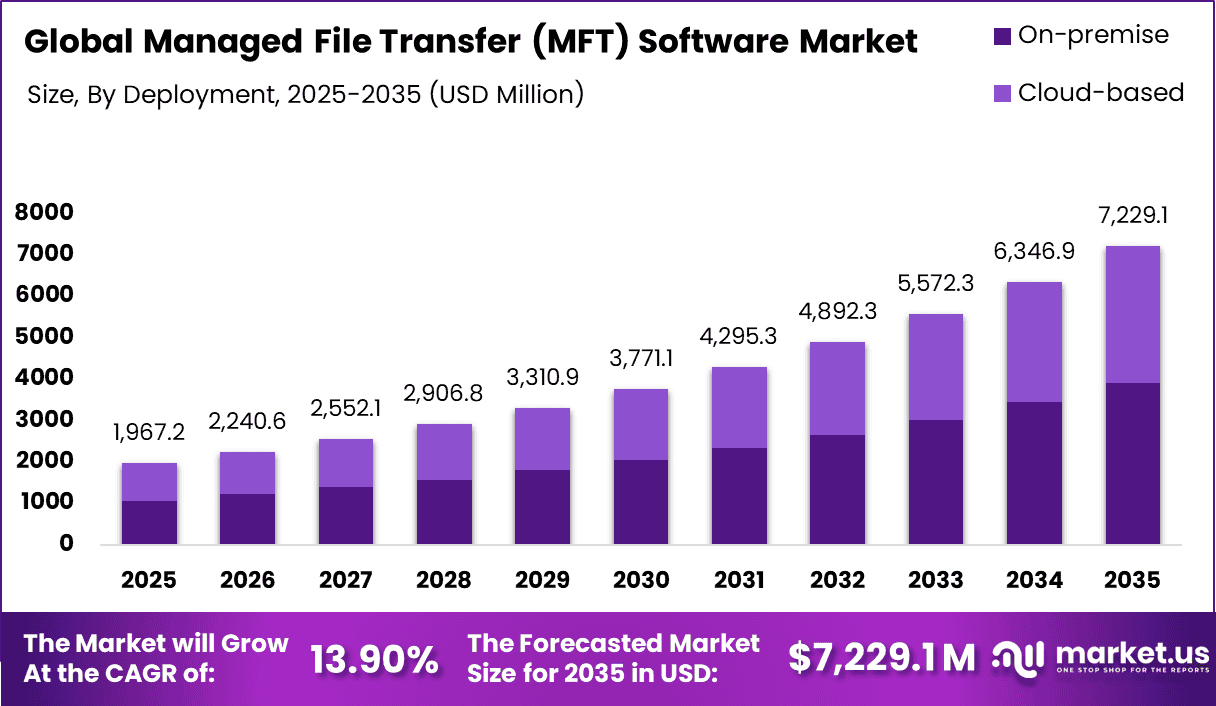
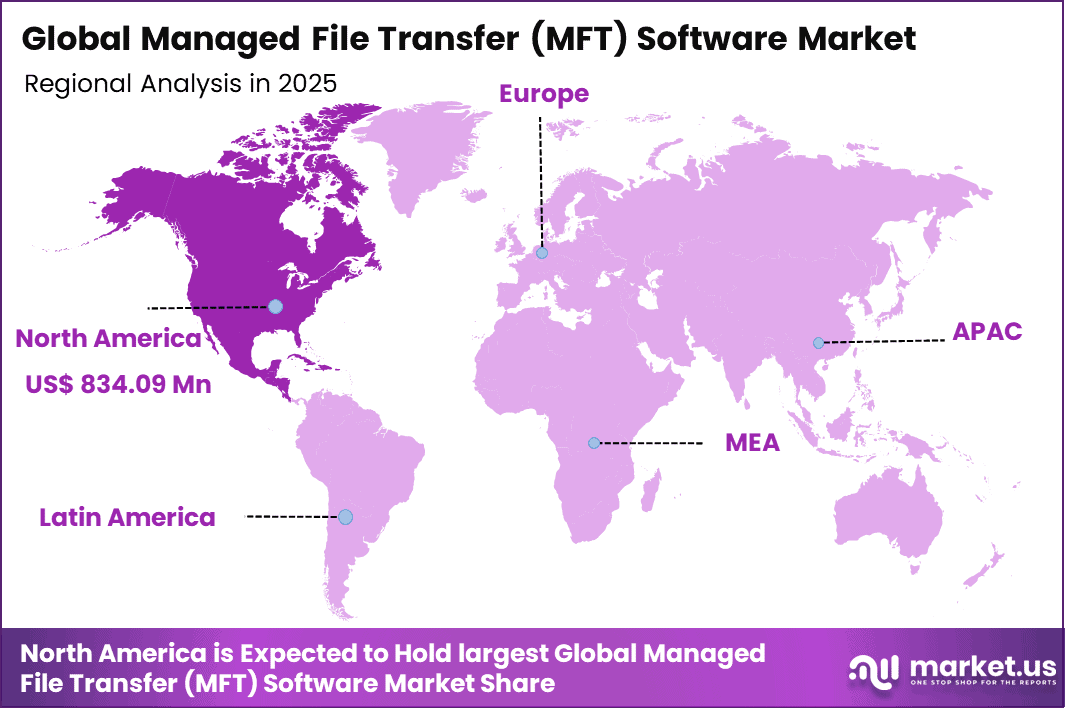
The Global Managed File Transfer (MFT) Software Market generated USD 1,967.2 million in 2025 and is predicted to register growth from USD 2,240.6 million in 2026 to about USD 7,229.1 million by 2035, recording a CAGR of 13.90% throughout the forecast span. In 2025, North America held a dominant market position, capturing more than a 42.4% share, holding USD 834.09 Million revenue.
Managed file transfer software is used to securely send, receive, and monitor files between people, systems, and business partners. It provides a controlled environment for transferring sensitive data such as financial records, customer information, healthcare files, and operational documents.
Unlike basic file sharing methods, these solutions offer encryption, automation, tracking, and policy controls that help organizations manage critical data movement with greater reliability. As businesses depend more on digital workflows, managed file transfer software has become an important part of secure enterprise operations.
One of the main driving factors is the growing need for stronger data security and regulatory compliance. Organizations are handling confidential information across internal teams and external partners, making secure transfer methods essential.
In addition, manual file exchange processes are slow and prone to errors, which is encouraging the adoption of automated solutions that can schedule transfers and confirm delivery. The rise of hybrid cloud environments is also supporting this market, as companies need tools that can move files across on premises systems and cloud platforms. Increasing cyber threats are further pushing businesses to replace unsecured transfer methods with managed and auditable systems.
Demand for managed file transfer software is rising as enterprises seek dependable and scalable ways to exchange large volumes of data. There is a strong preference for solutions that provide real time visibility, audit trails, workflow automation, and integration with existing business applications.
Organizations are also looking for platforms that can support multiple transfer protocols and operate across diverse IT environments. The demand is particularly strong in sectors such as banking, healthcare, manufacturing, retail, and government where secure data exchange is critical. As digital collaboration and compliance needs continue to grow, the need for reliable managed file transfer solutions is expected to increase steadily.
Top Market Takeaways
Automated application transfers command 35.6%, streamlining batch processing, API integrations, and scheduled workflows for high-volume enterprise file movements.
On-premise deployment holds 54.2%, ensuring data sovereignty, customized security protocols, and integration with legacy mainframes in regulated environments.
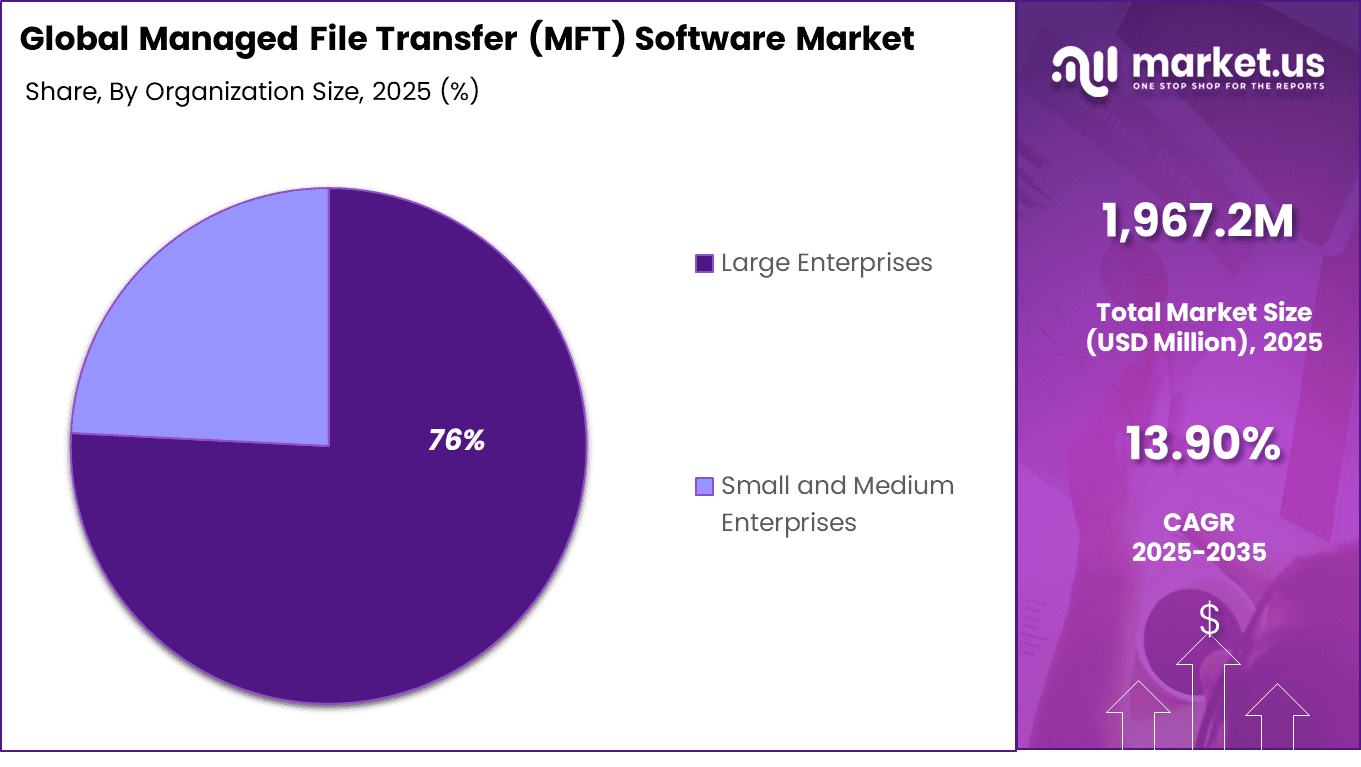
Large enterprises dominate at 75.8% by organization size, leveraging robust platforms for global partner ecosystems, audit trails, and failover redundancy.
BFSI end-user industry captures 28.1%, powering transaction reconciliations, regulatory reporting, and interbank transfers with end-to-end encryption.
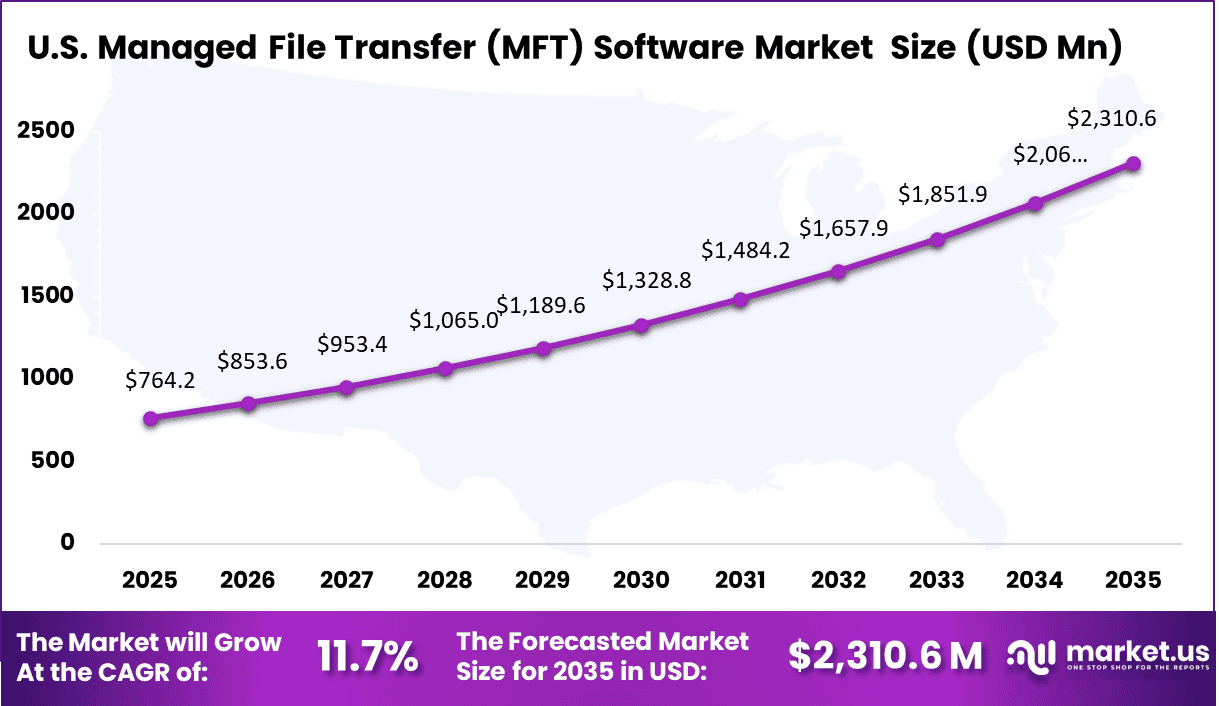
North America drives 42.4% global value, with U.S. market at USD 764.16 million and 11.7% CAGR, fueled by Dodd-Frank compliance and fintech data flows.
Drivers Impact Analysis
Key Driver
Impact on CAGR Forecast (~%)
Geographic Relevance
Impact Timeline
Additional Insight
Rising need for secure enterprise data transfer
+3.7%
North America, Europe, Asia Pacific
Short to medium term
Security needs drive MFT adoption
Increasing regulatory compliance for data exchange
+3.3%
North America, Europe
Medium term
Compliance boosts demand for controlled transfers
Growth in cloud computing and hybrid IT environments
+3.0%
Global
Medium to long term
Cloud usage expands file movement needs
Rising cyber threats and data breach concerns
+2.7%
Global
Medium term
Firms seek encrypted transfer solutions
Expansion of B2B digital workflows and automation
+2.4%
Global
Medium to long term
Automated processes increase transfer volumes
Restraints Impact Analysis
Key Restraint
Impact on CAGR Forecast (~%)
Geographic Relevance
Impact Timeline
Additional Insight
High deployment and integration costs
-2.8%
Emerging markets
Short to medium term
Costs slow adoption among smaller firms
Complexity in migrating from legacy systems
-2.4%
Global
Medium term
Legacy transitions delay projects
Limited awareness among SMEs
-2.0%
Developing regions
Medium term
Smaller firms rely on basic tools
Data sovereignty and cross-border regulations
-1.7%
Global
Medium to long term
Regulations complicate transfers
Dependence on skilled IT administration
-1.5%
Global
Long term
Expertise gaps affect management
By Solution Analysis
The automate application transfers segment accounted for 35.6% of the market share, reflecting its strong role in streamlining the secure movement of files between business applications and internal systems. This dominance is supported by the growing need for faster data exchange, reduced manual intervention, and consistent workflow execution. Organizations are increasingly using automated transfer solutions to improve operational efficiency and minimize delays in critical business processes.
Another factor driving this segment is the rising demand for error-free and traceable file movement across complex IT environments. Automated application transfers help businesses schedule recurring tasks, monitor transfer status, and ensure successful delivery. These capabilities are especially valuable for organizations handling frequent and time-sensitive data exchanges.
By Deployment Analysis
The on-premise segment held 54.2% share, driven by the need for stronger control over sensitive data and internal infrastructure. Many organizations prefer on-premise deployment to manage file transfers within their own secure environments, especially when dealing with confidential records and strict compliance requirements. This model also allows deeper customization based on internal workflows.
In addition, businesses with legacy systems often choose on-premise solutions for easier integration with existing IT architecture. Local deployment provides direct oversight of performance, security settings, and access controls. These advantages continue to support the leading position of on-premise MFT software.
By Organization Size Analysis
The large enterprises segment captured 76% of the market, reflecting their extensive need to manage high volumes of data transfers across departments, partners, and geographic locations. These organizations rely on MFT software to maintain secure and reliable communication channels while handling complex operational requirements. Strong governance and audit capabilities are major priorities for this segment.
Moreover, large enterprises have greater resources to invest in advanced transfer platforms with automation, analytics, and policy management features. Their focus on business continuity, data security, and process efficiency has significantly increased adoption of MFT solutions across enterprise environments.
By End-User Industry Analysis
The BFSI segment accounted for 28.1% of the market share, driven by the need to securely transfer financial data, customer records, and transaction files. Banks and financial institutions handle sensitive information daily, making secure file movement essential for operational integrity and regulatory compliance. MFT software helps ensure controlled and encrypted exchanges across systems and partners.
Furthermore, the increasing use of digital banking and interconnected financial services has raised the volume of file-based transactions. BFSI organizations are adopting managed transfer solutions to reduce risk, improve visibility, and maintain service reliability. This has reinforced the importance of MFT software within the BFSI industry.
Investor Type Impact Analysis
Investor Type
Growth Sensitivity
Risk Exposure
Geographic Focus
Investment Outlook
Venture capital firms
Moderate to high
High
US, Europe
Investing in secure data exchange startups
Private equity firms
High
Moderate
North America and Europe
Scaling enterprise software providers
Corporate investors
Very high
Moderate
Global
Strategic investments in cybersecurity ecosystems
Institutional investors
Moderate
Low to moderate
Developed markets
Prefer stable enterprise SaaS firms
Government and public funding bodies
Moderate
Low
Global
Supporting secure digital infrastructure
Technology Enablement Analysis
Technology
Impact on CAGR Forecast (~%)
Geographic Relevance
Impact Timeline
Additional Insight
AI-driven threat detection for file transfers
+3.8%
US, Europe
Medium to long term
Improves anomaly detection
Cloud-native MFT platforms
+3.4%
Global
Short to medium term
Enables scalable deployment
API-based integration with enterprise systems
+3.0%
Global
Medium term
Simplifies workflow connectivity
End-to-end encryption and zero-trust security
+2.7%
Global
Medium to long term
Strengthens data protection
Automation and orchestration tools
+2.4%
Global
Medium term
Reduces manual file handling
Key Challenges
High implementation cost makes adoption difficult for small businesses.
Complex integration with existing IT systems and applications.
Data security risks if transfers are not properly managed.
Lack of skilled professionals to manage advanced MFT systems.
Frequent software updates can disrupt daily operations.
Difficulty in handling large volumes of file transfers.
Limited flexibility in some legacy transfer solutions.
Dependence on stable network connectivity for smooth transfers.
Resistance to move from traditional file sharing methods.
Emerging Trends
The managed file transfer software market is evolving toward more secure, automated, and cloud connected data exchange environments. One of the key emerging trends is the shift from basic file sharing tools to policy driven transfer platforms that provide encryption, access controls, and full audit trails. This is helping organizations manage sensitive data with stronger oversight.
Another important trend is the growing integration of managed file transfer solutions with cloud storage, enterprise applications, and workflow systems, allowing files to move automatically across business processes. There is also increasing use of AI based monitoring tools that can detect unusual transfer behavior, failed deliveries, or potential security risks in real time. In addition, low code interfaces are gaining traction, enabling business teams to build transfer workflows without heavy technical support. Hybrid deployment models are also becoming more common, allowing organizations to manage transfers across on premise and cloud environments through a single platform.
Growth Factors
The growth of this market is driven by the rising need for secure data exchange across industries handling confidential information. As organizations share larger volumes of files with customers, partners, and internal teams, traditional email and consumer file sharing methods are becoming less suitable. Regulatory pressure around data privacy, retention, and traceability is also encouraging adoption of controlled transfer solutions.
Another major factor is the growing pace of digital transformation, where businesses need automated file movement between systems to reduce delays and manual effort. Remote and distributed work models are further increasing the need for secure access to files from multiple locations. Additionally, the rising frequency of cyber threats is pushing enterprises to invest in managed file transfer platforms that provide visibility, governance, and dependable delivery of critical business data.
Key Market Segments
By Solution
Real-Time Monitoring and Control
Fast Partner Onboarding/Collaboration
Automate Application Transfers
Other Solutions
By Deployment
Cloud-based
On-premise
By Organization Size
Large Enterprises
Small and Medium Enterprises
By End-user Industry
IT & Telecommunication
BFSI
Retail
Healthcare
Media & Entertainment
Other End-user Industry
Regional Analysis
North America accounted for 42.4% of the Managed File Transfer (MFT) Software market, supported by strong enterprise demand for secure data exchange and strict regulatory compliance requirements. Organizations across the region handle large volumes of sensitive files in sectors such as banking, healthcare, government, and retail, creating steady demand for controlled and auditable transfer solutions.
Businesses are increasingly replacing traditional file sharing methods with MFT platforms that offer encryption, workflow automation, access controls, and real-time tracking. In addition, the growing shift toward hybrid IT environments and cross-border data movement is strengthening adoption across the region.
The U.S. market reached USD 764.16 Million and is projected to grow at a CAGR of 11.7%, driven by rising cybersecurity concerns and increasing need for reliable business-to-business data transfer. Enterprises are adopting MFT software to reduce manual processes, improve operational efficiency, and protect confidential information during file exchange.
The expansion of cloud services and remote work models is also increasing the need for secure transfers across distributed systems and users. In addition, growing emphasis on governance, risk management, and digital transformation is expected to support steady growth of the MFT software market in the US over the coming years.
Key Regions and Countries
North America
US
Canada
Europe
Germany
France
The UK
Spain
Italy
Russia
Netherlands
Rest of Europe
Asia Pacific
China
Japan
South Korea
India
Australia
Singapore
Thailand
Vietnam
Rest of APAC
Latin America
Brazil
Mexico
Rest of Latin America
Middle East & Africa
South Africa
Saudi Arabia
UAE
Rest of MEA
Competitive Analysis
The competitive landscape of the Managed File Transfer (MFT) Software Market is led by a mix of global enterprise software companies and specialized secure data transfer providers. Companies such as IBM Corporation, Oracle Corporation, OpenText Corporation, TIBCO Software Inc., and Axway Inc. focus on large-scale MFT platforms that support secure file exchange, compliance management, workflow automation, and integration with enterprise systems.
These players serve highly regulated industries such as banking, healthcare, and government, where secure and reliable data movement is critical. Their strong global presence and broad software portfolios help them maintain a leading position in the market.
At the same time, companies such as GoAnywhere (HelpSystems LLC.), Progress Software Corporation, GlobalSCAPE Inc., Thru Inc., Cleo Communications Inc., Attunity Ltd. (QlikTech International AB), and Coviant Software compete by offering flexible, user-friendly, and cost-effective solutions for mid-sized and large organizations.
These players focus on cloud deployment, simplified administration, and faster implementation while maintaining strong security controls. Competition in this market is driven by data protection, regulatory compliance, automation capabilities, and the ability to manage growing file volumes across hybrid IT environments.
The future outlook for the Managed File Transfer (MFT) Software Market looks strong as businesses continue to focus on secure and reliable data exchange across internal teams, partners, and customers. The market is expected to grow with rising concerns around cybersecurity, compliance, and protection of sensitive files. More organizations are anticipated to replace manual and outdated transfer methods with automated MFT solutions that improve speed, tracking, and control. In the coming years, cloud deployment, AI-based monitoring, and integration with enterprise systems are expected to make MFT platforms more efficient and scalable, supporting wider adoption across industries.
Recent Developments
April, 2026 – IBM Sterling Secure File Gateway adds AI threat detection blocking 99% ransomware attempts. Quantum-safe encryption while hybrid cloud supports on-prem+AWS deployments seamlessly. Enterprise integration leader.
March, 2026 – Oracle Integration Cloud MFT automates EDI with 500+ partner protocols. Blockchain audit trails while real-time monitoring dashboards track 1M files daily. ERP ecosystem giant.
Report Scope
Report Features
Description
Market Value (2025)
USD 1,967.2 Million
Forecast Revenue (2035)
USD 7,229.1 Million
CAGR(2025-2035)
13.90%
Base Year for Estimation
2024
Historic Period
2020-2024
Forecast Period
2025-2035
Report Coverage
Revenue forecast, AI impact on Market trends, Share Insights, Company ranking, competitive landscape, Recent Developments, Market Dynamics and Emerging Trends
Segments Covered
By Solution (Real-Time Monitoring and Control, Fast Partner Onboarding/Collaboration, Other Solutions), By Deployment (Cloud-based, On-premise), By Organization Size (Large Enterprises, Small and Medium Enterprises), By End-user Industry (IT & Telecommunication, BFSI, Other End-user Industry)
Regional Analysis
North America – US, Canada; Europe – Germany, France, The UK, Spain, Italy, Russia, Netherlands, Rest of Europe; Asia Pacific – China, Japan, South Korea, India, New Zealand, Singapore, Thailand, Vietnam, Rest of Latin America; Latin America – Brazil, Mexico, Rest of Latin America; Middle East & Africa – South Africa, Saudi Arabia, UAE, Rest of MEA