Global Malware Analysis Market Size, Share and Analysis By Component (Solution, Services), By Deployment (On-Premises, Cloud-based), By Enterprise Size (Large Enterprises, Small & Medium Enterprises (SMEs), By Industry Vertical (BFSI, Government & Defense, Healthcare, IT & Telecom, Manufacturing, Others), By Regional Analysis, Global Trends and Opportunity, Future Outlook By 2025-2035
- Published date: March 2026
- Report ID: 180825
- Number of Pages: 226
- Format:
-
keyboard_arrow_up
Quick Navigation
- Report Overview
- Key Takeaway
- Key Insights Summary
- Role of Generative AI
- By Component: Solution
- By Deployment: On Premises
- By Enterprise Size: Large Enterprises
- By Industry Vertical: BFSI
- By Region: North America
- Emerging Trends
- Growth Factors
- Key Market Segments
- Driver Analysis
- Restraint Analysis
- Opportunity Analysis
- Challenge Analysis
- Key Players Analysis
- Recent Developments
- Report Scope
Report Overview
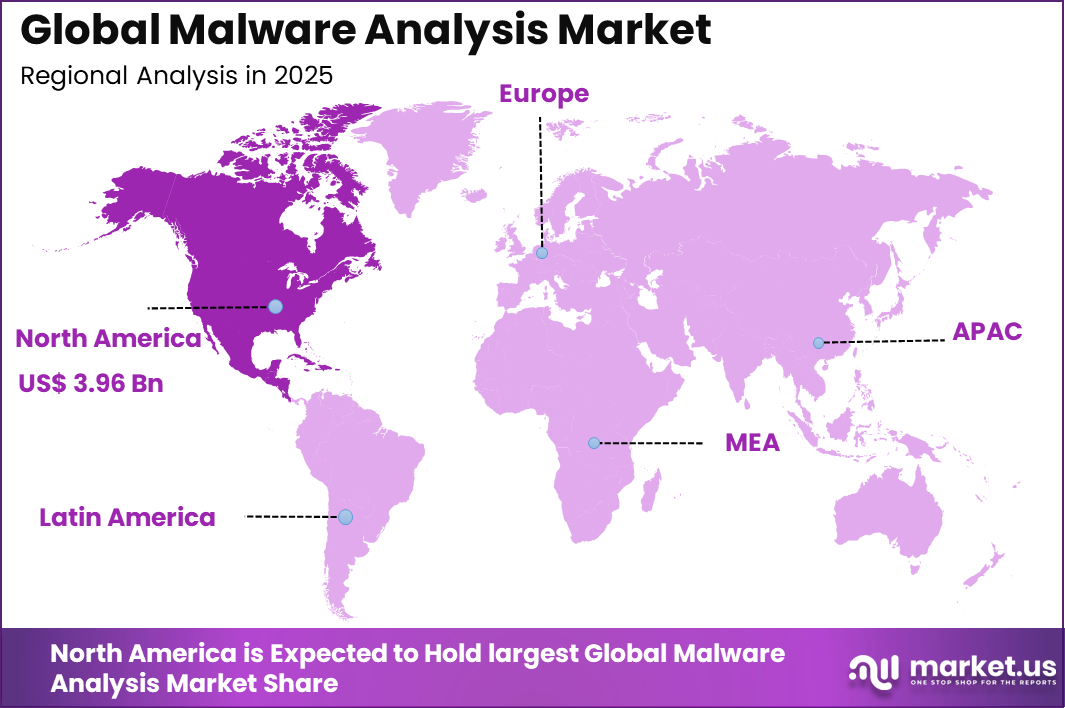
The Global Malware Analysis Market size is expected to be worth around USD 147.4 billion by 2035, from USD 12.2 billion in 2025, growing at a CAGR of 28.3% during the forecast period from 2025 to 2035. North America held a dominant market position, capturing more than a 32.5% share, holding USD 3.96 billion in revenue.
The malware analysis market focuses on technologies and services that examine malicious software to understand its behavior, origin, and potential impact. These solutions allow cybersecurity teams to identify how malware operates, spreads, and interacts with targeted systems. As cyber threats grow in scale and sophistication, organizations require deeper inspection tools to detect hidden threats. Malware analysis platforms therefore play a critical role in enterprise security strategies.
Market demand has increased due to the rapid expansion of digital infrastructure and connected devices. Organizations process sensitive data across cloud systems, mobile devices, and enterprise networks. Attackers exploit these environments using increasingly complex malware techniques. Analysis tools provide insight that helps security teams prevent future attacks.
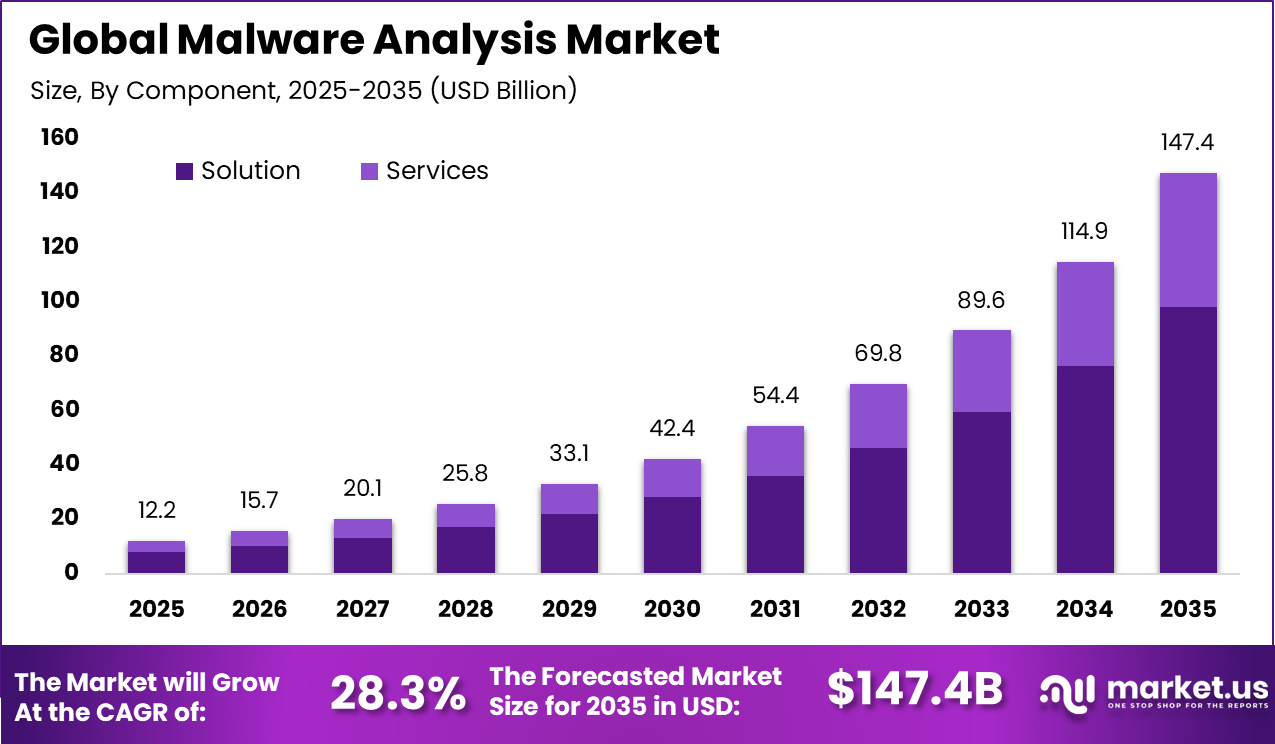
According to industry research, more than 450,000 new malicious programs are identified every day across global digital networks. The cumulative volume of known malware has reached nearly 1.2 billion unique samples, highlighting the scale and persistence of cyber threats faced by organizations and individuals. This rapid growth in malicious software reflects the increasing sophistication of cybercriminal activity and the expanding attack surface created by connected systems and cloud infrastructure.
Malware continues to play a major role in cybersecurity incidents, contributing to approximately 40% of reported data breaches in 2023. To address this challenge, advanced analytics and artificial intelligence techniques are being widely adopted. Machine learning models, including Decision Tree (DT) algorithms, have demonstrated detection accuracy levels approaching 99%, enabling faster identification of malicious patterns and improving overall threat response capabilities across enterprise security environments.
For instance, in February 2026, Check Point Software Technologies Ltd. unveiled Harmony Endpoint’s new malware dissection engine, achieving 95% accuracy against polymorphic threats. Israeli innovation drives North American adoption in healthcare, where compliance demands precise threat attribution.
Key Takeaway
- In 2025, the Solution segment led the Malware Analysis Market, accounting for 66.5% of total share.
- In 2025, On Premises deployment remained dominant, capturing 54.72% of the market.
- In 2025, Large Enterprises represented the primary customer segment with a 61.3% share.
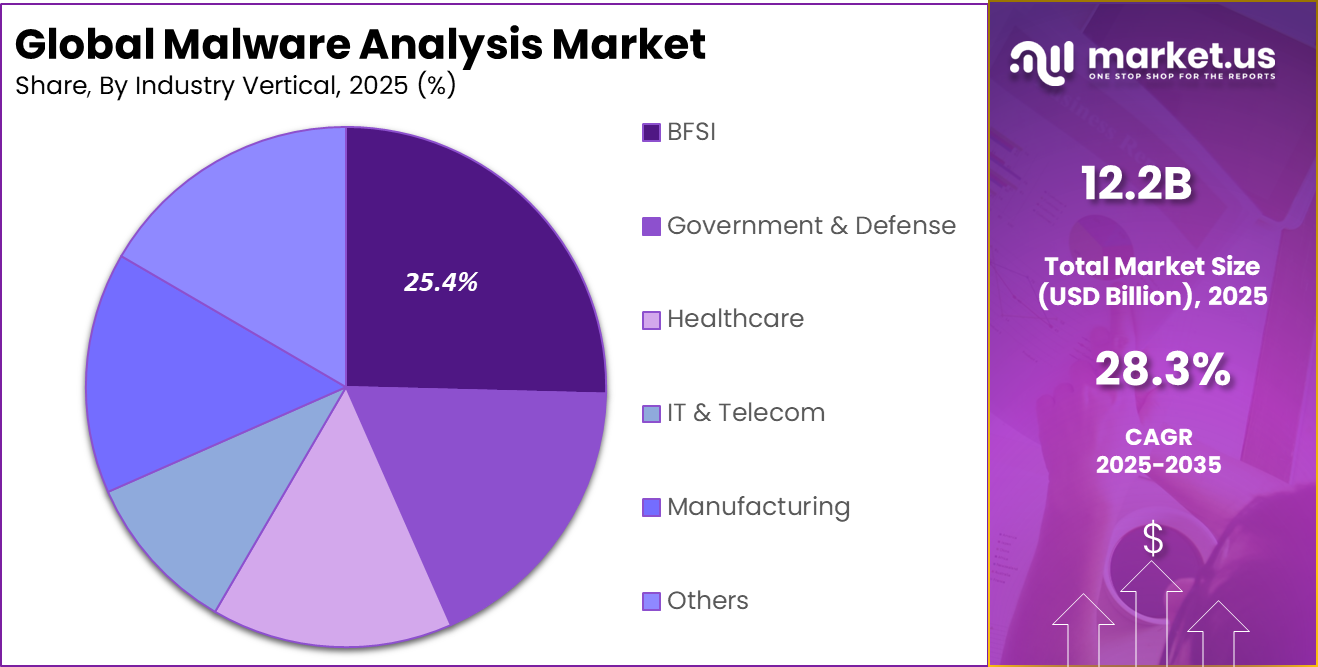
- In 2025, the BFSI sector held the largest industry share at 25.4%.
- In 2025, North America secured a 32.5% regional share, while the U.S. market reached USD 3.62 billion and recorded a growth rate of 26.4%.
Key Insights Summary
- Approximately 560,000 new and unique malicious files are detected each day, reflecting sustained threat expansion.
- The cumulative volume of malware and potentially unwanted applications has reached nearly 1.2 billion, with 2021 marking the peak year for new unique samples.
- Malware attacks have increased by 87% over the past decade, indicating long term threat acceleration.
- On Windows systems, SocGholish, also known as FakeUpdates, accounts for nearly 60% of reported attacks.
- In the second quarter of 2025, more than 143,000 malicious mobile packages were identified, with Trojan Banker and AdWare variants leading activity.
- Ransomware incidents increased by 29% in the fourth quarter of 2024, highlighting continued enterprise risk.
- Between 2022 and 2023, worms were the most frequently observed malware family, followed by Webshell, Emotet, and Negasteal variants.
- Decision Tree machine learning models achieved 99% detection accuracy, while Convolutional Neural Networks demonstrated 98.76% accuracy.
- Malware analysis approaches include static code examination, dynamic sandbox execution, and hybrid techniques for comprehensive threat identification.
- In 2023, 81% of organizations experienced malware, phishing, or password based attacks.
- RiskTool, AdWare, and Trojan Banker variants remain the leading mobile malware threats.
- The malware analysis market is expanding at approximately 31% due to rising attack complexity and the need to minimize false positives.
Role of Generative AI
Generative AI is transforming malware analysis by automating complex tasks such as code deconstruction and threat prediction. Many modern security tools handle nearly 85% of routine reverse engineering activities, allowing analysts to focus on sophisticated threats. These systems reduce investigation time from days to hours by producing detailed behavioral reports.
Security teams increasingly rely on AI systems to uncover hidden attack patterns that analysts may miss under pressure. Around 70% of security teams report stronger detection accuracy after adopting these tools. By simulating attacker techniques in real time, generative AI provides data driven insights that strengthen confidence in threat investigations.
By Component: Solution
Solutions account for 66.5% of the market, reflecting the growing reliance on specialized platforms that detect, analyze, and classify malicious code. Malware analysis solutions use advanced techniques such as behavioral analysis, sandbox testing, and code inspection to identify threats. Security teams rely on these platforms to understand attack methods and develop appropriate response strategies.
The dominance of solution platforms is also supported by their ability to integrate with broader cybersecurity infrastructures such as security information and event management systems. Automated analysis capabilities enable organizations to process large numbers of suspicious files quickly and accurately. As cyber threats continue to evolve, malware analysis solutions remain an essential component of enterprise security systems.
For Instance, in January 2026, Cisco Systems Inc. rolled out updates to its Secure Malware Analytics platform. Teams now get faster dynamic analysis for suspicious files, helping spot hidden threats in real time. This fits right into the solutions category, as users lean on these tools for quick, reliable protection without building from scratch.
By Deployment: On Premises
On premises deployment represents 54.72% of the market, highlighting the need for strict control over cybersecurity infrastructure and sensitive data environments. Many organizations prefer to conduct malware analysis within their internal networks to prevent exposure of confidential information. Internal deployment allows security teams to maintain direct oversight of threat detection processes.
Organizations operating in highly regulated industries often require internal security monitoring systems to comply with data protection standards. On premises analysis environments also allow customized configurations tailored to specific organizational security policies. As data protection concerns remain high, internal deployment continues to maintain significant adoption.
For instance, in March 2026, Palo Alto Networks Inc. strengthened on-premises support in its Cortex XDR, adding local sandboxing for isolated scans. Firms like it for keeping scans fully in-house, dodging cloud worries during sensitive checks. This fits the shift toward controlled environments.
By Enterprise Size: Large Enterprises
Large enterprises account for 61.3% of market adoption due to the complexity of their digital infrastructure and exposure to cyber threats. These organizations manage extensive IT systems, networks, and data repositories that require continuous monitoring. Dedicated cybersecurity teams within large enterprises implement advanced malware analysis platforms to strengthen threat detection capabilities.
The scale of operations in large organizations also increases the potential impact of cyberattacks. Automated malware analysis helps identify threats quickly and prevent widespread damage across enterprise systems. As cyber risks grow alongside digital transformation initiatives, large enterprises remain the primary adopters of malware analysis technologies.
For Instance, in February 2026, Check Point Software Technologies Ltd. tailored Harmony Endpoint for large-scale networks, scaling analysis across thousands of devices. Big outfits value the unified view it offers, easing oversight in sprawling systems. This drives adoption where complexity rules.
By Industry Vertical: BFSI
The BFSI sector represents 25.4% of the market due to the high sensitivity of financial data and strict regulatory requirements. Financial institutions handle large volumes of transactions and confidential customer information that must be protected from cyber threats. Malware analysis tools help detect malicious code targeting financial systems and online banking platforms.
Cybercriminals frequently target financial institutions due to the potential for financial gain. Continuous threat monitoring and analysis are therefore essential to maintaining secure financial operations. As digital banking and financial technologies expand, the BFSI sector continues to invest heavily in advanced malware analysis systems.
For Instance, in January 2026, Sophos Group plc introduced banking-focused Intercept X updates, sharpening malware checks for financial data flows. BFSI teams lean on it to block credential theft attempts common in their world. It matches the sector’s nonstop vigilance needs.
By Region: North America
North America holds 32.5% of the market share due to strong cybersecurity awareness and widespread adoption of advanced security technologies. Organizations across finance, technology, and government sectors rely on malware analysis platforms to protect digital infrastructure from evolving threats. The presence of major cybersecurity solution providers further supports regional market development.
For instance, in January 2026, Palo Alto Networks launched Cortex XDR 3.0 with advanced behavioral malware analytics, blocking sophisticated ransomware attacks across 50,000+ organizations. North America’s cutting-edge AI integration maintains its forefront position in cloud-native threat hunting.
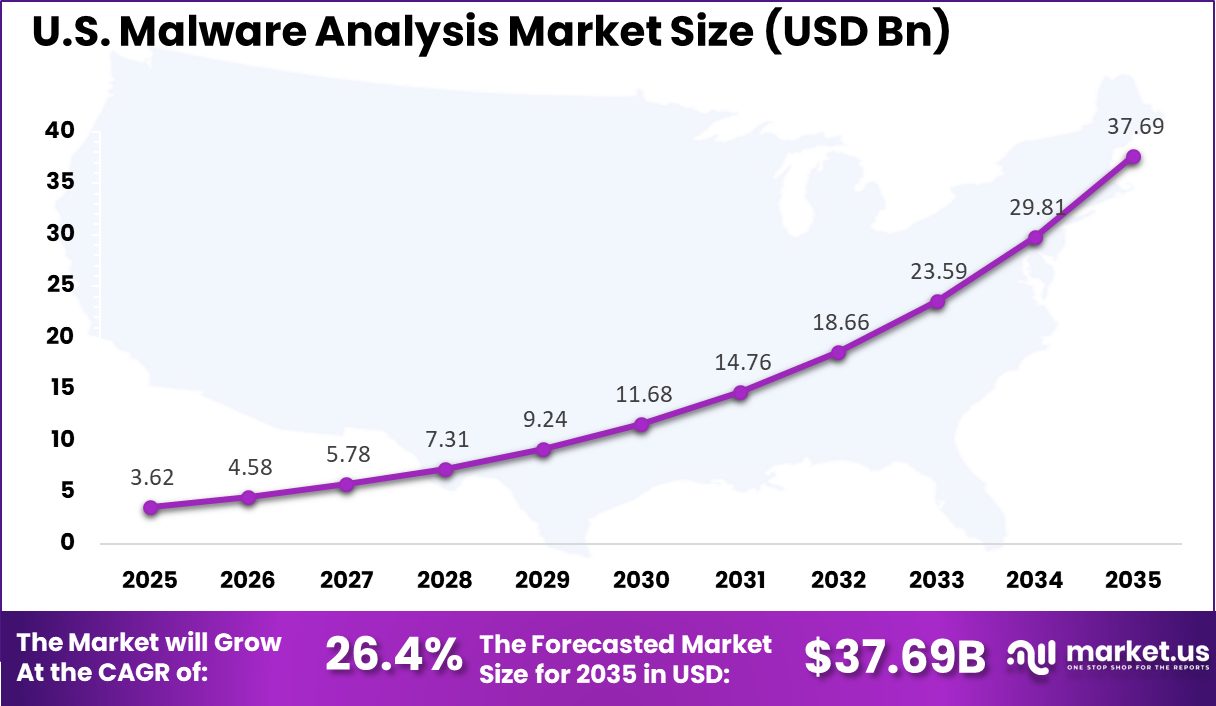
Within North America, the United States contributes USD 3.62 billion with a growth rate of 26.4%. The country’s extensive digital economy and high exposure to cyber threats have encouraged widespread investment in cybersecurity technologies. Continued focus on threat intelligence and security infrastructure modernization is expected to support sustained market growth.
For instance, in February 2026, Cisco enhanced its malware analysis dominance with Talos Intelligence platform updates, featuring AI-driven threat detection that neutralized 2.5 million malware variants daily. This innovation solidified U.S. leadership in real-time analysis for enterprise networks worldwide.
Emerging Trends
One emerging trend in the malware analysis market is the use of artificial intelligence and machine learning for automated threat analysis. AI-powered systems can analyze large volumes of malware samples, detect behavioral patterns, and identify previously unknown threats more quickly than manual analysis methods. This capability helps security teams respond to cyber threats with greater speed and accuracy.
Automation is reshaping the cybersecurity landscape as AI-driven attacks now power nearly 90% of cyber operations. These automated threats move quickly, forcing analysts to respond faster than before. Advanced sandbox environments with behavioral simulation help detect hidden activities and identify around 75% more zero day threats than traditional static methods.
Another trend is the growing adoption of cloud-based malware analysis platforms. Cloud environments allow organizations to analyze suspicious files in isolated virtual environments without risking their internal systems. This approach provides scalable analysis capabilities and enables faster detection of emerging threats.
Awareness of ransomware risks dropped from 86% to 70% among agencies in one year, highlighting the challenge. As a response, organizations increasingly use memory forensics and AI-assisted threat hunting to detect attacks that operate inside legitimate system processes.
Growth Factors
One of the primary growth factors driving the malware analysis market is the rapid increase in cyber threats worldwide. Malware attacks such as ransomware, spyware, and advanced persistent threats are becoming more sophisticated and difficult to detect using traditional security tools. Malware analysis solutions allow security teams to examine malicious code and understand its behavior, enabling faster threat detection and mitigation.
Another important growth factor is the increasing adoption of digital technologies and cloud infrastructure. As organizations migrate critical operations to cloud platforms and interconnected networks, the potential attack surface expands significantly. Malware analysis tools help organizations identify vulnerabilities and analyze malicious activities across complex digital environments.
Key Market Segments
By Component
- Solution
- Static Analysis
- Dynamic Analysis
- Services
- Training, Consulting, and Advisory
- Integration and Implementation
- Managed Security Information and Event Management
By Deployment
- On-Premises
- Cloud-based
By Enterprise Size
- Large Enterprises
- Small & Medium Enterprises (SMEs)
By Industry Vertical
- BFSI
- Government & Defense
- Healthcare
- IT & Telecom
- Manufacturing
- Others
Key Regions and Countries
North America
- US
- Canada
Europe
- Germany
- France
- The UK
- Spain
- Italy
- Russia
- Netherlands
- Rest of Europe
Asia Pacific
- China
- Japan
- South Korea
- India
- Australia
- Singapore
- Thailand
- Vietnam
- Rest of APAC
Latin America
- Brazil
- Mexico
- Rest of Latin America
Middle East & Africa
- South Africa
- Saudi Arabia
- UAE
- Rest of MEA
Driver Analysis
Increasing Sophistication of Cyber Attacks
A major driver of the malware analysis market is the increasing complexity of cyber attacks. Attackers use advanced techniques such as polymorphic malware, fileless attacks, and multi-stage exploits to evade traditional detection mechanisms. Malware analysis platforms enable cybersecurity teams to examine malicious code in detail and understand its behavior, helping them develop more effective defense strategies.
Another driver is the growing demand for proactive cybersecurity measures. Organizations are moving beyond reactive security approaches and implementing threat intelligence and analysis tools to anticipate potential attacks. Malware analysis systems provide insights into attack patterns and vulnerabilities, allowing organizations to strengthen their security posture.
For instance, in February 2026, CrowdStrike Holdings Inc. shared details on a global phishing surge through its Falcon platform alerts. Their analysis tools let security staff pick apart malicious links and payloads right away, cutting response times for affected firms. It highlighted the need for hands-on breakdown features amid daily attack spikes.
Restraint Analysis
Shortage of Cybersecurity Expertise
One restraint affecting the malware analysis market is the shortage of skilled cybersecurity professionals capable of conducting advanced malware investigations. Malware analysis requires deep technical knowledge of programming, operating systems, and network security. Many organizations face challenges in recruiting and retaining professionals with these specialized skills.
Another restraint involves the complexity of analyzing modern malware. Sophisticated malware often uses encryption, obfuscation, and anti-analysis techniques to avoid detection. Analyzing such threats requires advanced tools and significant processing resources, which can increase operational costs for organizations.
For instance, in November 2025, Sophos Group plc introduced training modules tied to its Intercept X software, aiming to upskill frontline workers on malware trends. With expert shortages slowing deep dives, this lets basic staff run initial scans and flag issues, bridging the know-how divide in tight teams.
Opportunity Analysis
Integration with Threat Intelligence Platforms
A significant opportunity in the malware analysis market lies in integrating analysis tools with broader threat intelligence platforms. By combining malware analysis with global threat intelligence feeds, organizations can identify emerging attack patterns and improve their ability to detect previously unknown threats.
Another opportunity involves the development of automated analysis environments known as sandboxing systems. These systems allow security teams to run suspicious files in controlled environments where malware behavior can be observed safely. Advanced sandbox technologies can accelerate threat investigation and improve incident response efficiency.
For instance, in March 2026, Fortinet Inc. expanded its FortiSandbox cloud service with better integration for remote setups, drawing in firms shifting data online. It offers on-demand malware testing without local hardware, making analysis smooth for spread-out operations and opening doors for broader use.
Challenge Analysis
Rapid Evolution of Malware Techniques
One of the major challenges in the malware analysis market is the rapid evolution of malware development techniques. Cybercriminals continuously modify their tools to bypass security defenses and avoid detection. Security teams must constantly update analysis techniques and detection methods to keep pace with these evolving threats.
Another challenge involves handling the massive volume of malware samples generated daily. Security systems may encounter thousands of suspicious files each day, making manual analysis impractical. Organizations must rely on automation and advanced analytics to manage these workloads effectively.
For instance, in December 2025, Malwarebytes Corporation updated its detection engine to focus on in-memory scripts dodging traditional scans, responding to stealthy campaigns. This shift helps spot hidden code, yet the quick mutations keep pushing teams to rethink approaches weekly.
Key Players Analysis
The Malware Analysis Market is driven by global cybersecurity vendors that provide advanced threat detection and malware investigation platforms. Cisco Systems Inc., Palo Alto Networks Inc., Fortinet Inc., and Check Point Software Technologies Ltd. offer integrated security platforms that include malware sandboxing, behavioral analysis, and network threat intelligence.
Endpoint security and managed threat detection providers also contribute significantly to malware investigation capabilities. CrowdStrike Holdings Inc., Sophos Group plc, McAfee Corp., ESET spol. s r. o., and Malwarebytes Corporation provide advanced endpoint detection, malware reverse engineering, and automated threat investigation tools. These solutions are widely used by enterprises and government organizations to analyze malicious files and detect zero day attacks.
Intezer Ltd., Hatching Triage Inc., Joe Security LLC, and Cuckoo Sandbox focus on sandbox based malware detection and automated threat classification. Additional security providers including AT&T Inc., Broadcom Inc., Juniper Networks Inc., Forcepoint LLC, Fidelis Cybersecurity Inc., Coro Cybersecurity, Rapid7 Corporation, NortonLifeLock Inc., and Tanium Inc. contribute advanced analytics, threat intelligence, and automated malware response tools.
Top Key Players in the Market
- Cisco Systems Inc.
- Palo Alto Networks Inc.
- Sophos Group plc
- Kaspersky Lab Group
- Fortinet Inc.
- Check Point Software Technologies Ltd.
- Qualys Inc.
- CrowdStrike Holdings Inc.
- AT&T Inc.
- Broadcom Inc.
- McAfee Corp.
- Juniper Networks Inc.
- VIPRE Security Group
- Forcepoint LLC
- Fidelis Cybersecurity Inc.
- Coro Cybersecurity
- Cuckoo Sandbox
- ESET spol. s r. o.
- Intezer Ltd.
- Hatching Triage Inc.
- Joe Security LLC
- Malwarebytes Corporation
- Rapid7 Corporation
- NortonLifeLock Inc.
- Tanium Inc.
- Others
Recent Developments
- In January 2026, Cisco Systems Inc. launched Secure Malware Analytics 2.0, enhancing dynamic sandboxing with 30% faster threat detection. This upgrade helps enterprises analyze sophisticated malware in real-time, maintaining Cisco’s leadership in automated threat intelligence across North American financial sectors.
- In January 2026, Fortinet Inc. released FortiSandbox Cloud with 40% improved processing speed for malware samples. This SaaS solution dominates U.S. federal deployments, offering automated analysis that scales with growing threat volumes without hardware investments.
Report Scope
Report Features Description Market Value (2025) USD 12.2 Bn Forecast Revenue (2035) USD 147.4 Bn CAGR (2025-2035) 28.3% Base Year for Estimation 2025 Historic Period 2020-2024 Forecast Period 2025-2035 Report Coverage Revenue forecast, AI impact on Market trends, Share Insights, Company ranking, competitive landscape, Recent Developments, Market Dynamics and Emerging Trends Segments Covered By Component (Solution, Services), By Deployment (On-Premises, Cloud-based), By Enterprise Size (Large Enterprises, Small & Medium Enterprises (SMEs), By Industry Vertical (BFSI, Government & Defense, Healthcare, IT & Telecom, Manufacturing, Others) Regional Analysis North America – US, Canada; Europe – Germany, France, The UK, Spain, Italy, Russia, Netherlands, Rest of Europe; Asia Pacific – China, Japan, South Korea, India, New Zealand, Singapore, Thailand, Vietnam, Rest of Latin America; Latin America – Brazil, Mexico, Rest of Latin America; Middle East & Africa – South Africa, Saudi Arabia, UAE, Rest of MEA Competitive Landscape Cisco Systems Inc., Palo Alto Networks Inc., Sophos Group plc, Kaspersky Lab Group, Fortinet Inc., Check Point Software Technologies Ltd., Qualys Inc., CrowdStrike Holdings Inc., AT&T Inc., Broadcom Inc., McAfee Corp.
Juniper Networks Inc., VIPRE Security Group, Forcepoint LLC, Fidelis Cybersecurity Inc., Coro Cybersecurity, Cuckoo Sandbox, ESET spol. s r.o., Intezer Ltd., Hatching Triage Inc., Joe Security LLC, Malwarebytes Corporation, Rapid7 Corporation, NortonLifeLock Inc., Tanium Inc., OthersCustomization Scope Customization for segments, region/country-level will be provided. Moreover, additional customization can be done based on the requirements. Purchase Options We have three license to opt for: Single User License, Multi-User License (Up to 5 Users), Corporate Use License (Unlimited User and Printable PDF) 
-
-
- Cisco Systems Inc.
- Palo Alto Networks Inc.
- Sophos Group plc
- Kaspersky Lab Group
- Fortinet Inc.
- Check Point Software Technologies Ltd.
- Qualys Inc.
- CrowdStrike Holdings Inc.
- AT&T Inc.
- Broadcom Inc.
- McAfee Corp.
- Juniper Networks Inc.
- VIPRE Security Group
- Forcepoint LLC
- Fidelis Cybersecurity Inc.
- Coro Cybersecurity
- Cuckoo Sandbox
- ESET spol. s r. o.
- Intezer Ltd.
- Hatching Triage Inc.
- Joe Security LLC
- Malwarebytes Corporation
- Rapid7 Corporation
- NortonLifeLock Inc.
- Tanium Inc.
- Others
Our Clients

- 180825
- March 2026