Report Overview
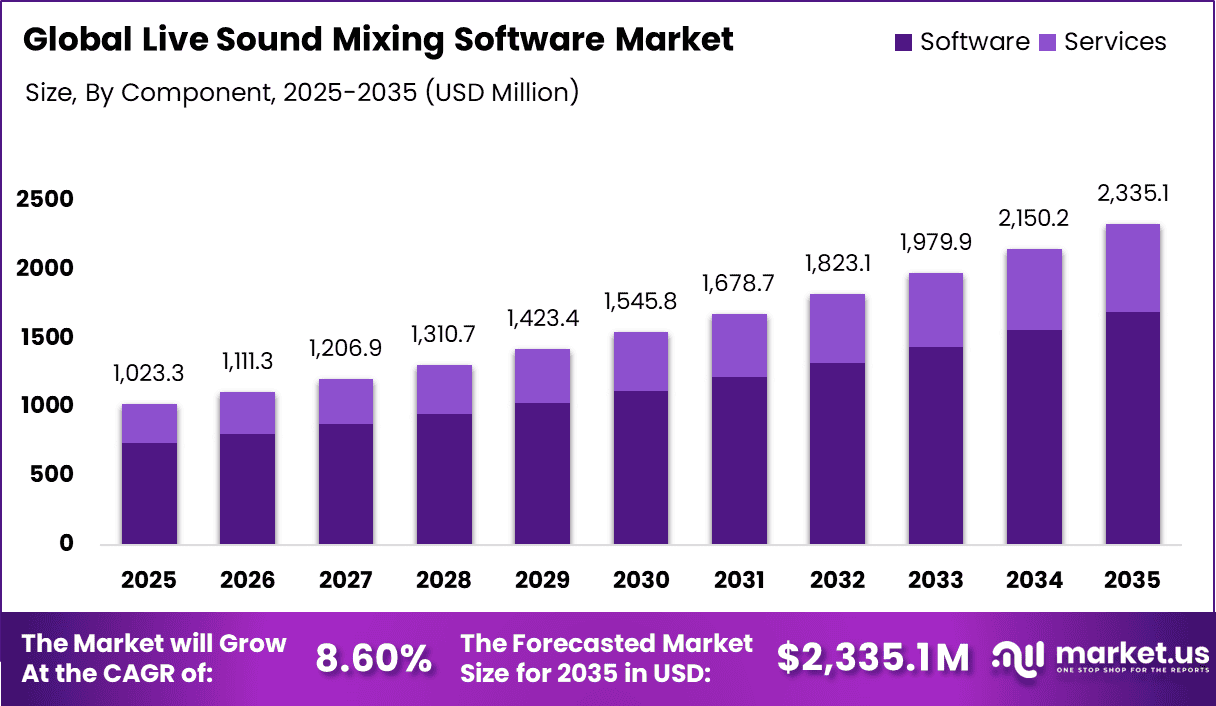
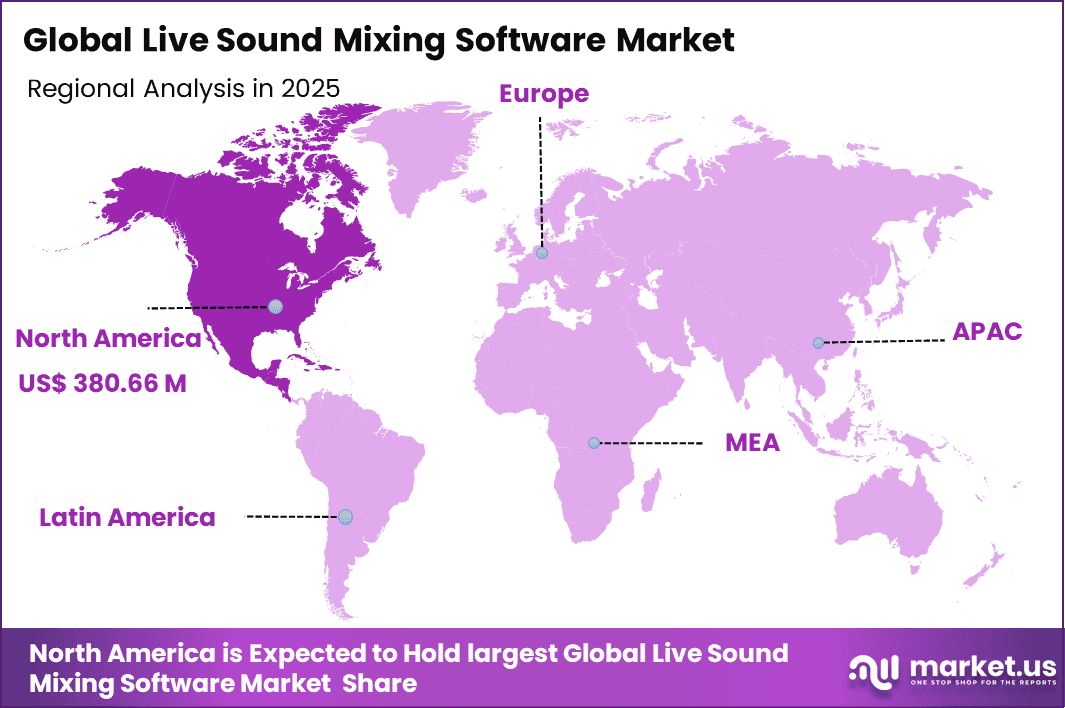
The Global Live Sound Mixing Software Market generated USD 1,023.3 million in 2025 and is predicted to register growth from USD 1,111.3 million in 2026 to about USD 2,335.1 million by 2035, recording a CAGR of 8.60% throughout the forecast span. In 2025, North America held a dominant market position, capturing more than a 37.2% share, holding USD 380.66 Million revenue.
Top Market Takeaways
- Software commands 72.5% market share, delivering real-time multitrack processing, effects automation, and hardware integration for professional front-of-house and monitor mixing.
- Concerts/live music events capture 30.2%, enabling dynamic gain riding, immersive spatial audio rendering, and audience microphone integration for large-scale performances.
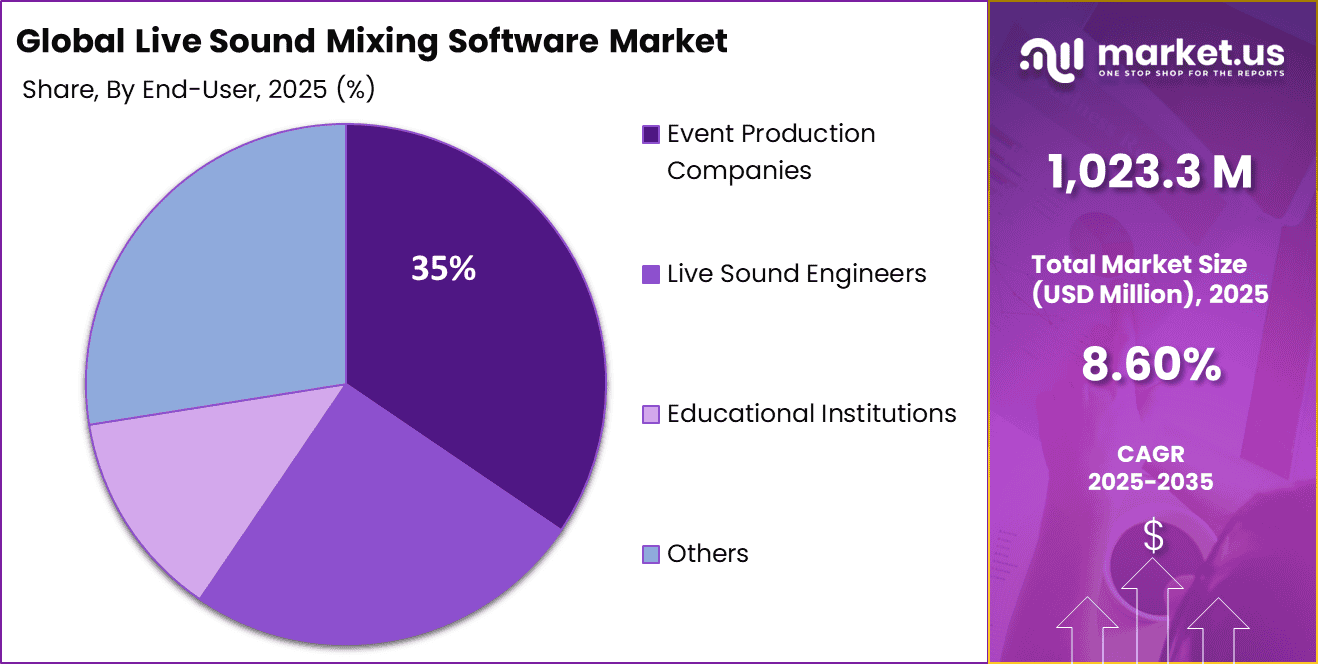
- Event production companies hold 34.5%, leveraging platforms for show file management, remote collaboration, and seamless venue-to-venue workflow portability.
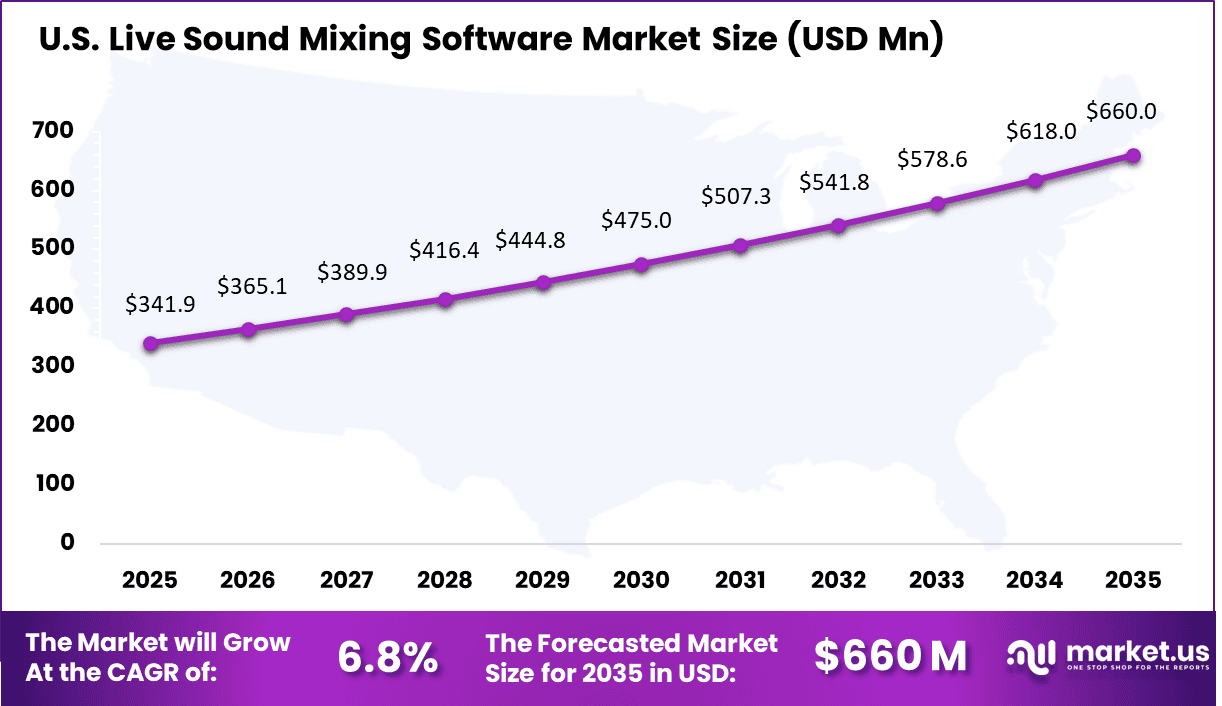
- North America drives 37.2% global value, with U.S. market at USD 341.85 million and 6.8% CAGR, fueled by festival circuit expansion and stadium touring recovery.
Live sound mixing software is used to manage and control audio during live events such as concerts, conferences, and broadcasts. It allows sound engineers to adjust levels, balance audio sources, apply effects, and ensure clear output in real time.
With the shift from traditional hardware consoles to digital systems, software based mixing solutions are becoming more common. These tools provide greater flexibility, remote control options, and integration with digital audio equipment, making them suitable for both large scale events and smaller setups.
One of the main driving factors is the growing number of live events and digital productions that require high quality audio management. Event organizers and production teams are focusing on delivering clear and consistent sound experiences, which increases the need for advanced mixing tools. The move toward digital and network based audio systems is also supporting the use of software solutions that can be controlled through computers and mobile devices.
In addition, the rise of live streaming and hybrid events is creating demand for tools that can manage both in person and online audio output. Improvements in audio processing and user interface design are further making these solutions more efficient and easier to use.
Demand for live sound mixing software is rising as professionals look for flexible and reliable audio control systems. There is a strong preference for solutions that can handle multiple audio inputs, provide real time adjustments, and maintain stable performance during live operations. Users are also seeking software that can integrate with existing audio equipment and support remote access for easier management.
The demand is not limited to large events, as smaller venues, studios, and independent creators are also adopting these tools. As live and digital audio experiences continue to grow, the need for efficient and user friendly sound mixing solutions is expected to increase steadily.
Drivers Impact Analysis
| Key Driver | Impact on CAGR Forecast (~%) | Geographic Relevance | Impact Timeline | Additional Insight |
|---|---|---|---|---|
| Growing demand for live events and concerts | +3.1% | North America, Europe, Asia Pacific | Short to medium term | Events increase demand for mixing tools |
| Increasing adoption of digital audio systems | +2.8% | Global | Medium term | Digital workflows enhance sound control |
| Rising popularity of streaming and hybrid events | +2.5% | Global | Medium to long term | Streaming needs advanced audio management |
| Expansion of entertainment and media industry | +2.3% | Global | Medium to long term | Media growth supports software adoption |
| Integration with advanced audio hardware and controllers | +2.0% | Developed markets | Medium term | Hardware integration improves performance |
Restraints Impact Analysis
| Key Restraint | Impact on CAGR Forecast (~%) | Geographic Relevance | Impact Timeline | Additional Insight |
|---|---|---|---|---|
| High cost of professional audio software solutions | -2.4% | Emerging markets | Short to medium term | Cost limits small user adoption |
| Complexity of advanced mixing software | -2.1% | Global | Medium term | Learning curve affects usability |
| Dependence on skilled audio professionals | -1.8% | Global | Medium to long term | Skill requirement limits usage |
| Compatibility issues with different hardware setups | -1.5% | Global | Medium term | Integration challenges arise |
| Limited adoption in smaller venues and regions | -1.3% | Developing markets | Medium term | Smaller setups use basic tools |
By Component Analysis
The software segment accounted for 72.5% of the market share, reflecting its dominant role in controlling and optimizing live audio environments. This dominance is supported by the growing need for digital tools that enable precise sound adjustments, real-time mixing, and seamless integration with audio hardware. Software solutions allow sound engineers to manage multiple channels efficiently, ensuring consistent audio quality during live performances.
Another factor driving this segment is the increasing shift toward digital sound systems that rely on advanced mixing interfaces. These platforms offer automation, remote access, and enhanced control features, which improve workflow and reduce manual effort. The ability to deliver high-quality sound output across different venues further strengthens the demand for live sound mixing software.
By Application Analysis
The concerts and live music events segment held 30.2% share, driven by the rising number of large-scale entertainment events and performances. These events require high-quality audio management to deliver an immersive experience for audiences. Live sound mixing software plays a critical role in balancing sound levels, managing acoustics, and ensuring clarity across different performance settings.
In addition, the growing popularity of live entertainment and music festivals has increased the demand for reliable and flexible mixing solutions. Event organizers and sound engineers rely on advanced software to handle complex audio setups and deliver consistent performance. This has supported the continued adoption of live sound mixing solutions in concert environments.
By End-User Analysis
The event production companies segment captured 35% of the market, driven by their responsibility for managing technical aspects of live events. These companies require advanced tools to handle sound design, mixing, and real-time adjustments across different venues and event types. Live sound mixing software helps them deliver high-quality audio experiences and meet client expectations.
Furthermore, event production companies are increasingly investing in modern audio technologies to stay competitive and improve service quality. The ability to manage multiple events efficiently and maintain consistent sound performance has strengthened the importance of these software solutions. This trend is expected to continue as the demand for professional event production services grows.
Investor Type Impact Analysis
| Investor Type | Growth Sensitivity | Risk Exposure | Geographic Focus | Investment Outlook |
|---|---|---|---|---|
| Venture capital firms | Moderate to high | High | US, Europe | Investing in audio tech startups |
| Private equity firms | Moderate | Moderate | North America and Europe | Scaling digital audio solution providers |
| Corporate investors | High | Moderate | Global | Strategic investments in media technology |
| Institutional investors | Moderate | Low to moderate | Developed markets | Prefer stable entertainment tech firms |
| Government and public funding bodies | Low to moderate | Low | Europe, Asia Pacific | Supporting creative and media industries |
Technology Enablement Analysis
| Technology | Impact on CAGR Forecast (~%) | Geographic Relevance | Impact Timeline | Additional Insight |
|---|---|---|---|---|
| AI-based audio mixing and automation | +3.3% | US, Europe | Medium to long term | Improves mixing efficiency |
| Cloud-based live sound mixing platforms | +2.9% | Global | Short to medium term | Enables remote collaboration |
| Integration with digital audio workstations (DAWs) | +2.6% | Global | Medium term | Streamlines production workflow |
| Real-time audio processing and effects | +2.4% | Developed markets | Medium to long term | Enhances sound quality |
| Wireless and network-based audio control systems | +2.1% | Global | Medium term | Improves flexibility in live setups |
Key Challenges
- High cost of professional software and equipment limits adoption.
- Complex interfaces make it difficult for beginners to use.
- Need for skilled sound engineers to manage live mixing.
- Compatibility issues with different audio hardware and systems.
- Risk of technical failures during live events.
- Latency issues affecting real-time sound performance.
- Integration challenges with other audio and production tools.
- Frequent software updates can disrupt workflows.
- Limited customization in some software solutions.
- Dependence on stable power and system performance during events.
Emerging Trends
The live sound mixing software market is moving toward more flexible and digitally controlled audio environments that can adapt quickly to different performance settings. One key emerging trend is the shift toward software based mixing solutions that can be controlled remotely through tablets and mobile devices, allowing sound engineers to adjust audio levels from anywhere within the venue. This is improving sound accuracy and audience experience.
Another important trend is the integration of AI assisted audio processing, where the software can automatically balance levels, reduce noise, and enhance clarity based on the live environment. There is also growing adoption of virtual mixing consoles that replicate physical hardware while offering more customization and scalability. In addition, real time collaboration features are being introduced, enabling multiple engineers to work on the same mix simultaneously. The use of cloud based storage for presets and configurations is also increasing, allowing quick setup and consistency across different events.
Growth Factors
The growth of this market is driven by the rising demand for high quality audio experiences in live events, concerts, and broadcasting environments. As audiences expect clear and immersive sound, event organizers are investing in advanced mixing solutions that can deliver consistent performance. The expansion of live entertainment, including music festivals and corporate events, is also supporting demand for professional audio tools.
Another major factor is the increasing use of digital audio systems, which require compatible software for efficient control and management. The need for faster setup and reduced technical complexity is encouraging the adoption of user friendly mixing platforms. Furthermore, the growth of streaming and hybrid events is creating additional demand for software that can manage both in venue and online audio output, ensuring seamless sound quality across different formats.
Key Market Segments
By Component
- Software
- On-Premises
- Cloud-Based
- Services
By Application
- Concerts/Live Music Events
- Corporate Events & Conferences
- Theatre & Performing Arts
- Broadcast & Production Studios
- Houses of Worship
- Others
By End-User
- Live Sound Engineers
- Event Production Companies
- Educational Institutions
- Others
Regional Analysis
North America accounted for 37.2% of the Live Sound Mixing Software market, supported by a strong presence of music events, concerts, and live entertainment activities. The region has a well-developed ecosystem for professional audio production, where sound engineers and event organizers rely on advanced software to manage complex live audio setups.
Increasing demand for high-quality sound experiences in concerts, festivals, and broadcasting is encouraging the use of digital mixing solutions. In addition, the shift toward software-based audio control and integration with digital sound equipment is strengthening adoption across both large venues and small-scale events.
The U.S. market reached USD 341.85 Million and is projected to grow at a CAGR of 6.8%, driven by steady demand from the entertainment and media industry. Growth is supported by increasing use of live streaming, hybrid events, and virtual performances, where precise sound control is essential.
Audio professionals are adopting mixing software to improve workflow efficiency, enable real-time adjustments, and enhance overall sound quality. The growing popularity of independent content creators and small production studios is also contributing to demand. This trend is expected to support consistent growth in the US market over the coming years.
Key Regions and Countries
- North America
- US
- Canada
- Europe
- Germany
- France
- The UK
- Spain
- Italy
- Russia
- Netherlands
- Rest of Europe
- Asia Pacific
- China
- Japan
- South Korea
- India
- Australia
- Singapore
- Thailand
- Vietnam
- Rest of APAC
- Latin America
- Brazil
- Mexico
- Rest of Latin America
- Middle East & Africa
- South Africa
- Saudi Arabia
- UAE
- Rest of MEA
Competitive Analysis
The competitive landscape of the Live Sound Mixing Software Market is shaped by a mix of professional audio equipment manufacturers and digital audio technology providers. Companies such as Yamaha Corporation, Avid Technology Inc., Solid State Logic (SSL), Allen & Heath, and DiGiCo UK Ltd. focus on high-end mixing solutions used in concerts, broadcasting, and large live events.
These players offer advanced software integrated with digital mixing consoles, providing real-time control, high audio quality, and reliability. Their strong reputation in professional audio and long-standing presence in the industry help them maintain a leading position.
At the same time, companies such as Behringer, Mackie, PreSonus Audio Electronics, Soundcraft, QSC LLC, Roland Corporation, Tascam, Midas, Focusrite, and Shure Incorporated focus on affordable and user-friendly solutions for small venues, studios, and independent creators.
These players emphasize ease of use, compatibility with different hardware, and flexible mixing features. Competition in this market is driven by improvements in digital audio processing, software integration, and the ability to deliver high-quality sound mixing across different performance environments.
Top Key Players in the Market
- Yamaha Corporation
- Avid Technology Inc.
- Shure Incorporated
- Behringer
- Mackie
- PreSonus Audio Electronics
- Soundcraft
- Allen & Heath
- QSC LLC
- DiGiCo UK Ltd.
- Solid State Logic (SSL)
- Roland Corporation
- Tascam
- Midas
- Focusrite
- Other Key Players
Future Outlook
The future outlook for the Live Sound Mixing Software Market looks positive as demand for high-quality audio continues to grow across concerts, events, streaming, and broadcasting. The market is expected to expand with the increasing use of digital mixing tools that offer better control, flexibility, and real-time adjustments. More sound engineers are anticipated to adopt software-based solutions for remote mixing and live streaming setups. In the coming years, advancements in AI, cloud integration, and automation are expected to improve sound quality and workflow efficiency, making these tools more powerful and easier to use for both professionals and beginners.
Recent Developments
- March, 2026 – Yamaha releases MGX Series firmware update with Steinberg ecosystem integration. CC1 controller and Elgato Stream Deck now manage key functions for faster live PA operation. Adds Sound Pad Editor, stereo pairing, and 30+ stability improvements.
- February, 2026 – Avid Pro Tools adds live mixing features shown at NAMM with immersive audio support up to 7.1.4. Track commit renders virtual instruments freeing CPU during shows while multi-channel mixdown handles stems export. Pro Tools Studio version suits professional live editing.
Report Scope
| Report Features | Description |
|---|---|
| Market Value (2025) | USD 1,023.3 Million |
| Forecast Revenue (2035) | USD 2,335.1 Million |
| CAGR(2025-2035) | 8.60% |
| Base Year for Estimation | 2024 |
| Historic Period | 2020-2024 |
| Forecast Period | 2025-2035 |
| Report Coverage | Revenue forecast, AI impact on Market trends, Share Insights, Company ranking, competitive landscape, Recent Developments, Market Dynamics and Emerging Trends |
| Segments Covered | By Component (Software (On-Premises, Cloud-Based), Services), By Application (Concerts/Live Music Events, Corporate Events & Conferences, Theatre & Performing Arts, Broadcast & Production Studios, Houses of Worship, Others), By End-User (Live Sound Engineers, Event Production Companies, Educational Institutions, Others) |
| Regional Analysis | North America – US, Canada; Europe – Germany, France, The UK, Spain, Italy, Russia, Netherlands, Rest of Europe; Asia Pacific – China, Japan, South Korea, India, New Zealand, Singapore, Thailand, Vietnam, Rest of Latin America; Latin America – Brazil, Mexico, Rest of Latin America; Middle East & Africa – South Africa, Saudi Arabia, UAE, Rest of MEA |
| Competitive Landscape | Yamaha Corporation, Avid Technology Inc., Shure Incorporated, Behringer, Mackie, PreSonus Audio Electronics, Soundcraft, Allen & Heath, QSC LLC, DiGiCo UK Ltd., Solid State Logic (SSL), Roland Corporation, Tascam, Midas, Focusrite, Other Key Players |
| Customization Scope | Customization for segments, region/country-level will be provided. Moreover, additional customization can be done based on the requirements. |
| Purchase Options | We have three license to opt for: Single User License, Multi-User License (Up to 5 Users), Corporate Use License (Unlimited User and Printable PDF) |