


Report Overview
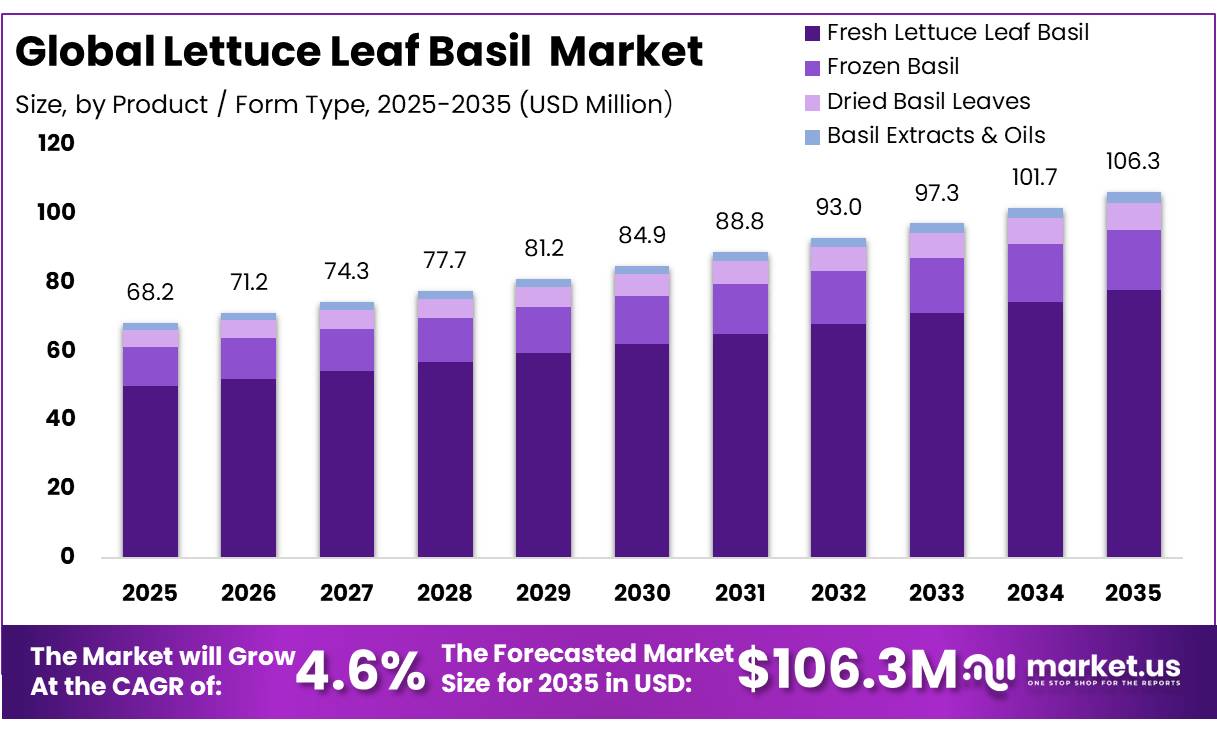
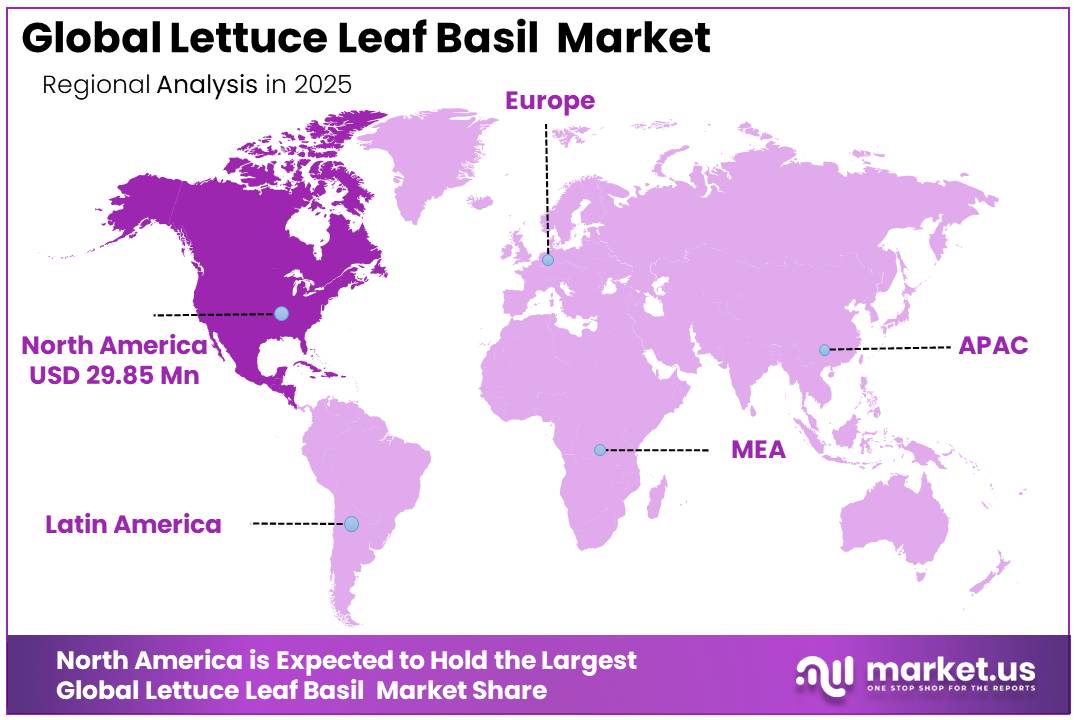
The Global Lettuce Leaf Basil Market was valued at USD 68.2 million, and between 2026 and 2035, this market is estimated to register a CAGR of 4.6%, reaching about USD 106.3 million by 2035. North America held a dominant market position, capturing more than a 43.8% share, holding USD 29.85 million in revenue.
Key Takeaways
- The global Lettuce Leaf Basil market was valued at USD 68.2 million in 2025.
- The global Lettuce Leaf Basil market is projected to grow at a CAGR of 4.6% and is estimated to reach USD 106.3 million by 2035.
- On the basis of product/form, the Fresh Lettuce Leaf Basil segment dominated the market, accounting for 73.2% of the total market share.
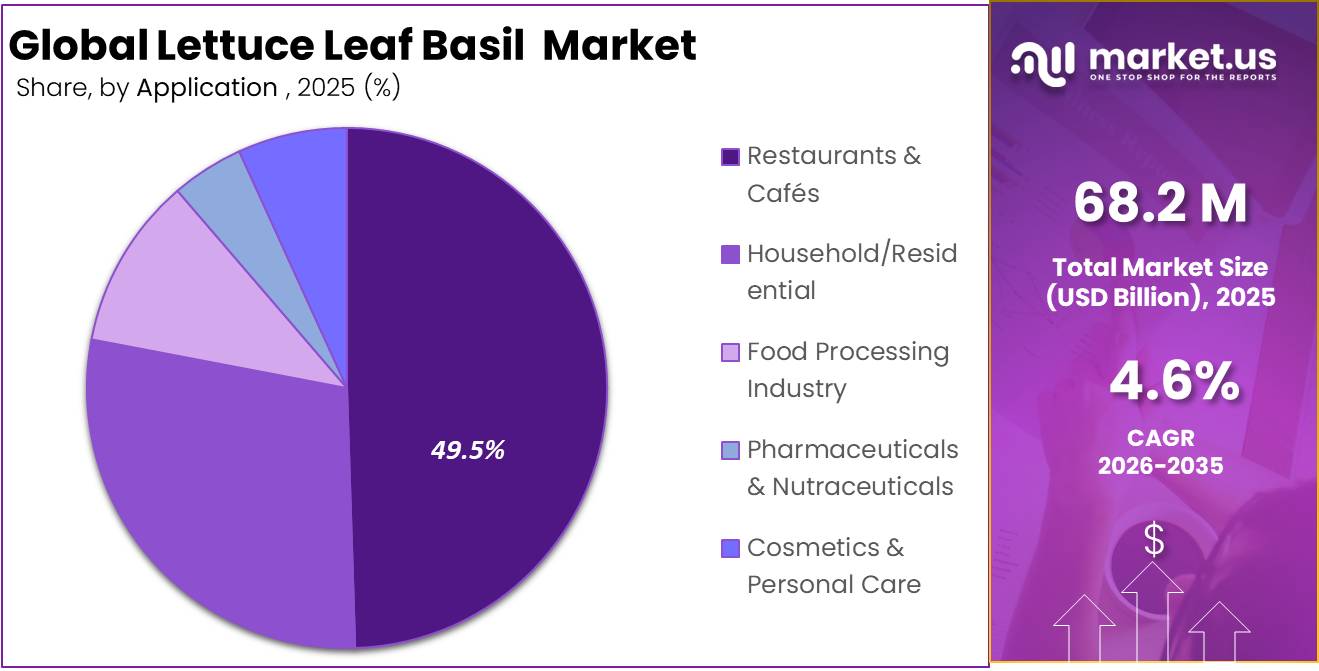
- Based on application, Restaurants & Cafés held the dominant position with approximately 49.5% market share.
- By distribution channel, Supermarkets/Hypermarkets dominated the global market with around 51.6% share.
- Based on cultivation type, Conventional Farming accounted for nearly 61.4% of the total market share.
- North America dominated the global lettuce leaf basil market, holding approximately 43.8% of the total market share.
Lettuce leaf basil is a large-leaved cultivar of Ocimum basilicum developed for fresh culinary use. Its crinkled leaves can reach about 12 centimetres, while plants commonly grow 0.1–0.5 metres high. The cultivar combines the aroma of sweet basil with a comparatively mild taste and a broad leaf surface, supporting applications in salads, sandwiches, wraps, pesto, garnishes and premium prepared meals. These characteristics give it a differentiated position between conventional basil, leafy greens and speciality culinary herbs.
The industrial base remains relatively niche because official agricultural datasets generally report lettuce leaf basil within the wider fresh-cut herb or basil category. Nevertheless, protected-cropping statistics show a commercially meaningful production platform. USDA data released in February 2026 reported that U.S. food crops grown under protection generated USD 1.011 billion in 2024 sales, 44% above 2019. Fresh-cut herbs alone involved 945 operations, covered 5.763 million square feet and produced 431,044 hundredweight. Hydroponic systems supplied 134,307 hundredweight, while total fresh-cut herb sales reached USD 86.536 million, including USD 75.599 million through wholesale channels.
Demand is being supported by healthier cooking, restaurant menu innovation and consumer interest in fresh, minimally processed ingredients. In January 2026, the World Health Organization advised people older than 10 years to consume at least 400 grams of fruit and vegetables daily. In May 2026, WHO also recommended salt intake below 5 grams per day and specifically encouraged the use of herbs and spices instead of salt. Global adult sodium intake averaged 4,278 milligrams per day in 2021, equivalent to around 11 grams of salt, strengthening the role of flavour-rich herbs in lower-sodium food formulation.
Lettuce Leaf Basil Market Segmentation
Product/Form Analysis
Fresh Lettuce Leaf Basil Dominates the Global Lettuce Leaf Basil Market.
Fresh Lettuce Leaf Basil led the global market, capturing around 73.2% of the share. This dominance results from rising demand for fresh herbs in restaurants, cafes, households, and gourmet foods. Its strong aroma, natural flavor, visual appeal, and versatility in salads, sauces, and Mediterranean dishes contribute to its popularity, alongside a shift towards natural food ingredients.
Basil Extracts & Oils are the fastest growing segment due to rising consumer demand for natural bioactive ingredients in nutraceuticals, pharmaceuticals, and cosmetics. Increased awareness of basil’s antioxidant, anti-inflammatory, and antimicrobial properties is boosting its use in dietary supplements, herbal products, functional beverages, and plant-based cosmetics. Manufacturers invest in advanced extraction technologies, like supercritical CO₂ and cold-press methods, for high-purity basil extracts. Dried and Frozen Basil have stable demand in food processing and manufacturing, valued for their shelf life, storage ease, and cost efficiency.
Application Analysis
Restaurants & Cafes Dominate the Global Lettuce Leaf Basil Market.
The Restaurants & Cafes segment made up for the biggest share in the lettuce leaf basil market, constituting about 49.5% of the total market share. This can mainly be attributed to the rising popularity of using fresh basil in exotic meals such as gourmet cooking, salad recipes, pastas, pizza toppings, sauces, among other high-quality meal preparations. There is an increased consumer demand for fresh ingredients and the need for authentic Mediterranean cuisines, which have helped sustain the demand for lettuce leaf basil within restaurants and cafés.
Pharmaceuticals & Nutraceuticals are rapidly growing due to recognition of basil’s bioactive compounds like rosmarinic acid and eugenol. Their antioxidant, anti-inflammatory, and antimicrobial properties boost demand for basil-derived ingredients in dietary supplements and herbal medicines, as consumers prefer natural health solutions over synthetic options. Stable demand in Household/Residential and Food Processing industries is driven by home cooking trends, increased cooking content online, and the use of basil in global food products.
Distribution Channel Analysis
Supermarkets and hypermarkets lead the global market for lettuce leaf basil.
Supermarkets/Hypermarkets emerged as the market leader, holding roughly 51.6% of the market share. The success of the segment is mainly due to the presence of the products at retail level along with higher availability and growing preference by consumers for easy accessibility to fresh herbs for cooking. Big retail players are consistently enlarging their organic and fresh produce categories due to increased consumer demand for healthy and natural food ingredients.
Online Retail/E-commerce will grow rapidly due to rising online grocery shopping, expanding digital platforms, and consumer preference for home delivery. Specialty grocery stores and direct-to-chef supply channels maintain stable demand from commercial usage of premium fresh herbs.
Cultivation Type Analysis
Conventional Farming Dominates the Global Lettuce Leaf Basil Market.
Traditional Farming held major shares in the global lettuce leaf basil market and constituted about 61.4% of the overall market share. This is because of its commercial nature, higher product availability, and more efficient production process. Traditional Farming has become more favored by larger agricultural businesses owing to the high volume of production of basil using traditional farming methods.
It is anticipated that Hydroponic/Indoor Farming will experience the highest growth rate over the forecast period attributed to factors such as rising acceptance of controlled environment agriculture, capacity to cultivate throughout the year, and enhanced productivity. On the other hand, Organic Farming is recording stable demand because of consumers’ growing inclination towards chemical-free products.
Key Market Segments
By Product/Form
- Fresh Lettuce Leaf Basil
- Frozen Basil
- Dried Basil Leaves
- Basil Extracts & Oils
By Application
- Restaurants & Cafés
- Household/Residential
- Food Processing Industry
- Pharmaceuticals & Nutraceuticals
- Cosmetics & Personal Care
By Distribution Channel
- Supermarkets/Hypermarkets
- Specialty Grocery Stores
- Online Retail/E-commerce
- Convenience Stores
- Direct-to-Chef/Foodservice Supply
By Cultivation Type
- Conventional Farming
- Organic Farming
- Hydroponic/Indoor Farming
Driver Analysis
Food-safety compliance is becoming a demand accelerator, not just a cost burden, because U.S. produce regulation now imposes operational discipline that favors controlled and traceable supply chains. FDA’s revised pre-harvest agricultural water rule became effective on July 5, 2024, with compliance dates of April 7, 2025 for large farms and April 6, 2026 for small farms, while harvest and post-harvest water requirements already require no detectable generic E. coli per 100 mL and prohibit untreated surface water for those uses.
In practice, that pushes basil and leaf-lettuce suppliers toward documented water systems, treatment monitoring, and auditable handling protocols, raising qualification barriers for fragmented growers but improving buyer confidence for compliant operators; the result is stronger penetration into supermarket private label, institutional catering, and export programs, supporting roughly +1.4 percentage points of incremental CAGR in the U.S.-linked value chain.
Drivers Impact Analysis
| Driver | (~) % Impact on CAGR Forecast | Geographic Relevance | Impact Timeline |
|---|---|---|---|
| CEA expansion for year-round lettuce leaf basil supply | +2.1% | North America core, EU, Gulf, APAC metros | Medium term |
| FSMA and traceability-led premiumization | +1.4% | U.S. core, Canada spill-over, export suppliers to U.S. | Short term |
| Energy and water productivity upgrades in greenhouses | +1.2% | EU, Gulf, North America, East Asia | Medium term |
| Retail fresh-cut and foodservice menu premium mix | +1.7% | North America, Western Europe, urban APAC | Short term |
| Local sourcing and import substitution in climate-stressed regions | +1.5% | Gulf, Singapore, North Asia, selected EU markets | Medium term |
Restraint Analysis
Energy-cost burden
Protected cultivation is central to year-round basil and premium leaf lettuce supply, but it also makes the category unusually sensitive to electricity, climate-control, and water-circulation costs, especially in Europe and high-tech indoor farms. Euro area inflation was still 2.2% in March 2025, while food remained a major inflation component and energy still represented about 9% of the HICP basket, meaning growers were operating in an input environment where utility volatility continued to flow through to delivered produce costs rather than fully normalizing.
At the same time, EU renewable-energy penetration reached 24.5% of gross final consumption in 2023 and 25.2% in 2024, which improves long-run resilience but does not eliminate near-term grid-price exposure for greenhouse operators. For lettuce leaf basil producers, even a mid-single-digit increase in power and climate-control spend materially reduces contribution margin because these crops are low-weight, high-frequency, and highly perishable; commercially, that drives delayed expansion of indoor capacity, tighter contract pricing, and slower penetration into price-sensitive retail channels, supporting an estimated -1.9 percentage-point drag on 2026 baseline CAGR
Restraint Impact Analysis
| Restraint | (~) % Impact on CAGR Forecast | Geographic Relevance | Impact Timeline |
|---|---|---|---|
| Energy-cost burden | -1.9% | EU core, North America, East Asia | Short term |
| Food-safety compliance load | -1.5% | U.S. core, export suppliers to U.S., Canada spill-over | Short term |
| Contamination and recall risk | -1.3% | North America core, LatAm export corridors | Short term |
| High shrink and shelf-life loss | -1.6% | North America, EU, APAC urban retail | Medium term |
| Farm labor tightness | -1.4% | U.S., Canada, Western Europe | Medium term |
Opportunity Analysis
Urban micro-farm supply
Urban micro-farm networks represent untapped upside because they monetize proximity economics and ultra-short lead times that the current baseline market still captures only marginally. FAO’s 2025 Kigali demonstration project deployed a vertical hydroponic farm with more than 1,500 plants and explicitly positioned herbs and vegetables as efficient urban food-production assets using less water and land than conventional systems, while FAO’s earlier urban horticulture work in African cities documented meaningful contributions to food security and income generation from peri-urban production systems.
For lettuce leaf basil, the opportunity is to build distributed supply nodes within or near high-density consumption zones hotels, premium grocers, dark stores, and hospitals where same day harvest can reduce logistics cost per sellable unit by an estimated 8% to 15%, lower spoilage by 2 to 4 percentage points, and command freshness premiums of 10% to 20%; because this requires network orchestration, digital ordering, and localized operating playbooks that are not yet standard practice, it remains a white-space expansion opportunity capable of adding about +1.4 percentage points to CAGR above baseline.
Opportunity Impact Analysis
| Opportunity | (~) % Potential CAGR Upside | Geographic Relevance | Execution Window |
|---|---|---|---|
| Institutional procurement | +1.8% | U.S. core, Canada, EU public channels | Short term |
| Fresh-cut premium SKUs | +2.0% | North America, Western Europe, urban APAC | Short term |
| Greenhouse roll-up M&A | +1.6% | North America core, EU, Gulf | Medium term |
| Urban micro-farm supply | +1.4% | Gulf, Singapore, tier-1 APAC cities, Africa metros | Medium term |
| Aquaponic circular model | +1.3% | Water-stressed regions, Gulf, North Africa, West U.S. | Long term |
Challenges Analysis
Grower know‑how gaps
Knowledge and capability gaps are a persistent challenge because a large share of global vegetable and herb output comes from small and medium growers who lack consistent access to updated agronomy, food-safety, and post-harvest management practices needed to run high-density basil and lettuce systems at optimal efficiency.
These constraints translate directly into lower average yields per unit area, inconsistent product quality, and more frequent residue or contamination issues that limit growers’ ability to qualify for premium urban retail or export programs; for lettuce leaf basil, where uniformity, flavor profile, and visual quality are commercially critical, the absence of structured technical assistance and extension services can easily compress output and usable quality by 10–20% relative to best practice.
Challenges Impact Analysis
| Challenge | (~) % CAGR Friction Drag | Geographic Relevance | Mitigation Horizon |
|---|---|---|---|
| Fragmented cold-chain logistics | -1.3% | North America, EU, APAC logistics corridors | Medium term |
| Climate variability on yields | -1.1% | North America, South Asia, Mediterranean | Long term |
| Grower know-how gaps | -0.9% | South Asia, Africa, LatAm smallholders | Long term |
| Input and wage volatility | -1.0% | U.S., EU, emerging APAC | Medium term |
| Limited granular demand data | -0.8% | Global retail and foodservice channels | Medium term |
Geopolitical Impact Analysis
Disruptions in Global Agricultural Supply Chains and Climate Policies are Impacting the Lettuce Leaf Basil Market.
The world lettuce leaf basil industries are being affected by political unrest, global trade policies, and interruptions in agricultural supply chain processes. The movement of costs within transport services, export-import policies, and labor issues within agricultural economies remain factors that affect the prices and supplies of fresh herbs throughout the world. Being a perishable herb, any interruptions in the process of logistics and global trade will greatly affect fresh herb quality, logistics costs, and supplies.
In addition to that, environmental laws, water management strategies, and sustainable measures that have something to do with the production process can also affect the market. Governments in different parts of the world are becoming more supportive towards sustainable agriculture practices, environmentally-controlled agriculture, and less use of chemicals. Such measures are motivating people to shift to hydroponics and cultivate crops locally to lessen reliance on conventional agricultural supply chains.
Moreover, issues like drought, adverse weather, and high temperatures that result from climate change still pose problems for the production of herbs. As a result, the significance of indoor growing techniques has become increasingly important in the international lettuce leaf basil market.
- According to the Food and Agriculture Organization, climate variability and supply chain disruptions continue to impact global agricultural production and food distribution systems.
Regional Analysis
North America Dominates the Global Lettuce Leaf Basil Market.
North America dominated the global market for lettuce leaf basil market, holding around 43.8% market share in the forecasted period. Such leadership by the region is driven mainly by the higher consumption of fresh herbs, increased demand for organics and health foods, and growing food service sector in North America comprising countries like the U.S. and Canada. Rising preference for Mediterranean food style, gourmet eating styles, and plant-based diets have considerably influenced the use of fresh basil leaves.
Moreover, the region will leverage established supermarket chains, effective cold chain infrastructure, and utilization of hydroponics and indoor farming technology to ensure year-round availability of the fresh herb. Moreover, there has been an increasing trend toward consumer preference for local, organic, and high-quality herbs in the region of North America, which will support the expansion of the industry in the region.
Asia Pacific is expected to experience the highest growth rate due to rapid urbanization, rising incomes, and a booming foodservice industry in China, India, Japan, South Korea, and Southeast Asia. Increased exposure to international cuisines, especially Mediterranean and Italian, is driving fresh basil use in urban restaurants and retail. The rise of quick-service restaurants, food delivery, and modern retail formats, along with a growing focus on health and plant-based diets, broadens basil’s market into nutraceuticals and wellness products.
Key Regions and Countries Covered
- North America
- The US
- Canada
- Europe
- Germany
- France
- The UK
- Spain
- Italy
- Russia & CIS
- Rest of Europe
- APAC
- China
- Japan
- South Korea
- India
- ASEAN
- Rest of APAC
- Latin America
- Brazil
- Mexico
- Rest of Latin America
- Middle East & Africa
- GCC
- South Africa
- Rest of MEA
Key Players Analysis
The lettuce leaf basil market around the world has been described as being moderately fragmented with the involvement of herbal providers, indoor farmers, food ingredient makers, and agricultural suppliers who compete on the grounds of their ability to produce high-quality products that are fresh and can be sustainably farmed. There is an increased emphasis on the provision of organic herbs, hydroponic systems, and premium fresh herbs by various organizations.
There has been a rising trend of collaborations among foodservice providers, supermarket chains, and hydroponic growers aimed at achieving a steady supply of fresh herbs while reducing reliance on transportation. Moreover, increased investments in indoor agriculture, organic production of herbs, and fresh produce distribution systems directly to consumers will create more competition in the global lettuce leaf basil market over the forecast period.
Market Key Players
- McCormick & Company
- Frontier Co-op
- Döhler GmbH
- Kerry Group
- Givaudan
- Symrise AG
- Takasago International Corporation
- Olam Group
- Greenyard NV
- The Growers Exchange
- Burpee Holding Company
- Baker Creek Heirloom Seeds
- West Coast Seeds
- Village Farms International
- AeroFarms
Key Development
- In July 2024, McCormick & Company, Incorporated announced the expansion of its fresh and natural herb-based ingredient portfolio, introducing new clean-label culinary herb product lines targeting growing consumer demand for premium, minimally processed seasoning solutions across North American retail and foodservice channels.
- In 2024–2025, Greenyard NV developed a new partnership model with REWE Group in the German fresh produce market its largest European market to expand the integrated supply of fresh fruits, vegetables, and herbs across German retail channels, reinforcing Greenyard’s position as a leading fresh produce supplier in European markets.
Report Scope
| Report Features | Description |
|---|---|
| Market Value (2025) | US$68.2 Mn |
| Forecast Revenue (2035) | US$106.3 Mn |
| CAGR (2026-2035) | 4.6% |
| Base Year for Estimation | 2025 |
| Historic Period | 2020-2024 |
| Forecast Period | 2026-2035 |
| Report Coverage | Revenue Forecast, Market Dynamics, Competitive Landscape, Recent Developments |
| Segments Covered | By Product/Form (Fresh Lettuce Leaf Basil, Frozen Basil, Dried Basil Leaves, Basil Extracts & Oils), By Application (Restaurants & Cafés, Household/Residential, Food Processing Industry, Pharmaceuticals & Nutraceuticals, Cosmetics & Personal Care), By Distribution Channel (Supermarkets/Hypermarkets, Specialty Grocery Stores, Online Retail/E-commerce, Convenience Stores, Direct-to-Chef/Foodservice Supply), By Cultivation Type (Conventional Farming, Organic Farming, Hydroponic/Indoor Farming) |
| Regional Analysis | North America – The US & Canada; Europe – Germany, France, The UK, Spain, Italy, Russia & CIS, Rest of Europe; APAC– China, Japan, South Korea, India, ASEAN & Rest of APAC; Latin America– Brazil, Mexico & Rest of Latin America; Middle East & Africa– GCC, South Africa, & Rest of MEA |
| Competitive Landscape | McCormick & Company, Frontier Co-op, Döhler GmbH, Kerry Group, Givaudan, Symrise AG, Takasago International Corporation, Olam Group, Greenyard NV, The Growers Exchange, Burpee Holding Company, Baker Creek Heirloom Seeds, West Coast Seeds, Village Farms International, AeroFarms |
| Customization Scope | Customization for segments, region/country-level will be provided. Moreover, additional customization can be done based on the requirements. |
| Purchase Options | We have three licenses to opt for: Single User License, Multi-User License (Up to 5 Users), Corporate Use License (Unlimited Users and Printable PDF) |





































