Report Overview
The Global Kubernetes Backup Software Market size is expected to be worth around USD 2,482.8 million by 2035, from USD 582.6 million in 2025, growing at a CAGR of 15.6% during the forecast period from 2025 to 2035. North America held a dominant market position, capturing more than 38.5% share and generating USD 224.3 million in revenue.
Kubernetes Backup Software refers to tools that protect containerized applications, persistent volumes, cluster settings, and related data running on Kubernetes. It helps organizations restore workloads after outages, errors, failed updates, or cyber incidents. These platforms support business continuity by making backup and recovery more organized, reliable, and easier to manage.
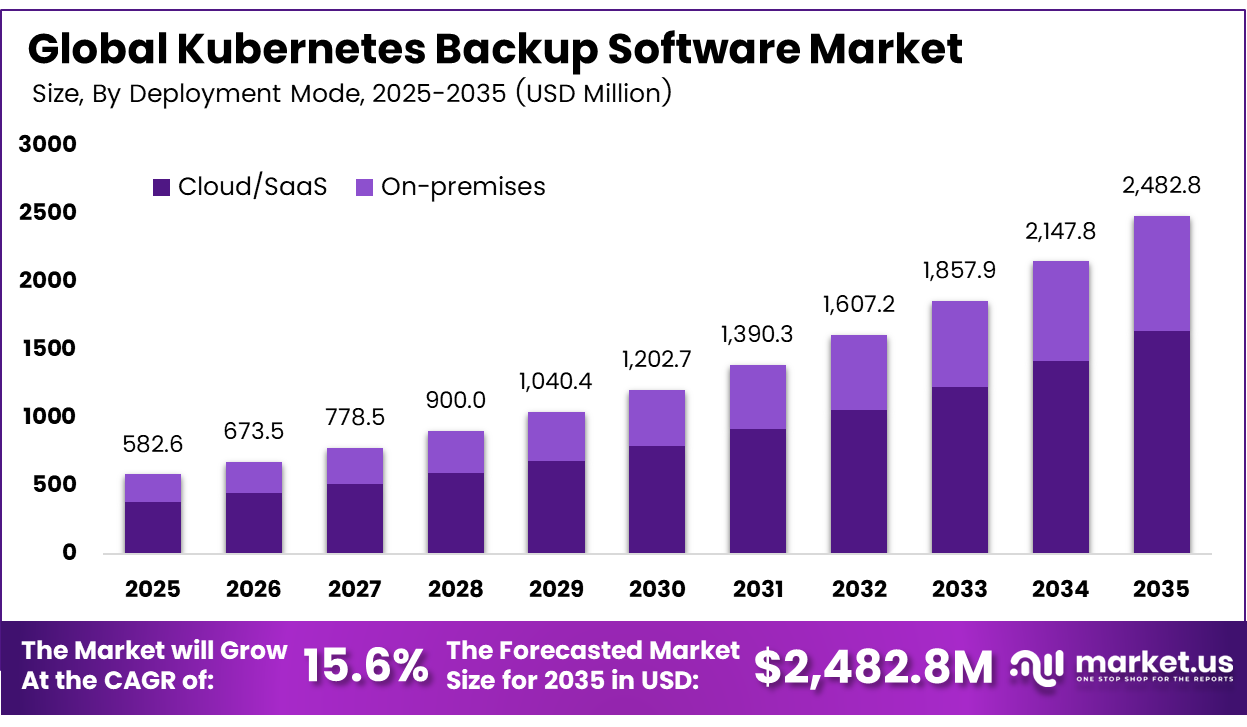 Top Driving factors include the rapid shift to microservices, wider use of databases in containers, and the need to meet recovery time targets of under 2 hours set by several resilience regulations. As clusters expand across regions, configuration complexity increases, raising the risk of human error and encouraging the adoption of automated backup and restore platforms.
The market for Kubernetes Backup Software is driven by the rising adoption of containerized applications across cloud, hybrid, and multi-cloud environments. As more organizations run critical workloads on Kubernetes, the need to protect persistent data, cluster configurations, and application state is increasing. Growing ransomware risks, downtime concerns, and recovery planning needs are also supporting demand for reliable backup platforms.
Demand is rising as hybrid and multi-cloud strategies become common across enterprises. Close to 90% of enterprises now use more than one cloud provider for production workloads. This creates a stronger need to protect persistent volumes, cluster metadata, and application state consistently across on-premises systems and public cloud environments.
For instance, in December 2025, Dell Technologies advanced its position by bundling Kubernetes‑aware backup within its broader data protection portfolio, tightly integrated with Dell storage and HCI platforms. The aim is to offer a single stack that protects traditional applications and cloud‑native services across on‑prem and multi‑cloud.
Key Takeaway
- In 2025, the Cloud/SaaS segment held a dominant market position, capturing a 65.8% share of the Global Kubernetes Backup Software Market.
- In 2025, the Large Enterprises segment held a dominant market position, capturing a 72.4% share of the Global Kubernetes Backup Software Market.
- In 2025, the Disaster Recovery segment held a dominant market position, capturing a 54.3% share of the Global Kubernetes Backup Software Market.
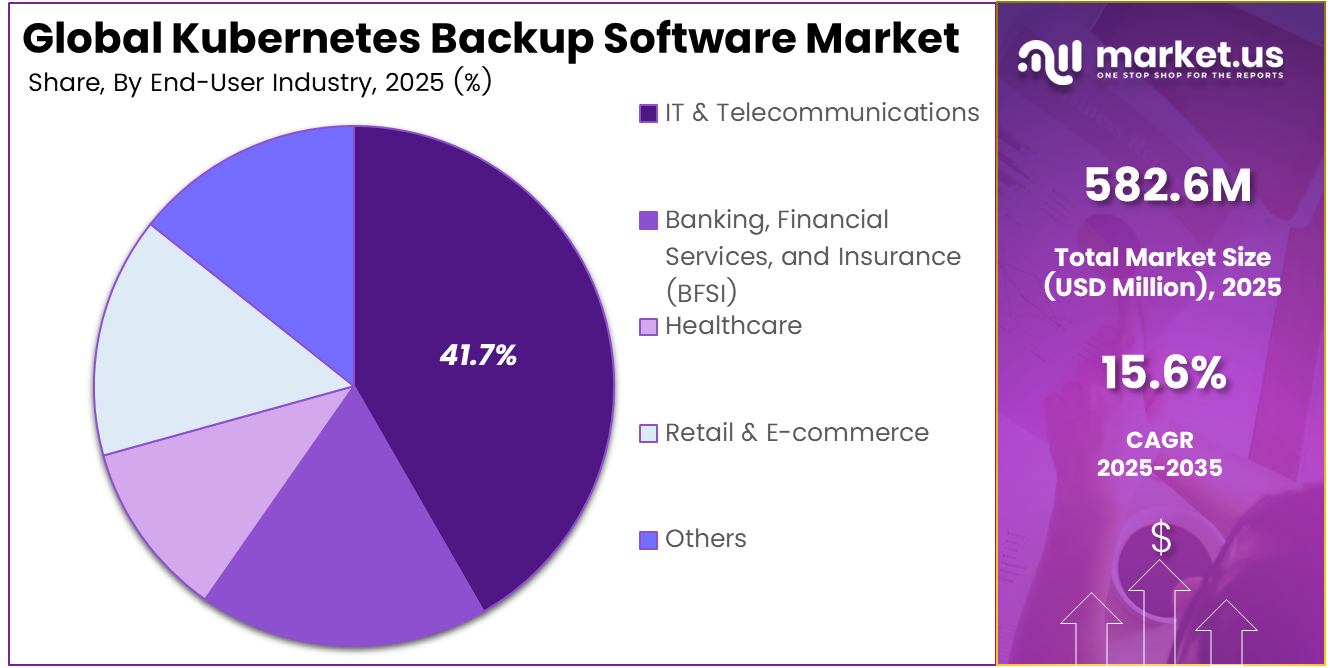
- In 2025, the IT & Telecommunications segment held a dominant market position, capturing a 41.7% share of the Global Kubernetes Backup Software Market.
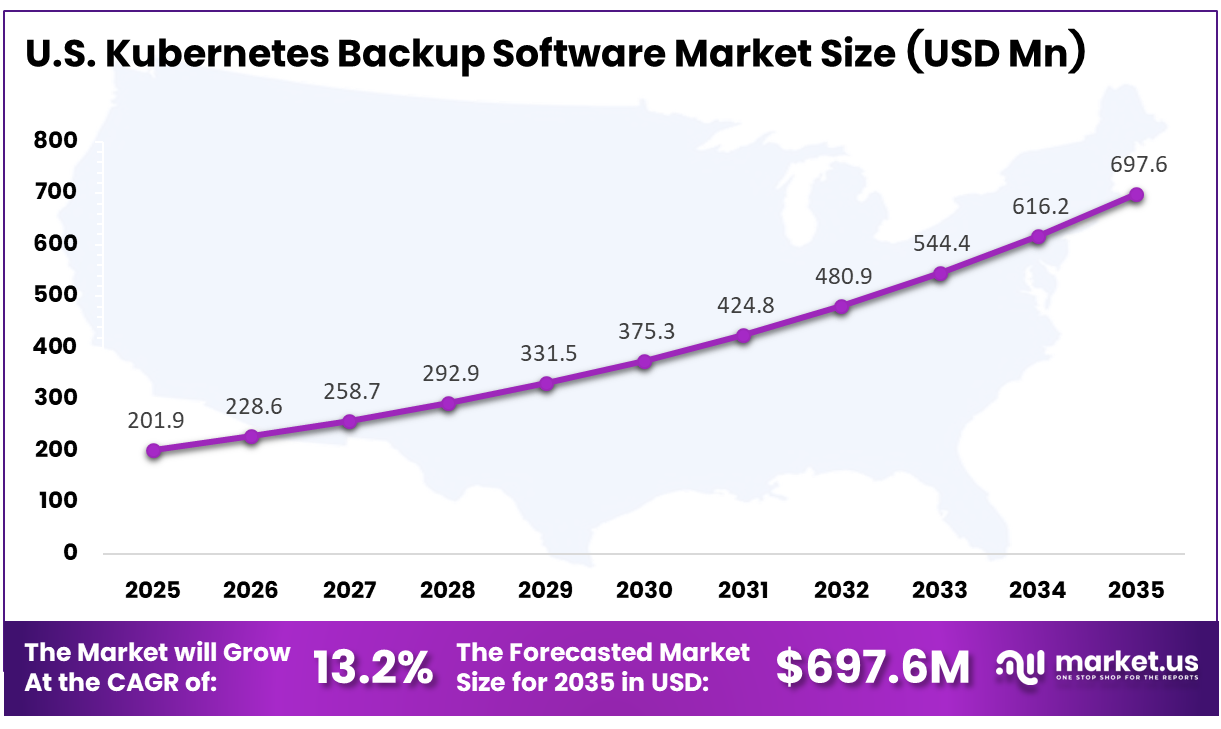
- The U.S. Kubernetes Backup Software Market was valued at USD 201.9 Million in 2025, with a robust CAGR of 13.2%.
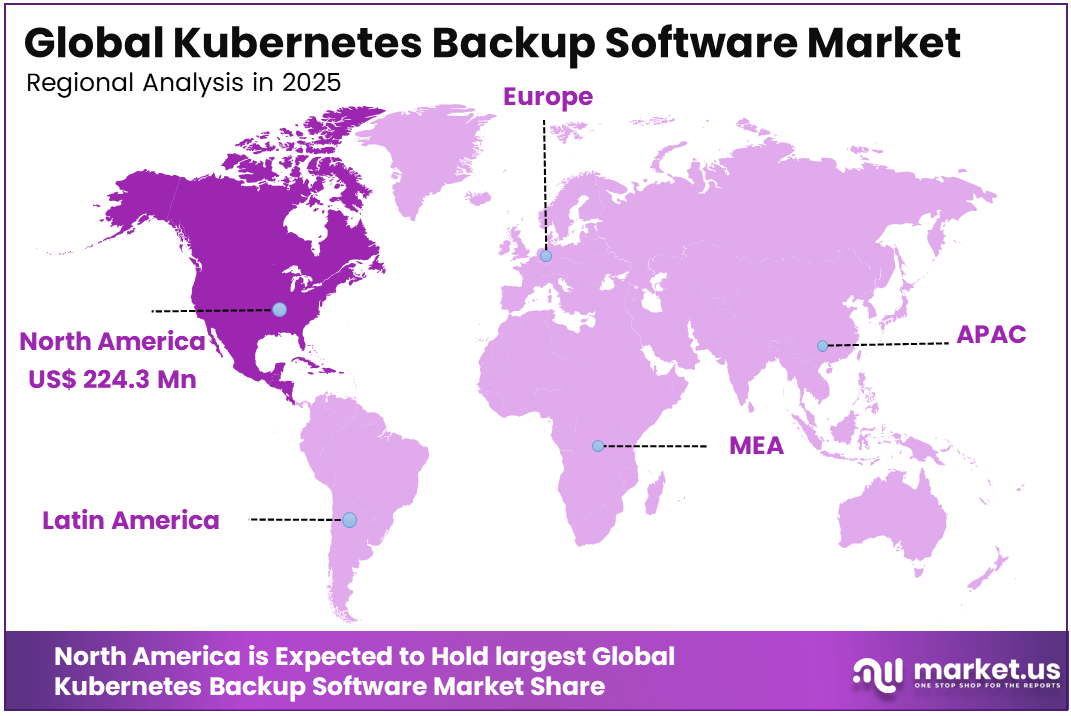
- In 2025, North America held a dominant market position in the Global Kubernetes Backup Software Market, capturing more than a 38.5% share.
Role of Generative AI
Generative AI is adding smarter functions to Kubernetes backup tools. It can study usage patterns, detect early risks, and suggest corrective steps before failures affect workloads. This helps reduce downtime and improve recovery planning. Around 66% of groups running gen AI models use Kubernetes for key workloads.
It also supports automated backup planning by reading real data flows across clusters. Teams can recover faster when AI models predict failure points and guide restoration actions. This adoption is linked to wider AI infrastructure use, where 82% run Kubernetes in production for modern application workloads.
Investment and Business Benefits
Investment opportunities are growing around Kubernetes backup as a service, policy-driven data protection, and tools built for regulated industries such as finance and healthcare. Funding interest is moving toward platforms that combine backup, copy data management, and security scanning, while also supporting automated compliance audits and recovery testing for complex cluster environments.
Business benefits include reduced downtime, faster recovery from cyberattacks, and less manual work for developers who no longer need custom scripts for every cluster. Centralized backup policies allow infrastructure teams to apply standard protection levels across hundreds of namespaces, improving internal audit performance and reducing the risk of configuration drift.
Regional Analysis
In 2025, North America held a dominant market position in the Global Kubernetes Backup Software Market, capturing more than 38.5% share and generating USD 224.3 million in revenue. This dominance is due to the strong presence of cloud native enterprises, advanced IT infrastructure, and high Kubernetes adoption across the U.S. and Canada. North American companies are investing in backup software to protect containerized workloads, persistent volumes, and application data across hybrid and multi-cloud environments. Rising ransomware concerns, strict recovery requirements, and strong spending on DevOps automation are also supporting wider use of Kubernetes backup platforms.
For instance, in May 2025, Commvault extended its Kubernetes protection to Red Hat OpenShift Virtualization, delivering unified cyber‑resilient backup for both VMs and containers with immutable, air‑gapped copies and faster, flexible recovery, underscoring North American leadership in securing hybrid Kubernetes environments.
U.S. Kubernetes Backup Software Market Size
The market for Kubernetes Backup Software within the U.S. is growing tremendously and is currently valued at USD 201.9 million; the market has a projected CAGR of 13.2%. The market is growing due to the strong adoption of Kubernetes across U.S. enterprises, cloud service providers, banks, healthcare firms, and technology companies. Rising use of containerized applications has increased the need to protect persistent data, configurations, and application state. Demand is also supported by ransomware risks, strict recovery targets, and growing hybrid cloud use, where reliable backup and fast restoration are becoming essential for business continuity.
For instance, in November 2025, Cohesity signed a strategic collaboration agreement with AWS to enhance large‑scale data protection, using native integration with key AWS services to protect workloads, including containerized applications, from a single platform, reinforcing North America’s edge in cloud‑centric Kubernetes backup.
Key Regions and Countries
North America
- US
- Canada
Europe
- Germany
- France
- The UK
- Spain
- Italy
- Russia
- Netherlands
- Rest of Europe
Asia Pacific
- China
- Japan
- South Korea
- India
- Australia
- Singapore
- Thailand
- Vietnam
- Rest of APAC
Latin America
- Brazil
- Mexico
- Rest of Latin America
Middle East & Africa
- South Africa
- Saudi Arabia
- UAE
- Rest of MEA
Deployment Mode Analysis
In 2025, the Cloud/SaaS segment held a dominant market position, capturing a 65.8% share of the Global Kubernetes Backup Software Market. This dominance is due to the easy setup, lower infrastructure burden, and centralized control offered by Cloud and SaaS based backup platforms. Enterprises prefer this model because Kubernetes clusters are often spread across cloud and on-premises environments, where backup management needs to remain simple and consistent.
Cloud and SaaS deployment also supports faster updates, policy management, and remote recovery operations. Infrastructure teams can protect workloads without building separate backup systems for every cluster. This makes the model suitable for companies that want flexible protection with less manual maintenance.
For instance, in July 2025, Commvault expanded its cloud-delivered platform to provide unified backup for Kubernetes applications, clusters, and data across hybrid and multi-cloud environments. By positioning Kubernetes protection as an integrated SaaS capability, Commvault is directly supporting the rapid move toward Cloud/SaaS deployment in this market segment.
Organization Size Analysis
In 2025, the Large Enterprises segment held a dominant market position, capturing a 72.4% share of the Global Kubernetes Backup Software Market. This dominance is due to the wider use of Kubernetes across complex enterprise environments. Large enterprises usually manage many clusters, business-critical applications, and regulated workloads. They need stronger backup governance, clear recovery policies, and better visibility across teams to keep operations stable and secure.
Large organizations also face higher risks from downtime, configuration errors, and failed upgrades. Kubernetes backup software helps them standardize protection across applications and locations. It also supports audit needs by keeping recovery processes more controlled, repeatable, and easier to monitor.
For instance, in March 2026, Cohesity announced an enterprise AI resilience strategy and is combining capabilities with Veritas’ enterprise data protection business, targeting complex, large-scale environments running containers. This move shows how vendors are consolidating advanced features to meet large enterprises’ expectations for unified protection of Kubernetes and other critical workloads.
Application Analysis
In 2025, the Disaster Recovery segment held a dominant market position, capturing a 54.3% share of the Global Kubernetes Backup Software Market. This dominance is due to the growing need for fast recovery after outages, cyber incidents, and failed deployments. Kubernetes environments can be complex because they include application data, metadata, configurations, and persistent volumes. Disaster recovery tools help restore these parts in a more organized way.
Disaster recovery is also important because many containerized applications now support core business processes. A simple snapshot may not be enough when full application recovery is required. Backup software helps teams reduce downtime and restore services with better accuracy during unexpected failures.
For instance, in May 2025, Veeam introduced Kasten v8 to unify protection for virtual machines and Kubernetes workloads, focusing on faster recovery and stronger resilience for production clusters. By aligning VM and container backup under one framework, Veeam is clearly targeting disaster recovery scenarios where rapid and consistent restoration is essential.
End-User Industry Analysis
In 2025, the IT & Telecommunications segment held a dominant market position, capturing a 41.7% share of the Global Kubernetes Backup Software Market. This dominance is due to the heavy use of Kubernetes in IT and telecommunications operations. These sectors depend on distributed applications, cloud native platforms, and continuous service availability. Backup software helps protect workloads running across data centers, cloud platforms, and edge environments.
IT and telecommunications companies also manage high volumes of digital traffic and customer-facing services. Any outage can affect service quality and user trust. Kubernetes backup platforms help these firms maintain recovery readiness, reduce manual work, and support stable operations across complex infrastructure.
For instance, in October 2025, at GITEX GLOBAL 2025, Cohesity showcased capabilities to protect a wide mix of modern workloads and cloud data on a single platform. These capabilities are aimed at service providers, telecom operators, and large IT organizations that run complex Kubernetes estates and need integrated backup across services they deliver to end customers.
Key Market Segments
By Deployment Mode
- On-premises
- Cloud/SaaS
By Organization Size
- Large Enterprises
- Small and Medium-sized Enterprises (SMEs)
By Application
- Disaster Recovery
- Application Migration & Cloning
- Compliance & Audit
- Others
By End-User Industry
- IT & Telecommunications
- Banking, Financial Services, and Insurance (BFSI)
- Healthcare
- Retail & E-commerce
- Others
Emerging Trends
Emerging trends are being shaped by broader Kubernetes adoption, as 96% of organizations now use Kubernetes. Immutable backups are becoming important because they help lock data against ransomware attacks. Edge computing is also increasing the demand for backup tools that support distributed systems and low-latency recovery.
Automation is another major trend in this market. Policy-driven backups are being connected with CI/CD pipelines so protection can be applied during deployment. Predictive analytics from backup data is also helping teams forecast risks, improve planning, and manage protection across multi-cloud environments.
Growth Factors
Rising ransomware attacks are creating a stronger demand for Kubernetes backup platforms, as 80% of firms run Kubernetes in production and need fast recovery. Stateful applications in containers are also increasing the need for full data protection, since basic snapshots may not protect metadata, volumes, and application state properly.
Hybrid and multi-cloud strategies are also supporting market growth. Close to 90% of enterprises say they use a mix of public and private clouds. This is increasing the adoption of Kubernetes backup platforms that can move, restore, and recover workloads across different clusters, regions, and cloud providers.
Market Dynamics
Drivers - Rapid Shift to Cloud Native and Kubernetes Workloads
The market is driven by the rapid shift toward cloud native applications and Kubernetes-based workloads. Enterprises are moving more business applications into containers, which increases the need to protect application data, persistent volumes, configurations, and cluster state through reliable backup software.
As Kubernetes becomes part of production environments, recovery planning is becoming more important. Teams need backup platforms that can restore workloads quickly after failed deployments, outages, or cyber incidents. This is increasing demand for tools designed specifically for containerized infrastructure.
For instance, in February 2025, Veeam released Kasten for Kubernetes v7.5, adding higher scale, faster backup and restore, and stronger compliance features for large containerized workloads. This update clearly targets enterprises that are shifting more critical production applications to Kubernetes and need dedicated protection.
Restraint - Complex Cluster Integration
Complex cluster integration remains a key restraint for the market. Kubernetes environments often include several namespaces, storage classes, secrets, policies, and application dependencies. Connecting backup software with all these layers can be difficult, especially when clusters are spread across different cloud and on-premises systems.
Many organizations also face skill gaps in managing Kubernetes data protection. Backup rules, restore sequences, and access permissions must be configured carefully. If these steps are not handled well, recovery can become slow or incomplete, making some firms cautious about wider adoption.
For instance, in March 2026, Rubrik introduced data protection for Google Workspace with air-gapped backups and rapid recovery from a unified platform. This move illustrated how customers often juggle different services and want consistent backup and recovery flows, reducing complexity across Kubernetes, SaaS, and cloud infrastructure.
Opportunities - Multi Cloud, Edge, and DevOps Integration
A strong opportunity is emerging from multi-cloud, edge, and DevOps integration. Organizations need backup software that can protect workloads across different environments while supporting fast recovery. Tools that work across clusters, regions, and platforms can help teams manage data protection more consistently.
DevOps teams are also looking for backup processes that fit into deployment pipelines. Policy-based backup, automated testing, and recovery workflows can support faster releases while reducing operational risk. This creates scope for solutions that combine data protection with modern application delivery practices.
For instance, in July 2025, Dell promoted cyber resilience for Kubernetes with automatic discovery of databases, virtual machines, file systems, and containers across on-premises and public cloud infrastructure. A shared policy engine and central console indicate a clear push to cover multi-cloud and edge-style Kubernetes use cases in one framework.
Challenges - Data Privacy
Data privacy is a major challenge for Kubernetes backup software providers and users. Backup copies may include sensitive customer data, credentials, configurations, and application records. If access controls and encryption are weak, stored backup data can become a security risk.
Privacy rules also make backup management more complex across regions and cloud platforms. Organizations must know where backup data is stored, who can access it, and how long it is retained. Meeting these requirements while keeping recovery fast can be difficult for infrastructure teams.
For instance, in April 2026, Cohesity detailed new data protection enhancements that include integrated malware scanning and self-encrypting capabilities within its appliances. These features respond directly to privacy and security expectations, helping customers protect sensitive workloads, including Kubernetes applications, while controlling access and meeting compliance requirements.
Key Players Analysis
One of the leading players in January 2026, Commvault expanded Metallic VM & Kubernetes Backup with richer coverage of CNCF‑certified Kubernetes distributions, enabling unified protection for VMs and containers under a SaaS model. This helps customers reduce tool sprawl and brings Kubernetes backup into a simpler, subscription‑based service.
Top Key Players in the Market
- Veeam Software Group GmbH
- Veritas Technologies, LLC
- Commvault Systems, Inc.
- Rubrik, Inc.
- Cohesity, Inc.
- Dell Technologies, Inc. (Dell EMC)
- IBM Corporation
- Trilio Data, Inc.
- Kasten by Veeam
- Portworx by Pure Storage
- Velero (VMware, Inc.)
- Storware, Inc.
- Bacula Systems SA
- Zmanda, Inc. (a BETSOL company)
- Clumio, Inc.
- Others
Recent Developments
- In December 2025, Rubrik sharpened its Kubernetes strategy by aligning its data security platform with zero‑trust and ransomware‑resilient backups for containerized applications. Enterprises are increasingly using Rubrik to orchestrate immutable snapshots and rapid recovery for stateful workloads running on Kubernetes.
- In December 2025, Cohesity deepened Kubernetes integration across its data protection platform, adding broader support for multi‑cluster backup, policy automation, and air‑gapped copies. These enhancements target customers running hybrid and multi‑cloud Kubernetes, where consistent recovery guarantees are becoming non‑negotiable.
Report Scope
| Report Features | Description |
|---|---|
| Market Value (2025) | USD 582.6 Million |
| Forecast Revenue (2035) | USD 2,482.8 Million |
| CAGR (2026-2035) | 15.6% |
| Base Year for Estimation | 2025 |
| Historic Period | 2020-2024 |
| Forecast Period | 2026-2035 |
| Report Coverage | Revenue Forecast, Market Dynamics, Competitive Landscape, Recent Developments |
| Segments Covered | By Deployment Mode (On-premises, Cloud/SaaS), By Organization Size (Large Enterprises, Small and Medium-sized Enterprises (SMEs)), By Application (Disaster Recovery, Application Migration & Cloning, Compliance & Audit, Others), By End-User Industry (IT & Telecommunications, Banking, Financial Services, and Insurance (BFSI), Healthcare, Retail & E-commerce, Others) |
| Regional Analysis | North America (US and Canada), Europe (Germany, France, The UK, Spain, Italy, and Rest of Europe), Asia Pacific (China, Japan, South Korea, India, Australia, and Rest of APAC), Latin America (Brazil, Mexico, and Rest of Latin America), Middle East & Africa (GCC, South Africa, and Rest of MEA) |
| Competitive Landscape | Veeam Software Group GmbH, Veritas Technologies, LLC, Commvault Systems, Inc., Rubrik, Inc., Cohesity, Inc., Dell Technologies, Inc. (Dell EMC), IBM Corporation, Trilio Data, Inc., Kasten by Veeam, Portworx by Pure Storage, Velero (VMware, Inc.), Storware, Inc., Bacula Systems SA, Zmanda, Inc. (a BETSOL company), Clumio, Inc., Others |
| Customization Scope | Customization at the segment and region/country levels will be provided. Moreover, customization can be tailored to the requirements. |
| Purchase Options | We have three licenses to opt for: Single User License, Multi-User License (Up to 5 Users), Corporate Use License (Unlimited Users and Printable PDF) |