


Report Overview
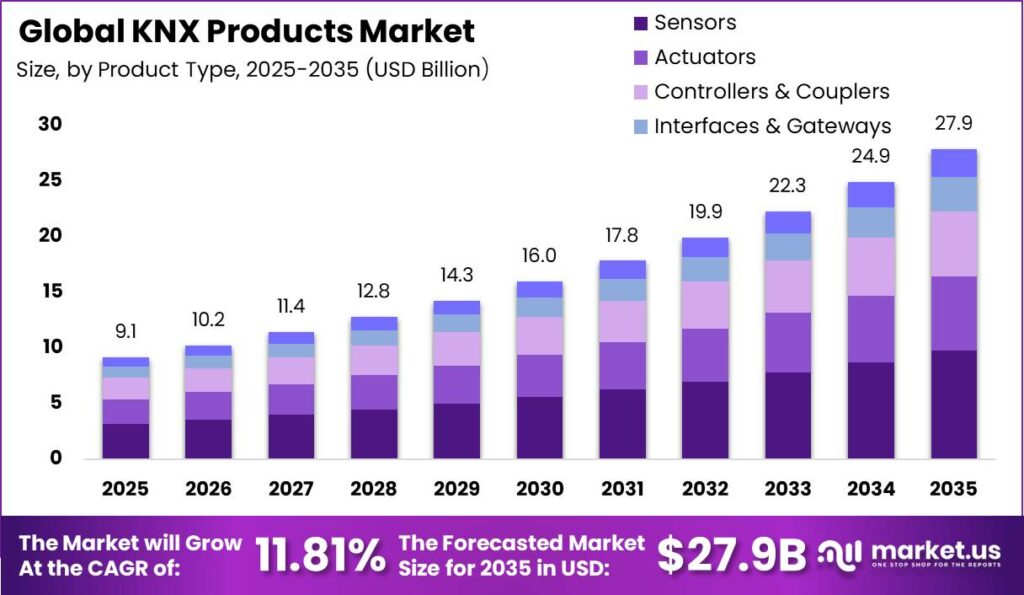
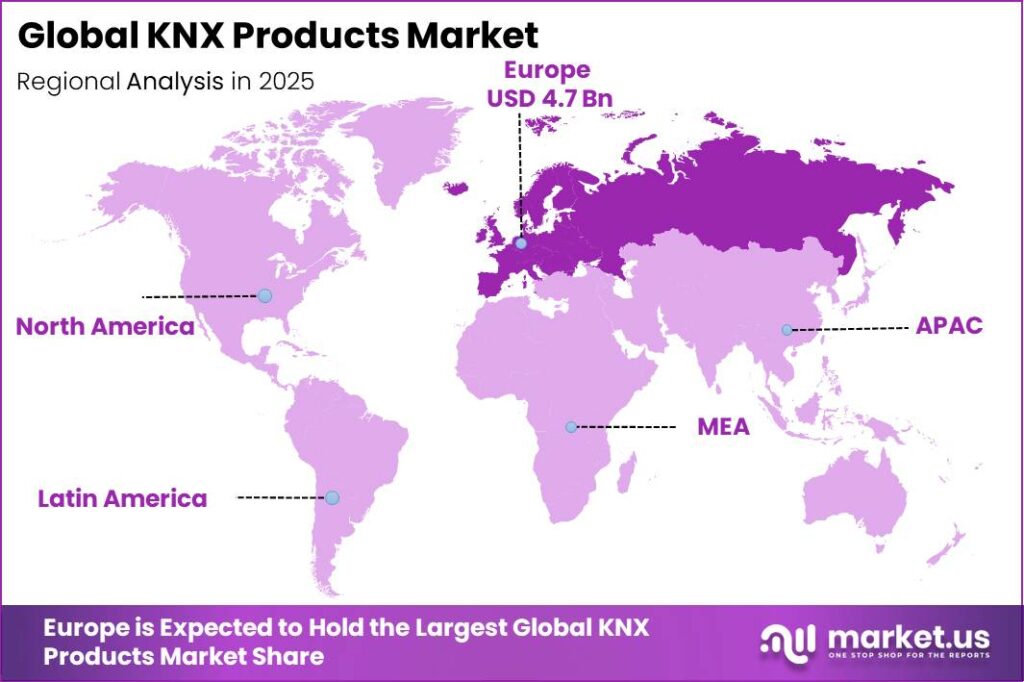
In 2025, the Global KNX Products Market was valued at USD 9.13 billion. The market is projected to grow at a CAGR of 11.81% during 2026–2035, reaching approximately USD 27.9 billion by 2035. Europe dominated the global market in 2025, accounting for more than 52.0% of the total market share and generating approximately USD 4.7billion in revenue.
The UNEP Global Status Report for Buildings and Construction 2024/2025 highlights that the buildings sector added approximately 5 billion square metres of new floor space in 2023 and contributes nearly one-third of energy-related CO₂ emissions and around 32% of global final energy use.
This expansion of new and renovated buildings is increasing the need for automated solutions that control lighting, HVAC, shading, and energy management systems, creating strong demand for KNX-enabled products. Europe’s growth is supported by strict energy efficiency regulations, including the EU Energy Performance of Buildings Directive, which targets an 11.7% reduction in energy consumption by 2030 compared with 2020 projections and encourages the adoption of smart building technologies.
According to the International Energy Agency, buildings account for around 30–37% of global final energy demand and energy-related CO₂ emissions, making energy optimization in heating, cooling, and lighting a major global priority. The World Green Building Council reports that certified green buildings can achieve 25–50% lower energy consumption compared with conventional buildings through advanced monitoring and automation.
Key Takeaway
- The Global KNX Products Market was valued at USD 9.13 billion in 2025 and is projected to reach USD 27.9 billion by 2035, growing at a CAGR of 11.81%.
- Europe dominated the KNX Products Market in 2025, accounting for over 52.0% share with approximately USD 4.7 billion in revenue.
- Sensors led the product type segment with a 35.00% share, supported by rising demand for intelligent monitoring and automation solutions.
- New installations dominated the installation segment with a 55.0% share, driven by KNX integration in new smart residential and commercial projects.
- Lighting Control held the leading application share at 32.0%, due to increasing adoption of automated and energy-efficient lighting systems.
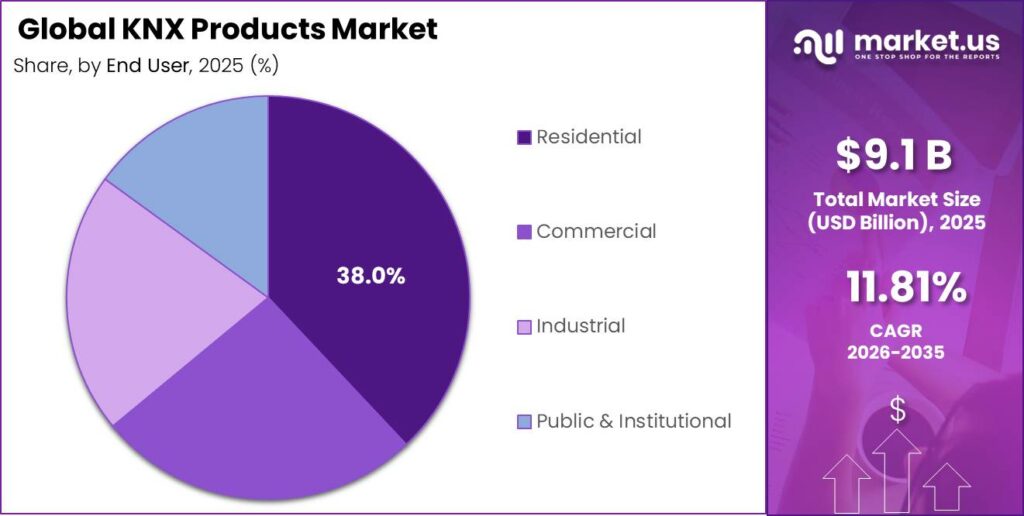
- Residential end users accounted for the largest share at 38.0%, supported by growing smart home adoption and residential automation demand.
By Product Type
Sensors hold the leading position in the KNX products market with a 35% market share, driven by their critical role in enabling intelligent building automation across lighting, HVAC, security, and energy management applications. As buildings focus more on energy efficiency and automation, demand for accurate real-time data from sensors continues to increase.
According to the International Energy Agency, buildings account for approximately 30% of global final energy consumption and around 27% of energy-related CO₂ emissions, making sensor-based monitoring and control systems essential for reducing energy usage.
The expansion of global building infrastructure is further strengthening sensor demand. The United Nations and World Bank estimate that more than 2.3 billion additional people will join urban populations by 2050, driving the development of new residential, commercial, and smart infrastructure projects.
By Installation
New installations account for the leading 55% share of KNX product deployments because smart automation systems are increasingly integrated during the initial design and construction phase of modern buildings. New projects allow developers to install KNX bus wiring, sensors, actuators, and controllers without the higher costs associated with later modifications.
According to the International Energy Agency, the buildings sector requires major efficiency improvements as buildings account for around 30% of global energy consumption, increasing the need for integrated automation solutions from the construction stage.
The European Commission’s Renovation Wave strategy targets the renovation of at least 35 million building units by 2030, creating significant opportunities for KNX-based upgrades in older structures. While retrofit projects are expanding rapidly, new installations maintain market leadership due to their ability to support complete automation ecosystems.
By Application
Lighting control, with a dominant 32% share of KNX applications, leads the market because it addresses the most ubiquitous, easily optimised electrical load in modern buildings while delivering rapid, measurable cost and energy savings.
Building-energy datasets from global agencies consistently show that lighting accounts for roughly 15–20% of total electricity consumption in residential and commercial properties, placing it among the top three end-uses alongside HVAC and appliances.
Technically, KNX lighting control combines dimming, occupancy-based switching, and daylight-responsive regulation to reduce lighting energy use by up to 50–60% when paired with efficient luminaires and sensors, materially lowering operating expenses and peak demand.
By End User
The residential end-user segment accounts for an estimated 38% share of global KNX product revenues, supported by the rapid adoption of smart homes, energy-efficient housing solutions, and residential automation systems. Residential buildings represent the largest portion of the global building stock, creating a significant demand base for KNX-enabled lighting, HVAC, shading, security, and energy management solutions.
According to the European Commission, buildings account for approximately 40% of the EU’s energy consumption, with residential buildings representing a major share, increasing the need for intelligent control systems that improve efficiency and reduce energy costs.
Europe alone has more than 250 million residential dwellings, creating a large installed base for automation upgrades and new smart-home projects. In key European markets such as Germany, KNX remains a widely adopted professional building automation standard, strengthening its presence in residential applications.
Key Market Segments
By Product Type
- Sensors
- Temperature Sensors
- Motion / Presence Sensors
- Light Sensors
- CO2 / Air Quality Sensors
- Actuators
- Switching Actuators
- Dimming Actuators
- Blind / Shutter Actuators
- Controllers & Couplers
- Area / Line Couplers
- IP Routers / Interfaces
- Interfaces & Gateways
- KNX-IP Gateways
- KNX-BACnet / Modbus
- System Devices
By Installation
- New
- New Residential
- New Commercial
- New Industrial
- Retrofit / Upgrade
- Smart Home Retrofit
- Energy Retrofit
- Commercial Upgrade
By Application
- Lighting Control
- Indoor Lighting
- Outdoor / Facade Lighting
- HVAC Control
- Heating Control
- Ventilation Control
- Security & Access Control
- Intrusion Detection
- Door Entry Systems
- Energy Management
- AV & Multimedia Control
By End User
- Residential
- Smart Homes
- Multi-Family Housing
- Commercial
- Office Buildings
- Hotels & Hospitality
- Retail Spaces
- Industrial
- Manufacturing Facilities
- Warehouses
- Public & Institutional
Market Dynamics
Drivers
| Driver | (~) % Impact on CAGR | Geographic Relevance | Impact Timeline |
|---|---|---|---|
| Mandatory EPBD Building Automation & Control System Compliance | +3.2% | European Union (pan-EU, 27 Member States); spillover to GCC & UK via aligned standards | Short term (less than or equal to 2 years) |
| Accelerating Smart City & Green Building Certification Programs | +2.4% | Global; highest density in North America, East Asia, Middle East | Medium term (2 to 4 years) |
| Rising Commercial Energy Costs Driving BAS Payback Urgency | +2.1% | Europe, Japan, South Korea, India; energy-import-dependent economies | Short term (less than or equal to 2 years) |
| Expansion of KNX-Certified Device Ecosystem (500+ Manufacturers) | +2.0% | Global; accelerating in Asia Pacific and Latin America | Medium term (2 to 4 years) |
| Hospitality & Healthcare Sector Automation Upgrades | +1.6% | North America, Europe, Southeast Asia | Medium term (2 to 4 years) |
| Residential Premium Segment Demand for Integrated Home Automation | +0.5% | Germany, Benelux, UAE, Australia, China Tier-1 cities | Short term (less than or equal to 2 years) |
Mandatory EPBD Building Automation & Control System Compliance
The recast Energy Performance of Buildings Directive (EU 2024/1275), which entered into force on 28 May 2024 and requires Member State transposition by 29 May 2026, is the single most structurally consequential demand lever the KNX market has experienced in its 30-year history.
The directive lowers the mandatory building automation and control system (BACS) installation threshold for non-residential buildings from 290 kW effective rated output to 70 kW by end-2029, pulling a broad tier of mid-sized commercial assets previously exempt into mandatory retrofit scope. Simultaneously, all newly constructed and extensively renovated residential buildings across the EU must incorporate mandatory automation and control functionalities by May 2026.
Because KNX is the only ISO/IEC 14543-standardized open protocol with certified device interoperability across 500+ manufacturers and 8,000+ certified product lines, it functions as a de facto compliance pathway for system integrators operating under the directive’s smart-readiness indicator (SRI) framework.
For KNX manufacturers, this translates into a near-certain volume pull across EU commercial refurbishment pipelines over the 2025 to 2029 horizon, compressing pre-sale cycles by an estimated 30 to 40% relative to discretionary smart-building upgrades, as project developers are now driven by statutory deadline risk rather than ROI discretion alone.
Restraints
| Restraint | (~) % Impact on CAGR | Geographic Relevance | Impact Timeline |
|---|---|---|---|
| Prohibitive Upfront System Cost in Residential & SME Segments | -2.8% | Global; most acute in Asia Pacific emerging markets, Eastern Europe, Latin America | Short term (less than or equal to 2 years) |
| Import Duties & Tariff Barriers on European KNX Hardware | -1.5% | India, Brazil, Southeast Asia, select African markets | Short term (less than or equal to 2 years) |
| Absence of Standardized Government Incentive Schemes Outside EU | -1.2% | North America, MENA, Sub-Saharan Africa | Medium term (2 to 4 years) |
| Proprietary Lock-in Perception Deterring Specifiers | -0.8% | Global; especially North America where BACnet dominance is entrenched | Medium term (2 to 4 years) |
| Tightening Credit Conditions Delaying Commercial Retrofit CapEx | -0.7% | Global; concentrated in rate-sensitive real estate markets (US, UK, Australia) | Short term (less than or equal to 2 years) |
Prohibitive Upfront System Cost in Residential & SME Segments
A fully installed KNX system for a mid-sized residential property typically commands a per-point installation cost that is 3 to 5 times higher than competing consumer-grade smart home ecosystems, a price gap that has proven structurally sticky despite the protocol’s multi-decade maturity.
For a standard residential build of approximately 150 to 200 m², total installed KNX system costs range between 8,000 EUR and 25,000 EUR depending on scope and region, representing a purchase barrier that effectively excludes the bottom 60 to 70% of the residential addressable universe in emerging economies.
In high-growth markets such as India, Brazil, and Southeast Asia where residential real estate volumes are among the fastest-expanding globally, the lack of locally manufactured KNX components compounds the hardware cost premium with import duty stacks that can add 15 to 28% to landed device costs, suppressing builder-developer adoption at precisely the construction-cycle entry point where protocol selection is made.
Challenges
| Challenge | (~) % CAGR | Geographic Relevance | Mitigation Horizon |
|---|---|---|---|
| Certified Installer & Integrator Deficit | -2.1% | Global; most acute in Asia Pacific, MENA, Sub-Saharan Africa, Latin America | Long term (greater than or equal to 4 years) |
| Cybersecurity Hardening & IP Exposure | -1.4% | Global; highest risk exposure in North America, EU post-NIS2 | Medium term (2 to 4 years) |
| Legacy TP-Wired Retrofit Complexity | -1.1% | Global; worst in pre-2000 built stock in Central & Eastern Europe, South Asia | Long term (greater than or equal to 4 years) |
| Multi-Protocol Project Fragmentation | -0.9% | Global; North America, Middle East large-scale commercial projects | Medium term (2 to 4 years) |
| Long Specification-to-Delivery Project Cycles | -0.7% | Global; large commercial, institutional, and infrastructure projects | Short term (less than or equal to 2 years) |
Certified Installer & Integrator Deficit
KNX system deployment is gated by certified professional competence: every installation requires KNX-Partner-certified technicians trained through accredited KNX Training Centres, a credential pathway that demands structured coursework, practical examination, and ongoing recertification.
As of 2025, the KNX Association reports approximately 100,000+ certified KNX Partners globally, a figure that is materially insufficient relative to the pipeline of compliant retrofits and new builds that EPBD timelines, net-zero corporate mandates, and smart city programs are simultaneously unlocking across 190+ countries. I
n rapidly expanding markets such as India, Southeast Asia, and Sub-Saharan Africa where construction activity is growing at 6 to 9% annually, the density of certified integrators per billion dollars of addressable building stock is estimated to be 5 to 8 times lower than in mature Western European markets, creating persistent execution bottlenecks that inflate project lead times by 4 to 10 weeks and push system commissioning costs up by 20 to 35% in underserved regions.
Opportunities
| Opportunity | (~) % CAGR | Geographic Relevance | Execution Window |
|---|---|---|---|
| KNX IoT & IPv6 Migration for Edge-Native Building Intelligence | +2.8% | Global; first-mover advantage in EU, North America, East Asia | Medium term (2 to 4 years) |
| Existing Commercial Building Retrofit Wave | +2.2% | Europe (worst-performing stock), North America, Japan | Short term (less than or equal to 2 years) |
| EV Charging & Demand Response Grid Integration | +1.8% | EU, UK, China, California; markets with utility-level demand response programs | Medium term (2 to 4 years) |
| Asia Pacific Greenfield Smart Building Expansion | +1.5% | China, India, Vietnam, Indonesia, South Korea | Long term (greater than or equal to 4 years) |
| KNX-as-a-Service & Managed Automation Subscription Models | +1.2% | Global; North America, Northern Europe leading adoption | Long term (greater than or equal to 4 years) |
| Healthcare & Life Sciences Vertical Specialization | +0.8% | North America, Germany, Japan, UAE | Medium term (2 to 4 years) |
KNX IoT & IPv6 Migration for Edge-Native Building Intelligence
KNX IoT, the KNX Association’s formally standardized extension of the KNX Classic twisted-pair ecosystem into native IPv6-based communication over Wi-Fi, Ethernet, and Thread, remains largely unexploited as a commercial revenue layer as of 2026, despite the open-source KNX IoT stack having reached certification-ready status in 2024 to 2025.
This is categorically untapped white space rather than a current driver: fewer than an estimated 5 to 8% of active KNX installations globally are presently operating with IoT-native, IP-addressed device nodes at scale, meaning that the vast majority of the installed base representing hundreds of millions of square meters of automated floor space is still running on legacy TP or RF media topologies that cannot participate in cloud analytics, AI-driven predictive maintenance, or real-time grid demand-response programs.
The commercial opportunity is a monetization model shift: manufacturers and system integrators who retool for KNX IoT can move from a one-time hardware sale to a recurring services architecture encompassing remote monitoring, and digital twin provisioning, a transition that based on analogous migrations in HVAC control and industrial automation typically expands per-installation gross margin by 15 to 25 percentage points over a 3 to 5 year horizon relative to pure hardware margin profiles.
Geopolitical Impact Analysis
Geopolitical tensions are increasing costs and supply chain risks in the KNX products market. Tariffs on semiconductor components, sensors, microcontrollers, and power-management ICs have risen to 10–20% across major economies since 2018.
Imported boards, connectors, and electronic components are facing estimated cost increases of 5–8%, which are often passed on through higher product prices. In 2024, Red Sea disruptions also increased shipping distances and operating expenses, pushing container freight rates close to pandemic-era peaks.
Global container shipping demand increased by 7.1% in 2024 after declining by 1.5% in 2022. Asia–Europe transit times also increased by approximately 7–10 days, raising inventory requirements for KNX modules, cables, and automation components.
European wholesale electricity prices declined by more than 50% in 2023 compared with 2022 but remained above pre-crisis levels. Average one-year Supramax time-charter rates reached USD 13,601 per day in 2024, up 21% from 2023, encouraging KNX manufacturers to adopt multi-sourcing, regional production, and stronger inventory strategies.
Regional Analysis
Europe dominates the KNX products market with approximately 52.0% market share, supported by mature construction activity, strong regulatory focus on energy efficiency, and widespread acceptance of KNX as a leading standard for home and building automation. The region represents a multi-billion-dollar opportunity, led by major markets including Germany, the UK, France, Italy, Spain, Belgium, and the Netherlands.
Industry assessments indicate that Europe’s share of global KNX revenues ranges between 45–60%, with one estimate placing the region’s contribution at around 45.4%, generating approximately USD 6.6 billion in revenues.
KNX has achieved more than 70% penetration in the European smart home automation segment and holds a share of around 50–56% in the German home automation market, reflecting strong adoption across residential and commercial projects.
Against a global KNX products market expected to grow from approximately USD 14–15 billion in the mid-2020s to over USD 30–40 billion by 2030–2035, Europe’s market value is estimated at around USD 4.5–6.5 billion. The region’s leadership is reinforced by strict EU building energy regulations, large-scale renovation projects, and the presence of major KNX-certified manufacturers and integrators such as Siemens, Schneider Electric, ABB, and JUNG.
Key Regions and Countries
North America
- US
- Canada
Europe
- Germany
- France
- The UK
- Spain
- Italy
- Rest of Europe
Asia Pacific
- China
- Japan
- South Korea
- India
- Australia
- Rest of APAC
Latin America
- Brazil
- Mexico
- Rest of Latin America
Middle East & Africa
- GCC
- South Africa
- Rest of MEA
Key Players Analysis
The KNX products market is led by major European electrical and automation companies, including Schneider Electric, Siemens Smart Infrastructure, ABB, and Legrand, which benefit from strong building automation portfolios, global distribution networks, and established customer bases.
The KNX ecosystem has reached 373 million installed devices and generated approximately €54.5 billion in cumulative market turnover over three decades, highlighting its strong market acceptance. KNX also accounts for around a 53% share of single-family smart home projects among electricians surveyed in Europe.
Tier-1 companies continue to drive adoption through energy management, HVAC control, and smart building solutions. Siemens Smart Infrastructure reported €19.8 billion revenue in fiscal 2025, with 10% comparable growth, while Schneider Electric recorded €11.095 billion revenue in Q4 2025.
Tier-2 specialists such as Hager, Jung, Gira, Theben, Zennio, MDT, and HDL Automation strengthen competition through specialized KNX sensors, actuators, gateways, and control devices, particularly in European residential and small commercial markets.
Top Key Players in the Market
- Siemens AG
- ABB Ltd.
- Schneider Electric
- Legrand SA
- Hager Group
- Jung Elektro
- Gira Giersiepen
- Theben AG
- Weinzierl Engineering
- MDT Technologies
- Berker (Hager Group)
- Rexel Group
Recent Developments
- In December 2025, ABB Ltd. completed the acquisition of Gamesa Electric’s power electronics business, adding a high-power conversion portfolio to enhance its integrated power and automation offerings.
- In April 2026, Legrand Group announced the acquisition of datacenter specialists Keydak (China) and TES (UK) via Euronext, adding €285 million in incremental annual revenue and capping a growth cycle that added €500 million in sales between 2020 and 2025.
- In May 2026, ABB Ltd. agreed to acquire Italian industrial transformer manufacturer Specialtrasfo S.p.A. (with €80 million in annual revenues) to strengthen its Motion High Power division, a transaction that subsequently closed ahead of schedule on July 1, 2026.
Report Scope
| Report Features | Description |
|---|---|
| Market Value (2025) | USD 9.13 Billion |
| Forecast Revenue (2035) | USD 27.9 Billion |
| CAGR (2026-2035) | 11.81% |
| Base Year for Estimation | 2025 |
| Historic Period | 2020-2024 |
| Forecast Period | 2026-2035 |
| Report Coverage | Revenue Forecast, Market Dynamics, Competitive Landscape, Recent Developments |
| Segments Covered | By Product Type (Sensors, Actuators, Controllers & Couplers, Interfaces & Gateways, System Devices), By Installation (New Residential, New Commercial, New Industrial, Retrofit / Upgrade), By Application (Lighting Control, HVAC Control, Security & Access Control, Energy Management, AV & Multimedia Control), By End User (Residential, Commercial, Industrial, Public & Institutional) |
| Regional Analysis | North America – US, Canada; Europe – Germany, France, The UK, Spain, Italy, Rest of Europe; Asia Pacific – China, Japan, South Korea, India, Australia, Singapore, Rest of APAC; Latin America – Brazil, Mexico, Rest of Latin America; Middle East & Africa – GCC, South Africa, Rest of MEA |
| Competitive Landscape | Siemens AG, ABB Ltd., Schneider Electric, Legrand SA, Hager Group, Jung Elektro, Gira Giersiepen, Theben AG, Weinzierl Engineering, MDT Technologies, Berker (Hager Group), Rexel Group |
| Customization Scope | Customization for segments and region/country-level will be provided. Moreover, additional customization can be done based on the requirements. |
| Purchase Options | We have three licenses to opt for: Single User License, Multi-User License (Up to 5 Users), Corporate Use License (Unlimited Users and Printable PDF) |





































