


Report Overview
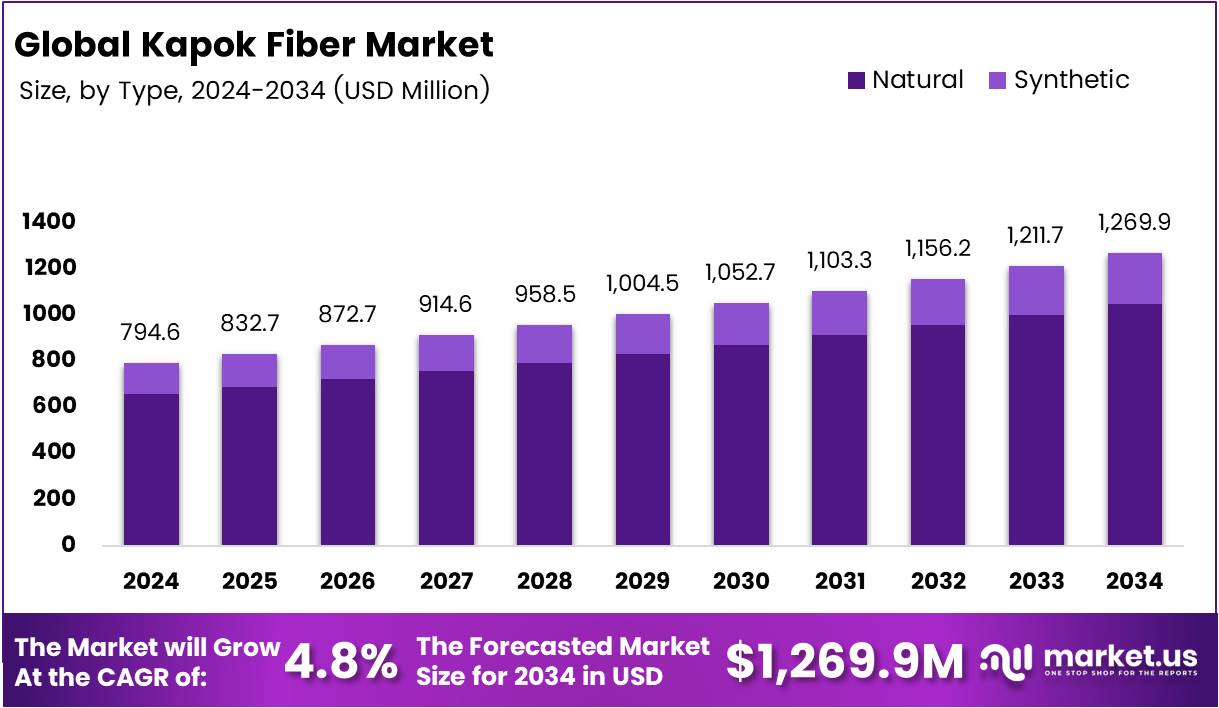
The Global Kapok Fiber Market size is expected to be worth around USD 1269.9 Million by 2034, from USD 794.6 Million in 2024, growing at a CAGR of 4.8% during the forecast period from 2025 to 2034.
Kapok fiber, derived from the seed hairs of the kapok tree, is gaining global traction as a sustainable textile material. With its lightweight, water-resistant, and biodegradable nature, it is increasingly replacing synthetic fibers. Moreover, its natural buoyancy and hypoallergenic properties attract use in home furnishings and eco-friendly insulation products.
The rising consumer preference for natural fibers is reshaping the textile and personal care sectors. Companies are actively integrating kapok into blended fabrics to reduce environmental impact. Furthermore, research initiatives are expanding its usability across high-performance applications, including acoustic panels, filtration media, and medical textiles, positioning kapok fiber as a versatile green material.
In addition, expanding awareness about renewable and compostable materials drives new business opportunities. Governments across Asia-Pacific and Latin America are investing in sustainable fiber farming and circular textile initiatives. These policies encourage local production and export of natural fibers, further fueling demand within the global kapok fiber market.
Manufacturers are also exploring automation and fiber extraction technologies to enhance yield and quality. As industries transition toward low-carbon production, kapok’s minimal processing requirement presents cost advantages. Likewise, sustainable packaging, furniture, and apparel segments are witnessing a rapid shift toward biodegradable fiber-based materials, strengthening market penetration.
According to an industry report, in a kapok/waste-silk nonwoven composite, increasing kapok content raised breaking strength from 0.58 MPa to 10.85 MPa, showcasing substantial structural improvement potential.
Additionally, the same report highlights that kapok/waste-silk biodegradable nonwovens achieved a 49.4% degradation rate in 30 days, indicating strong promise for compostable filling and packaging solutions. These findings emphasize kapok’s role in advancing sustainable material innovation and supporting global green manufacturing goals.
Key Takeaways
- The Global Kapok Fiber Market is projected to reach USD 1,269.9 Million by 2034, rising from USD 794.6 Million in 2024, at a CAGR of 4.8% (2025–2034).
- Natural Kapok Fiber dominated the market with an 82.7% share in 2024, driven by rising environmental consciousness and preference for biodegradable materials.
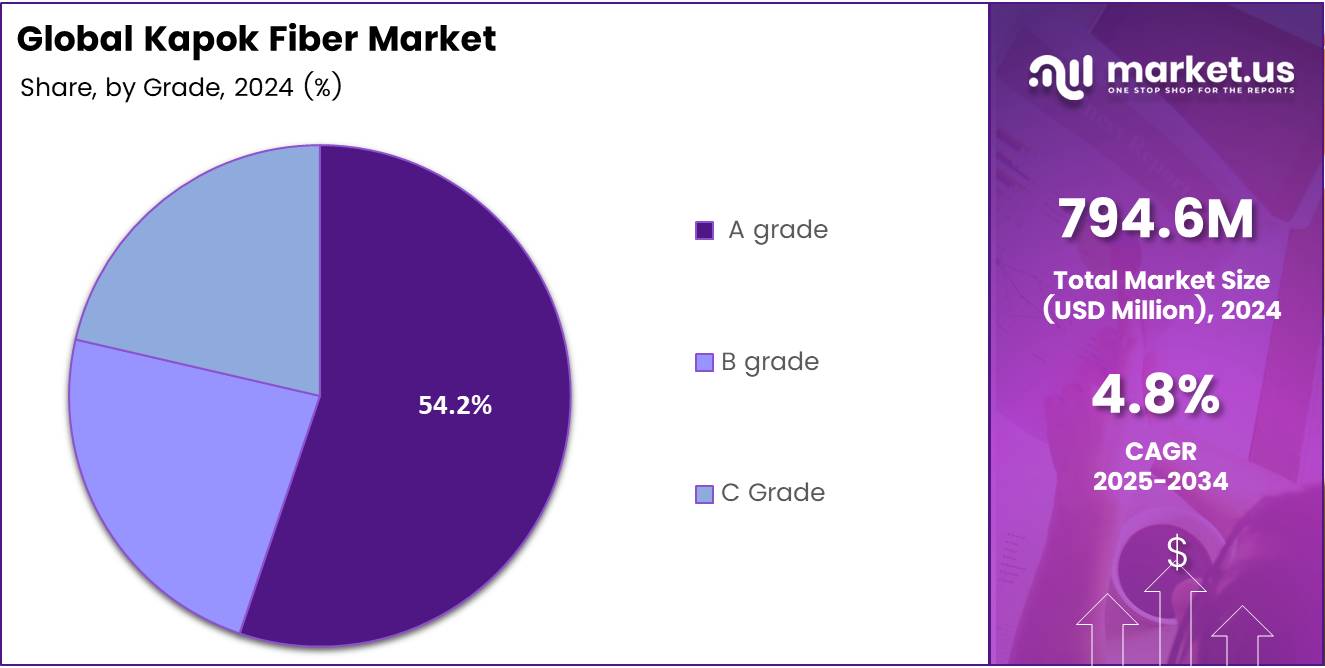
- A Grade Kapok Fiber accounted for 54.2% of the market in 2024, favored for its premium quality, high purity, and superior insulation performance.
- Textile & Apparel emerged as the leading end-use segment with a 32.8% share in 2024, fueled by demand for eco-friendly, hypoallergenic, and lightweight fabrics.
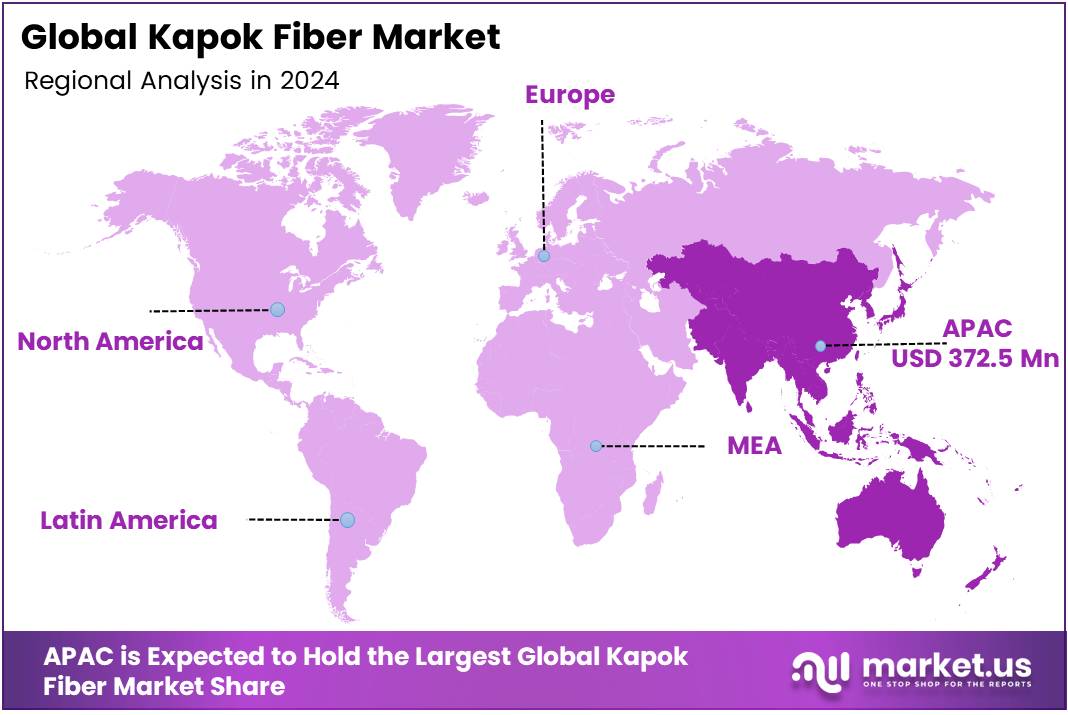
- Asia Pacific led the global market, capturing 46.8% share valued at USD 372.5 Million, supported by abundant raw material supply and strong sustainable textile demand.
By Type Analysis
Natural dominates with 82.7% due to its eco-friendly properties and high market demand.
In 2024, Natural held a dominant market position in the By Type segment of the Kapok Fiber Market, with a 82.7% share. Its dominance is attributed to growing environmental awareness and the increasing shift toward sustainable materials. Natural kapok fibers are biodegradable, lightweight, and water-resistant, making them a preferred choice in diverse applications.
Their demand is significantly rising across textile, furniture, and eco-friendly insulation industries due to their renewable origin and minimal environmental footprint. Manufacturers are focusing on expanding production capacities to meet this growing demand worldwide.
The Synthetic segment, though smaller, is witnessing steady growth due to its affordability and consistent quality. Synthetic kapok fibers are engineered to mimic the properties of natural fibers while offering better durability and availability. These fibers are increasingly used in applications where performance consistency and cost-effectiveness are key factors.
However, concerns related to environmental impact and non-biodegradability may restrain its adoption compared to natural fibers. The segment continues to serve niche markets where natural fiber availability or cost constraints limit usage.
By Grade Analysis
A Grade dominates with 54.2% due to superior fiber quality and wide applicability.
In 2024, A Grade held a dominant market position in the By Grade segment of the Kapok Fiber Market, with a 54.2% share. This dominance is driven by its premium quality, purity, and excellent fiber strength, which make it suitable for high-end textile and upholstery applications.
A-grade kapok fibers are extensively used by manufacturers focusing on luxury and eco-conscious product lines. Their superior insulation properties also make them popular in specialized industries such as bedding and protective clothing.
The B Grade segment captures a moderate market share, catering mainly to mid-range applications. These fibers are slightly less refined but still maintain good softness and buoyancy. They are widely used in cushion fillings, low-cost mattresses, and certain construction materials. The affordability of B-grade fibers helps expand their demand among small-scale producers, especially in developing markets where cost efficiency is critical.
The C Grade segment represents the lowest quality tier, often derived from mixed or unprocessed fiber batches. These fibers are primarily used in industrial applications such as insulation, packing, and filtration. Although less profitable, the segment contributes to sustainability by reducing waste through efficient material utilization. Growth remains modest yet stable due to limited use cases.
By End Use Analysis
Textile & Apparel dominates with 32.8% owing to the increasing demand for sustainable fabrics.
In 2024, Textile & Apparel held a dominant market position in the By End Use segment of the Kapok Fiber Market, with a 32.8% share. The segment benefits from the global trend toward eco-friendly and biodegradable clothing materials.
Kapok fibers’ softness, lightness, and natural hypoallergenic properties make them highly suitable for fashion and comfort wear. Leading apparel brands are integrating kapok blends to enhance product sustainability and consumer appeal.
The Building & Construction segment is gaining momentum due to kapok’s thermal and acoustic insulation qualities. Its lightweight and fire-resistant nature make it an effective green alternative for insulation panels and composites. As the construction industry moves toward sustainable materials, kapok fiber adoption continues to rise steadily in eco-housing and infrastructure projects.
The Pulp & Paper segment utilizes kapok for specialty paper production, especially in high-quality and biodegradable paper varieties. Its fine fibers improve texture and strength, appealing to premium stationery and packaging markets. Increasing awareness of reducing deforestation and promoting renewable fiber sources further supports this segment’s gradual growth.
The Furniture segment benefits from kapok’s natural cushioning and resilience. It is widely used in mattresses, pillows, and upholstery filling materials, offering comfort and sustainability. Manufacturers prefer kapok over synthetic alternatives due to its renewable nature and soft texture, contributing to its consistent demand in eco-conscious furniture manufacturing.
The Electrical & Electronics segment leverages kapok’s non-conductive and heat-resistant characteristics. It is used in insulation components and eco-packaging solutions for sensitive devices. Although niche, this segment is witnessing incremental growth as industries explore sustainable materials for protective and energy-efficient applications.
The Others segment includes applications in automotive, marine, and personal care products. Kapok fibers’ buoyancy makes them ideal for life jackets, while their absorbent nature supports oil spill management products. The diversification of kapok uses across emerging industries reflects its growing commercial potential and adaptability to innovation trends.
Key Market Segments
By Type
- Natural
- Synthetic
By Grade
- A Grade
- B Grade
- C Grade
By End Use
- Textile & Apparel
- Building & Construction
- Pulp & Paper
- Furniture
- Electrical & Electronics
- Others
Drivers
Rising Demand for Eco-Friendly and Biodegradable Textile Materials Drives Market Growth
The global kapok fiber market is witnessing strong growth due to the increasing demand for eco-friendly and biodegradable textile materials. Consumers are becoming more aware of the environmental impact of synthetic fibers, leading to a shift toward natural alternatives like kapok. Its lightweight, renewable, and biodegradable nature makes it an ideal choice for sustainable textile applications.
In addition, the expansion of sustainable bedding and mattress manufacturing industries is fueling market growth. Kapok fiber is naturally soft, breathable, and hypoallergenic, making it a preferred filling material for pillows, cushions, and mattresses. Manufacturers are increasingly incorporating kapok into their eco-conscious product lines to meet the growing consumer demand for green bedding products.
The fiber’s excellent thermal and acoustic insulation properties are also driving its use in construction and automotive sectors. Kapok offers a natural alternative to synthetic insulators, helping industries reduce their carbon footprint.
Furthermore, the growing awareness of hypoallergenic and chemical-free materials has boosted the adoption of kapok fiber. As consumers seek healthier, toxin-free options, kapok’s natural resistance to mold and dust mites enhances its appeal, strengthening its position in the sustainable materials market.
Restraints
Limited Global Supply Chain and Seasonal Production Constraints Challenge Market Growth
One of the major restraints in the kapok fiber market is its limited global supply chain and seasonal production. The fiber is mainly harvested from kapok trees found in tropical regions, making production dependent on climatic conditions and regional availability. This limits year-round supply and affects consistent market delivery.
High processing costs also act as a barrier to market expansion. Extracting kapok fibers is labor-intensive due to their delicate structure and the need for manual separation. This increases the overall cost of production compared to synthetic fibers, which are easier and cheaper to manufacture.
Additionally, kapok fiber faces low market penetration because of strong competition from synthetic alternatives like polyester and foam. These materials are widely available, cost-effective, and supported by well-established supply chains.
The market also struggles with inconsistent fiber quality and the absence of standardized grading systems. Variations in fiber properties make it difficult for manufacturers to maintain uniform product quality, restricting the widespread use of kapok fiber in large-scale industrial applications.
Growth Factors
Development of Blended Kapok Composites for Technical Textiles and Apparel Offers New Opportunities
The kapok fiber market is expected to grow significantly through the development of blended composites for technical textiles and apparel. Combining kapok with cotton, bamboo, or other natural fibers can improve durability and spinning efficiency, opening new possibilities for sustainable fashion and performance clothing.
The automotive industry is also emerging as a key opportunity area. Kapok fiber’s lightweight and cushioning properties make it ideal for car seat fillings, headrests, and interior panels. As automakers move toward sustainability, the adoption of natural fibers like kapok is likely to rise.
Expanding into bio-based packaging and filtration applications also presents promising growth potential. Kapok’s hollow structure allows for superior insulation and oil absorption, making it useful for eco-friendly packaging and filtration products.
Technological innovations in fiber processing and yarn spinning are expected to further enhance the commercial value of kapok. New machinery and treatment methods are helping improve fiber quality, scalability, and cost-efficiency, allowing manufacturers to tap into new market segments and broaden kapok’s industrial applications.
Emerging Trends
Surge in Vegan and Cruelty-Free Home Décor and Lifestyle Products Shapes Market Trends
A major trend shaping the kapok fiber market is the surge in vegan and cruelty-free home décor and lifestyle products. Consumers are actively choosing plant-based materials that align with ethical and sustainable living values, making kapok fiber a favored choice in cushions, mattresses, and upholstery.
The integration of kapok fiber into circular economy and zero-waste initiatives is further boosting its market visibility. Its biodegradability and renewable origin make it a perfect fit for industries aiming to reduce environmental waste and carbon emissions.
Growing use in organic baby products and natural sleep accessories is another emerging trend. Parents are increasingly opting for non-toxic, hypoallergenic materials, and kapok’s natural softness and safety make it ideal for baby bedding, toys, and sleepwear.
Collaborations between sustainable fashion brands and kapok producers are also driving innovation and awareness. These partnerships are helping build transparent supply chains and expand kapok’s presence in global markets, making it a key fiber in the future of sustainable materials.
Regional Analysis
Asia Pacific Dominates the Kapok Fiber Market with a Market Share of 46.8%, Valued at USD 372.5 Million
The Asia Pacific region holds a commanding position in the global Kapok Fiber market, accounting for 46.8% of the total market share and valued at USD 372.5 million. The dominance of this region is driven by abundant raw material availability, favorable climatic conditions for kapok cultivation, and growing demand for eco-friendly and sustainable fibers across industries. Countries such as Indonesia, China, and India are major contributors to production and consumption, strengthening the region’s leadership in the market.
North America Kapok Fiber Market Trends
The North American Kapok Fiber market is witnessing consistent growth supported by increasing consumer awareness toward sustainable materials and the growing adoption of natural fibers in home furnishings and personal care products. The United States, in particular, is focusing on eco-conscious product innovation and imports to meet the rising demand. The region’s emphasis on circular economy practices and green product certifications further enhances its market potential.
Europe Kapok Fiber Market Trends
Europe demonstrates steady market expansion owing to strong environmental regulations and consumer preference for biodegradable materials. The region’s textile and bedding industries are increasingly integrating kapok fiber into their product lines due to its hypoallergenic and lightweight properties. Additionally, sustainability-focused initiatives and policies promoting natural fibers are key factors supporting market penetration across major European economies.
Middle East and Africa Kapok Fiber Market Trends
The Middle East and Africa market for Kapok Fiber is gradually emerging, supported by growing interest in sustainable materials and limited but rising domestic production capacities. The market is primarily driven by the import of kapok-based products for use in bedding, cushions, and upholstery applications. Increased awareness and the expansion of textile manufacturing in select African countries are expected to foster future market opportunities.
Latin America Kapok Fiber Market Trends
Latin America presents a developing market for Kapok Fiber, characterized by growing utilization in eco-friendly textile and filler applications. Countries like Brazil and Colombia have suitable climatic conditions for kapok cultivation, offering potential for regional growth. The region’s gradual shift toward sustainable raw materials and increasing export activities are likely to strengthen its role in the global market over the coming years.
Key Regions and Countries
North America
- US
- Canada
Europe
- Germany
- France
- The UK
- Spain
- Italy
- Rest of Europe
Asia Pacific
- China
- Japan
- South Korea
- India
- Australia
- Rest of APAC
Latin America
- Brazil
- Mexico
- Rest of Latin America
Middle East & Africa
- GCC
- South Africa
- Rest of MEA
Key Kapok Fiber Company Insights
The global Kapok Fiber Market in 2024 has witnessed significant growth driven by the rising demand for sustainable, biodegradable, and lightweight materials across various industries.
Among the key players, Agro Raya continues to hold a prominent position due to its strong supply chain network and emphasis on high-quality natural kapok fiber production. The company’s integration of eco-friendly harvesting practices and efficient processing technology has strengthened its global footprint, particularly in the textile and bedding sectors.
Flocus has emerged as an innovation-driven manufacturer, focusing on the development of blended kapok-based materials for fashion and home furnishings. Its commitment to sustainability and consistent research into fiber modification and performance enhancement have positioned it as a preferred partner for eco-conscious brands seeking renewable fiber alternatives.
Lamitex Co. Ltd. demonstrates steady market performance through its diversified product portfolio and investment in fiber treatment technologies. The company’s focus on expanding its applications in insulation and nonwoven fabrics showcases its strategic efforts to capture niche market segments and strengthen its international market share.
Paradise Fibers Ltd. leverages its expertise in the natural fiber trade to deliver high-quality kapok fiber to a broad customer base. Its customer-centric approach, combined with efficient sourcing and quality assurance systems, ensures continued trust among buyers in both domestic and global markets. Overall, these companies play a crucial role in shaping the competitive landscape of the kapok fiber market, driving innovation, sustainability, and growth through diversified applications and responsible manufacturing practices.
Top Key Players in the Market
- Agro Raya
- Flocus
- Lamitex Co. Ltd.
- Paradise Fibers Ltd.
- Others
Recent Developments
- In Dec 2024, the Hitachi Global Foundation funded a project titled “Development of Efficient and Customizable Kapok Fiber Adsorbents for Water Treatment Applications” under its 2024 Asia Innovation Awards, highlighting growing support for sustainable material innovations.
- In Feb 2024, Flocus, a kapok-based textile innovator, announced operational scaling and social-compliance certification initiatives, though no official funding or acquisition was disclosed, signaling organic business expansion through responsible manufacturing.
- In Oct 2025, Flocus gained trade media attention for its advancements in kapok fiber sorting and spinning technology, yet no new financing or acquisition was reported, reflecting ongoing innovation-driven growth within the natural fiber sector.
Report Scope
| Report Features | Description |
|---|---|
| Market Value (2024) | USD 794.6 Million |
| Forecast Revenue (2034) | USD 1269.9 Million |
| CAGR (2025-2034) | 4.8% |
| Base Year for Estimation | 2024 |
| Historic Period | 2020-2023 |
| Forecast Period | 2025-2034 |
| Report Coverage | Revenue Forecast, Market Dynamics, Competitive Landscape, Recent Developments |
| Segments Covered | By Type (Natural, Synthetic), By Grade (A Grade, B Grade, C Grade), By End Use (Textile & Apparel, Building & Construction, Pulp & Paper, Furniture, Electrical & Electronics, Others) |
| Regional Analysis | North America (US and Canada), Europe (Germany, France, The UK, Spain, Italy, and Rest of Europe), Asia Pacific (China, Japan, South Korea, India, Australia, and Rest of APAC), Latin America (Brazil, Mexico, and Rest of Latin America), Middle East & Africa (GCC, South Africa, and Rest of MEA) |
| Competitive Landscape | Agro Raya, Flocus, Lamitex Co. Ltd., Paradise Fibers Ltd., Others |
| Customization Scope | Customization for segments, region/country-level will be provided. Moreover, additional customization can be done based on the requirements. |
| Purchase Options | We have three licenses to opt for: Single User License, Multi-User License (Up to 5 Users), Corporate Use License (Unlimited User and Printable PDF) |





































