Report Overview
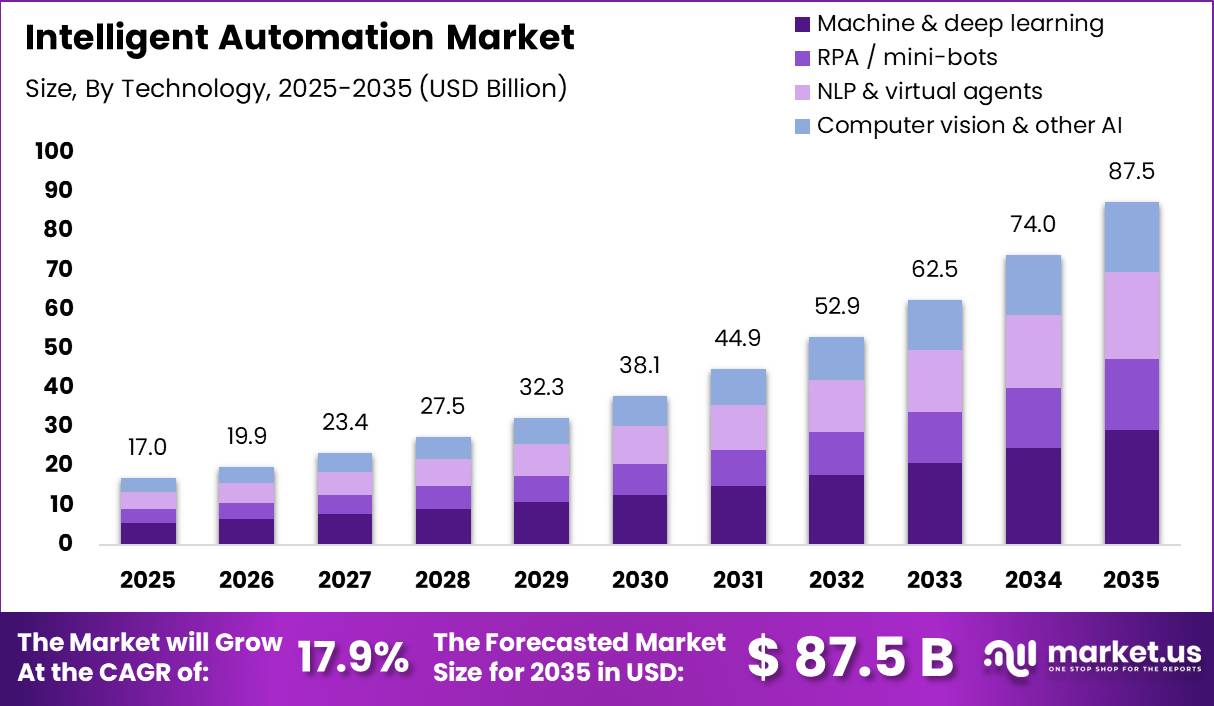
The Global Intelligent Automation Market is projected to grow from USD 17.0 billion in 2025 to USD 87.5 billion by 2035, registering a CAGR of 17.9%. North America accounted for 38.6% of the intelligent automation market in 2025, representing approximately USD 6.54 billion. This expansion is supported by rising enterprise investment in artificial intelligence, cloud software, data platforms, and automated business processes.
According to WIPO, global software spending was approaching USD 700 billion by 2025, supported by strong demand for cloud, data analytics, and AI-based applications. IDC also forecasts that worldwide spending on AI-centric systems would exceed USD 300 billion by 2026, growing at a CAGR of 26.5%. Banking, retail, manufacturing, and professional services account for a significant portion of this investment, as these industries use automation for fraud detection, customer support, sales operations, document processing, and workflow management.
The expansion of manufacturing and logistics automation is supporting strong demand for intelligent automation solutions. According to the International Federation of Robotics, Asia installed approximately 402,000 industrial robots in 2024, representing nearly 74% of global robot installations. Western Europe recorded a robot density of 267 units per 10,000 manufacturing employees, while North America reached 204 units per 10,000 employees.
Key Takeaway
- The Global Intelligent Automation Market is projected to grow from USD 17.0 billion in 2025 to USD 87.5 billion by 2035, at a 17.9% CAGR.
- Machine and deep learning dominated the technology segment with a 33.4% market share.
- Solutions accounted for the largest component share at 66.7%, supported by strong enterprise software and IT spending.
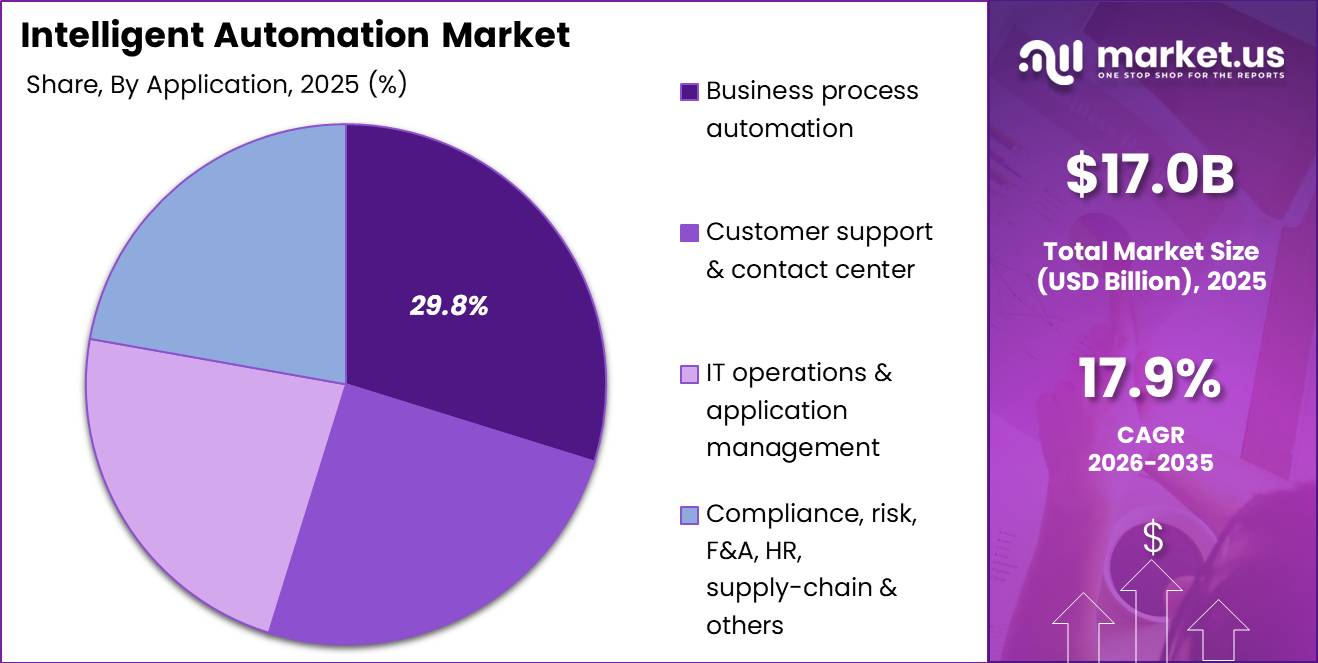
- Business process automation led the application segment with a 29.8% share, driven by repetitive workflow automation.
- BFSI was the leading end-use industry, accounting for 28.8% of the global market in 2025.
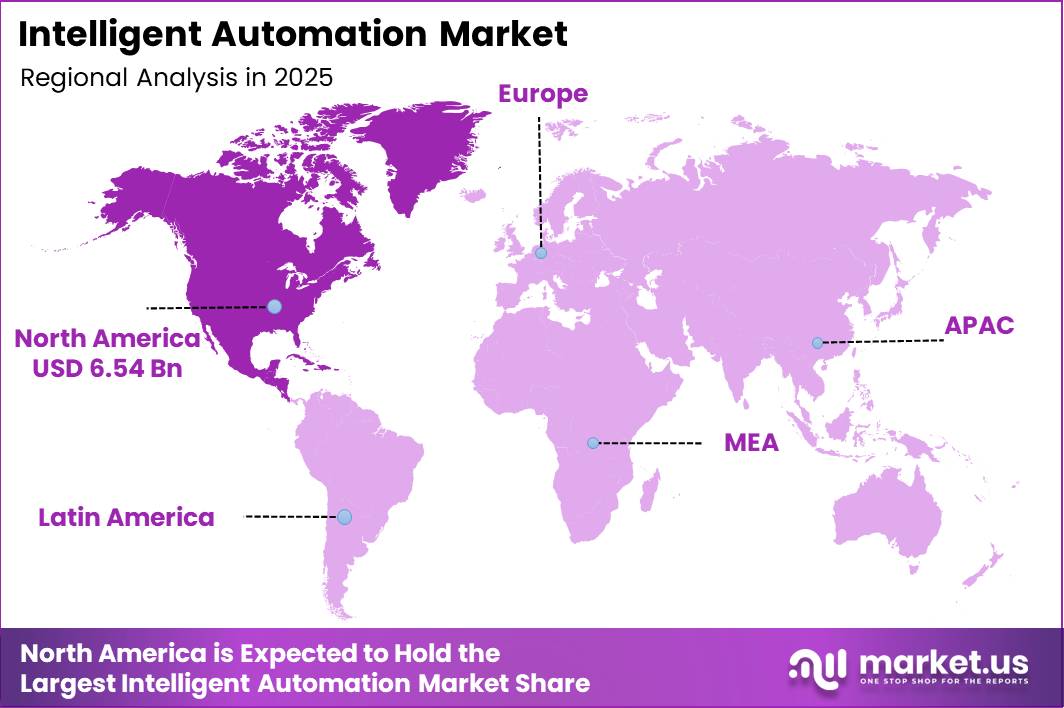
- North America led the market in 2025 with a 38.6% share, valued at approximately USD 6.54 billion.
By Technology
Machine and deep learning accounted for the largest share of the intelligent automation technology segment, at approximately 33.4%. Their leading position is supported by widespread use in prediction, anomaly detection, pattern recognition, and automated decision-making. According to the OECD, 20.2% of firms were using artificial intelligence in 2025, more than twice the level recorded in 2023.
Natural language processing and virtual agents represent the fastest-growing technology segment. Their growth is driven by rising demand for automated communication across customer service, employee support, and digital self-service platforms. NLP tools can understand user questions, generate responses, summarize documents, and route requests to the correct department.
By Business Model
The Solutions segment accounted for the largest share of the intelligent automation market, at approximately 66.7%. Its leading position is supported by strong global spending on information technology, communication systems, and enterprise software.
World Bank data indicate that ICT expenditure can represent around 5% to 8% of GDP in several advanced economies, translating into substantial annual investment in major markets. The services segment is expected to record the fastest growth due to rising demand for consulting, system integration, maintenance, and managed services.
World Bank data show that ICT services account for more than 3% to 10% of total service exports in many countries, highlighting the growing economic importance of technology-related services. Intelligent automation projects often require integration with enterprise resource planning systems, customer relationship management platforms, payment networks, and data infrastructure.
By Application
Business process automation accounted for the largest share of intelligent automation applications, at approximately 29.8%. Its leading position is supported by strong demand to automate high-volume and repetitive activities such as billing, payroll, procurement, claims processing, and order management. According to the U.S. Census Bureau, 59.0% of businesses consider cloud-based technology very important to their operations, while 58.9% report the same for specialized software.
Research covering more than 300,000 U.S. companies found that firms adopting automation technologies achieved around 11.4% higher labor productivity than non-adopters. Automation helps reduce manual processing, improve accuracy, shorten turnaround times, and lower operating costs. These benefits become especially important for organizations handling millions of invoices, transactions, customer requests, and business documents.
Census Bureau data indicate that 18% of firms use AI in at least one business function, increasing to 32% when measured by employment. Among AI users, 52% apply it in sales and marketing, 45% in strategy and business development, and 41% in IT. As companies automate more tasks across multiple departments, demand for business process automation platforms is expected to expand faster than more specialized applications.
By Vertical
The BFSI segment accounted for the largest share of the intelligent automation market, at approximately 28.8%. Its leading position is supported by the high volume of digital payments, financial transactions, insurance claims, and regulatory checks processed every day. BIS Red Book statistics show that major economies handle billions of cashless transactions annually through cards, credit transfers, and direct debits.
Banks, insurers, and payment providers use intelligent automation to combine workflow software, machine-learning models, document processing, and robotic process automation. These tools help reduce transaction processing time, improve accuracy, detect suspicious activity, and manage exceptions with limited manual effort.
Key Market Segments
By Technology
- Machine & deep learning
- RPA / mini-bots
- NLP & virtual agents
- Computer vision & other AI
By Business Model
- Solutions
- Services
By Application
- Business process automation
- Customer support & contact center
- IT operations & application management
- Compliance, risk, F&A, HR, supply-chain & others
By Vertical
- BFSI
- Domestic Dropshipping
- IT & telecom
- Manufacturing & logistics
- Healthcare & life sciences
- Retail & e-commerce
- Others (public sector, energy, media, etc.)
Geopolitical Impact Analysis
Geopolitical tensions are increasing costs and supply risks across the intelligent automation market. Tariffs, shipping delays, and energy price changes directly affect the servers, controllers, network equipment, and electronic components used in automation systems. U.S. Section 301 measures have imposed tariffs of up to 25% on several technology and industrial imports from China. For example, a 25% duty on a USD 10,000 industrial server or edge gateway would add USD 2,500 to its landed cost. This can reduce supplier margins or raise project costs for manufacturers, banks, logistics companies, and data-center operators.
Shipping disruptions are creating further pressure. UNCTAD reports that rerouting vessels around the Cape of Good Hope can add 10–14 days to Asia–Europe transit times and increase voyage distances by 3,000–3,500 nautical miles. Longer routes raise freight expenses, delay equipment deliveries, and make automation project schedules less predictable.
Energy volatility also increases operating costs. Intelligent automation systems depend on data centers, cloud infrastructure, cooling equipment, industrial robots, and connected production lines, all of which require significant electricity. Higher fuel and natural gas prices can therefore increase both data-center and factory operating expenses.
Regional Analysis
North America held the leading position in the intelligent automation market in 2025, accounting for approximately 38.6% of global revenue, or around USD 6.54 billion. The region’s dominance is supported by high technology spending, advanced cloud infrastructure, and early adoption of artificial intelligence across banking, retail, manufacturing, healthcare, and public services.
Large organizations in the United States and Canada increasingly use automation for payment processing, customer support, document management, regulatory reporting, and back-office operations. High labor costs and strict compliance requirements also encourage companies to automate repetitive and complex workflows, improving accuracy while lowering operating expenses.
Asia Pacific is expected to record the fastest growth during the forecast period. Expansion of e-commerce, digital banking, advanced manufacturing, and logistics networks is creating strong demand for intelligent automation across China, Southeast Asia, South Korea, and other regional markets. Businesses are adopting cloud-based and AI-enabled platforms to manage rising transaction volumes, customer requests, production activities, and supply-chain operations.
Key Regions and Countries
North America
- US
- Canada
Europe
- Germany
- France
- The UK
- Spain
- Italy
- Rest of Europe
Asia Pacific
- China
- Japan
- South Korea
- India
- Australia
- Rest of APAC
Latin America
- Brazil
- Mexico
- Rest of Latin America
Middle East & Africa
- GCC
- South Africa
- Rest of MEA
Market Dynamics
Drivers
| Driver | (~) %
CAGR |
Geographic Relevance | Impact Timeline |
|---|---|---|---|
| Generative AI & Agentic Automation Integration into Enterprise Workflows | +4.2% | North America, Western Europe, Japan | Short term (≤ 2 years) |
| Digital Transformation Mandates Across BFSI, Healthcare & Manufacturing | +2.8% | Global, with concentration in US, EU, India, China | Short term (≤ 2 years) |
| Labor Cost Inflation & Workforce Optimization Pressure | +2.1% | North America, Western Europe, ANZ | Short term (≤ 2 years) |
| Low-Code & No-Code Platform Democratization | +1.6% | Global, accelerated in APAC & LATAM | Medium term (2–4 years) |
| Cloud-Native Infrastructure Expansion Enabling Scalable RPA Deployment | +1.4% | Global, APAC growth acceleration | Medium term (2–4 years) |
| National AI Policy & Government Digital Infrastructure Investment | +1.0% | India, UAE, Saudi Arabia, EU member states | Medium term (2–4 years) |
Generative AI & Agentic Automation Integration into Enterprise Workflows
The integration of large language model orchestration, robotic process automation, and autonomous AI agents is changing enterprise automation purchasing. Companies are moving away from per-bot licenses, which typically cost USD 8,000 to USD 15,000 per attended bot annually, toward platform-based SaaS subscriptions and consumption pricing of around USD 0.002 to USD 0.05 per task execution. This shift is reducing the cost per automated workflow and expanding the number of processes that can be automated.
The agentic AI market was valued at approximately USD 7.06 billion in 2025 and is projected to reach nearly USD 93.2 billion by 2032. IBM and Salesforce estimate that more than 1 billion AI agents could be operational globally by the end of 2026. This rapid expansion is creating new sales opportunities for intelligent automation platforms, orchestration software, governance systems, and related services.
Enterprises testing agentic AI in BFSI, healthcare, and manufacturing have reported productivity improvements of around 34% to 60% in automation-intensive functions. U.S. deployments have generated an average ROI of approximately 192%, which is nearly 3 times higher than traditional RPA implementations. As a result, about 88% of C-suite executives plan to increase AI budgets for agentic initiatives in 2026, supporting higher demand for integrated automation platforms and middleware.
Restraints
| Restraint | (~) % CAGR | Geographic Relevance | Impact Timeline |
|---|---|---|---|
| EU AI Act High-Risk System Compliance Obligations Constraining Deployment Velocity | -2.4% | European Union, UK, and jurisdictions with EU-aligned AI legislation | Short term (≤ 2 years) |
| Elevated Interest Rates & Constrained Enterprise CapEx Budgets | -1.8% | North America, Europe, emerging markets with tight fiscal conditions | Short term (≤ 2 years) |
| High Total Cost of Ownership for Full-Stack IA Platform Deployment | -1.5% | Global, most severe in LATAM, Southeast Asia, Sub-Saharan Africa | Medium term (2–4 years) |
| Data Sovereignty & Cross-Border Data Transfer Restrictions | -1.2% | EU, India (DPDP Act), China, Brazil (LGPD) | Medium term (2–4 years) |
| Labor Union Opposition & Workforce Displacement Policy Risk | -0.7% | Western Europe, North America, Japan | Medium term (2–4 years) |
EU AI Act High-Risk System Compliance Obligations Constraining Deployment Velocity
The EU AI Act, which entered into force on 1 August 2024 and reaches full applicability on 2 August 2026, imposes a layered compliance architecture on intelligent automation systems classified as high-risk — including deployments in employment screening, credit decisioning, critical infrastructure, and biometric identification — mandating pre-market conformity assessments, real-time audit logging, explainability documentation, and human-in-the-loop oversight mechanisms before any system goes live in EU markets.
For enterprise buyers, each non-trivial intelligent automation deployment now requires legal review, a conformity assessment body (CAB) audit, and continuous post-market monitoring — adding an estimated 4–9 months to procurement-to-production timelines and increasing per-project compliance overhead by €150,000–€400,000 for mid-tier deployments in regulated sectors such as financial services and healthcare.
This directly compresses the pipeline conversion rate for IA vendors operating in EU jurisdictions: deals already in negotiation as of Q1 2026 are experiencing deferred signing pending internal compliance review, pushing recognized revenue into later quarters and suppressing near-term booking growth by an estimated 15–22% for EU-market-exposed vendors.
The chilling effect extends beyond the EU’s ~450 million consumer market; because the Act applies wherever EU-resident data is processed, multinationals with EU operations must apply compliant architectures globally or maintain costly parallel infrastructure — a structural tax on platform EBITDA margins estimated at 3–6 percentage points for pure-play IA software companies before amortization of one-time compliance buildout costs.
Challenges
| Challenge | (~) % CAGR | Geographic Relevance | Mitigation Horizon |
|---|---|---|---|
| Legacy System Integration Complexity | -2.6% | Global, most acute in BFSI, public sector, manufacturing | Long term (≥ 4 years) |
| AI & Automation Talent Deficit | -1.9% | Global; most severe in Southeast Asia, LATAM, Sub-Saharan Africa | Long term (≥ 4 years) |
| Algorithmic Bias & Model Governance Risk | -1.3% | Global, amplified under EU AI Act, US state AI laws | Medium term (2–4 years) |
| Cybersecurity Exposure in Autonomous Pipelines | -1.1% | North America, Europe, advanced APAC markets | Medium term (2–4 years) |
| Change Management & Workforce Adoption Friction | -0.9% | Global, pronounced in traditional industries | Medium term (2–4 years) |
Legacy System Integration Complexity
The structural incompatibility between modern intelligent automation platforms and the monolithic ERP, core banking, and manufacturing execution systems that underpin a majority of global enterprise infrastructure represents the single most pervasive ceiling on IA’s realized growth potential: organizations invest an average of $4.2 million annually in maintaining legacy systems, yet those same systems typically lack the open API surface, event-driven architecture, and structured data schemas required by AI orchestration engines to operate without constant exception handling.
In BFSI — which accounts for approximately 36.5% of intelligent process automation revenue globally — core banking platforms averaging 20–35 years in age require custom middleware, ETL pipeline construction, and data-lake harmonization projects that extend IA deployment timelines by 9–18 months and inflate per-implementation services costs by 40–65% above the software license cost alone, eroding the project-level ROI that justifies C-suite sign-off.
Across Indian enterprises specifically, 87% have identified legacy system replacement as a strategic priority in 2026, yet full modernization programs for a single large bank or manufacturer typically require 3–5 years and $50M–$250M in transformation spend, meaning the IA market must operate within an ecosystem where the underlying substrate resists the very integration it requires — forcing vendors to continuously invest in low-code connectivity layers, pre-built legacy connectors, and hyperautomation middleware suites rather than differentiating on core AI capability.
Opportunities
| Opportunity | (~) % CAGR | Geographic Relevance | Execution Window |
|---|---|---|---|
| SME & Mid-Market IA Monetization via Vertical SaaS Bundling | +3.1% | India, Southeast Asia, LATAM, Central & Eastern Europe | Medium term (2–4 years) |
| Healthcare Process Automation — Clinical Documentation & Revenue Cycle | +2.3% | North America, EU, GCC, India | Medium term (2–4 years) |
| Multi-Agent Orchestration Platform Layer & Marketplace Monetization | +2.0% | North America, Western Europe, Japan, Australia | Long term (≥ 4 years) |
| IA-as-a-Service for Government & Public Sector Digital Modernization | +1.5% | GCC (UAE, Saudi Arabia), India, EU member states | Medium term (2–4 years) |
| Supply Chain & Logistics Autonomous Decision Intelligence | +1.2% | Global, with early scaling in China, Germany, US | Long term (≥ 4 years) |
SME & Mid-Market IA Monetization via Vertical SaaS Bundling
The global SME segment — comprising over 330 million firms and contributing approximately 50% of global GDP — remains structurally underserved by intelligent automation vendors, whose go-to-market motions have historically targeted enterprises with dedicated IT functions and transformation budgets exceeding $1 million; this white space represents an incremental TAM of approximately $18–22 billion that sits entirely outside the current revenue base of leading IA platform vendors.
The barrier is not fundamental unwillingness: entry costs for AI tools in the SME segment have declined from approximately $50 per month in 2019 to $20–30 per month in 2025, and the World Economic Forum’s 2025 India SME AI playbook explicitly identifies intelligent process automation as the highest-ROI AI entry point for businesses with 10–500 employees.
Vendors executing this model can target gross margins of 72–80% on software-only vertical SaaS SKUs, versus the 45–58% blended margins typical of enterprise IA platform deals that carry heavy services components; achieving even 3–5% penetration of the addressable SME universe in India, Southeast Asia, and LATAM over a 4–6 year window would generate incremental platform ARR in the range of $5–8 billion annually, fundamentally rerating the revenue durability and margin profile of category leaders willing to productize for this tier.
Key Players Analysis
The intelligent automation market is led by Tier-1 companies such as UiPath, IBM, Microsoft, SAP, Oracle, ServiceNow, Accenture, and TCS. These vendors combine AI, workflow software, robotic process automation, cloud platforms, and global consulting services. UiPath reported USD 1.308 billion in fiscal 2024 revenue and USD 1.464 billion in annual recurring revenue, supported by around 10,830 customers.
IBM generated USD 62.8 billion in 2024 revenue and invested more than USD 7 billion in research and development. ServiceNow recorded approximately USD 10.9 billion in revenue and served more than 2,020 customers with annual contract values above USD 1 million. Accenture reported USD 64.9 billion in fiscal 2024 revenue, along with USD 3 billion in AI-related bookings.
Tier-2 companies, including Automation Anywhere, SS&C Blue Prism, Pegasystems, Appian, NICE, Tungsten Automation, and WorkFusion, compete through specialized RPA, case management, and customer-service automation. Their focused products and flexible deployment models help them serve specific industries and regional markets.
Top Key Players in the Market
- UiPath Inc.
- Automation Anywhere, Inc.
- Blue Prism Limited (SS&C Blue Prism)
- IBM Corporation
- Microsoft Corporation
- SAP SE
- Oracle Corporation
- Pegasystems Inc.
- Appian Corporation
- NICE Ltd.
- Kofax
- ServiceNow, Inc.
- WorkFusion, Inc.
- Accenture plc
- Tata Consultancy Services Limited (TCS)
Recent Developments
- In February 2026, UiPath acquired WorkFusion to add AI-based AML and KYC automation for banks. During the same month, Accenture acquired an AI solution from Avanseus to improve predictive maintenance and anomaly detection across large telecom networks.
- In January 2026, IBM completed its approximately USD 11 billion acquisition of Confluent, adding real-time data-streaming capabilities that process billions of events and support automation across banking, retail, and manufacturing.
Report Scope
| Report Features | Description |
|---|---|
| Market Value (2025) | USD 17.0 Billion |
| Forecast Revenue (2035) | USD 87.5 Billion |
| CAGR (2026-2035) | 17.9% |
| Base Year for Estimation | 2025 |
| Historic Period | 2020-2024 |
| Forecast Period | 2026-2035 |
| Report Coverage | Revenue Forecast, Market Dynamics, Competitive Landscape, Recent Developments |
| Segments Covered | By Technology (Machine & Deep Learning, RPA / Mini-Bots, NLP & Virtual Agents, and Computer Vision & Other AI), By Business Model (Solutions and Services), By Application (Business Process Automation, Customer Support & Contact Center, IT Operations & Application Management, Compliance, Risk, Finance & Accounting, HR, Supply Chain & Others), By Vertical (BFSI, IT & Telecom, Manufacturing & Logistics, Healthcare & Life Sciences, Retail & E-commerce, and Others) |
| Regional Analysis | North America – US, Canada; Europe – Germany, France, The UK, Spain, Italy, Rest of Europe; Asia Pacific – China, Japan, South Korea, India, Australia, Singapore, Rest of APAC; Latin America – Brazil, Mexico, Rest of Latin America; Middle East & Africa – GCC, South Africa, Rest of MEA |
| Competitive Landscape |
Intelligent Automation Market Size, Share and Analysis Report By Company (UiPath Inc., Automation Anywhere, Inc., Blue Prism Limited (SS&C Blue Prism), IBM Corporation, Microsoft Corporation, SAP SE, Oracle Corporation, Pegasystems Inc., Appian Corporation, NICE Ltd., Kofax, ServiceNow, Inc., WorkFusion, Inc., Accenture plc, and Tata Consultancy Services Limited (TCS)).
|
| Customization Scope | Customization for segments and region/country-level will be provided. Moreover, customization can be tailored to the requirements. |
| Purchase Options | We have three licenses to opt for: Single User License, Multi-User License (Up to 5 Users), Corporate Use License (Unlimited Users and Printable PDF) |