


Report Overview
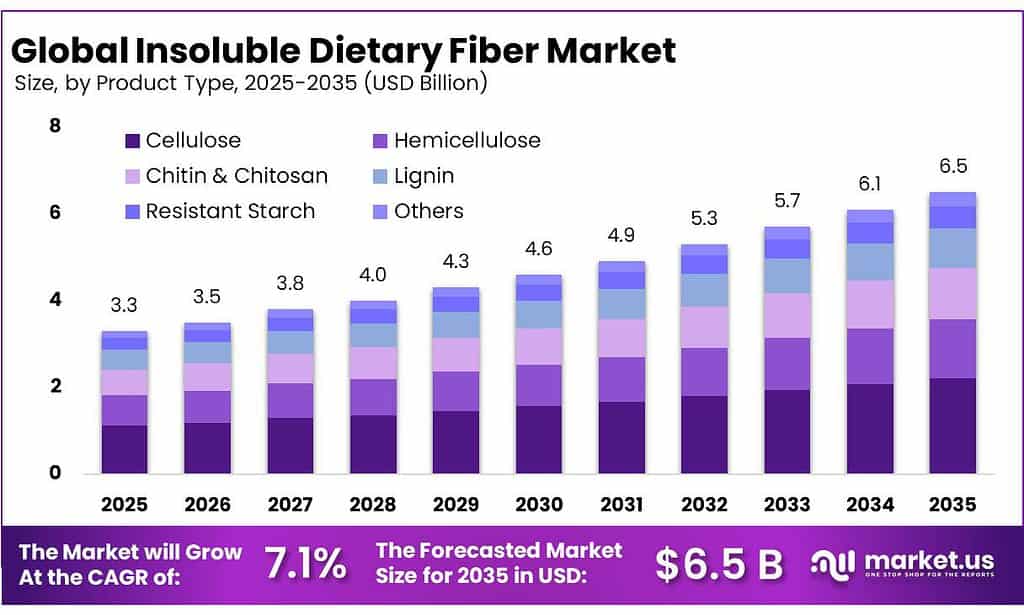
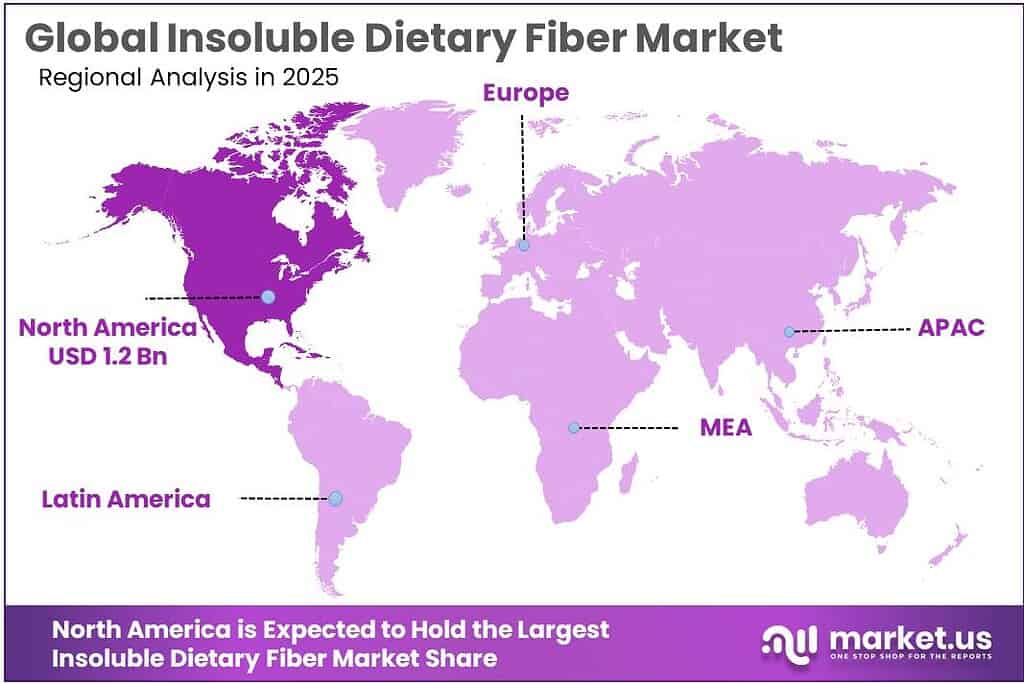
The Global Insoluble Dietary Fiber Market size is expected to be worth around USD 6.5 Billion by 2035, from USD 3.3 Billion in 2025, growing at a CAGR of 7.1% during the forecast period from 2026 to 2035. In 2025, North America held a dominant market position, capturing more than a 37.9% share, holding USD 1.2 Billion revenue.
Insoluble dietary fiber is a strategically relevant ingredient segment within the broader functional food and nutrition industry because it delivers both physiological and formulation value. From a health perspective, the category is anchored by persistent underconsumption of fiber across major markets and by formal dietary guidance from public authorities.
The World Health Organization recommends at least 25 grams of naturally occurring dietary fiber per day for adults and at least 400 grams of fruits and vegetables per day, while the U.S. FDA sets a Daily Value of 28 grams of dietary fiber on Nutrition Facts labels. In parallel, the U.S. Dietary Guidelines framework continues to treat fiber shortfall as a public health concern, and USDA analysis shows U.S. consumers averaged only 8.1 grams per 1,000 calories in 2017–2018, or just 58% of the recommended 14 grams per 1,000 calories.
From an industrial scenario standpoint, insoluble dietary fiber is increasingly positioned not only as a nutrition enhancer but also as a texturizing, water-binding and label-friendly systems ingredient. Ingredion Incorporated remains active in this space through ingredients such as citrus fibers and pulse flours; its FIBERTEX® CF citrus fibers contain more than 90% dietary fiber in the U.S., while its HOMECRAFT® pulse flours are described as naturally high in soluble and insoluble dietary fiber with 10%–20% protein on a dry basis.
The main driving factors are therefore structural rather than cyclical. First, regulatory and public-health guidance continues to encourage higher fiber intake: EFSA states that 25 grams per day is adequate for normal bowel function in adults, while WHO’s carbohydrate guidance reinforces the same 25-gram threshold. Second, front-of-pack and back-of-pack nutrition communication is making fiber more visible to shoppers, increasing the value of fiber-enriched claims in mainstream food categories.
Cargill, Incorporated is also relevant through its CitriPure® citrus fiber platform, which the company describes as an intrinsic mix of 40% soluble fiber and 60% insoluble fiber, supporting both fiber enrichment and texture enhancement. Together, these offerings show that the industry is moving toward multifunctional fibers that can support reformulation without sacrificing mouthfeel or processability.
Key Takeaways
- Insoluble Dietary Fiber Market size is expected to be worth around USD 6.5 Billion by 2035, from USD 3.3 Billion in 2025, growing at a CAGR of 7.1%.
- Cellulose held a dominant market position, capturing more than a 34.6% share.
- Cereals & Grains held a dominant market position, capturing more than a 52.8% share.
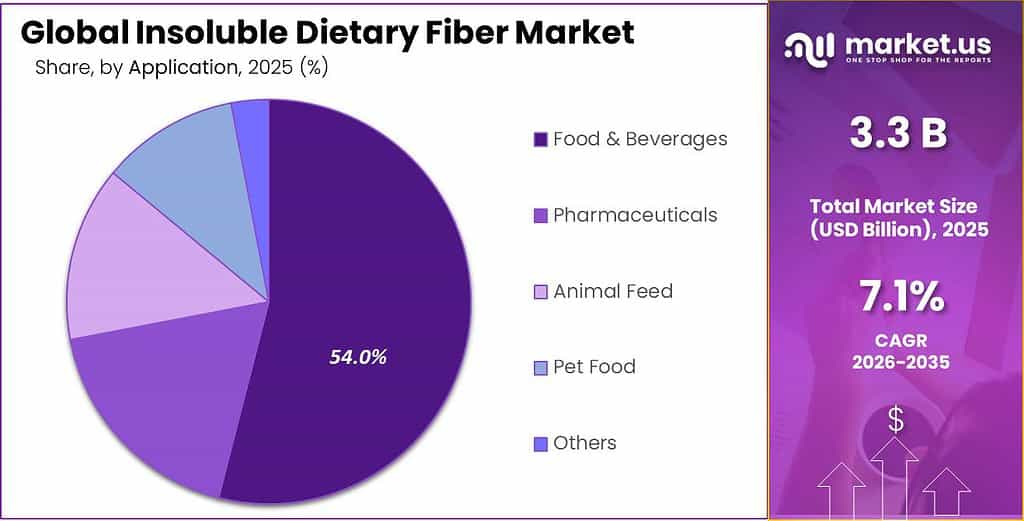
- Food & Beverages held a dominant market position, capturing more than a 54.3% share.
- North America held a dominant position in the insoluble dietary fiber market, accounting for 37.9% share and reaching a value of USD 1.2 Billion.
By Product Type Analysis
Cellulose leads the insoluble dietary fiber market with 34.6% share driven by wide usage across food applications
In 2025, Cellulose held a dominant market position, capturing more than a 34.6% share, as it continues to be one of the most widely used forms of insoluble dietary fiber in the food and beverage industry. Its strong presence is mainly due to its versatility, neutral taste, and compatibility with a wide range of formulations, especially in bakery, processed foods, and dietary products. Manufacturers prefer cellulose because it helps improve texture, adds bulk, and supports fiber enrichment without affecting flavor profiles, which is critical in consumer-accepted products.
By Source Analysis
Cereals & grains dominate with 52.8% share due to everyday consumption and easy availability
In 2025, Cereals & Grains held a dominant market position, capturing more than a 52.8% share, mainly because they are the most common and widely consumed source of insoluble dietary fiber across the world. Ingredients like wheat bran, rice bran, oats, and corn-based fibers are already part of daily diets, which makes it easier for food manufacturers to incorporate fiber without changing consumer eating habits. This strong base demand from staple foods such as bread, cereals, and baked products continues to support the segment’s leading position.
By Application Analysis
Food & beverages dominate with 54.3% share as fiber becomes part of everyday eating habits
In 2025, Food & Beverages held a dominant market position, capturing more than a 54.3% share, as insoluble dietary fiber is most commonly used in everyday food products. This segment benefits from high consumption of bakery items, breakfast cereals, snacks, and ready-to-eat meals where fiber is added to improve nutritional value.
Consumers are increasingly looking for healthier food choices, and adding fiber to regular foods allows companies to meet this demand without changing eating patterns.
Key Market Segments
By Product Type
- Cellulose
- Hemicellulose
- Chitin & Chitosan
- Lignin
- Resistant Starch
- Others
By Source
- Cereals & Grains
- Legumes
- Fruits & Vegetables
- Others
By Application
- Food & Beverages
- Pharmaceuticals.
- Animal Feed
- Pet Food
- Others
Emerging Trends
Rising “Fiber-Enriched Everyday Foods” Trend
One of the latest trends shaping the insoluble dietary fiber market is the growing shift toward adding fiber into everyday foods rather than relying on supplements. This trend is being driven by a simple reality—most people are still not getting enough fiber in their daily diets. According to global health data, adults are recommended to consume at least 25 grams of dietary fiber per day, as advised by the World Health Organization. However, actual intake remains much lower, with studies showing an average of around 17 grams per day.
Because of this gap, food companies are now focusing on adding insoluble dietary fiber into commonly consumed products like bread, cereals, snacks, and even beverages. This makes it easier for consumers to increase fiber intake without changing their eating habits too much. Instead of taking supplements, people are choosing fiber-rich versions of foods they already enjoy.
Government Support and Consumer Awareness Boosting the Trend
Government-backed dietary guidelines are also helping this trend grow. Public health bodies continue to promote whole grains, fruits, and vegetables as key sources of fiber, encouraging people to include them in daily meals. At the same time, data shows that only 20.5% of people meet the recommended fiber intake, highlighting a large opportunity for improvement
This has increased awareness among consumers, especially around digestive health and long-term wellness. People are now more conscious about reading labels and choosing products labeled as “high in fiber” or “whole grain.” As a result, brands are reformulating products to include more natural fiber sources and highlight them clearly on packaging.
Drivers
Rising Global Fiber Deficiency Driving Demand
One of the biggest factors pushing the insoluble dietary fiber market forward is the clear gap between how much fiber people should eat and how much they actually consume. Health organizations across the world, including the World Health Organization (WHO) and FAO, recommend that adults consume at least 25 grams of dietary fiber per day to maintain proper digestive health and reduce disease risks.
However, real-world intake levels are much lower in many regions. Studies show that average daily fiber intake is around 17 grams per day, which is significantly below recommended levels. In some populations, intake is only about 78% of the required amount, and only 20.5% of people actually meet the recommended fiber intake.
Strong Health Awareness and Preventive Nutrition Trends
Another major driver is the growing awareness of preventive healthcare and the role of diet in long-term wellness. Research shows that increasing fiber intake from 20 grams to 35 grams per day can reduce premature mortality risk by 10% to 48%, highlighting the strong health benefits associated with fiber consumption. This has made fiber, including insoluble dietary fiber, a key focus area in modern diets.
Consumers are now more aware of digestive health, gut balance, and weight management, and they are actively looking for foods that support these needs. This shift has encouraged food producers to add insoluble fiber into commonly consumed items like bread, cereals, snacks, and ready-to-eat meals. Instead of relying on supplements, people prefer getting fiber from regular foods, which has further strengthened demand in the food industry.
Restraints
Digestive Discomfort and Consumer Hesitation Limiting Fiber Intake
One of the key challenges holding back the wider adoption of insoluble dietary fiber is the discomfort some consumers experience when increasing fiber intake too quickly. While fiber is widely recommended for better digestion, health organizations also warn that sudden high intake can lead to bloating, gas, and abdominal discomfort.
Data from trusted sources also shows that while fiber is essential, tolerance levels vary. The World Health Organization recommends at least 25 grams of fiber per day, but many individuals struggle to reach this level comfortably. In fact, research indicates that average intake remains around 17 grams per day, showing a gap partly influenced by digestive concerns.
Product Formulation and Taste Challenges
From an industry perspective, incorporating insoluble dietary fiber into food products is not always easy. Unlike soluble fiber, insoluble fiber can affect texture, making products feel dry, gritty, or less appealing if not formulated carefully. This is especially important in categories like bakery, snacks, and beverages where taste and mouthfeel are critical for repeat purchases. Food manufacturers often need to balance fiber enrichment with sensory quality, which can increase production complexity and costs.
Government-backed dietary guidelines continue to encourage higher fiber intake, but they also emphasize gradual consumption. For example, the U.S. Department of Agriculture advises increasing fiber slowly to avoid discomfort, highlighting a practical limitation in consumer adoption.
Opportunity
Expanding Functional Food Industry Creating Strong Growth Opportunity
One of the biggest growth opportunities for insoluble dietary fiber lies in the rapid expansion of the functional food and health-focused product segment. Consumers today are not just eating for taste—they are looking for foods that offer clear health benefits. This shift is strongly supported by global nutrition recommendations. The World Health Organization advises adults to consume at least 25 grams of dietary fiber per day along with 400 grams of fruits and vegetables daily to support overall health
This gap between recommended and actual intake is creating a clear opportunity for food manufacturers. Instead of relying on supplements, consumers are increasingly choosing fiber-rich foods such as cereals, snacks, and bakery items. Insoluble dietary fiber fits well into this trend because it can be easily added to everyday products without changing taste significantly.
Government Push and Preventive Health Trends Supporting Growth
Government and public health initiatives are also playing an important role in creating growth opportunities. Many countries are promoting whole grains, fruits, and vegetables as part of daily diets to reduce the burden of chronic diseases. According to data supported by global health studies, only about 20.5% of people meet the recommended fiber intake, highlighting a large untapped demand
At the same time, research continues to highlight the health benefits of fiber. Diets rich in fiber have been linked to a reduced risk of major conditions such as cardiovascular diseases, obesity, and diabetes. This growing awareness is influencing both consumers and food companies. Brands are now positioning fiber as a key ingredient in “better-for-you” products, especially in ready-to-eat and convenience food categories.
Regional Insights
North America dominates with 37.9% share valued at USD 1.2 Billion driven by strong health awareness
North America held a dominant position in the insoluble dietary fiber market, accounting for 37.9% share and reaching a value of USD 1.2 Billion, supported by strong consumer awareness and a well-established functional food industry. The region, particularly the United States, has seen a consistent rise in demand for fiber-enriched foods due to increasing concerns around digestive health, obesity, and chronic diseases. Government-backed dietary guidelines in the U.S. continue to highlight fiber as a “nutrient of concern,” encouraging higher intake through whole grains and plant-based foods.
A key factor supporting this dominance is the large gap between recommended and actual fiber intake. Studies show that the average dietary fiber intake in the U.S. is around 15–16 grams per day, which is significantly below the recommended 25–30 grams per day. This shortfall has pushed both policymakers and food companies to focus on fiber fortification in everyday food products. Additionally, U.S. dietary data indicates that fiber consumption is only about 58% of the recommended level, reinforcing the need for increased intake through processed and packaged foods
Key Regions and Countries Insights
- North America
- US
- Canada
- Europe
- Germany
- France
- The UK
- Spain
- Italy
- Rest of Europe
- Asia Pacific
- China
- Japan
- South Korea
- India
- Australia
- Rest of APAC
- Latin America
- Brazil
- Mexico
- Rest of Latin America
- Middle East & Africa
- GCC
- South Africa
- Rest of MEA
Key Players Analysis
Ingredion Incorporated continues to play a strong role in the insoluble dietary fiber market through its focus on plant-based and functional ingredients. The company operates in more than 120 countries and supports over 19,000 customers, showing its wide global reach. In 2025, Ingredion emphasized fiber-rich product innovation, including formulations with up to 85% less sugar while maintaining texture and taste. Its investment in clean-label solutions and fiber fortification helps meet rising demand, especially in bakery and snack applications, where fiber inclusion is steadily increasing.
Cargill, Incorporated is a major player with operations in over 70 countries and a workforce of around 160,000 employees, supporting large-scale fiber production and supply. Its CitriPure® citrus fiber contains about 60% insoluble fiber, making it suitable for multiple food applications. In 2025, Cargill highlighted that 63% of consumers are actively trying to improve digestive health, which aligns with its fiber-focused product strategy.
Top Key Players Outlook
- Ingredion Incorporated
- Cargill, Incorporated
- Roquette Frères
- Tate & Lyle PLC
- ADM (Archer Daniels Midland Company)
- DuPont de Nemours, Inc.
- J. Rettenmaier & Söhne GmbH + Co KG
- Kerry Group
- BENEO
- SunOpta Inc.
Recent Industry Developments
In 2025, Ingredion Incorporated reported total net sales of around USD 7.2 Billion, showing its solid scale in the global ingredient market.
In 2025 Cargill, Incorporated, reported total revenue of approximately USD 154 Billion, reflecting its position as one of the largest global food and agriculture companies.
Report Scope
| Report Features | Description |
|---|---|
| Market Value (2025) | USD 3.3 Bn |
| Forecast Revenue (2035) | USD 6.5 Bn |
| CAGR (2026-2035) | 7.1% |
| Base Year for Estimation | 2025 |
| Historic Period | 2020-2024 |
| Forecast Period | 2026-2035 |
| Report Coverage | Revenue Forecast, Market Dynamics, Competitive Landscape, Recent Developments |
| Segments Covered | By Product Type (Cellulose, Hemicellulose, Chitin And Chitosan, Lignin, Resistant Starch, Others), By Source (Cereals And Grains, Legumes, Fruits And Vegetables, Others), By Application (Food And Beverages, Pharmaceuticals., Animal Feed, Pet Food, Others) |
| Regional Analysis | North America – US, Canada; Europe – Germany, France, The UK, Spain, Italy, Rest of Europe; Asia Pacific – China, Japan, South Korea, India, Australia, Singapore, Rest of APAC; Latin America – Brazil, Mexico, Rest of Latin America; Middle East & Africa – GCC, South Africa, Rest of MEA |
| Competitive Landscape | Ingredion Incorporated, Cargill, Incorporated, Roquette Frères, Tate & Lyle PLC, ADM (Archer Daniels Midland Company), DuPont de Nemours, Inc., J. Rettenmaier & Söhne GmbH + Co KG, Kerry Group, BENEO, SunOpta Inc. |
| Customization Scope | Customization for segments, region/country-level will be provided. Moreover, additional customization can be done based on the requirements. |
| Purchase Options | We have three licenses to opt for: Single User License, Multi-User License (Up to 5 Users), Corporate Use License (Unlimited User and Printable PDF) |





































