


Market Overview
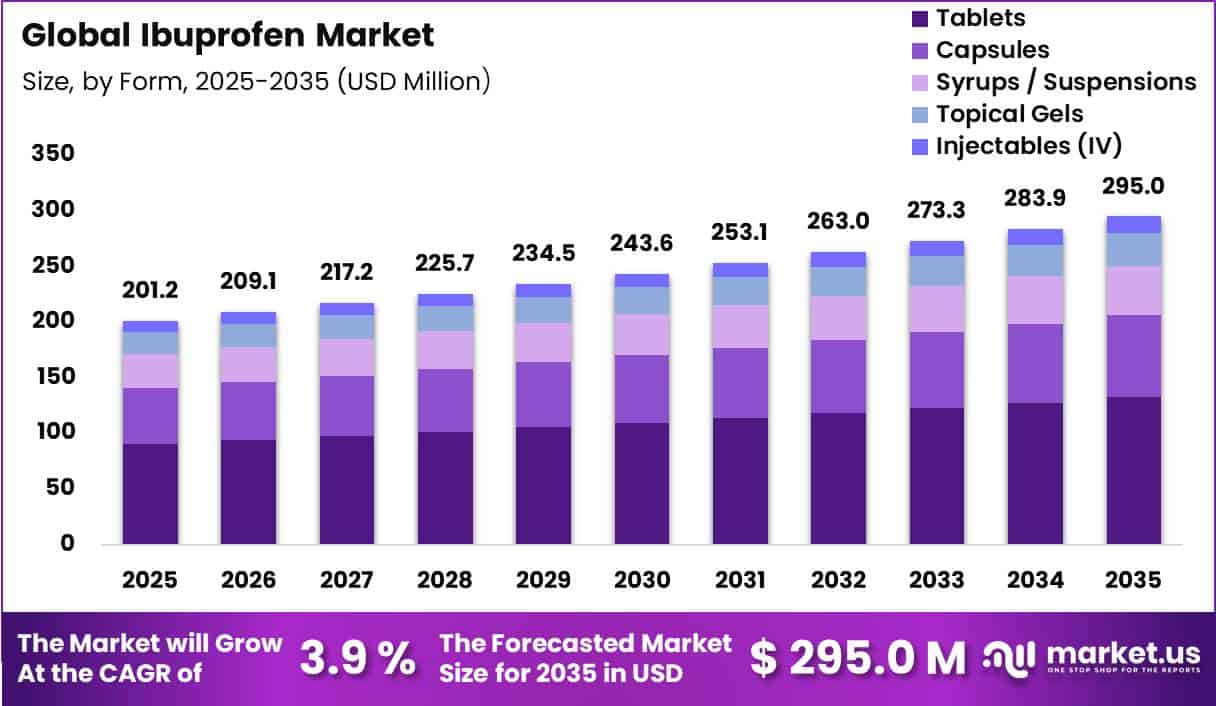
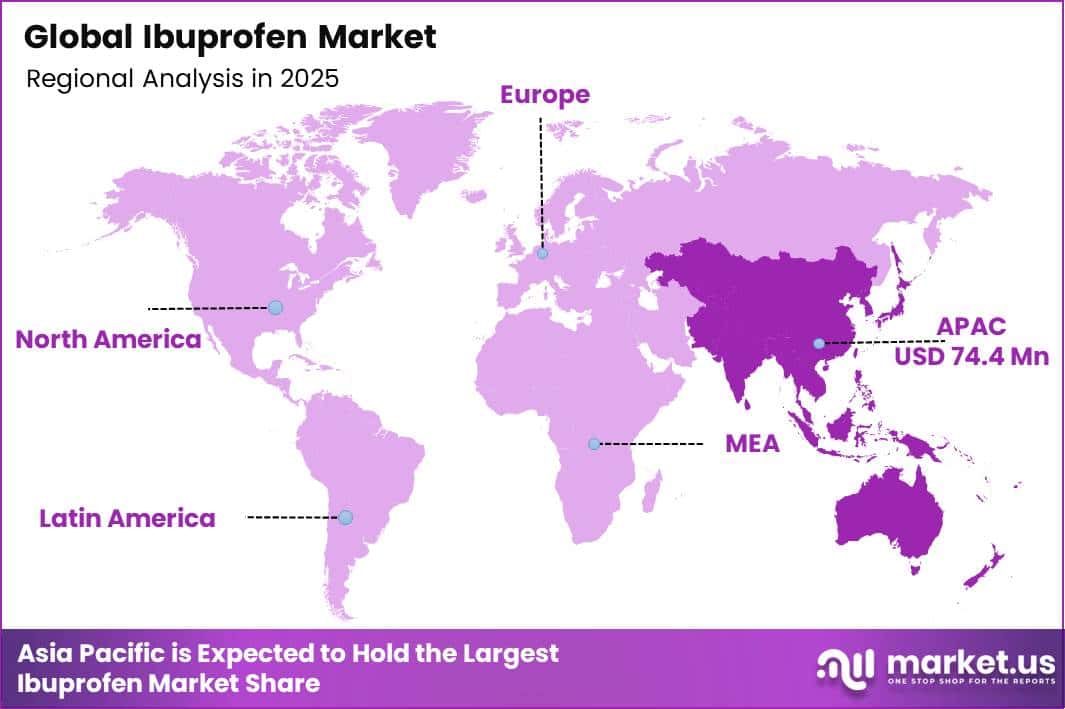
Global Ibuprofen Market size is expected to be worth around US$ 295.0 Million by 2035 from US$ 201.2 Million in 2025, growing at a CAGR of 3.9% during the forecast period from 2026 to 2035. In 2025, Asia Pacific led the market, achieving over 37.0% share with a revenue of US$ 74.4 Million.
The global ibuprofen market continues to grow as demand for safe and effective pain relief, fever reduction, and anti-inflammatory medicines increases across hospitals, clinics, pharmacies, and home healthcare settings. Ibuprofen is a widely used nonsteroidal anti-inflammatory drug (NSAID) available in both prescription and over-the-counter (OTC) formulations.
The U.S. Food and Drug Administration (FDA) states that OTC ibuprofen is approved for the temporary relief of minor aches, pains, and fever, while higher-strength prescription products are used under medical supervision.
The growing prevalence of musculoskeletal disorders, headaches, arthritis, sports injuries, and seasonal illnesses continues to support demand for ibuprofen worldwide. According to the U.S. National Library of Medicine (NCBI), more than 17 million ibuprofen prescriptions are filled annually in the United States, in addition to extensive OTC use, highlighting its broad role in pain management.
Ibuprofen is also included on the World Health Organization (WHO) Model List of Essential Medicines for specific indications, reflecting its established clinical effectiveness, affordability, and widespread global availability. WHO expert reviews continue to support its use when taken according to recommended dosing guidelines.
Manufacturers are investing in pediatric formulations, combination therapies, improved oral dosage forms, and patient-friendly packaging to enhance treatment adherence. At the same time, regulatory agencies continue to emphasize responsible use.
The FDA advises consumers to follow labeled dosing instructions carefully, noting that inappropriate or prolonged NSAID use may increase the risk of gastrointestinal bleeding, cardiovascular events, kidney injury, and pregnancy-related complications. These ongoing safety initiatives and continued pharmaceutical innovation are expected to support the long-term development of the global ibuprofen market.
Key Takeaways
- Market Size: Global Ibuprofen Market size is expected to be worth around US$ 295.0 Million by 2035 from US$ 201.2 Million in 2025.
- Market Share: The market is growing at a CAGR of 3.9% during the forecast period from 2026 to 2035.
- Form: The tablets segment dominated the ibuprofen market in 2025, accounting for 45.0% of the total market share.
- API Grade: The standard/regular ibuprofen segment held the largest market share of 69.0% in 2025, making it the dominant API grade in the global ibuprofen market.
- Application: The pain relief segment dominated the ibuprofen market in 2025, capturing 55.0% of the total market share.
- End User: The retail pharmacies/OTC segment accounted for the largest share of the ibuprofen market in 2025, representing 48.0% of total revenue.
- Sales Channel: The retail/OTC sales channel dominated the ibuprofen market in 2025, accounting for 45.0% of the total market share.
- Regional Analysis: In 2025, Asia Pacific led the market, achieving over 37.0% share with a revenue of US$ 74.4 Million.
Form Analysis
Tablets segment dominated the ibuprofen market in 2025.
The tablets segment dominated the ibuprofen market in 2025, accounting for 45.0% of the total market share. Tablets remain the preferred dosage form because they offer accurate dosing, long shelf life, affordability, and convenient storage.
They are widely prescribed for managing mild to moderate pain, fever, and inflammation across hospitals, clinics, and retail pharmacies. Their large-scale manufacturing capability and availability in both prescription and over-the-counter (OTC) formats further strengthen market demand. Tablets are also offered in immediate-release and sustained-release formulations, improving patient compliance for different treatment needs.
The capsules segment represented 25.0% of the market, driven by faster dissolution and improved swallowing comfort. Syrups and suspensions accounted for 15.0%, supported by strong demand among pediatric and geriatric patients who have difficulty swallowing solid medicines.
Topical gels captured 10.0% of the market as consumers increasingly prefer localized pain relief for muscle injuries, arthritis, and sports-related conditions while minimizing systemic side effects. The injectables (IV) segment held 5.0% market share, mainly used in hospital settings for postoperative pain management and patients unable to take oral medications.
Continuous innovation in dosage formulations and patient-focused drug delivery systems is expected to support balanced growth across all form segments.
API Grade Analysis
Standard/regular ibuprofen segment held the largest market share.
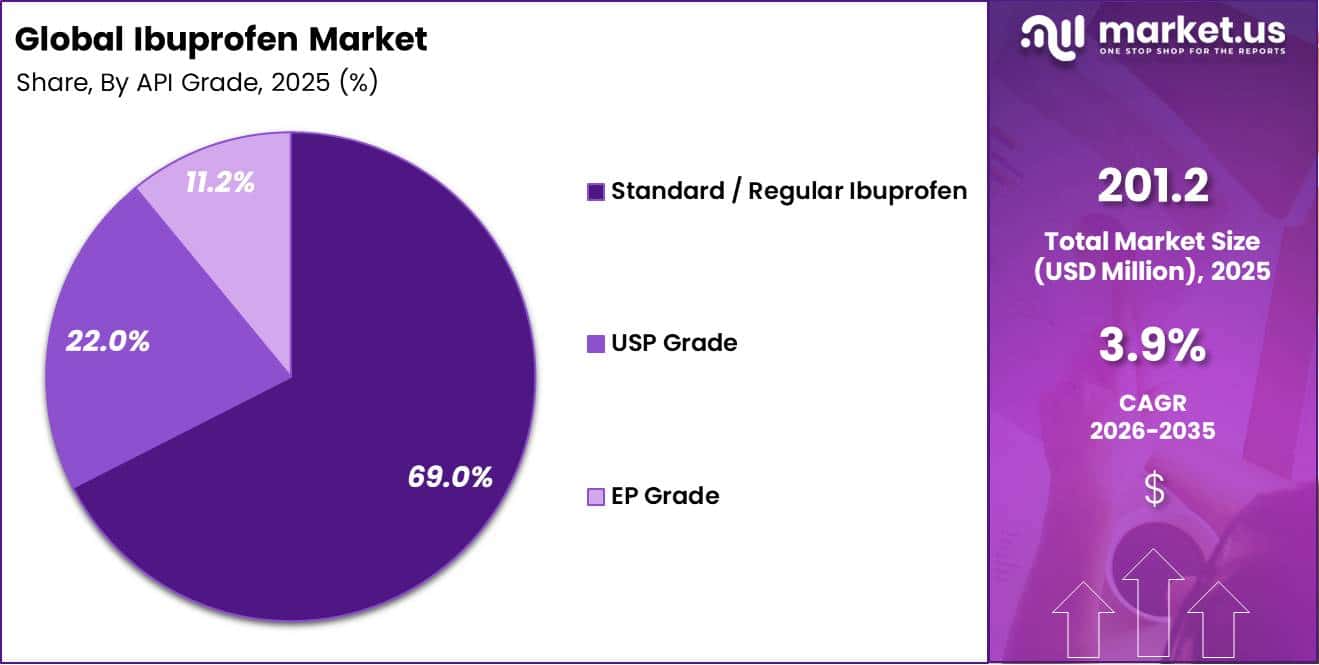
The standard/regular ibuprofen segment held the largest market share of 69.0% in 2025, making it the dominant API grade in the global ibuprofen market. This grade is extensively utilized in the production of conventional tablets, capsules, suspensions, and topical formulations due to its cost-effectiveness and suitability for high-volume pharmaceutical manufacturing.
Manufacturers favor standard-grade ibuprofen because it meets broad commercial requirements while supporting the production of both prescription and OTC medicines. Strong global demand for affordable pain relief medications continues to reinforce the leadership of this segment.
The USP grade segment accounted for 22.0% of the market, driven by pharmaceutical manufacturers supplying products that comply with the quality specifications of the United States Pharmacopeia. This grade is widely preferred for regulated pharmaceutical markets requiring stringent purity and quality standards.
Meanwhile, the EP grade represented 11.0% of the market and is primarily used by manufacturers serving European pharmaceutical markets that follow European Pharmacopoeia standards. Increasing regulatory compliance, global pharmaceutical exports, and expanding contract manufacturing activities are supporting demand for pharmacopeia-grade ibuprofen.
As international quality standards become increasingly harmonized, manufacturers continue investing in high-purity API production while maintaining strong demand for standard-grade products.
Application Analysis
Pain relief segment dominated the ibuprofen market in 2025.
The pain relief segment dominated the ibuprofen market in 2025, capturing 55.0% of the total market share. Ibuprofen remains one of the most widely used nonsteroidal anti-inflammatory drugs (NSAIDs) for treating headaches, dental pain, menstrual cramps, muscle pain, joint discomfort, and postoperative pain.
Its proven efficacy, rapid onset of action, and broad availability in both prescription and OTC products have made pain management the largest application area. Rising cases of musculoskeletal disorders, sports injuries, and age-related chronic pain continue to support consistent demand worldwide.
The anti-inflammatory segment represents another significant application, supported by increasing treatment of arthritis, tendon injuries, and inflammatory disorders requiring long-term symptom control. The fever reduction segment continues to experience stable demand as ibuprofen is widely recommended for reducing fever associated with viral and bacterial infections in both adults and children.
The others category, including veterinary applications and specialized pharmaceutical uses, contributes a smaller but steadily expanding share of the market. Continuous product innovation, broader healthcare access, and growing consumer preference for effective OTC pain management solutions are expected to strengthen demand across all application segments while maintaining the dominance of pain relief throughout the forecast period.
End User Analysis
Retail pharmacies/OTC segment accounted for the largest share of the ibuprofen market in 2025.
The retail pharmacies/OTC segment accounted for the largest share of the ibuprofen market in 2025, representing 48.0% of total revenue. Consumer preference for self-medication, easy product accessibility, and the widespread availability of OTC ibuprofen products continue to drive this segment.
Retail pharmacies remain the primary distribution point for tablets, capsules, topical gels, and pediatric formulations, allowing consumers to manage common pain, fever, and inflammation without hospital visits. Growing healthcare awareness and expanding pharmacy networks further support the segment’s market leadership.
The hospitals segment remains an important end user due to frequent use of ibuprofen for postoperative pain management, fever control, and inpatient care. Drug manufacturers also represent a substantial market segment, purchasing ibuprofen active pharmaceutical ingredients (APIs) for the production of branded and generic medicines supplied to global healthcare markets.
The others category, including clinics and research institutions, contributes additional market demand through specialized medical treatments and pharmaceutical development activities. Increasing production of generic medicines, expanding healthcare infrastructure, and rising consumption of OTC analgesics continue to strengthen demand across all end-user categories while reinforcing the dominant position of retail pharmacies in the global ibuprofen market.
Sales Channel Analysis
Retail/OTC sales channel dominated the ibuprofen market in 2025.
The retail/OTC sales channel dominated the ibuprofen market in 2025, accounting for 45.0% of the total market share. Strong consumer preference for convenient access to pain relief medications, expanding pharmacy networks, and widespread availability of non-prescription ibuprofen products continue to support this segment.
Retail outlets remain the primary purchasing destination for tablets, capsules, syrups, and topical gels, particularly for treating common headaches, fever, muscle pain, and minor inflammatory conditions. Increasing awareness of self-care and the growing availability of affordable generic brands further strengthen retail sales.
The distributors and wholesalers segment plays a critical role by supplying pharmaceutical products to hospitals, pharmacies, and healthcare institutions, ensuring efficient inventory management and broad market coverage.
Direct sales (B2B API) continue to expand as pharmaceutical manufacturers procure ibuprofen active pharmaceutical ingredients directly from API producers for large-scale medicine production. Online pharmacies are experiencing steady growth due to increasing digital healthcare adoption, home delivery services, and greater consumer convenience.
The others category includes institutional procurement and specialized healthcare distribution channels serving clinics and government healthcare programs. Continued expansion of pharmaceutical supply chains, e-commerce healthcare platforms, and global generic drug manufacturing is expected to support balanced growth across all sales channels while maintaining the leadership of the retail/OTC segment.
Key Market Segments
By Form
- Tablets
- Capsules
- Syrups / Suspensions
- Topical Gels
- Injectables (IV)
By API Grade
- Standard / Regular Ibuprofen
- USP Grade
- EP Grade
By Application
- Pain Relief
- Anti-inflammatory
- Fever Reduction
- Others (Veterinary, etc.)
By End User
- Retail Pharmacies / OTC
- Hospitals
- Drug Manufacturers
- Others (Clinics, Research)
By Sales Channel
- Retail / OTC
- Distributors / Wholesalers
- Direct Sales (B2B API)
- Online Pharmacies
- Others
Drivers
Patient Safety Automation in Medication and Transport Workflows.
Patient safety remains a major global healthcare challenge, with WHO estimating that about 1 in 10 hospitalized patients experience harm, and over half of these events are considered preventable. This elevates internal hospital logistics such as medication delivery, specimen transport, and patient movement to critical safety infrastructure rather than purely operational support functions.
The Joint Commission’s 2026 shift toward National Performance Goals reinforces this focus, emphasizing patient identification, communication accuracy, medication safety, and reduction of preventable harm. These requirements increasingly favor automated systems that integrate robotics with barcode scanning, smart medication cabinets, elevator systems, and centralized dispatch platforms.
Unlike traditional porter based workflows, automated transport systems improve traceability, reduce handoff errors, and standardize delivery times, which helps minimize variability in high risk environments like medication administration and lab specimen handling.
From a market perspective, the value proposition extends beyond labor efficiency to include reduced medical errors, improved compliance, and stronger audit readiness. This positions automation vendors to benefit most in North America and Europe, where safety regulations and performance reporting requirements are more stringent and consistently enforced.
| Driver | (~) % Impact on CAGR Forecast | Geographic Relevance | Impact Timeline |
|---|---|---|---|
| Patient-safety automation in medication and transport workflows | +2.4% | North America core, EU, Japan, South Korea, GCC tertiary hubs | Short term (≤ 2 years) |
| Hospital labor scarcity and task-shifting economics | +2.1% | North America core, EU, APAC metros, Australia | Short term (≤ 2 years) |
| Connected-device regulation and cyber-compliant procurement | +1.5% | U.S. core, EU, UK, advanced APAC | Medium term (2-4 years) |
| Reimbursement and margin pressure driving nonclinical productivity | +1.7% | U.S. core, Western Europe, developed APAC | Medium term (2-4 years) |
| Supply-chain resilience and inventory visibility digitization | +1.3% | U.S., EU, Japan, Singapore, Middle East flagship hospitals | Medium term (2-4 years) |
| AI-enabled hospital operations and fleet orchestration maturity | +1.9% | U.S., China, EU, South Korea, Singapore | Long term (≥ 4 years) |
Challenges
Complex Intra Hospital Integration in Logistics Robotics.
Hospital logistics robots must operate across 20–40 distinct workflows, including medication delivery, lab sample transport, linen handling, meal distribution, and sterile supply movement. Each workflow has unique timing, access control, and safety requirements, requiring deep integration with elevator systems, door controls, pharmacy automation, and EHR linked inventory platforms.
In early deployments, integration timelines often extend 6–12 months beyond initial expectations. Around 15–25% of robot missions face exceptions such as blocked corridors, access errors in automated dispensing systems, or conflicting priority rules, reducing effective utilization from a target of 18–20 hours per day to about 11–14 hours.
This limits fleet scalability within a single hospital to roughly 30–40 units in many cases. These challenges add 3–5% to total project costs and require significant ongoing supervision, often 50–80 additional staff hours per week.
As a result, expected cost savings per robot can be reduced by 8–12% in early years, delaying broader rollout decisions. Overall, integration complexity remains a key barrier to scale, slowing adoption until systems achieve consistently high mission success rates and standardized interoperability across hospital infrastructure.
| Challenge | (~) % CAGR Friction Drag | Geographic Relevance | Mitigation Horizon |
|---|---|---|---|
| Complex intra-hospital integration | -1.4% | North America core, EU hospital hubs, advanced APAC | Medium term (2-4 years) |
| Elevator and corridor congestion | -0.8% | Dense urban hospitals globally | Medium term (2-4 years) |
| Robust cybersecurity & data compliance | -1.1% | US, EU, high-digitization Asia | Long term (≥ 4 years) |
| Workforce adoption & process redesign | -1.3% | Global tertiary hospitals | Medium term (2-4 years) |
| Capital efficiency under reimbursement uncertainty | -1.6% | US, EU, selected emerging markets | Long term (≥ 4 years) |
| Multi-vendor interoperability & uptime | -1.0% | Large multi-site health systems | Medium term (2-4 years) |
Restraints
High Upfront CapEx and Slow ROI in Hospital Logistics Robotics.
Hospital logistics robotics adoption is constrained by high initial capital requirements and slower than expected payback periods.
Typical deployments of 10–20 autonomous mobile robots require upfront investments of around USD 1.5–3.0 million, plus ongoing annual service and software costs of 15–20%, along with additional IT integration expenses.These projects compete directly with other high priority hospital investments such as imaging systems, ICU expansion, and EHR upgrades.
As a result, capital committees often require payback within 24–36 months, while real world productivity gains such as 12–18% improvements in materials handling and 10–15% nursing time reallocation tend to translate into ROI timelines of 4–6 years once full workflow redesign and maintenance are included.
To address this mismatch, vendors are increasingly offering robotics as a service models with monthly fees per site, but hospitals still view these as semi fixed operational costs, especially when efficiency gains are partially offset by new coordination and IT oversight roles.
Overall, this cost and payback gap slows adoption decisions, extends sales cycles, and defers some deployments, reducing near term market growth momentum in hospital logistics robotics.
| Restraint | (~) % Impact on CAGR Forecast | Geographic Relevance | Impact Timeline |
|---|---|---|---|
| High upfront CapEx & slow ROI | -2.5% | North America core, EU, APAC tier-1 | Medium term (2-4 years) |
| Regulatory and classification friction for medical robots | -1.8% | North America, EU, China, India | Medium term (2-4 years) |
| Cybersecurity, data protection & interoperability gaps | -1.5% | North America core, EU, APAC corridors | Long term (≥ 4 years) |
| Skilled workforce and change-management bottlenecks | -1.4% | Global, stronger in LATAM, MEA, APAC tier-2 | Medium term (2-4 years) |
| Supply chain volatility for robotic components | -1.7% | EU, North America, APAC manufacturing hubs | Short–Medium term (≤ 4 years) |
| Hospital infrastructure & reimbursement misalignment | -2.1% | North America, EU, emerging Asia | Long term (≥ 4 years) |
Opportunity
Integrated Medication–Lab–Supply AMR Platforms in Hospitals.
This opportunity centers on unified autonomous mobile robot (AMR) platforms that combine medication delivery, lab specimen transport, and general supply logistics into a single orchestration layer integrated with hospital IT systems.
Today’s deployments are typically siloed by function pharmacy, lab, or supplies delivering 15–22% logistics cost reduction and 20–30% improvements in delivery efficiency, but still leaving 30–40% of material movement dependent on manual processes.
An integrated platform could significantly expand value by coordinating all intra hospital logistics through a single system, improving utilization and reducing duplication. For a typical 500 bed hospital, this could generate an additional USD 1.5–2.0 million annually through software licensing, fleet management, and performance based contracts, driven by incremental labor savings equivalent to several full time staff positions.
At broader scale, if 15–20% of hospitals in North America and Europe adopt integrated AMR systems by 2030, the segment could add USD 3–4 billion in incremental market value. This shift also moves vendors from hardware centric models toward higher margin software and orchestration platforms.
Overall, this represents a next phase evolution of hospital robotics, but remains an emerging opportunity because most systems today still operate in isolated workflows with limited interoperability and shallow integration into hospital wide data systems.
| Opportunity | (~) % Potential CAGR Upside | Geographic Relevance | Execution Window |
|---|---|---|---|
| Integrated meds–lab–supply AMR platforms | +2.0% | North America core, EU | Medium term (2-4 years) |
| Outsourced “Robotics-as-a-Service” hospital logistics | +1.5% | North America, EU, APAC emerging markets | Short term (≤ 2 years) |
| AI-optimized clinical logistics tied to LOS & adverse events KPIs | +1.3% | North America, EU, GCC | Medium term (2-4 years) |
| Pharmacy & therapeutics cold-chain automation inside hospitals | +1.0% | North America, EU, East Asia | Long term (≥ 4 years) |
| Multi-hospital robotic logistics networks & M&A roll-ups | +1.2% | North America, EU | Long term (≥ 4 years) |
| Infection-control & biohazard waste robotics for regulatory compliance | +0.8% | North America, EU, APAC | Medium term (2-4 years) |
Regional Analysis
In 2025, Asia Pacific emerged as the leading region in the Global Ibuprofen Market.
Asia Pacific emerged as the leading region in the global Ibuprofen Market in 2025, capturing more than 37.0% of the market and generating approximately US$ 74.4 million in revenue. The region’s dominance is driven by its large population base, increasing prevalence of pain, fever, arthritis, and inflammatory conditions, along with expanding healthcare access.
Countries such as China, India, Japan, and South Korea account for significant demand due to growing use of over-the-counter (OTC) pain relief medications and improved healthcare awareness. Rising healthcare expenditure, urbanization, and an aging population continue to support the steady consumption of ibuprofen across both developed and emerging economies.
The region also benefits from a strong pharmaceutical manufacturing ecosystem, particularly in the production of generic medicines and active pharmaceutical ingredients (APIs). Competitive manufacturing costs, well-established supply chains, and expanding pharmaceutical exports have strengthened Asia Pacific’s position in the global market.
In addition, government efforts to improve healthcare infrastructure, broader pharmacy distribution networks, and increasing investment in pharmaceutical production continue to support market expansion. These factors, combined with sustained demand for affordable and effective pain management therapies, are expected to help Asia Pacific maintain its market leadership throughout the forecast period.
Key Regions and Countries
North America
- The US
- Canada
Europe
- Germany
- France
- The U.K.
- Italy
- Spain
- Russia & CIS
- Rest of Europe
Asia Pacific
- China
- India
- Japan
- South Korea
- ASEAN
- Australia & New Zealand
- Rest of Asia Pacific
Middle East & Africa
- GCC
- South Africa
- Rest of Middle East & Africa
Latin America
- Brazil
- Mexico
- Rest of Latin America
Key Player Analysis
The Ibuprofen Market is moderately fragmented, with competition driven by a mix of global active pharmaceutical ingredient (API) manufacturers, formulation companies, and regional pharmaceutical suppliers.
Market participants compete on manufacturing efficiency, product quality, regulatory compliance, pricing, and supply reliability while expanding their presence across both prescription and over-the-counter (OTC) segments.
Innovation is increasingly focused on improving API production processes, ensuring consistent product quality, strengthening sustainable manufacturing practices, and developing differentiated dosage forms. Companies also emphasize expanding global distribution networks and securing long-term supply agreements to enhance market competitiveness.
Leading participants include BASF SE, IOL Chemicals and Pharmaceuticals Ltd. (IOLCP), SI Group, Strides Shasun (Strides Pharma Science), and Xinhua Pharmaceutical, all of which invest in research and development to improve production efficiency, regulatory compliance, and manufacturing capacity.
Granules India Ltd. (Biocause), Hebei Jiheng Pharmaceutical Co., Ltd., Hisoar (Zhejiang Hisoar Pharmaceutical), Solara Active Pharma Sciences, and Cumberland Pharmaceuticals Inc. focus on expanding API capabilities, strengthening global supply chains, and introducing high-quality pharmaceutical formulations.
Meanwhile, Alveda Pharmaceuticals Inc., CSL Limited, Sumitomo Chemical Co., Ltd., Xinhua-Perrigo Pharmaceutical, and Germin MED continue to enhance their market positions through strategic partnerships, product portfolio expansion, advanced manufacturing technologies, and integrated pharmaceutical workflows.
Collectively, these companies compete through ecosystem-based strategies that combine R&D, production optimization, regulatory expertise, and collaborative partnerships to strengthen global market reach, while Others contribute by serving regional markets and niche customer requirements.
Top Key Players
- BASF SE
- IOL Chemicals and Pharmaceuticals Ltd. (IOLCP)
- SI Group
- Strides Shasun (Strides Pharma Science)
- Xinhua Pharmaceutical
- Granules India Ltd. (Biocause)
- Hebei Jiheng Pharmaceutical Co., Ltd.
- Hisoar (Zhejiang Hisoar Pharmaceutical)
- Solara Active Pharma Sciences
- Cumberland Pharmaceuticals Inc.
- Alveda Pharmaceuticals Inc.
- CSL Limited
- Sumitomo Chemical Co., Ltd.
- Xinhua-Perrigo Pharmaceutical
- Germin MED
- Others
Recent Developments
- In June 2026, Granules India Ltd. announced that it had secured a sole first-to-file opportunity for a U.S. generic product while continuing to strengthen its global formulation portfolio. The development reflects the company’s strategy of expanding high-value pharmaceutical offerings and reinforcing its long-term manufacturing capabilities, which also support its broader API business, including pain management products.
- In February 2026, Solara Active Pharma Sciences announced that it had appointed strategic advisors to evaluate options for its ibuprofen business while converting its Vizag facility into a multipurpose manufacturing plant. The move represents a portfolio optimization strategy designed to improve operational efficiency and increase focus on higher-margin API products.
- In October 2025, Cumberland Pharmaceuticals Inc. announced that its ibuprofen injection received regulatory approval in Mexico. The approval follows the company’s commercialization agreement with PiSA Farmacéutica, supporting the expansion of its injectable pain management portfolio across the Latin American market.
- In June 2025, Xinhua Pharmaceutical received approval from China’s National Medical Products Administration (NMPA) for the marketing of its Ibuprofen Arginine API. The approval broadens the company’s ibuprofen product portfolio and strengthens its position in the anti-inflammatory and analgesic API market.
Report Scope
| Report Features | Description |
|---|---|
| Market Value (2025) | US$ 201.2 Million |
| Forecast Revenue (2035) | US$ 295.0 Million |
| CAGR (2026-2035) | 3.9% |
| Base Year for Estimation | 2025 |
| Historic Period | 2020-2024 |
| Forecast Period | 2026-2035 |
| Report Coverage | Revenue Forecast, Market Dynamics, Competitive Landscape, Recent Developments |
| Segments Covered | By Form (Tablets, Capsules, Syrups / Suspensions, Topical Gels, Injectables (IV)), By API Grade (Standard / Regular Ibuprofen, USP Grade, EP Grade), By Application (Pain Relief, Anti-inflammatory, Fever Reduction, Others (Veterinary, etc.)), By End User (Retail Pharmacies / OTC, Hospitals, Drug Manufacturers, Others (Clinics, Research)), By Sales Channel (Retail / OTC, Distributors / Wholesalers, Direct Sales (B2B API), Online Pharmacies, Others) |
| Regional Analysis | North America – The US, Canada; Europe – Germany, France, U.K., Italy, Spain, Russia & CIS, Rest of Europe; Asia Pacific – China, India, Japan, South Korea, ASEAN, Australia & New Zealand, Rest of Asia Pacific; Middle East & Africa – GCC, South Africa, Rest of Middle East & Africa; Latin America – Brazil, Mexico, Rest of Latin America |
| Competitive Landscape | BASF SE, IOL Chemicals and Pharmaceuticals Ltd. (IOLCP), SI Group, Strides Shasun (Strides Pharma Science), Xinhua Pharmaceutical, Granules India Ltd. (Biocause), Hebei Jiheng Pharmaceutical Co., Ltd., Hisoar (Zhejiang Hisoar Pharmaceutical), Solara Active Pharma Sciences, Cumberland Pharmaceuticals Inc., Alveda Pharmaceuticals Inc., CSL Limited, Sumitomo Chemical Co., Ltd., Xinhua-Perrigo Pharmaceutical, Germin MED, Others |
| Customization Scope | Customization for segments, region/country-level will be provided. Moreover, additional customization can be done based on the requirements. |
| Purchase Options | We have three licenses to opt for: Single User License, Multi-User License (Up to 5 Users), Corporate Use License (Unlimited User and Printable PDF) |





































