Global Gun Shop Software Market Size, Share, Industry Analysis Report By Deployment Mode (On-Premises, Cloud), By Enterprise Size (SMEs, Large Enterprises), By Functionality (Inventory Management, Point of Sale (POS), Customer Management, Compliance Management, Reporting), By End-use (Independent Gun Shops, Gun Shop Chains, Online Firearm Retailers, Others), By Region, Global Opportunity Analysis, Future Outlook and Industry Trends Forecast 2025-2034
- Published date: Sept. 2025
- Report ID: 158505
- Number of Pages: 267
- Format:
-
keyboard_arrow_up
Quick Navigation
- Gun Shop Software Market size
- Key Insight Summary
- Market Overview
- Analysts’ Viewpoint
- Investment and Business Benefits
- By Deployment Mode
- By Enterprise Size
- By Functionality
- By End-use
- By Region: North America
- Emerging Trends
- Growth Factors
- Key Market Segments
- Driver Analysis
- Restraint Analysis
- Opportunity Analysis
- Challenge Analysis
- Competitive Analysis
- Recent Developments
- Report Scope
Gun Shop Software Market size
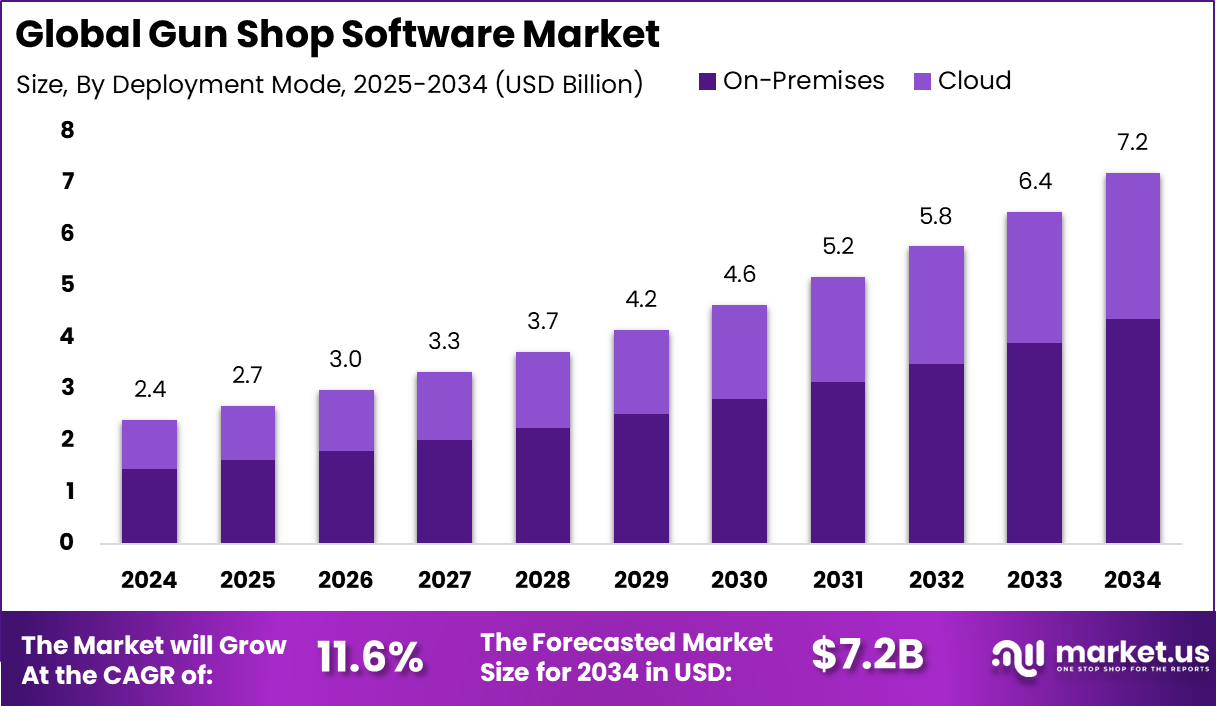
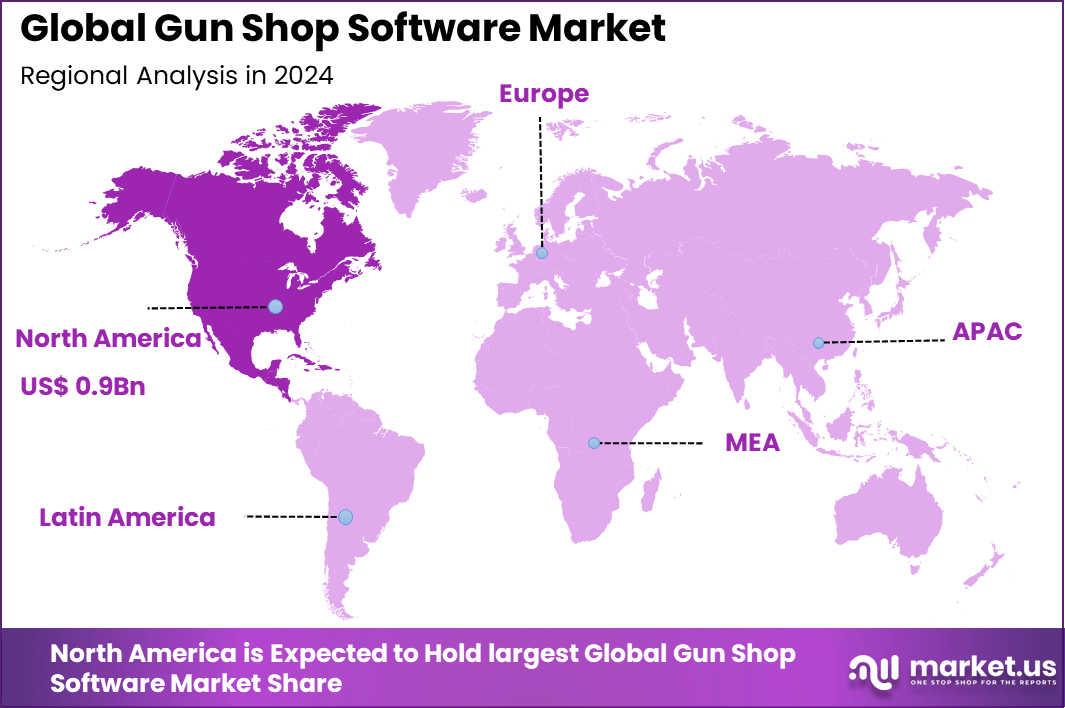
The Global Gun Shop Software Market size is expected to be worth around USD 6.4 Billion By 2034, from USD 2.4 billion in 2024, growing at a CAGR of 11.6% during the forecast period from 2025 to 2034. In 2024, North America held a dominan market position, capturing more than a 37.9% share, holding USD 0.9 Billion revenue.
Key Insight Summary
- By deployment mode, the On-Premises segment dominated with 60.6% share, reflecting preference for secure, locally managed systems.
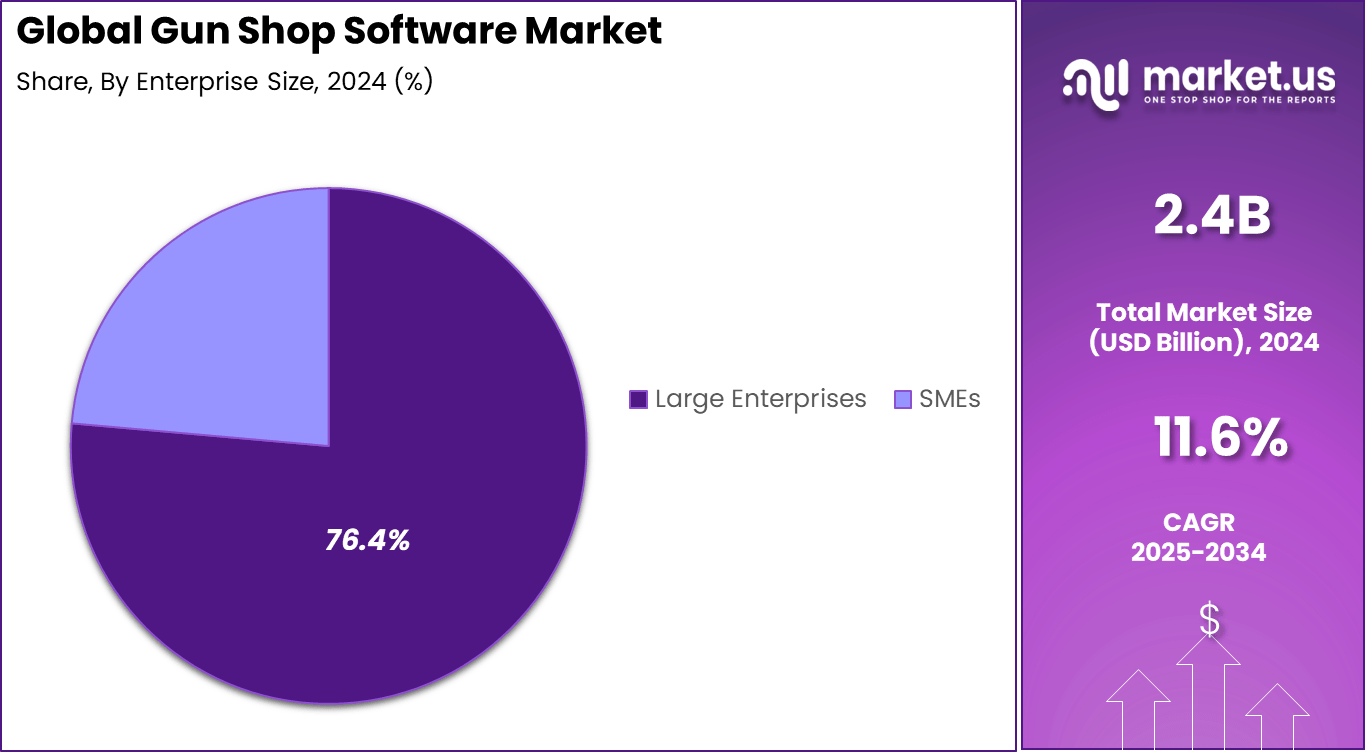
- By enterprise size, Large Enterprises led the market with a commanding 76.4% share, highlighting strong adoption among established gun retailers.
- By functionality, Inventory Management was the leading segment, capturing 35.5% share, as firearm businesses prioritize tracking and compliance.
- By end-use, Gun Shop Chains accounted for 48.5% share, driven by multi-location management needs and centralized software solutions.
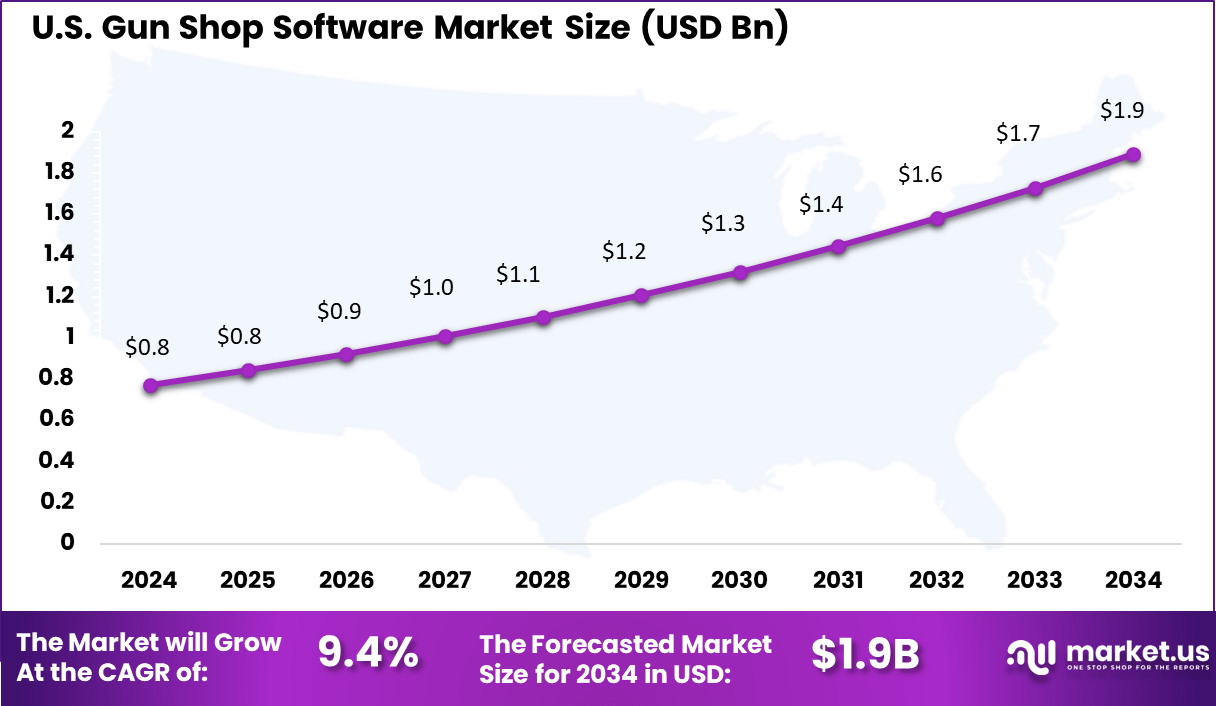
- Regionally, North America held 37.9% share, with the U.S. market valued at USD 0.77 Billion in 2024, growing steadily at a CAGR of 9.4%.
Market Overview
The Gun Shop Software Market refers to digital solutions designed to help firearm retailers, shooting ranges, and gunsmiths manage their business operations. These platforms typically include features for inventory tracking, sales processing, compliance management, customer relationship management, and reporting.
Gun shop software is specifically developed to address the regulatory complexity of firearm sales, including background checks, digital record-keeping, and integration with point-of-sale systems. The market serves both small independent retailers and larger chains seeking efficient and compliant management tools. The market is driven by increasing demand for accurate regulatory compliance in firearm sales and transfers.
Rising adoption of digital platforms among small and medium-sized firearm businesses is another driver, as shops look to streamline operations and improve accuracy. Growth in shooting sports participation, hunting activities, and firearm ownership in several regions supports the expansion of specialized software.
Analysts’ Viewpoint
Gun shops are increasingly adopting cloud-based solutions that offer scalability and remote access. Integration of background check systems directly into the point-of-sale software streamlines transactions and ensures real-time compliance with federal and state laws. Enhanced analytics capabilities allow retailers to track sales trends, forecast demand, and optimize inventory, contributing to more informed decision-making.
Studies show that after implementing such software, some retailers reported up to a 30% increase in sales and significant reductions in inventory discrepancies. The market is also seeing increasing adoption of modern technologies such as cloud computing, artificial intelligence, and mobile POS systems. Cloud-based platforms reduce the need for costly IT infrastructure and offer easier software updates aligned with regulatory changes.
AI and machine learning are being integrated to predict demand trends and automate compliance monitoring. Mobile POS systems enable sales flexibility across different locations, including events or remote setups. These technologies are adopted primarily to enhance operational efficiency, reduce manual errors, improve customer interaction, and stay compliant with evolving legal requirements.
Investment and Business Benefits
Investment opportunities in the gun shop software market are expanding, especially for providers that develop modular, scalable systems tailored for different shop sizes and regions. Emerging markets with less standardized regulations present a fertile ground for localized, adaptable software. Moreover, partnerships with regulatory authorities and firearm associations offer chances for vendors to embed compliance services directly into their software, creating long-term customer loyalty.
The market is expected to attract investments in R&D focused on automation, predictive analytics, and user-friendly interfaces to serve a wide range of users. Business benefits of adopting gun shop software include improved inventory accuracy, increased regulatory compliance, better customer management, and enhanced reporting capabilities.
Retailers save significant time by automating complex background checks and paperwork. They also minimize risks of regulatory fines by maintaining precise audit trails and real-time adherence to laws. Improved CRM features help build stronger relationships with customers, resulting in higher repeat purchase rates. Overall, businesses achieve operational efficiencies that translate into higher profitability and competitive advantage.
By Deployment Mode
In 2024, On-premises deployment accounts for 60.6% of the gun shop software market. Many businesses in this space prefer on-premises systems due to the sensitive nature of firearm-related data, which requires higher levels of security and compliance. These solutions give retailers more direct control over software infrastructure, making them well-suited for tightly regulated environments.
The preference also comes from long-established operational models where traditional software setups remain dominant. While cloud adoption is steadily rising, many gun shops still regard on-premises deployment as more reliable for handling point-of-sale transactions, firearm records, and security-sensitive workflows.
By Enterprise Size
In 2024, Large enterprises represent 76.4% of the demand for gun shop software. Their scale and multi-location operations drive the need for robust systems that can manage compliance, sales tracking, and customer records across branches. These businesses usually invest in feature-rich solutions that improve efficiency and standardize workflows.
Smaller players still rely on manual or less sophisticated tools, but big chains and distributors turn to comprehensive systems to match their complexity of operations. This concentration among large enterprises highlights the critical role of advanced software in enabling consistency and adherence to regulations across different locations.
By Functionality
In 2024, Inventory management leads as the top functionality with 35.5% share. Effective tracking of firearms, ammunition, and accessories is essential, especially in a market where strict regulatory requirements demand accuracy and accountability. Software tools with strong inventory management features help businesses minimize errors while maintaining compliance with record-keeping laws.
The functionality also improves operational efficiency by providing real-time stock visibility, automated reorder alerts, and sales integration. For gun shops, such systems not only prevent regulatory breaches but also ensure they keep the right products available for customers without stockouts.
By End-use
In 2024, Gun shop chains hold 48.5% of the market. Their distributed structures require centralized systems that can coordinate sales data, compliance records, and operational needs across multiple shops. This makes them the strongest adopters of specialized gun shop software solutions.
These chains recognize the importance of consistency, especially for regulatory checks and audit readiness. The software helps unify processes across branches, improves data visibility, and enables scalability as shops expand their footprint in the firearms retail landscape.
By Region: North America
North America commands 37.9% of the market, underscoring its role as the dominant region. Firearm regulations in the region create a pressing need for accurate record-keeping systems, pushing adoption of specialized software. Established retail chains and distributors continue to drive investment in advanced solutions tailored to compliance-heavy environments.
The region is also seeing innovation in workflow automation and digital integrations, enabling shops to streamline operations while meeting strict legal requirements. Gun shop owners in North America are prioritizing efficiency without overlooking accuracy or traceability.
By Country: The US
The US remains the single most significant market with strong projected growth of 9.4% CAGR. The country’s high volume of firearm transactions and regulatory oversight make software adoption a necessity rather than an option. Retailers are investing in technology to reduce operational risks and improve compliance management.
Beyond mandated uses, software tools are also being adopted to support customer engagement, loyalty programs, and advanced sales analytics. This broader utility ensures that software continues to gain ground, making the US a key driver of innovation and usage within the firearm retail ecosystem.
Emerging Trends
A clear trend in the gun shop software market is the shift toward cloud-based platforms that offer scalability and remote access. Many retailers are adopting mobile POS solutions that allow sales both within stores and at events, improving customer engagement and operational flexibility. Integration with automated background check systems has also improved, enabling real-time license verification and faster processing during firearm sales.
Additionally, there is growing incorporation of AI and machine learning for inventory management, sales forecasting, and customer analytics, helping shops tailor marketing and loyalty programs. Security enhancements to protect sensitive customer and transaction data are priorities, driven by increasing concerns over privacy and regulatory compliance.
Growth Factors
Several factors contribute to the steady growth of gun shop software. The increasing complexity of firearms regulations pushes retailers to use software solutions that simplify compliance through automated processes. Rising demand for efficient inventory management and streamlined sales operations further drives adoption. Cloud-based deployment reduces IT costs and improves software accessibility, attracting small to large retailers.
The need for data-driven insights to optimize business decisions also supports expanding use of software features like analytics and reporting. Regulatory demands for real-time background check integration and audit trails create necessity for specialized software that can handle these obligations accurately. Overall, growth is supported by retailers’ interest in operational efficiency, legal compliance, and customer service improvement
Key Market Segments
By Deployment Mode
- On-Premises
- Cloud
By Enterprise Size
- SMEs
- Large Enterprises
By Functionality
- Inventory Management
- Point of Sale (POS)
- Customer Management
- Compliance Management
- Reporting
By End-use
- Independent Gun Shops
- Gun Shop Chains
- Online Firearm Retailers
- Others
Regional Analysis and Coverage
- North America
- US
- Canada
- Europe
- Germany
- France
- The UK
- Spain
- Italy
- Russia
- Netherlands
- Rest of Europe
- Asia Pacific
- China
- Japan
- South Korea
- India
- Australia
- Singapore
- Thailand
- Vietnam
- Rest of Latin America
- Latin America
- Brazil
- Mexico
- Rest of Latin America
- Middle East & Africa
- South Africa
- Saudi Arabia
- UAE
- Rest of MEA
Driver Analysis
Regulatory Compliance Necessity
The primary driver of gun shop software adoption is the increasing complexity of firearm regulations. Gun shops must comply with various federal, state, and local laws regarding inventory tracking, background checks, and record maintenance. Software solutions that automate these compliance tasks reduce errors and administrative burden for retailers, ensuring they meet legal requirements efficiently.
For instance, in North America, software offering automated background check integration and ATF compliance tracking is becoming a must-have for many gun shops. This regulatory pressure creates consistent demand for advanced software designed specifically to navigate changing laws, helping retailers avoid costly penalties and maintain smooth operations.
Furthermore, technological improvements and tightening firearm laws worldwide encourage retailers to adopt systems that offer real-time compliance monitoring. This is visible not only in the US and Canada but also in emerging regions where firearm legislation is evolving. Cloud-based systems that update automatically with local regulations help gun shops stay compliant without manual intervention.
Restraint Analysis
High Implementation Cost
One significant restraint for gun shop software market growth is the high cost involved in implementing and maintaining these specialized systems. Many solutions include sophisticated features tailored to firearm retail needs, such as compliance automation, inventory control, and integrated CRM modules.
While beneficial, these technologies represent a large upfront investment and ongoing maintenance costs, which can be prohibitive for smaller or independent gun shops operating with limited budgets. For example, the price of licensing, staff training, and system upgrades may deter smaller shops from adopting advanced solutions, limiting market penetration among this segment.
Additionally, evolving regulations require frequent software updates, which add to the total cost of ownership, increasing the financial burden on retailers. Some gun shops hesitate to adopt new software due to uncertainty about return on investment, especially where digital literacy is low, or IT infrastructure is weak.
Opportunity Analysis
Expansion into Emerging Markets
Emerging firearm markets in regions like Southeast Asia, Latin America, and Eastern Europe present a promising growth opportunity for gun shop software providers. These regions often have less standardized regulations, creating a demand for flexible and localized software solutions that can adapt quickly to changing or evolving firearm laws.
Software vendors that provide modular, scalable systems capable of multilingual support and low-bandwidth operation can tap into these underserved markets effectively. For instance, mobile-first deployment models and affordable SaaS pricing tiers are gaining traction, allowing smaller retailers to trial software before committing fully.
Furthermore, partnerships with local firearm authorities and associations can build trust and facilitate regulatory onboarding, accelerating market adoption. As digital commerce grows in these regions, integrated online sales capabilities within gun shop software will also enhance customer reach and retail efficiency.
Challenge Analysis
Market Fragmentation and Competition
The gun shop software market faces the challenge of fragmentation with many small-scale and specialized providers. This fragmentation creates a crowded and competitive environment where no single vendor dominates, making differentiation difficult. Smaller providers often cater to niche requirements but lack the scale for rapid innovation or global reach.
Larger firms face pressure to continuously enhance features like user-friendly interfaces, compliance automation, and cloud integration to retain customers and justify subscription models. For example, competition from general retail POS systems that offer some firearm features forces dedicated software firms to continuously innovate.
Additionally, interoperability issues between different hardware and software platforms create operational challenges for retailers, limiting seamless integration with government databases or third-party services. This complicates software adoption, especially for multi-location retailers seeking unified systems. Smaller vendors may face resource strain as ongoing investment in product development and customer support is needed to overcome these challenges.
Competitive Analysis
In the gun shop software market, specialized providers such as Celerant Technology, AIMsi by Tri-Tech, Rapid Gun Systems, Gun StoreMaster, and FFL Boss are key players. Their platforms are designed to meet the unique compliance and inventory requirements of firearm retailers. By integrating ATF record-keeping, point-of-sale functionality, and e-commerce features, these companies support store owners in streamlining operations while ensuring regulatory adherence.
Broader retail management vendors including RetailSTAR by CAM Commerce Solutions, AXIS Retail Management Software, Acme Point of Sale, and Bravo Pawn Systems expand their presence in the sector with flexible solutions. These systems offer advanced inventory management, customer tracking, and reporting features suited for firearms as well as general retail.
Global retail software firms such as Lightspeed Retail, Epicor Eagle, Retail Pro International, iVend Retail, Rain Retail Software, Vend POS, Square for Retail, ShopKeep by Lightspeed, NCR Counterpoint, and Heartland Retail also play a significant role. While designed for broader retail applications, their solutions are adapted by firearm dealers for payment processing, sales analytics, and omnichannel integration.
Top Key Players in the Market
- Celerant Technology
- AIMsi by Tri-Tech
- Rapid Gun Systems
- Gun StoreMaster
- FFL Boss
- Gun Shop Software by Business Automation Specialists
- RetailSTAR by CAM Commerce Solutions
- AXIS Retail Management Software
- Acme Point of Sale
- Lightspeed Retail
- Epicor Eagle
- Bravo Pawn Systems
- Retail Pro International
- iVend Retail
- Rain Retail Software
- Vend POS
- Square for Retail
- ShopKeep by Lightspeed
- NCR Counterpoint
- Heartland Retail
- Others
Recent Developments
- In July 2025, Gearfire launched significant updates to its firearm eCommerce SaaS platform, improving eCommerce, point of sale, and merchant service features designed specifically for gun retailers. These updates focus on compliance, automation, and customer experience enhancements to better serve firearm businesses nationwide, enabling more efficient online and in-store operations.
- In January 2025, Gun StoreMaster showcased their automated FFL compliance software at SHOT Show 2025, promoting ease of ATF compliance for firearm retailers. They highlighted integrations with leading POS systems like QuickBooks POS and Celerant to simplify compliance and operational management.
Report Scope
Report Features Description Market Value (2024) USD 2.4 Bn Forecast Revenue (2034) USD 7.2 Bn CAGR(2025-2034) 11.6% Base Year for Estimation 2024 Historic Period 2020-2023 Forecast Period 2025-2034 Report Coverage Revenue forecast, AI impact on Market trends, Share Insights, Company ranking, competitive landscape, Recent Developments, Market Dynamics and Emerging Trends Segments Covered By Deployment Mode (On-Premises, Cloud), By Enterprise Size (SMEs, Large Enterprises), By Functionality (Inventory Management, Point of Sale (POS), Customer Management, Compliance Management, Reporting), By End-use (Independent Gun Shops, Gun Shop Chains, Online Firearm Retailers, Others) Regional Analysis North America – US, Canada; Europe – Germany, France, The UK, Spain, Italy, Russia, Netherlands, Rest of Europe; Asia Pacific – China, Japan, South Korea, India, New Zealand, Singapore, Thailand, Vietnam, Rest of Latin America; Latin America – Brazil, Mexico, Rest of Latin America; Middle East & Africa – South Africa, Saudi Arabia, UAE, Rest of MEA Competitive Landscape Celerant Technology, AIMsi by Tri-Tech, Rapid Gun Systems, Gun StoreMaster, FFL Boss, Gun Shop Software by Business Automation Specialists, RetailSTAR by CAM Commerce Solutions, AXIS Retail Management Software, Acme Point of Sale, Lightspeed Retail, Epicor Eagle, Bravo Pawn Systems, Retail Pro International, iVend Retail, Rain Retail Software, Vend POS, Square for Retail, ShopKeep by Lightspeed, NCR Counterpoint, Heartland Retail, Others Customization Scope Customization for segments, region/country-level will be provided. Moreover, additional customization can be done based on the requirements. Purchase Options We have three license to opt for: Single User License, Multi-User License (Up to 5 Users), Corporate Use License (Unlimited User and Printable PDF) 
-
-
- Celerant Technology
- AIMsi by Tri-Tech
- Rapid Gun Systems
- Gun StoreMaster
- FFL Boss
- Gun Shop Software by Business Automation Specialists
- RetailSTAR by CAM Commerce Solutions
- AXIS Retail Management Software
- Acme Point of Sale
- Lightspeed Retail
- Epicor Eagle
- Bravo Pawn Systems
- Retail Pro International
- iVend Retail
- Rain Retail Software
- Vend POS
- Square for Retail
- ShopKeep by Lightspeed
- NCR Counterpoint
- Heartland Retail
- Others
Our Clients

- 158505
- Sept. 2025