


Report Overview
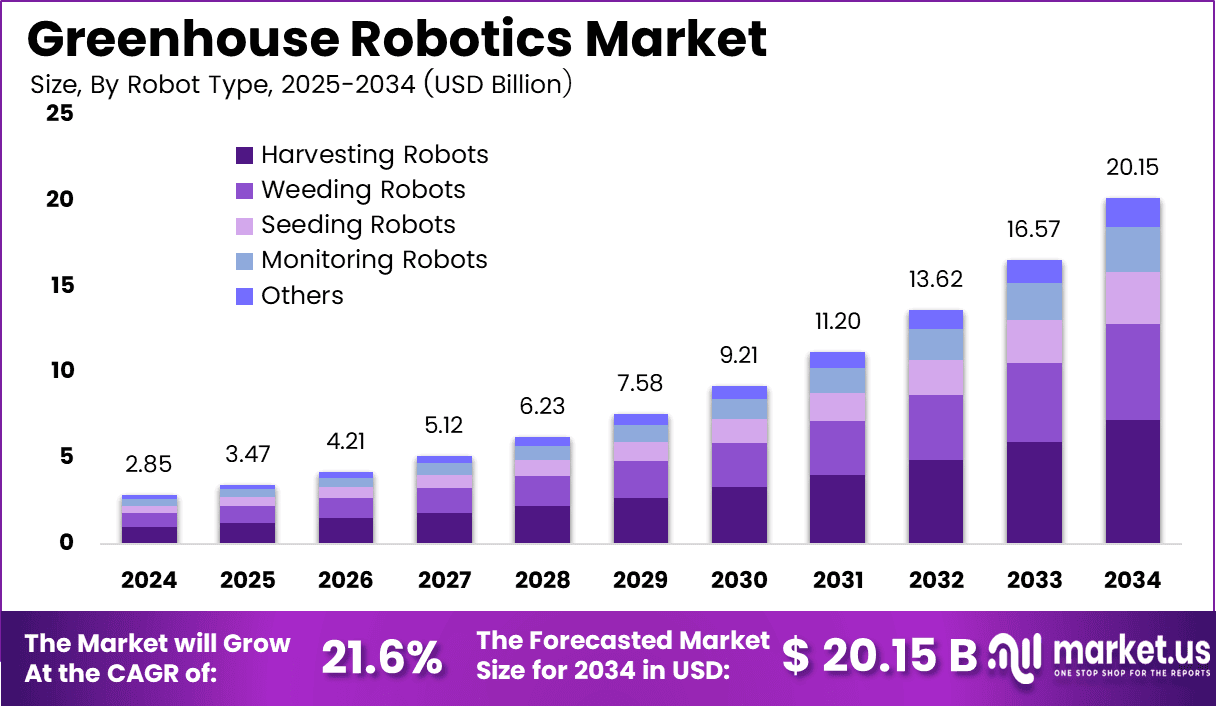
The Global Greenhouse Robotics Market was valued at USD 2.8 billion in 2024 and is projected to reach USD 20.1 billion by 2034, growing at a CAGR of 21.6% during the forecast period 2025 to 2034. North America leads the market with a 37.8% share and USD 1.08 billion in revenue.
Growth is tied directly to the expansion of controlled environment agriculture (CEA). The number of U.S. CEA operations rose from 1,476 in 2009 to 2,994 in 2019, and production volumes climbed 56% to 786 million pounds. Greenhouse vegetable area totaled 133 million square feet in 2022, with sales of USD 982 million. Rising labor costs push growers toward automation.
The USDA NASS Farm Labor Report shows the 2024 average field worker wage reached USD 18.42 per hour, up 3% year on year, while total hired workers rose to 797,000 in October 2024. The FAO reports that agricultural robotics is one of the three fastest emerging AI-driven areas in farming. The Congressional Research Service reports that U.S. farmers hired around 1.2 million domestic farmworkers in 2024, and the Department of Labor approved 363,000 H-2A certifications in FY2024.
Key Takeaways
- The Global Greenhouse Robotics Market was valued at USD 2.8 billion in 2024 and will reach USD 20.1 billion by 2034. The market will grow at a CAGR of 21.6% during the forecast period 2025 to 2034.
- By Offering, Hardware leads with a 56.7% share, while Software is the fastest-growing sub-segment.
- By Robot Type, Harvesting Robots lead with a 35.8% share, while Monitoring Robots are the fastest-growing sub-segment.
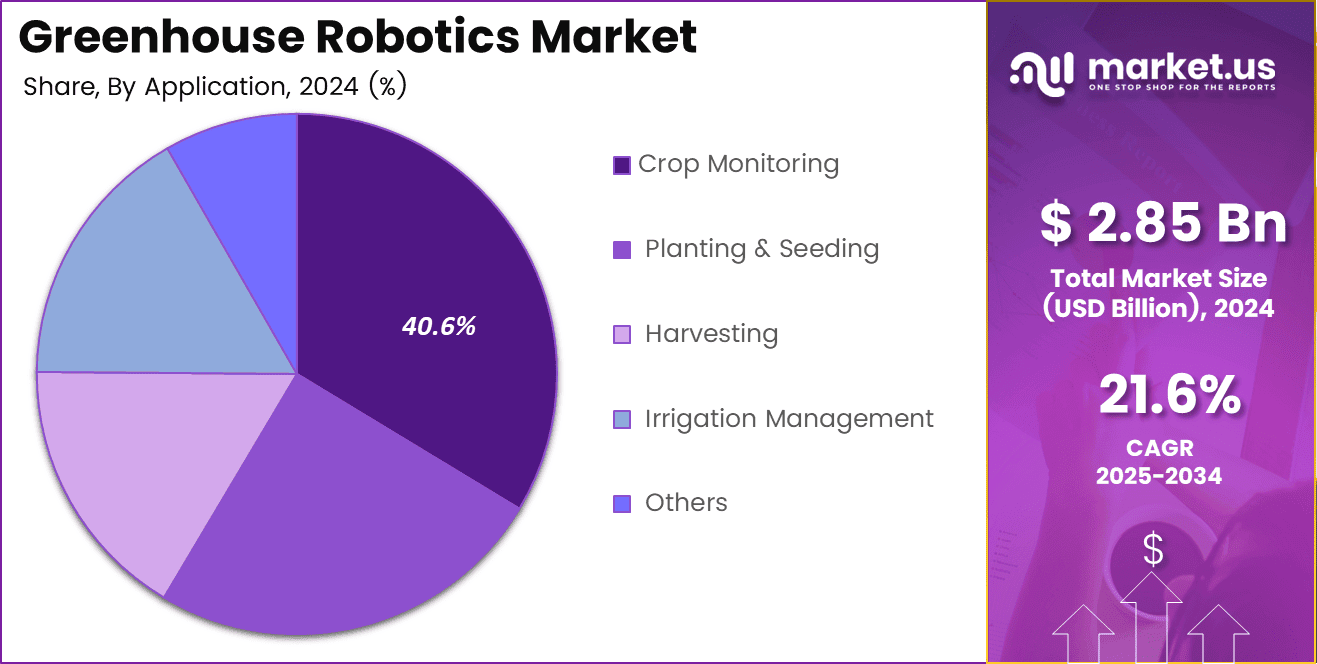
- By Application, Crop Monitoring leads with a 40.6% share, while Harvesting is the fastest-growing sub-segment.
- By End-User, Commercial Greenhouses lead with a 52.7% share, while Research Institutes are the fastest-growing sub-segment.
- North America dominates with a 37.8% share and revenue of USD 1.08 billion in 2025.
Role of Generative AI
Generative AI plays a transformative role in advancing greenhouse robotics by enabling autonomous decision-making, adaptive learning, and real-time optimization of agricultural processes. Through AI-driven algorithms, robots can analyze large datasets from sensors, cameras, and drones to predict crop health patterns, optimize irrigation cycles, and improve yield forecasting.
Generative AI enhances robotic navigation in complex greenhouse layouts by simulating countless operational scenarios, reducing downtime and energy consumption. It also supports the design of next-generation robots through automated 3D modeling and performance simulation, accelerating innovation cycles.
AI-powered vision systems enable precise detection of plant diseases and pests, facilitating early intervention. Farmers benefit from reduced labor costs, increased operational efficiency, and improved sustainability. With AI integration, greenhouse robotics are expected to transition from programmed automation to intelligent self-learning systems, shaping the future of precision agriculture and controlled-environment farming.
By Offering
Hardware dominates with 56.7% due to core machines requiring costly physical components.
Hardware leads because every greenhouse robot needs a mobile base, cameras, sensors, processors, batteries, motors, and task tools before it can create value. Growers also replace grippers, wheels, blades, and sensing units more often than they replace the full platform, which supports steady hardware revenue.
The International Federation of Robotics recorded almost 20,000 agricultural robot sales in 2023, after unit sales rose 21% that year. This expanding installed base increases demand for spare parts and upgrades. However, software should grow fastest. Better vision models help one machine detect fruit color, plant stress, weeds, and safe travel paths, while fleet software lets managers schedule many robots from one screen.
By Robot Type
Harvesting Robots dominate with 35.8% due to picking labor directly shaping saleable output.
Harvesting robots lead because picking repeats daily, requires careful handling, and directly controls saleable output. Greenhouse tomatoes, cucumbers, peppers, and berries grow in ordered rows, so robots can follow known routes and work under stable light and weather. This structure improves camera guidance and reduces navigation risk.
Labor economics also supports adoption. The USDA reports that wages and contract labor represented 42% of production expenses for greenhouse and nursery operations in the 2022 Census of Agriculture. It also places the 2024 average wage for crop, nursery, and greenhouse workers at $18.24 per hour. Those costs make automated picking attractive, especially during peak harvest windows when missed fruit quickly loses quality.
By Application
Crop Monitoring dominates with 40.6% due to continuous visibility supporting faster crop decisions.
Crop monitoring leads because greenhouse managers need continuous plant and climate data across every growth stage, not only during planting or harvest. A monitoring robot can inspect temperature, humidity, moisture, leaf color, fruit size, and pest signs along the same route each day.
This wide use supports the 40.6% application share and gives operators one data layer for labor planning, yield forecasts, irrigation, and crop protection. FAO estimates that greenhouses already cover 1.4 million to 2 million hectares worldwide, which creates a large area that growers must inspect repeatedly. Irrigation management should grow fastest as water pressure increases and growers seek fast savings from existing greenhouse systems.
Robots and connected sensors can measure root-zone moisture, find leaks, map dry spots, and trigger precise watering without waiting for manual checks. In an FAO-backed Saudi initiative, greenhouse farms in Al-Baha saved about 24% of water, while overall irrigation efficiency increased from 50% to more than 92%. These results give buyers a clear payback case.
By End-User
Commercial Greenhouses dominate with 52.7% due to large operations spreading automation costs efficiently.
Commercial greenhouses lead because they manage large areas, repeat tasks daily, and can spread robot costs across high crop volumes. They also lose more money when labor gaps delay picking, scouting, spraying, or plant care. USDA counted 23,060 U.S. horticultural specialty operations in 2024 and reported $18.307 billion in sales.
Corporate-owned businesses produced 63% of those sales, equal to $11.6 billion, even though family- or individually owned farms represented 56% of operations. This sales concentration gives commercial operators stronger budgets, clearer return targets, and enough scale for multi-robot fleets, maintenance contracts, and staff training. Research institutes should grow fastest from a smaller base.
Universities and public labs test new grippers, machine vision, navigation, and human-robot work methods before growers accept them. They also buy flexible platforms that teams can change for several crops and experiments. The U.S. National Science Foundation and its partners had invested nearly $500 million in the AI Institutes research network when NSF announced 7 new institutes in 2023, including one for climate-smart agriculture and forestry.
Key Market Segments
By Offering
- Hardware
- Software
- Services
By Robot Type
- Harvesting Robots
- Weeding Robots
- Seeding Robots
- Monitoring Robots
- Others
By Application
- Crop Monitoring
- Planting and Seeding
- Harvesting
- Irrigation Management
- Others
By End-User
- Commercial Greenhouses
- Residential Greenhouses
- Research Institutes
- Others
Geopolitical Impact Analysis
Trade policy shifts are reshaping the cost base for greenhouse robotics. The United States Trade Representative confirms that Section 301 List 1 tariffs of 25% on Chinese industrial machinery and robotics components remain in force, and semiconductor tariffs under HTS 8541 and 8542 rose from 25% to 50% on January 1, 2025.
The WTO reports that 47 member nations raised tariffs on at least one product category in 2025, up from 12 in 2020, with strategic technology products among the most affected. Since greenhouse robots depend on vision sensors, servo motors, and edge chips, these duties raise landed costs for arms, controllers, and cameras used by harvesting and monitoring robots.
Shipping disruptions add further pressure. The UNCTAD Review of Maritime Transport 2025 states that ship transit through the Suez Canal remained 70% below the 2023 average by May 2025. UNCTAD notes that vessels rerouting around Africa add roughly 12 days to an Asia-to-Europe voyage, acting as a supply shock equivalent to a 30% increase in transit times and cutting effective global container shipping capacity by around 9%.
These delays lengthen lead times for greenhouse robot assemblies shipped from Chinese and Southeast Asian factories to European system integrators such as Priva and Certhon, and raise inventory carrying costs for North American growers who source robotic harvesters and weeding robots from overseas suppliers.
Regional Analysis
North America Greenhouse Robotics Market Insights
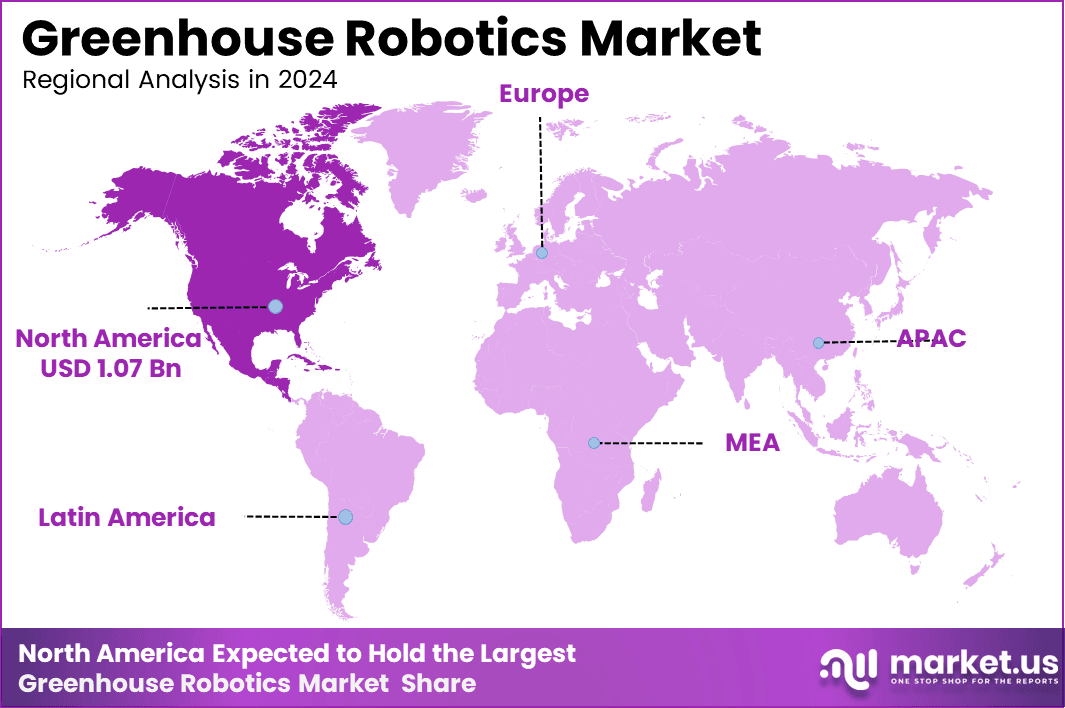
North America dominates the Global Greenhouse Robotics Market, holding a 37.8% share and generating USD 1.07 billion in revenue. The region hosts one of the world’s most mature controlled environment sectors, supported by strong grower demand for automated harvesting, monitoring, and seeding robots.
The USDA National Agricultural Statistics Service recorded 11,465 greenhouse vegetable farms in 2022, and it confirms that tomatoes, lettuce, and cucumbers make up 60% to 70% of CEA output. U.S. greenhouse tomato production alone reached 763 million pounds in 2023, a 67% increase over the prior period. Labor pressures speed up adoption.
Asia Pacific is the fastest-growing region in the forecast period. Rapid greenhouse expansion in China, Japan, and South Korea supports demand. Reports indicate that Asia accounts for more than half of global vegetable output, and government programs in China and South Korea fund smart farm pilots that integrate robotic harvesting and AI-driven monitoring.
US Market Size
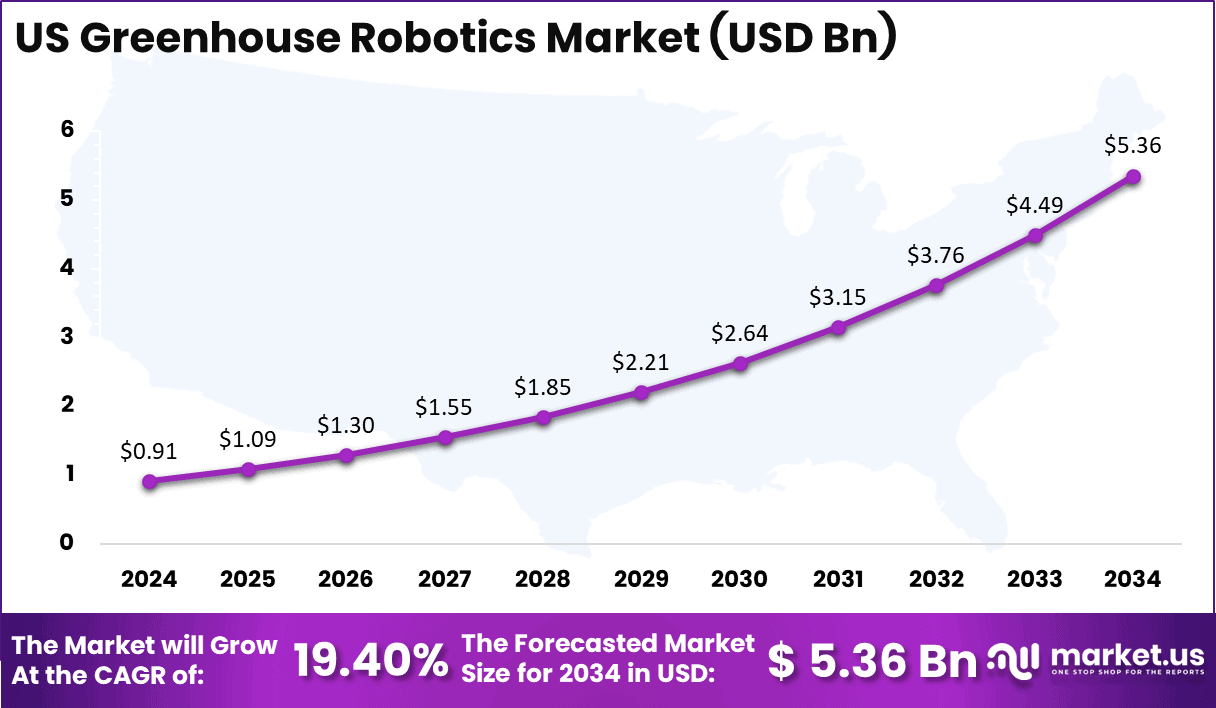
The US greenhouse robotics market is valued at USD 0.91 billion in 2024 and is projected to reach USD 5.36 billion by 2034, expanding at a CAGR of 19.4%. The growth is driven by the increasing adoption of automation in controlled-environment agriculture to address labor shortages, improve efficiency, and optimize crop yields.
Rising demand for fresh, locally produced vegetables and fruits is encouraging greenhouse operators to integrate AI-powered robotic systems for harvesting, planting, and monitoring. The push toward sustainability and precision farming has accelerated investments in smart robotics, supported by U.S. government incentives promoting agri-tech innovation.
Key Regions and Countries
North America
- US
- Canada
Europe
- Germany
- France
- The UK
- Spain
- Italy
- Rest of Europe
Asia Pacific
- China
- Japan
- South Korea
- India
- Australia
- Rest of APAC
Latin America
- Brazil
- Mexico
- Rest of Latin America
Middle East and Africa
- GCC
- South Africa
- Rest of MEA
Market Dynamics
Drivers
| Driver | (~) % Impact on CAGR Forecast | Geographic Relevance | Impact Timeline |
|---|---|---|---|
| Protected-crop labor substitution | +3.4% | North America, Western Europe, Japan, South Korea | Short term (2 years or less) |
| Sensor-led climate control | +2.7% | Global, strongest in intensive horticulture regions | Short term (2 years or less) |
| High-value crop consistency | +2.2% | Europe, North America, Gulf Cooperation Council, East Asia | Medium term (2 to 4 years) |
| Water-efficient production mandates | +1.8% | Middle East, Southern Europe, Western United States, Australia | Medium term (2 to 4 years) |
| Greenhouse fleet digitization | +1.5% | Netherlands, Canada, United States, China | Short term (2 years or less) |
Protected-crop labor substitution
Persistent labor shortages in harvesting, scouting, pruning, and crop handling are accelerating the adoption of greenhouse robotics. USDA Economic Research Service analysis from 2024 identifies labor availability as a key constraint in controlled-environment agriculture, while Virginia Cooperative Extension guidance from 2026 highlights shortages of workers with automation, plant-science, and data-management skills.
Robotics can reduce dependence on seasonal labor by allowing fewer skilled operators to manage larger production areas through automated monitoring and handling systems. These labor-productivity and crop-consistency benefits could contribute approximately +3.4% to the market’s baseline CAGR of 21.6%.
Restraints
| Restraint | (~) % Impact on CAGR Forecast | Geographic Relevance | Impact Timeline |
|---|---|---|---|
| Automated-facility capital intensity | -3.1% | Global, acute among smaller growers and emerging markets | Short term (2 years or less) |
| Elevated financing hurdle rates | -2.3% | North America, Europe, Latin America, Africa | Short term (2 years or less) |
| Grower cash-flow volatility | -1.9% | Global | Medium term (2 to 4 years) |
| Energy-cost exposure | -1.6% | Europe, East Asia, Northern climate zones | Short term (2 years or less) |
| Fragmented farm purchasing power | -1.2% | South Asia, Southeast Asia, Africa, Latin America | Medium term (2 to 4 years) |
Automated-facility capital intensity
High upfront investment remains a major restraint for greenhouse robotics because deployment often requires additional spending on conveyors, sensors, communication systems, safety equipment, and greenhouse retrofitting. USDA Economic Research Service analysis from 2024 highlights the significant capital and operating requirements of controlled-environment agriculture, while elevated borrowing costs further limit investment in automation projects.
These conditions are estimated to create a -3.1% deduction from the baseline CAGR as growers may delay projects that cannot demonstrate clear payback under conservative labor, energy, and yield assumptions. For suppliers, high investment requirements can reduce unit sales, extend sales cycles, and increase costs related to installation support, pilot financing, performance guarantees, and customer-specific engineering.
Challenges
| Challenge | (~) % CAGR Friction Drag | Geographic Relevance | Mitigation Horizon |
|---|---|---|---|
| Crop variability perception | -2.6% | Global | Medium term (2 to 4 years) |
| Mixed-fleet interoperability | -2.1% | North America, Europe, East Asia | Medium term (2 to 4 years) |
| Component sourcing concentration | -1.8% | Global | Medium term (2 to 4 years) |
| Humidity-driven equipment reliability | -1.5% | Tropical, coastal and high-humidity production regions | Long-term (4 years or more) |
| Data governance fragmentation | -1.2% | Europe, North America, East Asia | Long-term (4 years or more) |
Crop variability perception
Robotic performance in greenhouse environments remains limited by biological variation in fruit orientation, ripeness, stem structure, canopy density, and seasonal crop differences. Research published in 2025 shows that greenhouse automation must continuously interpret environmental and crop-health conditions, while USDA analysis from 2024 highlights ongoing technological and operational limitations in highly automated growing systems.
These challenges are estimated to create a -2.6% drag on maximum market growth because suppliers must invest in crop-specific datasets, model retraining, calibration, and exception handling. Long-term competitiveness will depend on larger annotated crop datasets, durable and washable robotic hardware, and contracts based on verified task-level performance.
Opportunities
| Opportunity | (~) % Potential CAGR Upside | Geographic Relevance | Execution Window |
|---|---|---|---|
| Robotics-as-a-service contracts | +3.2% | North America, Europe, Japan, Australia | Medium term (2 to 4 years) |
| Retrofit automation for existing glasshouses | +2.7% | Europe, North America, China, Türkiye | Medium term (2 to 4 years) |
| Autonomous crop-intelligence subscriptions | +2.3% | Global intensive-horticulture clusters | Long term (4 years or more) |
| Post-harvest greenhouse integration | +1.9% | North America, Europe, Gulf Cooperation Council, East Asia | Medium term (2 to 4 years) |
| Emerging-market leasing ecosystems | +1.6% | India, Southeast Asia, Latin America, Africa | Long term (4 years or more) |
Robotics-as-a-service contracts
Robotics-as-a-Service represents an untapped opportunity in the greenhouse robotics market because most automation purchases still require substantial upfront capital. USDA analysis from 2024 highlights the capital intensity of controlled-environment agriculture, while equipment-access models can reduce investment barriers.
Monthly, seasonal, or performance-based contracts could lower growers’ initial cash outlay by approximately 60% to 80% compared with direct equipment ownership. The model can also generate recurring revenue from software, maintenance, remote monitoring, and fleet utilization.
These services could improve supplier lifetime gross margins by around 5% to 12%. With suitable financing, standardized retrofit systems, and crop-specific performance benchmarks, Robotics-as-a-Service could potentially add approximately 3.2% above the market’s baseline CAGR of 21.6% by expanding adoption among smaller and mid-sized growers.
Key Players Analysis
The greenhouse robotics market splits into a Tier 1 group of diversified horticulture technology leaders and a Tier 2 group of specialist robotics challengers. Tier 1 leaders include Priva, Certhon, Spread Co., Ltd., AeroFarms, and Bowery Farming. Priva and Certhon anchor European greenhouse automation with integrated climate, irrigation, and internal logistics systems, and Certhon operates as a strategic partner of Priva across turnkey greenhouse builds.
According to the Palm Ventures announcement, AeroFarms completed its acquisition by an affiliate of Palm Ventures in April 2026 after operating a 140,000-square-foot Virginia facility. Tier 2 challengers include Iron Ox, Naio Technologies, Agrobot, FFRobotics, Metomotion, ecoRobotix, Harvest CROO Robotics, Blue River Technology, and Robotics Plus.
Iron Ox raised a Series C round of USD 53 million led by Breakthrough Energy Ventures, bringing total venture funding to USD 98 million, per the company announcement. Naio Technologies closed a USD 33 million round led by Mirova, and secured additional financing of EUR 6.4 million in late 2025 for European scale-up, per Naio Technologies.
Top Key Players in the Market
- Iron Ox
- Root AI
- Octinion
- Agrobot
- FFRobotics
- Metomotion
- Spread Co., Ltd.
- Priva
- Certhon
- LettUs Grow
- Autogrow
- ecoRobotix
- Harvest CROO Robotics
- Bowery Farming
- Green Automation Group
- AeroFarms
- Robotics Plus
- Naio Technologies
- Blue River Technology
Recent Developments
- In November 2025, SAIA Agrobotics closed EUR 10 million in new funding led by Check24 Impact, bringing total capital raised to EUR 20 million to launch its plants-to-robot greenhouse automation system in 2026.
- In November 2025, Naio Technologies secured EUR 6.4 million in fresh financing from Mirova, Bpifrance, and the Occitanie Region’s ARIS fund to scale production and expand European distribution of its greenhouse and field robots.
- In February 2026, Grodi raised EUR 2.5 million in a round led by Swanlaab Innvierte Agri FoodTech to advance its VEGA 11 autonomous greenhouse robot for Mediterranean greenhouses.
- In April 2026, an affiliate of Palm Ventures completed the acquisition of AeroFarms, taking control of its 140,000-square-foot Danville, Virginia vertical farming facility and retaining 145 employees.
- In July 2026, Hippo Harvest closed a USD 30 million Series C led by Cox Farms, North America’s largest greenhouse operator, to scale its robotics- and machine learning-powered greenhouses for USDA-certified organic leafy greens.
Report Scope
| Report Features | Description |
|---|---|
| Market Value (2024) | USD 2.8 Billion |
| Forecast Revenue (2034) | USD 20.1 Billion |
| CAGR (2025-2034) | 21.6% |
| Base Year for Estimation | 2024 |
| Historic Period | 2020-2023 |
| Forecast Period | 2025-2034 |
| Report Coverage | Revenue Forecast, Market Dynamics, Competitive Landscape, Recent Developments |
| Segments Covered | By Offering (Hardware, Software, Services); By Robot Type (Harvesting Robots, Weeding Robots, Seeding Robots, Monitoring Robots, Others); By Application (Crop Monitoring, Planting and Seeding, Harvesting, Irrigation Management, Others); By End-User (Commercial Greenhouses, Residential Greenhouses, Research Institutes, Others) |
| Regional Analysis | North America – US, Canada; Europe – Germany, France, The UK, Spain, Italy, Rest of Europe; Asia Pacific – China, Japan, South Korea, India, Australia, Singapore, Rest of APAC; Latin America – Brazil, Mexico, Rest of Latin America; Middle East & Africa – GCC, South Africa, Rest of MEA |
| Competitive Landscape | Iron Ox, Root AI, Octinion, Agrobot, FFRobotics, Metomotion, Spread Co., Ltd., Priva, Certhon, LettUs Grow, Autogrow, ecoRobotix, Harvest CROO Robotics, Bowery Farming, Green Automation Group, AeroFarms, Robotics Plus, Naio Technologies, Blue River Technology |
| Customization Scope | Customization for segments, region/country-level will be provided. Additional customization can be done based on requirements. |
| Purchase Options | We have three licenses to opt for: Single User License, Multi-User License (Up to 5 Users), Corporate Use License (Unlimited Users and Printable PDF) |





























