


Global Grain Storage Silos Market By Material (Metal, Wood, Concrete, and Others), By Silo Type (Flat Bottom Silos, Hopper Silos, Grain Bins, and Others), By Grain Type (Corn, Wheat, Soybean, Rice, Barley, and Others), By Capacity (Up to 1,000 tons, 1,000 to 5,000 tons, and Above 5,000 tons), By End-User (Farming / Primary Producers, Feed Mills And Animal Feed, Grain Processing Mills, Port And Bulk Terminals, Food And Beverage Processors, and Others), By Region and Companies - Industry Segment Outlook, Market Assessment, Competition Scenario, Trends and Forecast 2025-2035
- Published date: Feb 2026
- Report ID: 179185
- Number of Pages: 223
- Format:
-
keyboard_arrow_up
Quick Navigation
Report Overview
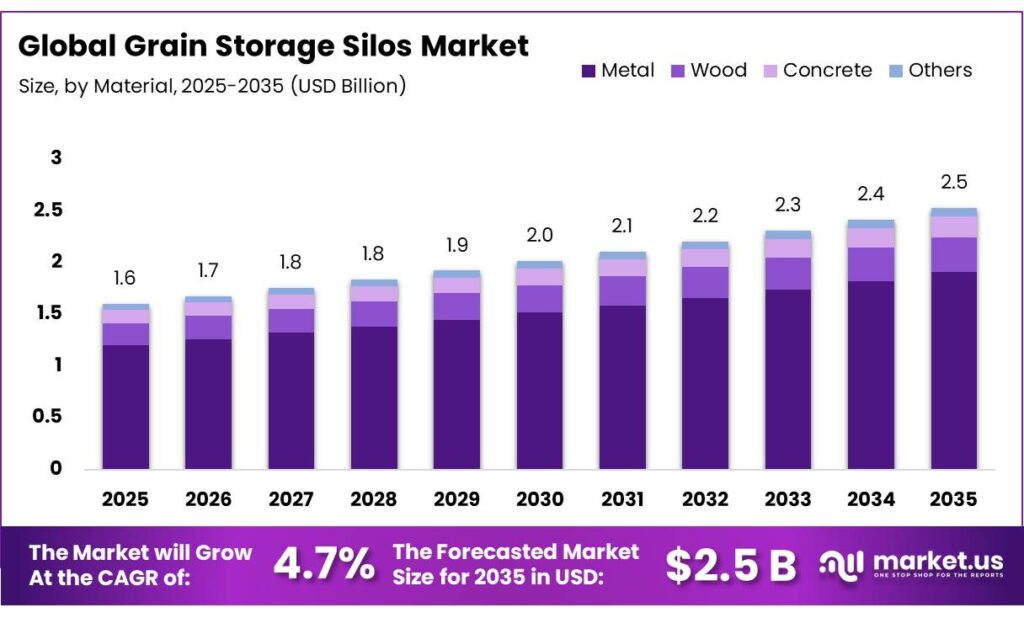
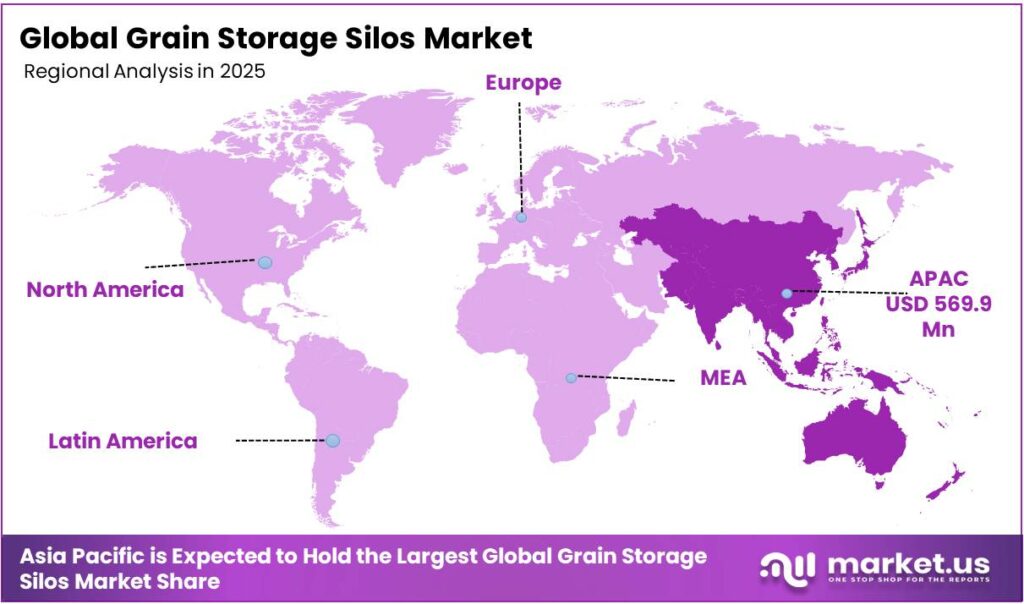
The Global Grain Storage Silos Market is expected to be worth around USD 2.5 Billion by 2035, up from USD 1.6 Billion in 2025, at a CAGR of 4.7% from 2026 to 2035. The Asia Pacific segment maintained 36.3%, supporting a Grain Storage Silos value of USD 569.9 Mn.
Grain storage silos are specialized, high-capacity structures designed to store bulk quantities of agricultural products, primarily grains like wheat, corn, rice, and barley. While they primarily serve as massive containers, modern silos are sophisticated engineering systems that actively protect and maintain the quality of the stored goods.
- According to the Food and Agriculture Organization (FAO) 2024 data, global agricultural production in 2024 saw significant expansion in land use, with crop areas reaching 1.5 billion hectares. The increase in agricultural production leads to the need for high-quality silos to store the produced yield.
The market is shaped by agricultural production, food security needs, and technological adoption, with infrastructure designed to reduce post-harvest losses and preserve grain quality. Additionally, Asia Pacific dominates the market due to massive cereal production in countries such as China and India, where government programs have expanded modern silo capacities.
- A total of at least 51 incidents related to agricultural confined spaces were recorded in the US alone, including 22 fatalities and 29 non-fatal cases. This represents a 38.6% decrease compared to the 83 cases reported in 2022, and a 7% reduction from 2023. These incidents pose a major threat to the demand for large grain silos.
Corn is the primary grain stored due to volume, robustness, and handling characteristics. On-farm storage by primary producers dominates as it allows immediate post-harvest quality management, while feed mills, processing plants, and terminals rely on shorter-term or specialized storage. Emerging trends include automation and sensor-based monitoring, enhancing operational efficiency and spoilage prevention.
- According to the United States Department of Agriculture (USDA), the global production of corn for the fiscal year 2024/25 was 1.23 billion metric tons, with the US and China producing over half of the global production.
Key Takeaways:
- The global grain storage silos market was valued at USD 1.6 billion in 2025.
- The global grain storage silos market is projected to grow at a CAGR of 4.7% and is estimated to reach USD 2.5 billion by 2035.
- On the basis of material, metal grain storage silos dominated the market, constituting 75.3% of the total market share.
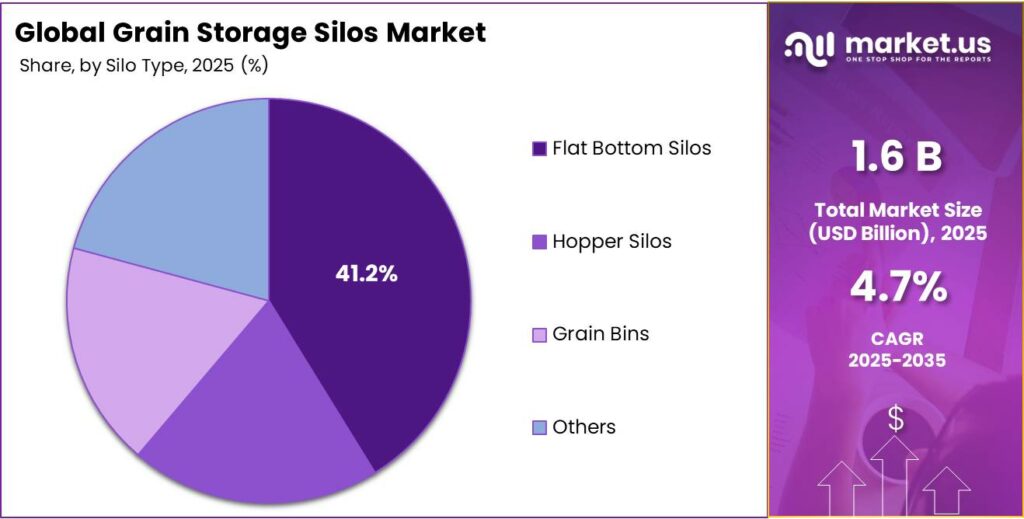
- Based on the silo type, flat-bottom silos dominated the market, with a substantial market share of around 41.2%.
- Based on the grain type, corn led the market, comprising 31.5% of the total market.
- Based on the capacity, 1,000-to 5,000-ton storage silos held a major share in the market, 41.7% of the market share.
- Among the end-users, farming/primary producers use the most grain storage silos, accounting for around 52.8% of the revenue.
- In 2025, the Asia Pacific was the most dominant region in the grain storage silos market, accounting for 36.3% of the total global consumption.
Material Analysis
Metal Grain Storage Silos Are a Prominent Segment in the Market.
The market is segmented based on the material of grain storage silos into metal, wood, concrete, and others. The metal grain storage silos led the market, comprising 75.3% of the market share, due to structural efficiency, durability, hygiene control, and installation flexibility. Galvanized steel silos offer high strength-to-weight ratios, enabling large storage capacities with comparatively lower foundation loads than reinforced concrete.
Additionally, factory-fabricated steel panels allow modular assembly, faster installation, and scalability, which supports phased capacity expansion. Similarly, smooth internal steel surfaces reduce grain residue buildup, facilitating cleaning and fumigation, while integrated aeration floors, temperature cables, and moisture monitoring systems can be readily incorporated. In contrast, wooden structures are more susceptible to moisture damage, pest infestation, and fire risk, and concrete silos, though durable, involve longer construction timelines and limited post-construction modification flexibility.
Silo Type Analysis
Flat Bottom Silos Dominated the Grain Storage Silos Market.
On the basis of silo type, the grain storage silos market is segmented into flat-bottom silos, hopper silos, grain bins, and others. The flat-bottom silos dominated the market, comprising 41.2% of the market share, as they are better suited for large-capacity and long-term bulk storage. Their design distributes grain loads directly onto a reinforced concrete foundation, enabling storage of very high volumes with structural stability and lower per-ton construction complexity compared to elevated hopper systems.
Additionally, flat-bottom silos allow the integration of full-floor aeration systems, temperature monitoring cables, and sweep augers for mechanized unloading. While hopper silos enable gravity discharge and faster turnover, they require elevated steel support structures, increasing material intensity and engineering complexity for large diameters.
Compared with smaller grain bins, flat-bottom silos accommodate centralized storage at commercial facilities, ports, and processing plants, where economies of scale, space efficiency, and compatibility with bulk handling systems are operational priorities.
Grain Type Analysis
Most Grain Storage Silos Are Utilized for Corn.
Most grain storage silos were utilized for corn, with a notable market share of 31.5%, due to its high production volumes, bulk handling characteristics, and storage behavior. Corn is often harvested at higher moisture levels than wheat or barley and therefore requires controlled aeration and drying before and during storage. Corn kernels are also mechanically robust, allowing vertical bulk storage in large-diameter silos without significant breakage under static loads.
In contrast, rice, especially milled rice, is more susceptible to cracking, and soybeans are more prone to mechanical damage and quality deterioration if improperly handled. Additionally, corn is heavily used in feed, ethanol, and industrial processing, leading to centralized, high-throughput storage at elevators and processing plants, applications where large metal silos offer operational efficiency and compatibility with mechanized conveying systems.
Capacity Analysis
1,000 to 5,000-ton Grain Storage Silos Held a Major Share of the Market.
Based on capacity, the grain storage silos market is segmented into up to 1,000 tons, 1,000 to 5,000 tons, and above 5,000 tons. 1,000 to 5,000-ton grain storage silos are most utilized, accounting for 41.7% of the market, as they provide an optimal balance between operational efficiency, structural requirements, and risk management. Capacities between 1,000 and 5,000 tons allow integration of aeration systems, temperature and moisture monitoring, and mechanized conveyors without excessive engineering or risk, making them technically and economically suitable for regional storage facilities, processing plants, and agricultural cooperatives.
In contrast, silos below 1,000 tons often require proportionally higher per-ton infrastructure costs and are less efficient for large-scale commercial or cooperative storage, making them more suitable for small farms rather than centralized grain handling.
Similarly, silos above 5,000 tons demand stronger foundations, heavier steel structures, and more complex unloading systems, increasing construction and maintenance complexity. Additionally, very large silos pose a higher operational risk in case of spoilage, pest infestation, or structural failure, as losses are concentrated.
End-User Analysis
Grain Storage Silos Services Are Mostly Utilized by Farming/Primary Producers.
Among the end-users, 52.8% of the total global consumption of grain storage silos is utilized by farming/primary producers, as silos enable immediate post-harvest storage, which is critical for managing seasonal harvest surpluses and protecting crop quality before sale or processing. On-farm silos allow producers to control moisture, temperature, and pest management directly, reducing post-harvest losses and maintaining the value of the grain.
In contrast, feed mills, grain processing plants, and port terminals often operate as intermediate or bulk handling facilities, where storage is integrated with rapid processing, blending, or export schedules, reducing the need for prolonged storage on-site. Similarly, food and beverage processors often require smaller, specialized storage tailored to specific input specifications rather than large-scale bulk storage.
Key Market Segments:
By Material
- Metal
- Steel
- Aluminum
- Wood
- Concrete
- Others
By Silo Type
- Flat Bottom Silos
- Hopper Silos
- Grain Bins
- Others
By Grain Type
- Corn
- Wheat
- Soybean
- Rice
- Barley
- Others
By Capacity
- Up to 1,000 tons
- 1,000 to 5,000 tons
- Above 5,000 tons
By End-User
- Farming / Primary Producers
- Feed Mills & Animal Feed
- Grain Processing Mills
- Port & Bulk Terminals
- Food & Beverage Processors
- Others
Drivers
Growing Demand for Food Security Drives the Grain Storage Silos Market.
Increased agricultural production and the imperative of food security, together with the drive to reduce post-harvest losses, are key drivers of demand for grain storage silos. According to a study by the Food and Agriculture Organization (FAO), projections indicate that feeding a global population of 9.1 billion by 2050 would necessitate an overall increase in food production of approximately 70% compared with levels recorded in 2005/07. In developing countries, agricultural output would need to nearly double. This expansion would require substantial growth in the reduction of post-harvest losses, leading to robust demand for high-quality silos.
According to a study published by the FAO, it is estimated that approximately 13% of global food production, equivalent to 1.25 billion tons, is lost after harvest and before reaching retail outlets every year. These substantial losses pose a serious threat to nutrition security, as they diminish the availability of essential nutrients within the food system. The inefficient storage leads to significant spoilage and quality degradation, prompting policy responses such as mechanized silo warehouses with large capacities to support long-term storage and mitigate such losses.
Restraints
Structural and Safety Hazards Might Pose Challenges to the Grain Storage Silos Market.
Structural and safety hazards represent significant operational challenges for the grain storage market, primarily driven by combustible dust, confined space risks, and mechanical integrity failures. According to the Occupational Safety and Health Administration (OSHA), grain handling is a high-hazard industry where moving grain can engulf a worker in less than 20 seconds, acting like quicksand.
- In the US, there were at least 34 grain-related entrapments in 2024, marking a 25% increase from 2023. The additional 17 cases involved livestock waste handling facilities, entanglements, and falls within or around grain handling facilities.
The grain engulfment and suffocation are leading causes of death in storage bins and silos, with recorded incidents more than doubling in the last two decades in the United States, where multiple workers were buried and killed in grain entrapments. Furthermore, beyond human risks, structural failures have been officially flagged.
For instance, a 28 m tall silo suffered catastrophic separation of a cold-formed conical bottom section, releasing around 600 tons of wheat due to micro-cracking at a folded joint. Similarly, farm safety authorities report incidents of silo collapse or buckling affecting transportable structures. Moreover, nine grain dust explosions were recorded in the U.S. in 2024, consistent with the 10-year average of 8.6 annually.
These events, often caused by ignition sources such as smoldering grain or equipment friction, cause substantial facility downtime and repair costs even when non-fatal. These risks underscore that silo design integrity, maintenance, and strict safety procedures are critical to mitigating structural and safety hazards in the grain storage domain.
Opportunity
Government Initiatives Create Opportunities in the Grain Storage Silos Market.
Government-led policy interventions and infrastructure programmes constitute documented opportunities for the grain storage silos sector by expanding storage capacity, improving post-harvest management, and strengthening food security frameworks. For instance, in the United States, the USDA Farm Service Agency (FSA) manages the Farm Storage Facility Loan (FSFL) Program, which provides low-interest financing for producers to build or upgrade grain bins and silos.
Similarly, in India, the ‘From Harvest to Home’ initiative reported that in June 2025, 48 silo locations with a combined capacity of 27.75 lakh tons were completed, and 87 locations with 36.875 lakh tons were under construction, with additional tenders underway. This reflects active public investment in mechanized steel silos for scientific bulk storage. These government programmes demonstrate public commitment to expand and modernize grain storage infrastructure, creating structured demand for scientific silos while seeking to minimize post-harvest losses and support food security objectives.
Trends
Adoption of Smart and Automated Systems.
There is a shift towards the adoption of automation and sensor monitoring in grain storage silos, reflecting a transition from manual condition checks to real-time, data-driven systems that support quality preservation and risk mitigation. The integration of Internet of Things (IoT) and Wireless Sensor Networks (WSN) has transformed silos from passive containers into active management systems.
The multi-point temperature, moisture, CO₂, and humidity sensors are deployed within silos to detect early signs of spoilage, insect activity, or unsafe conditions. Sensor systems can automatically control aeration fans and ventilation based on environmental data, reducing reliance on manual intervention.
Monitoring technologies often integrate level measurement and inventory tracking alongside environmental sensors to support continuous oversight of stored grain, with alerts and automation enhancing management. These practices underscore a trend toward sensor-driven automation in silo environments, where empirical data collection and automated interventions are explicitly used to optimize storage conditions, reduce losses, and improve operational responsiveness.
Geopolitical Impact Analysis
Geopolitical Tensions Have Led to Disrupted Grain Storage Supply Chains.
The geopolitical tensions, primarily the Russia-Ukraine conflict, have fundamentally shifted the grain storage market from a “just-in-time” to a “just-in-case” strategic model. According to the European Parliament, as of late 2023, the Ukrainian agricultural sector sustained an estimated US$80 billion in damages and losses, with targeted strikes on storage and transport infrastructure serving as a primary driver of global supply volatility.
Before the conflict, Ukraine and Russia together accounted for roughly 30% of global wheat exports and a significant share of maize and barley trade, which created systemic vulnerability as export routes and infrastructure were compromised. These geopolitical pressures influence grain silo utilization patterns, compel adjustments in on-farm and commercial storage strategies, and underline the strategic importance of resilient storage infrastructure that can respond to export network volatility. Consequently, governments in Sweden, Norway, India, and Indonesia are actively expanding national reserves to mitigate instability.
Regional Analysis
Asia Pacific Held the Largest Share of the Global Grain Storage Silos Market.
In 2025, the Asia Pacific dominated the global grain storage silos market, holding about 36.3% of the total global consumption, driven by the very high volumes of grain production and corresponding storage infrastructure expansion in major producers such as China and India.
According to an official from the National Food and Strategic Reserves Administration, China’s consistent construction of grain warehouses, including eco-friendly facilities, raised the country’s total grain storage capacity to over 700 million tons by the end of 2023, a 36% increase since 2014, with modernized facilities largely replacing outdated stack and open-air storage methods.
- According to the Indian Ministry of Agriculture, nearly 8% record growth in total food grain output is observed, with production rising to 357.73 million tons in 2024-25, up from 332.30 million tons in 2023-24.
China and India together produce more than half of the world’s rice, with Asia accounting for about 90% of global rice output, underscoring the magnitude of cereals in regional agriculture that necessitates extensive storage systems. India’s largest public storage agency, the Food Corporation of India, manages nearly 917 lakh tons of installed capacity across silos, godowns, and other structures, reflecting government-level storage commitments. These illustrate the scale of Asia Pacific’s grain storage infrastructure and its centrality in accommodating the region’s substantial cereal production and food security imperatives.
Key Regions and Countries
- North America
- The US
- Canada
- Europe
- Germany
- France
- The UK
- Spain
- Italy
- Russia & CIS
- Rest of Europe
- APAC
- China
- Japan
- South Korea
- India
- ASEAN
- Rest of APAC
- Latin America
- Brazil
- Mexico
- Rest of Latin America
- Middle East & Africa
- GCC
- South Africa
- Rest of MEA
Key Players Analysis:
Manufacturers of grain storage silos increasingly concentrate on product innovation, digital tool deployment, and strategic collaborations to differentiate their offerings and enhance competitive positioning.
Additionally, these players engage with agricultural cooperatives and industry groups to promote safety and the adoption of modern storage practices. The technology enhancement, education platforms, and partnerships are documented manufacturer strategies aimed at reinforcing product relevance and securing broader application across diverse farming and grain-handling contexts.
The major players in the industry
- Silos Córdoba
- PRADO SILOS
- Hoffmann, Inc.
- Symaga S.A.U.
- Silos Metálicos Zaragoza S.L.U. (SIMEZA)
- Bentall Rowlands Silo Storage Ltd.
- Mysilo
- Sukup Manufacturing Co.
- CST Industries
- Sioux Steel Company
- Chief Agri/Industrial Group
- Grain & Protein Technologies
- Brock Grain Systems
- Ag Growth International Inc. (AGI)
- Ecosphere India Pvt. Ltd.
- Other Key Players
Key Development:
- In July 2024, Ag Growth International (AGI), the Winnipeg-based parent company of several renowned grain handling equipment and storage brands, adopted a single standard wall design for its galvanized steel bins in the North American market.
- In July 2025, Silos Córdoba announced the initiation of a new international project in Mizil, Romania, in collaboration with Dutch Trading and MGN. The new facility is an integral part of a modern feed production plant developed by Dutch Trading International.
Report Scope
Report Features Description Market Value (2025) US$1.6 Bn Forecast Revenue (2035) US$2.5 Bn CAGR (2025-2035) 4.7% Base Year for Estimation 2025 Historic Period 2021-2024 Forecast Period 2025-2035 Report Coverage Revenue Forecast, Market Dynamics, Competitive Landscape, Recent Developments Segments Covered By Material (Metal, Wood, Concrete, and Others), By Silo Type (Flat Bottom Silos, Hopper Silos, Grain Bins, and Others), By Grain Type (Corn, Wheat, Soybean, Rice, Barley, and Others), By Capacity (Up to 1,000 tons, 1,000 to 5,000 tons, and Above 5,000 tons), By End-User (Farming / Primary Producers, Feed Mills & Animal Feed, Grain Processing Mills, Port & Bulk Terminals, Food & Beverage Processors, and Others) Regional Analysis North America – The US & Canada; Europe – Germany, France, The UK, Spain, Italy, Russia & CIS, Rest of Europe; APAC– China, Japan, South Korea, India, ASEAN & Rest of APAC; Latin America– Brazil, Mexico & Rest of Latin America; Middle East & Africa– GCC, South Africa, & Rest of MEA Competitive Landscape Silos Córdoba, PRADO SILOS, Hoffmann, Inc., Symaga S.A.U., Silos Metálicos Zaragoza S.L.U. (SIMEZA), Bentall Rowlands Silo Storage Ltd., Mysilo, Sukup Manufacturing Co., CST Industries, Sioux Steel Company, Chief Agri/Industrial Group, Grain & Protein Technologies, Brock Grain Systems, Ag Growth International Inc. (AGI), Ecosphere India Pvt. Ltd., and Other Players. Customization Scope Customization for segments, region/country-level will be provided. Moreover, additional customization can be done based on the requirements. Purchase Options We have three licenses to opt for: Single User License, Multi-User License (Up to 5 Users), Corporate Use License (Unlimited Users and Printable PDF) 
-
-
- Silos Córdoba
- PRADO SILOS
- Hoffmann, Inc.
- Symaga S.A.U.
- Silos Metálicos Zaragoza S.L.U. (SIMEZA)
- Bentall Rowlands Silo Storage Ltd.
- Mysilo
- Sukup Manufacturing Co.
- CST Industries
- Sioux Steel Company
- Chief Agri/Industrial Group
- Grain & Protein Technologies
- Brock Grain Systems
- Ag Growth International Inc. (AGI)
- Ecosphere India Pvt. Ltd.
- Other Key Players
Our Clients

- 179185
- Feb 2026






