


Report Overview
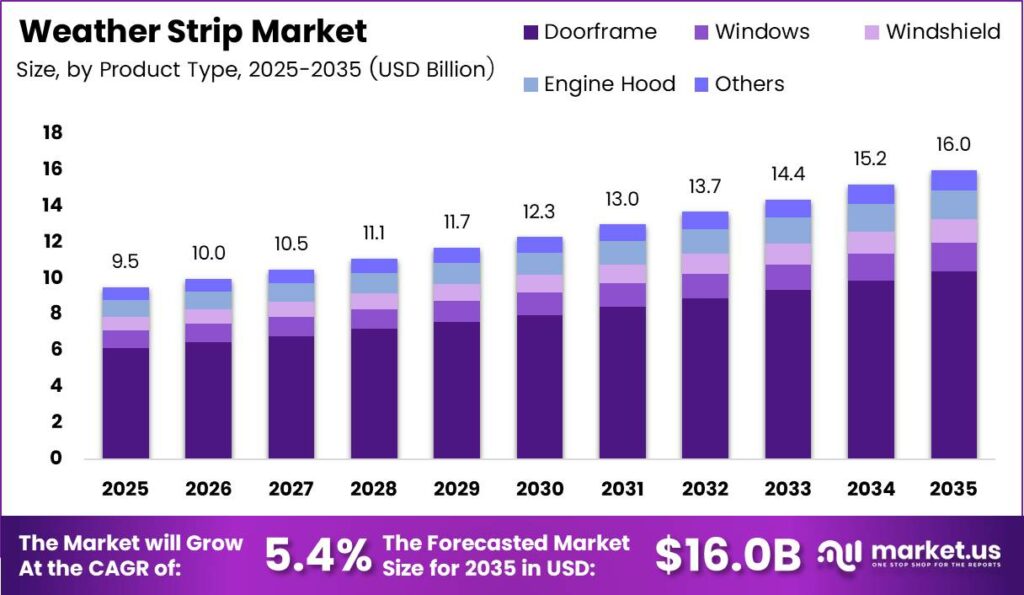
Global Weather Strip Market size is expected to be worth around USD 16.0 Billion by 2035 from USD 9.5 Billion in 2025, growing at a CAGR of 5.4% during the forecast period 2026 to 2035. This steady pace rewards suppliers that can serve vehicle assembly lines and building envelope projects from shared extrusion capacity. Investors should favor firms with qualified products in both channels, because dual exposure smooths demand cycles.
Weather strips are flexible sealing profiles that block air, water, dust, and noise at doors, windows, windshields, and engine hoods. By contrast with single use components, these seals split by material into EPDM, TPE or TPO, and others. Buyers span automotive, commercial buildings, residential buildings, and industrial enclosures. This structure spreads demand risk, but it forces suppliers to manage many profile designs and approval routes at once.
Key Takeaways
- The Global Weather Strip Market was valued at USD 9.5 Billion in 2025 and is expected to reach USD 16.0 Billion by 2035, growing at a CAGR of 5.4%.
- By Material Type, EPDM dominated with a 38.45% share in 2025 and is also the fastest growing material.
- By Product Type, Doorframe dominated with a 63.44% share in 2025 and is also the fastest growing product type.
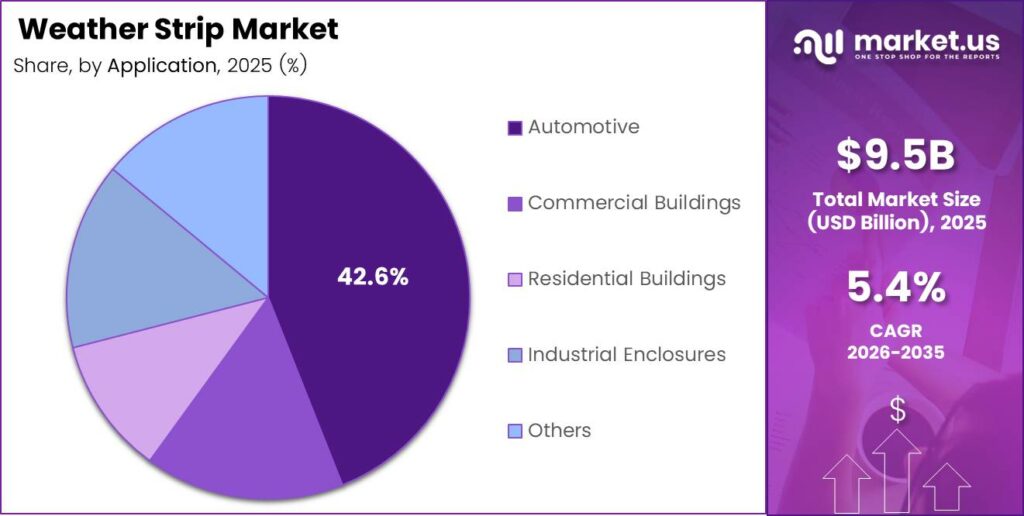
- By Application, Automotive dominated with a 42.67% share in 2025, while Commercial Buildings is the fastest growing application.
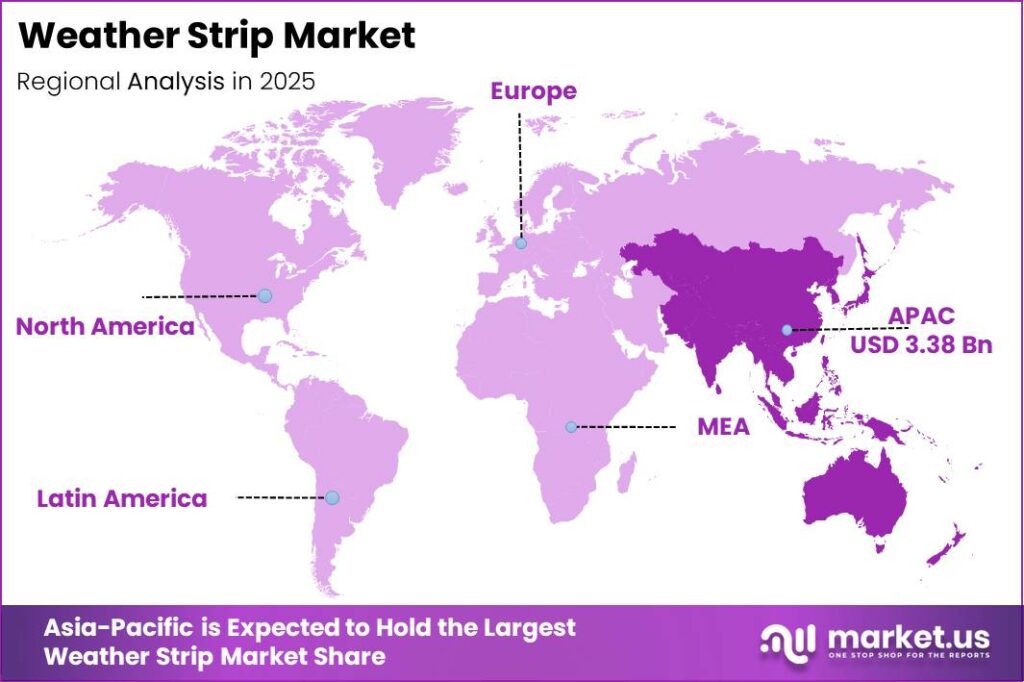
- Asia-Pacific dominated the market with a 35.67% share, valued at USD 3.38 Billion.
- Middle East and Africa is the fastest growing region in the market.
Government energy agencies now treat building air leakage as a direct policy target. The IEA indicates that buildings account for around 30% of global energy demand, which places doors and windows inside efficiency rules. As reported by the US Department of Energy, windows are responsible for approximately 10% of building energy use. This means each new commercial building project creates a direct specification need for tighter window and door seals.
However, the automotive channel is shifting its seal needs toward electric platforms. Data from ACEA shows the European Union registered 1,880,370 new battery electric passenger cars in 2025. Electric cars run without engine noise, so wind and road noise become easier for drivers to notice. As a result, rising electric vehicle output raises the value of acoustic door and window sealing per vehicle.
Material Type Analysis
EPDM dominates with 38.45% due to proven weathering and compression set durability.
In 2025, EPDM held a dominant market position in the By Material Type segment of Weather Strip Market, with a 38.45% share. Cooper Standard found that its Fortrex elastomer delivers a 30% mass reduction compared with EPDM, so lighter rivals now target EPDM volume. However, Toyoda Gosei commercialized weatherstrips with 20% recycled rubber, up from less than 5%, starting with the new Toyota RAV4. This signals that EPDM holders who add recycled content can defend share against lighter thermoplastics.
TPE or TPO serves buyers who want lighter, recyclable seals that run on standard thermoplastic processing lines. Data from Plastics Europe shows global plastics production reached 430.9 million tonnes in 2024, up 4.1% in one year. This means thermoplastic seal makers draw on a deep and growing resin supply base. As a result, TPE or TPO suppliers can scale output faster than rubber compounders that depend on curing capacity.
Others covers niche and specialty compounds bought for specific heat, chemical, or recycled content needs. Plastics Europe indicates that circular plastics production in Europe stands near 8 million tonnes, just 15% of EU plastics output. This signals a tight supply of certified recycled feedstock for specialty seal grades. Suppliers that secure recycled inputs early can charge a premium to buyers with audited sustainability targets.
Product Type Analysis
Doorframe dominates with 63.44% due to multiple seal layers per door opening.
In 2025, Doorframe held a dominant market position in the By Product Type segment of Weather Strip Market, with a 63.44% share. Toyoda Gosei indicates that rubber sponging processes cut opening trim weatherstrip weight by approximately 30%. Based on US Department of Energy data, sealing uncontrolled home air leaks can save 10% to 20% on heating and cooling bills. Doorframe suppliers that pair lighter sponge profiles with retrofit kits can win both vehicle and building channels.
Windows seals serve buyers focused on thermal comfort and cooling loads rather than vehicle cabin noise. According to the IEA, cooled floor area in buildings rises from 105 billion square metres in 2022 to 170 billion by 2035. This creates a long runway for window seals that limit hot air entry in warm regions. Window seal makers that certify thermal performance will win specification slots in newly cooled buildings.
Windshield seals sit at the boundary between glass and body, so buyers judge them on water tightness and wind noise. Figures from SMMT show UK factories produced 717,371 passenger cars in 2025. Based on IEA data, global electric car sales exceeded 20 million units in 2025, and quiet cabins make windshield noise easier to hear. Consequently, windshield profiles with acoustic features can earn higher content value per vehicle.
Application Analysis
Automotive dominates with 42.67% due to high seal content per vehicle.
In 2025, Automotive held a dominant market position in the By Application segment of Weather Strip Market, with a 42.67% share. According to OICA, global motor vehicle production reached 96.4 million units in 2025, up 3.9% from 2024. As reported by OICA, global vehicle sales hit 99.8 million units, up 4.7%, so seal volumes track a larger fleet. Toyoda Gosei developed horizontal recycling using 50% end of life vehicle polypropylene, linking automotive seal demand to circular sourcing.
Commercial Buildings buyers purchase through architects, facade contractors, and distributors that demand tested door and window seal performance. Figures from the US Census Bureau show private nonresidential construction spending reached a seasonally adjusted annual rate of USD 773.0 billion in August 2026. Total US construction spending hit USD 2,203.1 billion, up 0.9% from July. This means commercial seal suppliers face a large and still expanding US project pipeline.
Residential Buildings buyers include homebuilders and homeowners who weigh seal cost against comfort and energy bills. As reported by the US Census Bureau, about 1,497,800 privately owned housing units were completed in the US in 2025. Residential construction spending ran at a USD 882.3 billion annual rate in August 2026, which keeps steady volume flowing to builder seal channels. Industrial Enclosures and Others round out the application mix, serving dust and moisture sealing needs in plants and equipment.
Key Market Segments
By Material Type
- EPDM
- TPE or TPO
- Others
By Product Type
- Doorframe
- Windows
- Windshield
- Engine Hood
- Others
By Application
- Automotive
- Commercial Buildings
- Residential Buildings
- Industrial Enclosures
- Others
Regional Analysis
Asia-Pacific Dominates the Weather Strip Market with a Market Share of 35.67%, Valued at USD 3.38 Billion
Asia-Pacific anchors global weather strip demand through its dense vehicle and component supply base. Data from SIAM shows Indian domestic passenger vehicle sales reached 4,643,439 units during April 2025 to March 2026. One supplier announced an INR 5.758 billion parts plant in Maharashtra, with operations planned for the first half of 2029. This means added local capacity in India will sharpen competition for regional automaker seal contracts.
Middle East and Africa ranks as the fastest growing region in the weather strip market through 2035. The IEA EBC programme found that global building floor area should rise 20% between 2021 and 2030, with 80% in emerging economies. Consequently, suppliers that build commercial door and window seal distribution there can secure early accounts. By contrast, late entrants will face incumbents with set contractor lists.
As reported by the US Census Bureau, US housing permits ran at a 1,394,000 annual rate in August 2026. That level sits 2.7% below July, which tempers new build seal orders in North America. One supplier plans a 17.5 MW solar station at its Missouri plant. Another supplier added 0.99 MWp of solar capacity at its Łódź plant in Poland, lowering European plant energy costs.
Key Regions and Countries
North America
- US
- Canada
Europe
- Germany
- France
- The UK
- Spain
- Italy
- Rest of Europe
Asia Pacific
- China
- Japan
- South Korea
- India
- Australia
- Rest of APAC
Latin America
- Brazil
- Mexico
- Rest of Latin America
Middle East and Africa
- GCC
- South Africa
- Rest of MEA
Market Dynamics
Market Opportunity Analysis - Fast growing regions, applications, and materials remain underserved
Middle East and Africa offers the clearest regional white space in the weather strip market. The region grows fastest, yet the established supply base sits in Asia-Pacific. This creates room for local distribution hubs and regional finishing plants that cut delivery time for builders and assemblers. Investors who back early regional capacity can set approved vendor positions before larger suppliers redirect their attention.
Commercial Buildings stands out as the fastest growing application, yet automotive still commands the largest application share today. Most seal makers built their engineering, testing, and sales teams around vehicle programs. By contrast, commercial projects buy through architects, facade contractors, and distributors. New entrants that build specification support for these buyers can win project volume that automotive focused rivals often overlook.
TPE or TPO remains an underexploited material class, because EPDM holds both the leading share and the fastest growth. Thermoplastic grades can be reprocessed, which suits buyers chasing lighter and recyclable seals. However, EPDM leadership means most buyer specifications still start with EPDM. This means a new entrant can target TPE or TPO in window and windshield profiles rather than fighting EPDM head on in doorframes.
Residential Buildings remains underexploited by large automotive seal suppliers, even though US builders completed a large volume of homes in 2025. Homebuilders and homeowners buy through retail and contractor channels that reward packaging, availability, and simple installation. Therefore, brands that sell ready to fit residential seal kits can win shelf space that engineering led suppliers ignore. Investors should look for distributors that link builders, retailers, and contractors in one network.
Technology and Innovation Landscape - Hybrid compounds, thermoplastic seals, and certified recycling redefine seal design
Data from Toyoda Gosei shows door glass runs gain about 30% weight reduction through a lower specific gravity mixed rubber and plastic material. This shows that hybrid compounds can cut mass without abandoning rubber sealing behavior. Consequently, manufacturers with hybrid compounding skills can bid on lightweight vehicle programs while keeping existing extrusion lines in use. Buyers gain lighter parts without retooling body openings.
Cooper Standard’s Fortrex proprietary elastomer and its FlexiCore thermoplastic body seal both target the weight of conventional EPDM profiles. FlexiCore uses a fully thermoplastic design, which opens a path to reprocessing at end of life. As a result, automakers gain a lighter seal option that also supports recycling targets. Investors should watch whether thermoplastic seals win more closure programs beyond current production.
Toyoda Gosei applies ISCC PLUS certification and a mass balance approach to weatherstrips made with recycled rubber at Morimachi. This certification lets buyers count recycled content in audited sustainability reports. By contrast, uncertified recycled compounds offer cost savings but weaker proof for automaker procurement teams. Therefore, certified recycling capability is becoming a clear competitive requirement for suppliers serving sustainability focused vehicle programs.
Drivers
Heat loss through doors and windows creates retrofit demand without full window replacement. Based on Australian government data, sealing household gaps cuts heat loss by 15% to 25%. As reported by the US Department of Energy, weatherstripping often pays for itself within 1 year or less. This means installers can sell seals as a fast payback upgrade, which shortens the buying decision for homeowners.
According to the US Department of Energy, its Weatherization Assistance Program serves about 32,000 homes yearly and supports 8,500 jobs across the whole program. Therefore, sellers gain most by shifting from single profile sales toward installer ready kits and repeat contractor replenishment. As per our research, this retrofit driver adds about 0.40 percentage points to the 5.4% baseline CAGR. Investors should value suppliers with contractor channels above those tied only to new construction.
| Driver | (~) % Impact on CAGR Forecast | Geographic Relevance | Impact Timeline |
|---|---|---|---|
| Existing-building air-sealing retrofits | +0.40% | North America; Europe; Australia | Short term (≤ 2 years) |
| Installed-seal replacement demand | +0.25% | Global mature building and vehicle fleets | Short term (≤ 2 years) |
| Automotive acoustic-sealing specifications | +0.20% | China; Europe; Japan; South Korea | Medium term (2–4 years) |
| Factory-installed fenestration seals | +0.20% | Europe; North America; urban Asia | Medium term (2–4 years) |
| Industrial dust and moisture exclusion | +0.15% | Global manufacturing hubs | Short term (≤ 2 years) |
Restraints
High borrowing costs remove some new build seal orders entirely rather than only delaying them. Data from Freddie Mac shows US mortgage rates averaged 6.99% in April 2024 and reached 7.17% at month end. HUD found that total housing starts fell about 3.9% to 1.364 million units in 2024. Consequently, suppliers tied to new housing face thinner order books while rates stay high.
As per our research, a supplier with 20% new build exposure and a 5% drop in those orders loses about 1% of total revenue. This reflects why the global drag stays near 0.30 percentage points, since replacement demand and regional spread soften the hit. Extruders still face lower line use, weaker fixed cost absorption, and delayed capacity spending.
| Restraint | (~) % Impact on CAGR Forecast | Geographic Relevance | Impact Timeline |
|---|---|---|---|
| Financing-constrained new construction | −0.30% | North America; interest-sensitive developed markets | Short term (≤ 2 years) |
| US air-sealing tax-credit expiration | −0.15% | United States | Short term (≤ 2 years) |
| Qualified-supplier procurement exclusion | −0.12% | Global automotive and institutional procurement | Medium term (2–4 years) |
| Low-value export order uneconomics | −0.10% | Remote import-dependent markets | Short term (≤ 2 years) |
| Bonded-profile replacement incompatibility | −0.08% | Global legacy doors and glazing systems | Long term (≥ 4 years) |
Challenges
Weather strips must hold shape under long compression, temperature swings, and outdoor exposure, so every compound change needs fresh validation. ASTM indicates that its dense elastomeric compression gasket specification covers 10 test categories, including compression set, ozone resistance, and heat aging. As per our research, initial evaluation can take 8 to 16 weeks, and a failed redesign adds 4 to 8 weeks.
As a result, affected launches can stretch to 12 to 24 weeks, which drives an estimated 0.20 percentage point friction drag. This creates a revenue opening for suppliers that sell shared compound platforms, validation libraries, and accelerated aging test capacity to automakers and builders. Consequently, firms with faster in house testing can charge for speed and win program launches that slower rivals often miss.
| Challenge | (~) % CAGR Friction Drag | Geographic Relevance | Mitigation Horizon |
|---|---|---|---|
| Seal Durability Qualification Complexity | −0.20% | Global automotive and building-envelope suppliers | Medium term (2–4 years) |
| Elastomer Feedstock Price Volatility | −0.12% | Global rubber and polymer converters | Short term (≤ 2 years) |
| Extrusion Process Skill Shortages | −0.10% | North America; Europe; expanding Asian hubs | Medium term (2–4 years) |
| Profile Proliferation Inventory Complexity | −0.08% | Global multi-platform suppliers and distributors | Medium term (2–4 years) |
| Adhesive Installation Quality Variability | −0.05% | Global aftermarket and contractor channels | Short term (≤ 2 years) |
Opportunities
Cross linked rubber and mixed material seals cannot be remelted like simple plastics, which leaves room for collection and recovered feedstock services. Based on Continental’s 2025 annual report, industrial scale pyrolysis can turn complex rubber compounds into oil for future rubber and plastic products. However, value capture still needs scrap collection, material separation, conversion partners, and customer acceptance.
As per our research, using 20% recovered input at a 15% discount cuts the material bill by about 3%. With materials at 50% of selling price, the gross margin ceiling reaches 1.5 percentage points before collection and processing costs. Those costs can trim realistic gains to 0.5 to 1.0 points. Early movers that lock in scrap sources and recovery contracts can capture the 0.30 point CAGR upside.
| Opportunity | (~) % Potential CAGR Upside | Geographic Relevance | Execution Window |
|---|---|---|---|
| Closed-loop weather-strip material recovery | +0.30% | Europe; North America; Japan | Long term (≥ 4 years) |
| Cold-chain enclosure sealing adjacencies | +0.20% | India; Southeast Asia; Latin America | Medium term (2–4 years) |
| Marine and rail specialty profiles | +0.15% | Europe; Asia-Pacific; coastal economies | Medium term (2–4 years) |
| Digitally configured custom-profile orders | +0.15% | North America; Europe; advanced Asian markets | Medium term (2–4 years) |
| Regional distributor consolidation platforms | +0.10% | Fragmented regional aftermarket channels | Medium term (2–4 years) |
Key Company Insights
Cooper Standard reported consolidated sales of USD 686.4 million in the first quarter of 2026, up 2.9% year over year. The company’s FlexiCore closure seal entered production with a global automaker and offers up to 44% total weight reduction. This gives it an edge in lightweight programs. However, its 100% thermoplastic bet carries risk if automakers stay with proven rubber designs.
Toyoda Gosei reported weatherstrip revenue of ¥119.5 billion in FY2023, equal to 11.2% of total revenue. The company is adding a second rubber recycling line at Morimachi to double annual capacity to 1,200 tonnes. This recycling scale reduces exposure to virgin rubber costs and buyer sustainability pressure. However, weatherstrips remain a minority business, so capital may favor other product lines.
Key Players
- Cooper Standard
- Toyoda Gosei
- Hutchinson
- Henniges
- Nishikawa Rubber
- SaarGummi
- Kinugawa Rubber
- Magna
- Hwaseung
- Tokai Kogyo
- Guihang
- Jianxin Zhao’s
- Xiantong
- Haida
- Hebei Longzhi
- Other Key Players
Recent Developments
- March 2, 2026: Toyoda Gosei acquired all Ashimori Industry shares, making it a wholly owned subsidiary effective March 1, 2026, to support automotive safety systems and functional products.
- February 3, 2026: Hutchinson completed its acquisition of aerospace ice protection specialist Cox and Company, adding 3 manufacturing sites in Plainview, North Branford, and Santo Domingo.
- October 24, 2025: Toyoda Gosei and Kansai Paint announced in mold coating technology for large automotive plastic exterior parts, with approximately 60% lower production CO₂ emissions.
- January 7, 2025: Toyoda Gosei North America signed a 10 year renewable energy certificate purchasing agreement with Eurus Energy America, covering 100 GWh of additional renewable generation annually from a Texas wind power facility.
- December 18, 2024: Carlisle Companies completed the acquisition of the Plasti Fab and Insulspan EPS insulation businesses for USD 259.5 million in cash, strengthening its building envelope insulation portfolio.
- September 19, 2024: Toyoda Gosei announced a new Harohalli plant in Karnataka, India, with approximately INR 2.05 billion investment and a planned January 2026 production start for safety systems and interior and exterior products.
- August 1, 2024: Quanex completed its acquisition of Tyman, supported by USD 770 million in acquisition borrowings, comprising a USD 500 million Term Loan A and a USD 270 million revolving credit draw.
Geopolitical Impact Analysis
Red Sea disruption is lengthening the shipping routes that carry rubber compounds and finished seal profiles. According to UNCTAD, Suez Canal tonnage in early May 2025 remained 70% below the 2023 average. UNCTAD found that global seaborne ton miles rose 5.9% in 2024 as ships rerouted around the Cape of Good Hope. Consequently, Asian extruders shipping to Europe face longer lead times and higher landed costs per profile.
However, Gulf energy risk hits EPDM feedstocks more directly, because ethylene and propylene come from oil and gas. Figures from the IEA show about 80% of oil transiting the Strait of Hormuz in 2025 went to Asia. The IEA indicates that more than 110 billion cubic metres of LNG passed through the strait. Based on WTO data, merchandise trade volume grew 4.2% in 2025, keeping seal export flows active despite these risks.
Report Scope
| Report Features | Description |
|---|---|
| Market Value (2025) | USD 9.5 Billion |
| Forecast Revenue (2035) | USD 16.0 Billion |
| CAGR (2026-2035) | 5.4% |
| Base Year for Estimation | 2025 |
| Historic Period | 2020-2024 |
| Forecast Period | 2026-2035 |
| Report Coverage | Revenue Forecast, Market Dynamics, Market Opportunity Analysis, Technology and Innovation Landscape, Competitive Landscape, Recent Developments |
| Segments Covered | By Material Type (EPDM, TPE or TPO, Others), By Product Type (Doorframe, Windows, Windshield, Engine Hood, Others), By Application (Automotive, Commercial Buildings, Residential Buildings, Industrial Enclosures, Others) |
| Regional Analysis | North America (US and Canada), Europe (Germany, France, The UK, Spain, Italy, and Rest of Europe), Asia Pacific (China, Japan, South Korea, India, Australia, and Rest of APAC), Latin America (Brazil, Mexico, and Rest of Latin America), Middle East and Africa (GCC, South Africa, and Rest of MEA) |
| Competitive Landscape | Cooper Standard, Toyoda Gosei, Hutchinson, Henniges, Nishikawa Rubber, SaarGummi, Kinugawa Rubber, Magna, Hwaseung, Tokai Kogyo, Guihang, Jianxin Zhao’s, Xiantong, Haida, Hebei Longzhi, Other Key Players |
| Customization Scope | Customization for segments, region / country-level will be provided. Additional customization can be done based on requirements. |
| Purchase Options | We have three licenses to opt for: Single User License | Multi-User License (Up to 5 Users) | Corporate Use License (Unlimited User and Printable PDF) |





































