


Global Watermelon Seeds Market Size, Share, And Enhanced Productivity By Type (Roasted, Raw, Dried), By Form (Powder, Oil), By End-Use (Food Industry, Nutraceuticals, Dietary Supplements), By Distribution Channel (Online, Offline), By Region and Companies - Industry Segment Outlook, Market Assessment, Competition Scenario, Trends, and Forecast 2026-2035
- Published date: February 2026
- Report ID: 179314
- Number of Pages: 200
- Format:
-
keyboard_arrow_up
Quick Navigation
Report Overview
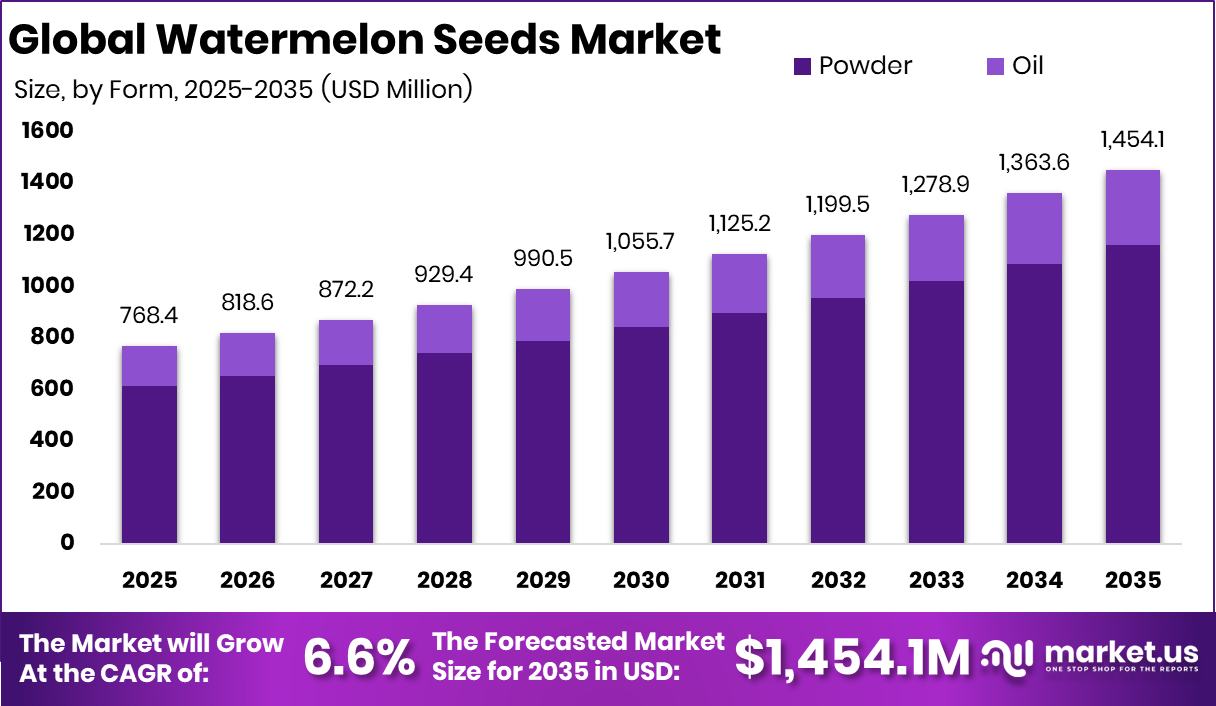
The Global Watermelon Seeds Market is expected to be worth around USD 1,454.1 million by 2035, up from USD 768.4 million in 2025, and is projected to grow at a CAGR of 6.6% from 2026 to 2035. The Watermelon Seeds Market in North America achieved 34.4%, contributing USD 264.3 Bn.
The Global Watermelon Seeds Market spans multiple product types, such as roasted, raw, and dried seeds, with further diversification into powder and oil forms used across the food industry, nutraceuticals, and dietary supplements. These seeds are valued for their nutrient density and versatility, making them suitable for both direct consumption and ingredient-based applications. As online and offline channels expand product accessibility, watermelon seeds continue gaining traction among health-focused consumers seeking natural protein, minerals, and plant-based functional ingredients.
Watermelon seeds are nutrient-rich kernels found within the fruit, typically consumed roasted, raw, dried, or processed into powder or oil. They are naturally high in protein, magnesium, healthy fats, and antioxidants, making them suitable for snacks, culinary use, and wellness applications.
The market refers to the global demand, supply, and production of watermelon seed-based products across food, nutraceutical, and supplement industries, shaped by evolving consumer preferences for clean-label and nutrient-dense plant foods.
Growth in the market is supported by rising demand for protein-rich plant ingredients and a growing consumer shift toward natural functional foods. Recent funding activities strengthen industry innovation, including Watermelon Ecosystem securing $4M Series A, valuing the company at $29 million, and Nourish You raising Rs 16 crore, signaling investor confidence in seed-based nutrition.
Demand continues to rise as consumers explore healthier snacking habits and ingredient-based nutrition. Additional capital inflow such as CredibleX securing US$55M and Corrsy raising USD 500K, contributes to a more supportive business ecosystem where food and agri-focused startups benefit indirectly from stronger regional investment environments.
Opportunities emerge in premium seed processing, clean-label functional ingredients, and product extensions like seed powders and fortified blends. With UAE-based Watermelon raising USD 4M, innovative players gain momentum, enhancing product availability and expanding use cases across global markets.
Key Takeaways
- The Global Watermelon Seeds Market is expected to be worth around USD 1,454.1 million by 2035, up from USD 768.4 million in 2025, and is projected to grow at a CAGR of 6.6% from 2026 to 2035.
- The Watermelon Seeds Market sees strong demand as roasted varieties capture 49.3% global consumption share.
- Powder form dominates the Watermelon Seeds Market, holding 79.8% share and driving broader product innovation worldwide.
- Food industry applications lead the Watermelon Seeds Market, accounting for 49.6% usage across multiple processed product categories.
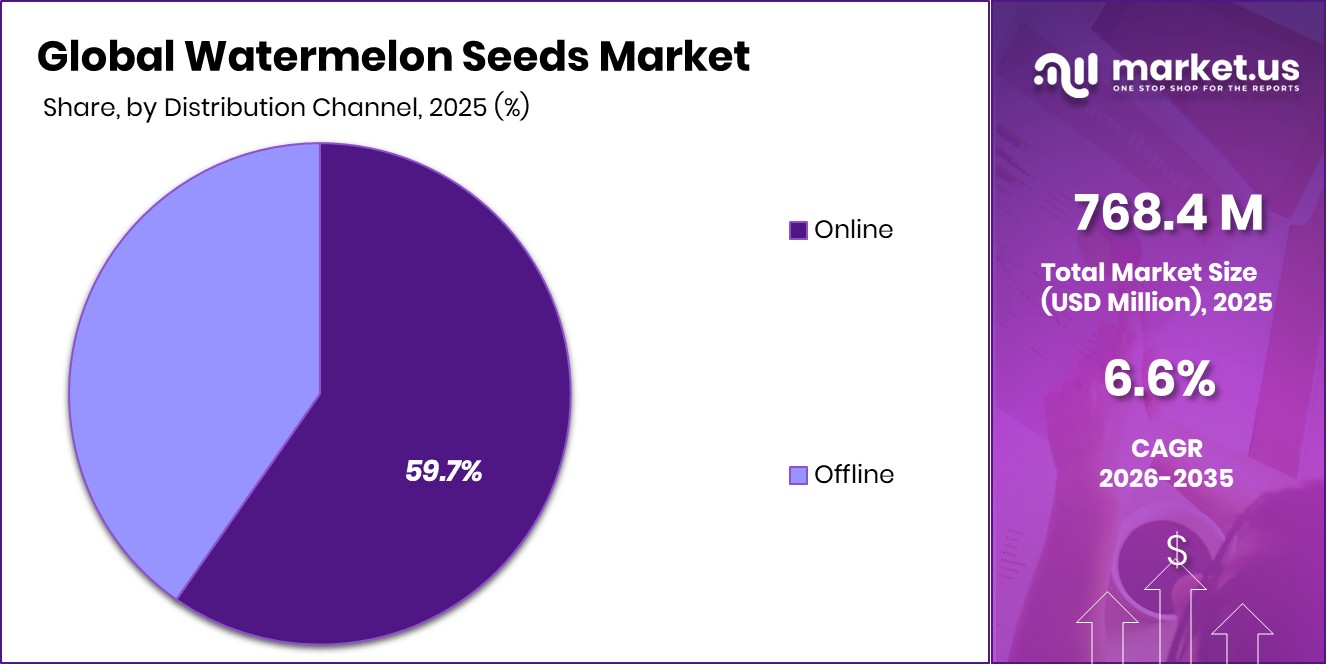
- Online distribution significantly boosts the Watermelon Seeds Market, with 59.7% sales driven by expanding e-commerce penetration.
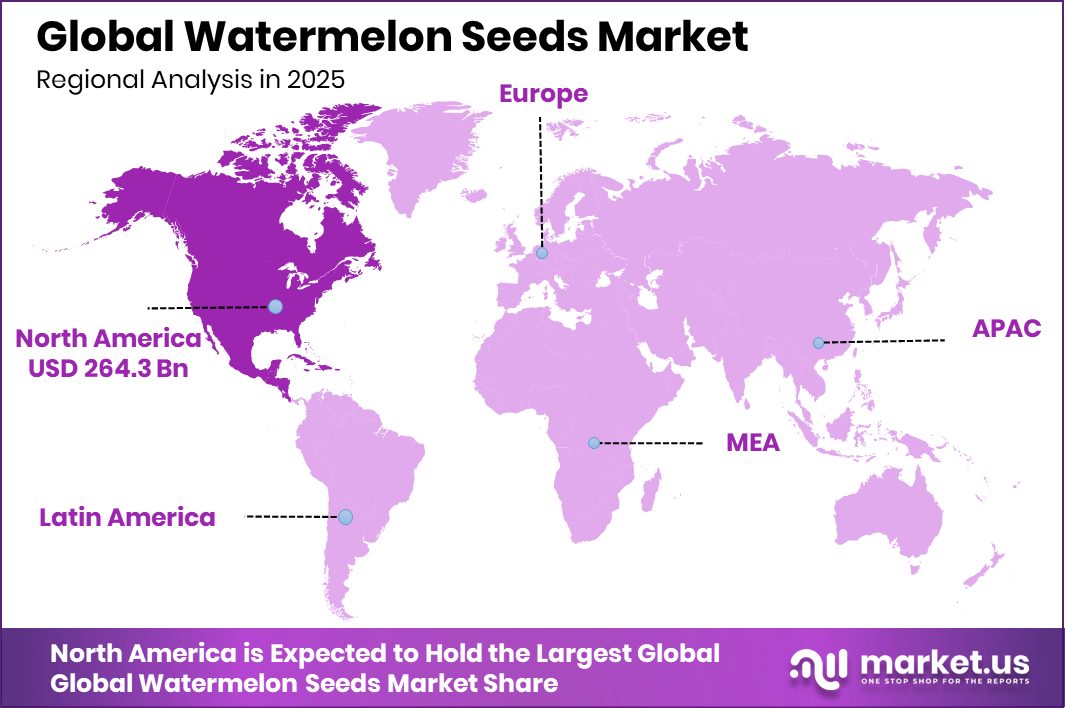
- In North America, the Watermelon Seeds Market reached USD 264.3 Bn with a 34.4% share.
By Type Analysis
Watermelon Seeds Market sees the roasted segment leading with 49.3% global share.
In 2025, the roasted segment is expected to hold a strong 49.3% share in the global Watermelon Seeds Market, reflecting rising consumer preference for ready-to-eat nutritious snacks. The popularity of roasted seeds continues to accelerate as health-conscious buyers seek high-protein, low-carb alternatives to traditional snacking formats. Food brands increasingly highlight natural roasting methods, clean-label formulations, and seasoning variations to attract premium buyers.
The demand is further supported by urban lifestyles, where on-the-go nutritious snacks dominate retail choices. Manufacturers are also introducing zip-lock, portion-controlled, and sustainable packaging to improve shelf appeal. With retailers expanding functional snack categories, roasted watermelon seeds remain a mainstream choice, driving stable demand across emerging and developed regions.
By Form Analysis
Watermelon Seeds Market growth is strengthened as the powder form captures a dominant 79.8% share.
In 2025, the powder form of watermelon seeds is projected to dominate the market with a 79.8% share, driven by its incorporation into bakery mixes, beverages, protein blends, and nutritional formulations. Powdered seed products are favored for their versatility and ability to enhance texture, natural protein levels, and micronutrient content in multiple food applications. The segment’s growth is supported by clean-label reformulations across the wellness food industry, encouraging brands to replace synthetic additives with nutrient-dense seed powders.
Fitness consumers increasingly use watermelon seed powder as a plant-based protein alternative, boosting retail demand. As companies expand product lines in smoothies, fortified foods, and functional supplements, powdered watermelon seeds remain a highly scalable and innovation-driven segment.
By End-Use Analysis
Watermelon Seeds Market expands as food industry accounts for 49.6% of overall demand.
In 2025, the food industry is set to capture 49.6% of total Watermelon Seeds Market demand, supported by rising usage in bakery, confectionery, snack bars, and breakfast cereals. Food manufacturers leverage the seed’s mild flavor and nutritional richness to develop high-fiber and high-protein product variants that appeal to expanding health-aware consumer groups.
Watermelon seeds are increasingly integrated into gluten-free and plant-based product lines, aligning with clean-eating trends. Companies focusing on functional foods use watermelon seed ingredients to enhance natural nutrient profiles without altering taste. As product developers emphasize wholesome formulations and new snack categories, the food industry remains the primary consumer of watermelon seed ingredients across global markets.
By Distribution Channel Analysis
Watermelon Seeds Market accelerates rapidly, with online distribution channels holding 59.7% share.
In 2025, the online distribution channel is expected to maintain a significant 59.7% share in the Watermelon Seeds Market, driven by strong e-commerce penetration and rising digital grocery adoption. Consumers increasingly rely on online platforms for convenient access to premium seed varieties, bulk packs, flavored roasted options, and wellness-oriented products. E-commerce brands are benefiting from subscription-based sales, influencer-led promotions, and transparent labeling that highlights nutritional value.
Online marketplaces also support small and emerging seed brands, allowing them to reach wider audiences without heavy retail investments. With improved logistics, competitive pricing, and fast delivery models, online channels continue to reshape how watermelon seed products are purchased, contributing to robust market expansion.
Key Market Segments
By Type
- Roasted
- Raw
- Dried
By Form
- Powder
- Oil
By End-Use
- Food Industry
- Nutraceuticals
- Dietary Supplements
By Distribution Channel
- Online
- Offline
Driving Factors
Rising health awareness boosts seed consumption.
Rising health awareness boosts seed consumption as more consumers turn toward natural, nutrient-rich foods that fit into balanced diets and clean-eating habits. Watermelon seeds, known for their protein, minerals, and healthy fats, are becoming a preferred choice in both snacks and functional food applications. This shift is supported by expanding agricultural programs in developing regions, such as Nigeria’s initiative providing support to over 50,000 households, which indirectly strengthens seed supply and encourages local cultivation.
As global diets continue to diversify, the market benefits from growing interest in plant-based nutrition and convenient roasted or powdered seed options. Together, these factors create a steady push that supports wider adoption of watermelon seed products across multiple industries.
Restraining Factors
Limited processing facilities slow market expansion
Limited processing facilities slow market expansion, particularly in regions where small-scale producers face challenges in acquiring modern equipment, maintaining hygiene standards, and meeting rising product demand. These constraints can affect consistency in seed quality, shelf stability, and availability, creating barriers for companies trying to scale operations. Although the sector is progressing, gaps in infrastructure remain a key bottleneck.
In this environment, supportive innovation ecosystems become increasingly relevant, such as Egyptian agri-fintech startup Mozare securing over $1M in pre-seed funding from Algebra Ventures, which highlights the growing investment interest in agricultural value chains. However, until processing capacity improves globally, the market may continue experiencing uneven growth and supply-side limitations.
Growth Opportunity
Increasing use in functional food formulations
Increasing use in functional food formulations presents strong opportunities for brands seeking to create high-protein, clean-label, and nutrient-dense offerings. Watermelon seed powder and oil are being integrated into smoothies, snack bars, bakery mixes, and dietary blends, allowing manufacturers to appeal to health-conscious consumers looking for plant-based ingredients. This momentum is further supported by emerging investments that nurture innovation in the nutrition sector.
A key example is the Long Island City-based nutrition startup that raised $20M in Series A funding, signaling rising investor interest in novel nutritional products and ingredient development. As food companies experiment with new formulations, watermelon seeds are positioned to benefit from their adaptability and strong nutritional profile.
Latest Trends
Rising popularity of roasted seed snacks
The rising popularity of roasted seed snacks reflects the shift toward healthier snacking, where consumers look for simple ingredients, high nutrient content, and convenient formats. Roasted watermelon seeds fit this trend well, offering a flavorful and protein-rich alternative to traditional processed snacks.
Beyond consumer preference, regulatory focus is also influencing product development and safety practices. A notable example is the FDA seeking $7.2 billion to enhance food safety, nutrition, and public health, which reinforces industry commitment to stronger standards across the food supply chain. As companies adapt to evolving guidelines, roasted and clean-label seed products continue to gain momentum, shaping evolving trends within the global Watermelon Seeds Market.
Regional Analysis
North America leads the Watermelon Seeds Market with 34.4% share worth USD 264.3 Bn.
In 2025, the Watermelon Seeds Market shows varied regional performance across North America, Europe, Asia Pacific, the Middle East & Africa, and Latin America, reflecting different demand patterns and consumption behaviors.
North America remains the dominant regional market, holding 34.4% share valued at USD 264.3 billion, supported by strong consumer interest in nutrient-rich seed-based foods and widespread retail penetration. Europe continues to expand steadily as health-focused consumers drive higher adoption of seed ingredients in bakery and snack formulations. The Asia Pacific region benefits from a large population base and rising use of seed products in traditional foods, contributing to growing consumption volumes.
Markets in the Middle East & Africa observe a gradual uptake as consumers incorporate seeds into emerging healthy snacking trends. Meanwhile, Latin America shows consistent progress as local manufacturers introduce seed-based offerings aligned with regional dietary habits. Together, these regions shape a balanced global landscape, with North America clearly leading overall market value and percentage share among all global segments.
Key Regions and Countries
- North America
- US
- Canada
- Europe
- Germany
- France
- The UK
- Spain
- Italy
- Rest of Europe
- Asia Pacific
- China
- Japan
- South Korea
- India
- Australia
- Rest of APAC
- Latin America
- Brazil
- Mexico
- Rest of Latin America
- Middle East & Africa
- GCC
- South Africa
- Rest of MEA
Key Players Analysis
In 2025, Bayer CropScience Limited continues to strengthen its position in the global watermelon seeds market through its focus on advanced seed genetics and consistent improvements in crop resilience. The company’s research-backed breeding programs support growers with varieties optimized for yield stability and adaptability across changing climatic conditions. Bayer’s emphasis on delivering dependable seed quality aligns with expanding commercial farming needs, helping reinforce its influence among large-scale producers seeking predictable performance. Its strong distribution capabilities further enhance accessibility for both domestic and international growers.
Vilmorin & Cie maintains a strategic foothold in the watermelon seeds landscape with its long-standing expertise in vegetable seed development and diversification. The company’s commitment to specialized breeding, flavor enhancement, and disease resistance positions it as a preferred partner for growers focusing on premium output. Vilmorin’s global breeding networks and region-specific product portfolios enable it to tailor offerings to different climatic zones, supporting steady competitiveness. Its investment in hybrid seed development continues to attract professional cultivators looking for consistent fruit quality and market-oriented attributes.
Syngenta plays a key role in shaping the market with its extensive innovations in hybrid watermelon seeds and adaptive agronomic traits. The company’s focus on vigor, uniform texture, and improved disease resistance supports farmers targeting large-scale commercial supply chains. Syngenta’s strong technical support and grower outreach programs help optimize crop performance, making its seed varieties reliable choices for producers seeking higher market returns. Its global presence and established seed development capabilities allow the company to influence evolving consumer and industry preferences within the watermelon category.
Top Key Players in the Market
- Bayer CropScience Limited
- Vilmorin & Cie
- Syngenta
- ORIGENE SEEDS
- Rizhao Golden Nut Group
- RIZWAN SEED COMPANY
- GoldSupplier
- TOKITA SEED CO., LTD
- Emerald Seed Company
- Hazera
Recent Developments
- In February 2026, Bayer CropScience reported strong quarterly financials, showing improved revenue and profits. While not specific to watermelon seeds, this performance helps the company continue investing in seed research and agritech innovations more broadly.
- In September 2025, Vilmorin & Cie completed the sale of its AgReliant Genetics joint venture in North America, which the company co-owned with KWS. This move focuses Vilmorin & Cie more tightly on its core seed business and its global vegetable seed offerings.
Report Scope
Report Features Description Market Value (2025) USD 768.4 Million Forecast Revenue (2035) USD 1,454.1 Million CAGR (2026-2035) 6.6% Base Year for Estimation 2025 Historic Period 2020-2024 Forecast Period 2026-2035 Report Coverage Revenue Forecast, Market Dynamics, Competitive Landscape, Recent Developments Segments Covered By Type (Roasted, Raw, Dried), By Form (Powder, Oil), By End-Use (Food Industry, Nutraceuticals, Dietary Supplements), By Distribution Channel (Online, Offline) Regional Analysis North America – US, Canada; Europe – Germany, France, The UK, Spain, Italy, Rest of Europe; Asia Pacific – China, Japan, South Korea, India, Australia, Singapore, Rest of APAC; Latin America – Brazil, Mexico, Rest of Latin America; Middle East & Africa – GCC, South Africa, Rest of MEA Competitive Landscape Bayer CropScience Limited, Vilmorin & Cie, Syngenta, ORIGENE SEEDS, Rizhao Golden Nut Group, RIZWAN SEED COMPANY, GoldSupplier, TOKITA SEED CO., LTD, Emerald Seed Company, Hazera Customization Scope Customization for segments, region/country-level will be provided. Moreover, additional customization can be done based on the requirements. Purchase Options We have three licenses to opt for: Single User License, Multi-User License (Up to 5 Users), Corporate Use License (Unlimited User and Printable PDF)  Watermelon Seeds MarketPublished date: February 2026add_shopping_cartBuy Now get_appDownload Sample
 -
-
- Bayer CropScience Limited
- Vilmorin & Cie
- Syngenta
- ORIGENE SEEDS
- Rizhao Golden Nut Group
- RIZWAN SEED COMPANY
- GoldSupplier
- TOKITA SEED CO., LTD
- Emerald Seed Company
- Hazera
Our Clients

- 179314
- February 2026






