


Global Precision Viticulture Market Size, Share Analysis Report By Component (Hardware, Software, Services), By Application (Yield Monitoring, Field Mapping, Crop Scouting, Weather Tracking And Forecasting, Irrigation Management, Inventory Management, Farm Labor Management) , By Region and Companies - Industry Segment Outlook, Market Assessment, Competition Scenario, Trends and Forecast 2026-2035
- Published date: Mar 2026
- Report ID: 180989
- Number of Pages: 306
- Format:
-
keyboard_arrow_up
Quick Navigation
Report Overview
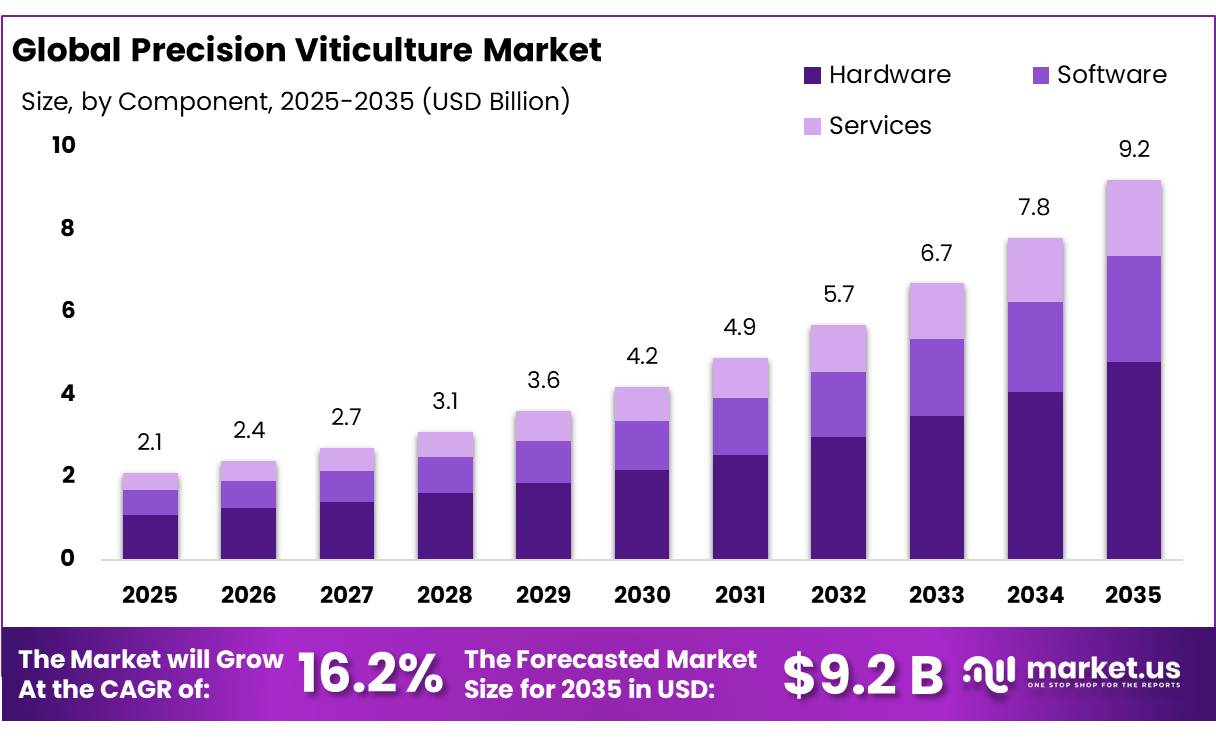
The Global Precision Viticulture Market size is expected to be worth around USD 9.2 Billion by 2035, from USD 2.1 Billion in 2025, growing at a CAGR of 16.2% during the forecast period from 2026 to 2035. In 2025, North America held a dominant market position, capturing more than a 42.8% share, holding USD 0.5 billion revenue.
Precision viticulture represents a technologically advanced approach to vineyard management that integrates geographic information systems (GIS), sensors, drones, satellite imagery, and data analytics to monitor and optimize grape production. This system allows vineyard managers to assess spatial variability within vineyards and apply site-specific management practices such as variable-rate irrigation, fertilization, and pest control. The increasing digitalization of agriculture and the growing demand for high-quality wine are accelerating the adoption of precision viticulture globally.
- According to the International Organisation of Vine and Wine (OIV), global wine production reached 232 million hectolitres in 2025, highlighting the large scale of the viticulture industry and the need for advanced technologies to maintain yield and quality amid climatic fluctuations.
 In addition, emerging regions such as India have expanded vineyard area at an average annual rate of 4.5% since 2019, reaching around 185 thousand hectares in 2024, indicating increasing global investment in grape cultivation.
The driving factors behind this expansion are multifaceted. Rising global demand for high-quality grape products, including wine and table grapes, incentivises growers to invest in predictive analytics and monitoring technologies that improve yield and quality while conserving resources.
Advanced sensors, drones, satellite imagery, global navigation satellite system (GNSS) tools, and artificial intelligence (AI)-powered analytics are central to these efforts, enabling real-time vineyard assessment and site-specific management. Precision agriculture more broadly is also promoted as a solution to food security challenges driven by a growing global population—estimated to reach 9.7 billion by 2050—requiring more efficient resource use and sustainable yield increases.
Government initiatives and policy support also play a significant role in facilitating precision viticulture uptake. In established wine producing regions such as Europe, sustainable vineyard management practices are part of broader agricultural policy frameworks that incentivize environmental performance and innovation in farm operations.
In Australia, for example, the government has allocated over AUD 90 million in funding to support the grape and wine sector, including data-driven vineyard insights and long-term viability programs aimed at reinforcing productivity and resilience. Additional state-level programs, such as Victoria’s AUD 5 million “Wine to the World” export strategy, seek to expand export capacity and competitiveness through targeted support for wineries to enter priority global markets.
Key Takeaways
- Precision Viticulture Market size is expected to be worth around USD 9.2 Billion by 2035, from USD 2.1 Billion in 2025, growing at a CAGR of 16.2%.
- Hardware held a dominant market position, capturing more than a 52.7% share.
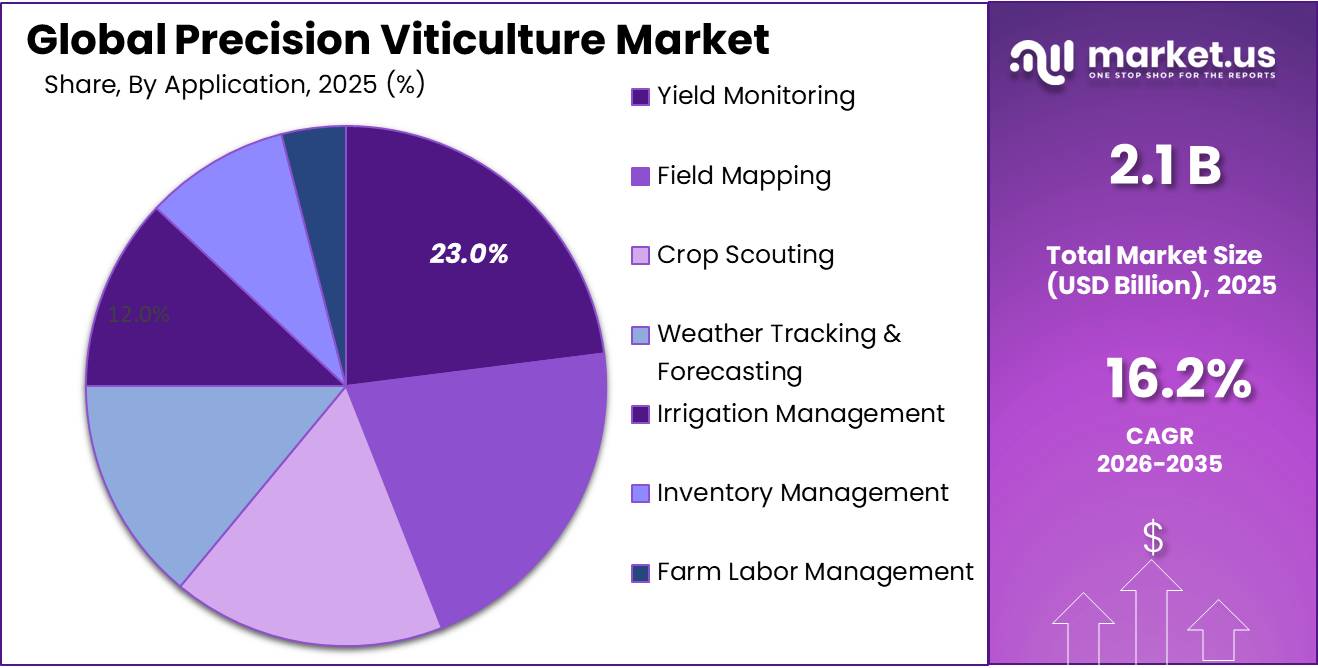
- Yield Monitoring held a dominant market position, capturing more than a 23.9% share.
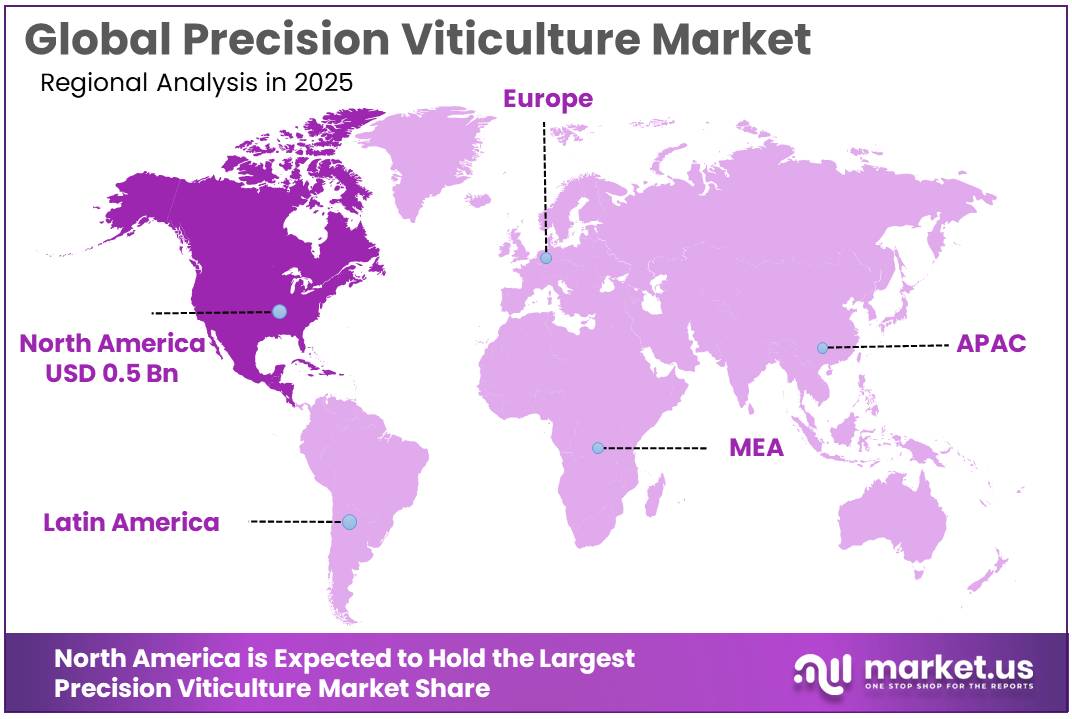
- North American precision viticulture market emerged as a leading regional segment, holding roughly 39.1% of the global pie and generating an estimated USD 0.5 billion.
By Component Analysis
Hardware dominates with 52.7% share driven by strong demand for field-based vineyard technologies
In 2025, Hardware held a dominant market position, capturing more than a 52.7% share. The segment maintained its leadership as vineyard operators continued to invest heavily in physical technologies that directly support field-level decision-making and crop monitoring. Hardware components in precision viticulture mainly include GPS/GNSS systems, remote sensing devices, drones, soil sensors, weather stations, yield monitors, and variable rate application equipment. These tools form the foundation of vineyard data collection and are essential for implementing site-specific management practices.
By Application Analysis
Yield Monitoring leads with 23.9% share as growers focus on production accuracy
In 2025, Yield Monitoring held a dominant market position, capturing more than a 23.9% share. The segment gained strong attention as vineyard owners increasingly focused on measuring grape output with greater precision to improve profitability and planning. Yield monitoring systems allow growers to track production levels across different vineyard blocks, helping them understand variations in soil performance, vine health, and input efficiency. This ability to generate accurate yield data at a micro level played a key role in supporting better harvest decisions during the year.
Key Market Segments
By Component
- Hardware
- Drones
- Application Control Device
- Guidance System
- Remote Sensing
- Variable Rate Technology
- Driverless tractors
- Mobile devices
- Others
- Software
- Cloud-based
- Web-based
- Services
- System Integration and Consulting
- Managed Services
- Assisted Professional Services
By Application
- Yield Monitoring
- Field Mapping
- Crop Scouting
- Weather Tracking & Forecasting
- Irrigation Management
- Inventory Management
- Farm Labor Management
Emerging Trends
Remote Sensing and AI Are Reshaping Precision Viticulture
One of the clearest and most exciting trends in precision viticulture today is the rapid adoption of remote sensing technologies and artificial intelligence (AI) to monitor vineyards more accurately than ever before. Growers no longer rely solely on manual checks or traditional schedules to manage their vines. Instead, they are turning to aerial images from drones, satellites, and sensors on farm equipment—and pairing these with smart analytics—to make better decisions that save time, reduce costs, and improve grape quality.
- According to the International Organisation of Vine and Wine (OIV), the total vineyard surface area in 2024 was about 7.1 million hectares, a small contraction from the previous year but still a vast and highly variable area to manage. Managing this large acreage efficiently is not easy, especially when microclimates and soil conditions can differ significantly even within the same vineyard.
Another part of this trend is that remote sensing tools are becoming more accessible and affordable. Drones, for example, once reserved for larger commercial growers, are increasingly within reach of small-and medium-scale vineyards thanks to lower equipment costs and simplified software interfaces. Many growers also subscribe to satellite image services that deliver regular updates on vine performance without needing physical equipment on site.
Government and institutional support are also nudging adoption in this direction. Although not yet universal, several national agricultural programmes are encouraging the use of digital agriculture tools that increase efficiency and sustainability. These include funding or incentives for soil moisture sensors, climate monitoring stations, and connectivity infrastructure in rural areas—components that make remote sensing data more useful in practice.
Drivers
Climate Change and Resource Efficiency in Precision Viticulture
One of the most significant driving forces pushing precision viticulture forward is the need to adapt to climate change while using resources more efficiently. Vineyard regions around the world are facing increasingly unpredictable weather, droughts, and heat waves that challenge traditional grape growing methods. This shift in climate patterns directly affects grape yield, quality, and the economic stability of viticulture businesses.
- At the same time, the wider food and agriculture system is under pressure. According to the Food and Agriculture Organization (FAO), agriculture accounts for a significant portion of total global greenhouse gas emissions from the food system, which was responsible for about 37% of total emissions in 2020. This means that vineyards—part of the broader agricultural sector—are both affected by climate impacts and contributors to environmental change.
Beyond addressing climate stress, precision viticulture also supports better resource efficiency overall. Agriculture must feed a growing global population now approaching nearly 8 billion people, and at the same time reduce its environmental footprint. Advanced monitoring systems and data analytics help vineyards optimize their irrigation and nutrient use based on real conditions in the field, rather than fixed schedules. This not only conserves water and reduces chemical runoff but also supports healthier vines and higher quality grapes.
Restraints
High Initial Investment and Adoption Challenges for Precision Viticulture
One of the biggest barriers slowing the widespread adoption of precision viticulture is the high upfront cost and financial strain associated with modern technology implementation. Vineyard owners, especially small and medium-scale growers, often find themselves hesitant to commit to expensive equipment such as drones, soil moisture sensors, GPS guidance systems, and advanced data analytics platforms.
According to the United Nations Food and Agriculture Organization (FAO), agriculture continues to be a sector of relatively low economic return compared with its societal importance. For example, smallholder farmers—who make up a substantial share of the global farming population—often operate with limited access to credit or financial instruments that could help cover the costs of advanced technology.
While FAO statistics cover agriculture overall rather than viticulture specifically, they show that roughly 80 % of the world’s farms are smallholder operations, many of which struggle with limited capital for investment in new tools and machinery.
Opportunity
Rising Global Grape Production and Quality Demand Boosts Precision Viticulture
One of the clearest growth opportunities for precision viticulture lies in the rising global grape production and the increasing demand for high-quality grape products, especially wine and table grapes. Every year, vineyards around the world produce tens of millions of tonnes of grapes, and this scale of production presents a huge opportunity for technologies that can help growers improve yield, quality, and sustainability.
In 2024, the world’s vineyard areas produced an estimated 77.7 million tonnes of fresh grapes, showing a 3.7% increase compared with the previous year, according to data from the International Organisation of Vine and Wine (OIV) report on global vine and wine statistics. This volume includes grapes destined for wine, fresh consumption, and drying, and reflects the ongoing importance of this crop across global agriculture.
Another compelling aspect of this opportunity stems from how much of this grape crop goes into wine production. Most grape production—about 71 % of the world’s total—goes into wine, with the balance used primarily as fresh fruit or dried grapes. This means the majority of global grape output enters a value chain where product quality is highly visible to end consumers and directly affects pricing, brand reputation, and returns to growers.
Governments and international organisations are recognising this growth opportunity as well. The Food and Agriculture Organization (FAO) has highlighted digital agriculture as part of its strategy to improve productivity and market access for rural communities. According to the FAO’s programme priorities, digital tools should be made more accessible so farmers and growers can benefit from better data, improved decision-making, and stronger market opportunities.
Regional Insights
North America leads with approximately 39.1% share and around 0.5 billion value driven by advanced viticulture adoption
In 2024, the North American precision viticulture market emerged as a leading regional segment, holding roughly 39.1% of the global pie and generating an estimated USD 0.5 billion in value. This dominant position reflects the region’s early and sustained investment in agricultural technologies, strong presence of commercial vineyards, and supportive infrastructure for data-driven farming.
The United States and Canada, in particular, have seen widespread adoption of remote sensing systems, soil and climate sensors, and machinery with GPS-enabled guidance, enabling growers to monitor spatial variability across vineyards and optimise inputs with remarkable precision.
Key Regions and Countries Insights
- North America
- US
- Canada
- Europe
- Germany
- France
- The UK
- Spain
- Italy
- Rest of Europe
- Asia Pacific
- China
- Japan
- South Korea
- India
- Australia
- Rest of APAC
- Latin America
- Brazil
- Mexico
- Rest of Latin America
- Middle East & Africa
- GCC
- South Africa
- Rest of MEA
Key Players Analysis
Atlas Vineyard Management is a US-based viticulture service and management company operating in premium wine regions like Napa and Sonoma. With an estimated annual revenue around USD 7.5 million and a team of approximately 94 employees, this firm combines traditional vineyard practices with modern tools such as iPads for field data sharing. Its work spans over 8,500 acres of managed vineyards, emphasizing sustainable practices and tailored viticultural solutions for grape quality improvement.
Deveron Corp. is a Canadian precision agriculture technology firm focused on soil sampling, drone data capture, and analytics to help growers make informed decisions. Founded in 2016, it operates with roughly 50-200 employees and delivers detailed agronomic insights to support yield improvements and input optimization. In 2022, Deveron reported a 236 % annual revenue growth to approximately USD 28.9 million, underlining the rising demand for data-centric services in crop systems, including vineyards.
TeeJet Technologies is a US-based agricultural products company specialising in precision application hardware, nozzles, and spray control systems that improve efficiency in vineyards and broadacre farms alike. With estimated annual revenue around USD 35 million and about 500 employees, TeeJet’s equipment helps growers achieve accurate chemical application and improved coverage. Its product portfolio is often integrated with GPS and automation systems, making it a valued contributor to precision input delivery in viticulture operations.
Top Key Players Outlook
- Deere & Company
- Trimble Inc.
- Topcon
- Atlas Vineyard Management, LLC
- Deveron
- TeeJet Technologies
- TABULA
- Aha Viticulture
- Ateknea Solutions
- Group ICV
Recent Industry Developments
In 2025, Trimble Inc. continued to show strength in recurring revenue streams, with annualised recurring revenue reaching USD 2.39 billion and quarterly revenue near USD 970 million, reflecting ongoing demand for its connected services and precision tools.
In fiscal 2025, John Deere recorded net sales of around USD 45.7 billion and net income of about USD 5.03 billion, showing resilience and continued demand for digital farming tools despite economic headwinds.
Report Scope
Report Features Description Market Value (2025) USD 2.1 Bn Forecast Revenue (2035) USD 9.2 Bn CAGR (2026-2035) 16.2% Base Year for Estimation 2025 Historic Period 2020-2024 Forecast Period 2026-2035 Report Coverage Revenue Forecast, Market Dynamics, Competitive Landscape, Recent Developments Segments Covered By Component (Hardware, Software, Services), By Application (Yield Monitoring, Field Mapping, Crop Scouting, Weather Tracking And Forecasting, Irrigation Management, Inventory Management, Farm Labor Management) Regional Analysis North America – US, Canada; Europe – Germany, France, The UK, Spain, Italy, Rest of Europe; Asia Pacific – China, Japan, South Korea, India, Australia, Singapore, Rest of APAC; Latin America – Brazil, Mexico, Rest of Latin America; Middle East & Africa – GCC, South Africa, Rest of MEA Competitive Landscape Deere & Company, Trimble Inc., Topcon, Atlas Vineyard Management, LLC, Deveron, TeeJet Technologies, TABULA, Aha Viticulture, Ateknea Solutions, Group ICV Customization Scope Customization for segments, region/country-level will be provided. Moreover, additional customization can be done based on the requirements. Purchase Options We have three licenses to opt for: Single User License, Multi-User License (Up to 5 Users), Corporate Use License (Unlimited User and Printable PDF)  Precision Viticulture MarketPublished date: Mar 2026add_shopping_cartBuy Now get_appDownload Sample
 -
-
- Deere & Company
- Trimble Inc.
- Topcon
- Atlas Vineyard Management, LLC
- Deveron
- TeeJet Technologies
- TABULA
- Aha Viticulture
- Ateknea Solutions
- Group ICV
Our Clients

- 180989
- Mar 2026






