


Global Omega-3 Polyunsaturated Fatty Acids Market Size, Share, And Enhanced Productivity By Type (Docosahexaenoic Acid, Eicosapentaenoic Acid, Alpha-Linolenic Acid), By Source (Marine Source.Plant Source), By Application (Dietary Supplements, Functional Food and Beverages, Pharmaceutical, Others), By Region and Companies - Industry Segment Outlook, Market Assessment, Competition Scenario, Trends, and Forecast 2025-2034
- Published date: March 2026
- Report ID: 182105
- Number of Pages: 285
- Format:
-
keyboard_arrow_up
Quick Navigation
Report Overview
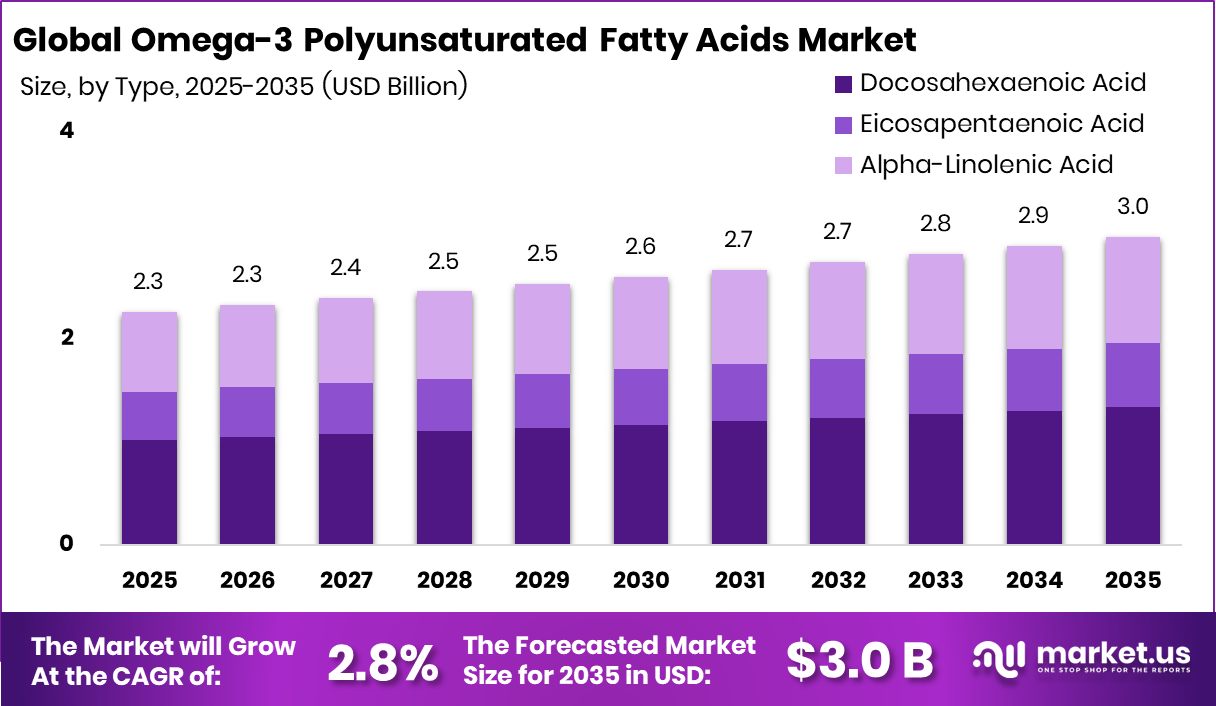
The Global Omega-3 Polyunsaturated Fatty Acids Market is expected to be worth around USD 3.0 billion by 2034, up from USD 2.3 billion in 2024. It is projected to grow at a CAGR of 2.8% from 2025 to 2034. North America dominates the Omega-3 Polyunsaturated Fatty Acids Market, accounting for 38.1% and USD 0.8 Bn.
Omega-3 Polyunsaturated Fatty Acids are essential fats that the human body cannot produce on its own and must obtain through diet or supplements. Key types include docosahexaenoic acid (DHA), eicosapentaenoic acid (EPA), and alpha-linolenic acid (ALA), each playing important roles in heart health, brain function, and inflammation control. These fatty acids are commonly derived from marine and plant sources and are widely used across nutrition and healthcare applications.
The Omega-3 Polyunsaturated Fatty Acids Market refers to the global ecosystem of production, distribution, and consumption of these fatty acids across segments such as dietary supplements, functional foods and beverages, pharmaceuticals, and other applications. The market is shaped by evolving consumer lifestyles, increased focus on preventive health, and expanding product formats that make omega-3 intake more accessible.
Growth is largely driven by rising awareness of long-term health benefits and the shift toward daily supplementation. Demand continues to strengthen as consumers prioritize heart, brain, and immune health through convenient formats like capsules and fortified foods. Expanding applications across age groups further support consistent consumption patterns.
Opportunities are emerging through innovation and investment activity. Long Island City-based nutrition startup raised $20M in Series A funding, while Bactolife secured $35m Series B to commercialize binding protein-based gut health ingredients. ARTAH Nutrition raised £2.85m to expand supplements, and Needed secured $5.8M for pregnancy nutrition products. Additionally, the FDA’s $7.2 billion initiative and a $4,500 Mundelein grant reflect growing institutional and local support.
- In October 2025, Axplora announced a global investment program exceeding €100 million in October 2025 to expand its manufacturing capabilities across multiple sites. The company focuses on producing complex molecules and high-quality ingredients, and this investment strengthens its ability to deliver reliable and scalable production. The expansion includes upgrades in France, Italy, and India, improving capacity and efficiency across its global network.
Key Takeaways
- The Global Omega-3 Polyunsaturated Fatty Acids Market is expected to be worth around USD 3.0 billion by 2034, up from USD 2.3 billion in 2024. It is projected to grow at a CAGR of 2.8% from 2025 to 2034.
- In the Omega-3 Polyunsaturated Fatty Acids Market, docosahexaenoic acid accounts for 44.8% share globally currently.
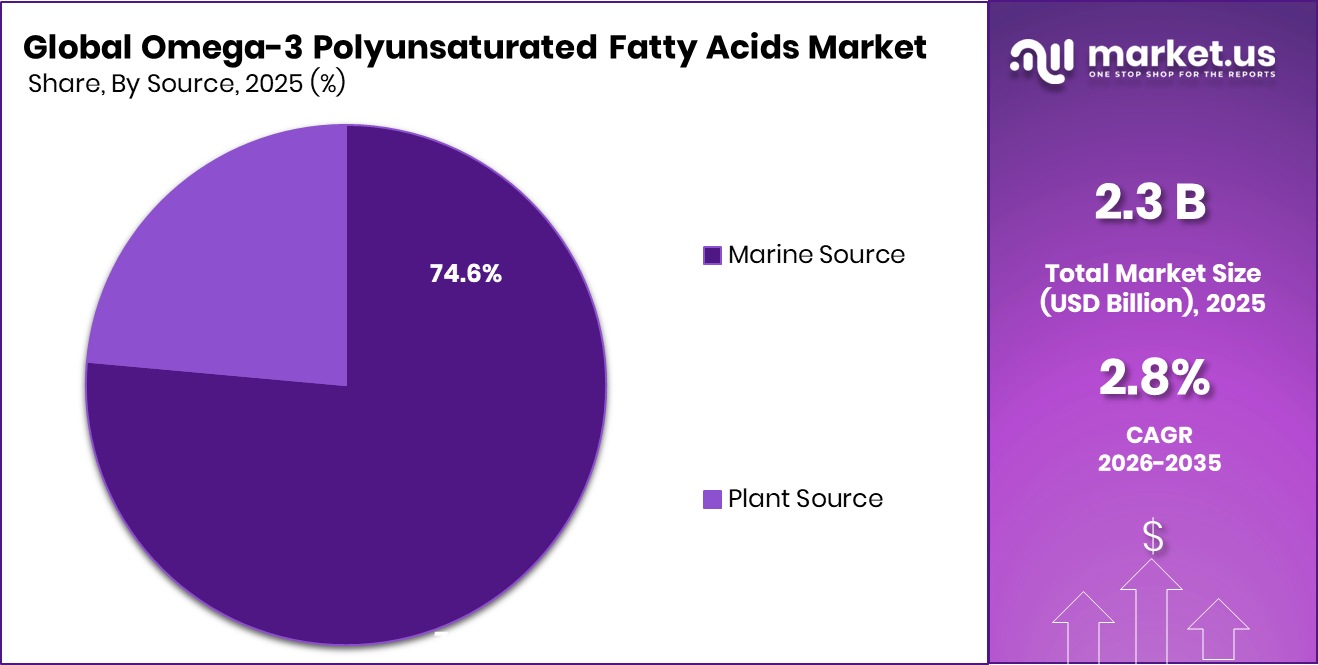
- Marine sources dominate the Omega-3 Polyunsaturated Fatty Acids Market, contributing 74.6% of overall production volume.
- Dietary supplements lead the application in the Omega-3 Polyunsaturated Fatty Acids Market, holding 56.3% demand share.
- The Omega-3 Polyunsaturated Fatty Acids Market in North America holds 38.1%, reaching a USD 0.8 Bn value.
By Type Analysis
Docosahexaenoic Acid dominates the Omega-3 Polyunsaturated Fatty Acids Market share significantly.
In 2025, the Omega-3 Polyunsaturated Fatty Acids Market continues to be strongly driven by docosahexaenoic acid (DHA), which accounts for 44.8% of the total market share by type. DHA’s dominance is largely attributed to its critical role in brain development, cognitive function, and eye health, making it highly sought after in both infant nutrition and adult wellness products. Increasing consumer awareness about preventive healthcare and mental well-being has further fueled demand for DHA-rich formulations.
Additionally, ongoing clinical research highlighting DHA’s benefits in reducing cardiovascular risks and supporting neurological health is encouraging its wider adoption across global markets, particularly in developed regions where health-conscious consumers actively seek scientifically backed nutritional solutions.
By Source Analysis
Marine sources lead the Omega-3 Polyunsaturated Fatty Acids Market due to their abundance.
In 2025, the Omega-3 Polyunsaturated Fatty Acids Market is primarily supported by marine sources, which contribute 74.6% of the total share by source. Fish oil and other marine-based ingredients remain the preferred choice due to their high bioavailability and rich concentration of essential fatty acids like EPA and DHA. The long-standing consumer trust in marine-derived omega-3 products continues to drive their dominance.Moreover, advancements in sustainable fishing practices and improved purification technologies have enhanced product quality, addressing concerns related to contaminants and environmental impact. While plant-based alternatives are emerging, marine sources still lead due to their proven efficacy, especially in clinical nutrition and pharmaceutical-grade applications across global markets.
By Application Analysis
Dietary supplements drive major growth in the Omega-3 Polyunsaturated Fatty Acids Market.
In 2025, the Omega-3 Polyunsaturated Fatty Acids Market sees dietary supplements emerging as the leading application segment, holding 56.3% of the overall share. This growth is largely driven by increasing consumer inclination toward preventive healthcare and daily nutritional support. Omega-3 supplements are widely consumed for heart health, joint support, and cognitive function, making them a staple in many wellness routines.
The rise of aging populations, particularly in developed economies, further boosts demand as individuals seek to manage chronic conditions through supplementation. Additionally, aggressive marketing strategies, easy product availability through online and offline channels, and growing trust in nutraceuticals contribute significantly to the expansion of this segment worldwide.
Key Market Segments
By Type
- Docosahexaenoic Acid
- Eicosapentaenoic Acid
- Alpha-Linolenic Acid
By Source
- Marine Source
- Plant Source
By Application
- Dietary Supplements
- Functional Food and Beverages
- Pharmaceutical
- Others
Driving Factors
Rising awareness of preventive healthcare
In the Omega-3 Polyunsaturated Fatty Acids Market, growing awareness around preventive healthcare continues to influence consumer behavior significantly. Individuals are increasingly focusing on long-term wellness, including heart, brain, and immune health, which supports consistent omega-3 intake through daily nutrition. This shift is also encouraging innovation in functional wellness products.
Reflecting this momentum, NextFoods secured $10 million in Series 3 funding led by ECP Growth to accelerate functional wellness innovation. Such developments indicate how consumer-driven health awareness is shaping product development and expanding the role of omega-3 across modern dietary habits globally.
Increasing demand for dietary supplements
The increasing demand for dietary supplements is a strong driving force in the Omega-3 Polyunsaturated Fatty Acids Market, as consumers seek convenient ways to meet nutritional needs. Omega-3 supplements have become a regular part of health routines, particularly for cardiovascular and cognitive support. This demand is further supported by innovation in gut and nutritional health solutions.
For instance, Bactolife raised $35 million in Series B funding to commercialize a new category of gut health ingredients based on binding proteins. Such investments highlight the broader supplement ecosystem growth, indirectly strengthening demand for omega-3-based products across various consumer segments.
Restraining Factors
High cost of omega-3 ingredients
High production and sourcing costs remain a key restraint in the Omega-3 Polyunsaturated Fatty Acids Market, especially for marine-based ingredients. Factors such as raw material availability, processing complexity, and sustainability requirements contribute to pricing challenges. These costs can limit affordability and restrict adoption in price-sensitive markets.
At the same time, companies across the broader nutrition sector are securing funding to manage scaling challenges. For example, Lo! Foods raised $3.5 million in a Series B round to expand its product offerings. This reflects ongoing efforts to balance cost structures while maintaining product accessibility in a competitive nutrition landscape.
Limited stability and shelf life
Omega-3 fatty acids are sensitive to oxidation, which affects product stability and shelf life, posing a technical challenge for manufacturers. This limitation requires advanced formulation, packaging, and storage solutions, increasing overall production complexity. Stability concerns can also influence consumer confidence and product performance in various applications.
Meanwhile, innovation in alternative ingredient technologies continues to grow. Revyve secured €24 million in funding to expand egg-replacing yeast proteins, reflecting broader advancements in food ingredient science. Such developments highlight the industry’s focus on improving ingredient functionality, which may indirectly support better stability solutions for omega-3 products in the future.
Growth Opportunity
Expansion in plant-based omega sources
The shift toward plant-based nutrition presents strong growth opportunities for the Omega-3 Polyunsaturated Fatty Acids Market. Consumers are increasingly seeking sustainable and vegan alternatives, driving interest in plant-derived omega-3 sources such as algae and seeds. This transition aligns with broader trends in clean-label and environmentally conscious consumption.
Supporting this movement, Greece’s Plant-Based Foods raised €1.05 million to scale its functional plant-based ice cream offerings. Such developments reflect growing investment in plant-based innovation, creating new avenues for omega-3 integration into diverse product formats while expanding market reach beyond traditional marine-based sources.
Growing demand in emerging economies
Emerging economies are becoming important growth areas for the Omega-3 Polyunsaturated Fatty Acids Market due to rising incomes, urbanization, and increasing health awareness. Consumers in these regions are gradually adopting dietary supplements and functional foods, creating new demand channels.
Additionally, local innovation ecosystems are gaining traction. Functional mushroom biotech KÄÄPÄ secured €900k in investment to scale its operations, highlighting expanding interest in health-focused ingredients. This broader momentum in nutritional innovation supports the adoption of omega-3 products, as consumers in developing markets increasingly prioritize wellness and preventive nutrition solutions.
Latest Trends
Innovation in functional food fortification
Functional food fortification is emerging as a key trend in the Omega-3 Polyunsaturated Fatty Acids Market, with manufacturers incorporating omega-3 into everyday food and beverage products. This approach enhances convenience and encourages regular consumption without reliance on supplements alone. The trend is supported by advancements in ingredient technology and formulation methods.
Bactolife secured over €30 million in Series B funding to commercialize binding proteins, reflecting strong innovation in functional ingredients. Such developments contribute to the evolution of fortified products, where omega-3 can be seamlessly integrated into a wide range of consumer food choices.
Rising popularity of algae-based omega-3
Algae-based omega-3 is gaining popularity as a sustainable and vegetarian alternative to traditional marine sources. It offers a direct source of DHA and aligns with clean-label and environmentally friendly preferences. This trend is particularly strong among younger consumers and those following plant-based diets.
Supporting this shift, moringa superfood producer Kuli Kuli secured $5 million in funding led by Kellogg to expand its product portfolio. While focused on plant-based nutrition, such investments highlight the growing acceptance of alternative health ingredients, reinforcing the potential of algae-based omega-3 in future product innovation and market expansion.
Regional Analysis
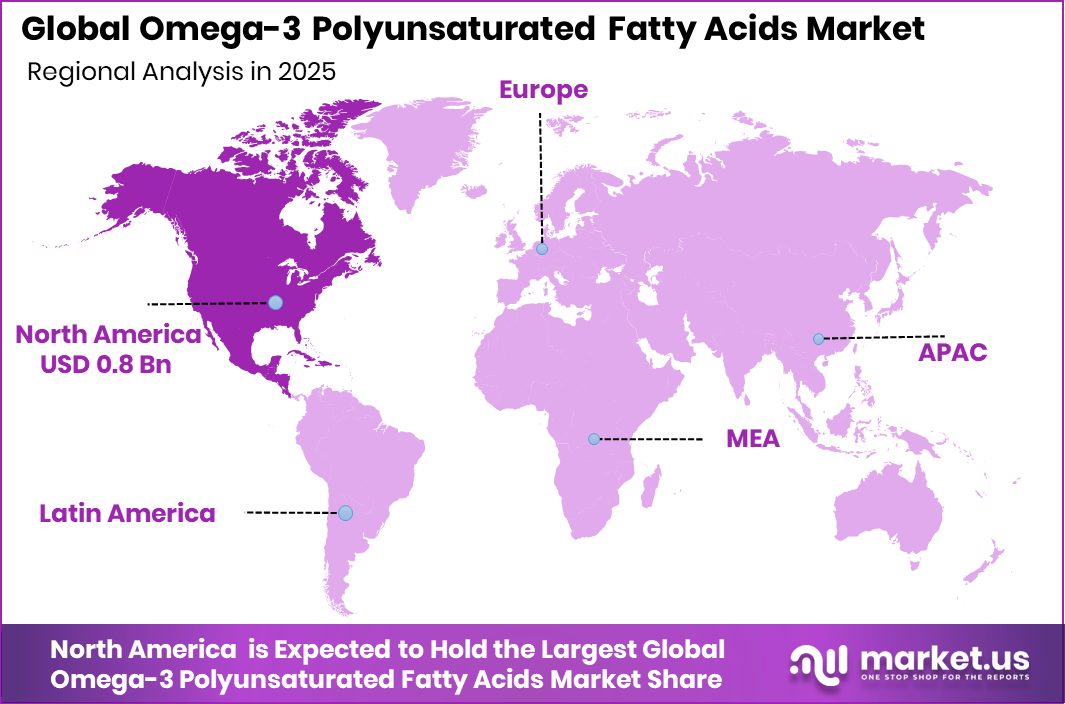
In 2025, North America leads the Omega-3 Polyunsaturated Fatty Acids Market with a 38.1% share, valued at USD 0.8 Bn.
In 2025, the Omega-3 Polyunsaturated Fatty Acids Market demonstrates varied regional dynamics across North America, Europe, Asia Pacific, the Middle East & Africa, and Latin America. North America emerges as the dominating region, accounting for 38.1% of the global market, with a valuation of USD 0.8 Bn, supported by strong consumer awareness and established supplement consumption patterns. Europe follows with steady demand driven by health-conscious populations and widespread adoption of omega-3 in functional foods and nutraceuticals.
Asia Pacific is witnessing notable expansion due to rising disposable incomes, increasing urbanization, and growing interest in preventive healthcare, particularly in emerging economies. Meanwhile, the Middle East & Africa region shows gradual growth, supported by improving healthcare infrastructure and rising dietary supplement penetration.
Latin America also reflects moderate development, with expanding retail channels and growing awareness of omega-3 benefits. Overall, while all regions contribute to market growth, North America continues to lead in both share and value, maintaining its dominant position in the global landscape.
Key Regions and Countries
- North America
- US
- Canada
- Europe
- Germany
- France
- The UK
- Spain
- Italy
- Rest of Europe
- Asia Pacific
- China
- Japan
- South Korea
- India
- Australia
- Rest of APAC
- Latin America
- Brazil
- Mexico
- Rest of Latin America
- Middle East & Africa
- GCC
- South Africa
- Rest of MEA
Key Players Analysis
In 2025, Aker Biomarine ASA continues to position itself as a specialized player with a focused approach toward marine-based omega-3 solutions. The company’s emphasis on krill-derived ingredients differentiates it within the competitive landscape, allowing it to cater to premium product segments. Its vertically integrated operations support consistency in sourcing and product quality, which strengthens its presence among health-focused consumers. This strategic positioning reflects a clear commitment to innovation within marine nutrition.
Archer Daniels Midland Company demonstrates a diversified operational model, leveraging its broad capabilities across nutrition and ingredient solutions. Its involvement in omega-3 fatty acids aligns with its wider portfolio, enabling integration across multiple application areas. The company’s size and well-established supply chain give it an edge over its competitors when it comes to distribution and accessibility. This enables ADM to maintain a stable presence while addressing evolving consumer preferences through flexible product offerings.
Axplora Group GmbH brings a distinct approach through its expertise in complex molecule development and manufacturing. Its role in the omega-3 space is supported by technical capabilities that align with high-quality production standards. The company’s focus on precision and reliability positions it as a dependable contributor within specialized segments. This strengthens its relevance in applications requiring consistent formulation and controlled production environments.
Top Key Players in the Market
- Aker Biomarine AA
- Archer Daniels Midland Company
- Axplora Group GmbH
- BASF SE
- Berg Lipidtech AS (BLT)
- Cellana LLC
- Croda International Plc
- DSM-Firmenich AG
- Epax AS
- Evonik Nutrition & Care GmbH
Recent Developments
- In December 2024, BASF signed an agreement to sell its Food and Health Performance Ingredients business to Louis Dreyfus Company. This business includes omega-3 oils used in human nutrition, along with other health ingredients. The move shows BASF restructuring its portfolio and focusing on core areas while transferring omega-3-related nutrition assets to another company.
- In November 2024, Aker BioMarine introduced PL+ EPA/DHA, a new omega-3 formulation combining krill phospholipids with fish oil. The company focuses on improving absorption, and this product shows significantly higher uptake in the body compared to traditional omega-3 oils. This innovation strengthens its position in high-performance nutritional ingredients.
Report Scope
Report Features Description Market Value (2025) USD 2.3 Billion Forecast Revenue (2035) USD 3.0 Billion CAGR (2026-2035) 2.8% Base Year for Estimation 2025 Historic Period 2020-2024 Forecast Period 2026-2035 Report Coverage Revenue Forecast, Market Dynamics, Competitive Landscape, Recent Developments Segments Covered By Type (Docosahexaenoic Acid, Eicosapentaenoic Acid, Alpha-Linolenic Acid), By Source (Marine Source, Plant Source), By Application (Dietary Supplements, Functional Food and Beverages, Pharmaceutical, Others) Regional Analysis North America – US, Canada; Europe – Germany, France, The UK, Spain, Italy, Rest of Europe; Asia Pacific – China, Japan, South Korea, India, Australia, Singapore, Rest of APAC; Latin America – Brazil, Mexico, Rest of Latin America; Middle East & Africa – GCC, South Africa, Rest of MEA Competitive Landscape Aker Biomarine AA, Archer Daniels Midland Company, Axplora Group GmbH, BASF SE, Berg Lipidtech AS (BLT), Cellana LLC, Croda International Plc, DSM-Firmenich AG, Epax AS, Evonik Nutrition & Care GmbH Customization Scope Customization for segments, region/country-level will be provided. Moreover, additional customization can be done based on the requirements. Purchase Options We have three licenses to opt for: Single User License, Multi-User License (Up to 5 Users), Corporate Use License (Unlimited User and Printable PDF)  Omega-3 Polyunsaturated Fatty Acids MarketPublished date: March 2026add_shopping_cartBuy Now get_appDownload Sample
 -
-
- Aker Biomarine AA
- Archer Daniels Midland Company
- Axplora Group GmbH
- BASF SE
- Berg Lipidtech AS (BLT)
- Cellana LLC
- Croda International Plc
- DSM-Firmenich AG
- Epax AS
- Evonik Nutrition & Care GmbH
Our Clients

- 182105
- March 2026






