Global Manufacturing Analytics Market By Component/Offering (Software Platforms & Applications [Descriptive Analytics Modules, Predictive & Prescriptive Analytics Modules], Services [Consulting & Implementation, Managed Services & Support]), By Deployment Model (On-Premises Deployment, Cloud-Based/SaaS Deployment, Hybrid Deployment), By Application/Use Case (Predictive Maintenance & Asset Management, Quality Control & Defect Analytics, Others), By Industry Vertical (Automotive Manufacturing, Electronics & Semiconductor Manufacturing),By Regional Analysis, Global Trends and Opportunity, Future Outlook By 2025-2035
- Published date: Feb. 2026
- Report ID: 178556
- Number of Pages: 199
- Format:
-
keyboard_arrow_up
Quick Navigation
- Report Overview
- Top Market Takeaways
- Drivers Impact Analysis
- Restraints Impact Analysis
- By Component and Offering
- By Deployment Model
- By Application and Use Case
- By Industry Vertical
- Investor Type Impact Matrix
- Technology Enablement Analysis
- Emerging Trends
- Growth Factors
- Key Market Segments
- Regional Analysis
- Competitive Analysis
- Future Outlook
- Recent Developments
- Report Scope
Report Overview
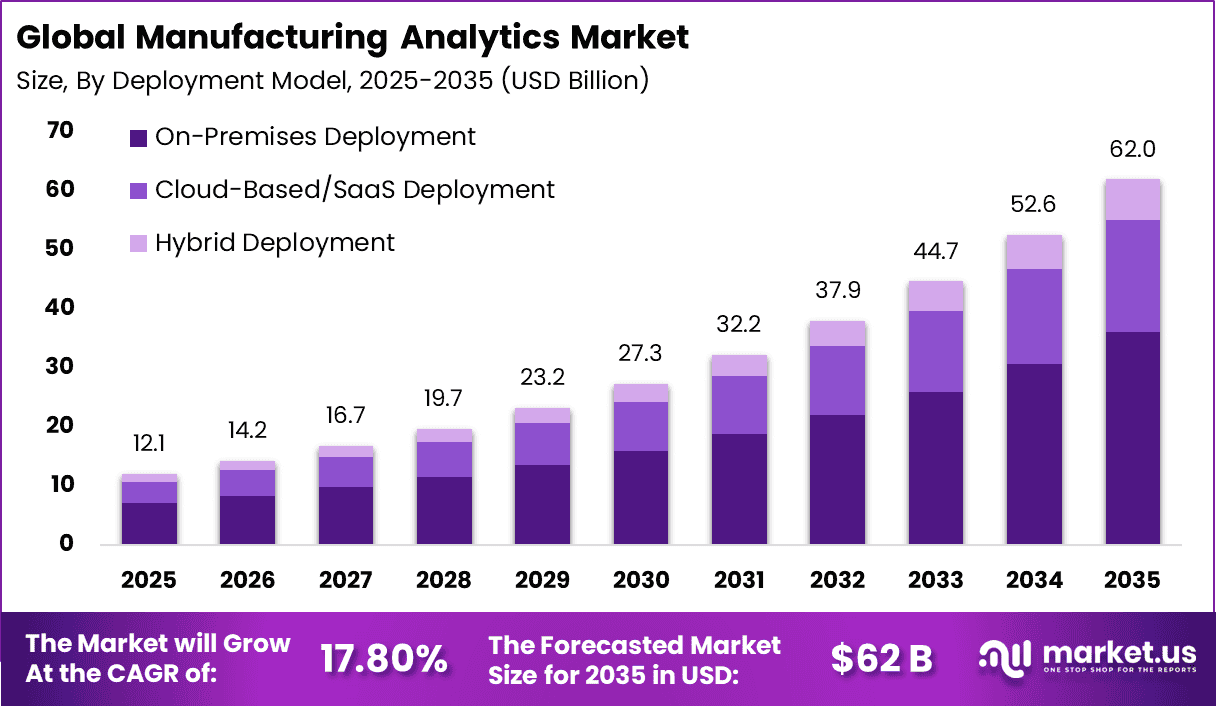
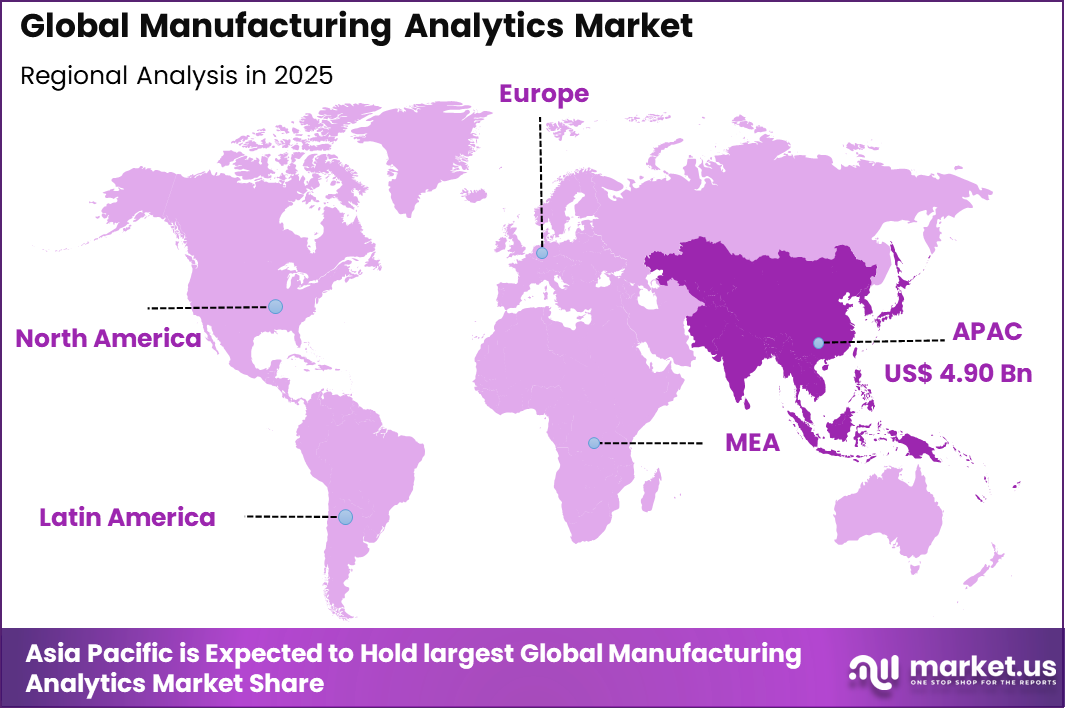
The Global Manufacturing Analytics Market generated USD 12.1 billion in 2025 and is predicted to register growth from USD 14.2 billion in 2026 to about USD 62 billion by 2035, recording a CAGR of 17.80% throughout the forecast span. In 2025, Asia Pacific held a dominan market position, capturing more than a 40.7% share, holding USD 4.90 Billion revenue.
The manufacturing analytics market is expanding as industrial enterprises move toward data driven production environments. Factories are increasingly equipped with sensors, connected machines, and digital control systems that generate large volumes of operational data. Analytics platforms convert this data into performance indicators that improve efficiency, reduce waste, and enhance product quality. As competition intensifies across global manufacturing hubs, data based decision making has become a strategic priority rather than an optional capability.
Digital transformation initiatives across industrial sectors are reinforcing demand for advanced analytics tools. Integration of enterprise resource planning systems, manufacturing execution systems, and industrial Internet of Things devices has created unified data ecosystems. These ecosystems allow real time monitoring of production lines and predictive assessment of equipment health. Manufacturing analytics is therefore positioned as a core enabler of smart factory development and operational resilience.
A primary driver of the Manufacturing Analytics market is the increasing focus on operational efficiency and cost optimization. Competitive pressures require manufacturers to minimize downtime and maximize asset utilization. Analytics platforms provide insights into production bottlenecks, energy consumption, and resource allocation. This capability supports measurable performance improvements.
Top Market Takeaways
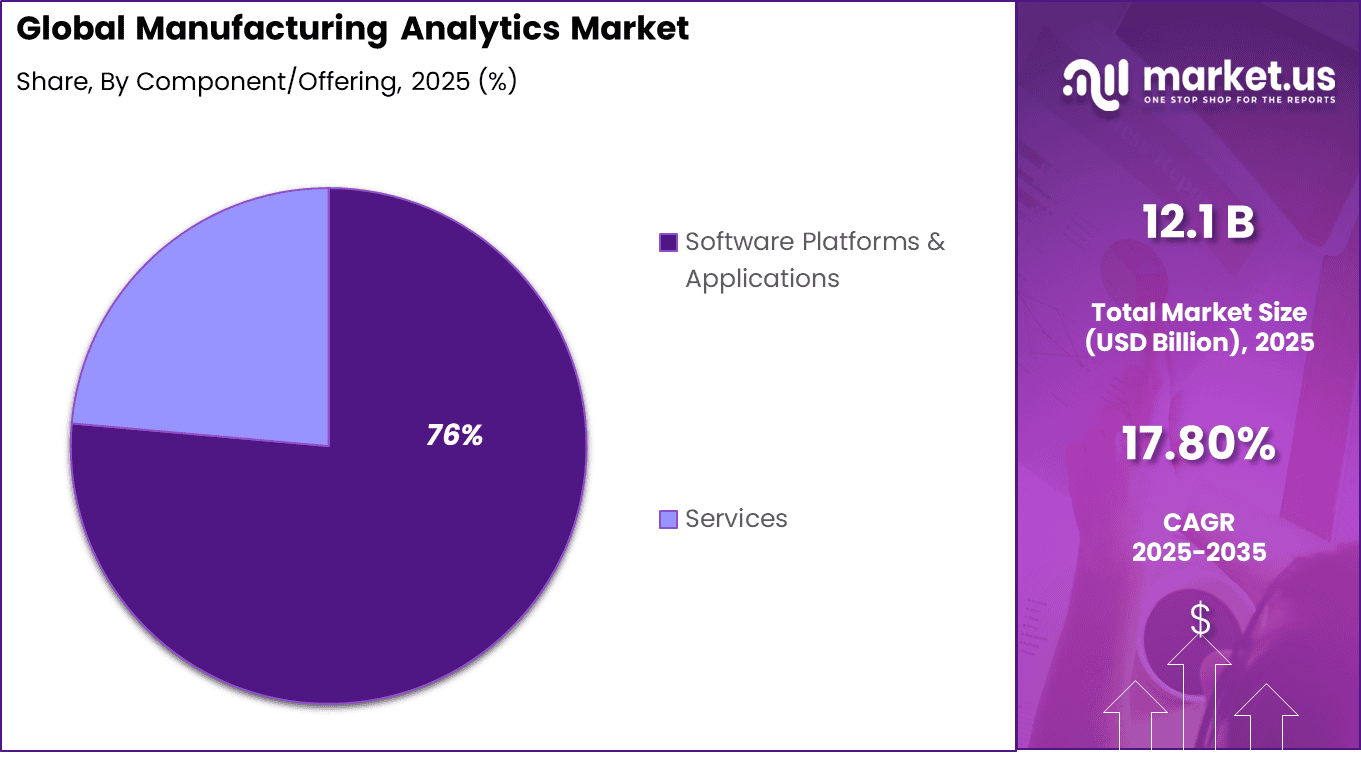
- By component/offering, software platforms & applications account for 76.4% of the market, delivering dashboards, AI algorithms, and integration for operational insights.
- By deployment model, on-premises deployment represents 58.2%, chosen for data security, low latency, and control in regulated settings.
- By application/use case, predictive maintenance & asset management capture 38.7%, forecasting failures and optimizing schedules via IoT and ML.
- By industry vertical, automotive manufacturing holds 40.5% share, applying analytics for supply chains, quality, and EV production.
Drivers Impact Analysis
Key Driver Impact on CAGR Forecast (~%) Geographic Relevance Impact Timeline Adoption of Industry 4.0 and Smart Factory Initiatives +3.4% Asia Pacific, Europe Medium to Long Term Increasing Deployment of Industrial IoT Sensors +2.9% Asia Pacific, North America Short to Medium Term Demand for Predictive Maintenance Solutions +2.3% Global Immediate to Medium Term Expansion of Cloud Based Manufacturing Platforms +1.8% North America, Asia Pacific Medium Term Rising Focus on Operational Efficiency and Cost Reduction +1.2% Global Ongoing Restraints Impact Analysis
Key Restraint Impact on CAGR Forecast (~%) Geographic Relevance Impact Timeline High Initial Implementation Costs -2.6% Asia Pacific, Latin America Short Term Data Security and Cyber Risk Concerns -1.9% North America, Europe Medium Term Lack of Skilled Data Analytics Workforce -1.4% Emerging Markets Medium Term Integration Challenges with Legacy Systems -1.0% Global Ongoing Uncertain ROI Measurement in Early Adoption Stages -0.6% Global Short Term By Component and Offering
Software platforms and applications account for 76.4% of the manufacturing analytics market, reflecting the central role of data-driven decision systems in modern production environments. These platforms collect, process, and interpret operational data from machines, sensors, and enterprise systems. Manufacturers rely on dashboards and analytics engines to monitor performance indicators such as downtime, throughput, and quality metrics.
The dominance of software solutions indicates a shift toward intelligence-led manufacturing operations. Advanced analytics platforms integrate machine learning algorithms to improve forecasting accuracy and operational planning. Real-time visualization tools enable managers to respond quickly to production inefficiencies. Integration with enterprise resource planning and manufacturing execution systems strengthens cross-functional coordination.
By Deployment Model
On-premises deployment holds 58.2% share, highlighting the preference for direct control over sensitive operational data. Many manufacturers operate in highly regulated environments where data sovereignty and system security are critical. On-site infrastructure allows companies to customize analytics configurations and maintain tighter governance. This approach remains common in facilities managing proprietary production processes.
While cloud-based and hybrid models are expanding, physical infrastructure continues to support large-scale industrial operations. Manufacturing plants often require low-latency data processing for real-time machine monitoring. Hybrid models are gradually emerging as companies combine cloud flexibility with local control. However, on-premises systems still represent the primary deployment framework across established production networks..
By Application and Use Case
Predictive maintenance and asset management represent 38.7% of total applications, underscoring the operational value of analytics in reducing unplanned downtime. Manufacturers use data models to anticipate equipment failures before breakdowns occur. Sensors embedded in machinery continuously generate performance data that is analyzed to detect anomalies. This proactive approach improves equipment lifespan and production reliability.
Asset management analytics also support optimized spare parts planning and maintenance scheduling. Reducing downtime directly contributes to improved cost efficiency and production continuity. The shift from reactive to predictive strategies reflects broader industrial automation trends. As competition intensifies, minimizing operational disruptions remains a strategic priority.
By Industry Vertical
Automotive manufacturing accounts for 40.5% of industry adoption, reflecting the sector’s advanced automation and data integration practices. Automotive plants operate complex production lines that require precise coordination between robotics, assembly units, and supply chain systems. Analytics platforms are used to monitor quality control, inventory flows, and production cycle times. This vertical’s strong adoption highlights its commitment to operational efficiency.
The transition toward electric vehicles and connected car technologies further increases data complexity within automotive facilities. Manufacturers are investing in analytics tools to manage supply chain variability and component traceability. Continuous improvement programs rely heavily on real-time production insights. As vehicle production evolves, analytics remain central to competitiveness and compliance.
Investor Type Impact Matrix
Investor Type Impact on CAGR Forecast (~%) Geographic Relevance Investment Horizon Industrial Automation Corporations +3.0% Asia Pacific, Europe Long Term Enterprise Software Providers +2.2% North America Medium to Long Term Private Equity in Industrial Digitalization +1.6% Asia Pacific Medium Term Venture Capital in AI Analytics Platforms +1.1% North America, Asia Pacific Medium Term Strategic Manufacturing Conglomerates +0.8% Global Long Term Technology Enablement Analysis
Technology Enabler Impact on CAGR Forecast (~%) Geographic Relevance Impact Timeline Artificial Intelligence and Machine Learning Models +3.5% Global Immediate to Medium Term Edge Computing in Industrial Environments +2.4% Asia Pacific, Europe Medium Term Digital Twin Technology +2.0% Europe, North America Medium to Long Term Advanced Data Visualization Platforms +1.3% Global Immediate 5G Enabled Industrial Connectivity +0.9% Asia Pacific Medium Term Emerging Trends
In the Manufacturing Analytics market, a strong trend is the shift toward real-time process insight that supports immediate action on quality and performance issues. Manufacturers are moving from periodic batch reporting to systems that continuously collect and analyse data from production lines, equipment sensors, and inspection stations.
This change helps teams identify patterns of variation as they happen and adjust settings or workflows before defects accumulate. Another emerging pattern is the presentation of insights in clear visuals and simple summaries, so production managers and technicians can understand causes and effects without needing deep analytical expertise.
Growth Factors
A key growth driver in this market is the increasing priority placed on operational efficiency and waste reduction in production environments. Manufacturers face pressure to deliver consistent quality while keeping costs under control, and analytics supports these goals by highlighting areas where processes drift or resources are under-utilised. By understanding performance data more deeply, organisations can make better decisions about maintenance schedules, line balancing, and material flows.
Another important driver is the need to support cross-functional alignment between production, quality, and supply chain teams. Shared analytical insights help these groups speak the same language about production performance, reduce friction in problem solving, and build confidence that actions are based on accurate, transparent information.
Key Market Segments
By Component/Offering
- Software Platforms & Applications
- Descriptive Analytics Modules
- Predictive & Prescriptive Analytics Modules
- Services
- Consulting & Implementation
- Managed Services & Support
By Deployment Model
- On-Premises Deployment
- Cloud-Based/SaaS Deployment
- Hybrid Deployment
By Application/Use Case
- Predictive Maintenance & Asset Management
- Quality Control & Defect Analytics
- Inventory & Supply Chain Optimization
- Energy & Resource Efficiency Analytics
- Production Throughput & OEE (Overall Equipment Efficiency) Analytics
- Others
By Industry Vertical
- Automotive Manufacturing
- Electronics & Semiconductor Manufacturing
- Metal & Machinery Manufacturing
- Food & Beverage Manufacturing
- Pharmaceutical & Chemical Manufacturing
- Other Discrete & Process Manufacturing
Regional Analysis
Asia Pacific accounts for 40.7% of the manufacturing analytics market, supported by rapid industrialization and strong expansion of smart manufacturing initiatives across major economies. Manufacturers in the region are increasingly adopting analytics platforms to improve production efficiency, reduce downtime, and enhance supply chain visibility. Demand is driven by rising automation levels, integration of industrial IoT systems, and the need to optimize operational performance in high-volume production environments.
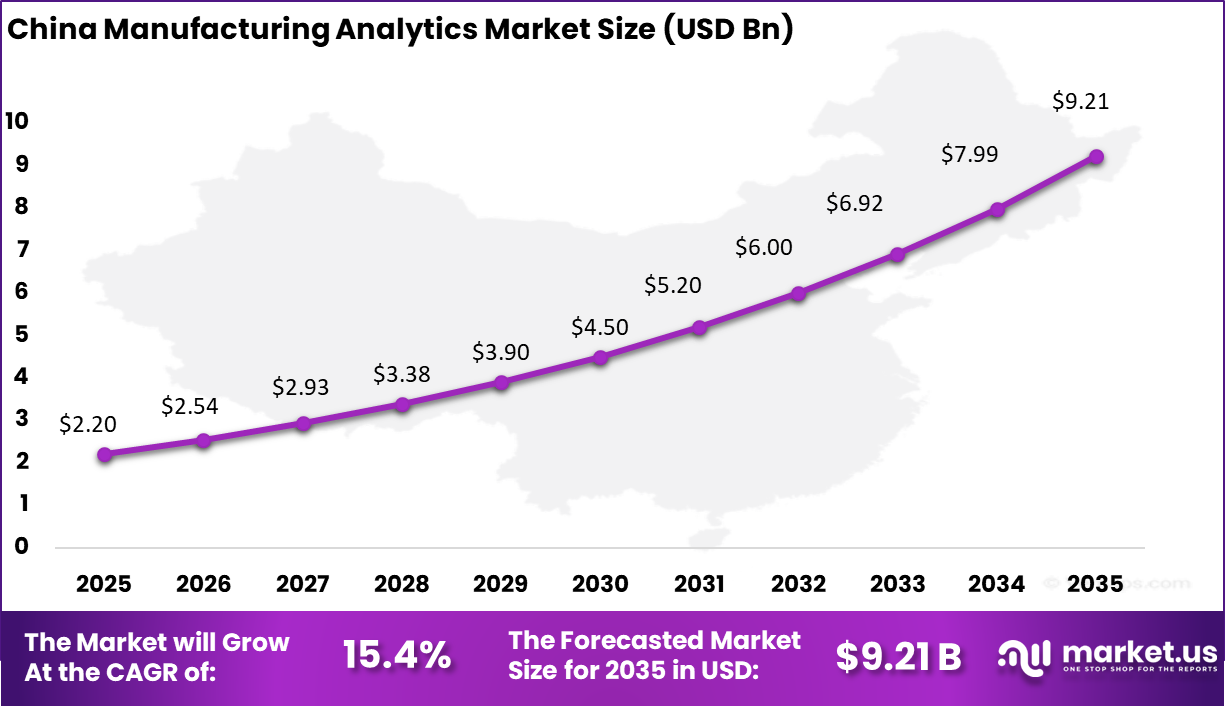
China represents a market size of USD 2.20 Bn and is growing at a CAGR of 15.4%, reflecting large-scale investment in digital factory transformation. Adoption is influenced by government-backed industrial modernization programs, increasing use of robotics, and the deployment of predictive maintenance solutions across manufacturing facilities. Growth is further supported by expansion of data-driven quality control systems and advanced analytics tools that enhance productivity and reduce operational costs.
Key Regions and Countries
- North America
- US
- Canada
- Europe
- Germany
- France
- The UK
- Spain
- Italy
- Russia
- Netherlands
- Rest of Europe
- Asia Pacific
- China
- Japan
- South Korea
- India
- Australia
- Singapore
- Thailand
- Vietnam
- Rest of APAC
- Latin America
- Brazil
- Mexico
- Rest of Latin America
- Middle East & Africa
- South Africa
- Saudi Arabia
- UAE
- Rest of MEA
Competitive Analysis
The Manufacturing Analytics market is led by established technology and industrial automation providers such as IBM Corporation, Microsoft Corporation, SAS Institute, Siemens AG, GE Digital, ABB, Rockwell Automation, TIBCO Software, Alteryx, and Tableau Software.
These companies compete on advanced data analytics, integration with industrial control systems, and strong support for predictive maintenance and production optimization. Their platforms are widely adopted by large manufacturers that require centralized data visibility across plants, supply chains, and equipment networks.
Competition in this market is driven by real time monitoring, machine performance analytics, and ease of integration with existing enterprise systems. Leading players focus on improving operational efficiency, reducing downtime, and supporting data driven decision making at the factory level.
Top Key Players in the Market
- IBM Corporation
- Microsoft Corporation
- SAS Institute Inc.
- Siemens AG
- GE Digital
- ABB Ltd.
- Rockwell Automation
- TIBCO Software Inc.
- Alteryx Inc.
- Tableau Software
- Others
Future Outlook
The future outlook for the Manufacturing Analytics Market is positive as manufacturers increasingly use data to improve production efficiency and quality. Demand for analytics solutions is expected to grow because these tools help identify trends, reduce downtime, and optimize operations.
Adoption of real-time data processing, artificial intelligence, and predictive insights will support better decision making across the manufacturing floor. Growth can be attributed to rising focus on automation, cost reduction, and competitive performance improvement. Overall, the market is expected to expand as companies prioritize data-driven manufacturing processes.
Recent Developments
- January, 2025 – SAP announced digital twin analytics capabilities for smart manufacturing. This integrates with SAP Analytics Cloud for production monitoring. It helps firms model operations and predict outcomes.
- In 2025 – GE Digital’s Predix APM offers asset performance management. It provides data-driven insights for efficiency. Manufacturers use it to cut downtime through simulations.
Report Scope
Report Features Description Market Value (2025) USD 12.1 Billion Forecast Revenue (2035) USD 62 Billion CAGR(2025-2035) 17.80% Base Year for Estimation 2024 Historic Period 2020-2024 Forecast Period 2025-2035 Report Coverage Revenue forecast, AI impact on Market trends, Share Insights, Company ranking, competitive landscape, Recent Developments, Market Dynamics and Emerging Trends Segments Covered By Component/Offering (Software Platforms & Applications [Descriptive Analytics Modules, Predictive & Prescriptive Analytics Modules], Services [Consulting & Implementation, Managed Services & Support]), By Deployment Model (On-Premises Deployment, Cloud-Based/SaaS Deployment, Hybrid Deployment), By Application/Use Case (Predictive Maintenance & Asset Management, Quality Control & Defect Analytics, Others), By Industry Vertical (Automotive Manufacturing, Electronics & Semiconductor Manufacturing) Regional Analysis North America – US, Canada; Europe – Germany, France, The UK, Spain, Italy, Russia, Netherlands, Rest of Europe; Asia Pacific – China, Japan, South Korea, India, New Zealand, Singapore, Thailand, Vietnam, Rest of Latin America; Latin America – Brazil, Mexico, Rest of Latin America; Middle East & Africa – South Africa, Saudi Arabia, UAE, Rest of MEA Competitive Landscape IBM Corporation, Microsoft Corporation, SAS Institute Inc., Siemens AG, GE Digital, ABB Ltd., Rockwell Automation, TIBCO Software Inc., Alteryx Inc., Tableau Software, Others Customization Scope Customization for segments, region/country-level will be provided. Moreover, additional customization can be done based on the requirements. Purchase Options We have three license to opt for: Single User License, Multi-User License (Up to 5 Users), Corporate Use License (Unlimited User and Printable PDF)  Manufacturing Analytics MarketPublished date: Feb. 2026add_shopping_cartBuy Now get_appDownload Sample
 -
-
- IBM Corporation
- Microsoft Corporation
- SAS Institute Inc.
- Siemens AG
- GE Digital
- ABB Ltd.
- Rockwell Automation
- TIBCO Software Inc.
- Alteryx Inc.
- Tableau Software
- Others
Our Clients

- 178556
- Feb. 2026