


Report Overview
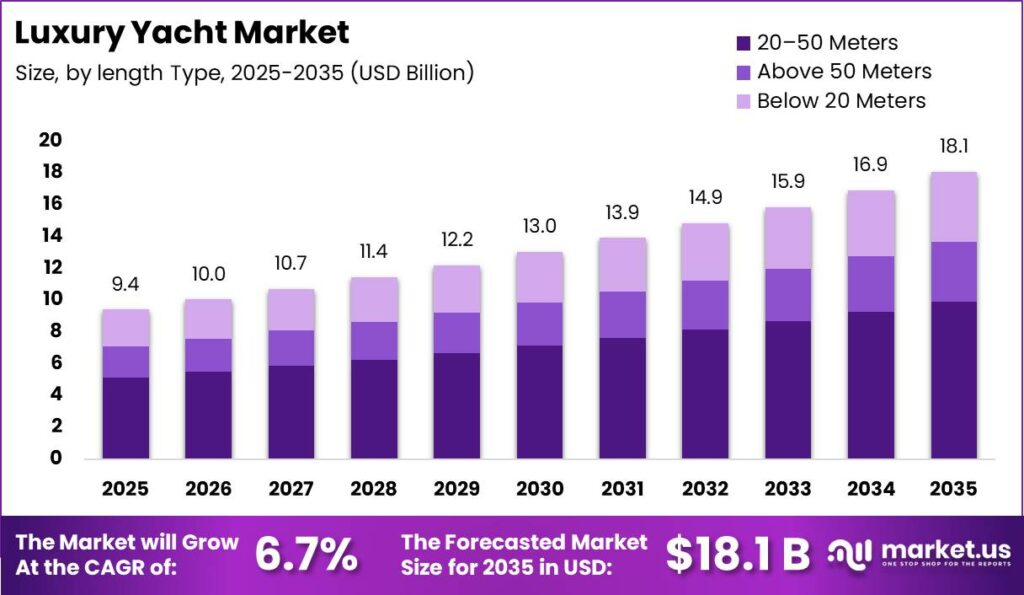
Global Luxury Yacht Market size is expected to be worth around USD 18.10 Billion by 2035 from USD 9.40 Billion in 2025, growing at a CAGR of 6.7% during the forecast period 2026 to 2035. This trajectory nearly doubles market value across ten years. Vendors that secure production slots early will capture disproportionate share as demand outpaces yard capacity.
The luxury yacht market covers motor, sailing, explorer, and catamaran vessels sold to private owners and charter operators. Builders design each yacht around length, material, propulsion, and application needs. This structure spreads value across shipyards, brokers, refit specialists, and crew services. Consequently, buyers face a fragmented supply chain where each layer sets its own margin and lead time.
Key Takeaways
- Global Luxury Yacht Market size will reach USD 18.10 Billion by 2035, up from USD 9.40 Billion in 2025 at a 6.7% CAGR.
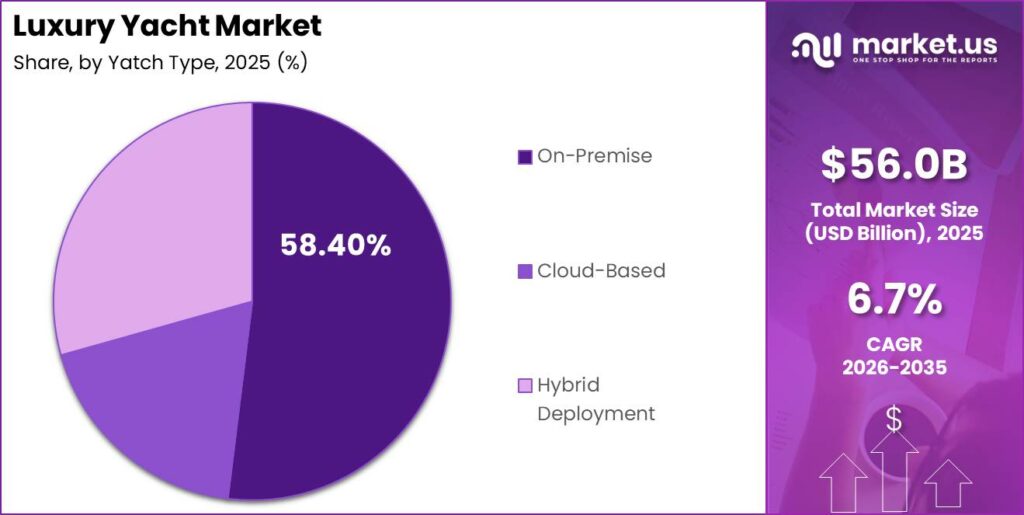
- Motor Yachts led the By Yacht Type segment with a 72.40% share in 2025.
- The 20 to 50 Meters class held 54.80% of the By Length segment.
- Fiberglass (FRP) captured 48.90% of the By Material Type segment.
- Diesel Propulsion dominated with 74.30% of the By Propulsion segment.
- Private Ownership accounted for 69.60% of the By Application segment.
- High-Net-Worth Individuals represented 76.50% of the By End User segment.
- Direct Sales led the By Distribution Channel segment at 66.20%.
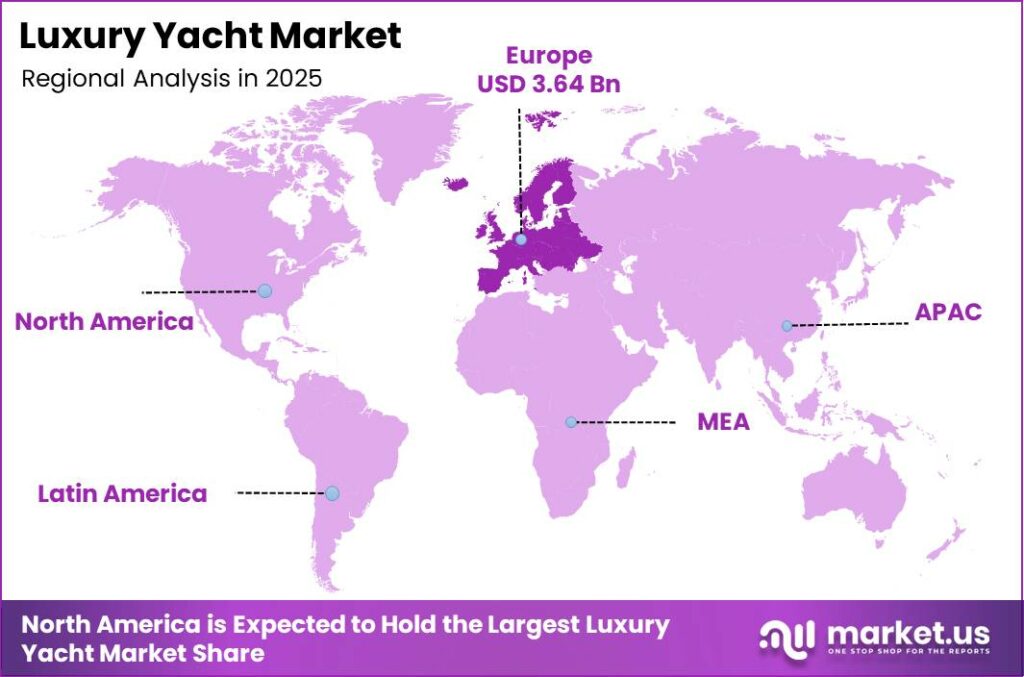
- Europe dominated with a 38.70% regional share, valued at USD 3.64 Billion.
Government policy shapes where yachts can dock and how they must run. Regulators across the Mediterranean now tie berthing rights to emissions compliance. This pushes owners toward cleaner propulsion and shore power upgrades. As a result, builders offering compliant vessels gain preferred access to premium ports and command higher resale confidence from buyers.
According to the Monaco Yacht Show, over 560 exhibitors and around 120 superyachts joined the 2024 edition, making it one of the world’s largest luxury yacht exhibitions. This scale concentrates qualified buyers in one venue over a few days. Consequently, shipyards that debut flagship models here convert leads faster and lock orders ahead of slower rivals who rely on scattered showroom traffic.
As reported by Boat International, the global superyacht fleet exceeded 6,000 vessels in 2024. This installed base fuels a large refit and modernization pipeline as older yachts need upgrades. Therefore, refit yards and technology suppliers can build steady recurring revenue independent of new-build cycles, giving them a hedge against periods when fresh orders slow.
Yacht Type Analysis
Motor Yachts dominates with 58.40% due to superior speed and onboard volume.
In 2025, Motor Yachts held a dominant market position in the By Yacht Type segment of Luxury Yacht Market, with a 58.40% share. Data from Boat International shows that of the 1,138 superyachts on order in 2025, more than 60% are motor yachts between 24 and 45 meters. This concentration signals where builder capacity flows. Yards that specialize in this size band will capture the deepest order pipeline.
Explorer Yachts serve owners who cruise remote and long-range destinations. These vessels carry extra fuel, reinforced hulls, and expedition gear for polar or Pacific routes. Buyer interest tracks rising demand for private travel beyond crowded marinas. Therefore, builders adding expedition capability can charge premiums and reach owners who value range over pure speed, opening a defensible niche against volume motor yacht yards.
Sailing Yachts attract owners who prize traditional seamanship and lower fuel use. These vessels appeal to buyers seeking quieter, more sustainable cruising over engine-driven power. Their steady demand supports specialist rigging and sail suppliers. This means yards focused on sailing craft can protect margin by serving a loyal enthusiast base rather than competing head-on with the crowded motor yacht field.
Catamaran Yachts win buyers with wide beams, shallow draft, and stable multihull decks. Groupe Beneteau unveiled the Prestige M7 luxury catamaran at the Cannes Yachting Festival 2025, delivering the volume of a 70-foot monohull inside a 58-foot length. This space efficiency reshapes buyer expectations. Consequently, builders that master multihull volume can undercut larger monohull pricing while matching living space, pressuring monohull yards on value.
Length Analysis
20 to 50 Meters dominates with 54.80% due to balanced cost and cruising range.
In 2025, 20 to 50 Meters held a dominant market position in the By Length segment of Luxury Yacht Market, with a 54.80% share. Data from Boat International shows more than 60% of the 1,138 yachts on order fall between 24 and 45 meters. This band matches entry superyacht budgets. Therefore, yards tooled for mid-length hulls face the strongest and most predictable order flow.
Above 50 Meters serves the top tier of owners who demand maximum space and crew capacity. These giant vessels require deep-water berths and large yards with heavy-lift capability. Their scarcity keeps prices and margins high per unit. As a result, the few shipyards able to build at this scale enjoy limited competition and can command multi-year deposits from committed buyers.
Below 20 Meters appeals to first-time luxury buyers and owners in tight cruising grounds. These smaller yachts cost less to run and dock in more marinas. Their accessibility widens the entry funnel into yacht ownership. This means brokers can use this segment to convert aspirational buyers who later trade up into larger, higher-margin vessels over time.
Material Type Analysis
Fiberglass (FRP) dominates with 48.90% due to low cost and easy molding.
In 2025, Fiberglass (FRP) held a dominant market position in the By Material Type segment of Luxury Yacht Market, with a 48.90% share. FRP suits series production because molds repeat quickly across many hulls. This lowers unit cost for volume builders. Consequently, yards using fiberglass can price competitively in the mid-length band where buyers weigh value against prestige.
Carbon Fiber and Advanced Composite attract performance-focused owners who want lighter, faster hulls. These materials cut weight, boost speed, and improve fuel economy on long passages. Their higher cost limits use to premium and racing-oriented vessels. Therefore, builders mastering composite layup can target a wealthy niche willing to pay for performance that fiberglass cannot match.
Aluminum serves explorer and larger custom yachts needing strength with manageable weight. The metal resists impact and suits reinforced expedition hulls for remote cruising. Its workability supports one-off custom builds over series production. This means aluminum specialists can position around bespoke and expedition demand, avoiding direct price wars with high-volume fiberglass yards.
Steel anchors the largest superyachts where hull strength outweighs weight concerns. Builders choose steel for vessels above 50 meters that prioritize durability and load capacity. Its robustness supports long service lives and heavy refit cycles. As a result, steel-focused yards align naturally with the top length tier, capturing owners who plan decades of ownership and repeated modernization.
Propulsion Type Analysis
Diesel Propulsion dominates with 74.30% due to proven range and refueling access.
In 2025, Diesel Propulsion held a dominant market position in the By Propulsion Type segment of Luxury Yacht Market, with a 74.30% share. Diesel offers reliable range and a global refueling network that alternatives lack. This maturity keeps it the default for most builds. Therefore, engine suppliers face steady diesel demand even as cleaner options slowly emerge across the fleet.
Hybrid and Electric Propulsion answers tightening emission rules at premium ports. According to the IEA, the global merchant fleet emitted approximately 706 million tonnes of CO2 in 2023, about 2% of energy-related emissions, accelerating cleaner marine technology investment. This regulatory pressure reaches luxury yachts. Consequently, builders offering hybrid systems gain preferred berthing access and appeal to ESG-minded owners.
Gas Turbine Propulsion powers high-speed vessels where owners prioritize rapid passages. Turbines deliver strong output for their weight but burn fuel quickly at cruise. Their use stays limited to performance-focused yachts. This means turbine suppliers serve a narrow, speed-driven niche rather than the broad mainstream market held by diesel systems.
Hydrogen and Alternative Fuel Propulsion targets the zero-emission frontier for early adopters. These systems remain costly and depend on scarce refueling infrastructure today. Owners choosing them signal environmental leadership over practicality. As a result, first-mover builders can shape emerging standards and lock in reputational advantage before hydrogen refueling networks mature at major cruising hubs.
Application Analysis
Private Ownership dominates with 69.60% due to exclusive personal use control.
In 2025, Private Ownership held a dominant market position in the By Application segment of Luxury Yacht Market, with a 69.60% share. According to the U.S. Coast Guard, the United States registered 11.6 million recreational boats in 2023, showing a deep private ownership base. This scale feeds the trade-up pipeline. Therefore, brokers can nurture owners toward larger luxury vessels over time.
Charter Services let users access yachts without the full cost of ownership. Operators buy vessels to rent by the week across premium cruising seasons. This model converts first-time users into future buyers after they sample the lifestyle. Consequently, charter growth acts as a demand funnel that ultimately feeds new-build and brokerage sales.
Corporate and Hospitality use yachts for client entertainment and branded events. Companies book vessels to host guests in exclusive settings that hotels cannot match. This demand peaks around major exhibitions and sporting events. This means operators positioned near event calendars can capture premium short-term bookings at rates above standard leisure charter pricing.
Marine Tourism opens yachting to broader travelers seeking curated sea experiences. Tour operators package day trips and multi-day cruises in scenic destinations. This segment widens the funnel beyond wealthy sole owners. As a result, destination operators can build volume revenue that complements the high-value but lower-frequency private ownership market.
End User Analysis
High-Net-Worth Individuals dominates with 76.50% due to concentrated private purchasing power.
In 2025, High-Net-Worth Individuals held a dominant market position in the By End User segment of Luxury Yacht Market, with a 76.50% share. As per our research, recreational boating generates more than €28 Billion in annual turnover across Europe, underscoring the wealth base behind private demand. This spending power anchors the market. Therefore, builders should tailor bespoke offerings directly to individual buyers.
Charter Operators buy fleets to rent vessels and earn recurring revenue. They prioritize durability, guest capacity, and low operating cost per charter week. Their purchasing focuses on proven, high-utilization designs. Consequently, builders serving operators must emphasize reliability and running economics rather than the one-off customization prized by private principals.
Luxury Resorts and Hotels add yachts to extend their premium hospitality offering. These buyers use vessels as branded experiences for high-value guests. Their demand ties to tourism strength in coastal destinations. This means builders can pursue resort partnerships as a distinct channel that bundles yachts into wider hospitality packages.
Corporate Buyers acquire yachts for entertainment, incentives, and brand positioning. Companies treat vessels as assets that project prestige to clients and staff. Their budgets follow business cycles and marketing priorities. As a result, sellers can time corporate outreach to strong earnings periods when discretionary brand spending expands.
Distribution Channel Analysis
Direct Sales dominates with 66.20% due to bespoke builder to buyer relationships.
In 2025, Direct Sales held a dominant market position in the By Distribution Channel segment of Luxury Yacht Market, with a 66.20% share. Custom yacht orders demand close collaboration between builder and buyer over long build cycles. This favors direct dealing over intermediaries. Therefore, shipyards that invest in in-house sales teams protect margin and control the client relationship end to end.
Yacht Brokers and Digital Sales Platforms connect buyers and sellers across the secondhand market. Brokers handle valuation, negotiation, and paperwork on used vessels. Digital tools now add virtual tours that speed remote deals. Consequently, brokers embracing online platforms can widen their buyer reach and close faster than firms relying only on in-person viewings.
Boat Shows and Exhibitions gather qualified buyers and flagship debuts in one venue. Events concentrate demand over a few high-traffic days each season. Builders use them to launch models and lock orders. This means exhibitors who plan strong show presence can convert leads efficiently and outpace rivals who skip these concentrated selling windows.
Key Market Segments
By Yacht Type
- Motor Yachts
- Explorer Yachts
- Sailing Yachts
- Catamaran Yachts
By Length
- 20 to 50 Meters
- Above 50 Meters
- Below 20 Meters
By Material Type
- Fiberglass (FRP)
- Carbon Fiber and Advanced Composite
- Aluminum
- Steel
By Propulsion Type
- Diesel Propulsion
- Hybrid and Electric Propulsion
- Gas Turbine Propulsion
- Hydrogen and Alternative Fuel Propulsion
By Application
- Private Ownership
- Charter Services
- Corporate and Hospitality
- Marine Tourism
By End User
- High-Net-Worth Individuals (HNWIs)
- Charter Operators
- Luxury Resorts and Hotels
- Corporate Buyers
By Distribution Channel
- Direct Sales
- Yacht Brokers and Digital Sales Platforms
- Boat Shows and Exhibitions
Regional Analysis
Europe Dominates the Luxury Yacht Market with a Market Share of 38.70%, Valued at USD 3.64 Billion
Europe leads the luxury yacht market with a 38.70% share worth USD 3.64 Billion. The region hosts leading shipyards, prime Mediterranean cruising grounds, and marquee events. This concentration of builders and berths keeps demand anchored here. Therefore, suppliers and brokers that base operations in Europe gain proximity to the deepest pool of buyers, yards, and premium ports.
Asia Pacific ranks as the fastest-growing region as new wealth expands the buyer base. Emerging owners across the region enter yacht ownership for the first time. Marina development supports larger vessels in new cruising destinations. Consequently, builders that establish early sales and service networks in Asia Pacific can capture greenfield demand before competitors build local presence.
Key Regions and Countries
North America
- US
- Canada
Europe
- Germany
- France
- The UK
- Spain
- Italy
- Rest of Europe
Asia Pacific
- China
- Japan
- South Korea
- India
- Australia
- Rest of APAC
Latin America
- Brazil
- Mexico
- Rest of Latin America
Middle East and Africa
- GCC
- South Africa
- Rest of MEA
Market Dynamics
Market Opportunity Analysis - Underserved regions, propulsion niches, and multihull designs open entry points for new players
The Asia Pacific region stands underexploited despite ranking as the fastest-growing market. Local builders and service networks remain thin compared with mature European hubs. This gap leaves greenfield demand from first-time owners unserved today. Therefore, new entrants that establish sales and refit centers across the region can capture buyers before established European yards build local presence.
The Hybrid and Electric Propulsion segment sits underexploited even as it grows fastest in propulsion. Diesel still holds 74.30% of the segment, leaving cleaner systems with limited installed supply. This creates room for specialists in low-emission drivetrains. Consequently, technology suppliers that scale hybrid systems early can win preferred-vendor status as port emission rules tighten across premium destinations.
The Catamaran Yacht type remains underexploited relative to the 72.40% held by motor yachts. Multihull designs deliver more usable space per foot yet occupy a small slice of the market. This mismatch signals unmet demand for volume-efficient vessels. As a result, builders that master multihull production can win value-focused buyers priced out of larger monohulls.
The Charter Services application is underexploited against the 69.60% held by private ownership. Charter converts first-time users into future buyers yet holds modest share today. This funnel role makes it strategically valuable beyond its current size. Therefore, operators that expand charter fleets in emerging destinations can seed long-term ownership demand while earning recurring revenue in the near term.
Technology and Innovation Landscape - Composites, expedition capability, wellness suites, and digital brokerage reshape competitive edges
Carbon fiber composite construction is reshaping how builders approach performance yachts. The material cuts weight, raises speed, and improves fuel economy over fiberglass hulls. This shift lets yards target owners who prize passage performance. Therefore, builders that invest in composite layup capability can command premiums and defend a niche that volume fiberglass yards cannot easily enter.
Explorer yacht design is advancing toward extended cruising range and expedition capability. Owners increasingly want vessels that reach remote and polar destinations beyond crowded marinas. This demand pushes builders to reinforce hulls and expand fuel capacity. Consequently, yards that develop true expedition platforms can serve a growing cohort seeking private travel far from conventional cruising grounds.
Wellness-focused onboard amenities are rising as owners add spas, beach clubs, and health suites. These features turn yachts into private wellness retreats at sea. This trend lifts interior fit-out value and complexity per vessel. As a result, builders and outfitters that specialize in wellness integration can capture higher interior spend and differentiate flagship models from standard layouts.
Digital yacht brokerage platforms are transforming how luxury yachts change hands. Virtual tours and online transactions let brokers close deals with remote buyers faster. This shift widens buyer reach beyond in-person viewings. Therefore, brokers that adopt digital tools early can accelerate sales velocity and outpace firms that still depend only on physical showings and boat shows.
Drivers
The core driver is a structural expansion of the ultra-high-net-worth population that directly enlarges the qualified buyer base. Knight Frank’s Wealth Report 2025 recorded the global UHNWI population growing about 4.2% in 2024 to exceed 626,000 individuals. The Middle East posted the highest regional growth at 6.2% year on year. This means shipyards should target these fast-rising wealth pools with bespoke superyacht offerings first.
India’s UHNWI cohort expanded 6.1%, the fastest in Asia-Pacific, while North America held the largest base near 240,000 individuals. Roughly 1 in 400 to 600 UHNWIs owns a yacht above 24 meters, so a 4% to 6% yearly rise adds up to 1,600 new qualified buyers. Therefore, builders that lock production slots early will capture this incremental demand ahead of rivals.
| Driver | (~) % Impact on CAGR Forecast | Geographic Relevance | Impact Timeline |
|---|---|---|---|
| Accelerating Global UHNWI Wealth Accumulation Expanding the Core Luxury Yacht Buyer Universe | +2.3% | United States, China, Middle East (UAE, Saudi Arabia), India, Europe | Short term (≤ 2 years) |
| Experiential Luxury Shift Driving Charter Fleet Investment & New Ownership Models | +1.6% | Mediterranean, Caribbean, Southeast Asia, Indian Ocean | Short term (≤ 2 years) |
| Middle East UHNWI & Sovereign Fleet Expansion Fueling Superyacht Orderbook Growth | +1.1% | UAE, Saudi Arabia, Qatar, Kuwait, Bahrain | Short term (≤ 2 years) |
| Hybrid & Hydrogen Propulsion System Adoption Driving Vessel Upgrade & New Build Premium Spend | +0.9% | Europe (Netherlands, Italy, Germany), United States, Australia | Medium term (2–4 years) |
| Remote Work & Digital Nomad Culture Expanding Floating Office & Live-Aboard Superyacht Demand | +0.5% | United States, United Kingdom, Scandinavia, Australia, Urban Asia | Medium term (2–4 years) |
Restraints
The main restraint is an expanding regulatory patchwork of emission and berthing rules at the most desirable cruising destinations. France’s Alpes-Maritimes council and Cannes introduced mandatory shore power requirements for vessels above 24 meters from the 2024 season, with non-compliant yachts facing berthing refusal. This affected an estimated 15% to 20% of the 800 to 1,000 superyachts transiting the Côte d’Azur yearly. Therefore, owners face pressure to retrofit or lose access.
New builds must add exhaust after-treatment, shore power gear, and hybrid options, adding €400,000 to €2.8 Million per vessel. This inflates entry prices at the 30 to 50 meter tier by up to 18% and compresses shipyard margins. Consequently, builders must decide whether to absorb these costs or pass them to buyers, and pre-2018 resale values fall as compliance gaps widen.
| Restraint | (~) % Impact on CAGR Forecast | Geographic Relevance | Impact Timeline |
|---|---|---|---|
| EU & Port Authority Superyacht Emissions Regulations Triggering Fleet Access Bans & Compliance Retrofit Costs | -1.7% | European Union (Mediterranean, Adriatic), France, Italy, Monaco, Croatia, Greece | Short term (≤ 2 years) |
| Russian UHNWI Sanctions-Driven Asset Freeze Removing a Significant Buyer & Owner Segment | -1.1% | European marinas & flag registries, Caribbean, UAE as relocation hubs | Short term (≤ 2 years) |
| Wealth Tax & Luxury Asset Levy Proposals Deterring New Superyacht Orders in Key European Markets | -0.7% | Spain, France, Italy, Netherlands, United Kingdom | Short term (≤ 2 years) |
| Marina Infrastructure Deficit & Berth Scarcity at Prime Mediterranean Destinations | -0.5% | Mediterranean: France, Italy, Croatia, Greece, Montenegro | Medium term (2–4 years) |
| Global Anti-Wealth Sentiment & ESG Reputational Risk Dampening Visible Fleet Expansion by Institutional UHNWI | -0.2% | United States, United Kingdom, Western Europe | Medium term (2–4 years) |
Challenges
The structural challenge is a workforce succession crisis in the specialist trades behind superyacht construction. Dutch, Italian, and German yards build roughly 65% to 70% of new tonnage above 30 meters, yet depend on aging master craftsmen averaging 48 to 54 years old. Retirement attrition may remove 25% to 35% of senior craftsmen over ten years. Therefore, yards face a widening skills gap that threatens build quality.
The global order book reached a record 786 vessels above 30 meters in 2024, up 9.4% from 2023, yet delivery timelines for the 40 to 60 meter tier stretched to 52 months. Warranty claim ratios rose toward 5% of contract value. Consequently, this friction creates a revenue opening for shipyards that invest in apprenticeship academies and modular off-hull construction to protect margins.
| Challenge | (~) % CAGR Friction Drag | Geographic Relevance | Mitigation Horizon |
|---|---|---|---|
| Skilled Marine Craftsman & Naval Architect Shortage | -0.9% | Netherlands, Italy, Germany, United Kingdom, United States | Long term (≥ 4 years) |
| Extended New-Build Lead Times Suppressing Order Conversion | -0.7% | Global, originating in Netherlands, Italy, Germany shipyard capacity constraints | Medium term (2–4 years) |
| Superyacht Crew Recruitment & Retention Crisis | -0.6% | Global; most acute for vessels flagged in EU, MCA-compliant flag states | Long term (≥ 4 years) |
| Flag State & Classification Regulatory Complexity for New Propulsion Systems | -0.4% | Global; RINA, Lloyd’s Register, Bureau Veritas approval timelines | Medium term (2–4 years) |
| Supply Chain Disruption for Custom Interior & Composite Material Components | -0.3% | European Union, United Kingdom — primary bespoke component sourcing hubs | Medium term (2–4 years) |
Opportunities
The largest opportunity is fractional ownership and syndication as a new asset class. The luxury yacht market runs on outright purchase or charter with no fractional infrastructure like private aviation, which exceeds $10 Billion yearly. Many buyers can justify $800,000 to $3 Million in annual luxury spend but cannot absorb €8 to €35 Million in sole-ownership costs. Therefore, a syndication platform unlocks a frozen buyer cohort.
A model with 4 to 8 co-owners per vessel at €1.5 to €5 Million per share could widen the addressable buyer base for the 40 to 55 meter tier by up to 8×. Platform operators managing 20 vessels earn €3.6 to €9 Million yearly at 60% to 75% gross margin. Consequently, the first mover reaching 10 to 15 vessels can build network effects that block later entrants.
| Opportunity | (~) % Potential CAGR Upside | Geographic Relevance | Execution Window |
|---|---|---|---|
| Fractional Ownership & Superyacht Syndication Platform Development as a New Asset Class | +1.5% | United States, United Kingdom, UAE, Singapore, Australia | Medium term (2–4 years) |
| Asia-Pacific UHNWI Market Development — Japan, India, Southeast Asia as Greenfield Buyer Cohorts | +1.1% | India, Japan, South Korea, Singapore, Indonesia, Australia | Medium term (2–4 years) |
| Zero-Emission Superyacht Premium Segment — Hydrogen & Full-Electric Vessels for ESG-Motivated Owners | +0.8% | Netherlands, Germany, Scandinavia, United States, UAE | Long term (≥ 4 years) |
| Expedition & Polar-Class Superyacht Segment Expansion into Untapped Cruising Geographies | +0.6% | Global; builder concentration in Netherlands & Germany; cruising in Arctic, Antarctic, Pacific | Long term (≥ 4 years) |
| Superyacht-as-a-Wellness-Destination: Medical, Spa & Longevity Tourism Charter Premium | +0.3% | Mediterranean, Caribbean, Indian Ocean, Southeast Asia | Long term (≥ 4 years) |
Key Company Insights
Azimut Benetti Group holds a structural advantage through its broad model range spanning mid-length production yachts to full custom superyachts. This breadth lets the group capture buyers across price tiers with one brand family. Its strong presence at events like the Cannes Yachting Festival, which hosted more than 700 boats and over 640 exhibitors in 2024, keeps it visible to qualified buyers. However, wide model spread can strain focus against pure custom specialists.
Ferretti S.P.A. competes through a multi-brand portfolio that targets distinct buyer segments with tailored positioning. This structure lets the company defend share across motor yacht categories at once. Its Italian design heritage supports premium pricing in a market where recreational boating generates more than €28 Billion in annual European turnover. Therefore, Ferretti gains pricing power, though its concentration in motor yachts leaves limited exposure to fast-growing explorer and multihull niches.
Key Players
- Azimut Benetti Group
- Ferretti S.P.A.
- Sanlorenzo S.P.A.
- Princess Yachts Limited
- Sunseeker International
- Lürssen
- Feadship
- Heesen Yachts
- Oceanco
- Gulf Craft Inc.
- Groupe Beneteau
- HanseYachts AG
- Baglietto S.P.A.
- ISA Yachts
- Rossinavi
Recent Developments
- April 2025: Gulf Craft Inc. launched the Majesty 100 Terrace, which drew strong industry attention through 2026 for its fold-out bulwark wings that expand the aft deck terrace to resemble a much larger vessel.
- May 2025: Princess Yachts debuted the Princess F58 flybridge motor yacht, integrating a fuel-efficient hull, a mini beach-club transom layout, and the latest custom Garmin marine electronics suites.
Geopolitical Impact Analysis
Global trade tensions are reshaping the raw material and component flows behind yacht construction. As reported by UNCTAD, container shipping rates rose sharply after Red Sea rerouting added roughly 10 to 14 days to Asia-Europe transit in 2024. This lengthens delivery of composite materials and marine electronics to European yards. Therefore, builders face longer lead times and higher landed costs on imported components.
Energy volatility is directly affecting yacht operating and build economics. According to the IEA, marine fuel prices stayed elevated through 2024 as Brent crude traded above $80 per barrel for much of the year. This raises both charter running costs and shipyard energy bills during long build cycles. Consequently, owners increasingly weigh hybrid propulsion to hedge fuel exposure, while yards pass higher energy costs into contract pricing.
Report Scope
| Report Features | Description |
|---|---|
| Market Value (2025) | USD 9.40 Billion |
| Forecast Revenue (2035) | USD 18.10 Billion |
| CAGR (2026-2035) | 6.7% |
| Base Year for Estimation | 2025 |
| Historic Period | 2020-2024 |
| Forecast Period | 2026-2035 |
| Report Coverage | Revenue Forecast, Market Dynamics, Market Opportunity Analysis, Technology and Innovation Landscape, Competitive Landscape, Recent Developments |
| Segments Covered | By Yacht Type (Motor Yachts, Explorer Yachts, Sailing Yachts, Catamaran Yachts), By Length (20 to 50 Meters, Above 50 Meters, Below 20 Meters), By Material Type (Fiberglass FRP, Carbon Fiber and Advanced Composite, Aluminum, Steel), By Propulsion Type (Diesel, Hybrid and Electric, Gas Turbine, Hydrogen and Alternative Fuel), By Application (Private Ownership, Charter Services, Corporate and Hospitality, Marine Tourism), By End User (HNWIs, Charter Operators, Luxury Resorts and Hotels, Corporate Buyers), By Distribution Channel (Direct Sales, Yacht Brokers and Digital Sales Platforms, Boat Shows and Exhibitions) |
| Regional Analysis | North America (US and Canada), Europe (Germany, France, The UK, Spain, Italy, and Rest of Europe), Asia Pacific (China, Japan, South Korea, India, Australia, and Rest of APAC), Latin America (Brazil, Mexico, and Rest of Latin America), Middle East and Africa (GCC, South Africa, and Rest of MEA) |
| Competitive Landscape | Azimut Benetti Group, Ferretti S.P.A., Sanlorenzo S.P.A., Princess Yachts Limited, Sunseeker International, Lürssen, Feadship, Heesen Yachts, Oceanco, Gulf Craft Inc., Groupe Beneteau, HanseYachts AG, Baglietto S.P.A., ISA Yachts, Rossinavi |
| Customization Scope | Customization for segments, region / country-level will be provided. Additional customization can be done based on requirements. |
| Purchase Options | We have three licenses to opt for: Single User License | Multi-User License (Up to 5 Users) | Corporate Use License (Unlimited User and Printable PDF) |





































