Report Overview
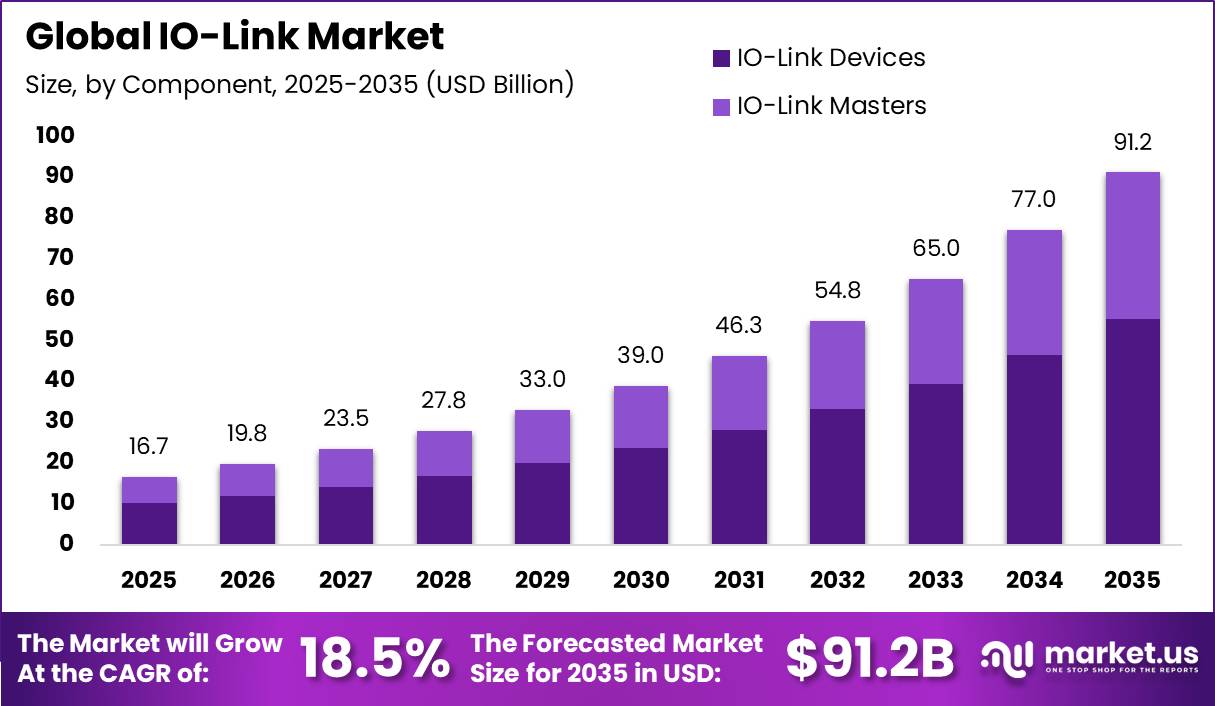
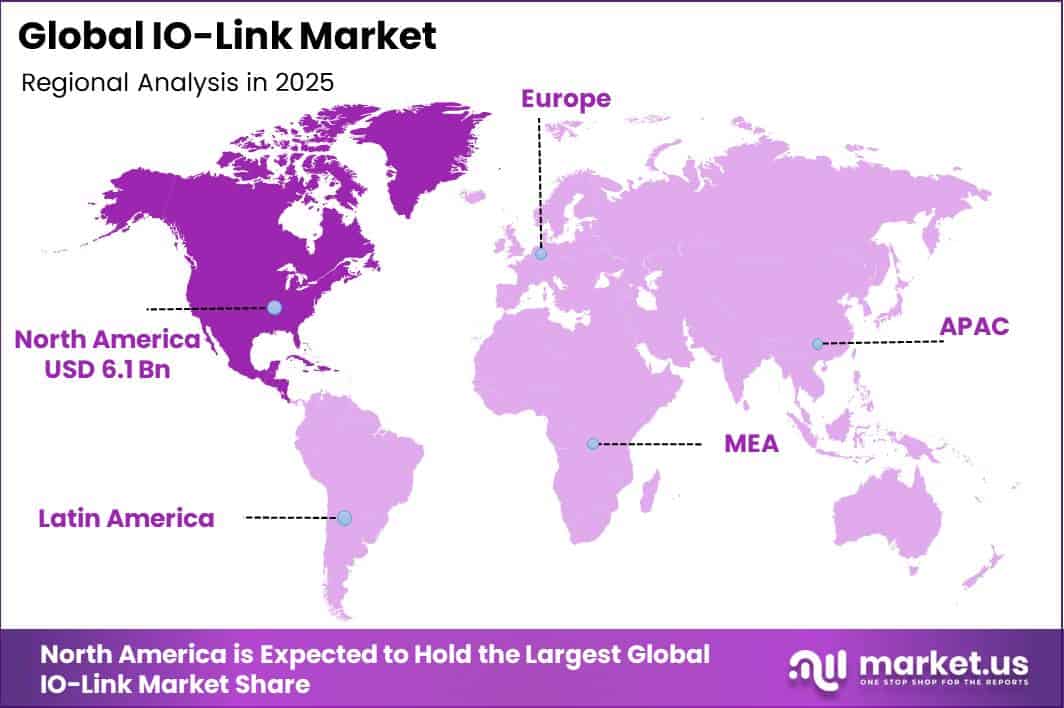
In 2025, the Global IO-Link Market was valued at USD 16.7 billion. The market is projected to grow at a CAGR of 18.5% during 2026–2035, reaching approximately USD 91.2 billion by 2035. North America dominated the global market in 2025, accounting for more than 36.5% of the total market share and generating approximately USD 6.1 billion in revenue.
Growth is being driven by rising investment in connected machines, industrial robots, smart sensors, and real-time production systems. IO-Link provides a common digital connection between field devices and control systems, helping manufacturers improve device configuration, condition monitoring, remote diagnostics, and equipment replacement.
According to the International Federation of Robotics, 542,000 industrial robots were installed worldwide in 2024, with annual installations remaining above 500,000 units for the fourth consecutive year. As each robotic cell requires several sensors, valves, identification devices, and other connected components, higher robot deployment is creating strong demand for IO-Link-enabled communication.
The Americas installed 50,100 industrial robots in 2024, while the United States accounted for 34,200 units, representing 68% of the regional total. Robot density in North America reached 204 robots per 10,000 manufacturing employees in 2024. In addition, U.S. manufacturing construction spending reached USD 215.4 billion in 2025.
Key Takeaway
- The IO-Link market is set to grow from USD 16.7 billion in 2025 to USD 91.2 billion by 2035, at an 18.5% CAGR.
- IO-Link Devices led the component segment with a 60.5% share, driven by semiconductor and EV manufacturing demand.
- IO-Link Wired held a dominant 72.1% share by type, favored for its reliability in fixed production lines.
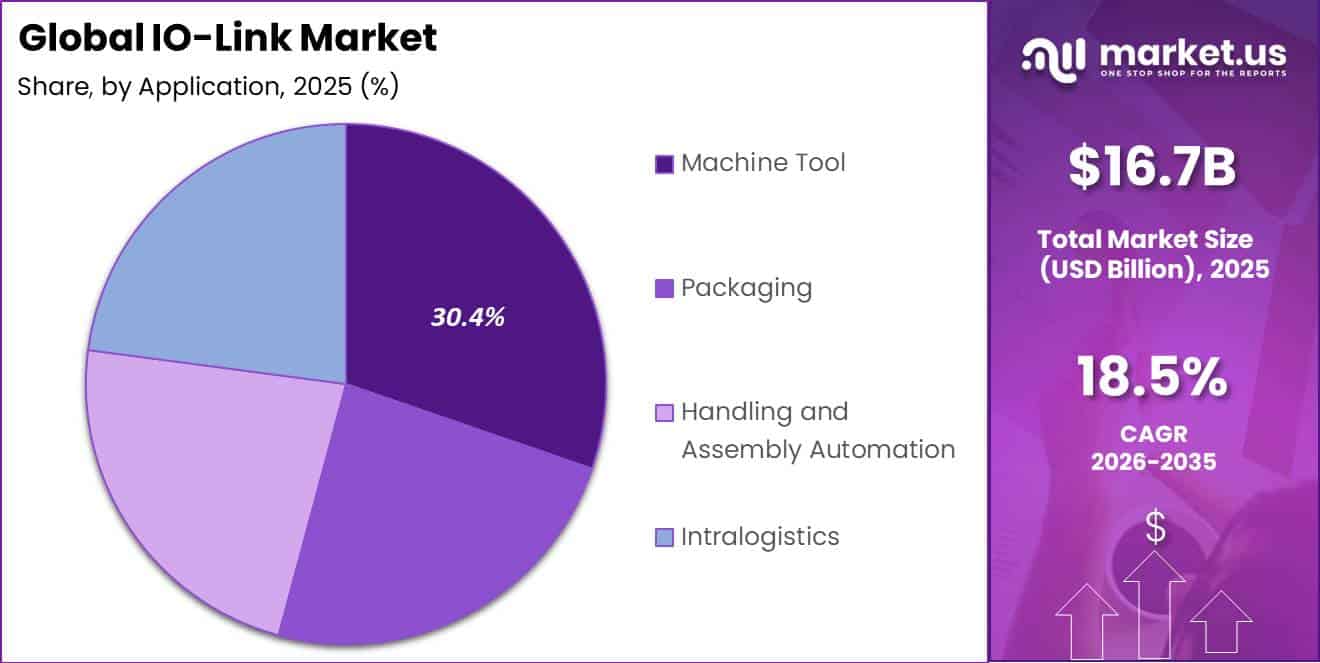
- The machine tool segment led by application with a 30.4% share, supported by rising CNC and precision manufacturing demand.
- Automotive led the industry vertical with a 27.9% share, driven by high automation across vehicle production plants.
- North America dominated the regional landscape in 2025, holding 36.5% of revenue at an estimated USD 6.1 billion.
Market Statistics and Data Insights
- Around 9.7 million new IO-Link devices and master ports were installed worldwide in 2025, taking the global installed base to 71 million nodes. This is one of the strongest direct indicators of actual IO-Link adoption.
- The IO-Link ecosystem now includes more than 500 corporate members worldwide and more than 30,000 available IO-Link products, showing broad supplier participation and device availability.
- PI’s IODDfinder currently lists more than 11,000 different IO-Link devices, creating a large standardized database of sensors and actuators that manufacturers can integrate across automation systems.
- IO-Link Wireless operates in the 2.4 GHz ISM band using 80 channels of 1 MHz each. A master can operate 5 tracks in parallel, with 8 devices per track and a 5 ms cycle time, supporting up to 40 wireless device connections in this architecture.
- Global electric-car sales exceeded 20 million units in 2025, increasing 20% from 2024. Electric cars represented 25% of all new cars sold worldwide, or one in every four new vehicles.
- Battery-electric vehicles accounted for 65% of global electric-car sales in 2025, increasing the manufacturing need for battery assembly, welding, thermal-management, inspection and testing equipment where digital sensors are widely used.
- Global motor-vehicle production increased from approximately 92.7 million vehicles in 2024 to 96.4 million in 2025, a rise of 3.9%. Global vehicle sales increased from 95.3 million to 99.8 million over the same period.
- Worldwide semiconductor-manufacturing-equipment sales reached USD 135.1 billion in 2025, increasing 15% from USD 117.1 billion in 2024. Expanding fabs create direct demand for pressure, flow, temperature, positioning, and process-control sensors.
- China, Taiwan and South Korea together represented 79% of worldwide semiconductor-equipment spending in 2025, compared with 74% in 2024. Taiwan’s spending increased 90% to USD 31.5 billion, while South Korea increased 26% to USD 25.8 billion.
- U.S. manufacturing-technology orders reached USD 5.74 billion in 2025, increasing 22.5% from 2024. This represents strong spending on machine tools and related automation equipment where IO-Link sensors and actuators can be deployed.
- 49% of manufacturers planned to use AI for cybersecurity in 2025, increasing from 40% in 2024. This is particularly relevant as IO-Link data increasingly moves from sensors into Ethernet, edge and cloud systems.
- 95% of surveyed manufacturers had already invested in AI/ML or planned to invest within the next five years, while investment in generative and causal AI increased 12% year over year.
By Component
IO-Link Devices held a dominant 60.5% share of the IO-Link market, supported by their direct use in automated production equipment. The segment includes sensors, actuators, valve terminals, RFID readers, and identification devices that collect real-time machine data and control physical operations.
Growing investment in semiconductor and electric vehicle manufacturing is increasing demand for these devices, as both industries require accurate monitoring and process control. According to the Semiconductor Industry Association, global semiconductor sales reached USD 630.5 billion in 2024. The International Energy Agency also reported that electric vehicles accounted for more than one in five cars sold worldwide in 2024.
Semiconductor fabs and battery plants use large numbers of pressure, flow, temperature, position, and optical sensors for assembly, inspection, material handling, and safety. IO-Link devices also support digital configuration, parameter storage, and equipment diagnostics, making them important for smart factories.
By Type
The IO-Link Wired segment held a dominant 72.1% share of the IO-Link market, supported by its strong use across fixed industrial production lines. Wired IO-Link provides reliable and low-latency communication for sensors, actuators, valves, and identification systems. It can carry both power and data through a standard unshielded three-wire cable, making it suitable for fast and electrically demanding factory environments.
According to the International Organization of Motor Vehicle Manufacturers, global vehicle production reached 92.7 million units in 2024. Automotive plants require accurate control across welding, painting, fastening, material handling, and final testing operations, where large numbers of field devices must communicate continuously without interruption.
Wired IO-Link supports stable data transfer, stored device parameters, quick equipment replacement, and direct fault reporting to control systems. These features help reduce commissioning time and improve production reliability.
By Application
The Machine Tool segment held a dominant 30.4% share of the IO-Link market, driven by the high use of sensors and control devices in CNC machines, machining centres, grinders, and automated metal-cutting systems. According to CECIMO, Europe’s machine-tool industry recorded more than EUR 25.5 billion in production in 2024, supported by around 1,500 industrial enterprises.
In the United States, manufacturing-technology orders reached USD 5.7 billion in 2025, increasing by 22.5% compared with 2024, according to AMT. Machine tools depend on sensors to monitor spindle condition, tool position, coolant levels, pressure, clamping force, and workpiece presence. IO-Link enables these devices to send digital data directly to machine controllers, supporting faster parameter changes, fault detection, and sensor replacement.
By Industry Vertical
The Automotive segment held a dominant 27.9% share of the IO-Link market, supported by the high level of automation used across vehicle production plants. According to the International Organization of Motor Vehicle Manufacturers, global vehicle production reached 92.5 million vehicles in 2024.
The International Energy Agency also reported that more than 17 million electric cars were sold worldwide in 2024, representing over 20% of total car sales and an increase of more than 25% year on year. Automotive plants use large numbers of sensors, actuators, valves, and RFID systems across body assembly, painting, battery production, powertrain operations, and final inspection.
Key Market Segments
By Component
- IO-Link Devices
- IO-Link Masters
By Type
- IO-Link Wired
- IO-Link Wireless
By Application
- Machine Tool
- Packaging
- Handling and Assembly Automation
- Intralogistics
By Industry Vertical
- Automotive
- Food and Beverage
- Pharmaceuticals
- Semiconductor and Electronics
- Oil and Gas
- Aerospace and Defense
- Other
Geopolitical Impact Analysis
Geopolitical disruption is increasing supply-chain risk and cost pressure across the IO-Link market, which depends on semiconductors, microcontrollers, sensors, connectors, copper cables, industrial enclosures, and programmable control hardware sourced globally. According to UN Trade and Development, shipping diversions increased global tonne-miles by 6% in 2024, almost three times faster than trade-volume growth.
By May 2025, cargo tonnage through the Suez Canal remained 70% below 2023 levels. Longer routes around the Cape of Good Hope increase shipping time and can delay the delivery of IO-Link devices, sensor chips, cables, and connector assemblies. Suppliers may therefore need higher inventories, alternative freight routes, and additional working capital, which can increase product costs.
Trade tensions also create pricing risks for North American IO-Link suppliers. UNCTAD reported that the average U.S. tariff on Chinese imports reached 47% from mid-May 2025, in addition to existing Section 301 and other duties. This can increase the cost of Chinese electronic components used in sensors, IO-Link masters, power supplies, and connectivity products.
Suppliers are increasingly considering sourcing from Mexico, Southeast Asia, and local manufacturing, although these changes can add qualification and logistics expenses. Energy costs are another concern, with the World Bank forecasting its energy-price index to rise by 24% in 2026 amid Middle East conflict risks.
Regional Analysis
North America dominated the global IO-Link market in 2025, accounting for 36.5% of total revenue and reaching an estimated value of USD 6.1 billion. The region’s strong position is supported by high automation investment across automotive, aerospace, semiconductor, food processing, logistics, and machinery manufacturing.
In the United States, manufacturing-technology orders reached USD 2.9 billion during the first seven months of 2025, increasing by 14.4% compared with the same period in 2024, according to AMT. Rising spending on CNC machines, automated production cells, inspection equipment, and material-handling systems is increasing demand for sensors, actuators, RFID readers, and valve terminals.
Asia Pacific is expected to be the fastest-growing regional market, supported by expanding semiconductor, electronics, automotive, battery, and industrial-equipment production. SEMI projected global semiconductor manufacturing capacity to increase by 6.6% in 2025, reaching approximately 33.6 million wafers per month.
Key Regions and Countries
North America
- US
- Canada
Europe
- Germany
- France
- The UK
- Spain
- Italy
- Rest of Europe
Asia Pacific
- China
- Japan
- South Korea
- India
- Australia
- Rest of APAC
Latin America
- Brazil
- Mexico
- Rest of Latin America
Middle East & Africa
- GCC
- South Africa
- Rest of MEA
Market Dynamics
Drivers
| Driver | (~) % CAGR | Geographic Relevance | Impact Timeline |
|---|---|---|---|
| Automotive Electrification Automation | +3.2% | Global; China, Europe, North America | Medium term (2 to 4 years) |
| Semiconductor Fab Digitalization | +2.8% | Asia Pacific, North America, Europe | Medium term (2 to 4 years) |
| Machine Retrofit Demand | +2.1% | Europe, North America, Japan | Short term (2 years or less) |
| Warehouse Automation Adoption | +1.7% | North America, Europe, Asia Pacific | Medium term (2 to 4 years) |
| Predictive Maintenance Deployment | +1.5% | Global | Short term (2 years or less) |
Automotive Electrification Automation
Automotive electrification is a major growth driver because EV production requires more digital pressure, position, temperature, flow, identification, and safety devices. The IEA reported global electric-car sales above 17 million units in 2024, up more than 25% and representing over 20% of global car sales. OICA also recorded about 92.5 million vehicles produced in 2024.
IO-Link supports faster sensor replacement, device monitoring, parameter storage, and shorter production changeovers across battery and vehicle lines. Higher automation content in EV manufacturing is increasing IO-Link adoption and could add an estimated +3.2% to the market’s baseline CAGR.
Restraints
| Restraint | (~) % CAGR | Geographic Relevance | Impact Timeline |
|---|---|---|---|
| Tariff-Driven Input Costs | -2.4% | North America, China, Europe | Short term (2 years or less) |
| High Industrial Borrowing Costs | -1.9% | Europe, North America, emerging markets | Short term (2 years or less) |
| Capital Budget Deferrals | -1.6% | Global | Medium term (2 to 4 years) |
| Small-Plant Retrofit Costs | -1.3% | Europe, Asia Pacific, Latin America | Medium term (2 to 4 years) |
| Legacy Controller Lock-In | -1.1% | Global | Long term (4 years or more) |
Tariff-Driven Input Costs
Tariff escalation is a major short-term restraint because IO-Link equipment depends on imported microcontrollers, sensors, connectors, copper cables, and printed circuit boards. UNCTAD reported that the average U.S. tariff on Chinese imports reached about 47% in 2025, while the WTO projected global merchandise-trade growth of only 0.9% in 2025.
UNCTAD also reported that shipping rerouting increased global tonne-miles by 6% in 2024, raising logistics and inventory costs. Higher tariffs and freight expenses can pressure supplier margins, delay machine upgrades, and push buyers toward alternative sourcing. Overall, these factors could reduce the market’s baseline growth by an estimated -2.4% until trade and supply conditions stabilize.
Challenges
| Challenge | (~) % CAGR | Geographic Relevance | Mitigation Horizon |
|---|---|---|---|
| Cybersecurity Compliance Burden | -2.0% | Europe; global exporters to Europe | Medium term (2 to 4 years) |
| Skilled Integration Shortage | -1.7% | North America, Europe, Asia Pacific | Long term (4 years or more) |
| Multi-Vendor Interoperability | -1.4% | Global | Medium term (2 to 4 years) |
| Component Qualification Cycles | -1.2% | Global | Medium term (2 to 4 years) |
| Harsh-Environment Reliability | -0.9% | Global | Long term (4 years or more) |
Cybersecurity Compliance Burden
Cybersecurity compliance remains a key challenge as IO-Link devices increasingly connect with Ethernet, edge, cloud, and plant-management systems. Cyber Resilience Act reporting duties begin on 11 September 2026, requiring serious vulnerabilities and incidents to be reported within 24 hours. Full application begins on 11 December 2027, while the EU Machinery Regulation applies from 20 January 2027.
Manufacturers must invest more in secure development, vulnerability management, software updates, and incident response. These requirements can increase engineering and lifecycle-support costs and slow product launches, especially for smaller suppliers. Overall, cybersecurity compliance could create an estimated -2.0% drag on the market’s maximum attainable CAGR.
Opportunities
| Opportunity | (~) % CAGR | Geographic Relevance | Execution Window |
|---|---|---|---|
| Device Data Subscription Models | +2.6% | North America, Europe, Japan | Medium term (2 to 4 years) |
| Brownfield SME Conversion | +2.2% | Europe, Asia Pacific, Latin America | Medium term (2 to 4 years) |
| Process Industry Penetration | +1.9% | Middle East, Europe, North America | Long term (4 years or more) |
| Autonomous Mobile Equipment | +1.6% | Asia Pacific, North America, Europe | Medium term (2 to 4 years) |
| Local Assembly Partnerships | +1.3% | India, Southeast Asia, Mexico | Long term (4 years or more) |
Device Data Subscription Models
Device-data subscriptions remain a future opportunity because most IO-Link sales still rely on one-time hardware purchases. The IEA expects industrial electricity demand to grow by about 3.3% annually through 2027, increasing the value of connected data for detecting leaks, motor overload, and equipment inefficiency.
The World Bank forecasts global commodity prices to fall by around 7% in 2025, encouraging suppliers to build recurring service revenue. Subscription-based diagnostics and remote configuration could improve gross margins by 5% to 10% and reduce service costs by about 15% to 25%. This opportunity could add around +2.6% above the baseline CAGR.
Key Players Analysis
Tier-1 leaders in the IO-Link market include Siemens AG, Schneider Electric SE, Rockwell Automation, OMRON Corporation, SICK AG, ifm electronic, Balluff, Pepperl+Fuchs, Turck, and Banner Engineering. Siemens, Schneider Electric, Rockwell, and OMRON have strong competitive positions because they can combine IO-Link devices with PLCs, industrial software, control systems, and wider automation platforms.
Siemens reported FY2025 revenue of EUR 78.9 billion, group R&D spending of EUR 6.6 billion, and Digital Industries revenue of EUR 16.7 billion, including EUR 6.17 billion from software. Schneider Electric recorded FY2025 revenue of EUR 40.2 billion, with Industrial Automation contributing EUR 7.02 billion and R&D spending of around 7% of revenue, or nearly EUR 2.8 billion.
These leading suppliers are estimated to account for around 35–45% of IO-Link revenue. Rockwell reported FY2025 Intelligent Devices sales of USD 3.756 billion, operating earnings of USD 676 million, and an 18.0% margin, while supporting expansion through a USD 2 billion investment plan. OMRON’s Industrial Automation Business generated JPY 409.5 billion, up 12.3%, while R&D increased by JPY 5.0 billion, with 42 products planned across FY2024–FY2026.
Tier-2 specialists such as Balluff, ifm, SICK, Pepperl+Fuchs, Turck, and Banner focus more strongly on sensors and field devices and are estimated to hold 30–40% of the market. European machine-tool output exceeded EUR 25.5 billion in 2024, supporting continued demand for IO-Link hardware.
Top Key Players in the Market
- Siemens AG
- Balluff GmbH
- ifm electronic gmbh
- SICK AG
- Rockwell Automation, Inc.
- OMRON Corporation
- Schneider Electric SE
- Hans Turck GmbH & Co. KG
- Pepperl+Fuchs SE
- Banner Engineering Corp.
Recent Developments
- In 2026, Schneider Electric entered into a definitive agreement to acquire 100% of Cognite Holding B.V. for USD 3.1 billion in an all-cash transaction. Announced on June 30, 2026, the deal is subject to regulatory approvals and is expected to integrate Cognite with AVEVA.
- In 2026, Siemens announced an investment of around EUR 200 million to develop a new highly automated factory in Amberg, Germany, scheduled for completion by 2030. The site will use industrial AI, digital twins, automated logistics, and robotics, and will support around 2,400 Smart Infrastructure employees. Siemens currently employs about 4,500 people across its Amberg operations, where it develops industrial controllers and monitoring devices.
Report Scope
| Report Features | Description |
|---|---|
| Market Value (2025) | USD 16.7 Billion |
| Forecast Revenue (2035) | USD 91.2 Billion |
| CAGR (2026-2035) | 18.5% |
| Base Year for Estimation | 2025 |
| Historic Period | 2020-2024 |
| Forecast Period | 2026-2035 |
| Report Coverage | Revenue Forecast, Market Dynamics, Competitive Landscape, Recent Developments |
| Segments Covered | By Component (IO-Link Devices, IO-Link Masters); By Type (IO-Link Wired, IO-Link Wireless); By Application (Machine Tool, Packaging, Handling and Assembly Automation, Intralogistics); By Industry Vertical (Automotive, Food and Beverage, Pharmaceuticals, Semiconductor and Electronics, Oil and Gas, Aerospace and Defense, Other) |
| Regional Analysis | North America – US, Canada; Europe – Germany, France, The UK, Spain, Italy, Rest of Europe; Asia Pacific – China, Japan, South Korea, India, Australia, Singapore, Rest of APAC; Latin America – Brazil, Mexico, Rest of Latin America; Middle East & Africa – GCC, South Africa, Rest of MEA |
| Competitive Landscape | Siemens AG, Balluff GmbH, ifm electronic gmbh, SICK AG, Rockwell Automation Inc., OMRON Corporation, Schneider Electric SE, Hans Turck GmbH & Co. KG, Pepperl+Fuchs SE, Banner Engineering Corp. |
| Customization Scope | Customization for segments, region/country-level will be provided. Additional customization can be done based on requirements. |
| Purchase Options | We have three licenses to opt for: Single User License, Multi-User License (Up to 5 Users), Corporate Use License (Unlimited Users and Printable PDF) |