


Global Industrial Lubricants Market Size, Share, And Enhanced Productivity By Base Oil (Mineral Oil, Synthetic Oil, Bio-based Oil), By Product Type (Hydraulic Fluid, Metal Working Fluid, Gear Oil, Grease, Others), By Application (Mining, Power Generation, Food Processing, Chemical Manufacturing, Textile Manufacturing, Steel and Metals, Others), By Region and Companies - Industry Segment Outlook, Market Assessment, Competition Scenario, Trends, and Forecast 2025-2034
- Published date: February 2026
- Report ID: 178765
- Number of Pages: 285
- Format:
-
keyboard_arrow_up
Quick Navigation
Report Overview
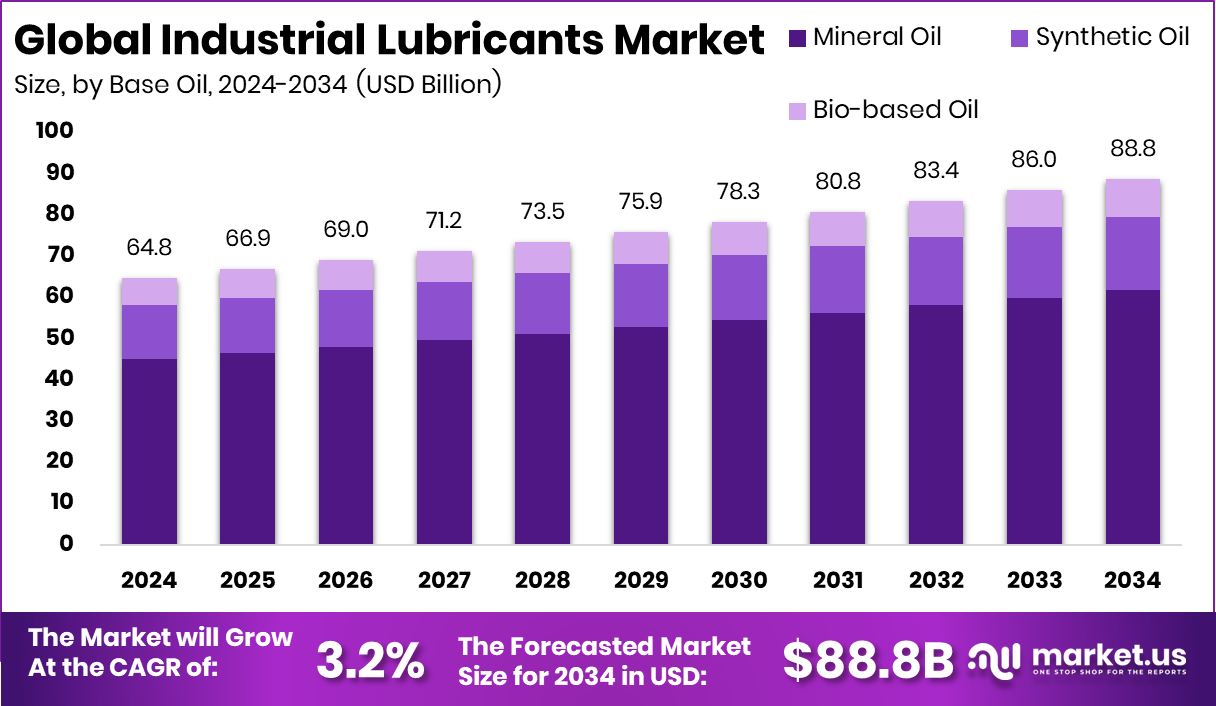
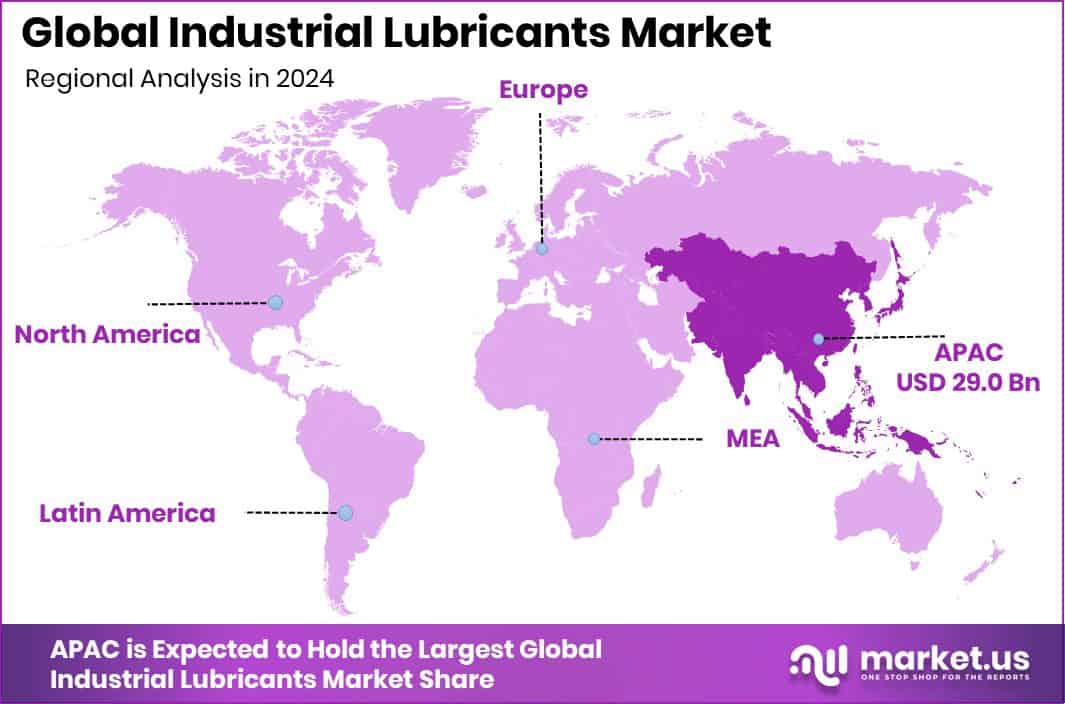
The Global Industrial Lubricants Market is expected to be worth around USD 88.8 billion by 2034, up from USD 64.8 billion in 2024, and is projected to grow at a CAGR of 3.2% from 2025 to 2034. Rapid industrial expansion drives Asia Pacific to sustain 44.8% and USD 29.0 Bn.
The global Industrial Lubricants Market covers a wide set of formulations such as mineral oil, synthetic oil, and bio-based oil, each used across applications like mining, power generation, food processing, chemical manufacturing, textiles, and steel production. These lubricants support machinery performance, reduce wear, and maintain reliability in environments that run continuously or under heavy loads. Product types span hydraulic fluids, metalworking fluids, gear oils, greases, and others, forming the backbone of day-to-day industrial operations across major sectors.
Industrial lubricants are specialized oils and greases designed to reduce friction, protect machine parts, manage heat, and extend equipment life in factories, plants, and industrial systems. The Industrial Lubricants Market represents the global ecosystem of manufacturers, formulators, distributors, and end users that rely on lubrication solutions to support industrial equipment across diverse sectors.
Growth in this market is closely tied to the expansion of industries that depend on heavy equipment and critical mineral production. Governments are increasing investments in resource supply chains, including the U.S. Department of Energy pledging $1 billion for critical mineral funds and Texas Tech receiving $3.3 million for mineral assessment, which supports higher machinery usage. These industrial activities naturally raise demand for hydraulic fluids, gear oils, and greases used in mining and processing.
Demand continues to rise as energy transition projects and mineral supply agreements expand. A recent example includes Japan and the U.S. securing $36 billion in gas and mineral deals, reinforcing the need for reliable machinery lubrication. However, shifting policy decisions—such as the U.S. canceling $13 billion in green energy funds—also reshape industrial priorities and equipment investments that indirectly influence lubricant consumption.
Opportunities in the market grow as global power and renewable energy projects evolve. New investments like the €157 million finance package for Ukraine’s private wind farms increase demand for specialty lubricants used in turbines and rotating equipment. As more regions modernize industrial infrastructure, lubricants remain an essential element for performance, durability, and operational continuity.
Key Takeaways
- The Global Industrial Lubricants Market is expected to be worth around USD 88.8 billion by 2034, up from USD 64.8 billion in 2024, and is projected to grow at a CAGR of 3.2% from 2025 to 2034.
- The industrial lubricants market shows strong dominance of mineral oil, accounting for 69.6% of total usage globally.
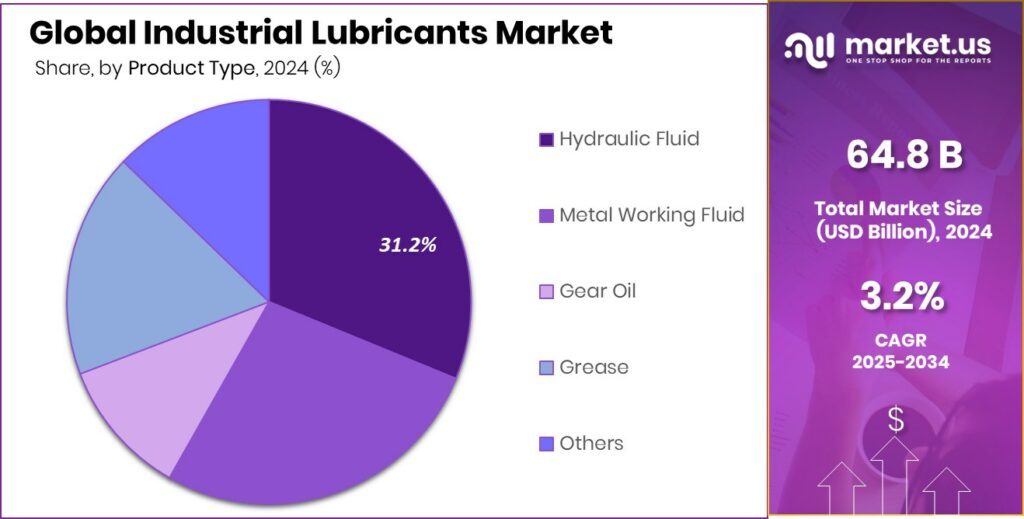
- Within the Industrial Lubricants Market, hydraulic fluids lead product demand, contributing a significant 31.2% share.
- Power generation remains the largest application segment in the Industrial Lubricants Market, holding 31.8% share.
- The Asia Pacific market is valued at USD 29.0 Bn, reflecting rising demand.
By Base Oil Analysis
Industrial Lubricants Market shows strong dominance with mineral oil holding nearly 69.6% share.
In 2024, the Industrial Lubricants Market continued to rely heavily on mineral oil–based formulations, which accounted for 69.6% of total consumption. This dominance is largely due to mineral oil’s affordability, wide availability, and compatibility with a broad range of industrial machinery. Many factories and processing units in developing regions still prefer mineral oil because it delivers dependable performance in high-load and continuous-operation environments.
While synthetic and bio-based oils are gaining interest, mineral oil remains the practical choice for sectors where cost sensitivity and high-volume usage are critical. Its extensive application across manufacturing lines, metalworking, heavy machinery, and transportation equipment keeps mineral oil firmly positioned as the backbone of the industrial lubrication ecosystem.
By Product Type Analysis
In the Industrial Lubricants Market, hydraulic fluid accounts for a significant 31.2%.
In 2024, hydraulic fluids represented 31.2% of the Industrial Lubricants Market, reaffirming their essential role in power transmission, equipment control, and operational stability across industries. Hydraulic systems remain central to construction machinery, mining equipment, manufacturing lines, presses, and automated systems, all of which demand reliable lubrication to prevent wear and overheating.
The rising installation of advanced hydraulic equipment in smart factories further fuels the need for consistent fluid quality and temperature stability. Manufacturers are also focusing on improving oxidation resistance and extending drain intervals, which increases system efficiency and reduces downtime. As industries expand automation and heavy-duty operations, the relevance of hydraulic fluids continues to strengthen within the overall lubricant demand structure.
By Application Analysis
Power generation leads the Industrial Lubricants Market, capturing roughly 31.8% of application demand.
In 2024, the power generation sector accounted for 31.8% of the Industrial Lubricants Market, underscoring the sector’s strong dependence on high-performance oils and greases for turbines, compressors, alternators, and cooling systems. Thermal, hydro, nuclear, and renewable power facilities all require consistent lubrication to maintain reliability, reduce friction, and support uninterrupted power output.
With grids expanding and energy demand increasing, operators prioritize lubricants that can withstand extreme temperatures and continuous operating cycles. The sector’s shift toward cleaner and more efficient power technologies has also increased the use of specialized turbine oils and advanced synthetic blends. As global electricity production scales upward, the importance of stable and high-quality lubrication in power generation becomes even more pronounced.
Key Market Segments
By Base Oil
- Mineral Oil
- Synthetic Oil
- Bio-based Oil
By Product Type
- Hydraulic Fluid
- Metal Working Fluid
- Gear Oil
- Grease
- Others
By Application
- Mining
- Power Generation
- Food Processing
- Chemical Manufacturing
- Textile Manufacturing
- Steel and Metals
- Others
Driving Factors
Rising demand for natural sweeteners globally
Rising machinery use across manufacturing, energy, and processing industries continues to strengthen demand for industrial lubricants. As plants automate and shift toward precision-dependent operations, the need for stable lubrication in pumps, compressors, turbines, and heavy machinery grows sharply. This momentum is reinforced by new investments aimed at improving manufacturing efficiency, such as H2Ok Innovations, raising $12 million in Series A funding to make industrial operations more precise for major customers like Coca-Cola and Unilever.
When large manufacturers invest in better process control and operational accuracy, it naturally increases the requirement for reliable lubricants that can support continuous workloads. These developments together expand lubricant consumption across industries, transitioning into more advanced production environments.
Restraining Factors
Limited sourcing of premium date varieties
High product costs remain a challenge for smaller industries that struggle to afford premium lubricants or maintain regular replacement cycles. Lubricants for harsh industrial conditions—high temperatures, heavy loads, and continuous cycles—are often formulated with expensive additives and synthetic components, making them difficult for micro-industries or low-margin operations to justify.
At the same time, global financial institutions continue to influence industrial investment flows. For example, HSBC helped the oil and gas industry raise $47 billion despite its net-zero pledge, showing how capital distribution often shifts toward high-value sectors rather than smaller industrial units. This uneven investment environment can limit access to advanced lubrication solutions for small-scale businesses.
Growth Opportunity
Expanding use in functional food formulations
Renewable energy projects create strong opportunities for industrial lubricants, especially in wind, solar, and bioenergy infrastructure, where turbines, gearboxes, and rotating components require long-life lubrication. As emerging markets invest in their local oil and energy ecosystems, lubricant demand expands even further.
A clear example is Nigeria’s oil content board launching a $100 million equity fund to support local producers, which helps build domestic manufacturing capacity and increases the use of industrial lubricants in refining, drilling, and processing operations. As more countries work to strengthen their energy sectors, including renewable and local hydrocarbon development, demand for specialized gear oils, greases, and hydraulic fluids continues to broaden.
Latest Trends
Increasing shift toward instant date powder
The industry is seeing a shift toward synthetic, high-performance formulations designed to withstand extreme loads, reduce downtime, and deliver longer service intervals. These advanced lubricants align with the direction of modern industrial operations that rely heavily on digital tools, supply chain platforms, and precision manufacturing.
Recent industry activities reflect this modernization wave, such as China’s industrial supply platform ZKH securing $315 million, which supports the expansion of equipment and manufacturing materials, including lubrication needs. Additionally, Terra Oleo raising US$3.1 million to advance its yeast-based fermentation platform for tailored lipids shows how alternative feedstocks and bio-derived components are entering the lubrication landscape. Together, these shifts shape a market increasingly defined by innovation and high-efficiency lubricant solutions.
Regional Analysis
The industrial lubricants market in the Asia Pacific holds 44.8%, showing strong regional dominance.
The Industrial Lubricants Market shows varied regional performance across North America, Europe, Asia Pacific, the Middle East & Africa, and Latin America, each influenced by its industrial base and manufacturing intensity. Asia Pacific remains the dominant region, holding 44.8% of the market and reaching a value of USD 29.0 Bn, driven by expanding production activity, rising machinery use, and continuous infrastructure development.
North America maintains a steady demand supported by established manufacturing, energy operations, and the modernization of industrial equipment. Europe follows with consistent adoption linked to automotive production, heavy engineering, and regulatory focus on efficient lubrication practices. Meanwhile, the Middle East & Africa benefit from ongoing industrialization and the presence of energy and processing industries that rely heavily on lubricants for operational reliability.
Latin America contributes through gradual industrial recovery and increased use of equipment in mining, agriculture, and manufacturing. Across all these regions, the market’s structure is shaped by the scale of industrial operations, equipment intensity, and modernization trends, with Asia Pacific clearly leading the segment due to its broad industrial footprint and higher consumption rates.
Key Regions and Countries
- North America
- US
- Canada
- Europe
- Germany
- France
- The UK
- Spain
- Italy
- Rest of Europe
- Asia Pacific
- China
- Japan
- South Korea
- India
- Australia
- Rest of APAC
- Latin America
- Brazil
- Mexico
- Rest of Latin America
- Middle East & Africa
- GCC
- South Africa
- Rest of MEA
Key Players Analysis
Exxon Mobil Corporation continues to hold a strong position in the global Industrial Lubricants Market in 2024 due to its long-standing expertise in formulating high-performance lubricants for heavy machinery, power equipment, and high-load manufacturing systems. The company benefits from its extensive refining capability, which supports the production of stable base oils essential for industrial applications. Its broad product portfolio and supply reliability across major industrial regions strengthen its global relevance, especially as end users seek dependable lubrication solutions for continuous operations.
Meanwhile, FUCHS demonstrates consistent growth momentum as it maintains a specialized focus on lubricant innovation and tailored industrial solutions. Focusing heavily on collaboration with machinery manufacturers, the company emphasizes compatibility, durability, and efficiency across its product range. This specialization helps FUCHS maintain strong relationships with industries that require custom formulations for metalworking, hydraulics, processing equipment, and automated manufacturing lines. Its commitment to performance-driven lubricant chemistry positions it as a technically dependable brand within the market.
Lastly, Lubrizol contributes significantly to the sector through its formulation expertise and additive technology, which are essential for enhancing lubricant stability, wear protection, and long-term performance. In 2024, the company’s role is increasingly important as industries demand lubricants that withstand extreme temperatures, higher pressures, and longer service intervals. By supplying advanced additive packages used in industrial oils and fluids, Lubrizol supports equipment reliability and aligns with the broader market shift toward improved operational efficiency and reduced maintenance downtime.
Top Key Players in the Market
- Exxon Mobil Corporation
- FUCHS
- Lubrizol
- Shell Global
- TotalEnergies
- Klüber Lubrication
- Valvoline Global Operations
- Chevron Corporation
- Quaker Chemical Corporation
- Castrol Limited
Recent Developments
- In May 2024, FUCHS officially opened its new High Performance Grease Plant (HPGP) in Yingkou, China. This facility produces advanced greases for many industrial uses, demonstrating the company’s investment in the Asia-Pacific lubrication market and its commitment to localized production and quality control.
- In April 2024, Exxon Mobil Corporation announced that it would build its first greenfield lubricant manufacturing plant in Maharashtra, India, with a planned capacity of 159,000 kiloliters per year to supply industrial and vehicle lubricants. The plant is expected to begin operations by the end of 2025. This expansion shows the company strengthening its production footprint for industrial & automotive oils in a fast-growing regional market.
Report Scope
Report Features Description Market Value (2024) USD 64.8 Billion Forecast Revenue (2034) USD 88.8 Billion CAGR (2025-2034) 3.2% Base Year for Estimation 2024 Historic Period 2020-2023 Forecast Period 2025-2034 Report Coverage Revenue Forecast, Market Dynamics, Competitive Landscape, Recent Developments Segments Covered By Base Oil (Mineral Oil, Synthetic Oil, Bio-based Oil), By Product Type (Hydraulic Fluid, Metal Working Fluid, Gear Oil, Grease, Others), By Application (Mining, Power Generation, Food Processing, Chemical Manufacturing, Textile Manufacturing, Steel and Metals , Others) Regional Analysis North America – US, Canada; Europe – Germany, France, The UK, Spain, Italy, Rest of Europe; Asia Pacific – China, Japan, South Korea, India, Australia, Singapore, Rest of APAC; Latin America – Brazil, Mexico, Rest of Latin America; Middle East & Africa – GCC, South Africa, Rest of MEA Competitive Landscape Exxon Mobil Corporation, FUCHS, Lubrizol, Shell Global, TotalEnergies, Klüber Lubrication, Valvoline Global Operations, Chevron Corporation, Quaker Chemical Corporation, Castrol Limited Customization Scope Customization for segments, region/country-level will be provided. Moreover, additional customization can be done based on the requirements. Purchase Options We have three licenses to opt for: Single User License, Multi-User License (Up to 5 Users), Corporate Use License (Unlimited User and Printable PDF)  Industrial Lubricants MarketPublished date: February 2026add_shopping_cartBuy Now get_appDownload Sample
 -
-
- Exxon Mobil Corporation
- FUCHS
- Lubrizol
- Shell Global
- TotalEnergies
- Klüber Lubrication
- Valvoline Global Operations
- Chevron Corporation
- Quaker Chemical Corporation
- Castrol Limited
Our Clients

- 178765
- February 2026






