


Global Glucose Market Size, Share, And Enhanced Productivity By Form (Syrup, Solid), By Application (Food and Beverages (Bakery and Confectionery, Dairy, Soups, Dressings and Sauces, Beverages, Others), Pharmaceutical, Cosmetic and Personal Care, Pulp and Paper, Others), By Region and Companies - Industry Segment Outlook, Market Assessment, Competition Scenario, Trends, and Forecast 2025-2034
- Published date: March 2026
- Report ID: 182086
- Number of Pages: 230
- Format:
-
keyboard_arrow_up
Quick Navigation
Report Overview
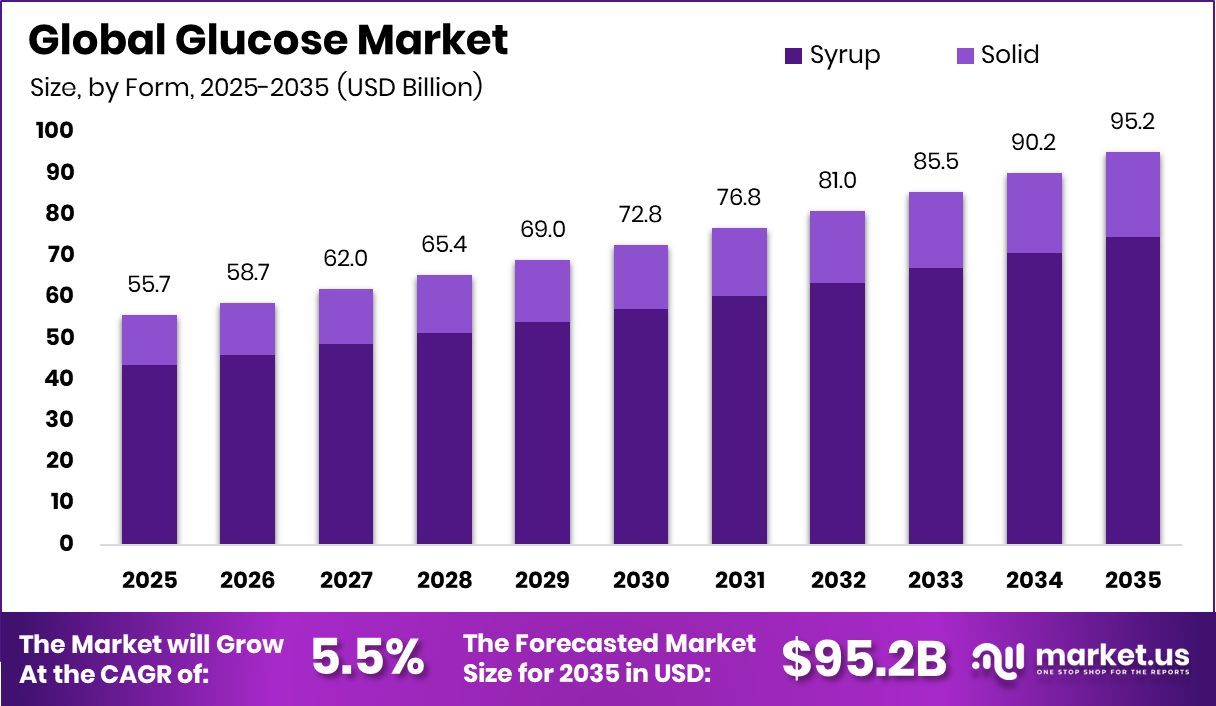
The Global Glucose Market is expected to be worth around USD 95.2 billion by 2034, up from USD 55.7 billion in 2024. It is projected to grow at a CAGR of 5.5% from 2025 to 2034. The Asia Pacific glucose market holds a 45.2% share, reaching USD 25.1 Bn in 2025.
Glucose is a simple sugar derived mainly from plant-based sources such as corn and starch-rich crops. It is widely used as an energy source and plays a key role in food production, pharmaceuticals, and industrial applications. Due to its sweetening, stabilizing, and moisture-retaining properties, glucose is available in forms such as syrup and solid, making it adaptable for different processing needs across industries.
The glucose market refers to the global production, distribution, and application of glucose in sectors like food and beverages, pharmaceuticals, cosmetics, and pulp and paper. In food and beverages, it is used across bakery and confectionery, dairy, soups, dressings, sauces, and beverages, while other industries utilize it for functional and technical purposes. The market structure reflects diverse applications supported by consistent demand for processed and packaged goods.
Growth in the glucose market is driven by rising consumption of convenience foods and expanding industrial usage. Increasing support for small and medium enterprises also contributes to sector development, as seen in initiatives like the ₦4bn fund partnership between BOI and Plateau for MSMEs. Additionally, the manufacturing sector focus is highlighted by MAKE UK’s concern over £1 billion in unused apprenticeship funding, indicating untapped production potential.
Demand for glucose continues to rise with the expansion of bakery, confectionery, and functional food segments. Investment activities further support this trend, such as Awake Chocolate securing $5.8 million to expand product offerings. Local bakery businesses are also benefiting, including Bakery Mazowsze receiving a £20,000 funding boost and a Newcastle bakery winning £25,000 to support initiatives like National Stottie Week.
Opportunities in the glucose market are linked to innovation, product diversification, and regional expansion. As food producers explore new formulations and improve product quality, glucose remains a key ingredient. Continued financial support and small-scale industry growth create pathways for broader market penetration, encouraging both established manufacturers and emerging businesses to scale operations effectively.
- In September 2025, ADM announced a joint venture with Alltech to strengthen its animal nutrition and ingredient solutions business. This development focuses on combining production expertise and innovation capabilities across North America, including multiple feed mills. While centered on nutrition, the move supports ADM’s broader ingredient portfolio, including glucose derived from corn processing.
Key Takeaways
- The Global Glucose Market is expected to be worth around USD 95.2 billion by 2034, up from USD 55.7 billion in 2024. It is projected to grow at a CAGR of 5.5% from 2025 to 2034.
- The glucose market by form shows syrup dominating with 78.4% share, indicating a strong industrial preference.
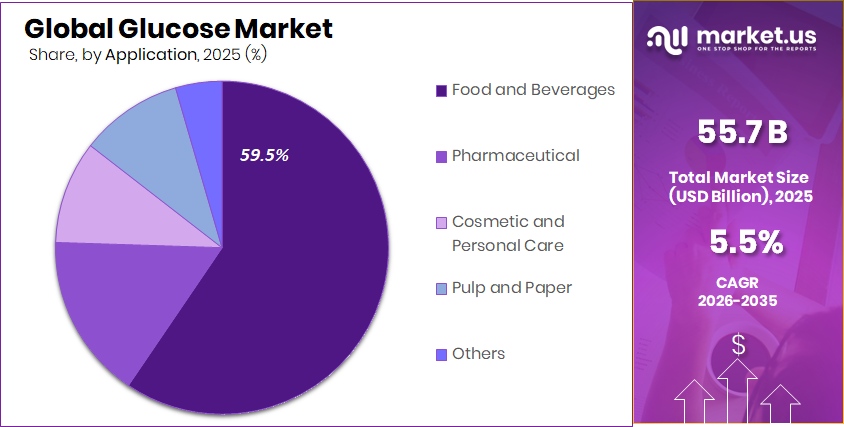
- The glucose market, by application, highlights food and beverages, leading with 59.5% demand globally today overall.
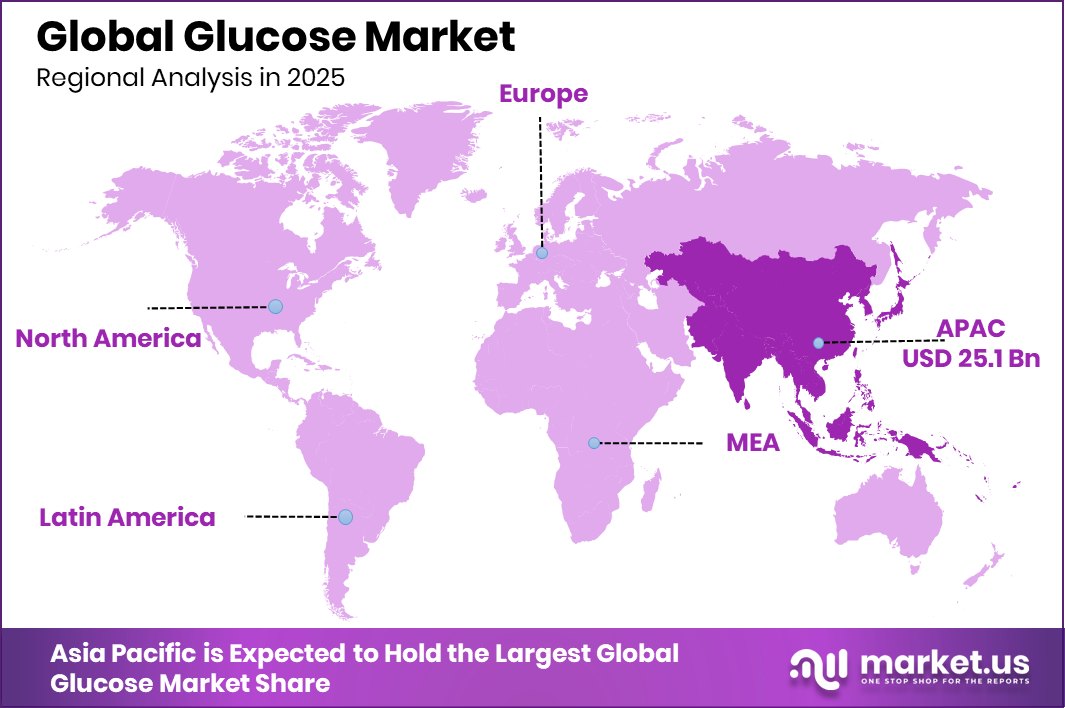
- With 45.2% share, the Asia Pacific glucose market achieves a USD 25.1 Bn valuation.
By Form Analysis
The glucose market shows syrup form dominates with a significant 78.4% share globally.
In 2025, the glucose market shows a strong dominance of syrup form, accounting for 78.4% of the total share. This widespread preference is driven by its ease of handling, quick solubility, and versatile usage across multiple industries. Syrup glucose is particularly favored in large-scale manufacturing due to its consistent texture and ability to blend seamlessly with other ingredients.
It plays a key role in confectionery, bakery, and processed food production, where maintaining moisture and enhancing sweetness are critical. Also, its low cost compared to solid forms helps it become more popular. Manufacturers continue to innovate in refining processes to improve purity and shelf stability, further strengthening the position of syrup glucose in the global market landscape.
By Application Analysis
The glucose market application in food and beverages leads strongly at 59.5%.
In 2025, food and beverages remain the leading application segment in the glucose market, holding a substantial 59.5% share. The demand is largely fueled by the expanding processed food industry and changing consumer lifestyles that favor convenience products. Glucose is widely used as a sweetener, preservative, and texture enhancer in items such as soft drinks, baked goods, dairy products, and snacks.
Its ability to improve flavor while extending product shelf life makes it highly valuable for manufacturers. Rising urbanization and increasing consumption of ready-to-eat foods further contribute to this growth. Additionally, ongoing product innovations and the introduction of functional foods continue to create new opportunities for glucose usage within the food and beverage sector.
Key Market Segments
By Form
- Syrup
- Solid
By Application
- Food and Beverages
- Bakery and Confectionery
- Dairy
- Soups, Dressings, and Sauces
- Beverages
- Others
- Pharmaceutical
- Cosmetic and Personal Care
- Pulp and Paper
- Others
Driving Factors
Rising demand for processed convenience foods
The glucose market continues to benefit from the steady rise in processed and convenience food consumption, particularly across urban populations where time-saving products are preferred. Glucose plays a key role in improving taste, texture, and shelf life in packaged foods such as bakery, dairy, and ready-to-eat meals. This demand is further supported by investments in the food supply chain, including initiatives like Dairy Farmers of America set to receive up to $46M grant from USDA, which strengthens production and processing capabilities.
Such funding helps improve efficiency and output in dairy and related segments, indirectly supporting glucose usage. As consumer lifestyles evolve toward convenience, the reliance on glucose as a functional ingredient continues to grow across multiple food categories.
Expanding applications across multiple industrial sectors
Glucose is no longer limited to food and beverages, as its applications have expanded into pharmaceuticals, cosmetics, and industrial processes. Its functional properties make it valuable for fermentation, binding, and moisture retention across diverse industries. This broad applicability supports consistent market growth and demand stability.
Government and institutional funding also play a role in strengthening these sectors, such as the $750,000 allocated for dairy farms to boost long-term success, which enhances raw material availability and processing infrastructure. These developments contribute to a more integrated supply chain, enabling glucose producers to cater to multiple industries efficiently. The widening scope of applications continues to position glucose as a versatile and essential component across various end-use sectors.
Restraining Factors
Fluctuating raw material prices affect production
The glucose market faces challenges due to fluctuations in the prices of key raw materials like corn and starch crops. Variations in agricultural output, climate conditions, and supply chain disruptions can directly impact production costs and pricing stability. These uncertainties create pressure on manufacturers to maintain margins while ensuring consistent supply.
Support initiatives such as the DFA Awarded $46 Million USDA Grant to Advance Dairy Conservation and Small Farm Markets highlight efforts to stabilize agricultural systems, but volatility still remains a concern. Such fluctuations can influence production planning and limit the ability of smaller producers to compete effectively. As a result, managing cost efficiency and securing reliable raw material sources remain critical challenges within the glucose market landscape.
Health concerns regarding excessive sugar consumption
Growing awareness around health and nutrition has led to increased scrutiny of sugar intake, including glucose-based products. Consumers are becoming more cautious about ingredients linked to obesity, diabetes, and other health issues, which may impact demand in certain segments. Regulatory bodies and public health initiatives are also encouraging reduced sugar consumption, influencing product reformulation strategies.
Funding programs like the USDA announce $11 million in funding awarded to support the dairy industry, reflecting broader efforts to improve food systems, yet health concerns persist. These shifts in consumer preference require manufacturers to balance functionality with health considerations. As a result, the perception of glucose as a traditional sweetener continues to pose a restraint, especially in markets focused on wellness and clean eating.
Growth Opportunity
Innovation in functional and low-sugar products
The glucose market is witnessing opportunities through the development of functional and low-sugar formulations that align with changing consumer preferences. Manufacturers are exploring ways to modify glucose usage to maintain product performance while reducing overall sugar content. This shift is supported by innovation-driven investments, such as the cow-free dairy startup Those Vegan Cowboys closing a €6.25 million funding round as it eyes a crowdfunding campaign.
Such developments indicate a broader move toward alternative and improved ingredient solutions. By integrating glucose with new technologies and formulations, producers can create products that meet both functional and health-oriented demands. This evolving landscape opens new avenues for product differentiation and value addition within the glucose market.
Expansion in emerging markets with urbanization
Rapid urbanization in emerging economies is creating strong growth potential for the glucose market. Increasing disposable incomes, changing dietary habits, and the expansion of retail and food processing industries are driving demand for glucose-based products. Infrastructure and promotional support also play a role, as seen in the EU’s €1.5bn promo scheme backing sustainable meat and dairy sectors.
Such initiatives contribute to the development of food supply chains and encourage the consumption of processed products where glucose is widely used. As cities expand and consumer preferences shift toward packaged and convenience foods, the demand for glucose is expected to rise. Emerging markets, therefore, present significant opportunities for manufacturers to scale operations and expand their reach.
Latest Trends
Growing demand for clean-label ingredients
Consumers are increasingly seeking transparency in food products, leading to a growing demand for clean-label ingredients in the glucose market. This trend emphasizes simple, recognizable components and minimal processing, encouraging manufacturers to refine production methods. Glucose producers are adapting by improving purity and reducing additives to align with consumer expectations.
Supportive initiatives such as USDA Awards More Than $11 Million to Support U.S Dairy Industry highlight ongoing investments in improving ingredient quality and supply chains. This shift toward clean labeling is influencing product development across food and beverage categories. As a result, glucose continues to evolve in its application, with a stronger focus on clarity, quality, and consumer trust in ingredient sourcing and processing.
Increased focus on sustainable production processes
Sustainability has become a key trend shaping the glucose market, with manufacturers focusing on reducing environmental impact and improving resource efficiency. Efforts include optimizing energy use, minimizing waste, and adopting eco-friendly production techniques. Industry support is reinforced by programs such as USDA Awards $11 Million to Boost Dairy Innovation Across the U.S., which encourages sustainable practices across related sectors. These initiatives contribute to more responsible sourcing and processing of raw materials used in glucose production.
As environmental concerns grow, companies are aligning their operations with sustainability goals to meet regulatory expectations and consumer demand. This trend is expected to influence long-term strategies, making sustainable production a central aspect of the glucose market’s future development.
Regional Analysis
In 2025, Asia Pacific dominates the glucose market with 45.2% share, valued at USD 25.1 Bn.
The global glucose market demonstrates varied regional dynamics across North America, Europe, Asia Pacific, Middle East & Africa, and Latin America, driven by industrial demand and consumption patterns. Asia Pacific emerges as the dominant region, accounting for 45.2% of the global market and reaching a valuation of USD 25.1 Bn. This dominance is supported by strong food processing industries and high consumption of packaged foods across developing economies.
North America represents a mature market, characterized by steady demand from established food and beverage manufacturers and consistent industrial usage. Europe follows with stable growth, supported by regulatory standards and demand for quality ingredients in processed food products.
The Middle East & Africa region reflects gradual expansion, driven by increasing urbanization and changing dietary habits. Latin America also shows moderate growth potential, supported by rising demand for convenience foods and expanding food processing sectors.
Key Regions and Countries
- North America
- US
- Canada
- Europe
- Germany
- France
- The UK
- Spain
- Italy
- Rest of Europe
- Asia Pacific
- China
- Japan
- South Korea
- India
- Australia
- Rest of APAC
- Latin America
- Brazil
- Mexico
- Rest of Latin America
- Middle East & Africa
- GCC
- South Africa
- Rest of MEA
Key Players Analysis
Archer Daniels Midland Company (ADM) continues to demonstrate strong positioning in the global glucose market in 2025 through its integrated value chain and diversified processing capabilities. The company’s strength lies in its ability to efficiently convert agricultural raw materials into high-quality glucose products while maintaining consistency and scale. ADM’s operational efficiency, global footprint, and focus on process optimization support its competitive edge. Its method highlights dependable supply and flexibility to meet different industry needs, strengthening its position as an important player in glucose production and distribution.
Ingredion Incorporated maintains a focused approach centered on ingredient solutions and application-driven development. In 2025, the company leverages its technical expertise to deliver glucose-based ingredients tailored to specific end-use requirements. Its strength lies in customization and formulation support, allowing it to address evolving customer needs across multiple industries. Ingredion’s emphasis on functional performance and product versatility enables it to remain relevant in a competitive landscape while strengthening relationships with manufacturers seeking specialized glucose solutions.
AGRANA Beteiligungs-AG demonstrates a balanced approach combining production expertise with a strong regional presence. In 2025, the company focuses on maintaining product quality and operational stability within its glucose offerings. Its structured manufacturing processes and emphasis on consistency support its market participation. AGRANA’s strategic positioning reflects a commitment to efficient resource utilization and dependable supply, enabling it to sustain its role among established glucose market players.
Top Key Players in the Market
- Archer Daniels Midland Company (ADM)
- Ingredion Incorporated
- AGRANA Beteiligungs-AG
- Tate & Lyle PLC
- Cargill, Incorporated
- Roquette Frères
- Grain Processing Corporation
- Tereos S.A
- Fooding Group Limited
- Global Sweeteners Holdings Limited
Recent Developments
- In August 2025, AGRANA acquired Slovenian food company Mercator-Emba to expand its food ingredient and processing capabilities in Europe. This supports its glucose- and starch-based product applications in the food service and retail sectors, helping the company grow its regional market presence.
- In February 2024, Ingredion launched NOVATION® Indulge 2940, a functional native corn starch designed for food and beverage applications. This product helps improve texture and mouthfeel in products like dairy and desserts, supporting glucose-based formulations where starch and sweeteners work together. The launch shows Ingredion’s focus on improving ingredient performance using simple, plant-based inputs.
Report Scope
Report Features Description Market Value (2025) USD 55.7 Billion Forecast Revenue (2035) USD 95.2 Billion CAGR (2026-2035) 5.5% Base Year for Estimation 2025 Historic Period 2020-2024 Forecast Period 2026-2035 Report Coverage Revenue Forecast, Market Dynamics, Competitive Landscape, Recent Developments Segments Covered By Form (Syrup, Solid), By Application (Food and Beverages (Bakery and Confectionery, Dairy, Soups, Dressings and Sauces, Beverages, Others), Pharmaceutical, Cosmetic and Personal Care, Pulp and Paper, Others) Regional Analysis North America – US, Canada; Europe – Germany, France, The UK, Spain, Italy, Rest of Europe; Asia Pacific – China, Japan, South Korea, India, Australia, Singapore, Rest of APAC; Latin America – Brazil, Mexico, Rest of Latin America; Middle East & Africa – GCC, South Africa, Rest of MEA Competitive Landscape Archer Daniels Midland Company (ADM), Ingredion Incorporated, AGRANA Beteiligungs-AG, Tate & Lyle PLC, Cargill, Incorporated, Roquette Frères, Grain Processing Corporation, Tereos S.A, Fooding Group Limited, Global Sweeteners Holdings Limited Customization Scope Customization for segments, region/country-level will be provided. Moreover, additional customization can be done based on the requirements. Purchase Options We have three licenses to opt for: Single User License, Multi-User License (Up to 5 Users), Corporate Use License (Unlimited User and Printable PDF) 
-
-
- Archer Daniels Midland Company (ADM)
- Ingredion Incorporated
- AGRANA Beteiligungs-AG
- Tate & Lyle PLC
- Cargill, Incorporated
- Roquette Frères
- Grain Processing Corporation
- Tereos S.A
- Fooding Group Limited
- Global Sweeteners Holdings Limited
Our Clients

- 182086
- March 2026






