


Global Fishing Net Market Size, Share, And Enhanced Productivity By Material (Nylon, High-Density Polyethylene (HDPE), Polypropylene, Polyester, Biodegradable Polymers (PLA, PHA)), By Net Type (Gill Nets, Trawl Nets, Cast Nets, Seine Nets, Drift Nets), By End User (Commercial Capture Fishing, Aquaculture Cages, Recreational/Artisanal Fishing), By Distribution Channel (Direct to Fleet Owners, Specialized Marine Equipment Dealers, Online B2B Platforms), By Region and Companies - Industry Segment Outlook, Market Assessment, Competition Scenario, Trends, and Forecast 2026-2035
- Published date: February 2026
- Report ID: 179116
- Number of Pages: 338
- Format:
-
keyboard_arrow_up
Quick Navigation
Report Overview
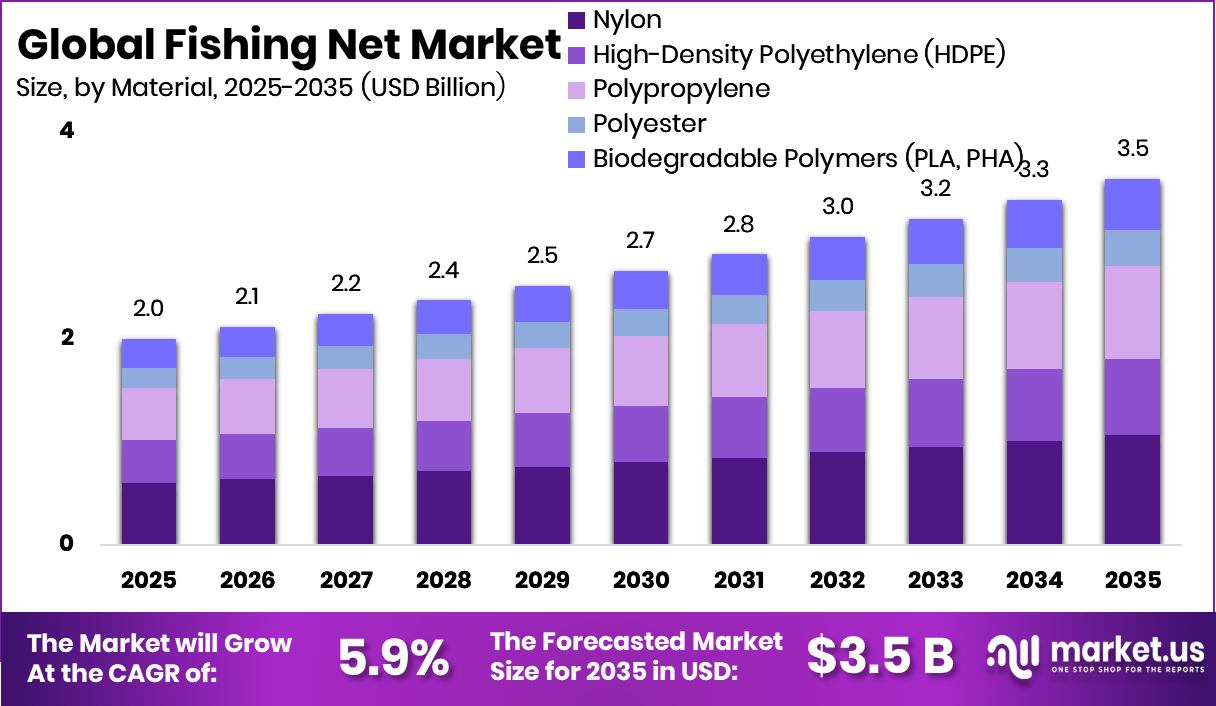
The Global Fishing Net Market is expected to be worth around USD 3.5 billion by 2035, up from USD 2.0 billion in 2025, and is projected to grow at a CAGR of 5.9% from 2026 to 2035. The fishing net market in the Asia Pacific holds 48.6%, totaling nearly USD 0.9 Bn.
The global Fishing Net Market is shaped by diverse materials such as nylon, HDPE, polypropylene, polyester, and emerging biodegradable polymers like PLA and PHA. Fishing nets themselves are essential woven or knotted mesh structures used across commercial capture fishing, aquaculture cages, and artisanal or recreational fishing activities. The market reflects continual improvements in strength, durability, and environmental responsibility as operators shift between gill nets, trawl nets, cast nets, seine nets, and drift nets depending on fishing style and water conditions.
Growing demand is influenced by rising activity in commercial fishing and expanding aquaculture operations worldwide. Supportive initiatives such as Fishing net recyclers receiving USD 126,000 in funding and Vonin securing £955,000 from a Scottish maritime program highlight increasing attention to modernizing fishing equipment. These developments drive the need for efficient, long-lasting nets and better material recovery systems.
New opportunities emerge from sustainability-focused innovations, strengthened further by funding movements. Catchwise raising €1.25 million, Syntetica securing €4.2 million for nylon recycling, and polypropylene recovery projects receiving USD 4.2 million in grants contribute to the shift toward eco-friendly net materials. A USD 120 million polypropylene recycling venture also supports future possibilities for circular production, opening space for biodegradable and low-impact net designs.
Overall, the Fishing Net Market is evolving through material advancements, shifting demand patterns, and strong sustainability-linked funding that encourages new solutions across direct-to-fleet channels, specialized marine dealers, and growing online B2B platforms.
Key Takeaways
- The Global Fishing Net Market is expected to be worth around USD 3.5 billion by 2035, up from USD 2.0 billion in 2025, and is projected to grow at a CAGR of 5.9% from 2026 to 2035.
- In the Fishing Net Market, nylon holds a strong 46.8% share, reflecting widespread global usage.
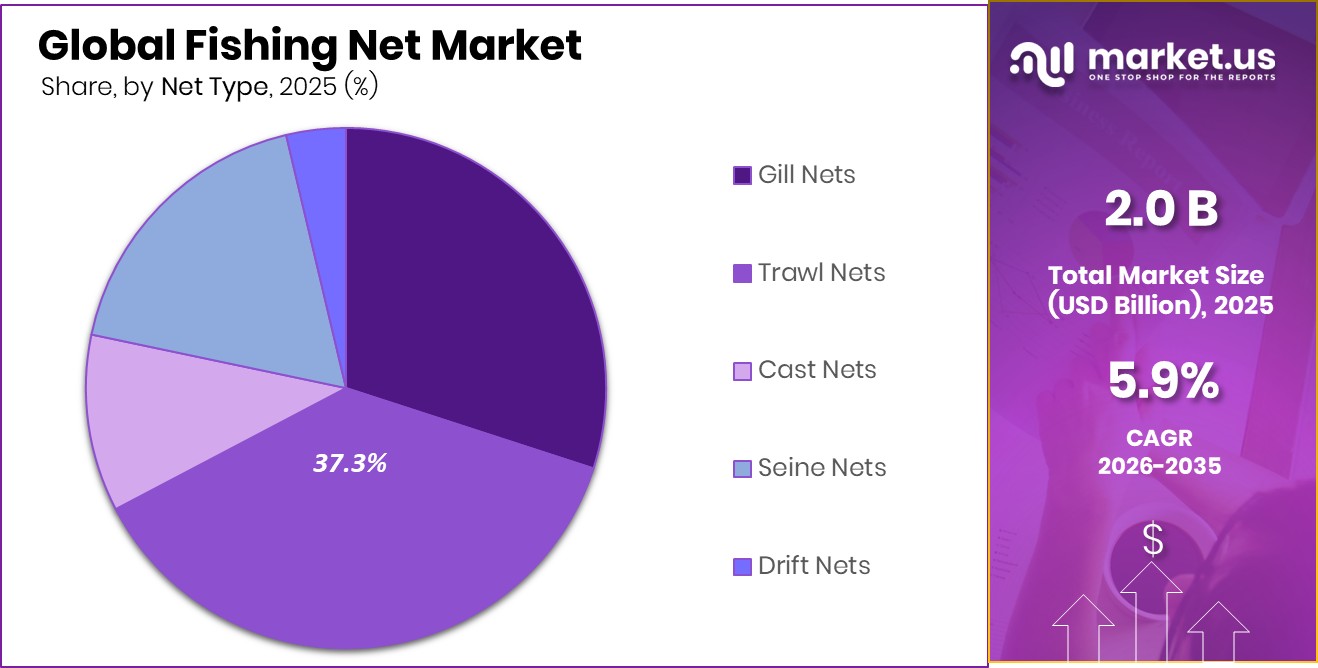
- Trawl nets dominate the Fishing Net Market with a notable 37.3% share among all net types.
- Commercial capture fishing drives the Fishing Net Market significantly, accounting for a commanding 67.9% share worldwide.
- Direct-to-fleet owners remain the leading distribution channel in the fishing net market at 53.5% share.
- In the Asia Pacific, the Fishing Net Market reaches USD 0.9 Bn, contributing 48.6%.
By Material Analysis
Fishing Net Market sees nylon leading the materials segment with a strong 46.8% share.
In 2025, the Fishing Net Market continues to see nylon dominating material preferences, holding a substantial 46.8% share. This strong position reflects nylon’s balance of durability, flexibility, and cost-efficiency, which makes it a preferred choice for both small and large fishing operations. Market feedback from coastal regions consistently highlights nylon’s longer service life and resistance to harsh marine conditions, helping fishing businesses reduce replacement cycles.
As sustainability discussions rise, nylon remains relevant because manufacturers increasingly focus on recyclable variants and low-impact production systems. In 2025, commercial procurement patterns show fishing communities favoring dependable materials that align with operational stability, making nylon the most economically and technically practical choice within marine gear procurement.
By Net Type Analysis
Fishing Net Market reports trawl nets dominating net type category at 37.3% globally.
In 2025, trawl nets maintain their dominant position within the Fishing Net Market, accounting for 37.3% of the segment. This leadership reflects the widespread use of trawling across major marine and inland fisheries that rely on efficient large-volume catch systems. Fishing operators emphasize trawl nets for their high yield capacity, ease of deployment, and compatibility with modern mechanized vessels.
Even as sustainability frameworks evolve, trawl nets remain integral for commercial fleets that depend on consistent throughput. In 2025, manufacturers focus on improving mesh strength and reducing drag to enhance fuel efficiency, allowing trawl users to operate more cost-effectively. These advantages help trawl nets retain market relevance across industrial and semi-industrial fishing ecosystems.
By End User Analysis
The Fishing Net Market shows commercial capture fishing contributing a major 67.9% demand share.
In 2025, commercial capture fishing represents the core demand engine of the Fishing Net Market, commanding 67.9% of total end-user share. This sizable contribution stems from the sector’s reliance on high-performance nets that support year-round operations across coastal and deep-sea environments.
Commercial fleets prioritize nets that offer strong tensile strength, reliable knot performance, and long operational life, ensuring minimal downtime during peak fishing seasons. With global seafood consumption trends holding firm, fleet operators continue investing in reliable netting systems to sustain productivity. In 2025, the market shows steady replacement cycles, with commercial buyers preferring robust materials and advanced designs that help reduce losses, improve handling efficiency, and support consistent daily catch performance.
By Distribution Channel Analysis
Fishing Net Market highlights direct-to-fleet-owners distribution, holding a solid 53.5% share.
In 2025, direct-to-fleet-owner distribution channels account for 53.5% of Fishing Net Market transactions, reflecting a strong shift toward streamlined procurement. Fleet owners increasingly prefer direct sourcing because it offers better pricing, higher customization options, and stronger after-sales support compared to intermediaries. This pathway also enables manufacturers to understand operational challenges more closely, helping them deliver nets tailored to vessel size, fishing method, and catch targets.
In 2025, large and mid-scale fleets maintain consolidated buying cycles, relying on trusted suppliers to reduce logistical delays and ensure consistent supply availability. As fishing operations prioritize predictable equipment access, direct-to-owner engagement continues to boost transparency, product reliability, and long-term vendor relationships.
Key Market Segments
By Material
- Nylon
- High-Density Polyethylene (HDPE)
- Polypropylene
- Polyester
- Biodegradable Polymers (PLA, PHA)
By Net Type
- Gill Nets
- Trawl Nets
- Cast Nets
- Seine Nets
- Drift Nets
By End User
- Commercial Capture Fishing
- Aquaculture Cages
- Recreational/Artisanal Fishing
By Distribution Channel
- Direct to Fleet Owners
- Specialized Marine Equipment Dealers
- Online B2B Platforms
Driving Factors
Rising commercial fishing activities increase demand
Rising commercial fishing activities continue to push global demand for durable and efficient fishing nets, as fleets increasingly prioritize materials that ensure reliability during long operational cycles. This momentum aligns with broader industry attention on improved material performance, particularly where polyester and polymer-based nets are commonly used.
The sector also gains indirect support from advancements in recycling infrastructure, such as Matterr securing a €30 million EU grant to build a polyester recycling plant, which strengthens future material availability. These developments collectively support a market environment where fishing operators depend on modern nets that balance strength, longevity, and environmental responsibility, reinforcing steady growth in the Fishing Net Market.
Restraining Factors
High-quality net materials raise costs
High-quality fishing net materials often come with elevated production costs, creating financial pressure on smaller operators and artisanal fishing groups. Pricing challenges increase when manufacturers rely on advanced polymers or precision-engineered fibers, making affordability a major concern in cost-sensitive coastal regions.
The landscape becomes even more complex with rising investments in next-generation materials, such as Ambercycle raising $10 million for a circular materials plant and Kintra Fibers securing $8 million to expand bio-based polyester alternatives. While these initiatives promise better sustainability, they also highlight cost hurdles that can slow immediate adoption of high-performance fishing nets.
Growth Opportunity
Sustainable net recycling technologies gain traction
Sustainable net recycling technologies present significant opportunities as the marine sectors worldwide seek to reduce waste and adopt circular practices. Increasing interest in recovering and reprocessing nylon, polyester, and polypropylene nets has opened new pathways for environmentally responsible product lines. This direction gains further momentum from large-scale funding initiatives such as DePoly, announcing $23 million to advance PET and polyester waste recycling, supporting the development of cleaner material loops. These advancements pave the way for fishing nets designed with recyclability in mind, creating promising openings in both commercial markets and aquaculture systems looking to align with sustainability goals.
Latest Trends
Shift toward eco-friendly fishing net materials
A clear trend in the Fishing Net Market is the accelerating shift toward eco-friendly fishing net materials, driven by industry interest in lowering environmental impact while maintaining durability. Manufacturers are exploring recycled polymers, bio-based fibers, and lower-energy production systems to meet rising expectations from regulators and coastal communities. This movement is strengthened by innovation-focused investments such as MacroCycle, raising $6.5 million to commercialize PET and polyester upcycling technology with 80% less energy, along with Fairbrics in France, securing €22 million to create polyester fiber from captured CO₂. Together, these advancements underline a broader transition to cleaner, smarter material solutions shaping the next generation of fishing nets.
Regional Analysis
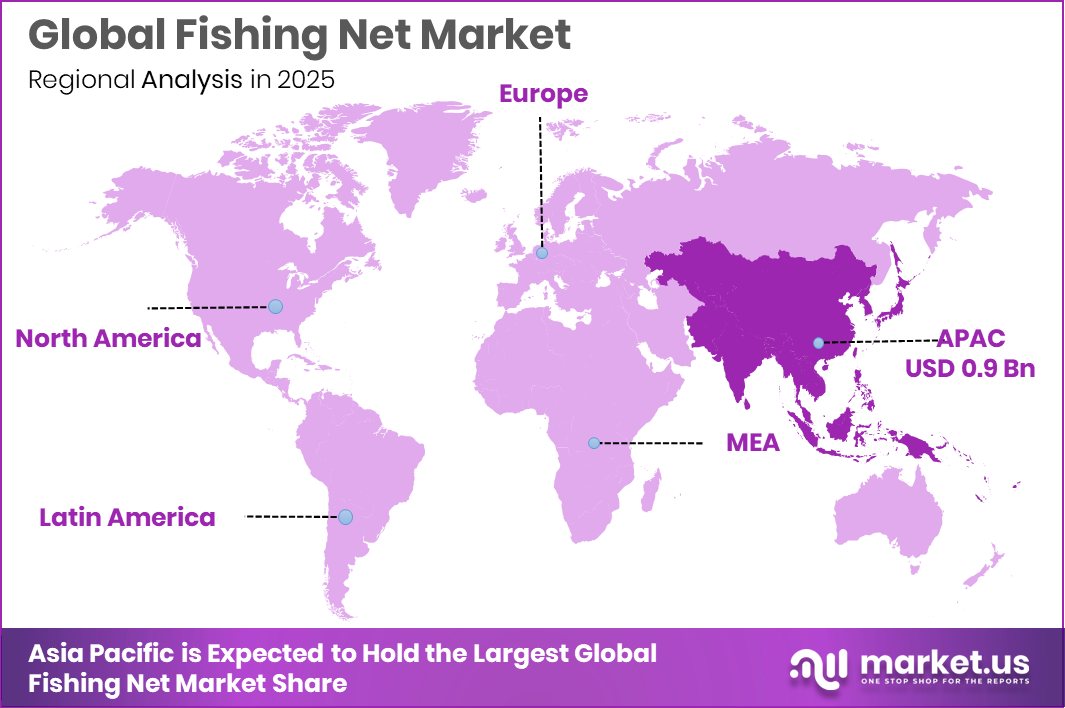
Asia Pacific leads the fishing net market with 48.6% valued at USD 0.9 Bn.
The Fishing Net Market shows varied regional performance across North America, Europe, Asia Pacific, the Middle East & Africa, and Latin America, with each region reflecting different consumption patterns and fishing activity levels. Asia Pacific remains the dominant region, holding 48.6% of the global share and reaching USD 0.9 billion, driven by extensive coastal fisheries and strong commercial capture activity across major fishing nations.
North America demonstrates steady adoption supported by organized fishing fleets and consistent demand for durable, high-performance nets suited for large-scale operations. Europe maintains a balanced market presence, benefiting from regulated fishing practices and a structured marine sector that prioritizes efficient net designs.
The Middle East & Africa region exhibits moderate but expanding usage, supported by growing coastal communities relying on marine capture for livelihood. Latin America continues to show stable demand, primarily from countries with active maritime economies and established fishing zones.
Collectively, the regional segmentation highlights Asia Pacific’s clear leadership, with other regions contributing to a diverse global market shaped by fishing intensity, commercial fleet size, and evolving net material preferences.
Key Regions and Countries
- North America
- US
- Canada
- Europe
- Germany
- France
- The UK
- Spain
- Italy
- Rest of Europe
- Asia Pacific
- China
- Japan
- South Korea
- India
- Australia
- Rest of APAC
- Latin America
- Brazil
- Mexico
- Rest of Latin America
- Middle East & Africa
- GCC
- South Africa
- Rest of MEA
Key Players Analysis
In 2025, Garware Technical Fibres Limited continues to strengthen its position in the global Fishing Net Market by focusing on performance-driven netting solutions that support demanding marine environments. The company’s emphasis on material durability, operational efficiency, and product customization reflects a clear understanding of evolving industry needs. Its portfolio remains aligned with commercial fleet requirements, especially where long service life and reduced maintenance are critical. Garware’s consistent improvements in fiber strength and design precision allow it to retain a strong footprint in regions with active coastal fisheries.
Nitto Seimo Co., Ltd. maintains its reputation for engineering precision and quality within the fishing net segment. In 2025, the company benefits from its legacy of fine craftsmanship and technology-led production, offering net systems known for superior handling and uniform mesh performance. Its long-standing engagement with fishing communities supports product designs that reflect real-world usage conditions. Nitto Seimo’s continued commitment to manufacturing excellence ensures stable demand, particularly among professional fleets seeking reliability and consistent catch performance.
King Chou Marine Technology Co., Ltd. remains a notable contributor through innovative marine and fishing solutions that cater to diverse operational scales. In 2025, the company’s focus on dependable net structures and enhanced mesh strength will help address the practical challenges faced by commercial operators. King Chou’s adaptability in product configurations positions it well among users requiring nets suited to varying vessel sizes and fishing techniques. Its ability to balance performance and usability supports its relevance in global fishing markets.
Top Key Players in the Market
- Garware Technical Fibres Limited
- Nitto Seimo Co., Ltd.
- King Chou Marine Technology Co., Ltd.
- AKVA group ASA
- Fujian Hongmei Fishing Tackle Co., Ltd.
- Miller Net Company, Inc.
- Qingdao Qihang Fishing Net Co., Ltd.
- Toray Industries, Inc.
- Siam Brothers Vietnam Joint Stock Company
- Jiangsu Jinlong Mesh Co., Ltd.
Recent Developments
- In June 2025, Garware Technical Fibres UK — a subsidiary of GTFL — signed an agreement to acquire Norway’s Offshore & Trawl Supply AS (OTS), a company that makes advanced synthetic rope and marine products used in fisheries, offshore, aquaculture, and marine services. This deal is aimed at expanding GTFL’s offerings beyond fishing nets into rope systems and strengthening its position in Europe and offshore markets, bringing more product variety under GTFL’s umbrella.
- In December 2024, Nitto Seimo Co., Ltd. updated and renewed its official company website to present its fishing net products, technologies, and company information more clearly for customers and industry partners. The refreshed site makes it easier to explore their range of set nets, purse seine nets, aquaculture nets, and trawl nets that support various fishing methods. This is aimed at improving communication with fishing communities and stakeholders.
Report Scope
Report Features Description Market Value (2025) USD 2.0 Billion Forecast Revenue (2035) USD 3.5 Billion CAGR (2026-2035) 5.9% Base Year for Estimation 2025 Historic Period 2020-2024 Forecast Period 2026-2035 Report Coverage Revenue Forecast, Market Dynamics, Competitive Landscape, Recent Developments Segments Covered By Material (Nylon, High-Density Polyethylene (HDPE), Polypropylene, Polyester, Biodegradable Polymers (PLA, PHA)), By Net Type (Gill Nets, Trawl Nets, Cast Nets, Seine Nets, Drift Nets), By End User (Commercial Capture Fishing, Aquaculture Cages, Recreational/Artisanal Fishing), By Distribution Channel (Direct to Fleet Owners, Specialized Marine Equipment Dealers, Online B2B Platforms) Regional Analysis North America – US, Canada; Europe – Germany, France, The UK, Spain, Italy, Rest of Europe; Asia Pacific – China, Japan, South Korea, India, Australia, Singapore, Rest of APAC; Latin America – Brazil, Mexico, Rest of Latin America; Middle East & Africa – GCC, South Africa, Rest of MEA Competitive Landscape Garware Technical Fibres Limited, Nitto Seimo Co., Ltd., King Chou Marine Technology Co., Ltd., AKVA group ASA, Fujian Hongmei Fishing Tackle Co., Ltd., Miller Net Company, Inc., Qingdao Qihang Fishing Net Co., Ltd., Toray Industries, Inc., Siam Brothers Vietnam Joint Stock Company, Jiangsu Jinlong Mesh Co., Ltd. Customization Scope Customization for segments, region/country-level will be provided. Moreover, additional customization can be done based on the requirements. Purchase Options We have three licenses to opt for: Single User License, Multi-User License (Up to 5 Users), Corporate Use License (Unlimited User and Printable PDF) 
-
-
- Garware Technical Fibres Limited
- Nitto Seimo Co., Ltd.
- King Chou Marine Technology Co., Ltd.
- AKVA group ASA
- Fujian Hongmei Fishing Tackle Co., Ltd.
- Miller Net Company, Inc.
- Qingdao Qihang Fishing Net Co., Ltd.
- Toray Industries, Inc.
- Siam Brothers Vietnam Joint Stock Company
- Jiangsu Jinlong Mesh Co., Ltd.
Our Clients

- 179116
- February 2026






