Report Overview
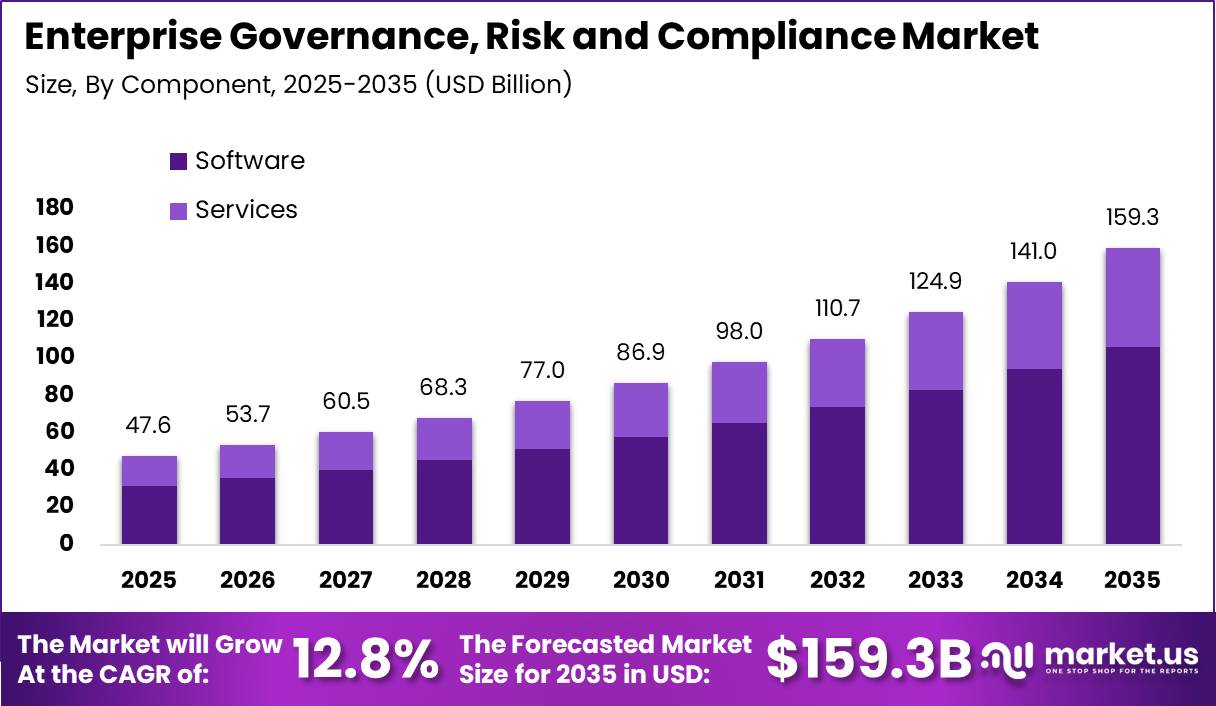
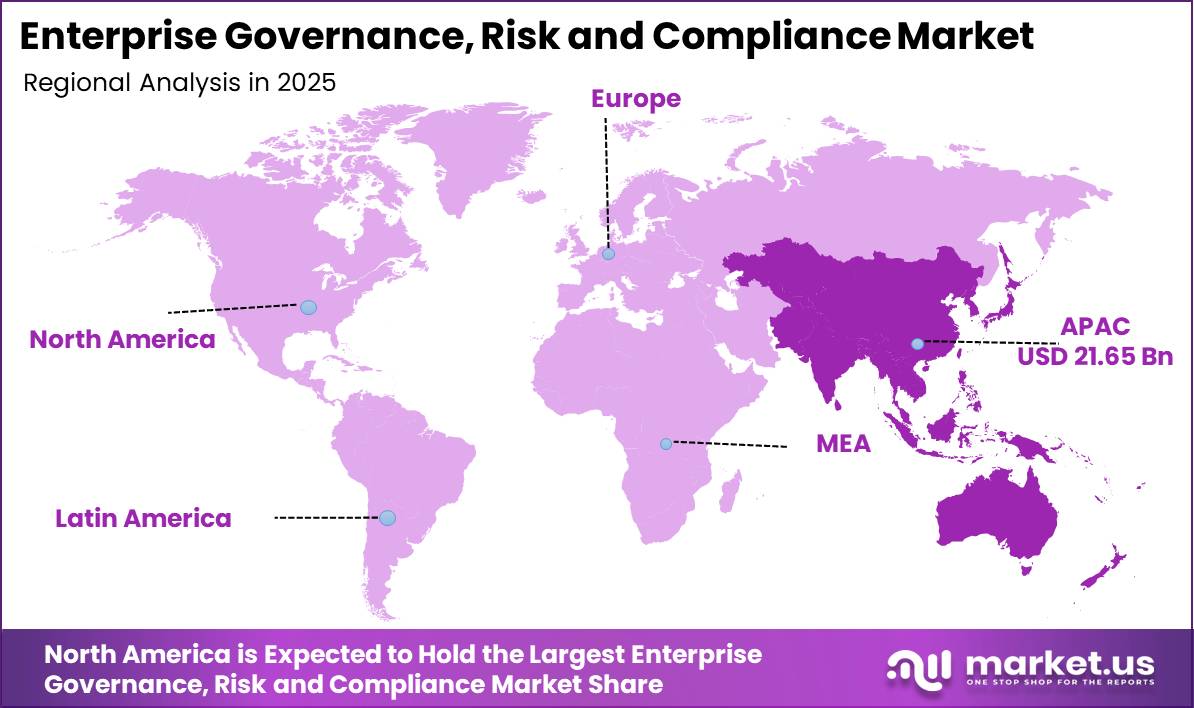
In 2025, the Enterprise Governance, Risk and Compliance Market was valued at USD 47.6 billion. The market is projected to grow at a CAGR of 12.8% during 2026-2035, reaching approximately USD 159.3 billion by 2035. Asia Pacific dominated the global market in 2025, accounting for more than 45.5% of the total market share and generating approximately USD 21.65 billion in revenue.
The rapid growth of the GRC market is being driven by increasing cyber threats, rising operational risks, and the accelerated expansion of the digital economy across Asia and other emerging markets. India’s government projects that the digital economy will contribute around 20% of national value added by 2029-30 and grow almost twice as fast as the overall economy.
This growth is increasing the adoption of digital services, data-driven operations, and technology platforms across public and private enterprises, creating a stronger need for effective governance, risk management, and compliance solutions. As organizations become more digitally connected, boards and regulators are demanding real-time dashboards, detailed audit trails, and automated controls, directly increasing the adoption of integrated GRC platforms that can manage risks, compliance requirements, and internal policies across thousands of users and systems.
The rising financial impact of cyber incidents and regulatory failures is encouraging organizations to replace manual compliance processes with structured GRC systems. The World Bank estimates that major cyber incidents can reduce GDP per capita by 0.018% to 0.038% in developing countries, while major national events such as Costa Rica’s cyberattack resulted in losses of approximately USD 1.6 billion, representing 2.3% of GDP.
Key Takeaway
- The global Enterprise Governance, Risk and Compliance (GRC) market was valued at USD 47.6 billion in 2025 and is projected to reach USD 159.3 billion by 2035, expanding at a CAGR of 12.8% during 2026-2035.
- By Component, Software dominated the market with a 66.7% share, while Services accounted for 33.3% in 2025.
- By Software Type, Risk Management led the segment with a 26.8% market share in 2025.
- By Organization Size, Large Enterprises held the leading position with a 64.4% market share in 2025.
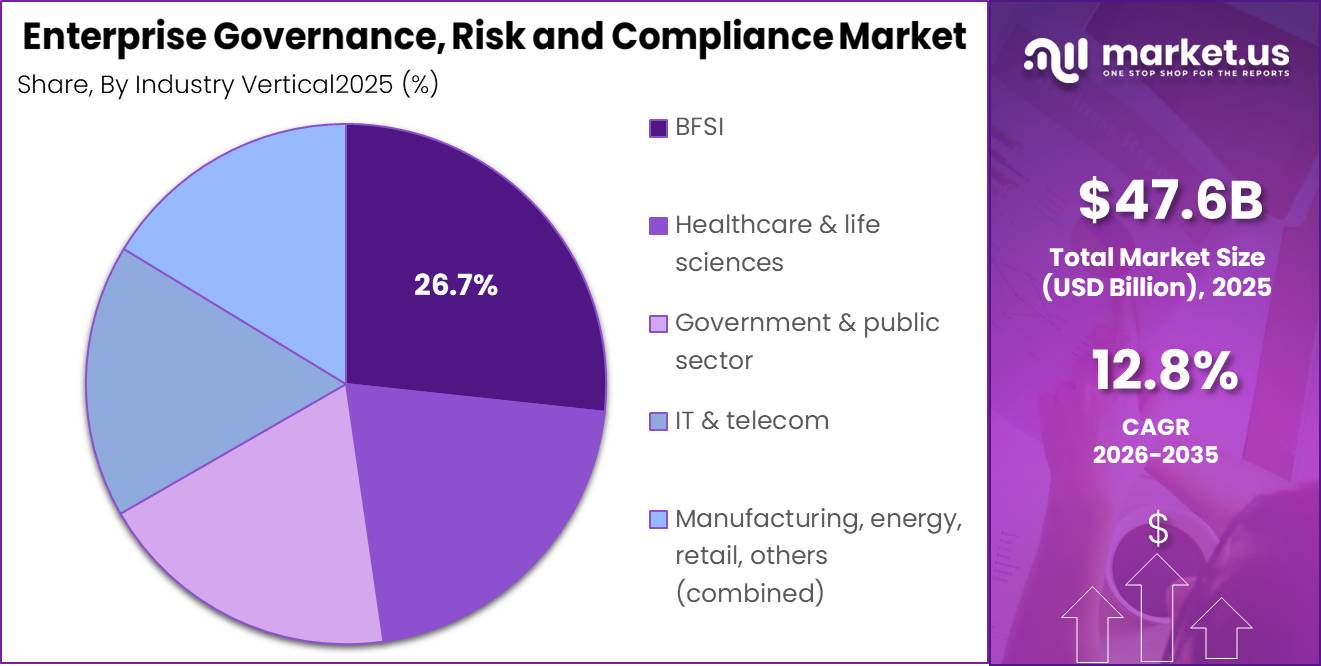
- By Industry Vertical, BFSI dominated the Enterprise GRC market with a 26.7% share, followed by Healthcare & Life Sciences at 21.0%.
- Government & Public Sector accounted for 19.0% share, while IT & Telecom contributed 17.0% of the market in 2025.
- Manufacturing, Energy, Retail, and Other industries collectively represented 16.3% of the global Enterprise GRC market in 2025.
- Asia Pacific dominated the Enterprise GRC market with a 45.5% share, representing approximately USD 21.65 billion in 2025.
By Component
A 66.7% share for software in the eGRC component mix is economically consistent with how regulators and enterprises now rely on technology to operationalize complex compliance and risk frameworks. Global standard-setting bodies such as the Financial Stability Board and national regulators emphasize the use of “RegTech” and supervisory technology to automate data collection, risk monitoring, and regulatory reporting, which are delivered primarily through software platforms rather than manual services.
For example, the IMF has estimated that severe cyber-attack scenarios could cost banks up to one-third of annual net income, while average annual cyber-management costs for individual financial entities have reached around USD 18 million, creating strong financial incentives to invest in software that continuously monitors controls and reduces incident frequency and impact.
By Software
Risk management software holds the largest share of 26.8% EGRC spending as organizations increasingly focus on identifying, measuring, and reducing financial, operational, cyber, and third-party risks. Enterprises manage risk across portfolios exceeding USD 50 trillion in global market capitalization across major exchanges, increasing the need for advanced risk assessment, stress testing, and reporting capabilities.
With global GRC and risk software revenues exceeding USD 50.7 billion in 2025 and expected to nearly double by 2030, demand from boards, CROs, and regulators for real-time risk dashboards, risk scoring, and continuous control monitoring continues to strengthen this segment’s leading position.
Policy, incident, and related GRC modules are expanding rapidly as organizations face increasing regulatory complexity and higher incident volumes. More than 60% of global organizations operate under five or more regulatory frameworks, creating strong demand for automated policy management, compliance attestations, and structured incident response workflows.
By Organization Size
Large enterprises dominate EGRC spending with 64.4% due to complex operations, higher regulatory exposure, and the need to manage risks across multiple regions and compliance frameworks. Over 75% of large enterprises worldwide have implemented at least one integrated GRC platform, while more than 82% of Fortune 500 companies in the United States use enterprise-wide GRC solutions.
Managing regulations such as SOX, HIPAA, PCI-DSS, and GDPR drives demand for centralized GRC platforms, supporting the segment’s 64.4% market share. SMEs are the fastest-growing EGRC segment as digital adoption, cybersecurity risks, and regulatory requirements increase compliance needs. Nearly 58% of mid-sized firms in the United States adopted cloud-based GRC tools between 2021 and 2024 to improve data protection, reporting, and risk management.
By Industry Vertical
The BFSI sector holds the largest vertical share of 26.7% in EGRC because financial institutions operate with high leverage, systemic interconnectedness, and strict prudential oversight, making governance and risk failures economically and socially critical. Global BFSI technology and operations spending runs into hundreds of billions of dollars annually, and a growing share is directed to regulatory compliance.
With national initiatives in markets like India projecting BFSI global capability centers to grow from about USD 40 billion in 2023 to well above USD 125 billion by 2032, the expansion of offshored risk, compliance, and analytics operations further amplifies EGRC demand, reinforcing BFSI’s dominant share of GRC investment.
Key Market Segments
By Component
- Software
- Services
By Software
- Risk management
- Compliance management
- Audit management
- Policy/incident / other GRC modules
By Organization Size
- Large enterprises
- Small & medium enterprises (SMEs)
By Industry Vertical
- BFSI
- Healthcare & life sciences
- Government & public sector
- IT & telecom
- Manufacturing, energy, retail, others (combined)
Market Dynamics
Drivers
| Driver | (~) % Impact on CAGR | Geographic Relevance | Impact Timeline |
|---|---|---|---|
| Regulatory Cascade: DORA, NIS2 & EU AI Act Enforcement | +3.8% | EU-primary; extraterritorial reach into North America, APAC, India | Short term (≤ 2 years) |
| Cloud & SaaS-Based GRC Platform Migration | +2.6% | Global; led by North America and Asia-Pacific | Short term (≤ 2 years) |
| AI & ML Integration into GRC Workflows | +2.2% | Global; concentrated in enterprise-tier North America and EU | Medium term (2-4 years) |
| BFSI Sector Demand Expansion for Operational Resilience | +1.7% | EU, North America, Southeast Asia | Short term (≤ 2 years) |
| Third-Party & Supply Chain Risk Mandates Becoming Statutory | +1.4% | EU, United States, Australia | Medium term (2-4 years) |
| Board-Level Cybersecurity Accountability (SEC Cyber Rules, DORA Governance) | +1.1% | North America, EU | Short term (≤ 2 years) |
The concurrent enforcement of three major EU digital-governance frameworks, the Digital Operational Resilience Act, NIS2, and the EU AI Act (transparency rules for General Purpose AI effective August 2025, high-risk system obligations from December 2027), has created the single largest statutory demand pulse ever seen in the eGRC market.
DORA alone applies to 21 distinct categories of financial entities across the EU and imposes fines of up to 2% of total global annual turnover on financial entities and up to €5 million on critical ICT third-party providers, while individual senior managers face personal fines of up to €1 million and temporary management bans, enforcement mechanisms sufficiently punitive to convert procurement conversations into mandatory capital allocations.
Restraints
| Restraint | (~) % Impact on CAGR | Geographic Relevance | Impact Timeline |
|---|---|---|---|
| High Upfront Integration Cost in Legacy IT Environments | -2.1% | North America, EU (large enterprise & public sector) | Medium term (2-4 years) |
| Data-Residency & Sovereignty Complexity in Multi-Cloud Deployments | -1.3% | Worldwide; acute in EU, India, China | Short term (≤ 2 years) |
| GRC Awareness Deficit Among SME Buyer Segment | -1.1% | Asia-Pacific, Latin America, MEA | Short term (≤ 2 years) |
| Regulatory Fragmentation & Jurisdictional Inconsistency Across Non-EU Markets | -0.9% | Global; most acute in ASEAN, Africa, Latin America | Long term (≥ 4 years) |
| Budget Compression from Macroeconomic Tightening & IT Spending Prioritization | -0.8% | Global; most pronounced in mid-market | Short term (≤ 2 years) |
The dominant structural hard stop suppressing eGRC deal velocity today is the capital and operational burden of integrating modern GRC platforms into incumbent legacy IT stacks, mainframe-era ERP systems, siloed GRC point-tools, and on-premise policy management databases that remain deeply embedded across large financial institutions, regulated utilities, and government-adjacent enterprises in North America and the EU.
A typical enterprise GRC deployment touching 5-8 existing systems of record (SIEM, ITSM, ERP, HRMS, audit management, third-party vendor portals) can require 12-18 months of professional-services engagement before the first automated control-evidence workflow is operational, with total implementation costs frequently exceeding $1.5 million-$4 million for a mid-sized financial entity before any platform licensing is counted, a cost profile that directly delays CapEx approval and pushes signed contracts into subsequent fiscal years.
Legacy migration complexity also drives up per-seat total cost of ownership estimates by 30-45% versus greenfield SaaS deployments, creating an adverse selection dynamic where the enterprises most urgently needing integrated GRC, systemically important financial institutions with the most complex control environments, face the steepest entry barriers to acquiring it.
Challenges
| Challenge | (~) % CAGR | Geographic Relevance | Mitigation Horizon |
|---|---|---|---|
| Shortage of Qualified GRC Professionals | -1.8% | Global; acute in Asia-Pacific & MEA | Long term (≥ 4 years) |
| GRC Platform Sprawl & Alert Fatigue | -1.6% | Mature markets: North America, EU | Medium term (2-4 years) |
| Continuous Regulatory Change Management Burden | -1.4% | Global; multi-jurisdictional enterprises | Long term (≥ 4 years) |
| AI Model Governance & Explainability Complexity | -1.2% | EU, North America, Singapore | Medium term (2-4 years) |
| Cross-Border Data Lineage & Privacy Compliance Friction | -0.9% | Worldwide; most acute in EU & India | Medium term (2-4 years) |
The structural talent deficit in enterprise GRC represents the most persistent ceiling-suppressing friction in the market, operating independently of regulatory mandates or technology investment: an organization may purchase an integrated GRC platform but realize only a fraction of its risk-reduction and compliance-efficiency potential if it lacks personnel capable of configuring risk taxonomies, interpreting control-testing outputs, and translating regulatory obligations into machine-readable control libraries.
An IDC analysis finds that over 90% of global enterprises will face critical skills shortages by 2026, with projected economic drag reaching up to $5.5 trillion globally in delayed outputs and missed revenue, a macro signal that is acutely concentrated in GRC, where 67% of practising compliance and risk professionals identify technology and AI-driven change as the single biggest current-career disruption, while simultaneously acknowledging fluency gaps in exactly those tools.
Opportunities
| Opportunity | (~) % Potential CAGR | Geographic Relevance | Execution Window |
|---|---|---|---|
| ESG & CSRD-Led GRC Platform Expansion | +2.9% | EU-primary (~50,000 in-scope companies); extending to global supply chains | Medium term (2-4 years) |
| SME & Mid-Market GRC Penetration via Vertical SaaS | +2.3% | Asia-Pacific, India, Latin America, MEA | Medium term (2-4 years) |
| Agentic AI & Autonomous Compliance Workflow Monetization | +2.0% | Global; early-mover advantage in North America & EU | Long term (≥ 4 years) |
| Cybersecurity-GRC Platform Convergence & Consolidation | +1.7% | North America, EU, Asia-Pacific | Medium term (2-4 years) |
| GRC-as-a-Service (GRCaaS) Managed Offering Roll-Up | +1.3% | Global; underserved mid-market and regulated verticals | Long term (≥ 4 years) |
The Corporate Sustainability Reporting Directive represents the most consequential untapped demand expansion vector in the enterprise GRC market precisely because it has not yet been structurally absorbed into mainstream GRC platform architectures: as of mid-2026, the majority of incumbent GRC vendors retain ESG reporting as a bolt-on module rather than a natively integrated governance workflow.
Extending a deployed enterprise GRC platform’s scope to cover CSRD-mandated ESRS reporting does not require greenfield IT investment; it requires framework-mapping expansions, new data-ingestion connectors to procurement and HR systems, and ESG-KPI dashboards, a product extension that carries gross margins approaching 70-75% on incremental SaaS revenue since the core infrastructure is already amortized.
For vendors that execute a deliberate CSRD-to-GRC platform land-and-expand motion, entering via ESG reporting and cross-selling financial risk management, internal audit, and third-party oversight modules, the unit-economic shift is compelling: deal sizes expand from point-solution ESG contracts averaging $80,000-$150,000 ARR to full-suite enterprise GRC relationships averaging $400,000-$900,000 ARR within a 24-36 month expansion cycle.
Geopolitical Impact Analysis
Geopolitical tensions are significantly affecting the cost structure and delivery timelines of Enterprise Governance, Risk and Compliance (EGRC) solutions by disrupting the software, hardware, and connectivity supply chains that support these platforms. WTO data shows that average MFN applied tariffs on ICT-related imports in key emerging markets such as India reached 15.8% in 2025, with only 4.0% of tariff lines remaining duty-free.
UNCTAD reports that supply chain lead times have increased by around 35% since 2022 due to disruptions at major trade chokepoints, including the Red Sea and Panama Canal. These disruptions have extended Asia-Europe transit times from approximately 30 days to more than 40 days, requiring alternative shipping routes through the Cape of Good Hope.
Energy market volatility is also creating additional cost pressure for EGRC data center operations and managed services. The U.S. Energy Information Administration’s Short-Term Energy Outlook projects Brent crude prices to average around 103-106 USD/b in Q2 2026, with inventories declining by approximately 8.5 million barrels per day before easing toward around 79 USD/b in 2027.
Regional Analysis
Asia Pacific leads the eGRC market due to rapid digital transformation across banking, manufacturing, telecommunications, and public sector organizations, along with increasing regulatory requirements in major economies such as India, China, Japan, and Australia.
The region accounts for a 45.5% market share, representing an estimated market value of approximately USD 21.65 billion. This strong position is supported by the growing adoption of risk analytics platforms, expansion of cloud-based compliance solutions, and increasing investments in RegTech technologies that help organizations automate audit processes, reporting, and policy management activities.
North America remains the fastest-growing and a structurally significant region in the eGRC market, supported by a mature regulatory environment, strict compliance enforcement, and high technology spending among large enterprises. Demand is particularly strong across highly regulated industries, including BFSI, healthcare, and energy.
The region has historically maintained the largest global revenue share, exceeding 34% in recent assessments, and continues to expand through early adoption of advanced solutions such as AI-powered risk modeling, integrated GRC platforms, and cloud-native governance technologies.
Key Regions and Countries
North America
- US
- Canada
Europe
- Germany
- France
- The UK
- Spain
- Italy
- Rest of Europe
Asia Pacific
- China
- Japan
- South Korea
- India
- Australia
- Rest of APAC
Latin America
- Brazil
- Mexico
- Rest of Latin America
Middle East & Africa
- GCC
- South Africa
- Rest of MEA
Key Players Analysis
The enterprise GRC market is primarily driven by leading platform providers such as SAP, Wolters Kluwer, Thomson Reuters, and Microsoft. These tier-1 vendors collectively account for an estimated 35-45% of global spending on integrated governance, risk, and compliance platforms and related content-based solutions. Their strong market position is supported by established ERP ecosystems, legal and regulatory content capabilities, productivity platforms, and enterprise technology relationships.
SAP remains a key player due to its deep integration with enterprise resource planning systems. The company reported total Q4 2024 revenue of €9.38 billion, including cloud revenue of €4.71 billion, with cloud revenue growing 27% year-on-year.
SAP’s GRC solutions, including Access Control, Process Control, Risk Management, and Identity Management, are deployed across more than 2,700 enterprises. This represents a low-single-digit share of the broader GRC technology market (approximately 1.5%), while maintaining strong penetration among SAP ERP customers.
Wolters Kluwer continues to strengthen its position as a content-driven compliance and regulatory solutions provider. The company reported 2025 full-year operating profit of €1,735 million, increasing 20% from €1,441 million in 2024. Its Financial & Corporate Compliance segment recorded organic revenue growth of 2% in 2025 and 5% in 2024, highlighting continued demand for compliance, finance, risk, and regulatory reporting solutions.
Top Key Players in the Market
- IBM Corporation
- Microsoft Corporation
- Oracle Corporation
- SAP SE (GRC suite)
- SAS Institute Inc.
- MetricStream, Inc.
- NAVEX Global, Inc.
- Archer Technologies / RSA Archer (Dell Technologies)
- ServiceNow, Inc.
- Wolters Kluwer N.V.
- Thomson Reuters Corporation
- OneTrust LLC
- LogicManager, Inc.
- Riskonnect, Inc.
- Diligent Corporation
- Others
Recent Developments
- In December, 2025, ServiceNow announced the acquisition of Veza, an AI-native identity security platform, in a deal valued at over USD 1 billion, strengthening its identity governance and AI-agent permission control capabilities.
- In July, 2025, BC Partners agreed to sell a majority stake in NAVEX to a consortium led by Goldman Sachs Alternatives with Blackstone as a minority shareholder. The transaction was valued at over USD 2.5 billion, highlighting strong investor interest in compliance and risk management SaaS solutions.
Report Scope
| Report Features | Description |
|---|---|
| Market Value (2025) | USD 47.6 Billion |
| Forecast Revenue (2035) | USD 159.3 Billion |
| CAGR (2026-2035) | 12.8% |
| Base Year for Estimation | 2025 |
| Historic Period | 2020-2024 |
| Forecast Period | 2026-2035 |
| Report Coverage | Revenue Forecast, Market Dynamics, Competitive Landscape, Recent Developments |
| Segments Covered | By Component (Software, Services), By Software (Risk Management, Compliance Management, Audit Management, Policy / Incident / Other GRC Modules), By Organization Size (Large Enterprises, Small & Medium Enterprises (SMEs)), By Industry Vertical (BFSI, Healthcare & Life Sciences, Government & Public Sector, IT & Telecom, Manufacturing, Energy, Retail & Others) |
| Regional Analysis | North America – US, Canada; Europe – Germany, France, The UK, Spain, Italy, Rest of Europe; Asia Pacific – China, Japan, South Korea, India, Australia, Singapore, Rest of APAC; Latin America – Brazil, Mexico, Rest of Latin America; Middle East & Africa – GCC, South Africa, Rest of MEA |
| Competitive Landscape | IBM Corporation, Microsoft Corporation, Oracle Corporation, SAP SE (GRC Suite), SAS Institute Inc., MetricStream, Inc., NAVEX Global, Inc., Archer Technologies / RSA Archer (Dell Technologies), ServiceNow, Inc., Wolters Kluwer N.V., Thomson Reuters Corporation, OneTrust LLC, LogicManager, Inc., Riskonnect, Inc., Diligent Corporation, Others |
| Customization Scope | Customization for segments and region/country-level will be provided. Moreover, customization can be tailored to the requirements. |
| Purchase Options | We have three licenses to opt for: Single User License, Multi-User License (Up to 5 Users), Corporate Use License (Unlimited Users and Printable PDF) |