


Global Electric Vehicle Battery Coolant Market Size, Share, And Enhanced Productivity By Battery Type (Lead Acid Battery, Lithium Ion Battery, Others), By Coolant(Glycol-based, Water-based), By Vehicle Type (Battery Electric Vehicles, Hybrid Electric Vehicles), By Region and Companies - Industry Segment Outlook, Market Assessment, Competition Scenario, Trends, and Forecast 2026-2035
- Published date: February 2026
- Report ID: 179757
- Number of Pages: 206
- Format:
-
keyboard_arrow_up
Quick Navigation
Report Overview
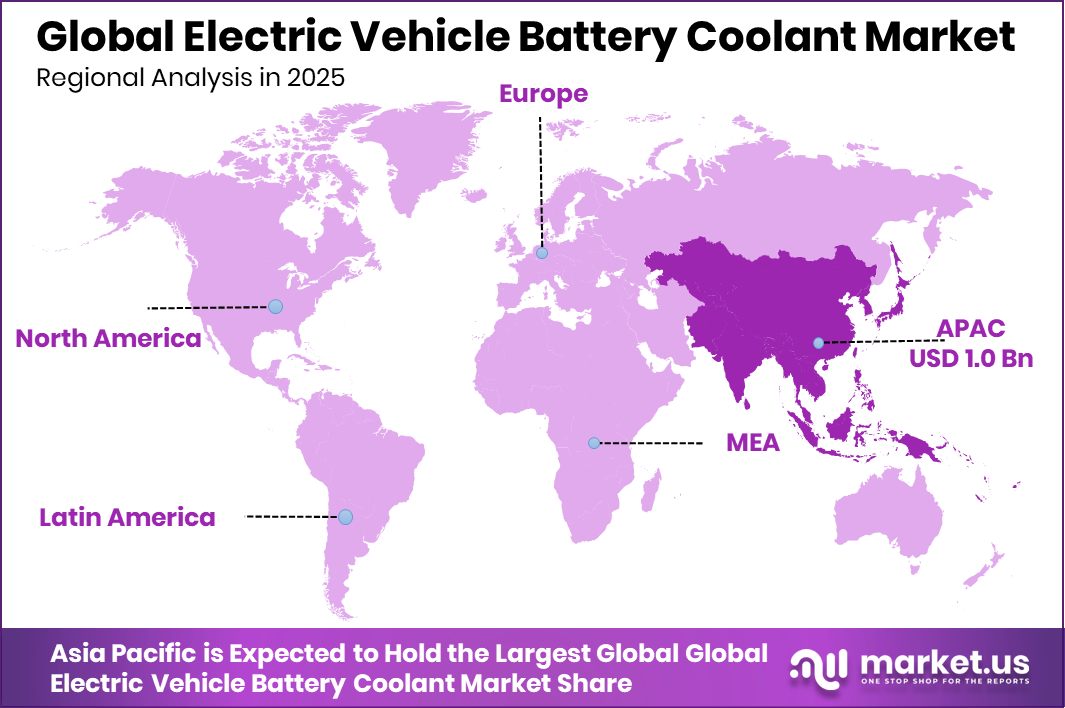
The Global Electric Vehicle Battery Coolant Market is expected to be worth around USD 3.2 billion by 2035, up from USD 2.2 billion in 2025, and is projected to grow at a CAGR of 3.7% from 2026 to 2035. Strong EV expansion helps Asia Pacific secure 49.4%, totaling USD 1.0 Bn market.
Electric Vehicle Battery Coolant is a specialized fluid designed to manage heat inside an electric vehicle’s battery pack. As batteries generate significant heat during charging and driving, coolant helps regulate temperature, prevent thermal stress, and maintain long-term performance. It is used across battery types such as lead-acid, lithium-ion, and other emerging chemistries, ensuring stability and safety within electric mobility systems.
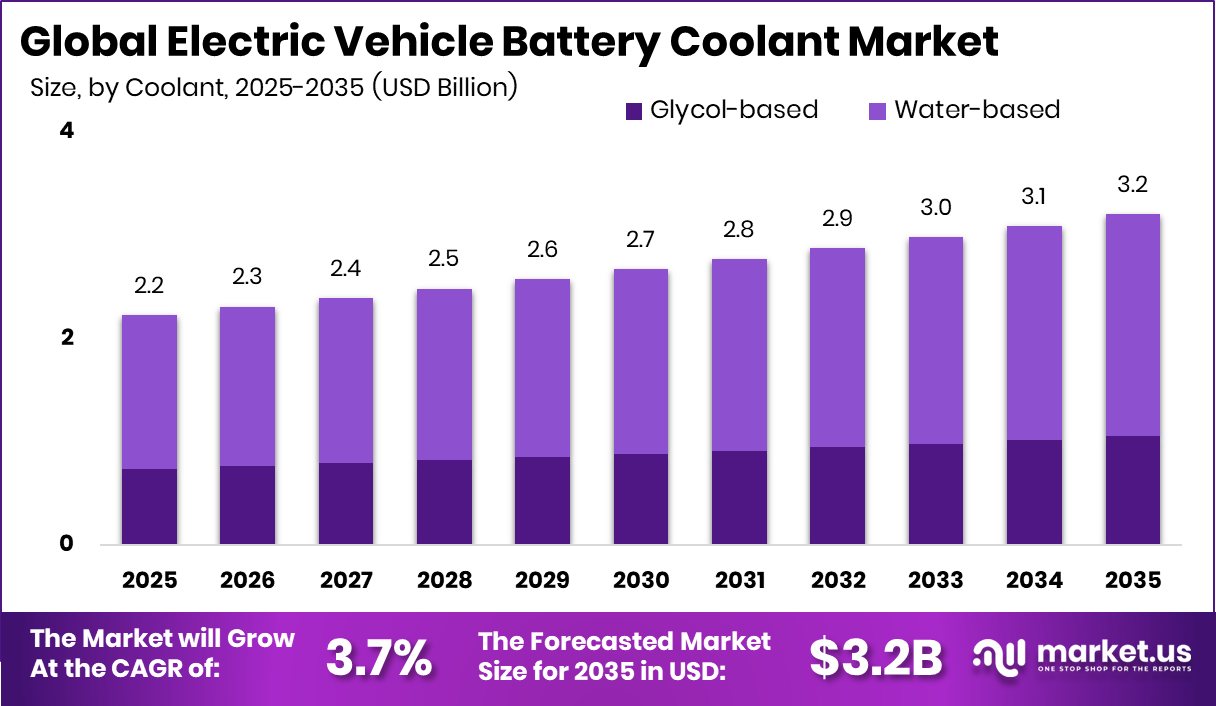
The Electric Vehicle Battery Coolant Market represents the growing demand for fluids that support efficient heat transfer, longer battery life, and reliable performance in Battery Electric Vehicles and Hybrid Electric Vehicles. With glycol-based and water-based coolants dominating current applications, the market continues to expand as thermal management becomes a core requirement across global EV platforms.
Growth is supported by increasing investments and innovation in cooling technologies. Recent advancements, such as Rheinmetall securing a new order for 800 V electric coolant pumps and Dana planning a $54.2 million EV battery cooling facility in suburban Detroit, highlight how thermal solutions are becoming more advanced and scalable.
Demand is further strengthened by funding that encourages next-generation cooling systems. Projects like Gcorelab receiving $482,000 for new battery cooling technology, Romeo Power raising $88 million, and Israel’s Carrar securing $18 million show the push toward safer, higher-performance batteries.
Opportunity widens as immersion cooling and innovative engineering solutions progress. Efforts such as XING Mobility & Castrol developing immersion-cooled battery systems and Trinity’s engineering team winning a €1.25 million National Challenge Fund prize demonstrate how research and industry collaboration are shaping the future of EV battery cooling.
Key Takeaways
- The Global Electric Vehicle Battery Coolant Market is expected to be worth around USD 3.2 billion by 2035, up from USD 2.2 billion in 2025, and is projected to grow at a CAGR of 3.7% from 2026 to 2035.
- The electric vehicle battery coolant market shows strong adoption as lithium-ion battery systems reach a notable 68.2% share.
- In the Electric Vehicle Battery Coolant Market, water-based coolant technologies dominate due to their 67.3% usage rate globally.
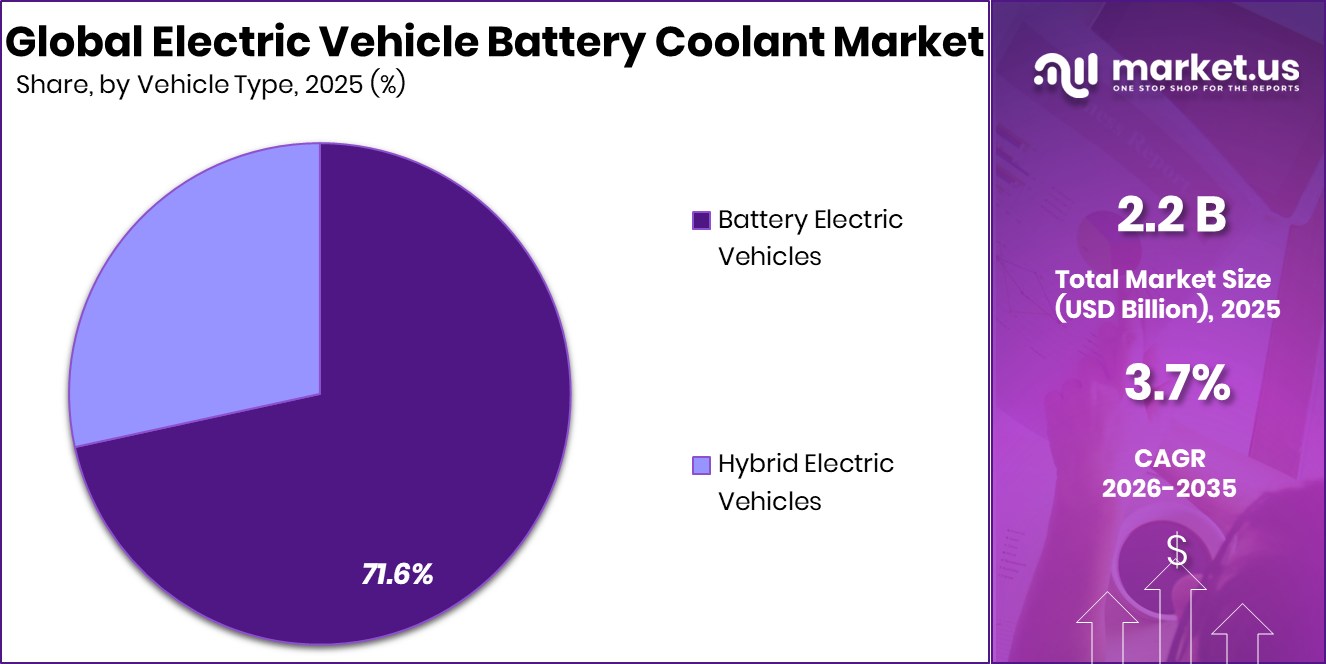
- The Electric Vehicle Battery Coolant Market expands rapidly as battery electric vehicles achieve a significant 71.6% market share.
- The region strengthens its dominance as the Asia Pacific records 49.4% and achieves USD 1.0 Bn.
By Battery Type Analysis
Electric Vehicle Battery Coolant Market was dominated by the lithium-ion battery segment with 68.2% share.
In 2025, the Electric Vehicle Battery Coolant Market continues to shift toward advanced thermal management solutions as lithium-ion batteries dominate with a commanding 68.2% share. This dominance is driven by the widespread use of high-energy, long-cycle lithium-ion packs in modern EVs, creating strong demand for coolants that stabilize temperature, enhance battery lifecycle, and support fast-charging systems.
Automakers are increasing investments in compact high-density battery platforms, which further strengthens the need for reliable coolant performance during peak load operations. With rising heat generation from next-generation cells, manufacturers are refining coolant formulations to ensure safety, reduce degradation, and maintain electric range. The segment’s dominance highlights its central role in shaping future EV innovation and thermal efficiency standards.
By Coolant Analysis
Electric Vehicle Battery Coolant Market was dominated by the water-based coolant segment, holding 67.3% share.
In 2025, water-based coolant systems hold a dominant 67.3% share in the Electric Vehicle Battery Coolant Market, driven by their heat-transfer efficiency, cost-effectiveness, and compatibility with emerging battery technologies. As EV makers prioritize sustainability and improved thermal regulation, water-based coolants have become the preferred option for liquid-cooling circuits in battery packs and power electronics. Their ability to disperse heat rapidly supports longer driving range, safer operation, and improved performance under extreme conditions.
Manufacturers are refining formulations with corrosion inhibitors, non-toxic additives, and improved stability to meet stricter thermal requirements. This solid dominance reflects a growing industry preference toward greener, high-efficiency cooling mediums that align with global regulatory pushes for cleaner mobility systems.
By Vehicle Type Analysis
Electric Vehicle Battery Coolant Market was dominated by battery electric vehicles, capturing 71.6% share.
In 2025, Battery Electric Vehicles take a leading 71.6% share in the Electric Vehicle Battery Coolant Market, reflecting their rapid global expansion and increasing adoption in both consumer and commercial fleets. As BEVs rely solely on battery systems for propulsion, the demand for advanced cooling solutions becomes essential for maintaining temperature balance, protecting cells, and enhancing overall vehicle reliability.
The dominance of this segment is supported by rising fast-charging infrastructure, government incentives, and continuous improvements in thermal design. With higher energy densities and larger battery packs, BEVs require precise coolant circulation to avoid overheating and extend service life. This dominance underscores how BEVs are shaping future coolant technology development across major automotive markets.
Key Market Segments
By Battery Type
- Lead Acid Battery
- Lithium Ion Battery
- Others
By Coolant
- Glycol-based
- Water-based
By Vehicle Type
- Battery Electric Vehicles
- Hybrid Electric Vehicles
Driving Factors
Rising EV adoption boosts coolant demand
Rising EV adoption boosts coolant demand as electric vehicles rely heavily on efficient thermal management to maintain battery health, performance, and charging stability. The growing shift toward electrified mobility strengthens the need for advanced coolant systems capable of handling higher temperatures generated by modern battery architectures. This momentum is reinforced by strong financial activity in the energy storage ecosystem, including Ionic Mineral Technologies closing a $29 million Series B funding round, which supports advancements in battery technology materials.
Likewise, European energy storage startups securing €2.14 billion in funding highlights how large-scale investments are accelerating innovations surrounding battery systems, indirectly lifting the demand for enhanced coolant solutions that can meet the expectations of next-generation electric vehicles.
Restraining Factors
High coolant development costs slow growth
High coolant development costs slow growth as manufacturers face rising expenses tied to formulation improvements, safety testing, and compatibility validation with advanced battery chemistries. These challenges often extend development timelines and create barriers for smaller players attempting to enter the field. Further pressure comes from funding being directed toward alternative battery solutions, such as Flow Battery Startup Flux XII, securing $4 million in seed funding, which signals growing interest in systems that may require different cooling approaches.
Additionally, Cornish Lithium raising $47 million in equity funding strengthens upstream battery material innovation, but it also shifts attention toward core battery components rather than specialized coolant technologies, moderating market expansion for traditional coolant developers.
Growth Opportunity
Immersion cooling technologies open new applications
Immersion cooling technologies open new applications by offering superior heat transfer, improved safety margins, and longer battery service life. These systems present fresh opportunities for coolant manufacturers to develop specialized fluids tailored for direct-contact battery cooling, especially as EV platforms scale toward higher power outputs and faster charging speeds. The innovation landscape is further energized by strong financial momentum in the sector.
European startups transforming energy storage with €2.14 billion in funding highlight the pace of modernization in battery infrastructure. At the same time, Forge Nano raising $40 million to scale up battery manufacturing reflects how next-generation production methods can heighten demand for compatible immersion cooling fluids, creating clearer pathways for long-term market adoption.
Latest Trends
Shift toward long-life coolant formulations
A shift toward long-life coolant formulations is becoming a defining trend as manufacturers aim to reduce maintenance needs while ensuring thermal stability across more demanding EV applications. The market is observing faster development cycles driven by major financial commitments in the broader battery ecosystem. For instance, Redwood Materials’ raising $350 million in Series E funding underscores the industry’s push toward efficient battery recycling and material recovery—factors that influence coolant compatibility with sustainable battery systems.
Additionally, HPQ being awarded up to $3 million in federal funding to accelerate the commercialization of silicon-based battery materials supports next-generation battery designs that require optimized coolant performance. Together, these advancements reinforce the movement toward durable, high-efficiency coolant technologies.
Regional Analysis
Asia Pacific leads the market with 49.4% share, reaching a USD 1.0 Bn in value.
In the Electric Vehicle Battery Coolant Market, regional demand varies significantly across North America, Europe, Asia Pacific, the Middle East & Africa, and Latin America, shaped by EV adoption rates and battery-driven thermal management needs. Asia Pacific dominates the global landscape, holding a strong 49.4% share and reaching USD 1.0 Bn, supported by the region’s expanding electric mobility ecosystem and large-scale manufacturing capabilities.
North America continues to show steady progress as EV models diversify and thermal safety standards tighten across the United States and Canada. Europe remains a major contributor due to its strong regulatory push for electrified transportation and rising battery production activity across key countries.
Meanwhile, Latin America is gradually building momentum with early EV penetration and localized cooling system demand, while the Middle East & Africa reflects emerging interest driven by urban electrification initiatives and premium EV imports. Across all regions, the accelerating shift toward battery-intensive vehicles reinforces the need for reliable coolant solutions, but Asia Pacific maintains clear leadership, setting the pace for market growth and technological advancements.
Key Regions and Countries
- North America
- US
- Canada
- Europe
- Germany
- France
- The UK
- Spain
- Italy
- Rest of Europe
- Asia Pacific
- China
- Japan
- South Korea
- India
- Australia
- Rest of APAC
- Latin America
- Brazil
- Mexico
- Rest of Latin America
- Middle East & Africa
- GCC
- South Africa
- Rest of MEA
Key Players Analysis
In 2025, BASF SE continues to strengthen its position in the Electric Vehicle Battery Coolant Market through its focus on advanced chemical formulations tailored for next-generation EV thermal systems. The company’s emphasis on improving coolant stability, material compatibility, and long-term thermal efficiency aligns closely with the rising performance expectations of global automakers. BASF’s long-standing expertise in specialty chemicals gives it an edge as OEMs seek coolants that support high-density battery packs and faster charging environments. Its strategic approach toward developing high-performance fluids places the company in a favorable spot as thermal management becomes a central design priority across electric vehicles.
In 2025, Valvoline Inc. continues expanding its footprint in EV-ready fluid technologies, building on its established presence in the automotive service ecosystem. The company’s growing focus on battery-safe coolant blends positions it well, as electric vehicles require precise heat control to maintain performance and reliability. Valvoline’s brand strength in vehicle fluids helps it transition naturally into EV coolant offerings designed for diverse operating environments. Its entry into specialized EV fluids reflects a strategic shift toward higher-value segments, ensuring long-term relevance as combustion-engine service demand evolves.
In 2025, Exxon Mobil Corporation remains an influential player as it leverages its broad petrochemical capabilities to supply advanced coolant formulations optimized for electric mobility. The company’s expertise in engineered fluids supports the increasing need for coolants capable of managing heat loads from larger battery packs and demanding driving conditions. Exxon Mobil’s continued development of thermal-control products demonstrates its intent to play a long-term role in EV fluid innovation. As global electrification accelerates, its ability to deliver stable, durable coolant solutions reinforces its strategic relevance in the evolving automotive fluid landscape.
Top Key Players in the Market
- BASF SE
- Valvoline Inc.
- Exxon Mobil Corporation
- Shell Group
- GS Caltexa
- Dober
- VALEO
- Veedol
- Arteco
- CASTROL LIMITED.
Recent Developments
- In September 2025, BASF introduced a new range of GLYSANTIN® ELECTRIFIED® low electrical conductivity coolants designed to improve safety and performance in electric vehicle battery systems. These coolants keep electrical current low even around high-voltage parts, helping reduce fluid breakdown and lower risks like overheating or battery failures. Production began at its Pudong site in Shanghai, China, targeting compliance with China’s updated standards for EV cooling fluids.
- In 2025, Valvoline highlighted its role in supporting electric vehicle technologies by celebrating World EV Day and showcasing its EV fluids and partnerships with original equipment manufacturers (OEMs) that use Valvoline fluids to help improve battery temperature control, drive train efficiency, and overall EV performance.
Report Scope
Report Features Description Market Value (2025) USD 2.2 Billion Forecast Revenue (2035) USD 3.2 Billion CAGR (2026-2035) 3.7% Base Year for Estimation 2025 Historic Period 2020-2024 Forecast Period 2026-2035 Report Coverage Revenue Forecast, Market Dynamics, Competitive Landscape, Recent Developments Segments Covered By Battery Type (Lead Acid Battery, Lithium Ion Battery, Others), By Coolant(Glycol-based, Water-based), By Vehicle Type (Battery Electric Vehicles, Hybrid Electric Vehicles) Regional Analysis North America – US, Canada; Europe – Germany, France, The UK, Spain, Italy, Rest of Europe; Asia Pacific – China, Japan, South Korea, India, Australia, Singapore, Rest of APAC; Latin America – Brazil, Mexico, Rest of Latin America; Middle East & Africa – GCC, South Africa, Rest of MEA Competitive Landscape BASF SE, Valvoline Inc., Exxon Mobil Corporation, Shell Group, GS Caltexa, Dober, VALEO, Veedol, Arteco, CASTROL LIMITED. Customization Scope Customization for segments, region/country-level will be provided. Moreover, additional customization can be done based on the requirements. Purchase Options We have three licenses to opt for: Single User License, Multi-User License (Up to 5 Users), Corporate Use License (Unlimited User and Printable PDF)  Electric Vehicle Battery Coolant MarketPublished date: February 2026add_shopping_cartBuy Now get_appDownload Sample
 -
-
- BASF SE
- Valvoline Inc.
- Exxon Mobil Corporation
- Shell Group
- GS Caltexa
- Dober
- VALEO
- Veedol
- Arteco
- CASTROL LIMITED.
Our Clients

- 179757
- February 2026






