


Report Overview
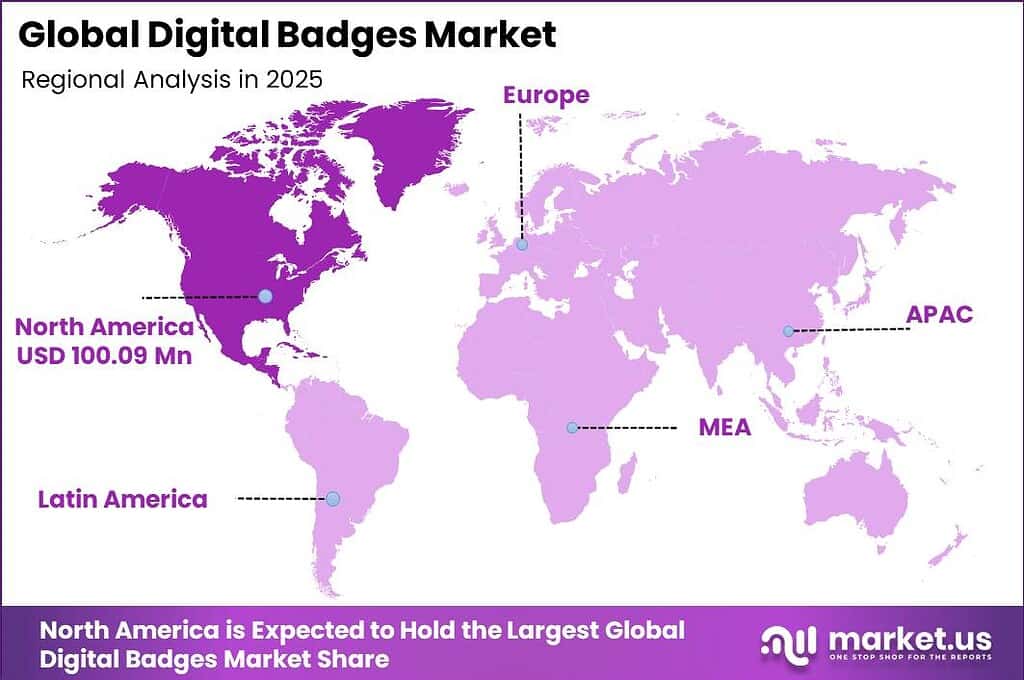
In 2025, the Global Digital Badges Market was valued at USD 253.4 Million. The market is projected to grow at a CAGR of 18.1% during 2026–2035, reaching approximately USD 1,337.7 Million by 2035. North America dominated the global market in 2025, accounting for more than 39.5% of the total market share and generating approximately USD 100.09 million in revenue.
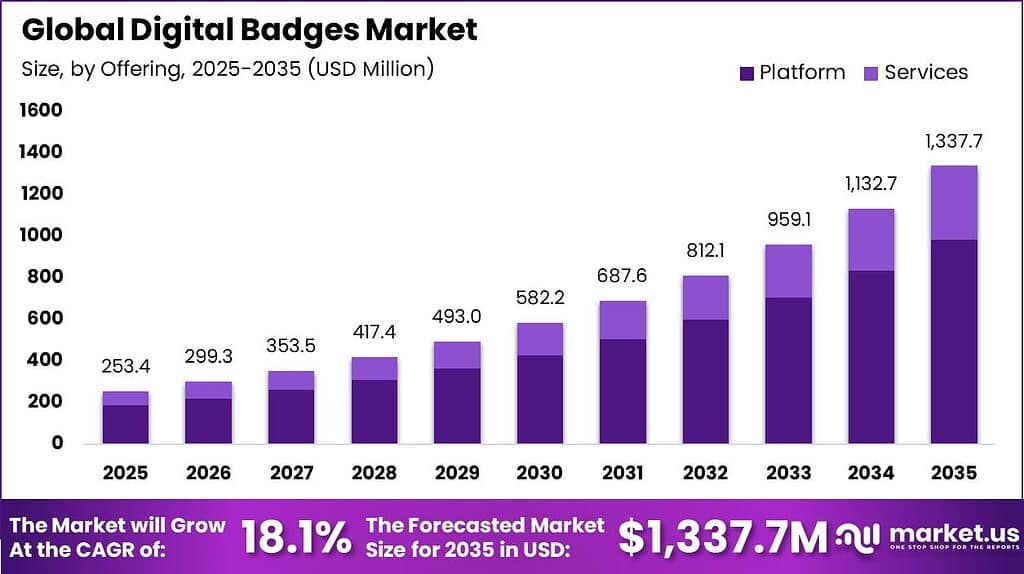
This strong and sustained expansion is closely linked to the rapid scaling of digital learning and skills‑based employment. UNESCO reports that 327 million more children and youth are in school today than in 2000, which has pushed governments and institutions to expand learning capacity and quality using online and blended formats that depend on digital assessment and recognition tools such as badges.
At the same time, the U.S. Bureau of Labor Statistics projects that employment in computer and information technology occupations will grow much faster than the average for all occupations from 2024 to 2034, generating about 317,700 openings per year, which drives employers to formalize and verify digital skills at scale through micro‑credentials and badges rather than only traditional degrees.
UNESCO has highlighted that quality assurance in distance and online education has historically lagged, with less than 35% of higher education quality assurance bodies involved in evaluating distance education before the pandemic, which pushes regulators and institutions to adopt more transparent and standardized recognition formats such as digital badges to track outcomes as online enrolments grow.
In parallel, the World Economic Forum’s skills work shows that a large share of digital skills requirements in jobs are being reshaped by AI and data, while only about 20% of business leaders believe their workforce is currently proficient in these skills, creating a measurable skills gap that firms are trying to close via modular reskilling programs that issue stackable digital badges.
Key Takeaway
- The global digital badges market was valued at USD 253.4 million in 2025, projected to grow at a CAGR of 18.1% and is estimated to reach USD 1,337.7 million by 2035.
- On the basis of offering, the platform segment dominated the market, constituting 73.5% of the total market share.
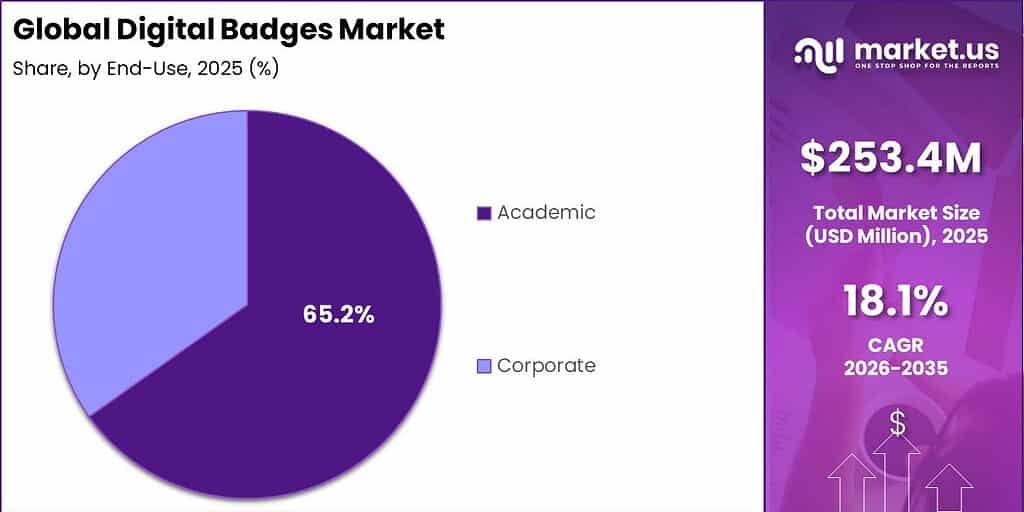
- Based on end-use, the academic segment dominated the digital badges market, accounting for 65.2% of the total market share.
- In 2025, North America was the most dominant region in the digital badges market, accounting for 39.5% of the total market share, equivalent to approximately USD 100.09 million.
Market Statistics and Data Insights
Issuance Volume and Demand
- Badges issued globally more than quadrupled from 74.7 million in 2022 to 320.4 million in 2025, per the 1EdTech/Credential Engine 2025 Badge Count survey of 24 badging platforms.
- Distinct badges offered to learners more than tripled from 521,000 (2022) to 1,708,774 (2025), with participating platforms rising from 15 to 24.
- Credential Engine’s Counting Credentials 2025 identifies 1,022,028 badges among 1,850,034 unique U.S. credentials — the largest credential category, ahead of certificates (486,352) and degrees (264,099).
- Badges showed the steepest growth of any credential type in the U.S. count, rising from 430,272 in 2022 to nearly 1.02 million in 2025 — roughly a 138% increase in three years.
- Total U.S. annual expenditure across the credentialing ecosystem is $2.34 trillion, spread across 134,491 credential providers.
- Skill or competency demonstration is the most common badge use case, supported by 90% of surveyed platforms, followed by short-term microcredentials (81%) and activity completion (76%).
- Community organizations and non-profits issue badges through 76% of platforms, four-year universities through 71%, two-year colleges through 67%, and industry associations and employers through 62% each.
Employer and Institutional Adoption
- 96% of employers agree microcredentials strengthen a candidate’s application, and 87% had hired at least one microcredential holder in the prior year (Coursera Microcredentials Impact Report 2025).
- 90% of employers are willing to pay higher starting salaries — typically 10–15% more — for candidates holding recognized or credit-bearing credentials.
- 53% of employers have eliminated degree requirements entirely, up from 30% the prior year — a 77% year-over-year jump; the figure reaches 57% in the U.S. (TestGorilla, State of Skills-Based Hiring 2025).
- Among skills-based hiring practitioners, 55% have removed degree requirements versus 48% of non-practitioners, and 37% of employers qualify as leaders who both removed requirements and grew non-degreed hiring by 20%+.
- 85% of institutions now design microcredentials explicitly for workforce development and 84% for professional advancement, per the 2026 UPCEA/Modern Campus Institutional Perspectives report (n≈300, surveyed late 2025).
- The same survey found broader institutional adoption has slowed and perceived fiscal impact has declined, with scaling blocked by resourcing models, governance structures, and legacy systems rather than by weak demand.
Learner Outcomes and Program Performance
- 85% of microcredential earners say it improved their job prospects and 91% believe it will help them succeed once employed.
- A 2025 peer-reviewed quasi-experimental study of primary pupils found digital badges significantly improved computational thinking skills, but produced no significant gain in CT self-efficacy or learning motivation — and badge visibility to peers had no measurable effect.
- A March 2025 survey of SC-SWIFT graduate science-communication interns found badges increased program engagement and self-reported skill confidence while documenting extracurricular competencies for both academic and non-academic employers.
- University of Guelph 2025 SoTL findings report that skill-based badges drive substantially more learner motivation than participation-based badges, making badge criteria design the primary performance lever.
Technical Standards and Public Infrastructure
- Open Badges 3.0 is now a formal profile of the W3C Verifiable Credentials Data Model 2.0: each badge is a signed JSON document carrying issuer profile, recipient identifier, achievement, criteria, evidence, issuance date, and a cryptographic proof binding the issuer’s private key, checkable against a published public key — making badges tamper-evident without contacting the issuer.
- More than 76,000 European Digital Credentials for Learning have been issued into Europass wallets, and the December 2025 EU technical webinar on building, sealing, and issuing EDCs via API drew ~200 live participants.
- Skill India Digital Hub reports more than 1.5 crore candidates alongside 7,000+ training providers, 70+ assessment agencies, and 68,000+ employer partners, issuing portable verifiable credentials co-branded by NSDC and Sector Skill Councils.
- Australia’s federal microcredentials pilot authorised $32.5 million across 2021-22 to 2025-26 — $2 million for design, $16.5 million for delivery to up to 4,000 students, $8 million for offshore-relevant credentials — funding 73 new courses across two rounds in national skills priority fields.
By Offering
In 2025, Platform held a dominant market position, capturing more than a 73.5% share. The segment’s strength reflects how fashion brands are consolidating design, merchandising, and digital storefront workflows onto unified generative AI platforms rather than isolated tools, with global AI in fashion spending rising from around USD 3.1 billion in 2025 to higher levels in 2026 as adoption deepens.
Between March and October 2025, major apparel groups expanded platform pilots for automated look-book generation and virtual fittings, contributing to a visible rise in AI‑enabled fashion tech investments that supported an industry value near USD 300 billion by 2025.
By End-use
Academic held a significant share of the market in 2025, accounting for 65.2% of generative AI in fashion deployments across education and research environments. Universities and design schools have been ramping up AI‑focused fashion curricula, supported by the wider AI in fashion market rising from about USD 2.23 billion in 2024 to roughly USD 3.14 billion in 2025, which makes advanced tools more accessible for teaching labs.
During September–December 2025, many institutions integrated generative design modules into semester projects, using AI to simulate fabric drape, colorways, and sustainable material options, mirroring broader fashion tech growth toward USD 300 billion by 2025. In early 2026, particularly January and February, academic research groups intensified experimentation with AI‑driven consumer insight models, aligned with studies highlighting how AI reshapes fashion decision‑making and user experience.
This activity benefits from expanding AI in fashion infrastructure worldwide, with long‑term industry forecasts to 2034 and 2035 motivating grant funding and cross‑border collaborations. As 2026 progresses into mid‑year, academic labs remain key testbeds, validating generative tools before wider commercial rollout.
Key Market Segments
By Offering
- Platform
- Services
By End-use
- Academic
- Corporate
Geopolitical Impact Analysis
Geopolitical frictions are reshaping cost structures across the digital badges value chain, affecting cloud credentialing platforms, LMS integrations, NFC/RFID cards, and semiconductor-dependent secure elements through tariffs, energy costs, and logistics disruptions. WTO data show that average applied MFN tariffs on ICT products remain low, often 0–3%, but sector-specific disputes have introduced 7–25% duties on selected electronics, raising costs for controller chips, smart card substrates, and readers.
Energy costs are also increasing data-center expenses: the IEA reports that electricity prices rose 36% for EU households and 26% in the US between 2019 and 2024, while EU energy-intensive industrial prices in 2024 were roughly 2× US levels and 50% higher than China. In H1 2025, EU wholesale electricity prices averaged about USD 90/MWh, approximately 30% higher year-on-year, increasing operating costs for regional SaaS and credentialing providers.
Logistics disruptions are adding further pressure. UNCTAD highlights that geopolitical tensions, including the Red Sea and Strait of Hormuz crises, are forcing longer shipping routes and increasing freight costs for card printers, secure card stock, and NFC-enabled devices. Containerized trade contracted 3.7% in 2022 before growing only 1.2% in 2023, reflecting continued freight volatility.
UNCTAD also estimates that full maritime decarbonization by 2050 could double annual fuel costs, potentially raising transportation costs for globally sourced badge hardware. Meanwhile, IEA data indicate wholesale power prices across the EU, US, and Japan increased 30–40% year-on-year in H1 2025, while European natural gas prices were about 20% above 2024 levels.
Regional Analysis
North America dominates the global digital badges market, accounting for 39.5% of the total market share with a valuation of USD 100.09 million, reflecting its advanced digital learning infrastructure and high adoption rates across key end-user segments. The United States contributes the majority share within the region, supported by over 70% penetration of digital learning platforms across higher education institutions and enterprises. More than 4,000 universities and colleges in the U.S. have integrated digital credentialing systems, with micro-credentials and skill-based certifications growing at a rate exceeding 15% annually.
Corporate adoption is equally significant, with nearly 60% of large enterprises utilizing digital badges for employee training, skill validation, and workforce development initiatives. The region also benefits from a highly digitized workforce, where over 80% of professionals engage in online or hybrid learning formats, accelerating the demand for verifiable and portable credentials.
The presence of leading technology providers and credentialing platforms further strengthens innovation and scalability within the market. Government-backed workforce upskilling programs and industry-driven certification standards continue to support widespread adoption. High internet penetration exceeding 90%, combined with strong enterprise digitization and growing emphasis on skills-based hiring, positions North America as the most mature and revenue-generating region in the global digital badges market.
Key Regions and Countries
North America
- US
- Canada
Europe
- Germany
- France
- The UK
- Spain
- Italy
- Rest of Europe
Asia-Pacific
- China
- Japan
- South Korea
- India
- Australia
- Rest of APAC
Latin America
- Brazil
- Mexico
- Rest of Latin America
Middle East & Africa
- GCC
- South Africa
- Rest of MEA
Market Dynamics
Drivers
| Driver | (~) % Impact on CAGR Forecast | Geographic Relevance | Impact Timeline |
|---|---|---|---|
| Expansion of micro-credentials in higher education and workforce upskilling | +6.0% | Europe, North America, Asia-Pacific | Short term (≤ 2 years) |
| Standardization via Open Badges 2.x and conformance-certified platforms | +4.5% | Global | Short to Medium term (1–4 years) |
| Corporate LMS and HR tech integration of digital credentials | +3.8% | North America, Europe, Asia-Pacific | Short term (≤ 2 years) |
| Growth of online learning and MOOC ecosystems | +3.2% | Global | Short to Medium term (1–4 years) |
| Regulatory encouragement of skills-based recognition | +2.9% | European Union, selected OECD economies | Medium term (2–4 years) |
| Rising demand for verifiable credentials in professional certification | +2.5% | Global | Short term (≤ 2 years) |
Expansion of micro-credentials in higher education and workforce upskilling
The rapid institutionalization of micro-credentials, particularly after the Council of the European Union Recommendation on a European approach to micro-credentials in 2022, is pushing universities and training providers to embed digital badges as the de facto representation layer for short-form learning outcomes, typically spanning 1–30 hours or 3–30 ECTS-equivalent units in formal frameworks.
This shift is structurally altering business models from one-off course completion certificates to modular stacks of competency badges, allowing institutions to monetize multiple discrete learning events per learner per year and raising average credential issuance volumes per active learner by plausible factors of 2–3x versus legacy transcript-only models.
For corporate L&D budgets that already allocate several hundred dollars per employee annually, even redirecting an additional 10–20% toward micro-credentialed programs with embedded badges translates into tens of millions of incremental issued badges across EU and OECD employers, especially when combined with existing evidence that major badging ecosystems surpassed roughly 43 million badges issued globally by around 2020.
Restraints
| Restraint | (~) % Impact on CAGR Forecast | Geographic Relevance | Impact Timeline |
|---|---|---|---|
| Fragmented quality assurance and recognition of digital badges | -4.2% | Global, with higher impact in emerging markets | Short to Medium term (1–4 years) |
| Budget constraints and procurement inertia in educational institutions | -3.6% | Global | Short term (≤ 2 years) |
| Data protection and privacy compliance complexity | -3.1% | Europe, North America | Short to Medium term (1–4 years) |
| Limited employer trust in non-degree credentials | -2.8% | Global | Short term (≤ 2 years) |
| Legacy credentialing systems lock-in | -2.5% | North America, Europe | Medium term (2–4 years) |
| Interoperability gaps with national qualification frameworks | -2.3% | Europe, Asia-Pacific | Medium term (2–4 years) |
Fragmented quality assurance and recognition of digital badges
The absence of uniform governmental or regulatory quality standards for micro-credentials and associated digital badges creates structural uncertainty for issuers and employers, with recent academic work noting that micro-credentials are being integrated into qualification frameworks without robust, harmonized quality assurance baselines.
In practice, this fragmentation means that a university or corporate academy may issue hundreds of badge types with divergent assessment rigor, clock-hour commitments, and verification processes, forcing large employers screening thousands of applicants per year to either ignore many badges or invest in bespoke evaluation rules, which can add several minutes per candidate and material screening labor costs at scale.
For platform vendors, inconsistent recognition dampens conversion rates from pilot projects to enterprise-wide rollouts: if only an estimated 50–60% of issued badges are perceived as meaningful by hiring managers in key markets, the effective monetizable credential volume is narrowed, shaving several percentage points off the otherwise achievable CAGR in regions where digital learning adoption is already strong.
Strategically, vendors must divert product and customer-success resources into consultancy-style alignment with institutional QA units and national frameworks instead of pure SaaS scaling, elongating sales cycles by an additional 3–6 months for complex academic or public-sector deals and delaying CapEx decisions on large-scale badge infrastructure deployments.
Challenges
| Challenge | (~) % CAGR Friction Drag | Geographic Relevance | Mitigation Horizon |
|---|---|---|---|
| Complex ecosystem interoperability management | -3.9% | Global | Medium term (2–4 years) |
| Scalability and performance of badge issuance platforms | -3.4% | Global | Short to Medium term (1–4 years) |
| Talent gap in digital credential design | -3.0% | North America, Europe, Asia-Pacific | Medium term (2–4 years) |
| Evolving verification and anti-fraud requirements | -2.7% | Global | Long term (≥ 4 years) |
| Integration overhead with diverse EdTech stacks | -2.5% | Global | Medium term (2–4 years) |
| User adoption friction across multiple badge wallets | -2.2% | Global | Short term (≤ 2 years) |
Complex ecosystem interoperability management
As the Open Badges specification has evolved from early releases to versions 2.0 and 2.1, with features such as embedded evidence, endorsements, internationalization, and federated “backpacks,” vendors operating globally must maintain compatibility across dozens of LMS, HRIS, and portfolio platforms, as well as with conformance-certified products from at least 19 organizations spanning 8 countries.
When issuance volumes scale into the tens of millions of badges, even small discrepancies in how various systems handle revocation, evidence links, or metadata can lead to support tickets for several percent of transactions, increasing per-badge servicing costs by a few cents and effectively narrowing gross margins by 2–3 percentage points in high-volume segments.
Opportunities
| Opportunity | (~) % Potential CAGR Upside | Geographic Relevance | Execution Window |
|---|---|---|---|
| End-to-end digital credentialing suites for national and cross-border micro-credential frameworks | +5.5% | Europe, OECD economies | Medium term (2–4 years) |
| Sector-specific badging in regulated industries (healthcare, finance, defense) | +4.2% | North America, Europe, Asia-Pacific | Medium to Long term (3–5 years) |
| Advanced analytics and skills intelligence monetization | +3.8% | Global | Medium term (2–4 years) |
| Blockchain-secured, portable multi-platform badge wallets | +3.3% | Global | Long term (≥ 4 years) |
| SMB-focused credentialing-as-a-service offerings | +2.9% | Global, with emphasis on emerging markets | Short to Medium term (1–4 years) |
| Integration of digital badges into public employment and skills portals | +2.6% | Europe, selected Asia-Pacific and Latin American countries | Medium to Long term (3–5 years) |
End-to-end digital credentialing suites for national and cross-border micro-credential frameworks
This opportunity remains underexploited because most current deployments focus on institutional or platform-level solutions rather than providing fully managed, interoperable credentialing suites that align directly with emerging national and regional micro-credential policies such as the European approach adopted in 2022.
Governments and consortia designing frameworks that support micro-credentials of 1–30 learning hours and standardized descriptors need infrastructure that can issue, verify, and exchange millions of badges across borders, but procurement and integration complexity means many countries still rely on fragmented pilots or legacy documentation systems, leaving a sizable portion of the potential credential volume uncaptured by specialized vendors.
Vendors that can offer end-to-end suites combining Open Badges-compliant issuance, registry services, learner wallets, and analytics tuned to policy metrics can justify premium per-credential pricing or annual subscription fees while driving down unit costs via economies of scale, potentially improving gross margins by 5–10 percentage points compared with single-institution SaaS deals.
Key Players Analysis
The global digital badges market remains highly fragmented, with a clear two-tier competitive structure emerging among education technology, workforce learning, and credentialing providers.
Tier-1 players, including Pearson/Credly, Instructure/Canvas Credentials, and Skillsoft, benefit from established customer bases, broad learning platforms, and the ability to integrate digital badges into wider skills and certification ecosystems. These players collectively account for approximately 35–45% of global digital-badge spending.
Pearson strengthened its market position through the USD 200 million acquisition of Credly in 2022. Prior to the acquisition, Credly generated approximately USD 13–13.3 million in revenue in 2021, growing around 47% year-on-year, and had issued approximately 50 million credentials to 25 million individuals across more than 2,000 enterprise customers.
Instructure also provides significant competitive scale through Canvas Credentials, with total company revenue reaching USD 530.2 million in 2023, while Skillsoft’s Content & Platform segment generated USD 405 million in FY2024.
Tier-2 players consist primarily of specialized credentialing platforms, led by Accredible, along with Badgecraft, Badge List, Parchment, and Nocti Business Solutions. Accredible has established a strong position through high credential issuance volumes, having issued more than 75–80 million credentials cumulatively by 2023. Its customers published nearly 25 million credentials in 2023, representing 26.3% growth from 2022 and reaching approximately 6 million learners worldwide.
Collectively, Tier-2 and long-tail providers account for roughly 55–65% of the market, although most individual competitors remain below USD 10–15 million in annual revenue. Overall, competition is increasingly centered on platform integration, credential verification, enterprise scalability, and partnerships with educational institutions and employers.
Top Key Players in the Market
- Pearson
- SkillSoft Corporation
- PeopleCert
- Accredible
- Parchment
- Accreditrust Technologies
- Badge List
- BadgeCraft
- Convergence Tech
- Open Badge Factory
- Certopus
- Credly
Recent Developments
- In June 2026, Instructure announced that organizations using its Canvas Credentials (Badgr) platform issued more than 60 million digital badges in the first half of 2026, up from approximately 38 million badges issued over the same period in 2025, as disclosed in its mid‑year business update.
- In September 2025, the Royal Society of Arts (RSA) Digital Badging Commission reported that the global digital badge market was valued at approximately USD 312.2 million in 2025, with formal projections indicating growth to beyond USD 500 million by 2030, positioning digital badging as a core mechanism for skills recognition in national workforce strategies.
Report Scope
| Report Features | Description |
|---|---|
| Market Value (2025) | USD 253.4 Million |
| Forecast Revenue (2035) | USD 1,337.7 Million |
| CAGR (2026-2035) | 18.1% |
| Base Year for Estimation | 2025 |
| Historic Period | 2020-2024 |
| Forecast Period | 2026-2035 |
| Report Coverage | Revenue Forecast, Market Dynamics, Competitive Landscape, Recent Developments |
| Segments Covered | By Offering (Platform, Services), By End-use (Academic, Corporate) |
| Regional Analysis | North America – US, Canada; Europe – Germany, France, The UK, Spain, Italy, Rest of Europe; Asia-Pacific – China, Japan, South Korea, India, Australia, Singapore, Rest of APAC; Latin America – Brazil, Mexico, Rest of Latin America; Middle East & Africa – GCC, South Africa, Rest of MEA |
| Competitive Landscape | Pearson, SkillSoft Corporation, PeopleCert, Accredible, Parchment, Accreditrust Technologies, Badge List, BadgeCraft, Convergence Tech, Open Badge Factory, Certopus, Credly |
| Customization Scope | Customization for segments, region/country-level will be provided. Moreover, additional customization can be done based on the requirements. |
| Purchase Options | We have three licenses to opt for: Single User License, Multi-User License (Up to 5 Users), Corporate Use License (Unlimited Users and Printable PDF) |





























