Global Digital Advertising Market Size, Share and Analysis Report By Component (Software/Solutions, Services), By Platform Type (Search Engine Advertising, Social Media Advertising, Video and Streaming Advertising, Display and Native Advertising, Retail Media Advertising, Digital Out-of-Home Advertising), By Pricing Model (Cost Per Click, Cost Per Mille, Cost Per Action, Programmatic Real-Time Bidding), By Ad Format (Banner Ads, Interstitial Ads, In-Stream Video Ads, Short-Form Video Ads, Shoppable Ads), By End-User Industry (Fast-Moving Consumer Goods, Retail and E-commerce, Healthcare and Pharmaceuticals, Media and Entertainment, Travel and Leisure, Financial Services, Technology, Telecommunications, Automotive, Others), By Device Type (Mobile, Desktop, Connected TV, Digital Billboards), By Regional Analysis, Global Trends and Opportunity, Future Outlook By 2025-2035
- Published date: Feb. 2026
- Report ID: 177945
- Number of Pages: 199
- Format:
-
keyboard_arrow_up
Quick Navigation
- Report Overview
- Top Market Takeaways
- Key Insights Summary
- By Component
- By Platform Type
- By Pricing Model
- By Ad Format
- By End User Industry
- By Device Type
- Regional Analysis
- Key Market Segments
- By Pricing Model
- Driver Analysis
- Restraint Analysis
- Opportunity Analysis
- Challenge Analysis
- Top Emerging Trends
- Customer Impact: Trends and Disruptors
- Competitive Analysis
- Recent Developments
- Report Scope
Report Overview
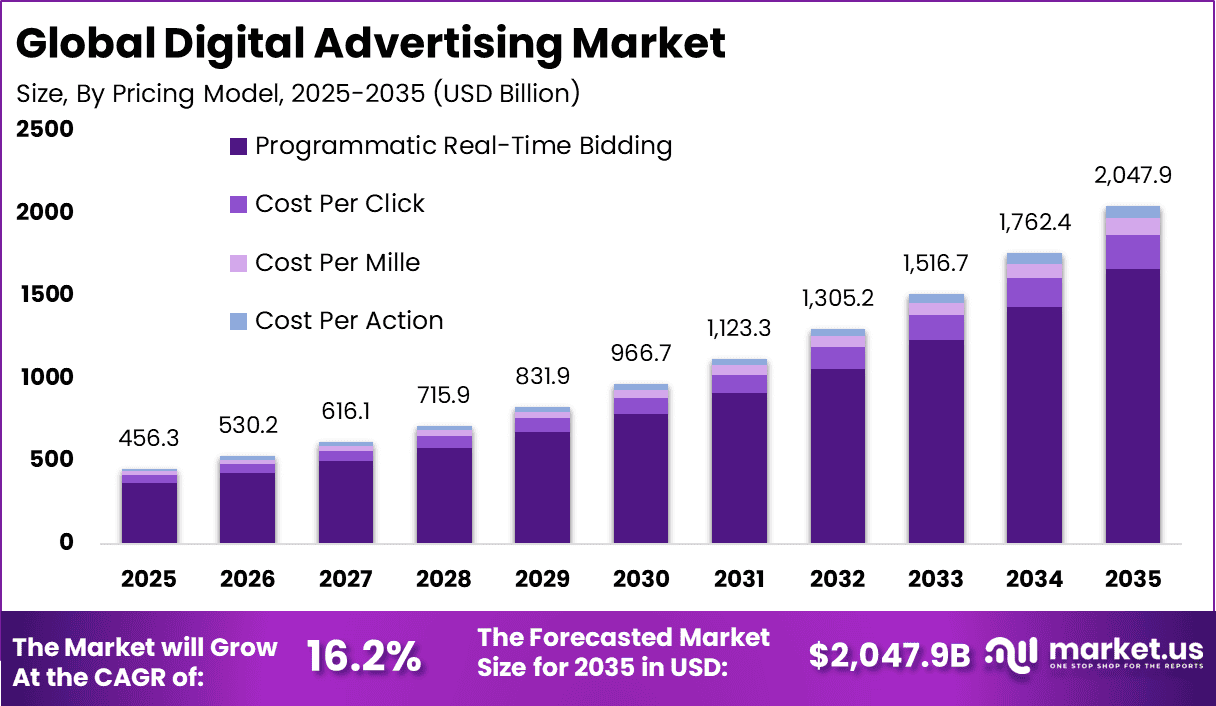
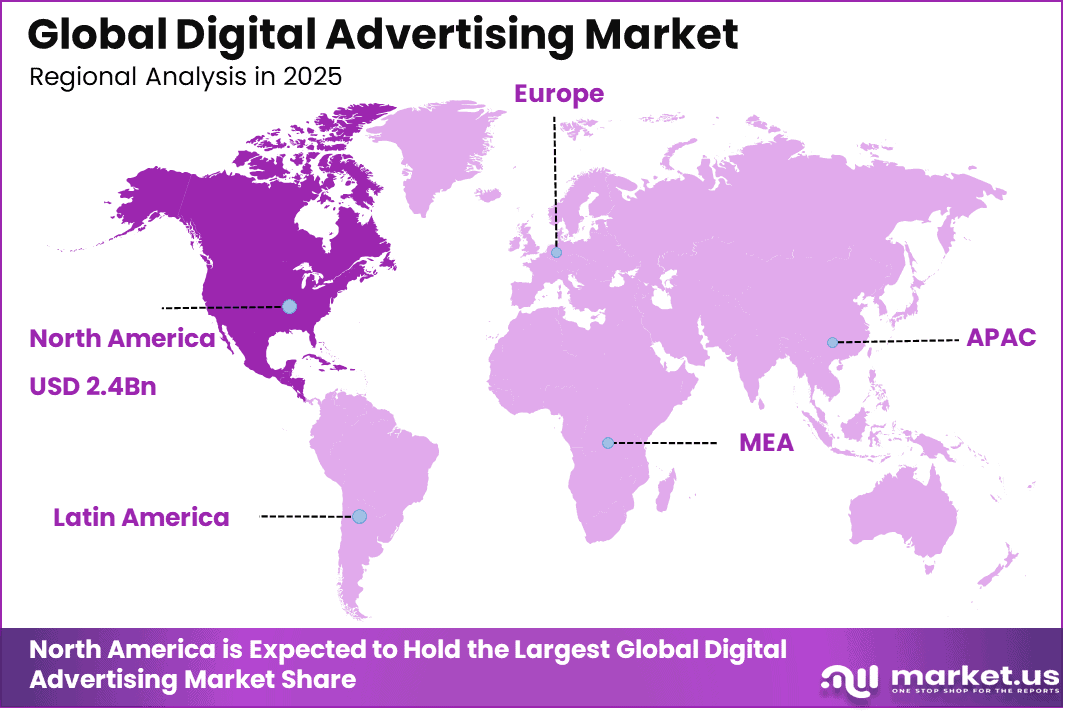
The Global Digital Advertising Market size is expected to be worth around USD 2,047.9 Billion By 2035, from USD 456.3 billion in 2025, growing at a CAGR of 16.2% during the forecast period from 2026 to 2035. North America held a dominant Market position, capturing more than a 36.2% share, holding USD 165.1 Billion revenue.
The Digital Advertising Market represents the ecosystem where promotional messages are delivered through online channels such as search engines, social platforms, websites, mobile applications, and connected devices. Advertisements are distributed using automated bidding systems that match marketing content with user behavior and intent. The shift from traditional media toward measurable engagement has made digital channels central to marketing strategies. Businesses rely on these channels to reach audiences across devices in real time.
Globally, more than 60% of marketing interactions now occur through digital touchpoints rather than offline media. The ability to track impressions, clicks, and conversions allows advertisers to evaluate performance continuously. As consumer attention shifts to mobile and online services, digital placements have become the primary medium for brand communication. The market therefore evolves alongside internet usage and e commerce activity.
Top Market Takeaways
- By component, software and solutions accounted for 71.0% of the Digital Advertising Market, supported by automated campaign management and analytics capabilities.
- By platform type, social media advertising represented 25.0% of total spending, reflecting high user engagement across digital communities.
- By pricing model, programmatic real time bidding dominated with a 81.4% share, driven by automated and data driven ad placements.
- By ad format, short form video ads captured 40.0% of the market, supported by rising consumption of mobile video content.
- By end user industry, fast moving consumer goods held a 22.4% share, reflecting strong brand marketing activity.
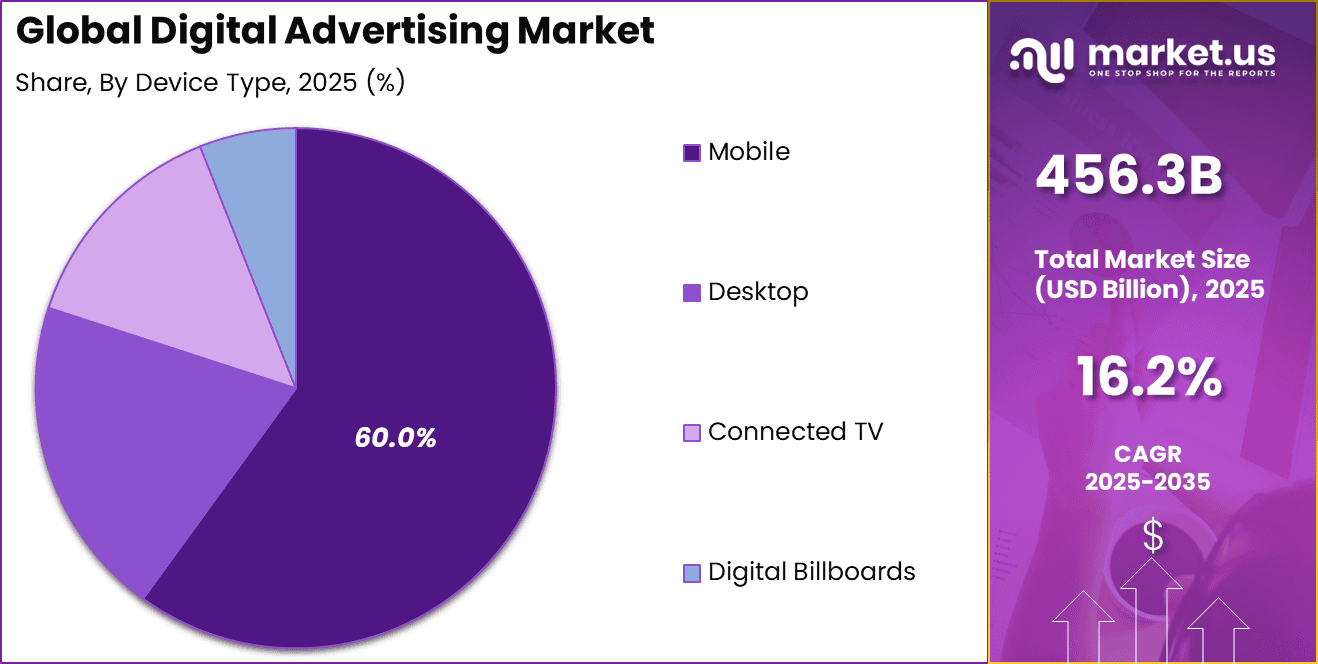
- By device type, mobile accounted for 60.0% of total digital advertising demand, driven by high smartphone penetration.
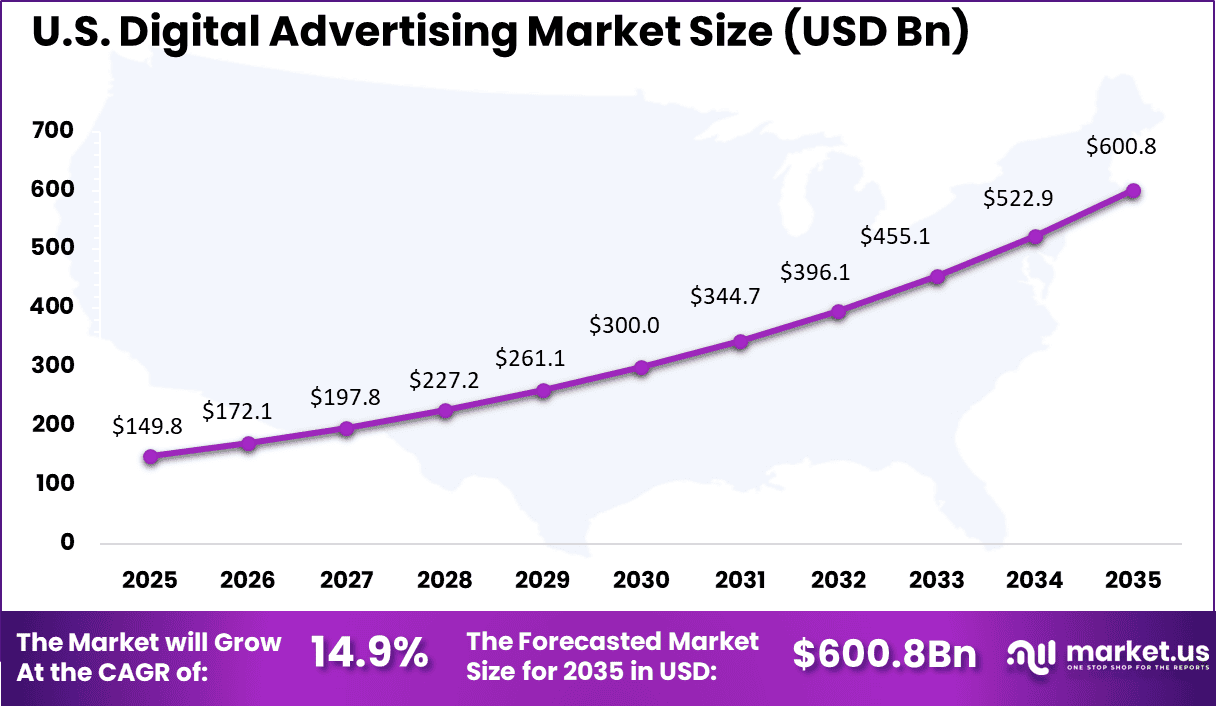
- Regionally, North America held a 36.2% share, with the US valued at USD 149.8 billion and recording a CAGR of 14.96%, reflecting steady growth in digital media investment.
Key Insights Summary
- Based on data from marketingltb, 63% of businesses increased their digital marketing spending over the past year, reflecting sustained shift toward online channels.
- Around 41% of total marketing budgets are now allocated to digital initiatives.
- Nearly 72% of companies plan to raise their digital marketing budgets in the coming year.
- About 58% of marketers identify digital marketing as the highest return on investment channel.
- Approximately 79% of businesses report that digital marketing generates more leads compared with traditional methods.
- Close to 47% of organizations outsource at least one digital marketing function to external providers.
- Around 54% of business owners report feeling overwhelmed by the range of digital marketing tools available.
- Nearly 62% of marketers depend heavily on automation tools for daily campaign management and reporting.
- About 68% of marketers track performance metrics on a weekly basis.
- Despite widespread adoption, 34% of companies still operate without a documented digital marketing strategy.
By Component
Software and solutions accounted for 71.0% of industry usage. Advertising platforms integrate audience segmentation, campaign management, and analytics into unified systems. Marketers can plan, launch, and adjust campaigns within a single interface while monitoring engagement indicators in real time. This improves campaign efficiency and reduces operational complexity.
Automation capabilities enable continuous optimization of creatives and placements. Performance metrics such as click patterns and viewing duration are analyzed instantly to refine targeting. The approach minimizes manual adjustments and improves conversion probability. Organizations therefore prioritize analytical advertising platforms rather than manual media buying.
Integration with customer databases also strengthens campaign personalization. Advertisers match behavioral insights with promotional content to improve relevance. This supports higher engagement rates across digital channels. The software layer therefore acts as the operational core of modern marketing activity.
By Platform Type
Social media advertising represented 25.0% of campaign distribution. Online communities provide extensive audience reach and detailed demographic segmentation. Advertisers target users based on interests, interactions, and browsing behavior. This precision improves marketing efficiency compared with broad messaging strategies.
Continuous content consumption on social platforms supports frequent brand exposure. Promotional material appears alongside regular user content, improving visibility without interrupting browsing behavior. Interactive features such as comments and sharing increase campaign engagement. The environment supports both awareness and direct response objectives.
Real time feedback also enables rapid campaign adjustments. Performance can be evaluated within hours rather than weeks. Marketers refine messaging according to audience reactions. This responsiveness encourages sustained investment in social channels.
By Pricing Model
Programmatic real time bidding accounted for 81.4% of transaction methods. Automated auctions purchase advertising inventory based on audience value and contextual relevance. The system evaluates user data instantly and determines the optimal bid price. This improves cost efficiency and targeting precision.
Automation reduces manual negotiation between advertisers and publishers. Campaigns adjust dynamically according to performance indicators. Budget allocation shifts toward high performing placements automatically. The model therefore maximizes return on advertising expenditure.
Transparency also improves because advertisers track spending and impressions continuously. Data driven decisions replace fixed placement commitments. This flexibility strengthens advertiser confidence in digital channels.
By Ad Format
Short form video advertisements held 40.0% share of creative formats. Consumers increasingly prefer brief visual content compatible with fast scrolling behavior. Video combines motion, sound, and storytelling within limited viewing time. This improves message retention compared with static formats.
Mobile viewing habits reinforce the popularity of concise video communication. Users consume content in short sessions throughout the day. Advertisers adapt by delivering quick and engaging messages. The format supports awareness campaigns and product demonstrations simultaneously.
Interactive features further increase engagement. Viewers can respond immediately through clicks or embedded actions. Campaign performance becomes measurable in real time. These characteristics support widespread adoption of short duration video advertising.
By End User Industry
Fast moving consumer goods accounted for 22.4% of advertising demand. Brands in this sector require continuous visibility due to high purchase frequency. Digital platforms enable rapid promotion of offers and product launches. This supports frequent consumer engagement.
Seasonal promotions and price campaigns benefit from targeted messaging. Advertisers reach specific demographic groups aligned with consumption patterns. Quick feedback helps adjust marketing strategies promptly. The result is improved promotional efficiency.
Brand competition also drives digital investment within this sector. Companies rely on measurable campaigns to maintain market presence. Analytical tracking allows evaluation of consumer response. Continuous optimization strengthens marketing effectiveness.
By Device Type
Mobile devices represented 60.0% of advertisement delivery. Consumers spend significant time on smartphones for communication, shopping, and entertainment. Advertisers prioritize mobile optimized content to match user behavior. Campaign formats are therefore designed for smaller screens and touch interaction.
Location awareness further enhances targeting capabilities. Promotions can be delivered based on user proximity and activity context. This improves relevance and response rates. Mobile interaction thus becomes a central advertising channel.
Continuous connectivity also enables immediate engagement. Users can respond to advertisements without switching devices. Seamless interaction improves conversion probability. Mobile platforms therefore dominate digital advertising delivery.
Regional Analysis
North America accounted for 36.2% of market participation. The region demonstrates strong digital consumption and advanced marketing technology adoption. Businesses rely on performance measurement and automated campaign optimization. High internet penetration supports sustained advertising activity.
The United States contributed USD 149.8 Bn with an estimated growth rate of 14.96% annually. Companies allocate significant budgets to measurable online promotion channels. Advanced analytics and audience targeting support continued expansion. Digital advertising remains a primary marketing strategy across industries.
Key Market Segments
By Component
- Software/Solutions
- Services
By Platform Type
- Search Engine Advertising
- Social Media Advertising
- Video and Streaming Advertising
- Display and Native Advertising
- Retail Media Advertising
- Digital Out-of-Home Advertising
By Pricing Model
- Programmatic Real-Time Bidding
- Cost Per Click
- Cost Per Mille
- Cost Per Action
By Ad Format
- Banner Ads
- Interstitial Ads
- In-Stream Video Ads
- Short-Form Video Ads
- Shoppable Ads
By End-User Industry
- Fast-Moving Consumer Goods
- Retail and E-commerce
- Healthcare and Pharmaceuticals
- Media and Entertainment
- Travel and Leisure
- Financial Services
- Technology
- Telecommunications
- Automotive
- Others
By Device Type
- Mobile
- Desktop
- Connected TV
- Digital Billboards
Regional Analysis and Coverage
- North America
- US
- Canada
- Europe
- Germany
- France
- The UK
- Spain
- Italy
- Russia
- Netherlands
- Rest of Europe
- Asia Pacific
- China
- Japan
- South Korea
- India
- Australia
- Singapore
- Thailand
- Vietnam
- Rest of Latin America
- Latin America
- Brazil
- Mexico
- Rest of Latin America
- Middle East & Africa
- South Africa
- Saudi Arabia
- UAE
- Rest of MEA
Driver Analysis
Expansion of Online Consumer Activity
A primary driver is the rising amount of time users spend on connected platforms. Daily activities including shopping, entertainment, communication, and information search now occur digitally, creating continuous exposure opportunities for advertisers. Businesses follow audiences to these environments in order to maintain visibility and relevance.
Another driver comes from the effectiveness of targeted promotion. Behavioral and contextual signals help identify consumer interests, enabling more relevant messaging and improving engagement rates. This measurable efficiency encourages companies to shift budgets from traditional channels toward digital formats.
Restraint Analysis
Privacy Regulations and Data Restrictions
One important restraint is the tightening of data protection regulations and platform privacy controls. Restrictions on tracking technologies reduce the availability of detailed user identifiers, which limits personalization precision. Advertisers must redesign measurement methods and rely more on aggregated analytics.
In addition, consumer awareness about data usage has increased sensitivity toward intrusive advertising practices. Excessive targeting or repetitive messaging may lead to avoidance behaviors such as ad blocking or subscription based content consumption. These reactions can reduce campaign reach and effectiveness.
Opportunity Analysis
Commerce Integration and Interactive Formats
Significant opportunity exists in integrating advertising directly with purchasing journeys. Shoppable media allows users to move from product discovery to transaction within the same interface, shortening the conversion path. This alignment between marketing and commerce increases efficiency for both brands and consumers.
Interactive content also provides engagement advantages. Formats that include augmented visualization, short video, or conversational experiences encourage active participation rather than passive viewing. Higher engagement improves recall and supports stronger brand relationships.
Challenge Analysis
Measurement Fragmentation Across Platforms
A major challenge involves fragmented measurement across multiple digital environments. Users interact with content across devices and platforms, making it difficult to attribute outcomes accurately to a single campaign. Organizations must combine diverse datasets to understand the full impact of advertising activity.
Another challenge is maintaining brand safety and content suitability. Automated placements can occasionally appear alongside inappropriate material, which may affect brand perception. Continuous monitoring and contextual controls are therefore required to preserve reputation and trust.
Top Emerging Trends
Artificial intelligence is increasingly used to optimize campaign delivery and creative variation. Algorithms analyze engagement patterns and automatically adjust bids, timing, and message formats to improve performance. This automation reduces manual management while improving efficiency.
Contextual advertising is also gaining importance as reliance on individual tracking decreases. Ads are matched to the surrounding content rather than personal identifiers, supporting privacy compliance while maintaining relevance. This shift represents a structural change in digital marketing strategies.
Customer Impact: Trends and Disruptors
Consumers experience more relevant and less disruptive advertising as contextual targeting improves. Messages aligned with current interests reduce unnecessary exposure and enhance browsing comfort. This balance improves acceptance of promotional content.
At the same time, seamless integration between media and commerce shortens the decision process. Users can discover and purchase products quickly within the same digital environment, transforming advertising from interruption into part of the shopping experience.
Competitive Analysis
Global advertising holding companies such as WPP plc, Omnicom Group Inc., Publicis Groupe S.A., Interpublic Group of Companies, Inc., and Dentsu Group Inc. dominate brand strategy and media planning. These firms manage large digital budgets across display, search, social, and video channels. Their strength lies in integrated campaigns and global client relationships. Demand is driven by data-led targeting and performance measurement requirements.
Digital platform and ad tech leaders such as Alphabet Inc., Meta Platforms, Inc., Amazon.com, Inc., Microsoft Corporation, TikTok Pte. Ltd., Snap Inc., and X Corp. command strong user engagement and first-party data assets. These platforms benefit from scalable programmatic ecosystems and advanced targeting tools.
Independent programmatic and regional players such as The Trade Desk, Inc., AppLovin Corporation, and BlueFocus Communication Group Co., Ltd. strengthen data-driven buying and cross-channel analytics. These firms focus on AI-based bidding and measurable ROI. Other vendors expand innovation and geographic reach, supporting sustained growth in the digital advertising market worldwide.
Top Key Players in the Market
- WPP plc
- Omnicom Group Inc.
- Publicis Groupe S.A.
- Interpublic Group of Companies, Inc.
- Dentsu Group Inc.
- The Trade Desk, Inc.
- Alphabet Inc.
- Meta Platforms, Inc.
- Amazon.com, Inc.
- Microsoft Corporation
- TikTok Pte. Ltd.
- Snap Inc.
- X Corp.
- BlueFocus Communication Group Co., Ltd.
- AppLovin Corporation
- Others
Recent Developments
- In August 2024, Google launched its advertising solution Google Ads Attribution globally to help businesses better understand customer journeys and optimize ad spending across multiple channels. The platform uses machine learning to deliver a more accurate and comprehensive view of campaign performance, enabling improved marketing decision making.
- The Trade Desk rolled out new AI-powered tools for digital advertising in September 2025, enhancing data scoring and programmatic buys across CTV and open web channels.
Report Scope
Report Features Description Market Value (2025) USD 456.3 Bn Forecast Revenue (2035) USD 2,047.9 Bn CAGR(2026-2035) 16.2% Base Year for Estimation 2025 Historic Period 2020-2024 Forecast Period 2026-2035 Report Coverage Revenue forecast, AI impact on Market trends, Share Insights, Company ranking, competitive landscape, Recent Developments, Market Dynamics and Emerging Trends Segments Covered By Component (Software/Solutions, Services), By Platform Type (Search Engine Advertising, Social Media Advertising, Video and Streaming Advertising, Display and Native Advertising, Retail Media Advertising, Digital Out-of-Home Advertising), By Pricing Model (Cost Per Click, Cost Per Mille, Cost Per Action, Programmatic Real-Time Bidding), By Ad Format (Banner Ads, Interstitial Ads, In-Stream Video Ads, Short-Form Video Ads, Shoppable Ads), By End-User Industry (Fast-Moving Consumer Goods, Retail and E-commerce, Healthcare and Pharmaceuticals, Media and Entertainment, Travel and Leisure, Financial Services, Technology, Telecommunications, Automotive, Others), By Device Type (Mobile, Desktop, Connected TV, Digital Billboards) Regional Analysis North America – US, Canada; Europe – Germany, France, The UK, Spain, Italy, Russia, Netherlands, Rest of Europe; Asia Pacific – China, Japan, South Korea, India, New Zealand, Singapore, Thailand, Vietnam, Rest of Latin America; Latin America – Brazil, Mexico, Rest of Latin America; Middle East & Africa – South Africa, Saudi Arabia, UAE, Rest of MEA Competitive Landscape WPP plc, Omnicom Group Inc., Publicis Groupe S.A., Interpublic Group of Companies, Inc., Dentsu Group Inc., The Trade Desk, Inc., Alphabet Inc., Meta Platforms, Inc., Amazon.com, Inc., Microsoft Corporation, TikTok Pte. Ltd., Snap Inc., X Corp., BlueFocus Communication Group Co., Ltd., AppLovin Corporation, Others Customization Scope Customization for segments, region/country-level will be provided. Moreover, additional customization can be done based on the requirements. Purchase Options We have three license to opt for: Single User License, Multi-User License (Up to 5 Users), Corporate Use License (Unlimited User and Printable PDF)  Digital Advertising MarketPublished date: Feb. 2026add_shopping_cartBuy Now get_appDownload Sample
 -
-
- WPP plc
- Omnicom Group Inc.
- Publicis Groupe S.A.
- Interpublic Group of Companies, Inc.
- Dentsu Group Inc.
- The Trade Desk, Inc.
- Alphabet Inc.
- Meta Platforms, Inc.
- Amazon.com, Inc.
- Microsoft Corporation
- TikTok Pte. Ltd.
- Snap Inc.
- X Corp.
- BlueFocus Communication Group Co., Ltd.
- AppLovin Corporation
- Others
Our Clients

- 177945
- Feb. 2026