


Global Boiler Market Size, Share Analysis Report By Fuel (Natural gas, Oil, Coal, Electric, Others), By Capacity (≤10 MMBTU/hr, 10-50 MMBTU/hr, >50-100 MMBTU/hr, >100-250 MMBTU/hr, 250 MMBTU/hr), By Technology (Condensing, Non-condensing), By Application (Residential, Commercial, Industrial, Others), By Sales Channel (Online, Dealer, Retail) , By Region and Companies - Industry Segment Outlook, Market Assessment, Competition Scenario, Trends and Forecast 2026-2035
- Published date: April 2026
- Report ID: 184075
- Number of Pages: 331
- Format:
-
keyboard_arrow_up
Quick Navigation
Report Overview
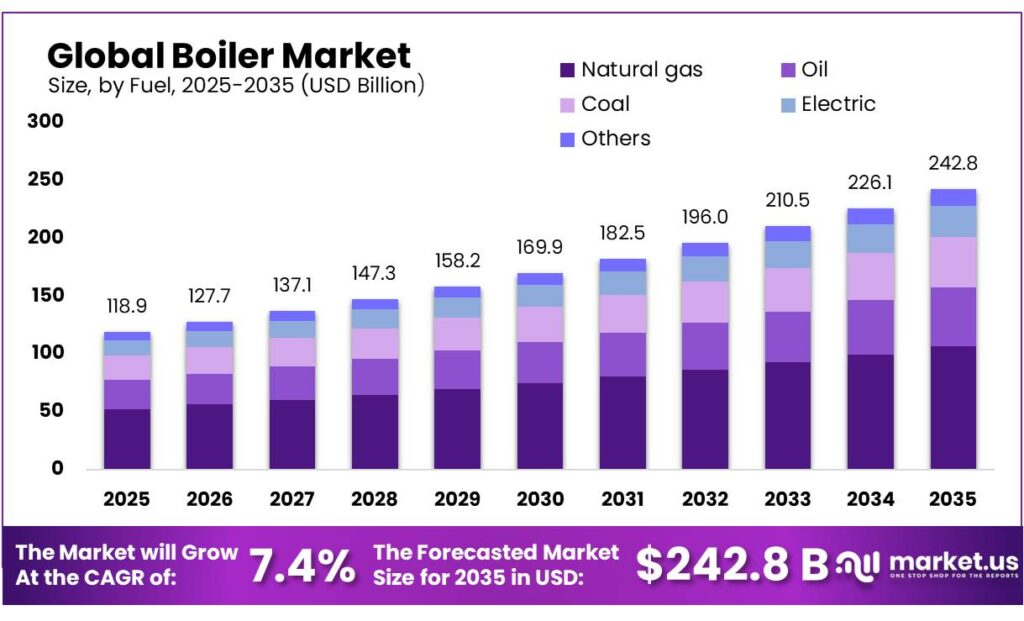
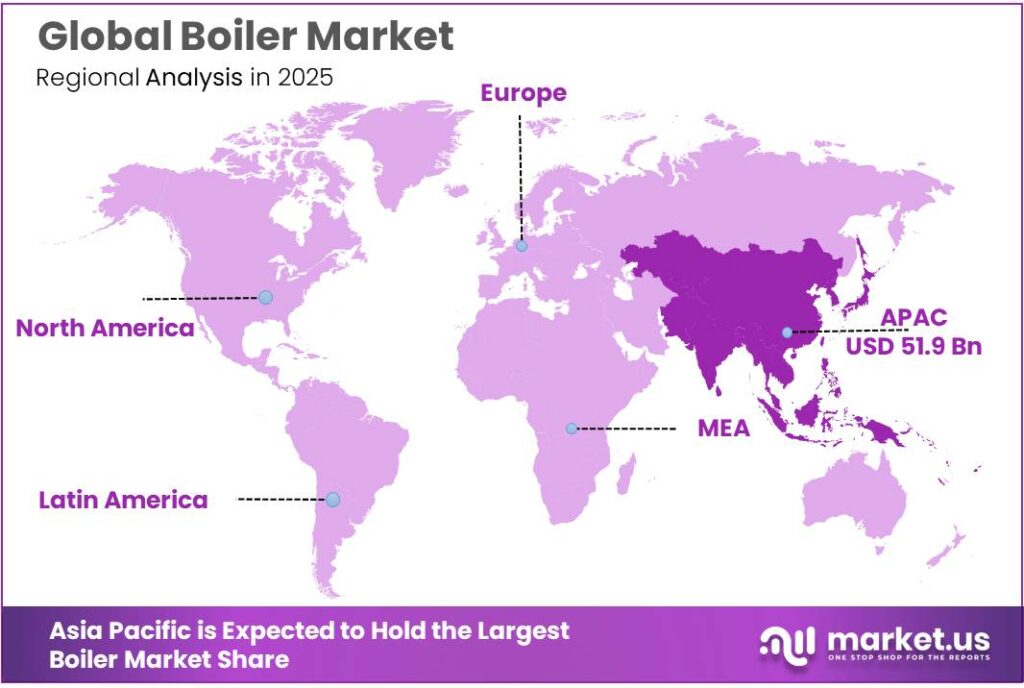
The Global Boiler Market size is expected to be worth around USD 242.8 Billion by 2035, from USD 118.9 Billion in 2025, growing at a CAGR of 7.4% during the forecast period from 2026 to 2035. In 2025, Asia Pacific held a dominant market position, capturing more than a 43.7% share, holding USD 51.9 Billion revenue.
The boiler industry remains a core part of industrial utilities because it supplies dependable steam and hot water for processing, sterilization, cleaning, space heating, and cogeneration. In practical terms, its relevance is tied to the scale of industrial heat demand: the International Energy Agency states that industry accounted for 37% of global energy use in 2022, equal to 166 EJ, while its newer efficiency outlook notes that total final energy consumption exceeded 450 EJ in 2024 and that industry represented nearly 40% of that demand.
From an industrial scenario perspective, food and beverage processing remains one of the most stable demand centers for boilers because steam is essential for pasteurization, cooking, drying, sanitation, and packaging-line thermal loads. In Europe, FoodDrinkEurope reports that the food and drink industry generates €1.2 trillion in turnover, contributes €250 billion in value added, and employs 4.7 million people, making it the region’s largest manufacturing industry.
In the United States, USDA reports 42,708 food and beverage manufacturing establishments in 2022, while the U.S. Census Bureau shows that U.S. food manufacturing recorded $904.1 billion in shipment value in 2021. That installed industrial base supports steady replacement demand for boilers as plants modernize utilities, raise hygiene standards, and pursue fuel savings.
The main growth drivers are energy productivity, emissions compliance, and fuel flexibility. Australia’s government energy guidance notes that, on a typical industrial site, boilers can account for up to 60% of energy costs and 35% of potential energy-efficiency improvements, which explains why end users prioritize economizers, controls, heat recovery, condensate return, and high-efficiency burner upgrades.
The IEA also highlights the direction of technology change: for selected 2024 industrial comparisons, it cites indicative efficiencies of 84% for coal boilers, 87% for natural-gas boilers, and 98% for electric boilers, while industrial heat pumps can reach 350%. This efficiency gap is steadily pushing the boiler sector toward hybrid, electric, and renewable-ready configurations rather than conventional fossil-only designs.
In the United States, the Department of Energy’s Industrial Heat Shot targets industrial heat solutions with at least 85% lower greenhouse-gas emissions by 2035 and estimates the pathway could help cut 575 million metric tons of carbon-equivalent emissions by 2050. In Europe, the European Commission announced the IF25 Heat Auction in 2025 with a budget of up to €1 billion to support industrial process-heat decarbonization, and formally opened the auction on 4 December 2025.
In 2025, A. O. Smith showed continued relevance to the commercial heating space: its 2025 annual report said company net sales reached $2.984 billion, up from $2.950 billion in 2024, supported in part by higher commercial water heater and boiler volumes. The company also announced the acquisition of Leonard Valve Company in November 2025 to broaden its commercial hot-water system capabilities.
Key Takeaways
- Boiler Market size is expected to be worth around USD 242.8 Billion by 2035, from USD 118.9 Billion in 2025, growing at a CAGR of 7.4%.
- Natural gas held a dominant market position, capturing more than a 44.6% share in the boiler market.
- 10–50 MMBTU/hr held a dominant market position, capturing more than a 29.3% share.
- Industrial held a dominant market position, capturing more than a 48.8% share in the boiler market.
- Unconventional/Tight and Shale held a dominant market position, capturing more than a 43.7% share.
- Asia Pacific held the dominant position in the boiler market with a 43.7% share, valued at USD 51.9 billion.
By Fuel Analysis
Natural gas dominates with 44.6% share in 2025, supported by clean combustion and easy fuel availability.
In 2025, Natural gas held a dominant market position, capturing more than a 44.6% share in the boiler market by fuel segment. This leadership is mainly linked to its cleaner combustion profile, better thermal efficiency, and lower maintenance needs compared with coal- and oil-based systems. Across food processing, chemicals, paper, and general manufacturing, natural gas boilers remain the preferred choice because they offer stable steam generation, fast heat response, and easier compliance with tightening emission norms.
By Capacity Analysis
10–50 MMBTU/hr leads with 29.3% share in 2025, driven by its strong fit for mid-sized industrial steam needs.
In 2025, 10–50 MMBTU/hr held a dominant market position, capturing more than a 29.3% share in the boiler market by capacity. This range remains a preferred choice across food processing, chemicals, textiles, pharmaceuticals, and medium-scale manufacturing because it offers the right balance between steam output and operating cost. Many plants choose this capacity when they need reliable process heat without moving to oversized high-capacity systems. Its strong demand also comes from the flexibility to support batch production, sterilization, drying, washing, and other continuous thermal processes with steady fuel use.
By Technology Analysis
Industrial boiler technology leads with 48.8% share in 2025, backed by heavy process heat demand across manufacturing sectors.
In 2025, Industrial held a dominant market position, capturing more than a 48.8% share in the boiler market by technology. This segment continues to lead because large-scale manufacturing industries depend on high-pressure steam and continuous heat supply for daily operations. Sectors such as food processing, chemicals, pulp and paper, refining, textiles, and pharmaceuticals rely heavily on industrial boiler systems for process heating, sterilization, drying, and cleaning applications. The strong share of this segment is mainly supported by its ability to deliver reliable thermal output, operate for long production hours, and handle varied fuel options such as natural gas, biomass, and oil.
By Application Analysis
Unconventional/Tight and Shale leads with 43.7% share in 2025, supported by rising steam demand in advanced extraction and processing operations.
In 2025, Unconventional/Tight and Shale held a dominant market position, capturing more than a 43.7% share in the boiler market by application. This segment remains strong because shale and tight resource development needs reliable thermal systems across drilling support, separation, treatment, and site utility operations. Boilers are widely used for steam generation, fluid heating, equipment cleaning, and temperature control in upstream and midstream processes linked to unconventional resource production. The segment’s large share is also supported by the expansion of shale and tight reservoir activity, where operators continue to invest in efficient field infrastructure and dependable heat systems to support continuous output.
By Sales Channel Analysis
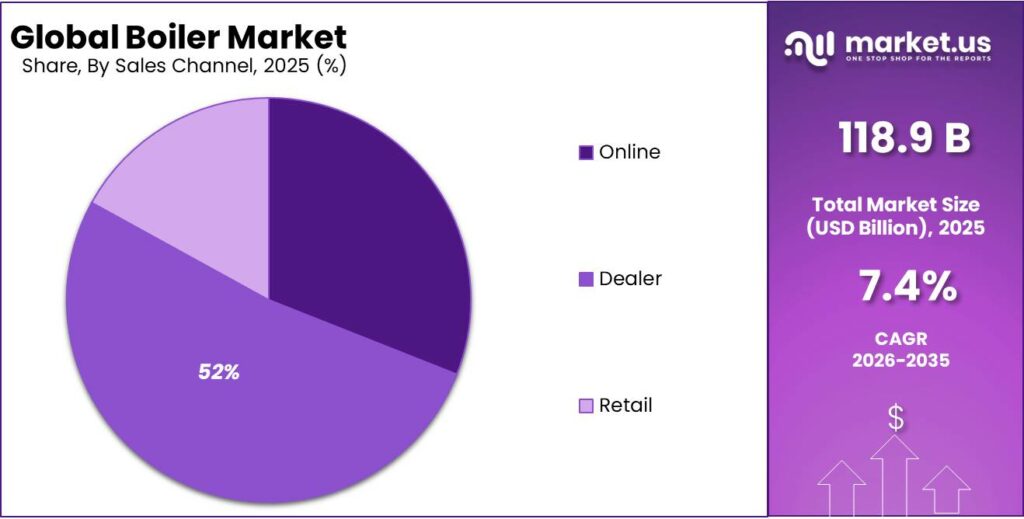
Dealer channel dominates with 52.5% in 2025, supported by strong buyer trust and wide service reach.
In 2025, Dealer held a dominant market position, capturing more than a 52.5% share in the boiler market by sales channel. This leadership was mainly supported by the strong role dealers play in connecting manufacturers with end users across industrial, commercial, and institutional buyers. Many customers continued to prefer dealer networks because they offer easier product comparison, local availability, faster delivery coordination, and dependable after-sales support. Dealers also remained important for handling installation guidance, maintenance arrangements, and replacement part access, which are key decision factors in boiler purchases.
Key Market Segments
By Fuel
- Natural gas
- Oil
- Coal
- Electric
- Others
By Capacity
- ≤10 MMBTU/hr
- 10-50 MMBTU/hr
- >50-100 MMBTU/hr
- >100-250 MMBTU/hr
- 250 MMBTU/hr
By Technology
- Condensing
- Non-condensing
By Application
- Residential
- Single Family
- Multi Family
- Commercial
- Offices
- Healthcare Facilities
- Educational Institutions
- Lodgings
- Retail Stores
- Others
- Industrial
- Food Processing
- Pulp & Paper
- Chemical
- Refinery
- Primary Metal
- Others
By Sales Channel
- Online
- Dealer
- Retail
Emerging Trends
Electrified steam systems are becoming the clearest new trend in boilers
One major latest trend in the boiler industry is the move toward electrified and low-emission steam systems, especially in plants that need clean and reliable heat every day. This shift is no longer just a pilot idea. It is now being pushed by both policy and operating needs. In late 2025, the European Commission opened the IF25 Heat Auction with a budget of €1 billion to support projects that decarbonize industrial process heat. That matters for boilers because process heat is where many factories still depend on fossil fuels.
The IEA reported in 2025 that global industrial heat demand is expected to grow by 14% between 2025 and 2030, equal to 16 EJ, while the renewable share of industrial heat is expected to rise from 12% in 2024 to 16% in 2030. This shows where the market is heading: cleaner steam, smarter control systems, and more electric boiler use in low-temperature applications.
Food manufacturers are helping push this boiler trend forward
The food and drink industry is one of the strongest reasons this trend is gaining ground so quickly. Food plants need steam for pasteurization, sterilization, washing, drying, and cooking, so they cannot afford unstable or outdated heat systems.
In Europe alone, the food and drink industry employs 4.7 million people, generates €1.2 trillion in turnover, and creates about €250 billion in value added, making it the region’s largest manufacturing industry. Because this sector runs on continuous thermal processing, even small gains in boiler efficiency or emissions performance matter at a very large scale. That is why food companies are becoming early adopters of cleaner steam solutions.
Drivers
Rising processed food production is a major driver for boiler demand
One major driving factor for the boiler market is the steady rise in processed food and dairy production, where steam remains essential for sterilization, pasteurization, cooking, drying, and cleaning. Food plants depend on boilers because thermal consistency directly affects product safety and shelf life. A strong example comes from the food processing industry, where process steam demand is estimated at 23,000–24,000 TPH in FY2025, and is projected to reach 29,000–30,000 TPH by FY2030, clearly showing how expanding food output is pushing boiler installations higher.
In dairy, the same trend is visible, with steam demand reaching 7,700 TPH in FY2025, supported by rising milk treatment and value-added dairy processing volumes. As more food manufacturers move toward packaged, ready-to-eat, and hygienic production lines, the need for reliable industrial steam systems naturally increases. This makes food industry expansion one of the most practical and visible demand generators for boiler systems in 2025 and 2026.
Government safety and efficiency initiatives are strengthening replacement demand
Another strong growth driver is government-led boiler safety, inspection, and energy-efficiency initiatives, which are encouraging industries to replace older systems with modern units. A trusted example is the Gujarat Directorate of Boilers initiative, where the government completed 100% inspection coverage of 23,719 boilers and 675 economizers between 2022–23 and 2024–25, helping maintain zero explosion-related deaths for three straight years.
This kind of regulatory action creates direct demand for upgraded boilers, controls, economizers, and monitoring systems because industries need compliant and efficient equipment to continue operations safely. The same initiative also included ₹22 crore in state allocation, highlighting how public spending on industrial safety can support equipment modernization.
Restraints
Fuel price volatility is a major restraint for boiler operating economics
One major restraining factor for the boiler market is the volatility in fuel and energy costs, which directly affects steam generation economics in food and process industries. Boilers are long-life assets, but their real burden comes from operating expenses, especially fuel.
When natural gas, oil, or electricity prices fluctuate sharply, food manufacturers face unpredictable production costs, making it difficult to plan margins for dairy, bakery, beverages, and packaged foods. A trusted 2025 industry source notes that food plants are among the most exposed sectors to rising utility bills because thermal processing runs continuously across cooking, sterilization, and cleaning lines.
High energy burden in food processing limits boiler upgrade decisions
The restraint becomes stronger in food manufacturing because steam demand is non-negotiable. Government-backed energy statistics show that the industrial sector consumed 302.4 million tonnes of oil equivalent in FY2024–25, highlighting how energy-intensive process industries have become. In food plants, a large share of this demand comes from process heat, where boilers support pasteurization, evaporation, drying, and sanitation.
When fuel bills rise unexpectedly, processors often postpone boiler modernization, burner retrofits, or efficiency upgrades even when those projects are technically justified. This creates a real market restraint: demand exists, but capital decisions get pushed out because energy cost swings reduce confidence in return timelines.
Opportunity
Electrification and clean steam upgrades are a major growth opportunity for boilers
One of the biggest growth opportunities for the boiler market is the shift toward electric boilers and low-carbon steam systems in food processing and other clean manufacturing industries. Food plants need reliable steam for pasteurization, sterilization, cooking, drying, and cleaning, but many facilities are now under pressure to reduce emissions without affecting hygiene standards.
A strong 2025 industry report shows that total process steam demand reached 186,000 TPH in FY2025, with expected 9.5% CAGR growth through FY2030, creating a very large upgrade base for cleaner boiler technologies. This is where electric boilers, biomass-ready units, and smart steam systems create a major opportunity. Another trusted 2025 clean steam report noted that process boilers generate 1.26 billion tonnes of steam annually, which shows how even small technology shifts can create large-scale equipment demand.
Government decarbonization programs are opening long-term replacement demand
A second major opportunity comes from government-backed decarbonization and industrial electrification initiatives, which are encouraging factories to modernize boiler rooms. Trusted 2025 policy roadmaps show that governments are actively supporting electrification, clean biomass, solar thermal integration, and hydrogen-ready heat systems for process industries.
For food manufacturers, this creates a clear upgrade path because steam remains essential while compliance standards are getting stricter. The opportunity is especially strong in low- and medium-temperature process heating, where electric boilers are becoming more commercially practical. A 2025 electrification roadmap highlighted that process heat below 80°C is already the most cost-effective electrification zone, with the potential to save 1.7 million tonnes of CO2.
Regional Insights
Asia Pacific dominates with 43.7% share, reaching USD 51.9 Bn on the back of industrial expansion and steam-intensive manufacturing growth.
Asia Pacific held the dominant position in the boiler market with a 43.7% share, valued at USD 51.9 billion, supported by the region’s large industrial base, expanding food processing capacity, chemicals, refining, pulp & paper, and fast-growing manufacturing output. The region’s strength comes from the continued scale-up of steam-dependent industries across China, Japan, South Korea, and Southeast Asia, where boilers remain critical for sterilization, drying, cleaning, and process heating.
A major support factor is the scale of regional manufacturing itself—according to UNIDO, Asia continues to account for the largest share of global manufacturing value added, led by China and East Asia’s heavy industrial ecosystem. This concentration of factories directly supports replacement and new boiler installations across medium- and large-capacity industrial facilities.
Key Regions and Countries Insights
- North America
- US
- Canada
- Europe
- Germany
- France
- The UK
- Spain
- Italy
- Rest of Europe
- Asia Pacific
- China
- Japan
- South Korea
- India
- Australia
- Rest of APAC
- Latin America
- Brazil
- Mexico
- Rest of Latin America
- Middle East & Africa
- GCC
- South Africa
- Rest of MEA
Key Players Analysis
A.O. Smith remains one of the strongest names in the boiler and commercial hot water space, supported by its scale, product reliability, and North American dominance. In 2025, the company reported USD 2.984 billion in sales, up from USD 2.950 billion in 2024, showing steady expansion despite a mature market. Its commercial water heating and boiler-linked systems continue to benefit from replacement demand in industrial and institutional buildings.
Ariston Holding has a strong position in global thermal comfort and industrial heating solutions, supported by its broad Europe-led distribution network and premium energy-efficient systems. In 2025, the company generated €2.707 billion in net revenue, with 3.0% organic growth, reflecting resilient demand across heating and hot water applications. Its strength in condensing systems, electric heating, and commercial thermal solutions keeps it relevant in the boiler market.
Babcock & Wilcox continues to hold a critical role in industrial boilers, utility steam generation, and energy infrastructure projects. In 2025, the company reported USD 587.7 million in revenue, rising from USD 581.0 million in 2024. A major highlight was its USD 2.8 billion backlog, which increased 470% year-over-year, showing very strong future project visibility in industrial energy and boiler-related installations. Its position is especially strong in large utility, waste-to-energy, and industrial steam applications where custom-engineered systems are required.
Top Key Players Outlook
- A.O. Smith
- Ariston Holding
- Babcock & Wilcox
- Babcock Wanson
- Baxi
- BDR Thermea Group
- Bosch Limited
- Bradford White Corporation
- BURNHAM COMMERCIAL BOILERS
- Carrier
- Clayton Industries
- Cleaver-Brooks
Recent Industry Developments
For 2026, A.O. Smith is guiding for 2% to 5% sales growth and EPS of $3.85 to $4.15, and it expects about $70 million of sales contribution from Leonard Valve, while its boiler platform is also getting support from product innovation such as Lochinvar’s LECTRUS commercial electric boiler, which won a 2025 design award announced in January 2026.
Report Scope
Report Features Description Market Value (2025) USD 118.9 Bn Forecast Revenue (2035) USD 242.8 Bn CAGR (2026-2035) 7.4% Base Year for Estimation 2025 Historic Period 2020-2024 Forecast Period 2026-2035 Report Coverage Revenue Forecast, Market Dynamics, Competitive Landscape, Recent Developments Segments Covered By Fuel (Natural gas, Oil, Coal, Electric, Others), By Capacity (≤10 MMBTU/hr, 10-50 MMBTU/hr, >50-100 MMBTU/hr, >100-250 MMBTU/hr, 250 MMBTU/hr), By Technology (Condensing, Non-condensing), By Application (Residential, Commercial, Industrial, Others), By Sales Channel (Online, Dealer, Retail) Regional Analysis North America – US, Canada; Europe – Germany, France, The UK, Spain, Italy, Rest of Europe; Asia Pacific – China, Japan, South Korea, India, Australia, Singapore, Rest of APAC; Latin America – Brazil, Mexico, Rest of Latin America; Middle East & Africa – GCC, South Africa, Rest of MEA Competitive Landscape A.O. Smith, Ariston Holding, Babcock & Wilcox, Babcock Wanson, Baxi, BDR Thermea Group, Bosch Limited, Bradford White Corporation, BURNHAM COMMERCIAL BOILERS, Carrier, Clayton Industries, Cleaver-Brooks Customization Scope Customization for segments, region/country-level will be provided. Moreover, additional customization can be done based on the requirements. Purchase Options We have three licenses to opt for: Single User License, Multi-User License (Up to 5 Users), Corporate Use License (Unlimited User and Printable PDF) 
-
-
- A.O. Smith
- Ariston Holding
- Babcock & Wilcox
- Babcock Wanson
- Baxi
- BDR Thermea Group
- Bosch Limited
- Bradford White Corporation
- BURNHAM COMMERCIAL BOILERS
- Carrier
- Clayton Industries
- Cleaver-Brooks
Our Clients

- 184075
- April 2026






