


Global 3D Concrete Printing Market Size, Share, Growth Analysis By Printing System (Gantry-based Systems, Robotic Arm-based Systems, Crane-based/Contour Crafting Systems), By Material Type (Cement-based Concrete Mixes, Geopolymer-based Mixes, Fiber-reinforced Concrete Mixes, Custom Proprietary Mortars/Binders), By Application (Residential Housing, Commercial & Office Buildings, Public Infrastructure, Emergency & Disaster Relief Shelters, Architectural & Decorative Elements), By Region and Companies - Industry Segment Outlook, Market Assessment, Competition Scenario, Statistics, Trends and Forecast 2025-2034
- Published date: Dec 2025
- Report ID: 172191
- Number of Pages: 341
- Format:
-
keyboard_arrow_up
Quick Navigation
Report Overview
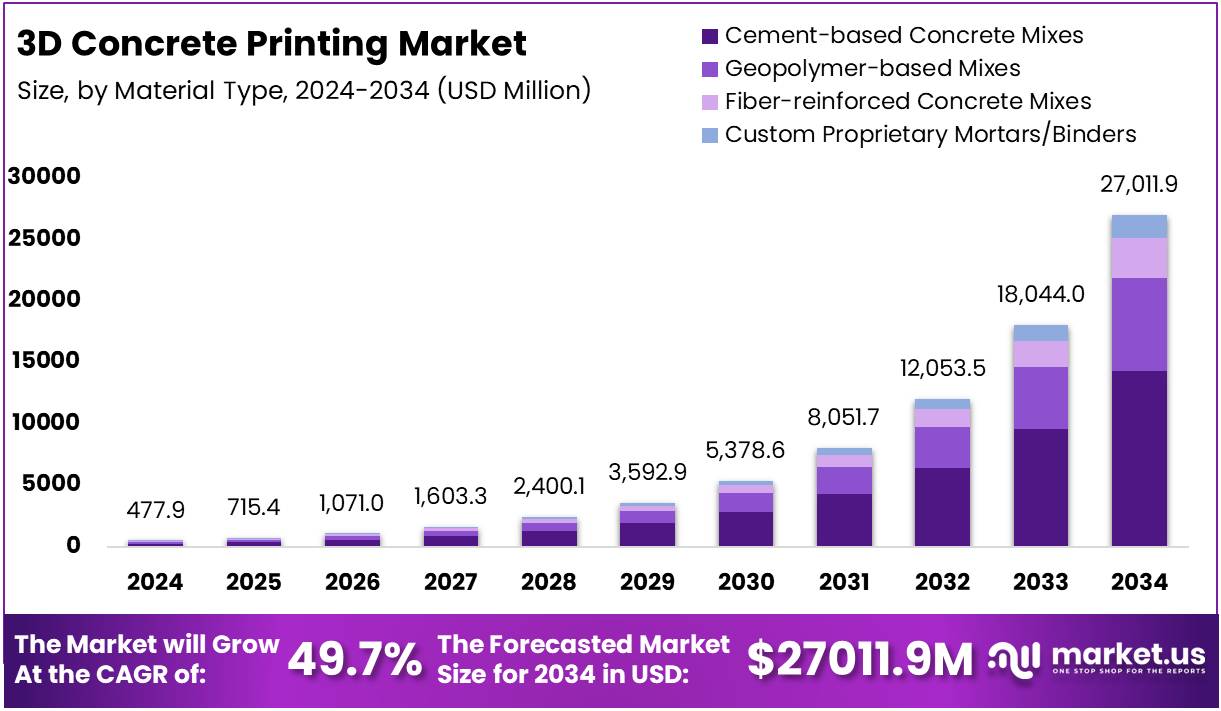
The Global 3D Concrete Printing Market size is expected to be worth around USD 27011.9 Million by 2034, from USD 477.9 Million in 2024, growing at a CAGR of 49.7% during the forecast period from 2025 to 2034.
3D concrete printing represents an innovative additive manufacturing technology transforming construction practices. This advanced method deposits concrete layers systematically, creating structures without traditional formwork. Consequently, the construction industry witnesses accelerated project timelines and enhanced design flexibility. Moreover, this technology enables architects to realize complex geometries previously deemed impractical using conventional methods.
The 3D concrete printing market encompasses equipment, materials, software, and services facilitating automated construction. Currently, this market demonstrates substantial momentum driven by urbanization demands and skilled labor shortages. Furthermore, stakeholders recognize significant cost optimization potential through reduced material consumption and shortened construction cycles. Industry adoption accelerates as technological capabilities mature and demonstrate consistent reliability.
Growth trajectories appear remarkably promising as construction sectors embrace digital transformation initiatives. Simultaneously, housing shortages across developed and emerging economies create urgent demand for rapid building solutions. Additionally, sustainability mandates compel industries toward environmentally responsible construction methodologies. These converging factors position 3D concrete printing as a viable mainstream alternative.
Investment opportunities flourish across equipment manufacturing, specialized concrete formulations, and software development segments. Meanwhile, governments increasingly support innovative construction technologies through favorable policies and pilot project funding. Regulatory frameworks evolve progressively, establishing standards for structural integrity and safety compliance. Consequently, market participants gain clearer operational guidelines supporting commercial scalability.
Government initiatives significantly influence market expansion through infrastructure modernization programs and affordable housing mandates. Several nations allocate substantial budgets toward construction technology advancement, recognizing long-term economic benefits. Moreover, regulatory bodies collaborate with industry stakeholders to develop comprehensive certification processes. This institutional support accelerates mainstream adoption and investor confidence.
Operational advantages substantiate market enthusiasm beyond theoretical potential. Notably, 3D printing ensures up to 60% waste reduction and 70% production efficiency enhancement compared to conventional concrete structures. Furthermore, case studies demonstrate impressive scalability 80% of certain homes utilize 3D printing including interior and exterior walls. Economically, 3D-printed concrete walls save approximately 15% per square foot in building costs. These quantifiable benefits validate technology investments and forecast sustained market growth.
Key Takeaways
- The global 3D concrete printing market is projected to grow from USD 477.9 Million in 2024 to USD 27,011.9 Million by 2034 at a CAGR of 49.7%.
- Gantry-based systems lead the printing system segment with a dominant share of 48.40% in 2024.
- Cement-based concrete mixes dominate the material type segment, accounting for 53.80% of the market in 2024.
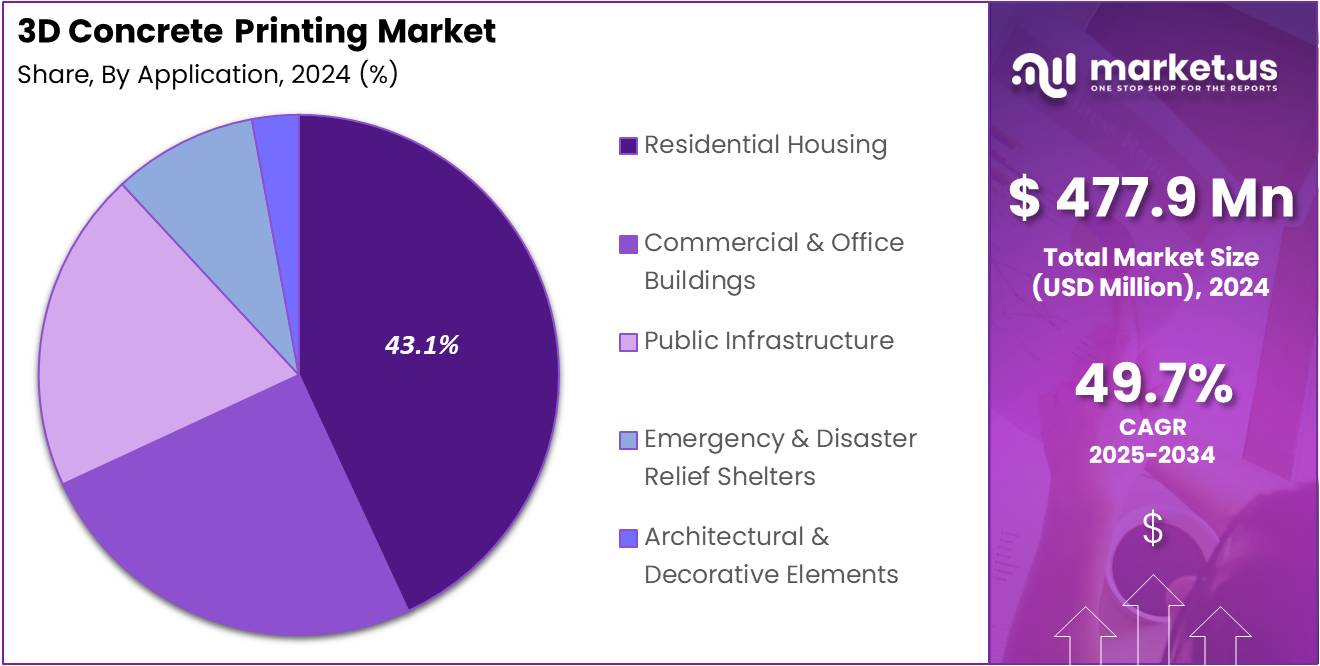
- Residential housing is the largest application segment, holding a market share of 43.10% in 2024.
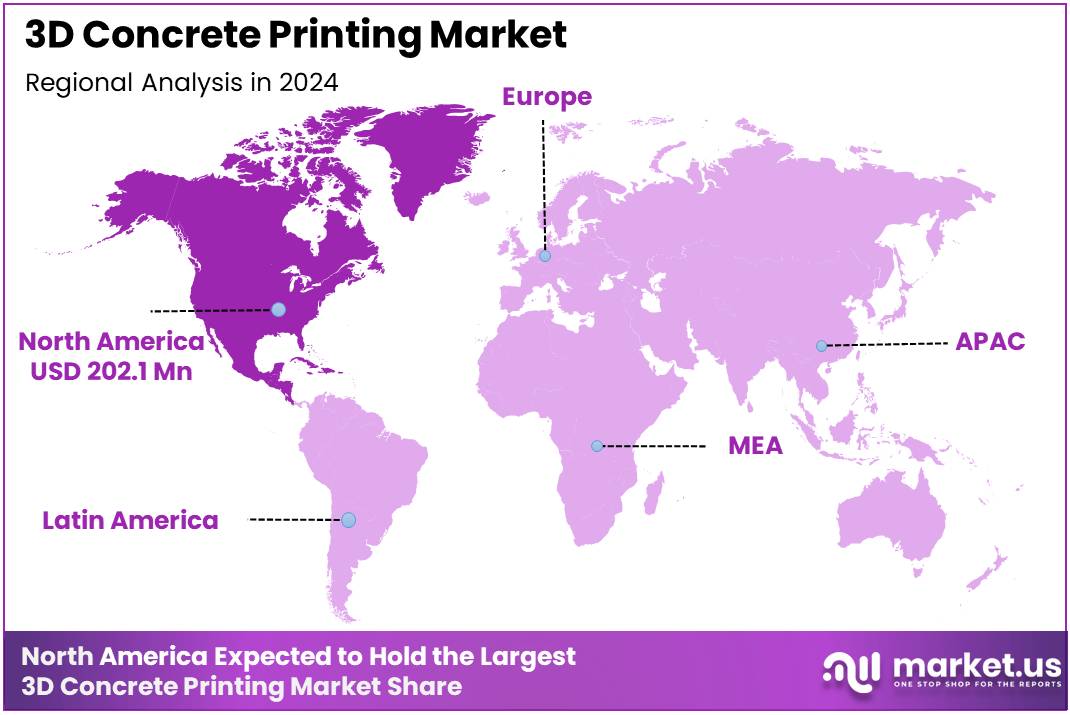
- North America dominates the global market with a 42.3% share, valued at USD 202.1 Million.
Printing System Analysis
Gantry-based Systems dominate with 48.40% due to their precision and scalability in large-scale construction projects.
In 2024, Gantry-based Systems held a dominant market position in the By Printing System Analysis segment of 3D Concrete Printing Market, with a 48.40% share. These systems utilize overhead frameworks moving along fixed rails, enabling precise layer-by-layer concrete deposition. Their superior stability makes them ideal for printing entire structures with consistent quality and minimal human intervention. The ability to handle heavy concrete loads has made them the industry standard for construction applications.
Robotic Arm-based Systems offer exceptional flexibility in confined spaces. These multi-axis platforms create intricate geometric patterns and reach complex angles efficiently. Their compact footprint makes them perfect for interior applications, renovations, and decorative elements in high-end projects. Growing demand for customized architectural features continues to drive adoption of robotic arm technology across construction sectors.
Crane-based/Contour Crafting Systems provide unmatched scalability for mega-construction projects. These systems excel in public infrastructure and emergency housing where rapid deployment is essential. Their ability to operate on uneven terrain makes them valuable for disaster relief, though higher operational complexity limits widespread adoption. Mobile platforms enable printing across vast sites, making them suitable for large-scale remote developments.
Material Type Analysis
Cement-based Concrete Mixes dominate with 53.80% due to their proven performance and widespread industry acceptance.
In 2024, Cement-based Concrete Mixes held a dominant market position in the By Material Type Analysis segment of 3D Concrete Printing Market, with a 53.80% share. These Portland cement formulations are optimized for additive manufacturing with specialized admixtures. Their established supply chains and regulatory compliance make them the preferred choice, ensuring structural integrity and durability. Predictable curing behavior facilitates seamless integration into traditional building workflows.
Geopolymer-based Mixes are gaining traction as sustainable alternatives utilizing industrial byproducts like fly ash. These eco-friendly formulations significantly reduce carbon emissions while delivering comparable mechanical properties. Their rapid setting characteristics make them suitable for specialized applications, attracting environmentally conscious developers. Research institutions continue advancing geopolymer technology to challenge conventional cement-based materials in mainstream construction.
Fiber-reinforced Concrete Mixes incorporate fibers enhancing tensile strength and crack resistance. These composites address concrete’s brittleness, improving structural performance without traditional steel reinforcement. Fibers distribute stresses evenly, reducing thermal expansion vulnerability. Enhanced durability and reduced maintenance requirements justify premium pricing for critical infrastructure applications.
Custom Proprietary Mortars/Binders represent cutting-edge innovations for niche applications. These tailored formulations address specific requirements like ultra-rapid setting or extreme temperature tolerance. Companies protect intellectual property while offering differentiated solutions driving innovation. Specialized binders enable unique aesthetic finishes that expand design possibilities and performance capabilities of 3D printing technology.
Application Analysis
Residential Housing dominates with 43.10% due to global housing shortages and cost-efficiency advantages of 3D printing technology.
In 2024, Residential Housing held a dominant market position in the By Application Analysis segment of 3D Concrete Printing Market, with a 43.10% share. The technology addresses affordable housing challenges by reducing construction timelines from months to days while cutting labor costs significantly. Governments deploy 3D printing for various housing projects, appealing to environmentally conscious buyers. Rapid urbanization in developing nations drives demand for scalable, cost-effective residential construction solutions.
Commercial & Office Buildings increasingly utilize 3D printing for modern workspaces and retail centers. The method enables distinctive facades and complex geometries impossible with conventional techniques. Developers appreciate accelerated delivery schedules and reduced labor requirements. The technology’s ability to create column-free interiors attracts companies prioritizing employee experience and operational flexibility.
Public Infrastructure applications encompass bridges, pathways, and utility structures requiring durability and rapid deployment. Municipalities leverage 3D printing for infrastructure renewal, reducing traffic disruptions through faster construction. Government agencies recognize long-term maintenance savings through precise material placement. Enhanced structural optimization makes 3D printing attractive for budget-conscious public sector projects.
Emergency & Disaster Relief Shelters demonstrate 3D printing’s humanitarian potential, providing rapid-response housing in disaster-affected regions. International aid organizations deploy mobile equipment to create durable shelters surpassing temporary accommodations, offering superior weather protection. The ability to utilize locally sourced materials reduces logistics costs and accelerates relief efforts in crisis situations.
Architectural & Decorative Elements showcase 3D printing’s creative capabilities, producing intricate facades and artistic installations. Designers exploit the technology’s freedom to fabricate organic forms unachievable through conventional methods. High-end projects commission bespoke elements commanding premium pricing and driving aesthetic innovation. Elimination of complex formwork enables cost-effective production of customized architectural features.
Key Market Segments
By Printing System
- Gantry-based Systems
- Robotic Arm-based Systems
- Crane-based/Contour Crafting Systems
By Material Type
- Cement-based Concrete Mixes
- Geopolymer-based Mixes
- Fiber-reinforced Concrete Mixes
- Custom Proprietary Mortars/Binders
By Application
- Residential Housing
- Commercial & Office Buildings
- Public Infrastructure
- Emergency & Disaster Relief Shelters
- Architectural & Decorative Elements
Drivers
Growing Demand for Faster and More Sustainable Construction Methods Drives Market Growth
The construction industry is experiencing a major shift toward efficiency and sustainability. Traditional building methods often take months or years to complete, leading to high labor costs and material waste. 3D concrete printing offers a solution by reducing construction time significantly, sometimes completing structures in just days or weeks. This speed advantage makes the technology particularly attractive for projects with tight deadlines and budget constraints.
Technology improvements have made concrete printing more reliable for building strong and long-lasting structures. Modern printers can now create complex designs with high-strength materials that meet industry standards. This advancement allows builders to construct everything from residential homes to commercial buildings with greater precision and reduced material consumption. The ability to produce durable structures expands the technology’s application across various construction sectors.
Governments worldwide are recognizing the potential of this technology for infrastructure development. Many countries have launched initiatives promoting smart city projects and sustainable construction practices. These programs often include funding and support for innovative building technologies like 3D concrete printing, which aligns with environmental goals and urban development needs. Such government backing provides the financial and regulatory support necessary for broader market adoption.
Restraints
Limited Availability of Standardized Materials for Large-Scale Construction Applications Restrains Market Expansion
One major challenge facing the 3D concrete printing market is the shortage of approved materials suitable for large construction projects. Unlike traditional concrete that has decades of testing and standardization, printing materials are still evolving. Many current options lack the consistency and quality assurance needed for widespread commercial use. This material limitation restricts the types and scales of projects that can be undertaken with confidence.
The regulatory environment presents another significant hurdle for market growth. Building codes and safety regulations were developed for conventional construction methods and do not adequately address 3D printed structures. Obtaining permits and approvals can be complicated and time-consuming as authorities work to understand this new technology. Many jurisdictions lack specific guidelines for evaluating and certifying 3D printed buildings.
These challenges create uncertainty for construction companies considering adoption. Without clear standards and regulations, there are concerns about liability, insurance coverage, and long-term structural performance. This situation slows down investment decisions and limits the technology’s expansion into mainstream construction markets. Industry stakeholders continue to work with regulatory bodies to establish appropriate frameworks for this emerging technology.
Growth Factors
Expansion in Affordable Housing Projects Using 3D Concrete Printing Technology Creates Growth Opportunities
The global housing shortage presents a massive opportunity for 3D concrete printing adoption. Many developing and developed countries struggle to provide affordable homes for their populations. This technology can dramatically reduce construction costs by minimizing labor expenses and material waste, making housing more accessible to lower-income families. Several pilot projects worldwide have already demonstrated the viability of printing affordable homes at scale.
Sustainability is becoming a priority across industries, and concrete printing is evolving to meet these demands. Researchers and companies are developing eco-friendly materials that reduce carbon emissions and use recycled components. These innovations appeal to environmentally conscious builders and governments seeking to meet climate commitments. The development of green concrete alternatives positions the technology as a solution for sustainable construction challenges.
The integration of advanced technologies like robotics and artificial intelligence is opening new possibilities. AI-powered systems can optimize printing patterns, predict structural weaknesses, and improve overall quality. Robotic automation increases precision and allows for more complex architectural designs. Together, these technologies are making 3D concrete printing more reliable and attractive for diverse construction applications. The convergence of AI, robotics, and printing technology represents a significant leap forward in construction automation.
Emerging Trends
Adoption of Modular 3D Concrete Printing for Rapid Construction in Urban Areas Represents Key Trending Factor
Urban areas are increasingly adopting modular 3D printing approaches to address rapid population growth and space constraints. This method allows components to be printed off-site and assembled quickly at construction locations. The approach minimizes disruption to city life while accelerating project completion timelines significantly. Modular construction also offers flexibility in design and easier scalability for expanding urban infrastructure.
Architects and designers are embracing 3D printing for its ability to create unique and complex structures. Traditional construction methods often limit creative possibilities due to cost and technical constraints. With concrete printing, designers can experiment with curved walls, intricate patterns, and customized shapes that were previously difficult or impossible to achieve affordably. This design freedom is transforming architectural possibilities and attracting attention from high-end commercial and residential projects.
The market is witnessing growing partnerships between established construction companies and technology startups. These collaborations combine construction expertise with cutting-edge printing innovations. Such partnerships are accelerating technology development, improving printing efficiency, and creating practical solutions for real-world building challenges. This trend is expected to continue as both sectors recognize mutual benefits.
Regional Analysis
North America Dominates the 3D Concrete Printing Market with a Market Share of 42.3%, Valued at USD 202.1 Million
North America maintains its commanding position in the global 3D concrete printing market, accounting for 42.3% of the market share with a valuation of USD 202.1 million. The region’s dominance is driven by significant investments in construction automation, strong manufacturing infrastructure, and increasing adoption of sustainable building practices. The growing emphasis on addressing labor shortages in the construction industry, coupled with supportive government initiatives promoting innovative construction methodologies, has accelerated the deployment of 3D concrete printing solutions across the United States and Canada.
Europe 3D Concrete Printing Market Trends
Europe represents a significant market for 3D concrete printing, driven by stringent sustainability regulations and ambitious carbon neutrality targets across the European Union. The region has witnessed substantial adoption in countries such as Germany, the Netherlands, and France, where innovative housing projects are being executed using 3D printing technology. Strong collaboration between academic institutions, construction companies, and technology providers facilitates the development of advanced printing materials and techniques.
Asia Pacific 3D Concrete Printing Market Trends
The Asia Pacific region is emerging as a rapidly growing market, fueled by massive urbanization and infrastructure development projects across China, Japan, Singapore, and Australia. The construction industry is actively exploring automated building technologies to address rising labor costs and improve construction speed. Government initiatives supporting smart city developments and sustainable construction practices are creating favorable conditions for 3D concrete printing adoption in the region.
Middle East and Africa 3D Concrete Printing Market Trends
The Middle East and Africa region is demonstrating growing interest in 3D concrete printing technology, particularly in the GCC countries where ambitious construction projects and smart city initiatives are underway. Countries such as the United Arab Emirates and Saudi Arabia have showcased several pioneering 3D printed building projects. The region’s extreme climate conditions and skilled labor shortages are driving the adoption of automated construction solutions.
Latin America 3D Concrete Printing Market Trends
Latin America represents an emerging opportunity for 3D concrete printing adoption, with Brazil, Mexico, and Argentina showing increasing interest in innovative construction technologies to address housing shortages. The region’s construction sector is gradually recognizing the potential of additive manufacturing to reduce building costs and minimize construction time. Pilot projects and collaborations between local firms and international technology providers are laying the groundwork for future market expansion.
Key Regions and Countries
North America
- US
- Canada
Europe
- Germany
- France
- The UK
- Spain
- Italy
- Rest of Europe
Asia Pacific
- China
- Japan
- South Korea
- India
- Australia
- Rest of APAC
Latin America
- Brazil
- Mexico
- Rest of Latin America
Middle East & Africa
- GCC
- South Africa
- Rest of MEA
Key 3D Concrete Printing Company Insights
COBOD International A/S continues to play a foundational role in shaping the global 3D concrete printing market in 2024. The company’s gantry-based systems are widely adopted for residential and low-rise construction, reflecting strong trust from construction firms and public-sector stakeholders. Its focus on standardized, scalable printing solutions positions it well for broader industrial adoption and repeat project deployments.
ICON Technology, Inc. stands out for its application-driven approach, particularly in large-scale housing and community infrastructure projects. In 2024, ICON’s emphasis on automation, digital construction workflows, and faster build cycles reinforces its reputation as a technology-first player. The company’s ability to integrate design software with on-site printing strengthens execution efficiency and long-term market relevance.
Apis Cor Inc. remains a key innovator due to its mobile and rotational 3D printing systems, which enable flexible construction across diverse geographies. Its solutions are especially suited for rapid deployment scenarios, including remote and constrained locations. In 2024, Apis Cor’s adaptability and compact system design support growing interest in decentralized and on-demand construction models.
XtreeE maintains a strong position through its architectural and structural optimization capabilities in 3D concrete printing. The company focuses on high-performance concrete elements, complex geometries, and sustainability-oriented designs. In 2024, XtreeE’s alignment with advanced engineering practices and digital fabrication trends enhances its appeal for premium construction and infrastructure-focused applications.
Top Key Players in the Market
- COBOD International A/S
- ICON Technology, Inc.
- Apis Cor Inc.
- XtreeE
- Contour Crafting Corporation
- CyBe Construction B.V.
- Winsun (Yingchuang Building Technique Co., Ltd.)
- Vertico B.V.
- BetAbram d.o.o.
- Hyperion Robotics Oy
Recent Developments
- In February 2025, Putzmeister launched the INSTATIQ brand to strengthen its presence in construction 3D printing solutions.The launch focuses on scalable, automated concrete printing technologies aimed at improving on-site productivity and build precision.
- In November 2024, Aridditive secured €500,000 in pre-seed funding to accelerate its 3D concrete printing expansion plans.The funding supports technology development, pilot projects, and wider commercial adoption of advanced concrete printing systems.
- In October 2024, COBOD International launched the BOD3 3D construction printer targeting mid-scale building applications.The system is designed to enhance printing speed, material efficiency, and design flexibility for modern construction projects.
Report Scope
Report Features Description Market Value (2024) USD 477.9 Million Forecast Revenue (2034) USD 27011.9 Million CAGR (2025-2034) 49.7% Base Year for Estimation 2024 Historic Period 2020-2023 Forecast Period 2025-2034 Report Coverage Revenue Forecast, Market Dynamics, Competitive Landscape, Recent Developments Segments Covered By Printing System (Gantry-based Systems, Robotic Arm-based Systems, Crane-based/Contour Crafting Systems), By Material Type (Cement-based Concrete Mixes, Geopolymer-based Mixes, Fiber-reinforced Concrete Mixes, Custom Proprietary Mortars/Binders), By Application (Residential Housing, Commercial & Office Buildings, Public Infrastructure, Emergency & Disaster Relief Shelters, Architectural & Decorative Elements) Regional Analysis North America (US and Canada), Europe (Germany, France, The UK, Spain, Italy, and Rest of Europe), Asia Pacific (China, Japan, South Korea, India, Australia, and Rest of APAC), Latin America (Brazil, Mexico, and Rest of Latin America), Middle East & Africa (GCC, South Africa, and Rest of MEA) Competitive Landscape COBOD International A/S, ICON Technology, Inc., Apis Cor Inc., XtreeE, Contour Crafting Corporation, CyBe Construction B.V., Winsun (Yingchuang Building Technique Co., Ltd.), Vertico B.V., BetAbram d.o.o., Hyperion Robotics Oy Customization Scope Customization for segments, region/country-level will be provided. Moreover, additional customization can be done based on the requirements. Purchase Options We have three licenses to opt for: Single User License, Multi-User License (Up to 5 Users), Corporate Use License (Unlimited User and Printable PDF)  3D Concrete Printing MarketPublished date: Dec 2025add_shopping_cartBuy Now get_appDownload Sample
 -
-
- COBOD International A/S
- ICON Technology, Inc.
- Apis Cor Inc.
- XtreeE
- Contour Crafting Corporation
- CyBe Construction B.V.
- Winsun (Yingchuang Building Technique Co., Ltd.)
- Vertico B.V.
- BetAbram d.o.o.
- Hyperion Robotics Oy
Our Clients

- 172191
- Dec 2025






