


Global Genetically Modified Labeled Food Market Size, Share Analysis Report By Product Type (Fruits And Vegetables, Meat, Poultry And Seafood, Cereals And Grains, Bakery And Confectionery, Oils And Fats, Beverages, Snacks And Savory Foods, and Others), By Distribution Channel (Supermarkets And Hypermarkets, Convenience Stores, Specialty Stores, Online Retail, and Others), By Region and Companies - Industry Segment Outlook, Market Assessment, Competition Scenario, Trends and Forecast 2025-2034
- Published date: Jan 2025
- Report ID: 172946
- Number of Pages: 360
- Format:
-
keyboard_arrow_up
Quick Navigation
Report Overview
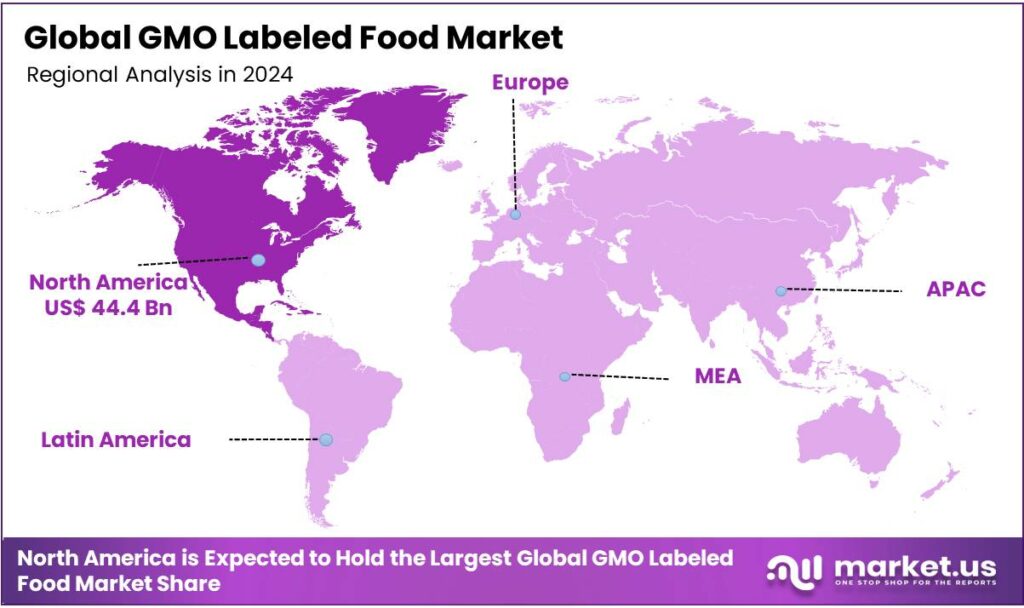
The Global Genetically Modified Labeled Food Market size is expected to be worth around USD 230.7 Billion by 2034, from USD 120.6 Billion in 2024, growing at a CAGR of 6.7% during the forecast period from 2025 to 2034. In 2024 North America held a dominant market position, capturing more than a 36.8% share, holding USD 44.4 Billion in revenue.
Genetically modified (GM) labeled foods are products containing organisms whose DNA has been altered in a lab to add beneficial traits such as pest resistance or enhanced nutrition, using modern biotechnology for changes not possible in nature, requiring disclosure on packaging so consumers can make informed choices. The market is shaped by a variety of factors such as regulatory enforcement, consumer perception, technological advancement, and retail structure.
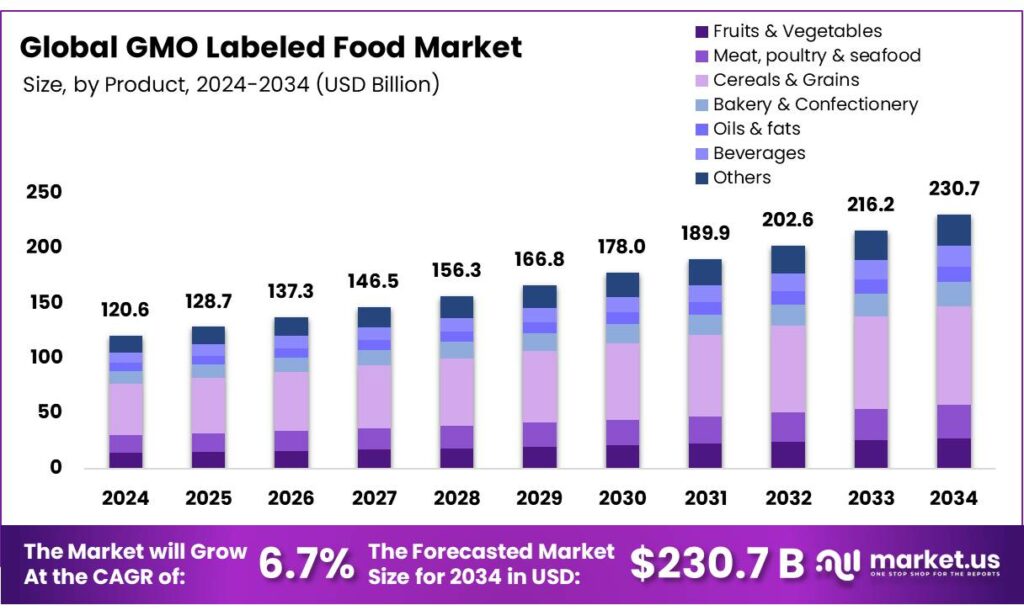
Mandatory labeling thresholds and traceability requirements in multiple regions have institutionalized disclosure practices, compelling manufacturers to clearly identify genetically modified ingredients and strengthening transparency across supply chains.
However, persistent consumer skepticism regarding safety and environmental impact continues to moderate acceptance, particularly in categories perceived as minimally processed. Opportunities are emerging through nutritionally enhanced and climate-resilient genetically modified crops, which address micronutrient deficiencies and agricultural stress while supporting food security objectives.
- In 2023, GM technology was used in 76 countries and regions globally, and 206.3 million hectares of GM crops were planted in 27 countries and regions.
- GM crop production has experienced an over 100-fold increase in the last 25 years. Soybean, around 50%, maize, approximately 30%, cotton, about 13%, and canola, around 5%, are the four primary cultivated genetically modified crops.
Key Takeaways
- The global genetically modified labeled foods market was valued at USD 120.6 billion in 2024.
- The global genetically modified labeled foods market is projected to grow at a CAGR of 6.7% and is estimated to reach USD 230.7 billion by 2034.
- Based on product type, genetically modified labeled cereals & grains dominated the market, constituting 38.9% of the total market share.
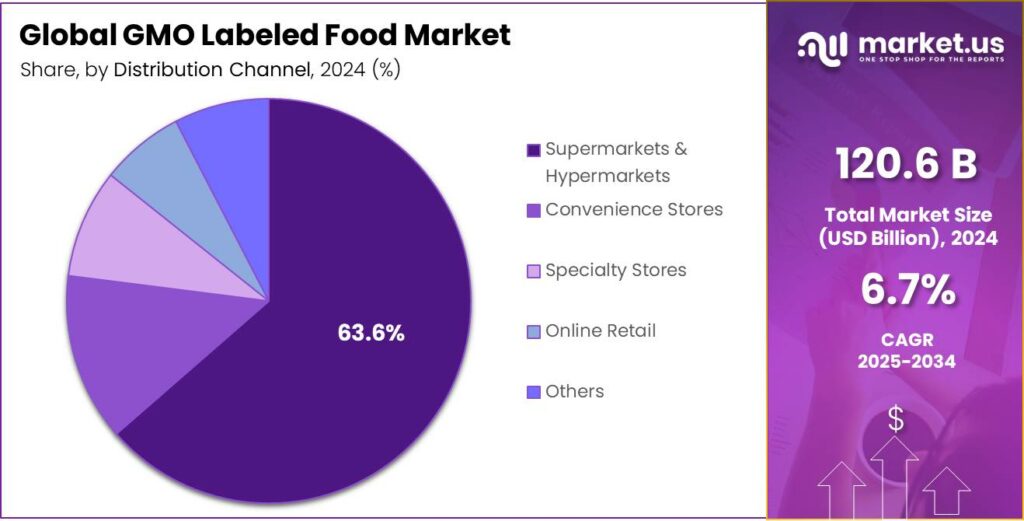
- Among the distribution channels, supermarkets & hypermarkets held a major share in the genetically modified labeled foods market, 63.6% of the market share.
- In 2024, North America was the most dominant region in the genetically modified labeled foods market, accounting for 36.8% of the total global consumption.
Product Type Analysis
Genetically Modified Labeled Cereals and Grains Are a Prominent Segment in the Market.
The genetically modified labeled foods market is segmented based on product type into fruits & vegetables, meat, poultry & seafood, cereals & grains, bakery & confectionery, oils & fats, beverages, snacks & savory foods, and others. The genetically modified labeled cereals & grains led the market, comprising 38.9% of the market share.
Genetically modified labeled cereals and grains are more widely utilized than other food categories, primarily due to agronomic, technological, and supply chain efficiencies. Staple crops such as corn, wheat, rice, and soy are genetically modified to enhance yield stability, pest resistance, and tolerance to drought, attributes that are easier to achieve and manage at scale compared with perishable produce or animal-based products.
In addition, cereals and grains have longer shelf lives and are extensively processed, which simplifies segregation, storage, and labeling of genetically modified inputs. In contrast, fruits and vegetables present biological complexity and higher consumer sensitivity, while meat, poultry, and seafood involve indirect genetic modification through feed, creating labeling challenges. Additionally, cereals and grains serve as foundational ingredients across multiple food categories, increasing their utilization frequency.
Distribution Channel Analysis
Supermarkets & Hypermarkets Held a Major Share of the Genetically Modified Labeled Foods Market.
Based on the material required for genetically modified labeled foods, the market is divided into supermarkets & hypermarkets, convenience stores, specialty stores, online retail, and others. Among the distribution channels, 63.6% of the total global consumption of genetically modified labeled foods was sold through supermarkets & hypermarkets.
Genetically modified labeled foods are predominantly sold through supermarkets and hypermarkets due to their operational scale, regulatory compliance capabilities, and consumer purchasing behavior. Supermarkets and hypermarkets also offer extensive shelf space, enabling clear product differentiation and side-by-side comparison between genetically modified and non-genetically modified alternatives, which supports informed consumer choice.
In contrast, convenience stores prioritize rapid turnover and limited assortments, reducing their ability to accommodate specialized labeling requirements. Specialty stores often focus on organic or non-genetically modified positioning, limiting relevance for genetically modified products. Online retail, while growing, faces challenges related to consumer trust, regulatory clarity across jurisdictions, and the need for physical label verification at purchase, reinforcing the dominance of large brick-and-mortar retail channels.
Key Market Segments
By Product Type
- Fruits & Vegetables
- Meat, poultry & seafood
- Cereals & Grains
- Bakery & Confectionery
- Oils & fats
- Beverages
- Snacks & Savory foods
- Others
By Distribution Channel
- Supermarkets & Hypermarkets
- Convenience stores
- Specialty Stores
- Online retail
- Others
Drivers
Stringent Regulatory Frameworks Drive the Genetically Modified Labeled Foods Market.
Stringent regulatory frameworks have considerably shaped the landscape for genetically modified labeled foods, imposing quantifiable compliance thresholds and rigorous inspection requirements. For instance, in the European Union, labelling laws require clear labeling of foods containing over 0.9% GMOs, with exceptions for adventitious or technically unavoidable presence, and producers are mandated to retain origin and traceability documentation for a minimum of five years, creating measurable administrative obligations for manufacturers and distributors.
Similarly, jurisdictions such as Australia and New Zealand enforce labeling when content exceeds 1% GM material, and Japan requires disclosure for major processed products where GM ingredients make up 5% or more of total weight. Indian laws, primarily through the FSSAI, mandate clear labeling for pr e-packaged foods containing 1% or more GM ingredients, requiring a notice on the front of the pack, with exceptions for undetectable modified DNA, while banning GMOs in infant food and requiring prior approval for all GM food manufacturing, sale, or import.
Such diverse quantitative standards across multiple regions underscore that regulatory rigor compels food producers to invest in advanced testing, enhance traceability systems, and adopt robust quality assurance measures to maintain market access and uphold consumer trust.
Restraints
Consumer Skepticism Might Hinder the Growth of the Genetically Modified Labeled Foods Market.
Consumer skepticism poses a substantive challenge to the acceptance of genetically modified labeled foods, as evidenced by quantifiable public attitudes across multiple regions. A global survey that interviewed 150,000 people in 142 countries found that genetically modified food is seen by survey participants as high risk, with 48% saying they think these foods mostly harm consumers, indicating widespread uncertainty and negative perception. Similarly, in the United States, approximately 51% of adults believe GM foods are worse for health than non-GM alternatives, with only a small minority holding a favorable view, reinforcing polarized domestic sentiment.
Similarly, significant proportions of consumers in markets such as India, Russia, and several parts of Europe report safety concerns or limited understanding of GM technology, which often translates into reduced willingness to purchase these products. Furthermore, in the US, the Center for Food Safety (CFS) filed a lawsuit against the USDA challenging the GMO labeling regulations. Such lawsuits can further discourage consumers from influencing purchasing behavior, retailer strategies, and marketing approaches for GM-labeled foods, consequently constraining broader market acceptance and adoption.
Opportunity
Developing Nutritionally Enhanced and Resilient Crops Creates Opportunities in the Genetically Modified Labeled Foods Market.
Developments in genetically modified foods that are nutritionally enhanced and more resilient to environmental stressors present measurable opportunities within the genetically modified labeled foods market. For instance, Golden Rice, engineered to biosynthesize beta-carotene, can provide up to 60% of the recommended daily intake of vitamin A for children in a single portion of around 150 grams, thereby directly addressing micronutrient deficiencies in populations heavily reliant on rice as a staple food.
Similarly, as with iron deficiency, anemia impacts billions of individuals globally, particularly in rice-consuming regions. Vietnam National University researchers reported the development of iron-rich rice using CRISPR-Cas9 gene editing.
Similarly, Argentinean company Bioceres Crop Solutions developed a drought-tolerant, genetically modified wheat variety known as HB4. Consequently, genetic modifications that confer drought and stress tolerance allow staple crops such as maize and wheat to sustain yields under water-limited conditions, quantifiably improving crop reliability in regions prone to erratic rainfall. These innovations combine quantifiable improvements in nutrient content and environmental resilience, making GM foods more relevant to farmers facing climate variability.
Trends
Increased Consumer Demand for Transparency.
Increased consumer demand for transparency has emerged as a significant and quantifiable trend impacting the genetically modified labeled foods market, as measured by clear preferences for detailed product information and traceability. For instance, approximately 88.6% of Canadian consumers strongly or somewhat agree that genetically modified food products have to be clearly labeled, reflecting a dominant majority seeking disclosure at the point of sale.
Similarly, a study published by the National Institutes of Health (NIH) stated that over 56% of urban Chinese respondents express a positive preference for traceability information on genetically modified soybean oil, underscoring the importance of transparent supply chain data in purchase decisions. Furthermore, a study revealed that about 67% of consumers want to know everything that goes into the food they buy, with 85% globally reporting that detailed ingredient information is of major importance to them, highlighting a widespread and measurable expectation for clear labeling.
Consequently, manufacturers are increasingly adopting smart packaging solutions, such as QR codes and enhanced labeling practices, to meet these quantified consumer demands and build brand trust.
Geopolitical Impact Analysis
Geopolitical Tensions Are Shaping Market Dynamics of the Genetically Modified Labeled Food.
The geopolitical tensions are exerting measurable and multifaceted impacts on the genetically modified (GM) labeled foods market, influencing trade flows, regulatory approaches, and strategic decision-making across major agricultural economies. Escalating trade disputes, such as between the United States and China, have led to sharp contractions in agricultural exports.
The U.S. shipments of key commodities such as soybeans and cereals to China have fallen by more than 70% year-on-year, highlighting substantial market displacement and export reorientation. Similarly, national policy actions illustrate divergent geopolitical postures toward GM cultivation. For instance, Mexico’s legislature approved a constitutional ban on planting GM corn, which could strain trade relations as the United States exports roughly US$5 billion in GM corn annually to Mexico, and most of the corn produced is GM corn.
These trends coincide with broader shifts in agricultural sourcing, as China and other major buyers diversify away from traditional suppliers, and as regulatory frameworks adapt to geopolitical priorities such as food security and economic sovereignty. Such dynamics introduce quantifiable volatility in supply chains, heighten compliance and logistical costs, and necessitate strategic recalibration by producers and exporters operating within the GM-labeled foods sector.
Regional Analysis
North America Held the Largest Share of the Global Genetically Modified Labeled Food Market.
In 2024, North America dominated the global genetically modified labeled foods market, holding about 36.8% of the total global consumption. The dominance of the region in the market is demonstrated by quantifiable indicators of extensive adoption and production capacity, particularly in the United States and Canada.
According to the USDA Economic Research Service, the United States has pioneered the commercial cultivation of genetically modified crops, where over 90% of major commodities such as soybeans, corn, and cotton are genetically engineered, making it one of the most significant producers globally.
Similarly, Canada exhibits high adoption, with GM canola representing approximately 95% of all canola acreage, reinforcing a substantive role of the country in GM agriculture. This extensive cultivation underpins the prevalence of genetically modified ingredients across North American food systems, with more than 75% of food products available in Canadian retail markets containing at least one genetically modified ingredient.
Key Regions and Countries
- North America
- The US
- Canada
- Europe
- Germany
- France
- The UK
- Spain
- Italy
- Russia & CIS
- Rest of Europe
- APAC
- China
- Japan
- South Korea
- India
- ASEAN
- Rest of APAC
- Latin America
- Brazil
- Mexico
- Rest of Latin America
- Middle East & Africa
- GCC
- South Africa
- Rest of MEA
Key Players Analysis
Companies in the genetically modified labeled foods market often focus on strategic activities such as innovation, consumer education, and brand differentiation to boost sales and enhance their market share. For instance, they invest heavily in research and development to improve the quality and resilience of GM products, making them more appealing to farmers.
In addition, these players collaborate with various research institutions to innovate their products. Similarly, they emphasize partnerships with environmental organizations or sustainability initiatives to build trust and appeal to buyers. Furthermore, some major companies expand their product offerings and enter emerging markets, which diversifies their customer bases.
The Major Players in The Industry
- Nestlé S.A.
- The Kraft Heinz Company
- PepsiCo Inc.
- Unilever PLC
- General Mills Inc.
- Danone S.A.
- Kellanova
- Conagra Brands, Inc.
- The Campbell Soup Company
- Post Holdings, Inc.
- Tyson Foods, Inc.
- JBS S.A.
- R. Simplot Company
- Mars, Incorporated
- Kerry Group plc
- Okanagan Specialty Fruits
- Other Key Players
Key Development
- In October 2024, Okanagan Specialty Fruits launched its fourth variety of genetically modified (GM) non-browning apple in the US, the Arctic Gala.
- In February 2024, Perfect Day, the leading precision fermentation innovator and supplier, partnered with Unilever’s Breyers to launch Breyers Lactose-Free Chocolate made with Perfect Day’s dairy protein from precision fermentation.
Report Scope
Report Features Description Market Value (2024) USD 120.6 Bn Forecast Revenue (2034) USD 230.7 Bn CAGR (2025-2034) 6.7% Base Year for Estimation 2024 Historic Period 2020-2023 Forecast Period 2025-2034 Report Coverage Revenue Forecast, Market Dynamics, Competitive Landscape, Recent Developments Segments Covered By Product Type (Fruits & Vegetables, Meat, Poultry & Seafood, Cereals & Grains, Bakery & Confectionery, Oils & Fats, Beverages, Snacks & Savory Foods, and Others), By Distribution Channel (Supermarkets & Hypermarkets, Convenience Stores, Specialty Stores, Online Retail, and Others) Regional Analysis North America – The US & Canada; Europe – Germany, France, The UK, Spain, Italy, Russia & CIS, Rest of Europe; APAC– China, Japan, South Korea, India, ASEAN & Rest of APAC; Latin America– Brazil, Mexico & Rest of Latin America; Middle East & Africa– GCC, South Africa, & Rest of MEA Competitive Landscape Nestlé S.A., The Kraft Heinz Company, PepsiCo Inc., Unilever PLC, General Mills Inc., Danone S.A., Kellanova, Conagra Brands, Inc., The Campbell Soup Company, Post Holdings, Inc., Tyson Foods, Inc., JBS S.A., J.R. Simplot Company, Mars, Incorporated, Kerry Group plc, Okanagan Specialty Fruits, and Other Players. Customization Scope Customization for segments, region/country-level will be provided. Moreover, additional customization can be done based on the requirements. Purchase Options We have three licenses to opt for: Single User License, Multi-User License (Up to 5 Users), Corporate Use License (Unlimited Users and Printable PDF)  Genetically Modified Labeled Food MarketPublished date: Jan 2025add_shopping_cartBuy Now get_appDownload Sample
 -
-
- Nestlé S.A.
- The Kraft Heinz Company
- PepsiCo Inc.
- Unilever PLC
- General Mills Inc.
- Danone S.A.
- Kellanova
- Conagra Brands, Inc.
- The Campbell Soup Company
- Post Holdings, Inc.
- Tyson Foods, Inc.
- JBS S.A.
- R. Simplot Company
- Mars, Incorporated
- Kerry Group plc
- Okanagan Specialty Fruits
- Other Key Players
Our Clients

- 172946
- Jan 2025






