


Report Overview
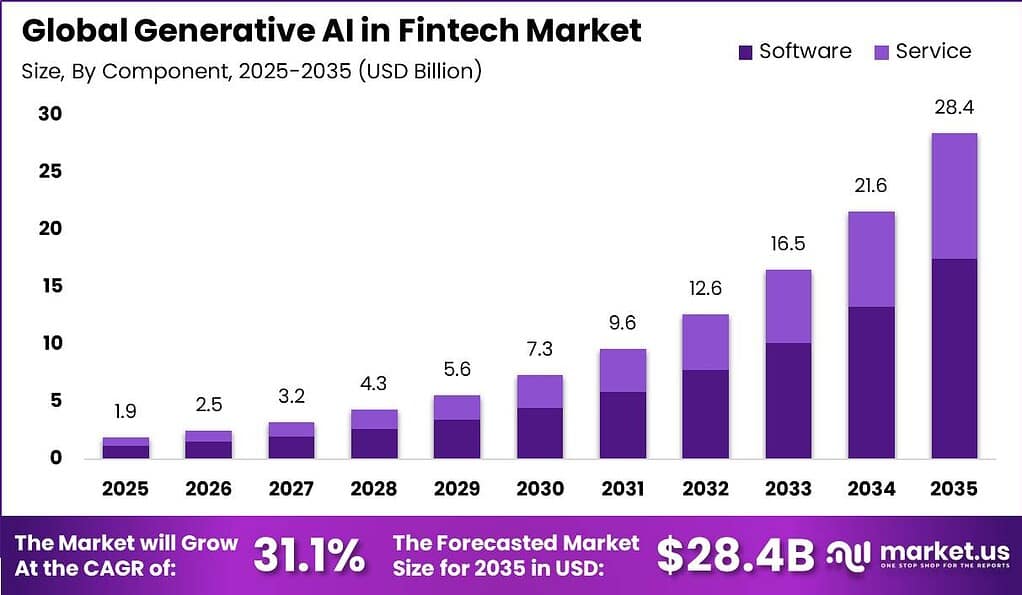
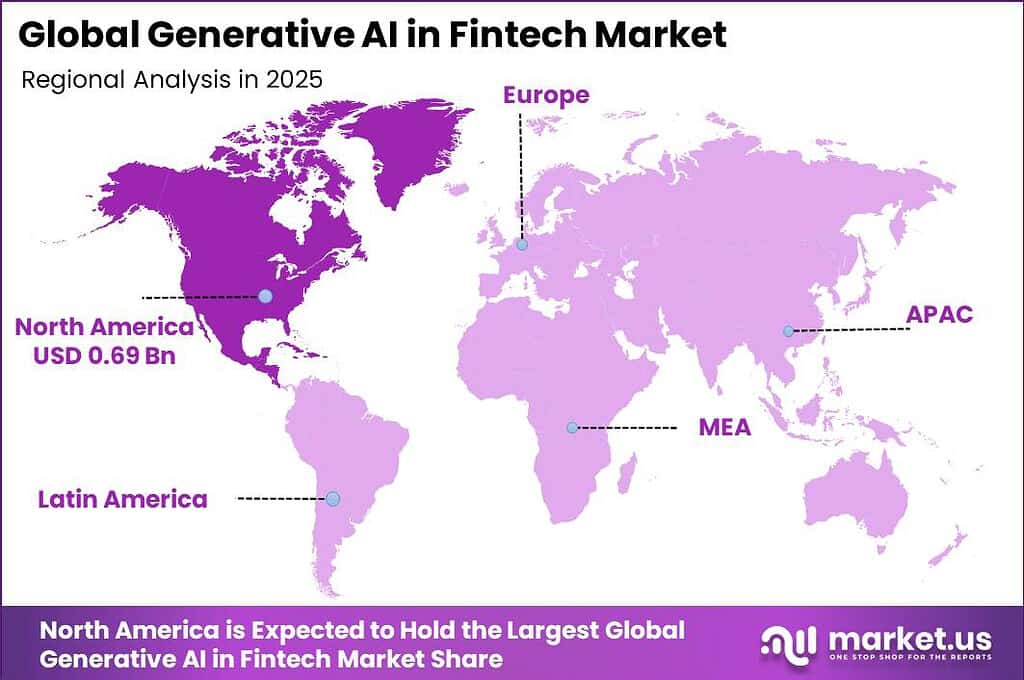
In 2025, the Global Generative AI in Fintech Market was valued at USD 1.9 billion. The market is projected to grow at a CAGR of 31.1% during 2026–2035, reaching approximately USD 28.4 billion by 2035. North America dominated the global market in 2025, accounting for more than 36.5% of the total market share and generating approximately USD 0.69 billion in revenue.
According to the World Bank’s Global Findex 2025, the share of adults in developing economies making or receiving digital payments has risen from 13% in 2014 to about 37% in recent years, while average digital financial transactions per adult jumped from 55 to 251 between 2017 and 2024, showing more than a fourfold increase in transaction volume that must be scored, monitored and screened in real time.
The IMF and BIS highlight that such expansion in digital payments and fintech activity is now a material driver of financial inclusion and GDP growth, which in turn pushes banks, payment firms and insurers to deploy generative AI for fraud detection, compliance automation, credit analytics and conversational banking at scale.
AI adoption across banking, insurance, capital markets, and payments continues to strengthen demand for generative AI platforms. AI spending in financial services reached about USD 35 billion in 2023, while the Financial Stability Board and BIS indicate that financial-sector AI services could grow from roughly USD 166 billion in 2023 to around USD 400 billion globally.
As financial institutions move from pilot projects to production-scale AI for document processing, regulatory reporting, portfolio optimization, and customer support, generative AI is expected to capture a growing share of this spending. This supports market expansion from USD 1.9 billion to about USD 28.4 billion, representing a 31.1% CAGR during 2026–2035.
Key Takeaway
- The global generative AI in fintech market was valued at USD 1.9 billion in 2025.
- The global generative AI in fintech market is projected to grow at a CAGR of 31.1% and is estimated to reach USD 28.4 billion by 2035.
- On the basis of component, the software segment dominated the market, constituting 61.4% of the total market share.
- Based on deployment, the cloud segment dominated the generative AI in fintech market, accounting for 72.3% of the total market share.
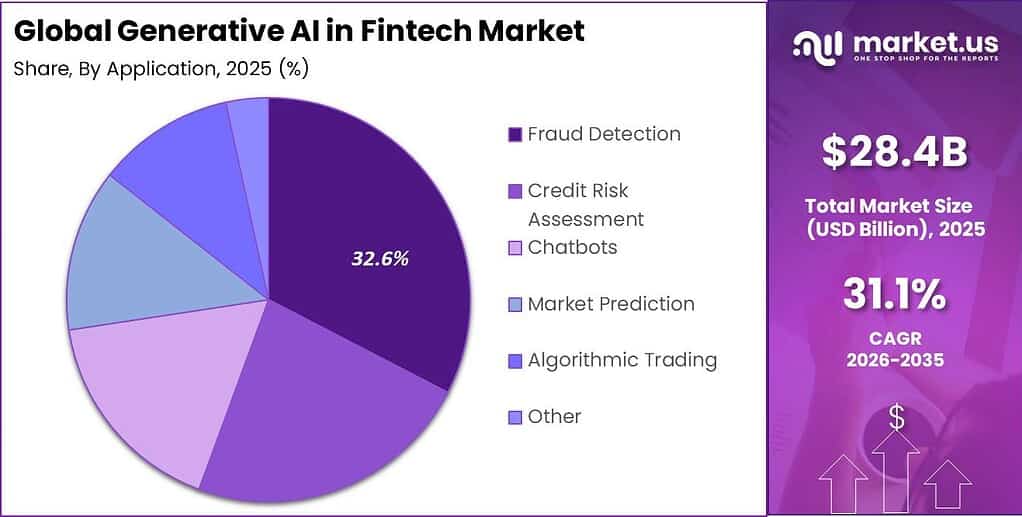
- On the basis of application, fraud detection dominated the market, accounting for 32.6% of the total market share.
- In 2025, North America was the most dominant region in the generative AI in fintech market, accounting for 36.5% of the total market share, equivalent to approximately USD 0.69 billion.
By Component
In 2025, Software held a dominant market position, capturing more than a 61.4% share, aligning closely with global generative AI data showing software representing around 64.1% of the overall market that year. Enterprise studies indicate that companies spent roughly 37 billion USD on generative AI in 2025, with more than half of this directed to application‑layer software rather than infrastructure, underlining why banks prioritize configurable tools over custom hardware builds.
Survey work across financial services shows about 59% of finance leaders already using AI in core finance functions by late 2025, and a growing share of that usage involves generative models embedded in software for reporting, reconciliation, and forecasting.
By Deployment
In 2025, Cloud held a dominant market position, capturing more than a 72.3% share, mirroring broader AI trends where cloud has become the primary environment for financial‑services AI workloads. A 2026 global survey of 453 financial‑services executives found that 91% are already using or plan to use cloud services for AI initiatives within 12 months, with reported adoption of cloud for AI and machine‑learning projects reaching 59% in Asia‑Pacific and the Americas and 49% in Europe.
Separate fintech analyses show cloud deployment already leading AI in fintech by 2024, while on‑premise is expanding from a smaller installed base. Cost metrics are equally strong: institutions that migrate to cloud infrastructure report typical IT operating‑expense reductions in the 38–50% range in the first year, freeing budget for more advanced generative models in 2025 and 2026.
By Application
In 2025, Fraud Detection held a dominant market position, capturing more than a 32.6% share, closely aligned with broader AI‑in‑fintech statistics that place fraud and risk management at about 30.55% of application deployments that year. Industry surveys report that roughly 90% of financial institutions already use AI to identify emerging fraud trends, and 92% say adversaries themselves are using generative AI, turning fraud prevention into one of the most intensive AI battlegrounds in 2025.
More than half of observed AI‑related fraud cases now involve deepfakes, while 60% of surveyed professionals highlight voice‑cloning risks and 59% point to AI‑driven phishing, pushing banks to deploy generative models that simulate new attack patterns and stress‑test controls.
Academic and industry work on fintech security in 2025 also underscores AI’s role in strengthening transaction‑monitoring and anti‑money‑laundering workflows, as models analyse high‑frequency payments data at scale. By early 2026, these quantifiable threat levels and operational needs keep fraud detection at the centre of generative AI investment roadmaps across banking, payments, and digital‑lending platforms.
Key Market Segments
By Component
- Software
- Service
By Deployment
- Cloud
- On-Premises
By Application
- Fraud Detection
- Credit Risk Assessment
- Chatbots
- Market Prediction
- Algorithmic Trading
- Other
Market Dynamics
Drivers
| Driver | (~) % Impact on CAGR Forecast | Geographic Relevance | Impact Timeline |
|---|---|---|---|
| Transaction-scale AI personalization | +5.0% | North America, Europe, Asia-Pacific | Short term (≤ 2 years) |
| GenAI-native fintech startups | +4.0% | Global | Short term (≤ 2 years) |
| Fraud detection and AML enhancement | +3.5% | Global | Short term (≤ 2 years) |
| Cost-to-income ratio compression | +3.0% | Developed markets | Medium term (2–4 years) |
| Cloud-first banking infrastructure | +2.5% | Global, skew to North America&Europe | Medium term (2–4 years) |
| Open banking and data portability | +2.0% | Europe, UK, select Asia-Pacific | Medium term (2–4 years) |
Transaction-scale AI personalization
Root cause adoption is the rapid deployment of generative AI copilots into customer-facing fintech journeys, where large language and recommendation models are embedded into payment apps, robo-advisors, and digital lending flows to personalize offers at the level of individual transactions rather than at a static segment level, and this has accelerated post-2024 as financial institutions observed double-digit uplifts in digital engagement in earnings disclosures.
Quantitatively, pilots reported click-through and conversion rate increases of around 15–25%, with average revenue per user rising by 5–10%, while automated conversational servicing deflected 20–35% of contact center volumes, cutting per-interaction servicing costs from roughly US$3–5 for human calls to well under US$0.50 for AI-led chats in markets with mature digital channels.
Strategically, this shifts fintech business models from standardized fee schedules to dynamic, behavior-based pricing and bundled cross-sell, enabling SaaS-like recurring revenue uplift of low single-digit net retention points annually and supporting operating margin expansion of around 3–5% over 2–3 years as fixed technology investments amortize over millions of incremental personalized interactions, which justifies the incremental contribution of about +5.0% to the baseline generative AI in fintech CAGR.
Restraints
| Restraint | (~) % Impact on CAGR Forecast | Geographic Relevance | Impact Timeline |
|---|---|---|---|
| EU AI Act compliance burden | -4.0% | European Union | Short term (≤ 2 years) |
| Model risk guidance uncertainty | -3.5% | United States, India | Short term (≤ 2 years) |
| High compute and licensing costs | -3.0% | Global | Short term (≤ 2 years) |
| Data residency and localization | -2.5% | Europe, India, select Asia-Pacific | Medium term (2–4 years) |
| Capital and risk appetite constraints | -2.0% | Emerging markets | Medium term (2–4 years) |
| Consumer trust and mis-selling risk | -1.5% | Global | Short term (≤ 2 years) |
EU AI Act compliance burden
The core restraint is the immediate compliance burden created by the EU AI Act for high-risk financial services use cases, where AI systems used in creditworthiness assessment, pricing, and risk scoring fall into tightly regulated categories, and the Act entered into force on 1 August 2024 with full applicability from 2 August 2026, forcing banks and fintechs to freeze or delay certain generative AI deployments in the European Union.
Quantitatively, large financial institutions report multi-year compliance programs costing in the high tens of millions of euros, with internal teams increasing model validation headcount by around 20–30%, and project timelines for AI credit models extended by 6–12 months to meet documentation, transparency, and human oversight requirements, effectively deferring expected revenue uplift and keeping cost-to-income ratios flat rather than achieving projected 2–3% efficiency gains.
Strategically, this compresses near-term margins because institutions must run parallel human-led and legacy rule-based workflows while the compliant AI stack is built, inflating operational expenditure by low single-digit percentages and reducing the effective CAGR by approximately -4.0% relative to unconstrained adoption in the EU, which anchors the restraint’s magnitude while still keeping the global generative AI in fintech market on a positive growth trajectory.
Challenges
| Challenge | (~) % CAGR Friction Drag | Geographic Relevance | Mitigation Horizon |
|---|---|---|---|
| Opaque model explainability standards | -3.5% | Global | Medium term (2–4 years) |
| Specialized AI talent shortage | -3.0% | Global, stronger in emerging markets | Medium term (2–4 years) |
| Integration with legacy cores | -2.8% | Global, more acute in incumbent banks | Long term (≥ 4 years) |
| Evolving cyber and fraud threats | -2.5% | Global | Medium term (2–4 years) |
| Data quality and bias remediation | -2.3% | Global | Medium term (2–4 years) |
| Vendor lock-in and dependency | -2.0% | Global | Long term (≥ 4 years) |
Opaque model explainability standards
The principal structural challenge is ambiguity around how much explainability regulators and boards require for generative AI in key fintech workflows, given that recent interagency model risk guidance in the United States explicitly scopes out generative AI from formal model definitions while still insisting banks apply broader risk management controls, and Indian draft guidance on AI/ML model risk management similarly pushes institutions toward robust governance without yet prescribing clear, uniform metrics for complex generative systems.
Quantitatively, this has led to extended validation cycles where AI credit or advisory models undergo 3–5 iterative review rounds, adding 3–6 months to deployment timelines and raising compliance and risk costs per model by around 20–40%, while some institutions cap exposure by initially limiting generative AI-driven decisions to small portfolios representing less than 10% of assets, thereby constraining the maximum achievable growth relative to technological potential.
Over the medium term, financial firms must invest in explainability tooling, standardized documentation frameworks, and board-level AI risk committees, increasing fixed governance overhead by low single-digit percentages of total technology spend and dragging the market’s maximum CAGR by approximately -3.5% until explainability expectations stabilize across major jurisdictions, which transforms this issue into a persistent friction rather than a hard stop on generative AI adoption.
Opportunities
| Opportunity | (~) % Potential CAGR Upside | Geographic Relevance | Execution Window |
|---|---|---|---|
| GenAI-as-a-service for regulated banks | +4.5% | North America, Europe, India | Medium term (2–4 years) |
| SME and microfinance credit innovation | +3.8% | Asia-Pacific, Africa, Latin America | Medium term (2–4 years) |
| Embedded AI wealth and insurance advisory | +3.5% | Global | Long term (≥ 4 years) |
| Regtech and compliance automation suites | +3.0% | Europe, North America | Medium term (2–4 years) |
| Cross-border payments and FX optimization | +2.5% | Global | Medium term (2–4 years) |
| AI-native financial infrastructure platforms | +2.0% | Global | Long term (≥ 4 years) |
GenAI-as-a-service for regulated banks
This opportunity is future white space rather than a current driver because major banking regulators have signaled that generative AI sits outside formal model risk guidance yet must still be governed prudently, creating demand for specialized GenAI-as-a-service platforms that offer pre-validated, compliant building blocks for regulated institutions which are currently experimenting but have not scaled production deployments, especially in Europe, North America, and India.
Quantitatively, banks with assets above around US$30 billion explicitly referenced as the primary focus of recent US guidance face governance programs costing in the tens of millions annually, and a GenAI-as-a-service offering that reduces validation and documentation effort by even 20–30% could expand operating margins by roughly 1–2% on digital product lines while lowering unit costs for AI-enabled transactions from a few dollars to well below US$1, materially enhancing the economics of AI-powered lending, advisory, and servicing.
If such platforms standardize templates for AI Act compliance in the EU and align with RBI and other national model risk expectations, they can unlock incremental CAGR upside of around +4.5% by accelerating adoption among risk-averse incumbents and converting today’s constrained pilots into broad rollouts across regulated portfolios, without double-counting the baseline growth already driven by standalone fintech innovators.
Geopolitical Impact Analysis
Geopolitical tensions are materially altering the cost structure and delivery reliability of generative AI infrastructure for fintech, as higher tariffs, energy price volatility, and route disruptions feed directly into server, GPU, and cloud service pricing. Bilateral US–China tariffs have risen to an average of 16–17% on affected goods, with effective US tariff levels on Chinese imports climbing to roughly 57.6% by late 2025.
These higher duties translate into mid‑to‑high double‑digit uplifts in hardware procurement budgets for AI-optimized data centers, compressing margins for fintech vendors that rely on cross‑border sourcing of accelerators and memory (HBM, DDR) while simultaneously raising the total cost of ownership for banks and payment processors scaling generative AI workloads.
Concurrently, disruptions in key maritime corridors such as the Red Sea have forced carriers to reroute Asia–Europe and Gulf traffic via longer Cape of Good Hope journeys, with UN trade analysis indicating substantial redeployment of container capacity away from Gulf routes and spot rate surges from Shanghai of around USD 500 per container, amplifying logistics costs and extending transit times for rack servers.
Energy market dynamics and rising AI-related power demand are feeding into operating expenditures for generative AI in fintech. The International Energy Agency estimates that data centers consumed about 415 TWh in 2024, accounting for roughly 1.5% of global electricity use and growing at around 12% annually since 2017, a trajectory that pushes electricity-intensive GPU clusters into direct competition with other industrial loads.
Regional Analysis
North America holds the leading position in the global generative AI in fintech market, accounting for approximately 36.5% of the total market share, with a valuation of USD 0.69 billion. The region’s dominance is primarily driven by the early adoption of advanced technologies, a strong presence of leading fintech firms, and significant investments in artificial intelligence by both private and public sectors.
The United States, in particular, acts as the central hub, supported by a robust financial ecosystem, well-established digital infrastructure, and a high concentration of AI startups and technology giants. Financial institutions across the region are actively integrating generative AI solutions to enhance fraud detection, automate customer service through AI-driven chatbots, improve risk assessment models, and optimize personalized financial advisory services.
Canada also plays a notable role, particularly in AI research and development, supported by government initiatives and academic institutions. Additionally, rising demand for real-time data analytics, algorithmic trading, and automated compliance solutions continues to propel adoption across banking, insurance, and wealth management sectors. Overall, North America’s technological maturity, investment landscape, and innovation ecosystem firmly establish it as the dominant region in the generative AI in fintech market.
Key Regions and Countries
North America
- US
- Canada
Europe
- Germany
- France
- The UK
- Spain
- Italy
- Rest of Europe
Asia-Pacific
- China
- Japan
- South Korea
- India
- Australia
- Rest of APAC
Latin America
- Brazil
- Mexico
- Rest of Latin America
Middle East & Africa
- GCC
- South Africa
- Rest of MEA
Key Players Analysis
Tier-1 leaders in the Generative AI in Fintech market are Microsoft, Alphabet (Google Cloud), and IBM, whose cloud, AI, data, and software platforms collectively account for an estimated 55–65% of generative AI in financial services spend in 2025–2026. Tier-2 challengers, including OpenAI, C3.ai, DataRobot, Zest AI, Kasisto, Upstart, AlphaSense, and CLARA Analytics, capture the remaining 35–45%, primarily through specialized risk analytics, credit scoring, fraud detection, and conversational AI applications.
Microsoft leads Tier-1, reporting FY2025 revenue of $281.7 billion, Azure annual revenue above $75 billion, up 34% year-on-year, and Intelligent Cloud quarterly revenue of $32.9 billion in early 2026, up 29%. Its FY2025 Intelligent Cloud segment generated approximately $29.9 billion in a single quarter, while Azure and other cloud services grew 39%. Against a generative AI in financial services market of $1.95 billion in 2025 and $2.51 billion in 2026, with North America contributing over 42%, Microsoft is estimated to hold roughly 25–30% of global revenue.
Alphabet’s Google Cloud generated over $10 billion in Q2 2024 revenue with operating profit above $1 billion, while later revenue reached $11.4 billion, growing 35% year-on-year. Its financial-services AI deployments support an estimated 15–20% market share. IBM generated $62.8 billion in 2024 revenue, including approximately $26 billion from software and $20 billion from consulting, together representing about 75% of revenue. IBM’s generative AI book of business exceeded $3 billion, while GenAI software and consulting bookings surpassed $7.5 billion, supporting an estimated 10–15% share.
Tier-2 vendors primarily monetize through software subscriptions, consulting, and usage-based pricing, with most remaining below the 3–5% global share threshold. IBM alone cites an AI consulting pipeline above $6 billion and more than $3 billion in cumulative generative AI consulting business. With the market projected to reach $17.88 billion by 2035 from $1.95 billion in 2025 and $2.51 billion in 2026, at a CAGR of about 24.8%, Microsoft, Alphabet, and IBM could maintain a combined 50–60% share, while challengers gain ground in credit scoring, investment research, fraud detection, and regulated conversational banking.
Top Key Players in the Market
- Open AI
- Microsoft Corporation
- Google LLC
- Genie AI Ltd.
- IBM Corporation
- MOSTLY AI Inc.
- Veesual AI
- Adobe Inc.
- Synthesis AI
Recent Developments
- In April 2026, Meta Platforms and Broadcom expanded their multi-generation MTIA custom-AI-ASIC partnership through 2029. Meta committed to an initial deployment exceeding 1 GW of custom silicon, the first phase of a planned multi-gigawatt rollout; Broadcom’s scope includes XPU-based chip design, advanced packaging, and networking.
- In March 2025, TSMC announced an additional $100 billion U.S. advanced-semiconductor investment plan. The expansion comprises three additional wafer fabs, two advanced-packaging fabs, and one major R&D center in Arizona, on top of its previously announced three fabs; TSMC said the completed cluster could place about 30% of its 2 nm-and-below capacity in Arizona.
Report Scope
| Report Features | Description |
|---|---|
| Market Value (2025) | USD 1.9 Billion |
| Forecast Revenue (2035) | USD 28.4 Billion |
| CAGR (2026-2035) | 31.1% |
| Base Year for Estimation | 2025 |
| Historic Period | 2020-2024 |
| Forecast Period | 2026-2035 |
| Report Coverage | Revenue Forecast, Market Dynamics, Competitive Landscape, Recent Developments |
| Segments Covered | By Component – Software, Service; By Deployment – Cloud, On-Premises; By Application – Fraud Detection, Credit Risk Assessment, Chatbots, Market Prediction, Algorithmic Trading, Other |
| Regional Analysis | North America – US, Canada; Europe – Germany, France, The UK, Spain, Italy, Rest of Europe; Asia-Pacific – China, Japan, South Korea, India, Australia, Singapore, Rest of APAC; Latin America – Brazil, Mexico, Rest of Latin America; Middle East & Africa – GCC, South Africa, Rest of MEA |
| Competitive Landscape | OpenAI, Microsoft Corporation, Google LLC, Genie AI Ltd., IBM Corporation, MOSTLY AI Inc., Veesual AI, Adobe Inc., Synthesis AI |
| Customization Scope | Customization for segments and region/country levels will be provided. Moreover, customization can be tailored to the requirements. |
| Purchase Options | We have three licenses to opt for: Single User License, Multi-User License (Up to 5 Users), Corporate Use License (Unlimited Users and Printable PDF) |





























