


Global Fruit and Vegetable Crop Protection Market Size, Share, And Enhanced Productivity By Form (Liquid, Solid), By Origin (Synthetic, Bio-based), By Type (Herbicides, Fungicides, Insecticides, Others), By Mode Of Application (Foliar Spray, Seed Treatment, Soil Treatment, Others), By Region and Companies - Industry Segment Outlook, Market Assessment, Competition Scenario, Trends, and Forecast 2025-2034
- Published date: March 2026
- Report ID: 181358
- Number of Pages: 270
- Format:
-
keyboard_arrow_up
Quick Navigation
Report Overview
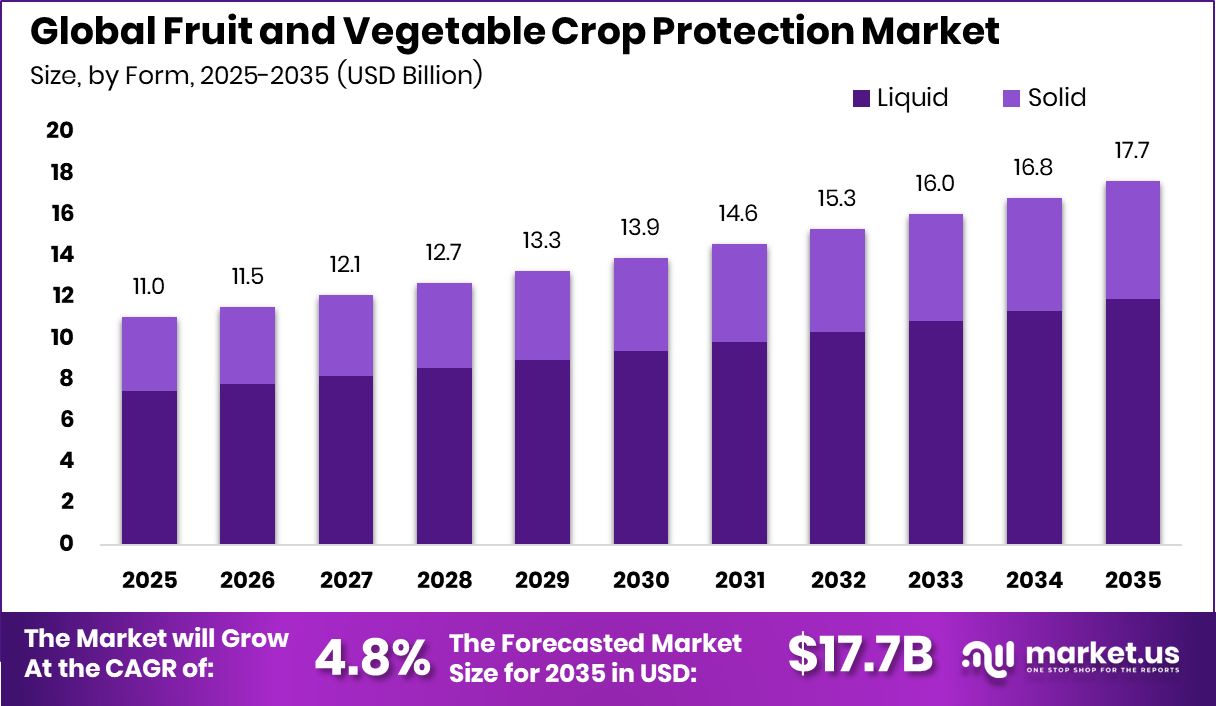
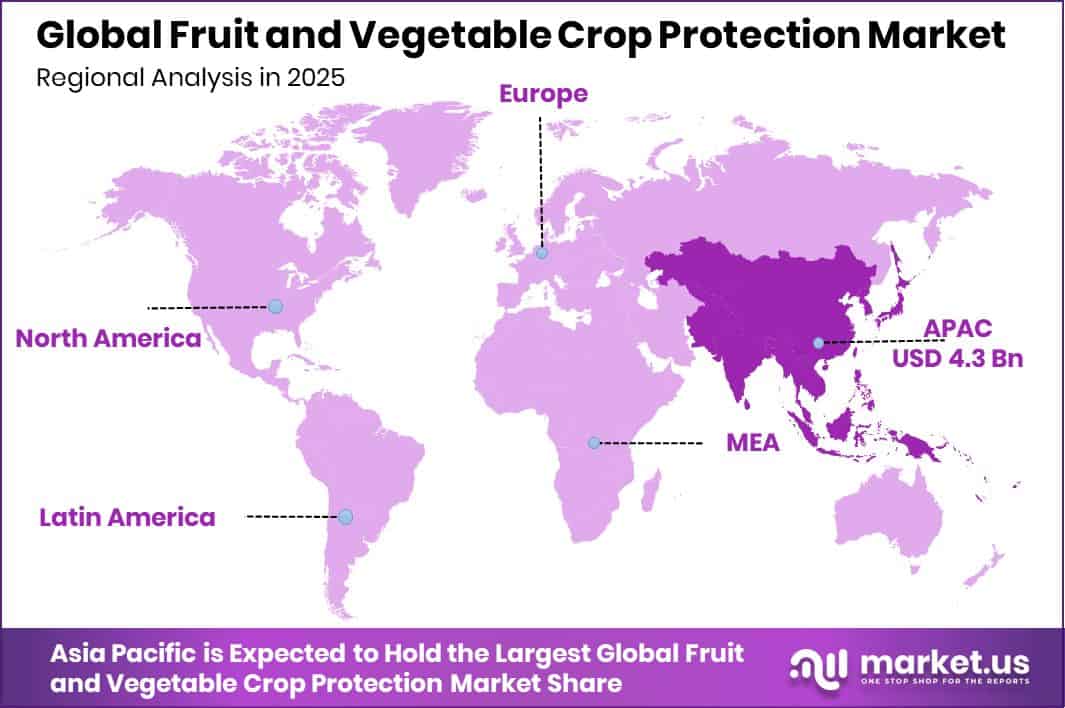
The Global Fruit and Vegetable Crop Protection Market is expected to be worth around USD 17.7 billion by 2034, up from USD 11.0 billion in 2024, and is projected to grow at a CAGR of 4.8% from 2025 to 2034. Asia Pacific accounted for 39.9% of the Fruit and Vegetable Crop Protection Market, totaling USD 4.3 Bn.
Fruit and vegetable crop protection refers to the use of products and practices that protect horticultural crops from pests, diseases, weeds, and other biological threats that reduce yield and quality. These solutions include herbicides, fungicides, insecticides, and other protective treatments applied through foliar spray, seed treatment, or soil treatment. Such protection methods help farmers maintain healthy plant growth, improve harvest quality, and reduce losses caused by environmental and biological stresses.
The Fruit and Vegetable Crop Protection Market represents the commercial ecosystem that produces, distributes, and applies protection solutions used in horticulture farming. The market includes products available in liquid and solid forms, developed through synthetic and bio-based origins to manage crop threats. Increasing cultivation of fruits and vegetables, along with the need to maintain consistent crop productivity and quality, supports the adoption of crop protection solutions across global agricultural systems.
One of the key growth factors is the rising need to reduce crop losses and maintain food supply stability. Fruits and vegetables are highly sensitive to pest attacks, fungal infections, and weed competition. Farmers increasingly rely on protective solutions to ensure better crop survival and higher yield efficiency. Expanding horticulture production and improved farming techniques are strengthening the demand for crop protection inputs.
Demand for crop protection solutions is also increasing due to the growing focus on soil health and sustainable agricultural practices. Investments in soil research and biological technologies are supporting this shift. For example, LiORA secured $5.1 million in seed funding to scale its soil remediation platform in the United States, while Loam Bio raised $73 million in Series B funding from Lowercarbon, Acre, and others to boost soil carbon initiatives. Additionally, a soil testing company based in the Prairies raised $5 million in seed funding, reflecting increasing attention toward soil management.
The market also presents opportunities through innovations in soil science, biological crop protection, and advanced agricultural technologies. Public and private initiatives are accelerating research in soil health and crop resilience. Wyandotte County announced plans to remove 65,000 tons of contaminated soil near Kaw Point, while soil biology specialist Biome Makers secured $15 million in Series B funding to advance soil microbiome insights.
Ascribe Bioscience raised $2.5 million to develop soil signaling molecules that help prevent crop loss, and Hone attracted an impact investor after raising $4.7 million in Series A funding for real-time soil carbon testing solutions. These developments highlight the growing importance of soil-focused technologies that support effective crop protection and sustainable horticulture production.
- In February 2026, UPL Limited, a company that develops crop protection products such as fungicides, herbicides, and insecticides for farmers, announced a major corporate reorganisation to combine its India and global crop protection businesses into a new entity called UPL Global Sustainable Agri Solutions. This restructuring aims to strengthen crop protection operations and improve global market access.
Key Takeaways
- The Global Fruit and Vegetable Crop Protection Market is expected to be worth around USD 17.7 billion by 2034, up from USD 11.0 billion in 2024, and is projected to grow at a CAGR of 4.8% from 2025 to 2034.
- In the Fruit and Vegetable Crop Protection Market, liquid formulations dominate with a 67.5% share due to ease of application.
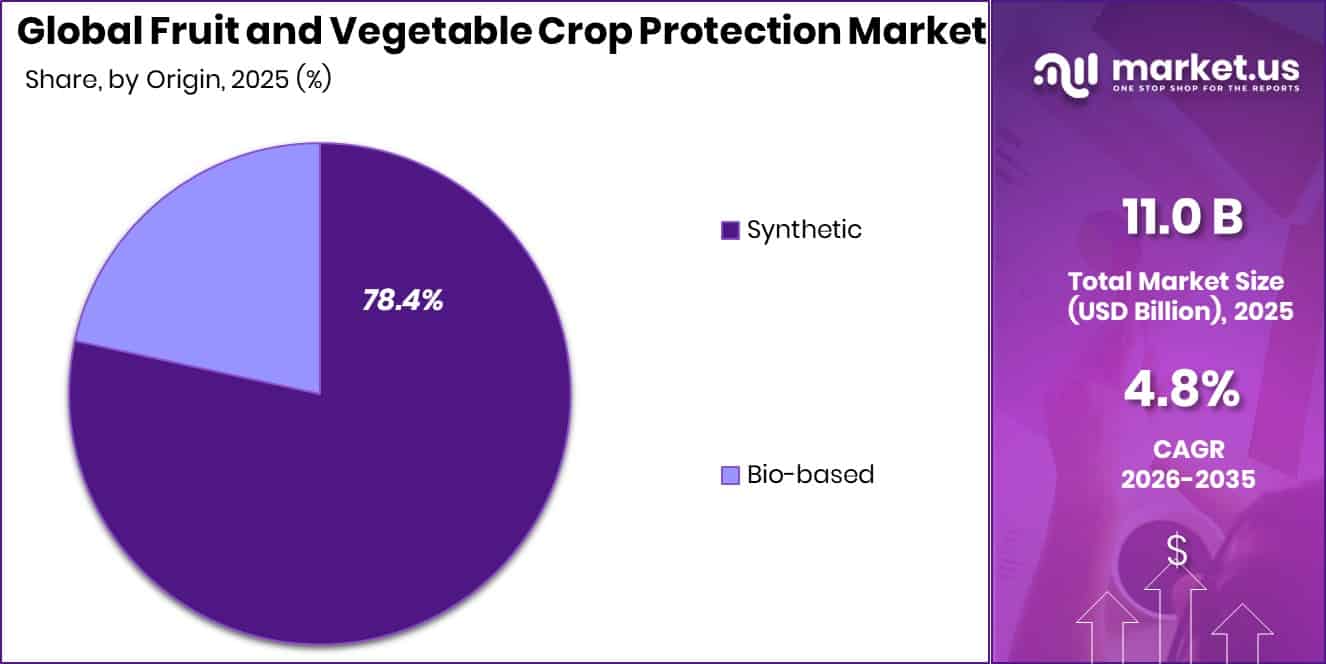
- In the Fruit and Vegetable Crop Protection Market, synthetic products account for 78.4% due to their strong effectiveness.
- Fungicides hold 41.8% share in the Fruit and Vegetable Crop Protection Market, controlling fungal diseases.
- Foliar spray dominates application mode with 56.9% in the Fruit and Vegetable Crop Protection Market globally.
- In the Asia Pacific, the Fruit and Vegetable Crop Protection Market held 39.9%, valued at USD 4.3 Bn.
By Form Analysis
In the Fruit and Vegetable Crop Protection Market, liquid formulations dominate with 67.5% share globally.
In 2025, liquid formulations accounted for 67.5% of the Fruit and Vegetable Crop Protection Market, reflecting their strong preference among growers due to ease of mixing, uniform application, and quick absorption by plant surfaces. Farmers widely use liquid crop protection products in vegetables and fruit orchards because they allow precise dosage and better coverage during spraying operations. These formulations also support compatibility with modern spraying equipment used in both small and large-scale farming systems.
As fruit and vegetable cultivation intensifies to meet rising food demand, the demand for liquid crop protection products continues to increase due to their effectiveness, convenience, and adaptability across diverse crop protection programs.
By Origin Analysis
The Fruit and Vegetable Crop Protection Market is largely driven by synthetic products, holding 78.4%.
In 2025, synthetic products held 78.4% of the Fruit and Vegetable Crop Protection Market, driven by their high efficiency in controlling a wide range of pests, diseases, and weeds affecting fruit and vegetable crops. Synthetic crop protection solutions provide consistent results, longer shelf life, and faster action compared to many biological alternatives.
Farmers rely on these products to maintain crop quality, prevent yield losses, and ensure commercial-grade production required by global food supply chains. The continued adoption of synthetic crop protection products is also supported by ongoing research and development, improving formulation efficiency and expanding their role in protecting high-value horticultural crops.
By Type Analysis
Within the Fruit and Vegetable Crop Protection Market, the fungicides lead type segment has 41.8%.
In 2025, fungicides represented 41.8% of the Fruit and Vegetable Crop Protection Market, highlighting their critical role in protecting crops from fungal diseases that significantly affect yield and quality. Fruits and vegetables are highly vulnerable to fungal infections such as blight, mildew, and rot, making fungicide use an essential part of crop management practices.
Farmers apply fungicides at different stages of crop growth to prevent disease outbreaks and maintain healthy plant development. With increasing cultivation of high-value horticultural crops and rising concerns about crop losses caused by fungal pathogens, fungicides continue to dominate the crop protection strategies used across fruit and vegetable farming.
By Mode Of Application Analysis
In the Fruit and Vegetable Crop Protection Market, foliar spray application accounts for 56.9%.
In 2025, foliar spray accounted for 56.9% of the Fruit and Vegetable Crop Protection Market by mode of application, as it allows direct delivery of crop protection products to plant leaves where pests and diseases commonly develop. This method ensures rapid absorption and targeted action, making it highly effective for managing insects, fungal infections, and nutrient deficiencies in fruit and vegetable crops.
Farmers prefer foliar spraying because it improves product efficiency while reducing wastage and application time. The widespread availability of advanced spraying technologies and the need for timely crop protection interventions further support the growing adoption of foliar spray methods in horticulture.
Key Market Segments
By Form
- Liquid
- Solid
By Origin
- Synthetic
- Bio-based
By Type
- Herbicides
- Fungicides
- Insecticides
- Others
By Mode Of Application
- Foliar Spray
- Seed Treatment
- Soil Treatment
- Others
Driving Factors
Rising global fruit and vegetable production demand
The continuous growth in global fruit and vegetable production is a major factor supporting the expansion of the Fruit and Vegetable Crop Protection Market. Farmers are increasing cultivation areas and improving productivity to meet rising consumer demand for fresh produce. As production expands, the risk of weeds, pests, and crop diseases also increases, making crop protection solutions essential for maintaining yield stability and crop quality.
Agricultural research institutions are also supporting this effort through innovation and scientific studies. For example, an MSU-led research team received a $500K grant to combat herbicide-resistant weeds in soybeans, highlighting the growing focus on improving crop protection strategies and managing weed resistance in modern agricultural systems.
Increasing pest and disease management needs
Fruits and vegetables are highly sensitive to pest attacks, fungal diseases, and insect infestations that can significantly reduce harvest quality and productivity. As horticulture farming intensifies, farmers are increasingly adopting advanced crop protection solutions to prevent large-scale crop losses.
Effective pest and disease management has become essential to maintain a consistent food supply and improve farm profitability. The rising complexity of pest resistance is also encouraging new technological developments in crop protection. For instance, Bindbridge raised $3.8 million to fight herbicide resistance using AI-designed crop protection solutions, reflecting growing investment in innovative technologies that help farmers manage evolving pest challenges more efficiently.
Restraining Factors
Strict regulations on the usage of chemical pesticides
Government regulations related to chemical pesticide usage are becoming stricter across many agricultural regions. These regulations aim to reduce environmental impact, protect soil quality, and minimize potential health risks associated with excessive chemical use. While these policies support sustainable farming practices, they also create challenges for farmers and product developers by limiting the availability of certain conventional crop protection products.
Compliance with regulatory standards often increases development costs and slows product approvals. This situation is encouraging the search for alternative solutions. For example, RootWave secured $15 million in funding to expand its chemical-free electric weeding platform across Europe and the United States, reflecting the growing shift toward non-chemical weed control technologies.
High cost of advanced crop protection
Advanced crop protection technologies often involve complex research, formulation development, and regulatory testing, which increases their overall cost. For many small and medium-scale farmers, the high price of innovative crop protection products can limit adoption despite their potential benefits. The need for specialized application equipment and technical knowledge further adds to operational expenses.
As a result, affordability remains an important challenge in the broader adoption of modern crop protection methods. At the same time, investments in innovation continue to rise. ADM recently led $10.5 million in funding for Harpe Bioherbicide Solutions, supporting the development of next-generation herbicide technologies that aim to improve crop protection efficiency while addressing long-term agricultural challenges.
Growth Opportunity
Rising adoption of bio-based protection
The increasing interest in bio-based crop protection products is creating new opportunities in the Fruit and Vegetable Crop Protection Market. Farmers and agricultural stakeholders are exploring biological solutions that can manage pests and weeds while supporting sustainable farming practices. Bio-based protection products are often designed to work with natural biological processes, helping improve crop resilience and reduce environmental impact.
As research and development continue to expand, new technologies are emerging to address resistance issues and improve crop protection performance. Supporting this shift, Moa raised $44 million in Series B funding to launch the next generation of herbicides, highlighting growing investment in innovative crop protection technologies that focus on improved efficiency and sustainability.
Expanding horticulture farming in emerging economies
Horticulture farming is expanding rapidly across emerging economies due to increasing population growth, urban food demand, and improved agricultural infrastructure. Countries with favorable climates are increasing fruit and vegetable production to strengthen food supply and support agricultural exports. This expansion creates strong demand for crop protection solutions that help farmers maintain crop health and reduce yield losses.
Technological innovation is also contributing to this opportunity by providing new protection strategies. For example, Bindbridge raised $3.8 million to develop a targeted protein degradation platform aimed at next-generation crop protection, demonstrating how advanced scientific research is helping improve pest management capabilities in expanding horticulture markets.
Latest Trends
Growing development of biological crop protection
The development of biological crop protection technologies is becoming a significant trend in modern agriculture. These solutions are designed to manage pests and weeds using biological or mechanical approaches that reduce reliance on traditional chemicals. Farmers are increasingly interested in such technologies as they support sustainable farming practices while protecting crop productivity.
Innovations in robotics and automation are also transforming the crop protection landscape. For example, Carbon Robotics raised $30 million in funding to scale its AI-powered LaserWeeder™ platform, which uses advanced laser technology and artificial intelligence to eliminate weeds efficiently while reducing the need for chemical herbicides in agricultural fields.
Increasing focus on soil health solutions
Improving soil health has become an important focus in agricultural innovation, as healthy soil supports stronger plant growth and natural crop resilience. Modern crop protection strategies increasingly integrate soil management practices that improve microbial activity, nutrient availability, and long-term soil productivity. Technologies designed to protect crops while preserving soil quality are gaining attention from farmers and researchers.
Robotics and precision agriculture are also contributing to this shift. Saga Robotics raised $11.2 million to expand its fleet of robotic systems that use UV-C light to control powdery mildew, demonstrating how advanced technology can help protect crops while supporting healthier and more sustainable agricultural ecosystems.
Regional Analysis
Asia Pacific dominated the Fruit and Vegetable Crop Protection Market with 39.9%, reaching USD 4.3 Bn.
The Fruit and Vegetable Crop Protection Market demonstrates varied regional performance across North America, Europe, Asia Pacific, the Middle East & Africa, and Latin America, influenced by differences in agricultural intensity, crop diversity, and pest management practices.
Asia Pacific represents the dominating region in the global market, accounting for 39.9% of the total share and reaching a value of USD 4.3 Bn. The region’s leadership is supported by extensive fruit and vegetable cultivation, large agricultural land availability, and strong reliance on crop protection solutions to maintain yield quality and productivity. Countries across Asia Pacific have significant horticultural production, which increases the need for fungicides, insecticides, and other crop protection inputs to manage pests and diseases affecting perishable crops.
North America and Europe represent mature agricultural markets where advanced farming practices and consistent crop protection usage support steady demand. Meanwhile, Latin America shows growing adoption of crop protection products due to expanding fruit and vegetable exports and increasing commercial farming activities.
The Middle East & Africa region is gradually witnessing market growth as horticulture production expands and farmers adopt crop protection solutions to improve crop quality and reduce post-harvest losses in fruits and vegetables.
Key Regions and Countries
- North America
- US
- Canada
- Europe
- Germany
- France
- The UK
- Spain
- Italy
- Rest of Europe
- Asia Pacific
- China
- Japan
- South Korea
- India
- Australia
- Rest of APAC
- Latin America
- Brazil
- Mexico
- Rest of Latin America
- Middle East & Africa
- GCC
- South Africa
- Rest of MEA
Key Players Analysis
Bayer CropScience AG remains a prominent participant in the global Fruit and Vegetable Crop Protection Market in 2025, supported by its extensive portfolio of crop protection products designed for horticultural production. The company focuses on providing solutions that help growers manage pests, diseases, and crop stress across a wide variety of fruit and vegetable crops. Its product development approach emphasizes improving application efficiency, crop safety, and performance under different cultivation conditions. Through continuous product refinement and integration with modern farming practices, Bayer CropScience AG maintains a strong presence among fruit and vegetable growers seeking reliable crop protection solutions.
Syngenta International AG plays an important role in the Fruit and Vegetable Crop Protection Market by offering diverse crop protection technologies targeted at high-value horticultural crops. The company emphasizes integrated crop management strategies that combine chemical and advanced protection solutions to address pest and disease challenges faced by fruit and vegetable producers. Its portfolio is designed to support crop quality, yield stability, and sustainable production practices. By maintaining a strong focus on innovation and grower-focused solutions, Syngenta International AG continues to strengthen its position in horticultural crop protection.
Corteva Agriscience is also a key contributor to the Fruit and Vegetable Crop Protection Market, providing crop protection products aimed at improving crop resilience and productivity. The company focuses on delivering targeted protection solutions that support effective pest and disease management across diverse horticultural systems. Corteva Agriscience continues to develop solutions that align with modern agricultural practices while helping farmers maintain consistent crop quality and farm productivity.
Top Key Players in the Market
- Bayer Cropscience AG
- Syngenta International AG
- Corteva Agriscience
- BASF SE
- UPL Limited
- Adama Agricultural Solutions
- AMVAC Chemical Corporation
- Certis LLC
- FMC Corporation
- Nufarm Limited
Recent Developments
- In December 2025, BASF SE, known for producing crop protection solutions for farmers, entered a co-development partnership with ADAMA to develop and commercialize new fungicide formulations using the Gilboa® active ingredient. The collaboration focuses on improving disease management solutions and helping growers protect crop yields more effectively.
- In November 2025, Corteva Agriscience introduced new bioinsecticides and nature-inspired crop protection solutions designed to control destructive insect pests. These innovations help farmers protect crops such as apples and oranges while improving sustainable pest management and reducing crop losses caused by insects.
- In September 2025, Syngenta International AG, which works on crop protection technologies and seeds for agriculture, signed a collaboration with Heritable Agriculture to use advanced technology for identifying the best vegetable varieties for growers. The initiative supports innovation in vegetable production and improves crop development for farmers worldwide
Report Scope
Report Features Description Market Value (2025) USD 11.0 Billion Forecast Revenue (2035) USD 17.7 Billion CAGR (2026-2035) 4.8% Base Year for Estimation 2025 Historic Period 2020-2024 Forecast Period 2026-2035 Report Coverage Revenue Forecast, Market Dynamics, Competitive Landscape, Recent Developments Segments Covered By Form (Liquid, Solid), By Origin (Synthetic, Bio-based), By Type (Herbicides, Fungicides, Insecticides, Others), By Mode Of Application (Foliar Spray, Seed Treatment, Soil Treatment, Others) Regional Analysis North America – US, Canada; Europe – Germany, France, The UK, Spain, Italy, Rest of Europe; Asia Pacific – China, Japan, South Korea, India, Australia, Singapore, Rest of APAC; Latin America – Brazil, Mexico, Rest of Latin America; Middle East & Africa – GCC, South Africa, Rest of MEA Competitive Landscape Bayer Cropscience AG, Syngenta International AG, Corteva Agriscience, BASF SE, UPL Limted, Adama Agricultural Solutions, AMVAC Chemical Corporation, Certis LLC, FMC Corporation, Nufarm Limited Customization Scope Customization for segments, region/country-level will be provided. Moreover, additional customization can be done based on the requirements. Purchase Options We have three licenses to opt for: Single User License, Multi-User License (Up to 5 Users), Corporate Use License (Unlimited User and Printable PDF)  Fruit and Vegetable Crop Protection MarketPublished date: March 2026add_shopping_cartBuy Now get_appDownload Sample
 -
-
- Bayer Cropscience AG
- Syngenta International AG
- Corteva Agriscience
- BASF SE
- UPL Limited
- Adama Agricultural Solutions
- AMVAC Chemical Corporation
- Certis LLC
- FMC Corporation
- Nufarm Limited
Our Clients

- 181358
- March 2026






